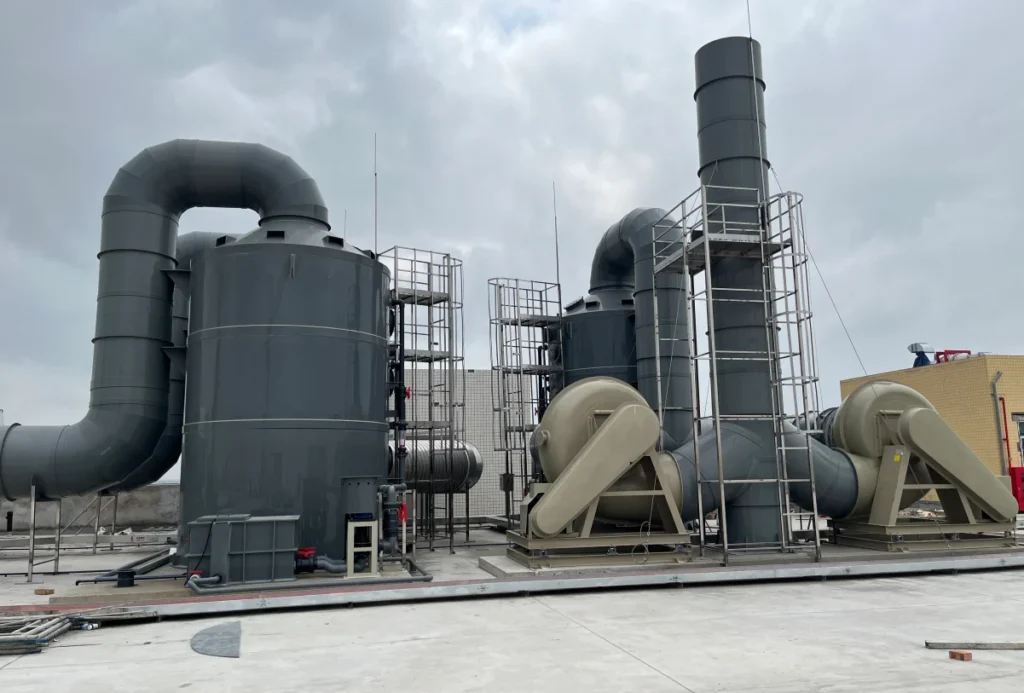
A scrubber system is not a single piece of equipment. It is a category of air pollution control technology that includes five fundamentally different approaches – wet, dry, semi-dry, biological, and hybrid configurations – and the most expensive mistake a facility can make is assuming that a wet scrubber is the only option. Each type uses a different removal mechanism, produces a different waste stream, suits a different range of pollutants, and carries a different 5-year total cost of ownership. Selecting the wrong system type – not the wrong vessel size, but the wrong technology category – can double your operating costs or leave you with a wastewater stream your plant cannot treat.
This guide covers all five scrubber system types with their operating principles, performance ranges, cost characteristics, system components, and a 5-step selection framework for choosing between them. For detailed coverage of individual gas scrubber equipment types, see our gas scrubber guide →.
Key Takeaways
- Five types of scrubber systems exist – wet, dry, semi-dry, biological, and hybrid – and each solves a different problem. Wet systems achieve 85-99.9% for soluble gases but generate wastewater. Dry systems eliminate wastewater at 50-95% efficiency. Biological systems handle VOCs and odor at $2,000-8,000 per year operating cost. Selecting the wrong technology category because “that is what we have always used” wastes capital and operating budget.
- The scrubber system costs 2.0-3.5x the scrubber vessel alone when you include fan, ductwork, piping, instrumentation, controls, and installation. A $50,000 vessel budget becomes a $125,000-175,000 installed system. Budgeting for only the vessel is the most common cause of project cost overruns.
- Particle size determines wet scrubber type selection more than any other factor. Particles above 10 microns are captured by spray towers at 70-90%. Submicron particles below 1 micron require venturi scrubbers at 30-100+ inches WC pressure drop, with annual energy costs of $125,000-140,000 per 10,000 cfm. Installing the wrong wet scrubber type for your particle size range means either insufficient removal or wasted energy.
- Biological scrubber systems are the most overlooked option for VOC and odor control. They operate at 80-99% removal with no chemical consumption, making their 5-year TCO substantially lower than wet chemical scrubbers or carbon adsorbers for suitable applications. The limitations are larger footprint and concentration range below 1,000-2,000 ppm.
- Site constraints often override theoretical efficiency rankings. A packed bed wet scrubber achieves 99%+ efficiency on paper, but if the site has no wastewater treatment capacity or an 18 ft ceiling height, it is not a viable solution. Evaluate water availability, wastewater treatment, available height, and electrical capacity before selecting the scrubber type.
What Is a Scrubber System?
A scrubber system is a complete arrangement of equipment designed to remove pollutants from an industrial gas stream using a scrubbing medium – liquid (wet scrubbers), dry sorbent (dry scrubbers), microorganisms (biological scrubbers), or a combination (hybrid systems). The system includes not just the scrubber vessel but also the fan, recirculation or reagent handling equipment, instrumentation, controls, mist elimination, and waste management components. The total installed cost of a complete scrubber system is typically 2.0-3.5x the cost of the scrubber vessel alone.
Five Main Types at a Glance
| Type | Scrubbing Medium | Efficiency Range | Waste Output | Best For |
|---|---|---|---|---|
| Wet scrubber | Water or chemical solution | 85-99.9% | Wastewater or slurry | Soluble gases, PM, high efficiency |
| Dry scrubber | Dry alkaline sorbent | 50-95% | Dry solids | Acid gases, water-limited sites |
| Semi-dry scrubber | Reagent slurry (evaporates) | 90-98% | Dry solids | Balance of cost and performance |
| Biological scrubber | Microorganisms on media | 80-99% | Minimal (biomass) | VOCs, odor, low operating cost |
| Hybrid system | Combination of above | 95-99%+ | Variable | Multi-pollutant, ZLD requirements |
Why the System Costs More Than the Vessel
A common budget mistake is sizing the scrubber vessel and assuming that is the total project cost. In practice, the vessel accounts for only 30-45% of the installed system cost. The fan and motor add another 15-25%, ductwork and stack 10-15%, instrumentation and controls 8-12%, piping and pumps 8-10%, and installation labor 10-20%. A vessel quoted at $50,000 typically becomes a $125,000-175,000 installed system. Budgeting for only the vessel is the most common cause of project cost overruns in scrubber system procurement.
Wet Scrubber Systems
Wet scrubber systems use a liquid – water or a chemical solution – to capture pollutants from the gas stream. They are the dominant type of scrubber system, accounting for the majority of installed industrial capacity. Wet systems achieve the highest removal efficiencies (85-99.9%) and handle both gaseous and particulate pollutants simultaneously, but they produce a wastewater or slurry stream that requires treatment. Four main wet scrubber configurations are commercially available, each suited to different pollutant types and efficiency targets.
Spray Tower Systems
Spray tower systems are the simplest wet scrubber configuration – an empty vessel with spray nozzles that atomize scrubbing liquid into the gas stream. The gas enters at the bottom and flows upward while liquid is sprayed downward from multiple nozzle levels.
Operating Principle
Pollutant removal occurs through direct contact between the gas and atomized liquid droplets. Soluble gases are absorbed into the droplet surface, and particles above 10 microns are captured by impaction when the gas flows around each droplet. The droplets then fall to the sump for recirculation or disposal.
Key Design Parameters
Superficial gas velocity is 4-8 ft/s. The liquid-to-gas (L/G) ratio is 5-20 gallons per 1,000 actual cubic feet per minute (acfm). Nozzle pressure ranges from 15-50 psi producing droplet sizes of 500-2,000 microns. Pressure drop is 2-6 inches WC with an annual energy cost of $14,000-20,000 per 10,000 cfm. Gas absorption efficiency is 85-95% and particulate removal is 70-90% for particles above 10 microns.
Best Applications
Spray towers are best suited for gas cooling, pre-scrubbing, humidification, and applications where moderate efficiency is acceptable and lowest capital cost is the priority. The limitation is limited gas-liquid contact area – 10-50 m2 per m3 of gas volume compared to 100-300 m2/m3 for packed beds.
Packed Bed Scrubber Systems
Packed bed systems fill the vessel with packing media that creates extensive wetted surface area. The scrubbing liquid flows over the packing while gas flows upward (countercurrent) or across (crossflow), providing thorough gas-liquid contact.
Random Packing vs Structured Packing
Random packing (Raschig rings, Pall rings, Intalox saddles) is the most common choice for gas scrubbers, available in polypropylene, ceramic, and stainless steel at $15-60 per cubic foot. For most acid gas scrubber applications, 1-2 inch random PP packing at $20-35 per cubic foot provides the best balance of cost and mass transfer efficiency. Structured packing provides higher capacity and lower pressure drop but costs 3-5x more, and is justified only for very large-diameter scrubbers or applications with tight pressure-drop limits.
Countercurrent vs Crossflow Configuration
Countercurrent configuration provides the highest mass transfer driving force (99%+ removal for soluble gases) because the freshest liquid contacts the most dilute gas at the top of the bed. It requires 20-30 ft vertical clearance above the packing. Crossflow reduces system height by 30-50% at the expense of 5-10% lower removal efficiency, because the liquid and gas exit the packing at near-equilibrium, reducing the log mean concentration difference. The choice between them is determined primarily by available headroom.
When to Use Packed Beds
Packed beds are the standard choice when 99%+ removal of soluble gases (HCl, HF, NH3, SO2) is required, provided the inlet gas does not contain more than 50-100 mg/Nm3 of particulate matter. They are the most commonly specified scrubber for chemical process exhaust.
Venturi Scrubber Systems
Venturi scrubber systems use a converging-diverging throat to accelerate gas to 50-100 m/s, shearing injected liquid into fine droplets of 50-200 microns. They are the only wet scrubber type that captures submicron particulate at high efficiency – 90-99% for particles below 1 micron.
Operating Principle
The capture mechanism follows Calvert’s contact power theory: submicron particle removal efficiency is directly proportional to the pressure drop across the venturi throat. Higher gas velocity at the throat creates finer droplets and more turbulent mixing, increasing the probability of particle-droplet collision. A venturi operating at 60 inches WC achieves approximately 97-98% removal for 0.5 micron particles, while a venturi at 30 inches WC achieves about 90-93% for the same particle size.
Energy Trade-off
The trade-off is energy consumption. Pressure drop of 30-100+ inches WC requires 150-200 hp per 10,000 cfm of fan power, costing $125,000-140,000 per year in energy alone. The fan power for a venturi scrubber is 10-15x that of a spray tower at the same flow rate. This operating cost must be factored into the 5-year TCO comparison when evaluating venturi scrubbers against other options.
Variable Throat Design
Variable-throat venturis provide 3:1 turndown by adjusting the throat area with a movable cone or disc. This allows the system to maintain removal efficiency across varying gas flow rates – important for batch processes where exhaust volume changes with production cycles. Fixed-throat venturis are simpler and lower cost but lose efficiency when flow deviates from the design point.
Crossflow Scrubber Systems
Crossflow scrubber systems direct the gas horizontally across a vertical packing section while liquid flows downward by gravity. This arrangement reduces overall system height by 30-50% compared to vertical countercurrent packed beds.
Space-Saving Advantage
The horizontal gas flow allows crossflow scrubbers to operate in spaces as low as 8-12 ft, compared to 20-30 ft needed for vertical countercurrent packed beds. This makes them the standard choice for indoor installations, semiconductor cleanrooms, wastewater treatment plants, and marine engine rooms where building height is limited.
Efficiency Trade-off
Crossflow achieves 90-95% acid gas removal, about 5-10% below countercurrent packed beds. The efficiency reduction occurs because the mass transfer driving force is inherently lower in crossflow – liquid and gas approach equilibrium conditions at the same end of the packing, reducing the average concentration gradient. For applications where 90-95% removal meets the emission standard and headroom is constrained, crossflow is the correct choice.
Wet Scrubber Comparison Table
| Type | Gas Removal | PM Removal | DP (in WC) | Energy Cost/Yr (10k cfm) | Best Fit |
|---|---|---|---|---|---|
| Spray tower | 85-95% | 70-90% (>10 um) | 2-6 | $14,000-20,000 | Lowest cost, moderate efficiency |
| Packed bed | 99%+ | Not for PM >50 mg/Nm3 | 4-30 | $50,000-65,000 | High gas absorption |
| Venturi | 90-98% | 90-99% (<1 um) | 30-100+ | $125,000-140,000 | Submicron PM |
| Crossflow | 90-95% | Similar to packed | 3-8 | $18,000-28,000 | Space-limited |
Dry Scrubber Systems
Dry scrubber systems remove acid gases using a dry alkaline sorbent – lime (Ca(OH)2), sodium bicarbonate (NaHCO3), or trona – that reacts with pollutants to form solid reaction products. They produce no wastewater and are the preferred technology where water supply is limited or wastewater discharge is not permitted. Dry systems require a downstream baghouse or ESP to capture the reaction solids, and the overall system includes sorbent storage, injection equipment, and a particulate control device. Removal efficiency ranges from 50-95% depending on the sorbent type and injection method.
Spray Dryer Absorber (SDA) Systems
SDA systems atomize a lime slurry into the hot gas stream through rotary or dual-fluid atomizers. The water evaporates as the gas is cooled from 120-200 C down to approximately 60-80 C, leaving dry reaction products (calcium sulfite, calcium sulfate, plus fly ash) that are captured in a downstream baghouse. SDA achieves 90-95% SO2 removal at a capital cost approximately 80% of a wet FGD system, with no wastewater generation. The operating cost is 1.5-2x higher than wet FGD because lime is consumed at a stoichiometric ratio of 1.3-2.0 (30-100% excess). SDA is commonly used in coal-fired power plants below 300 MW burning lower-sulfur coal (<2% S), municipal waste incinerators, and industrial boilers where water supply is limited.
Dry Sorbent Injection (DSI) Systems
DSI is the simplest dry scrubbing method – powdered sorbent is injected directly into the duct upstream of an existing baghouse or ESP. The sorbent reacts with acid gases during 1-3 seconds of contact time in the duct and continues reacting on the filter cake. DSI achieves 50-90% acid gas removal with the lowest capital cost of any scrubber technology, at 30-50% of wet FGD system cost. The wide efficiency range depends on the sorbent type, injection rate, duct geometry, and gas temperature. Sodium bicarbonate provides higher removal than lime per unit mass but costs 2-3x more. Sorbent utilization is only 30-50% because most of the injected sorbent passes through without reacting – a key limitation compared to circulating or wet systems. DSI is often used for moderate emission reduction where a full scrubber system cannot be justified, or as a polishing step to boost existing removal.
Wet vs Dry Scrubber Comparison
| Parameter | Wet Scrubber System | Dry Scrubber System |
|---|---|---|
| Removal efficiency | 90-99.9% | 50-95% |
| Wastewater generated | Yes (requires treatment) | No (dry solids) |
| Capital cost index (10k cfm) | 1.0x | 0.3-0.8x |
| Operating cost driver | Energy (fan, pump) | Reagent consumption |
| Particulate removal | Yes (co-removal possible) | Requires downstream filter |
| Gas temperature limit | Up to 800 C (with quench section) | 120-200 C (optimal reaction range) |
| Best for | High efficiency, combined gas + PM | Acid gases only, water-limited sites |
Semi-Dry and Hybrid Scrubber Systems
Semi-dry scrubber systems use a reagent slurry or dry sorbent injected with water into the gas stream, where the water content evaporates during the reaction so the final byproduct is collected as dry solids. They occupy the middle ground between wet and dry systems – providing better gas-liquid contact than dry injection for higher removal efficiency, without the wastewater generation of wet scrubbing. This category is the most overlooked option in scrubber system selection, and none of the top-ranking guides on this topic cover it in depth.
Circulating Dry Scrubber (CDS) Systems
Circulating dry scrubbers inject dry lime or sodium bicarbonate into a reactor vessel where the sorbent is suspended in the upward gas flow, creating a fluidized bed that maximizes gas-sorbent contact time. Unreacted sorbent is separated from the gas stream by a cyclone or baghouse and recirculated to the reactor. A single sorbent particle may cycle through the reactor 20-50 times before being purged, achieving sorbent utilization rates of 95%+ compared to 30-50% for single-pass DSI. CDS systems achieve 95-98% SO2 removal with no wastewater, at a capital cost approximately 85-90% of wet FGD. They are more compact than SDA systems (no large spray dryer vessel required) and are used for industrial boilers, cement kilns, glass furnaces, and biomass combustion in the 50-300 MW range. The main limitation is the solids handling system – the recirculation loop, dust return, and purge system add mechanical complexity compared to single-pass DSI.
Hybrid Wet-Dry Systems
Hybrid systems combine a wet scrubber with a dry polishing stage to achieve the high removal efficiency of wet scrubbing with reduced wastewater generation. The wet stage removes 90-95% of pollutants, producing a concentrated blowdown stream with minimal volume. The dry stage uses DSI or a small SDA to polish the remaining 5-10%, eliminating the need for large-volume wastewater treatment. Hybrid configurations are increasingly specified in waste incineration, biomass combustion, and multi-pollutant control where both acid gases and trace pollutants (dioxins, mercury) must be removed and where zero liquid discharge (ZLD) is a project requirement.
Semi-Dry vs Wet vs Dry Comparison
| Parameter | Wet Scrubber | Semi-Dry (CDS) | Dry (DSI) |
|---|---|---|---|
| SO2 removal | 95-99% | 95-98% | 50-90% |
| Wastewater | Yes (large volume) | No (evaporated) | No |
| Capital cost index | 1.0x | 0.85-0.90x | 0.3-0.5x |
| Reagent utilization | 95%+ | 95%+ | 30-50% |
| Mechanical complexity | Moderate | Moderate-High (recirc loop) | Low |
| Best application | Highest efficiency needed | Balance of cost and performance | Lowest capex required |
Biological Scrubber Systems
Biological scrubber systems – also called bioscrubbers, biofilters, or biotrickling filters – use microorganisms to break down organic pollutants in the gas stream. The contaminated gas passes through a packed bed where bacteria and fungi growing on the packing media metabolize the pollutants into CO2, water, and biomass. Biological systems are most effective for water-soluble VOCs, odor-causing compounds (H2S, mercaptans, NH3), and low-concentration organic emissions from food processing, wastewater treatment, and pharmaceutical manufacturing. None of the top-ranking guides on industrial scrubber systems cover this technology category, making it a significant differentiation opportunity.
Biofilter Systems
Biofilters use a moist organic or inorganic packing medium (compost, wood chips, perlite, or structured synthetic media) that supports microbial growth. The gas passes through the bed at low velocity – typically 100-300 ft/h for organic media, up to 500 ft/h for structured media – and the pollutants diffuse into the biofilm where microorganisms degrade them. Removal efficiencies of 80-99% are achievable for soluble VOCs and odor compounds at operating temperatures of 15-40 C. The gas stream must be pre-humidified to near-saturation to prevent drying of the media, which would reduce biological activity and cause gas channeling. Biofilters have the lowest operating cost of any scrubber type – no chemical consumption and minimal energy (only a fan) – but require a larger footprint (typically 30-100 ft2 per 1,000 cfm) and cannot handle peak pollutant concentrations above 1,000-2,000 ppm without substrate inhibition of the microorganisms.
Biotrickling Filter Systems
Biotrickling filters are similar to biofilters but with a recirculating liquid stream that continuously supplies nutrients, moisture, and pH control to the microorganisms. The liquid flow, typically 1-5 gpm per 1,000 cfm, allows better control of operating conditions than biofilters, enabling biotrickling filters to handle 3-5x higher pollutant loads. They are used for H2S removal from biogas (99%+ removal at inlet concentrations of 500-5,000 ppm), odor control at wastewater treatment plants, and industrial VOC abatement where pollutant concentrations are moderate and continuous operation is required. Operating cost is still low compared to wet chemical scrubbers – no reagent cost beyond nutrients – but higher than biofilters due to the recirculation pump energy.
Biological vs Wet Chemical Scrubbers for VOC and Odor Control
For VOC and odor applications, the choice between biological and wet chemical scrubbing depends on the pollutant concentration, load variability, and required removal consistency. Biological scrubbers have significantly lower operating cost – $2,000-8,000 per year versus $15,000-30,000 per year for a chemical wet scrubber at comparable scale – because they consume no chemicals and use minimal energy. However, biological systems are sensitive to load spikes and require 2-4 weeks for microbial acclimation after startup or extended shutdown. Wet chemical scrubbers respond immediately to load changes and can handle variable inlet concentrations, but they consume chemicals continuously regardless of pollutant load. For applications with steady loads and moderate concentrations – composting facilities, food processing, biogas – biological scrubbers are the preferred economic choice. For variable loads and high peak concentrations – chemical plant vents, batch processes – wet chemical scrubbers provide more reliable compliance.
Complete System Components and Cost Breakdown
A scrubber system is more than the vessel where gas-liquid contact occurs. Every component in the system affects performance, reliability, and total installed cost. Understanding the full component list and cost distribution is essential for accurate project budgeting and for comparing vendor quotes.
The Six Essential System Components
1. Scrubber vessel. The tower or reactor where gas contacts the scrubbing medium. Material options range from polypropylene (PP) for low-temperature acid gas service, to FRP for moderate temperatures, to stainless steel or lined carbon steel for high-temperature or corrosive conditions. The vessel material alone can account for 20-30% of vessel cost depending on the specification.
2. Fan and motor. The fan must overcome the total system pressure drop including the scrubber, ductwork, mist eliminator, and stack. Fan selection is critical: an undersized fan cannot deliver design flow, and an oversized fan wastes energy. Centrifugal fans are standard for scrubber systems, with wheel material selected for corrosion resistance.
3. Pump and piping. Recirculation pumps deliver the scrubbing liquid from the sump to the spray nozzles or packing distribution system. Pump material, seal type, and flow rate must match the liquid chemistry. For chemical scrubbers, the recirculation loop also includes the chemical dosing system for pH control.
4. Instrumentation and controls. At minimum, a scrubber system needs pH monitoring (for chemical scrubbers), differential pressure across the packing, liquid flow rate, and fan status indication. Advanced systems add continuous emission monitoring (CEMS), automatic chemical dosing, and remote SCADA integration.
5. Mist eliminator. After gas-liquid contact, the gas passes through a mist eliminator to remove entrained liquid droplets that would otherwise carry pollutants out of the stack. Chevron-style mist eliminators are standard for most applications, with mesh pad types used where higher removal efficiency is needed.
6. Waste handling. The collected pollutants must leave the system as liquid effluent, slurry, or dry solids. The waste handling method – treatment pond, clarifier, filter press, or dry solids disposal – affects both capital cost and ongoing operating cost, and is one of the most commonly overlooked aspects of scrubber system design.
Typical Cost Distribution for a Complete System
| Component | % of Installed Cost | Notes |
|---|---|---|
| Scrubber vessel | 30-45% | Includes packing, nozzles, internals |
| Fan and motor | 15-25% | Varies with pressure drop requirement |
| Ductwork and stack | 10-15% | Site-dependent |
| Instrumentation and controls | 8-12% | More for CEMS or SCADA |
| Piping and pumps | 8-10% | Including chemical dosing |
| Installation labor | 10-20% | Site-dependent |
A vessel quoted at $50,000 typically results in a total installed system cost of $125,000-175,000 depending on the site-specific requirements for ductwork, controls, and installation.
How to Select a Scrubber System
Selecting the right scrubber system requires answering five questions in sequence. Each answer eliminates some scrubber types and narrows the field to the technically viable options. After the viable types are identified, compare their 5-year total cost of ownership to make the final selection.
Step 1 – Identify Your Pollutant Type
Classify the emission as gaseous, particulate, or mixed. For gaseous pollutants, determine whether they are water-soluble (HCl, HF, SO2, NH3), chemically reactive (Cl2, NO2), or poorly soluble in water (VOCs, NO, CO). Soluble and reactive gases are candidates for wet packed bed scrubbing → at 99%+ removal. Poorly soluble gases may require biological treatment for VOCs and odors, or alternative technologies for NO and CO. For particulate, measure the particle size distribution. Particles above 10 microns are captured by spray towers at 70-90% efficiency, particles between 1-10 microns require venturi scrubbers, and particles below 1 micron need venturi scrubbers at high pressure drop for 90-99% removal. If the gas stream contains both gases and particulate, wet scrubber systems that handle both in a single vessel have a cost advantage over separate treatment stages.
Step 2 – Determine Required Removal Efficiency
The required removal efficiency is set by the applicable emission standard, such as EPA MATS for power plants or OSHA workplace exposure limits for in-plant air quality. For 99%+ removal of soluble gases, a packed bed wet scrubber system is the standard choice. For 90-95% removal with no wastewater, dry scrubber systems are viable, with SDA providing the higher end and DSI the lower end of that range. For 80-99% removal of VOCs and odors at the lowest operating cost, biological scrubber systems are the best option. Apply a 10-20% safety factor above the regulatory minimum to account for process variability, aging of equipment, and future tightening of emission limits.
Step 3 – Evaluate Site Constraints
Three site constraints can override the theoretical efficiency ranking and eliminate otherwise suitable technologies:
Available height. Vertical packed bed wet scrubbers need 20-30 ft of clearance above the packing for mist elimination and gas disengagement. Crossflow scrubbers fit in 8-12 ft heights, making them the choice for indoor or space-constrained installations.
Water and wastewater capacity. If the facility has no wastewater treatment capacity, wet scrubbers are not feasible regardless of their efficiency advantage. Dry or biological systems become mandatory. If water supply is limited, DSI or CDS systems that consume minimal or no water are preferred over wet scrubbers or SDA systems that need continuous water.
Electrical capacity. Venturi scrubbers require 150-200 hp per 10,000 cfm for their fan. A facility without available transformer capacity may need to select a lower-pressure-drop type such as a spray tower or packed bed, even if a venturi would provide better particulate removal.
Step 4 – Compare Total Cost of Ownership
Compare the 5-year total cost of ownership across the technically feasible types identified in Steps 1-3. The table below provides representative cost ranges for a 10,000 cfm scrubber system. Your actual costs will vary with pollutant type, material selection, and site conditions.
| Scrubber Type | Capital Cost (10k cfm) | Annual Operating Cost | 5-Year TCO | Cost Driver |
|---|---|---|---|---|
| Spray tower (wet) | $55,000-140,000 | $14,000-20,000 | $125,000-240,000 | Low energy |
| Packed bed (wet) | $85,000-200,000 | $50,000-65,000 | $335,000-525,000 | Moderate energy + chems |
| Crossflow (wet) | $70,000-160,000 | $18,000-28,000 | $160,000-300,000 | Low energy |
| Venturi (wet) | $110,000-325,000 | $125,000-140,000 | $735,000-1,025,000 | High fan energy |
| DSI (dry) | $30,000-100,000 | $40,000-90,000 | $230,000-550,000 | Reagent consumption |
| SDA (semi-dry) | $60,000-180,000 | $35,000-60,000 | $235,000-480,000 | Reagent + maintenance |
| Biofilter | $50,000-150,000 | $2,000-8,000 | $60,000-190,000 | Lowest op cost |
Step 5 – Decision Matrix
Use this matrix as a quick-reference guide to identify which scrubber system types are technically viable for your application. Match your pollutant type and key constraints against each technology.
| Pollutant / Condition | Spray Tower | Packed Bed | Venturi | Crossflow | SDA | DSI | Biofilter |
|---|---|---|---|---|---|---|---|
| Soluble gases (HCl, HF, NH3) | Moderate | Best | No | Good | Good | Moderate | No |
| Acid gases (SO2, NO2) | Moderate | Best | No | Good | Good | Moderate | No |
| VOCs and odors | Poor | Moderate | Poor | Poor | No | No | Best |
| PM >10 um | Good | Not for PM | Best | Not for PM | Not for PM | Not for PM | No |
| Submicron PM (<1 um) | Poor | Not for PM | Best | Not for PM | Not for PM | Not for PM | No |
| No wastewater allowed | No | No | No | No | Yes | Best | Yes |
| Limited height (<12 ft) | No | No | No | Best | No | N/A | Good |
| Lowest operating cost | Good | Moderate | Poor | Good | Moderate | Moderate | Best |
Frequently Asked Questions About Scrubber Systems
What are the main types of scrubber systems?
The five main types of scrubber systems are wet scrubber systems (using liquid contact, 85-99.9% efficiency, produces wastewater), dry scrubber systems (using dry sorbent, 50-95% efficiency, no wastewater), semi-dry systems (using slurry that evaporates, 90-98% efficiency), biological scrubber systems (using microorganisms for VOC/odor, 80-99% efficiency), and hybrid systems (combining two or more technologies for multi-pollutant control). Each type operates on a different removal principle and suits a different range of applications.
What is the difference between a scrubber system and a scrubber vessel?
A scrubber vessel is the tower or reactor where gas-liquid contact occurs. A scrubber system includes the vessel plus all supporting components: fan, pump, piping, instrumentation, controls, chemical dosing, mist eliminator, and waste handling equipment. The total installed cost of a complete scrubber system is typically 2.0-3.5x the cost of the scrubber vessel alone. Budgeting for only the vessel is the most common cause of project cost overruns in scrubber procurement.
When should I choose a dry scrubber instead of a wet scrubber?
Choose a dry scrubber when water supply is limited, wastewater discharge is not permitted, or the required removal efficiency is in the 50-95% range rather than 99%+. Dry scrubbers have 30-50% lower capital cost than wet scrubbers but higher reagent operating costs. They cannot remove particulate matter in the same vessel – a downstream baghouse or ESP is required. For applications requiring 99%+ removal, high-sulfur gas streams above 2% S, or combined gas and particulate control, wet scrubbers remain the standard choice.
What is a biological scrubber system used for?
Biological scrubber systems are used for water-soluble VOCs, odor-causing compounds (H2S below 5,000 ppm, mercaptans, NH3), and low-concentration organic emissions. They operate at ambient temperature (15-40 C), have the lowest operating cost of any scrubber type at $2,000-8,000 per year with no chemical consumption, but require a larger footprint (30-100 ft2 per 1,000 cfm) and cannot handle peak concentrations above 1,000-2,000 ppm. They are most economical for steady-load applications like composting, food processing, and biogas treatment.
What are the essential components of a scrubber system?
A complete scrubber system includes six essential components: (1) the scrubber vessel with internals, (2) the fan and motor sized for the total system pressure drop, (3) the recirculation pump and piping with chemical dosing, (4) instrumentation and controls including pH monitoring, (5) the mist eliminator to prevent liquid carryover, and (6) the waste handling system for effluent, slurry, or dry solids. The vessel accounts for 30-45% of total installed cost, with the balance distributed across the other five components.
Conclusion
Selecting the right scrubber system requires matching the technology to the pollutant type, required efficiency, site constraints, and total cost of ownership – in that order. Wet scrubber systems provide the highest efficiency for gas and particulate removal but generate wastewater. Dry scrubber systems eliminate wastewater at moderate efficiency. Semi-dry systems offer a balance between wet and dry. Biological scrubber systems provide the lowest operating cost for VOC and odor control. Hybrid systems combine technologies for multi-pollutant and ZLD applications.
The 5-step selection framework in this guide provides a systematic method for narrowing the options: identify the pollutant, set the efficiency target, evaluate site constraints, compare TCO, and use the decision matrix. For detailed specifications and budget pricing for your specific application, contact our engineering team → with your process parameters including gas flow rate, temperature, pollutant type and concentration, and site utility availability.