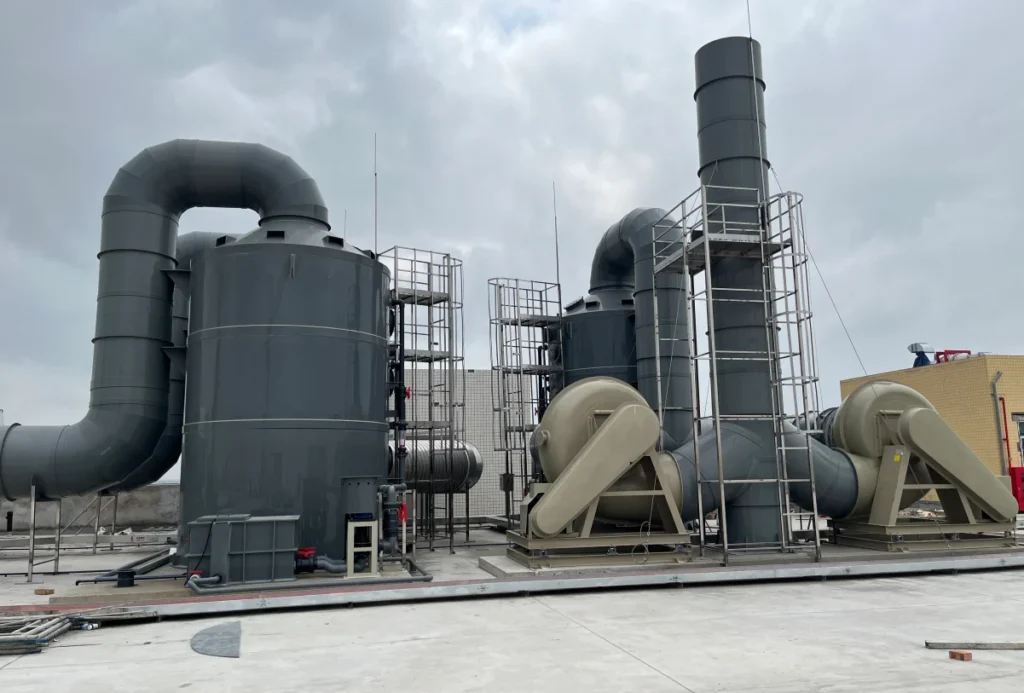
A stack scrubber system is not a distinct type of scrubber – it is a scrubber integrated directly into the exhaust stack rather than sitting on a separate foundation. The most common mistake in specifying a stack scrubber is treating it as a product category when in reality it is a retrofit decision: should the scrubber be mounted on the stack or installed on the ground and connected with ductwork? Vendors may quote either configuration as a “stack scrubber system,” and the total installed cost difference between the two approaches can reach 2x or more depending on the site conditions.
This guide covers what a stack scrubber actually means in engineering terms, the two integration methods, the site conditions that favor each approach, the four engineering assessments required for a retrofit, and a cost comparison to support the decision. For a broader overview of scrubber system types and selection, see our scrubber system guide →.
What “Stack Scrubber” Actually Means
A stack scrubber is not a separate scrubber class like wet, dry, or biological. Those are technology classifications based on the scrubbing medium. A stack scrubber is a configuration classification based on how the scrubber is physically connected to the exhaust stack. Any scrubber technology can be configured as a stack scrubber, and understanding the two possible configurations is essential for comparing vendor quotes.
The Two Integration Methods
Method 1: Stack-Integrated (Mounted on the Stack)
In a stack-integrated configuration, the scrubber vessel is installed directly on top of or within the stack shell, becoming a section of the stack itself. The gas flows from the process exhaust duct into the scrubber section at the base, passes upward through the contact zone and mist eliminator, then continues through the remaining stack height to the atmosphere. This arrangement eliminates the need for outlet ductwork from the scrubber back to the stack and reduces the total system pressure drop by 20-35% because there are no outlet duct losses. The scrubber vessel must be designed with flanged connections matching the stack diameter, and the stack structure must support the full weight of the vessel, liquid hold-up, and access platforms.
Method 2: Standalone with Stack Ductwork (Ground-Mounted)
In a standalone configuration, the scrubber sits on its own concrete foundation adjacent to the stack. The process gas is ducted from the existing exhaust duct to the scrubber inlet, and the cleaned gas is ducted from the scrubber outlet to the stack via a transition section. This requires both inlet and outlet ductwork with independent support structures. The scrubber vessel can be round or rectangular, sized independently of the stack diameter, and is accessible at grade for all maintenance activities. The stack structure carries no additional load beyond the ductwork breeching.
Hardware Configuration Differences
Vessel Design
Stack-integrated vessels must match the stack cross-section (typically round), include flanged connections at both ends for integration into the stack shell, and are limited in diameter by the existing stack. Standalone vessels can be round or rectangular, sized for optimal mass transfer independently of stack constraints, and placed on a foundation of any orientation.
Ductwork
Stack-integrated systems need only a single inlet transition from the process duct to the scrubber section, typically 8-15 ft of transition duct. Standalone systems require both an inlet duct (from process to scrubber, 20-60 ft depending on layout) and an outlet duct (from scrubber to stack, 20-60 ft), plus support structures for both runs.
Foundation
Stack-integrated scrubbers require no separate foundation — the stack foundation must already support the stack weight plus any added load. Standalone scrubbers need a reinforced concrete foundation sized for the vessel weight, liquid hold-up, wind loading, and seismic requirements, typically $15,000-35,000 for a 10,000 cfm system.
Why This Distinction Matters for Procurement
When a procurement team issues an RFQ for a “stack scrubber system,” different vendors may quote fundamentally different configurations under the same name. One vendor quotes a stack-integrated unit at $148,000 with the note “requires stack structural verification.” Another quotes a standalone unit at $175,000 including foundation and ductwork. The buyer sees only two different prices and may choose the lower one, only to discover later that the stack cannot support the integrated unit and that structural reinforcement adds $40,000. The question is not which vendor offers the lower price but which configuration fits the specific site conditions. Understanding both options before sending the RFQ is the only way to get comparable quotes.
Good and Poor Candidates for Stack-Integrated Retrofit
Three site conditions determine whether stack-integrated or standalone is the better approach: available ground space, stack structural condition, and maintenance access requirements. Each condition can eliminate one configuration regardless of the cost advantage of the other.
Good Candidates for Stack-Integrated Retrofit
Space-Limited Sites
Facilities where the stack is located in a congested area with no available ground space for a scrubber foundation are the clearest candidates for stack integration. This includes indoor stacks where the building floor is occupied by production equipment, rooftop stacks where structural deck space is limited, and older industrial plants where equipment has been added over decades with no预留 space. In these situations, ground-mounting a standalone scrubber would require building extension, equipment relocation, or additional land acquisition — costs that far exceed the premium of stack integration.
Stacks with Adequate Structural Reserve
Steel stacks originally designed with a safety factor of 3:1 or higher typically have reserve capacity for the additional load of a scrubber section. Concrete stacks built after 1980 with documented structural drawings should also be evaluated first — they often have reserve capacity because the original design included future loading allowances. The structural engineer must verify the foundation, shell, and anchor bolts against the combined loads of the existing stack plus the scrubber, platforms, and environmental loading.
Wet FGD Retrofit to Power or Industrial Boiler Stacks
Power plants required to meet EPA MATS emission standards have driven extensive FGD scrubber retrofits to existing boiler stacks. This is the most mature stack-integrated scrubber application, with well-documented engineering methodology from the EPRI Wet Stacks Design Guide (TR-107099). The guide covers materials selection for the wet-dry interface zone below the scrubber section, corrosion protection strategies for the stack shell, condensate collection and management, and the specific considerations for converting an existing dry stack to a wet stack.
Marginal Candidates (Evaluate Case by Case)
FRP Stacks
FRP stacks are lightweight and corrosion-resistant but have limited load-bearing capacity compared to steel or concrete. The FRP shell at the scrubber support elevation must be locally reinforced with additional laminate thickness or a steel support ring. The connection between the FRP stack and the scrubber section requires careful design to avoid stress concentrations that can cause cracking.
Stacks with Existing Access Platforms
If the stack already has a structural platform at the elevation where the scrubber section would be installed, the cost premium of stack integration drops significantly because the largest hidden cost — platform fabrication and installation — is already covered.
Poor Candidates for Stack Integration
Structurally Compromised Stacks
Any stack with visible cracking, spalling concrete, corrosion of the steel shell, missing liner sections, or documented foundation settlement must be repaired or replaced before considering any additional loading. Retrofitting a scrubber onto a compromised stack structure creates a safety hazard regardless of the cost savings.
High-Maintenance Applications
Applications with high particulate loading (>100 mg/Nm3), sticky or adhesive contaminants, or frequent process changes that require packing replacement more than once per year are poor candidates for stack integration. The cost of repeated crane rentals, platform access, and production downtime for maintenance at height will quickly exceed the initial cost savings of stack integration.
Future Expansion Anticipated
If production increases are planned that will require a larger scrubber or additional treatment capacity within the next 5 years, a standalone installation with预留 space for expansion is more cost-effective than modifying or replacing a stack-integrated system.
Engineering Considerations for Stack Retrofit
Four engineering assessments determine whether a stack-integrated scrubber retrofit is technically feasible and cost-effective. Each assessment can rule out stack integration or identify hidden costs that shift the balance toward a standalone configuration.
Structural Loading Assessment
The first question is whether the existing stack can support the additional load. This is not a judgment call — it requires calculation by a structural engineer.
What Loads Are Added
A complete stack-integrated scrubber system at 10,000 cfm adds: the scrubber vessel weight (FRP construction at 8-12 lb/ft3, or stainless steel at 15-20 lb/ft3 of vessel volume), the liquid weight in the sump and packing during operation (typically 30-50% of the empty vessel weight), the access platform and stairway (5,000-15,000 lb depending on height and code requirements), and the duct transition and breeching sections. The total added load typically ranges from 5,000-30,000 lb for a 10,000 cfm system, with larger systems scaling proportionally.
Critical Check Points by Stack Type
For steel stacks, the critical check points are the base plate and anchor bolts — these are typically the limiting factor because the original design margin at the foundation is fixed. For concrete stacks, the critical check is the shell section at the scrubber support elevation, where the combined compressive load from the stack above and the scrubber below must be within the concrete design strength. For FRP stacks, the critical check is the local stress at the scrubber connection flange, where the concentrated load must be distributed through reinforcement.
Reinforcement Options and Cost Impact
Steel stacks can be reinforced by adding gusset plates at the base, stiffening rings at the scrubber elevation, or enlarging the foundation. Concrete stacks can be reinforced with carbon fiber wrap, external steel collars, or additional support columns. If the reinforcement cost exceeds the cost of a standalone scrubber foundation plus additional ductwork — which it often does for concrete stacks — the standalone configuration becomes the correct choice.
Pressure Drop and Fan Integration
The existing fan must have sufficient spare capacity to handle the additional pressure drop of the scrubber section. If it does not, the cost of a replacement fan or motor can eliminate any cost advantage of stack integration.
Reading the Existing Fan Curve
Three parameters determine whether the existing fan is adequate: the current operating point (flow rate in cfm and static pressure in inches WC), the fan curve showing available static pressure at the design flow rate, and the motor nameplate power and service factor. The fan curve must show that at the target flow rate, the fan can deliver at least 110% of the total system resistance including the new scrubber — the 10% margin accounts for duct fouling and filter loading over time.
Spare Static Pressure Calculation
The calculation is straightforward: fan available static pressure at design flow, minus the existing system resistance (ductwork, stack, existing controls), minus the scrubber pressure drop (3-30 in WC depending on scrubber type), equals the remaining margin. If the remaining margin is less than 10% of the fan available pressure, the fan is undersized for the retrofit and must be replaced or upgraded.
Motor Power Verification
Fan power consumption follows the fan law: power is proportional to flow times pressure. If the scrubber adds 10 in WC of pressure drop to a system currently operating at 20 in WC total, the fan power increases by approximately 50%. The motor nameplate power and its service factor (typically 1.15 for industrial motors) determine whether the existing motor can handle the additional load without overheating.
Why Stack Integration Has an Advantage Here
In a standalone configuration, the fan must overcome the scrubber pressure drop plus the pressure loss of both the inlet and outlet ductwork — typically 2-6 in WC additional. In a stack-integrated configuration, the outlet ductwork is eliminated and the inlet ductwork is shorter, reducing total system pressure drop by 20-35%. In retrofit situations where the existing fan has marginal spare capacity, this lower pressure drop can be the deciding factor that makes stack integration feasible without a fan replacement.
Duct Transition Design
The transition from the existing exhaust duct to the scrubber inlet must be designed to minimize pressure loss and prevent material accumulation.
Transition Geometry
The included angle of the transition should not exceed 30 degrees to avoid flow separation and excessive pressure loss. Round-to-round transitions are preferred because they maintain uniform velocity distribution. Round-to-rectangular transitions add 15-30% more pressure loss than round-to-round of the same length and should only be used when space constraints leave no alternative.
Connection Method
Flanged connections are the standard method for stack scrubber transitions because they allow disassembly for future maintenance or modification. The stack shell must be reinforced at the breeching point — a simple hole cut in the stack without reinforcement creates a stress concentration point that can propagate cracks under thermal cycling. Welded connections are permanent and lower-cost but prevent future modification. Clamped connections allow adjustment but have poor sealing for positive pressure systems.
Independent Support Requirement
The transition duct must be independently supported from the stack or building structure. Hanging the transition weight from the stack shell — the most common installation shortcut — transfers bending moment to the stack wall and causes misalignment at the scrubber connection over time. The support structure should be designed for the transition weight plus any accumulated material and wind loading.
Access and Maintenance Planning
This is the most commonly underestimated cost in stack scrubber retrofits. The cost of providing OSHA-compliant access to a scrubber section at 30-100 ft elevation frequently surprises project teams who focus on the scrubber equipment cost and overlook the access infrastructure.
OSHA Platform Requirements
OSHA standard 1910.28 requires work platforms at any elevation where maintenance tasks are performed. The minimum platform width is 28 inches, but 36 inches is recommended for scrubber maintenance to allow room for packing removal. A stairway (preferred for frequent access) or fixed ladder with fall protection must reach the platform elevation. OSHA workplace exposure limits for the specific pollutants being treated also affect the scrubber design. Monroe Environmental’s rebuild case studies across multiple installations show that adding compliant access to existing stacks typically costs $20,000-60,000 depending on height and complexity — a cost often omitted from initial budget estimates.
Packing Replacement Logistics
Packed bed scrubbers need periodic media replacement every 2-5 years depending on gas composition and particulate loading. The access plan must include: a davit or monorail at the platform level for lifting packing material from grade, clearance above the packing for extraction (typically 3-5 ft above the bed), a staging area on the platform for new and spent media, and a chute or hoist path for lowering spent media to disposal containers at grade.
Nozzle and Instrument Access
Spray nozzles require inspection every 3-6 months and cleaning or replacement annually. pH probes, differential pressure transmitters, and level switches require calibration access. Every instrument and nozzle that requires routine attention must be reachable from the platform without scaffolding — a seemingly obvious requirement that is frequently overlooked until the first maintenance shutdown reveals that a pH probe is located 4 ft below the platform grating with no access.
Cost Comparison: Stack-Integrated vs Standalone Retrofit
The cost difference between the two configurations is typically smaller than most buyers expect — 5-15% of total installed cost — making the decision primarily about site constraints rather than first cost. The table below provides representative ranges for a 10,000 cfm wet scrubber system retrofitted to an existing 60 ft steel stack.
| Cost Category | Stack-Integrated | Standalone (with ductwork) | Key Variable |
|---|---|---|---|
| Scrubber vessel | $45,000-75,000 | $40,000-65,000 | Stack-integrated needs flange reinforcement |
| Fan and motor | $30,000-50,000 | $30,000-50,000 | Similar at same pressure drop |
| Ductwork and transitions | $8,000-15,000 | $25,000-50,000 | Stack takes only inlet transition |
| Foundation | $0 (stack-mounted) | $15,000-35,000 | Standalone needs concrete pad |
| Structural support/platform | $20,000-60,000 | $5,000-10,000 | Stack platform vs grade access |
| Installation labor | $30,000-50,000 | $25,000-45,000 | Work at height premium |
| Piping and electrical | $15,000-25,000 | $20,000-35,000 | Longer runs for standalone |
| Structural engineering | $5,000-15,000 | $2,000-5,000 | Stack analysis needed |
| Total installed | $153,000-290,000 | $162,000-295,000 | Difference 5-15% |
Where Stack Integration Actually Saves Money
The two largest savings from stack integration are ductwork ($17,000-35,000 less because only one short inlet transition is needed instead of two long duct runs) and foundation ($15,000-35,000 eliminated because the stack carries the scrubber weight). These savings are predictable and apply to most retrofits.
Where Stack Integration Costs More
The two largest additional costs are the structural platform and access system ($15,000-50,000 more than a standalone unit that is accessed at grade) and the structural engineering assessment ($3,000-10,000 more for stack analysis and reinforcement design). Installation labor is also higher for work at height, typically 15-25% more than grade-level installation of a standalone unit.
Hidden Costs That Can Tip the Decision
Three costs are frequently omitted from initial stack scrubber budgets and discovered only during detailed engineering: stack structural reinforcement if the assessment reveals insufficient capacity ($20,000-100,000 depending on the extent), production downtime for stack modification (typically 3-7 days versus 1-2 days for connecting ductwork to an existing stack), and the cost of revising the building code compliance if the modified stack height changes the wind loading classification or fire code requirements.
When to Request Dual Quotes
For any retrofit project where ground space is available but limited, the recommended approach is to request budget quotes for both configurations from the same vendor. This ensures that the comparison is apples-to-apples — the same scrubber technology and materials, the same instrumentation package, and the same warranty terms — with the only difference being the integration method and its associated site work costs. A single-vendor dual quote eliminates the configuration ambiguity described in Section 1 and provides a clear basis for the build-or-buy decision on the access platform.
NFPA Certification for Stack Scrubbers
When the exhaust stream contains combustible gases or the scrubber is installed in a hazardous location, NFPA certification is a mandatory requirement, not an option. This specification must be verified before purchase because not all scrubber vendors offer NFPA-compliant systems, and field-modifying a non-certified system to meet NFPA requirements after delivery is typically 1.5-2x more expensive than purchasing certified equipment from the start.
What NFPA Affects in a Stack Scrubber System
NFPA compliance affects four distinct aspects of the system design. Electrical classification: all instrumentation, controls, and electrical components in classified areas must be rated for the appropriate Class, Division, and Group per NFPA 70 (NEC). A Class I, Division 2 rating is typical for most scrubber applications handling flammable gases. Material conductivity and grounding: the scrubber vessel, ductwork, and all components in contact with the gas stream must be electrically conductive and grounded to prevent static discharge accumulation. FRP vessels, which are common for corrosion resistance, require internal conductive liners or grounding grids to meet this requirement. Flame arrestors or explosion relief: the scrubber inlet and outlet may require flame arrestors to prevent flame propagation, or explosion relief panels to vent overpressure in the event of an ignition. Fan construction: the fan wheel and housing must be spark-resistant construction (non-ferrous wheel or conductive coating) to prevent ignition from mechanical contact.
NFPA and Stack Configuration
Stack-integrated scrubbers present a particular challenge for NFPA compliance because the scrubber section is part of the stack shell, limiting the installation locations for flame arrestors and explosion relief. In a standalone configuration, the scrubber vessel has accessible inlet and outlet duct sections where flame arrestors can be installed without modifying the stack structure. If the application requires NFPA certification and a stack-integrated configuration is preferred, the NFPA compliance cost and design impact must be evaluated before committing to the configuration choice.
Verify Before Purchase
NFPA certification should be stated explicitly in the RFQ as a mandatory requirement, not something that can be added as a change order after the order is placed. Request the vendor’s NFPA compliance documentation, including the hazardous area classification drawing, the instrumentation list with Class/Division ratings, and the grounding system design. Field verification by a qualified electrical engineer should be completed before the system is placed into service.
Real Retrofit Case References
The following cases from Monroe Environmental’s published rebuild and retrofit projects illustrate common scenarios where stack scrubber retrofit decisions are made and the factors that determined the approach.
Case 1: Packed Tower Rebuild for Medical Implant Manufacturer
A medical implant manufacturer operating a nitric acid fume scrubber noticed a steady decline in removal efficiency over 18 months. Low flow and low efficiency led to inadequate control of acid fumes. Monroe was called to assess the system and determined that a rebuild of the existing scrubber (originally built by a different manufacturer) was the fastest, most cost-effective solution — not a replacement. The rebuild included cleaning the packing, replacing corroded piping, and installing new spray nozzles. The system passed emissions testing after the rebuild at approximately 40% of the cost of a new scrubber. This case illustrates the first question in any stack scrubber retrofit evaluation: can the existing system be rebuilt rather than replaced?
Case 2: Quench Tower Retrofit for Medical Waste Incinerator
A medical waste incineration facility had operated its wet scrubbing system for nearly 20 years. A site evaluation revealed that the quench tower was leaking in several areas due to corrosion, the FRP housing had developed cracks, and the scrubber internals were outdated design with low performance. The retrofit approach included replacing the quench tower with an updated design, repairing the FRP housing, replacing scrubber internals with current-technology packing, and upgrading the spray system. This case illustrates the structural integrity assessment required for older stack-scrubber systems — 20 years of thermal cycling and corrosive exposure can degrade both the scrubber and the stack connection, requiring repairs before any new equipment can be installed.
Lessons from These Cases for Stack Retrofit Planning
Two patterns emerge from these and similar retrofit projects. First, a rebuild or retrofit of existing equipment costs 40-70% less than a complete replacement — but only if the existing stack and vessel shell are structurally sound. Second, the most common cause of retrofit cost overruns is structural and access work discovered during the engineering assessment that was not included in the initial budget. Monroe’s case data shows that structural repairs and access modifications account for 30-50% of total retrofit costs in projects where the existing stack was not evaluated before the budget was set.
Frequently Asked Questions
What is a stack scrubber system?
A stack scrubber system is not a distinct scrubber technology type — it is a scrubber integrated directly into the exhaust stack structure rather than sitting on a separate foundation. It can use any scrubber technology (wet, dry, or semi-dry) configured for stack mounting.
What is the difference between a stack-integrated scrubber and a standalone scrubber?
A stack-integrated scrubber mounts on the stack structure, eliminating the separate foundation and outlet ductwork, reducing total system pressure drop by 20-35%. A standalone scrubber sits on its own foundation with ductwork connecting to the stack. Standalone scrubbers are easier to maintain at grade and more flexible for future expansion. The total installed cost difference is typically 5-15%.
Can any existing stack be retrofitted with a scrubber?
Not without engineering evaluation. The stack must have adequate structural capacity for the scrubber weight plus liquid hold-up and access platforms. The existing fan must have sufficient spare static pressure to handle the additional pressure drop. A structural engineer and process engineer should evaluate these factors before deciding on the configuration.
What NFPA requirements apply to stack scrubbers handling combustible gases?
NFPA certification affects electrical classification of instrumentation, material conductivity and grounding, flame arrestors or explosion relief panels, and spark-resistant fan construction. The RFQ should state NFPA compliance as a mandatory requirement because not all vendors offer certified systems.
Conclusion
A stack scrubber system is a configuration decision, not a product category. The choice between stack-integrated and standalone installation depends on three factors in order of importance: available ground space, stack structural condition, and maintenance access requirements. The total installed cost difference is typically only 5-15%, smaller than most buyers expect, so the decision should be driven by site constraints and operational priorities rather than first cost alone.
The recommended evaluation sequence for any stack scrubber retrofit project is: (1) structural assessment of the existing stack by a qualified engineer, (2) fan capacity verification against the expected scrubber pressure drop, (3) maintenance access plan with cost estimate for platform and stairway installation, and (4) budget quotes for both configurations from the same vendor to enable apples-to-apples comparison. Contact our engineering team → with your stack dimensions, gas flow rate, pollutant data, and any available structural drawings for a configuration assessment. Browse our standard gas scrubber systems → for reference specifications.