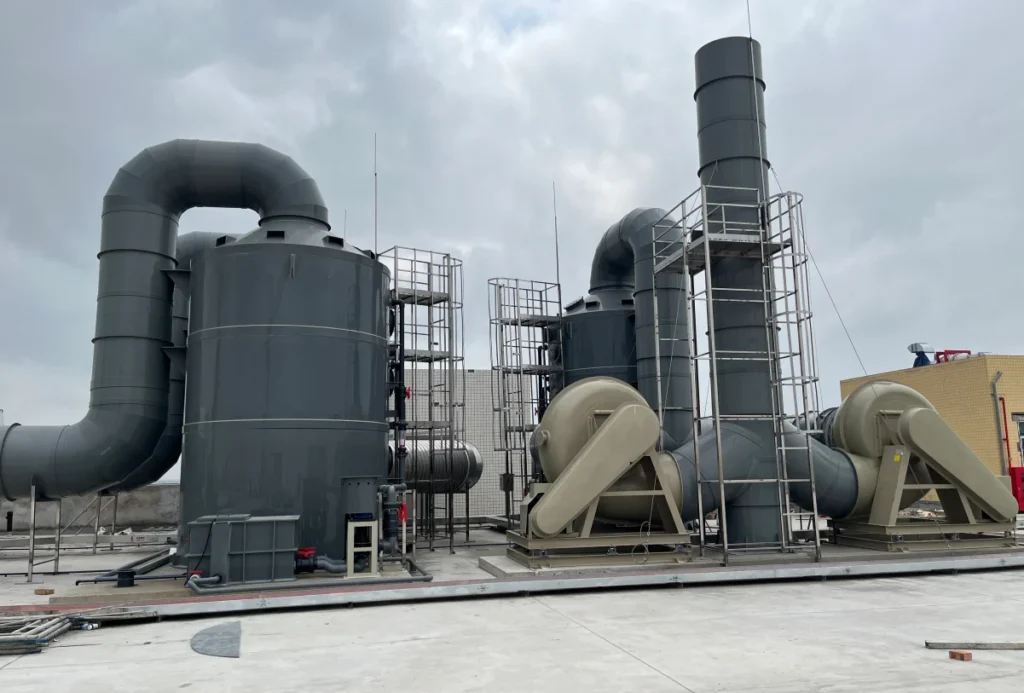
Introduction
You need a wet scrubber for a corrosive gas stream containing HCl, H2SO4, or Cl2. The operating temperature is 180 degF. Carbon steel will corrode within months. Stainless steel 316L will work but costs 80 to 120 percent more than your budget allows. Polypropylene will save money upfront, but 180 degF is its maximum continuous operating temperature, leaving zero safety margin for process upsets. Fiberglass reinforced plastic sits in the middle of these three options. It offers a higher temperature rating than PP at up to 220 degF, a lower cost than SS316L at roughly half the price, and excellent corrosion resistance across a broad range of chemicals. But that performance depends entirely on one thing: specifying the correct resin system and laminate structure for your specific gas composition and operating conditions. Choose the wrong resin and a fiberglass reinforced plastic wet scrubber that should last 15 years can fail within 18 months. This guide covers FRP material science, design rules, comparison with alternative materials, and application-specific selection criteria to help you specify a fiberglass reinforced plastic wet scrubber that delivers its full service life.
Key Takeaways
- FRP is not a single material but a material system: the combination of resin type (polyester, vinyl ester, or epoxy), glass reinforcement form, and laminate structure determines chemical resistance, temperature rating, and service life. A scrubber built with vinyl ester resin and a 100-mil corrosion barrier handles HCl gas at 200 degF for 15 years. The same vessel built with general-purpose polyester fails within 12 months.
- The 180 degF to 220 degF range is where FRP dominates the material selection matrix. Below 180 degF, PP is more economical at 30 to 50 percent lower cost. Above 220 degF, SS316L or PVDF is required. Between 180 and 220 degF, FRP with vinyl ester resin has no cost-effective alternative.
- FRP is immune to chloride stress corrosion cracking, which is the primary failure mechanism for SS316L in wet scrubber environments. In FGD scrubbers, marine exhaust cleaning, and HCl scrubbing where chlorides are present above 10 ppm and temperature exceeds 140 degF, FRP is the more reliable choice regardless of cost.
- FRP scrubbers require different design rules than metal vessels. Nozzle connections need pad reinforcement with a 2:1 ratio because FRP fractures without warning. Support saddles must distribute loads over 120 degrees of circumference. Through-bolting is not allowed because it penetrates the corrosion barrier.
- The three failure modes chemical attack on the corrosion barrier, thermal cycling fatigue at nozzle junctions, and hidden impact damage are all detectable through annual tap testing and biennial spark testing. Repair costs for localized damage range from $500 to $3,000, versus $10,000 to $20,000 for equivalent rubber-lined steel repairs.
What Is an FRP Wet Scrubber?
FRP Scrubber Definition and Basic Operating Principle
A fiberglass reinforced plastic wet scrubber is an air pollution control vessel manufactured from composite materials consisting of glass fiber reinforcement embedded in a polymer resin matrix. The operating principle of a fiberglass reinforced plastic wet scrubber is identical to any wet scrubber: contaminated gas enters the vessel, contacts a scrubbing liquid through spray nozzles or packed media, pollutants transfer from the gas phase to the liquid phase by absorption or chemical reaction, and the cleaned gas exits after passing through a mist eliminator. The difference from metal or thermoplastic scrubbers is the shell material. FRP is not a single material but a material system the combination of resin type (polyester, vinyl ester, or epoxy), glass reinforcement form (chopped strand mat, woven roving, or continuous filament), and laminate structure (resin-rich inner layer, structural core, and exterior coating) determines the vessel’s chemical resistance, temperature rating, and mechanical strength. A scrubber fabricated with vinyl ester resin and a 100-mil corrosion barrier can handle HCl gas at 200 degF for 15 years. The same vessel built with general-purpose polyester resin would show visible degradation within 12 months under identical conditions.
How FRP Scrubbers Differ from PP and Metal Scrubbers
FRP occupies a specific position in the material selection matrix that no single alternative covers. Polypropylene handles temperatures up to 180 degF at a cost index of 1.0, but loses structural integrity above that point and degrades under UV exposure outdoors. Stainless steel 316L handles up to 400 degF with excellent chemical resistance but costs 3.2 times as much as PP. FRP with vinyl ester resin handles up to 220 degF at a cost index of 1.8 roughly halfway between PP and SS316L.
The material choice also changes the mechanical design rules. Metal nozzles can be welded directly to a steel shell. FRP nozzles require pad reinforcement because the composite material does not yield plastically before failure it fractures without warning. Manway openings in FRP vessels require a reinforcement ratio of at least 2:1 around the opening, compared with the 1.5:1 typical for steel. Support saddles for FRP vessels must distribute the load over a wider area to avoid point-loading that can cause local delamination. These differences mean that designing an FRP scrubber is not the same as designing a metal scrubber and using cheaper materials you cannot simply substitute FRP for SS316L in an existing metal vessel drawing.
FRP Material Properties for Scrubber Construction
Resin Systems: Polyester, Vinyl Ester, and Epoxy
The resin matrix in a fiberglass reinforced plastic wet scrubber determines the vessel’s chemical resistance and maximum operating temperature. Three resin types are used in scrubber construction. General-purpose orthophthalic polyester resin is the lowest-cost option at roughly 70 percent of the cost of vinyl ester, but its chemical resistance is limited to mild environments below 150 degF and it degrades rapidly in acidic or alkaline service. Isophthalic polyester resin improves on this with better water resistance and temperature rating up to 170 degF, making it suitable for water-only scrubbing where pH stays between 4 and 10.
Vinyl ester resin is the dominant choice for corrosive scrubber service. Formulations such as bisphenol-A epoxy vinyl ester provide excellent resistance to acids, alkalis, and many solvents at continuous operating temperatures up to 220 degF, with short-term excursion capability to 240 degF. Epoxy novolac vinyl ester extends this to 250 degF and provides superior solvent resistance. Brands such as Derakane and Hetron are the industry standards. The cost premium for vinyl ester over polyester is 30 to 40 percent, but the service life difference in corrosive service is 10 to 15 years versus 1 to 3 years.
Fiberglass Reinforcement and Laminate Structure
The laminate structure of an FRP scrubber is built in three layers, each serving a different function. The inner corrosion barrier is a resin-rich layer containing 85 to 95 percent resin and 5 to 15 percent glass fiber in the form of a surface veil and chopped strand mat. This layer provides the chemical resistance by keeping the glass fibers isolated from the corrosive process environment. Standard thickness for the corrosion barrier is 100 mils (2.5 millimeters) for moderate service, with 150 to 200 mils specified for highly corrosive conditions.
The structural laminate uses 30 to 40 percent resin content with chopped strand mat, woven roving, or combination reinforcement to provide the mechanical strength. This layer carries the vessel’s structural loads. The exterior coating is a resin-rich gel coat with UV inhibitors to prevent surface degradation from sunlight exposure. A typical total wall thickness for a 10-foot diameter scrubber at 1 PSIG design pressure is 0.375 to 0.5 inches, of which approximately 0.25 inches is structural laminate and 0.1 inches is corrosion barrier. If the corrosion barrier is damaged by mechanical impact or thermal stress, acid can reach the glass fibers in the structural laminate and wick along the fiber-resin interface by capillary action, causing progressive delamination that spreads far beyond the initial damage point.
Temperature and Pressure Limits of FRP Scrubbers
The temperature limit of an FRP scrubber is set by the resin system, not the glass reinforcement. For basic design guidelines, the Engineering Toolbox scrubber reference provides general performance data for scrubber systems. Polyester resins are limited to 150 to 170 degF continuous. Vinyl ester resins reach 200 to 220 degF continuous. Epoxy novolac vinyl ester extends to 250 degF. Beyond 250 degF, no standard FRP resin system provides reliable long-term service and the designer must switch to PVDF-lined FRP, stainless steel, or other high-temperature materials.
The pressure limit for standard FRP scrubber design is 1 PSIG (approximately 28 inches of water column gauge pressure), which covers the vast majority of scrubber applications where the vessel operates at atmospheric pressure plus the fan static pressure. Higher pressures up to 5 PSIG require special laminate design with increased wall thickness, additional reinforcement, and compliance with ASME RTP-1 or similar standards. Vessels designed for partial vacuum must include stiffening rings or increased wall thickness to prevent buckling.
Thermal cycling is a specific risk for FRP scrubbers. Each cycle from operating temperature down to ambient creates micro-cracks in the resin matrix due to the differential thermal expansion between the resin and the glass fibers. After 500 to 1,000 cycles depending on the temperature swing and resin toughness, these micro-cracks can connect to form leak paths through the corrosion barrier. For scrubbers that operate continuously with infrequent shutdowns, this is rarely an issue. For scrubbers that start and stop daily, the designer should specify a more flexible resin system or increase the corrosion barrier thickness.
FRP vs Alternative Scrubber Materials
Material Comparison Table
| Material | Max Temp (degF) | Acid Resistance | Cl- SCC Risk | Cost Index | Typical Life |
|---|---|---|---|---|---|
| Polypropylene (PP) | 180 | Good | None | 1.0 | 8-12 yr |
| FRP (Vinyl Ester) | 220 | Excellent | None | 1.8 | 15-20 yr |
| PVC/CPVC | 150 | Good | None | 0.9 | 8-10 yr |
| Stainless Steel 316L | 400 | Excellent | High above 140 degF | 3.2 | 15-25 yr |
| Rubber-Lined Steel | 200 | Excellent | None (if liner intact) | 3.0 | 10-15 yr |
| PVDF | 300 | Excellent | None | 4.5 | 15-20 yr |
FRP vs Polypropylene
Polypropylene is the most common thermoplastic used for scrubber construction below 180 degF, but when specifying an frp scrubber system you gain higher temperature capability. Its cost index of 1.0 makes PP the most budget-friendly option, and its chemical resistance to acids and alkalis is good at moderate temperatures. However, PP has three limitations that drive many engineers to FRP. First, temperature: PP softens above 180 degF with a heat deflection temperature of approximately 200 degF at 66 PSI, meaning the material loses structural rigidity at the upper end of its range. If a process upset pushes the gas temperature to 200 degF, a PP scrubber may distort or collapse. FRP retains its mechanical properties up to 220 degF because the glass fibers carry the load, not the resin matrix.
Second, UV resistance: PP degrades under sunlight exposure, becoming brittle and discolored within 2 to 3 years outdoors unless compounded with UV stabilizers. FRP with a UV-inhibited gel coat shows negligible degradation after 10 years outdoors. Third, mechanical strength: PP has a tensile strength of approximately 4,000 PSI versus FRP at 20,000 to 30,000 PSI. This means FRP vessels can be built with thinner walls for the same pressure rating, partially offsetting the material cost difference. For a 10-foot diameter scrubber operating at ambient pressure, an FRP vessel requires wall thickness of about 0.4 inches, while a PP vessel requires 0.75 to 1.0 inches due to the lower stiffness of the thermoplastic.
FRP vs Stainless Steel 316L
Stainless steel 316L is the benchmark material for high-temperature and high-pressure scrubber service. Its cost index of 3.2 reflects the material cost plus the fabrication complexity involved in welding and forming stainless steel. The weight penalty is significant: SS316L density is 0.29 lb/in3 versus FRP at approximately 0.06 lb/in3. An SS316L scrubber weighs roughly 4 to 5 times as much as an equivalent FRV vessel, requiring heavier foundation supports and structural steel. The temperature advantage is clear: SS316L handles continuous service at 400 degF versus FRP at 220 degF. For scrubber inlet temperatures above 250 degF, SS316L is the standard choice unless a quench section cools the gas before it contacts the FRP vessel.
However, SS316L has a critical vulnerability that FRP does not: chloride stress corrosion cracking. In wet scrubber environments where chlorides are present from HCl absorption or seawater use, SS316L can develop cracks at temperatures above 140 degF and chloride concentrations above 10 ppm. This is a known failure mode in FGD scrubbers and marine exhaust gas cleaning systems. FRP is completely immune to chloride SCC because the polymer matrix does not experience stress corrosion. For scrubber applications where temperature stays below 220 degF and chlorides are present, FRP is often the better choice than SS316L on both performance and cost grounds.
FRP vs Rubber-Lined Steel
Rubber-lined steel scrubbers consist of a carbon steel shell with an internal rubber lining of 3/16 to 1/4 inch thickness bonded to the steel. The cost index of 3.0 reflects the steel shell plus the lining application and quality control testing. The rubber lining provides excellent resistance to acids and alkalis up to 200 degF, and the steel shell provides high mechanical strength. The operational risk is that if the rubber lining is damaged by mechanical impact, overheating, or delamination from the steel substrate, the corrosive gas or liquid reaches the carbon steel and causes rapid localized corrosion. A pinhole in the lining can corrode through a 1/4-inch steel shell within weeks, creating a leak that requires shutting down the entire system for repair.
FRP, by contrast, is a homogeneous material meaning the entire wall thickness provides corrosion resistance. A scratch or gouge in an FRP vessel that penetrates only the corrosion barrier can be repaired by grinding and re-laminating without replacing the vessel. The repair cost for a localized FRP damage area is typically $1,000 to $3,000, versus $10,000 to $20,000 for stripping and re-lining a rubber-lined vessel of equivalent size. For rebuild and maintenance guidance, see our wet scrubber rebuilds guide →. For facilities that operate scrubbers in remote locations or with limited maintenance access, the FRP advantage in repairability is a significant factor.
Design Considerations Specific to FRP Scrubbers
Corrosion Allowance and Resin-Rich Layer Design
The corrosion barrier in a fiberglass reinforced plastic wet scrubber is not an optional coating it is an integral part of the laminate that determines the vessel’s service life. Industry standards including ASTM C582 and ASME RTP-1 specify minimum corrosion barrier thickness based on the corrosiveness of the service environment. For moderate service where pH stays between 2 and 12 and temperature is below 180 degF, the minimum corrosion barrier thickness is 100 mils (2.5 millimeters). This consists of a C-veil or Nexus surface veil followed by two plies of 1.5-oz chopped strand mat, all saturated with the same resin type used in the structural laminate. For severe service where pH drops below 2, temperature exceeds 180 degF, or the gas contains oxidizing agents such as chlorine or nitric acid, the minimum increases to 150 to 200 mils.
The corrosion barrier must be inspected after fabrication using a spark test at 10,000 to 15,000 volts to detect pinholes or voids. Any defect found must be ground out and re-laminated before the vessel enters service. A corrosion barrier that passes spark test at fabrication but receives mechanical damage during installation will fail prematurely. For this reason, the vessel should be hydrostatically tested before the corrosion barrier is applied, and the final spark test should be performed after the vessel is set on its foundation.
Nozzle, Manway, and Support Reinforcement
One of the most common design errors when specifying an frp wet scrubber system is treating nozzle and manway connections the same way as in metal vessels. In a metal vessel, a welded nozzle connection distributes stress through the ductility of the material. In FRP, the same connection creates a stress concentration point that can cause cracking at the nozzle-to-shell junction after thermal cycling. Standard FRP design practice requires pad reinforcement around all openings with a reinforcement ratio of at least 2:1, meaning the reinforced area is twice the area removed for the opening. The pad consists of additional layers of chopped strand mat and woven roving built up around the nozzle to a diameter of at least twice the nozzle diameter. Manway openings larger than 18 inches diameter require additional reinforcing rings or a thicker shell section around the opening.
Support saddles for horizontal FRP scrubbers must distribute the vessel weight over a minimum of 120 degrees of the shell circumference, compared with 90 to 120 degrees for metal vessels. A typical saddle width is 6 to 12 inches depending on the vessel diameter, with a rubber or felt pad between the saddle and the FRP shell to prevent abrasive wear. Vertical FRP scrubbers are supported on bearing rings or legs that are molded into the laminate, not bolted through the shell. Through-bolting penetrates the corrosion barrier and creates a leak path that is difficult to seal.
FRP Scrubber Sizing
FRP is a shell material, not a design parameter that changes the absorption calculation. The column diameter, packed bed height, and L/G ratio for an frp wet scrubber system are determined using the same gas velocity selection and HTU-NTU methodology described in our wet scrubber design guide →. The difference is in the material-specific design rules: maximum design velocity must account for the lower stiffness of FRP compared with metal, which can increase vibration risk in tall columns. For FRP scrubbers taller than 30 feet, wind load and seismic load calculations must include the lower modulus of elasticity of FRP (approximately 1.5 to 2.5 million PSI) versus steel (29 million PSI). The column shell thickness must be increased or stiffening rings added at intervals of 10 to 15 feet to prevent buckling under wind load. This is particularly important for outdoor installations where the scrubber acts as a cantilevered structure. The flange connections between the scrubber shell and ducting must also be designed differently: FRP flanges require flat-face design with full-face gaskets, whereas metal flanges use raised-face design with ring gaskets.
UV Protection and External Environment
FRP exposed to sunlight undergoes surface degradation as ultraviolet radiation breaks down the polymer resin matrix. The first visible sign is discoloration and chalking of the surface, typically appearing after 1 to 2 years of outdoor exposure on unprotected FRP. Continued exposure leads to erosion of the resin from the surface, exposing the underlying glass fibers a condition known as fiber bloom. Once fibers are exposed, moisture can wick along the fiber-resin interface by capillary action, causing progressive delamination that extends below the surface.
Prevention requires a UV-inhibited gel coat or paint system. Standard FRP scrubbers supplied for outdoor service should include a gel coat containing UV absorbers such as benzotriazole or hindered amine light stabilizers at a thickness of 15 to 20 mils. The gel coat should be reapplied every 5 to 7 years depending on the local UV index. An alternative is a two-part polyurethane paint system applied over the gel coat, which provides 10 to 15 years of UV protection before repainting is needed. For scrubbers installed indoors or in shaded locations, UV protection is not required, but the exterior should still have a gel coat for moisture resistance and appearance.
Applications for FRP Wet Scrubbers
Chemical Processing
Chemical manufacturing generates some of the most corrosive exhaust streams in industry. HCl gas from chlorination reactions, H2SO4 mist from acid concentration processes, and Cl2 from chlorine handling all require scrubber materials that resist acid attack at elevated temperatures. FRP with vinyl ester resin handles these conditions at a cost far below SS316L, and unlike SS316L, FRP is not subject to chloride stress corrosion cracking. A typical installation is a packed bed FRP scrubber treating 15,000 CFM of HCl-laden exhaust at 180 degF. See our complete wet scrubber guide → for a broader overview of scrubber technology applications. The FRP vessel, with a vinyl ester resin and 150-mil corrosion barrier, operates 8,000 hours per year with a service life of 12 to 15 years. The same service in SS316L would cost approximately 1.8 times as much for the vessel alone, and the risk of chloride SCC at the gas-liquid interface would require annual dye-penetrant inspection of all weld seams.
Metal Finishing and Plating
Metal finishing operations generate exhaust streams containing chromic acid mist, nitric acid fumes, and alkaline cleaning vapors. The scrubbers in these applications often operate at lower temperatures of 90 to 120 degF but face a wide pH range from pH 1 in the acid scrubber to pH 12 in the alkaline scrubber. FRP with a vinyl ester resin provides the broad-spectrum chemical resistance needed for this pH variation. A common configuration is a crossflow FRP scrubber handling 25,000 CFM from a hard chrome plating line, with a packed bed of polypropylene packing and recirculation at 80 GPM. The FRP shell resists the chromic acid mist that would pit stainless steel within 6 to 12 months. The cost advantage is significant: an FRP scrubber for this service costs $35,000 to $55,000 versus $70,000 to $95,000 for SS316L.
Wastewater Treatment Odor Control
Wastewater treatment plants use wet scrubbers to remove hydrogen sulfide and organic odor compounds from the air drawn off headworks, primary clarifiers, and sludge processing areas. The gas stream is typically saturated with moisture at ambient temperature, containing H2S at 5 to 50 ppm and organic sulfur compounds. The scrubbing liquid is typically sodium hydroxide with sodium hypochlorite added for oxidation. The presence of hypochlorite as an oxidizing agent eliminates many resin options vinyl ester with post-cure treatment is required. FRP is the dominant material for WWTP odor control scrubbers because of its resistance to the corrosive environment and its ability to withstand outdoor installation. A typical installation consists of a vertical FRP packed bed scrubber 8 to 12 feet in diameter, operating 24/7 with a target H2S removal of 98 percent. The FRP vessel is outfitted with chevron mist eliminators and UV-resistant gel coat for outdoor service. Service life of 15 to 20 years is standard. PP scrubbers in the same service fail earlier due to UV degradation and the higher operating temperature from the hypochlorite reaction.
Power Plant Flue Gas Desulfurization
Flue gas desulfurization scrubbers in power plants operate in one of the most corrosive environments in industrial gas treatment. The combination of SO2, HCl, HF, and the chlorides concentrated in the recirculating slurry creates conditions that cause chloride SCC in SS316L welds within 2 to 5 years of service. FRP with epoxy novolac vinyl ester resin handles the FGD environment at 160 to 190 degF without corrosion issues, as demonstrated by installations at multiple coal-fired power plants. The FRP vessels for FGD service require the highest level of quality control, including 100 percent spark testing of the corrosion barrier and post-cure of the resin system to maximize cross-link density. The wall thickness for FGD FRP vessels ranges from 0.5 to 0.75 inches depending on the vessel diameter of 20 to 40 feet. These are among the largest FRP scrubbers in service, with diameters up to 40 feet and heights up to 100 feet.
Pharmaceutical Manufacturing
Pharmaceutical manufacturing processes generate exhaust streams that vary dramatically as production batches change. A scrubber handling reactor exhaust on one day may process organic solvent vapors in an alkaline scrubber and the next day handle HCl gas from a chlorination step. FRP with vinyl ester resin provides the broad chemical resistance needed for this service variability. The design must account for the wide range of organic solvents that may contact the FRP shell, since some ketones and chlorinated solvents can attack vinyl ester resins. For pharmaceutical applications where solvent exposure is a concern, a PVDF-lined FRP vessel provides the chemical resistance of PVDF with the structural strength of FRP at a cost index of 4.5 which is still competitive with all-stainless construction.
Maintenance and Service Life of FRP Scrubbers
Expected Service Life
The service life of a fiberglass reinforced plastic wet scrubber depends primarily on three factors: resin selection relative to the chemical environment, operating temperature relative to the resin rating, and the quality of the corrosion barrier at fabrication. A properly specified and fabricated FRP scrubber in continuous corrosive service such as a chemical plant HCl scrubber at 180 degF typically delivers 12 to 18 years of service before the corrosion barrier requires refurbishment. In moderate service such as a WWTP odor control scrubber at ambient temperature, 20 years is achievable with minimal maintenance. The end of service life is typically signaled by increasing porosity in the corrosion barrier detected through routine spark testing, rather than by a sudden failure. When spark test readings show 5 or more defects per 100 square feet of surface area, the corrosion barrier has reached the end of its useful life and requires re-lamination. This re-lamination process involves grinding the inner surface to remove the degraded resin, applying a new corrosion barrier over the existing structural laminate, and returning the vessel to service for another 10 to 15 years.
Three Common Failure Modes
Fiber Bloom from Chemical Attack on the Resin-Rich Layer Causes Progressive Delamination That Spreads Far Beyond the Initial Damage Point
The most common failure mode in FRP scrubbers is chemical attack on the corrosion barrier that exposes the glass fibers. This begins when the resin at the inner surface degrades due to chemical attack, temperature excursion, or mechanical abrasion. Once the glass fibers are exposed, the scrubbing liquid wicks along the fiber-resin interface by capillary action, causing the laminate to separate layer by layer. This delamination can spread 6 to 12 inches beyond the initial damage point before it becomes visible as a bulge or blister on the inner surface. Regular inspection using a tap test where the surface is tapped with a light hammer to detect the hollow sound of delaminated areas catches this condition before it reaches the structural laminate. Any delaminated area larger than 2 square inches should be repaired immediately by grinding out the affected area, drying the laminate, and rebuilding with new resin and reinforcement.
Thermal Cycling Fatigue Causes Micro-Cracking at Nozzle-to-Shell Junctions and Flanged Connections
FRP scrubbers that cycle between operating temperature and ambient temperature on a daily or weekly basis experience differential thermal expansion between the FRP shell and any metal components. The coefficient of thermal expansion for FRP is approximately 10 to 15 microstrain per degF, compared with 6 to 9 for stainless steel. This difference creates cyclic stress at every point where metal meets FRP including nozzle flanges, instrument connections, and support brackets. After 500 to 2,000 thermal cycles depending on the temperature swing of 50 to 150 degF, micro-cracks develop in the resin at these interfaces. The cracks propagate slowly with each subsequent cycle until they create a leak path through the corrosion barrier. Prevention involves using flexible gaskets at flange connections, applying a resin-rich fillet at all nozzle-to-shell junctions, and specifying a flexible resin system for vessels that experience frequent temperature cycling. Epoxy novolac vinyl ester has approximately 20 percent higher elongation at break than standard bisphenol-A vinyl ester, making it better suited for thermal cycling service.
Mechanical Impact Damage Creates Cracks That Propagate Through the Laminate Under Operating Stress
Mechanical impact from tools dropped during maintenance, ladders leaned against the vessel, or equipment bumped into the shell during nearby work is the third most common failure mode. Unlike metal vessels where a dent is cosmetic, an impact on FRP creates internal fractures that may not be visible from the surface but extend through the laminate. The damage typically consists of delamination between the corrosion barrier and structural laminate at the impact point, possibly with fiber breakage in the structural layer. A sharp impact from a steel tool at 10 ft-lb of energy on a 0.4-inch FRP wall can create a delaminated area of 3 to 6 square inches with no visible surface crack. This hidden damage grows under operating pressure and thermal cycling. Any known impact on an FRP scrubber should be followed by a tap test of the affected area plus 12 inches in all directions. If the tap test indicates delamination, the area should be ground out and re-laminated. The repair cost for a typical impact damage area is $500 to $2,000 depending on access difficulty. For additional reference on scrubber system monitoring and performance, see the EPA wet scrubber monitoring guide.
Inspection Frequency and Methods
Standard inspection protocol for FRP scrubbers includes a monthly visual check of the exterior for discoloration, chalking, or fiber bloom, and a quarterly check of the interior for surface condition when the vessel is shut down for maintenance. An annual tap test of accessible areas detects delamination before it reaches the structural laminate. A biennial spark test of the corrosion barrier verifies its integrity. The most critical inspection points are the nozzle-to-shell junctions, the manway opening reinforcement, the support saddle contact areas, and the liquid inlet zone where the recirculated scrubbing liquid first contacts the vessel wall. Any of these areas showing degradation faster than the general vessel should be repaired during the same shutdown. If spark test results show more than 2 defects per square meter or any single defect larger than 0.5 square inches, the corrosion barrier should be repaired before the vessel returns to service.
Frequently Asked Questions About FRP Wet Scrubbers
What is an FRP wet scrubber?
An FRP wet scrubber is an air pollution control vessel made from fiberglass reinforced plastic that removes pollutants from industrial exhaust gas by contacting the gas with a scrubbing liquid. The FRP construction provides corrosion resistance that allows the scrubber to handle acidic and alkaline gas streams at temperatures up to 220 degF. See the What Is an FRP Wet Scrubber section above for the complete definition with operating principle details.
What is the maximum temperature for an FRP scrubber?
Standard FRP scrubbers with vinyl ester resin are rated for continuous operation up to 220 degF, with short-term excursion capability to 240 degF. Polyester resin scrubbers are limited to 150 to 170 degF. Epoxy novolac vinyl ester extends the range to 250 degF. Above 250 degF, PVDF-lined FRP or stainless steel is required. See the Temperature and Pressure Limits section above for the detailed discussion of thermal cycling effects.
How long does an FRP scrubber last?
An FRP scrubber with correct resin selection and operation within temperature limits delivers 15 to 20 years of service life. The corrosion barrier can be refurbished by re-lamination at approximately 12 to 18 years, extending the total service life to 25 to 30 years. See the Maintenance and Service Life section above for inspection protocols and failure mode details.
Is FRP better than stainless steel for scrubbers?
FRP is better than stainless steel 316L when the operating temperature is below 220 degF and chlorides are present in the gas stream, because FRP is immune to chloride stress corrosion cracking. FRP also costs approximately 40 to 50 percent less than SS316L and weighs roughly one-fourth as much. SS316L is better when the temperature exceeds 220 degF or pressure exceeds 1 PSIG. See the FRP vs Stainless Steel section above for the full comparison.
Can an FRP scrubber be repaired?
Yes. Localized damage to an FRP scrubber can be repaired by grinding out the damaged laminate, drying the area, and rebuilding with new resin and glass reinforcement. Repair costs typically range from $500 to $3,000 for localized damage, versus $10,000 to $20,000 for re-lining a rubber-lined steel vessel of equivalent size. See the Maintenance section above for repair procedures and inspection methods.
Conclusion
FRP wet scrubbers occupy a specific and valuable position in the material selection matrix for corrosive gas treatment. A fiberglass reinforced plastic wet scrubber handles temperatures up to 220 degF that would soften polypropylene, cost roughly half as much as stainless steel 316L, and resist chloride environments that cause stress corrosion cracking in metals. The key to a successful FRP scrubber installation is resin selection: vinyl ester for general corrosive service, epoxy novolac for higher temperatures and solvents, and polyester only for mild conditions below 150 degF. The corrosion barrier must be designed and fabricated to the correct thickness for the specific chemical environment, and the vessel must be operated within its temperature rating. With proper specification and maintenance, an FRP scrubber delivers 15 to 20 years of reliable service at a total cost of ownership significantly below any metal alternative for the temperature range where FRP is applicable. If you are evaluating a wet scrubber for corrosive gas service and want to determine whether FRP is the right material for your application, contact our engineering team or browse our customizable wet scrubber range → for standard FRP configurations.