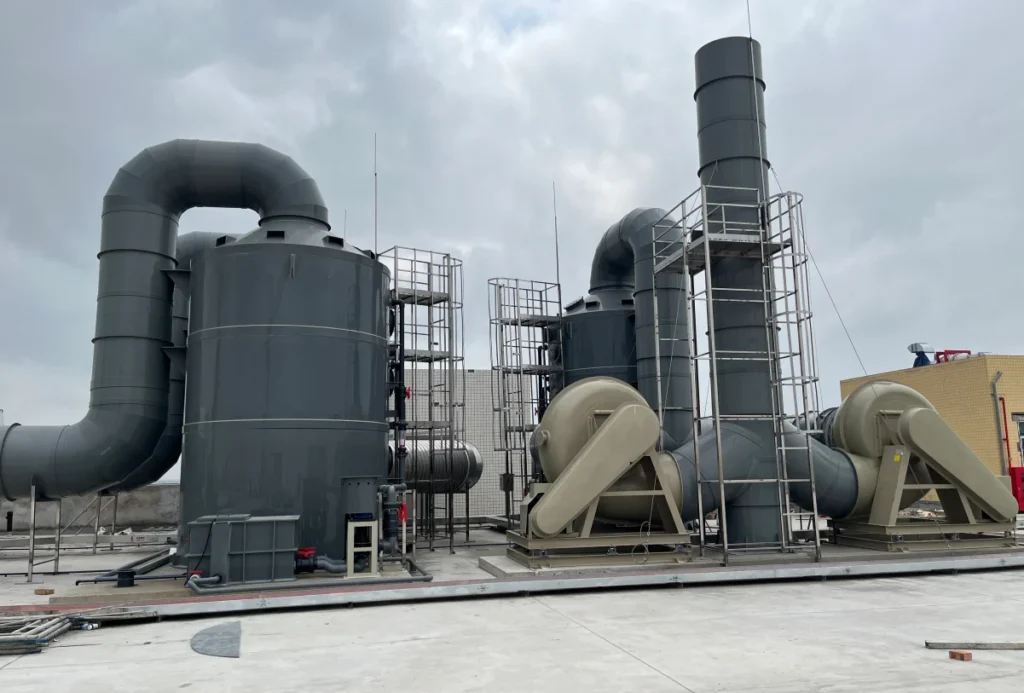
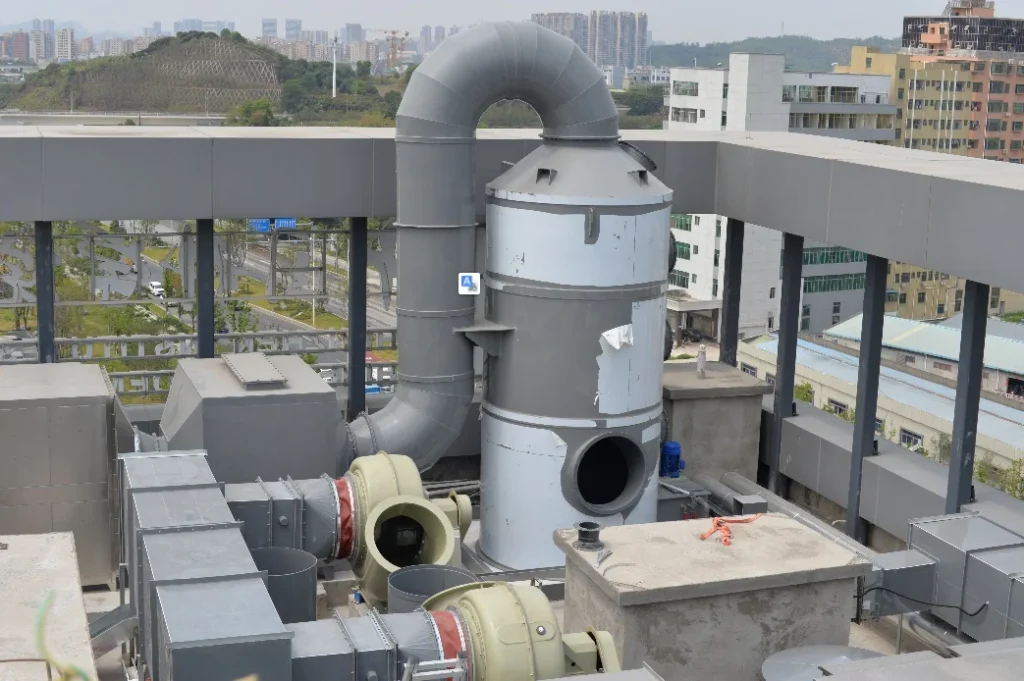
A **boiler scrubber system** removes SO2 from the flue gas of coal-fired and oil-fired industrial boilers before the gas exits the stack. Unlike a process gas scrubber that handles a defined pollutant at known concentration, a boiler scrubber must treat a large-volume flue gas stream at 150-200 deg C, containing SO2 (200-2,000 ppmv), fly ash particulate, and combustion byproducts. The choice between limestone, lime, or caustic scrubbing depends on the boiler size, the local reagent cost, and the disposal or sale options for the byproducts. This guide covers the chemistry of boiler flue gas desulfurization, the scrubber vessel selection for different boiler sizes, and the design and operating parameters for coal-fired power plant emission scrubber systems.
What Is a Boiler Scrubber System?
A boiler scrubber system is a flue gas desulfurization (FGD) system that removes sulfur dioxide (SO2) from the combustion exhaust of coal-fired, oil-fired, or biomass-fired industrial boilers. The scrubber contacts the flue gas with an alkaline reagent – limestone slurry, lime slurry, or caustic soda solution – that absorbs SO2 and converts it to a non-volatile sulfite or sulfate compound. The boiler scrubber is fundamentally a gas absorption system, not a particulate collection system, although fly ash is incidentally captured in the scrubbing liquid.
Why Boilers Need Scrubbers – SO2, PM, and NOx
Boiler flue gas contains SO2 at 200-2,000 ppmv from the sulfur content of the fuel (0.5-3% in typical bituminous coal). Without scrubbing, SO2 is discharged to the atmosphere where it contributes to acid rain. EPA regulations (40 CFR Part 60 for new sources, Part 63 for hazardous air pollutants) require 90-98% SO2 removal for coal-fired utility boilers. A boiler scrubber system meets these requirements while also capturing 50-80% of the fly ash that passes through the particulate collector (ESP or baghouse).
How Boiler Scrubbing Differs from Process Gas Scrubbing
Boiler scrubbers differ from chemical plant scrubbers in three dimensions: scale, reagent type, and byproduct management. The gas flow rates are one to two orders of magnitude larger than process vent scrubbers. The reagent is typically limestone slurry rather than caustic because limestone costs $10-30 per tonne versus $400-600 per tonne for NaOH. The byproduct (gypsum) is produced at industrial scale – 150,000 tonnes per year from a 500 MW plant – and can be sold as a construction material rather than disposed as waste. These differences drive fundamentally different equipment choices: spray towers instead of packed beds, rubber-lined carbon steel instead of FRP, and pneumatic conveying of dry gypsum instead of liquid blowdown.
Power Plant Scrubber System Design
Spray Tower FGD – The Standard for Large Plants
A power plant scrubber system for coal-fired boilers uses a spray tower absorber. The flue gas enters at the bottom, is quenched to saturation temperature (50-65 deg C), and rises through 3-5 spray levels where limestone slurry (CaCO3 at 10-15% solids) is sprayed downward. The tower diameter for a large power plant is 8-16 meters, handling 500,000-2,000,000 m3/h of flue gas. Each spray level operates with a dedicated recirculation pump. The L/G ratio is 8-12 L/m3, and the tower height is 25-40 meters.
The spray tower is the preferred vessel for lime/limestone FGD because the open chamber handles the abrasive slurry without plugging. The spray nozzles are large-diameter (25-50 mm) to resist plugging and abrasion. The mist eliminator section at the top of the tower requires continuous water wash to prevent gypsum scaling.
Coal-Fired Power Plant Emission Scrubber Systems
Coal-fired power plant emission scrubber systems represent the largest installed base of SO2 scrubbers by gas flow volume. Approximately 85% of FGD units installed in the United States are wet scrubbers, with roughly 79% using lime or limestone. A single 500 MW unit produces flue gas at 1,500,000-2,000,000 m3/h containing 500-2,000 ppmv SO2. The FGD spray tower achieves 90-98% SO2 removal with limestone slurry at L/G of 8-12 L/m3. The gypsum byproduct from a 500 MW plant is approximately 150,000 metric tons per year.
L/G Ratio and Tower Sizing
For a limestone spray tower with 3 spray levels treating 50,000 m3/h of flue gas at 0.8 m/s: Tower diameter: 4.7 m. L/G ratio: 8-12 L/m3. Recirculation rate: 50,000 x 10 = 500,000 L/h. For a caustic packed bed scrubber treating the same flow at 1.2 m/s: Tower diameter: 3.8 m. L/G ratio: 2-5 L/m3. Packing depth: 2-3 m of 25 mm polypropylene Pall rings.
Gypsum Handling and Forced Oxidation
Forced oxidation is standard in modern FGD systems. Air is injected into the sump to convert calcium sulfite (CaSO3) to calcium sulfate dihydrate (CaSO4-2H2O) – gypsum. The oxidation produces larger, more easily dewatered crystals. Wallboard-grade gypsum requires less than 1% residual CaSO3 and chloride below 200 ppm. The gypsum slurry is dewatered in hydrocyclones and vacuum belt filters to 85-90% solids before sale or landfilling.
Operating Cost and Byproduct Management
Limestone vs Caustic Cost Comparison
The reagent choice for a boiler scrubber system is primarily an economic decision driven by the boiler size. Limestone (CaCO3) costs $10-30 per tonne delivered as crushed rock. For a 50,000 m3/h flue gas with 500 ppmv SO2 at 95% removal: limestone consumption is approximately 102 kg/h at a reagent cost of $2/hour. The equivalent caustic consumption would be 41 kg/h of pure NaOH at $20/hour – a factor of 10 difference.
| Cost Item | Limestone FGD | Caustic Scrubbing |
|---|---|---|
| Reagent cost/kg SO2 | $0.02-0.05 | $0.30-0.60 |
| Equipment capital | $50-150 per m3/h | $30-80 per m3/h |
| Maintenance | Higher (slurry handling) | Lower (solution only) |
| Byproduct value | Gypsum ($5-15/tonne) | None |
| Best for | >100 MW boilers | <100 MW boilers |
Gypsum as a Salable Byproduct
Wallboard-grade gypsum (CaSO4-2H2O) sells for $5-15 per tonne. A 500 MW boiler producing 150,000 tonnes per year of gypsum generates $750,000-2,250,000 per year in byproduct revenue, offsetting 10-20% of the total FGD operating cost. Gypsum quality specifications: less than 1% residual CaSO3, less than 200 ppm chloride, and a consistent particle size distribution with d50 of 40-60 um. Achieving these specifications requires precise control of forced oxidation, limestone grind size, and chloride purge rate.
Wastewater and Sludge Management
FGD wastewater contains chlorides, sulfates, dissolved metals, and suspended solids. The blowdown rate is set by the chloride concentration limit – typically 10,000-20,000 ppm chloride in the recirculating slurry. The FGD wastewater is treated through chemical precipitation, sedimentation, and filtration before discharge under an NPDES permit.
Operation and Maintenance
Slurry Chemistry and pH Control
The pH of the limestone slurry in a boiler scrubber system is the primary process control parameter. The setpoint is pH 5.0-6.0. Below pH 4.5, SO2 absorption efficiency drops sharply. Above pH 6.0, limestone dissolution slows and unreacted reagent passes through the system. A pH sensor in the recirculation line controls the limestone feed rate. The sensor requires weekly calibration and replacement every 3-6 months.
For a boiler scrubber system using caustic soda, the pH setpoint is 6-8. Operating at pH 6-7 reduces caustic consumption by 40% compared to pH 8 operation. The pH controller adjusts the caustic metering pump based on the sensor signal.
Scaling Prevention at Wet-Dry Interface
The wet-dry interface at the flue gas inlet is the most vulnerable scaling zone in a boiler scrubber system. Dry solids deposit at the boundary where the hot, dry flue gas meets the saturated scrubbing liquid. The interface must be continuously washed or designed to operate fully wet. Gypsum scaling on the mist eliminator is controlled by continuous water wash at 0.5-1.0 L/m2 of eliminator area.
Gypsum Dewatering and Handling
The gypsum slurry from the sump bleed stream passes through hydrocyclones for primary dewatering and vacuum belt filters for final dewatering to 85-90% solids. The dewatered gypsum is conveyed to a storage building for loading onto trucks or rail cars. The filtrate from dewatering returns to the scrubber sump. The chloride content is controlled by blowing down a portion of the filtrate.
Frequently Asked Questions
What is a boiler scrubber system?
A boiler scrubber system removes SO2 from boiler exhaust using limestone slurry, lime, or caustic soda. A boiler scrubber system is a flue gas desulfurization system that converts SO2 to gypsum or sodium sulfite.
What is the difference between limestone and caustic FGD?
Limestone FGD uses crushed limestone slurry (CaCO3 at 10-15% solids) in a spray tower. The byproduct is gypsum, which can be sold. The capital cost is higher, and the system is more complex. Caustic FGD uses NaOH solution in a packed bed or spray tower. The byproduct is sodium sulfite/sulfate in liquid blowdown. The capital cost is lower, but the reagent cost is 10-20 times higher. Limestone is preferred for boilers above 100 MW.
What is a coal-fired power plant emission scrubber system?
Coal-fired power plant emission scrubber systems remove 90-98% of SO2 from flue gas. The standard design is a spray tower absorber with limestone slurry. The system includes a quench section, 3-5 spray levels, a forced oxidation sump, a mist eliminator, and gypsum dewatering equipment.
How does a power plant scrubber system work?
A power plant scrubber system sprays limestone slurry into the flue gas. SO2 dissolves into the liquid, reacts with CaCO3 to form CaSO3, and is oxidized to gypsum (CaSO4-2H2O). The gypsum is dewatered and sold. The cleaned gas exits through a mist eliminator.
What is the annual operating cost of an FGD system?
The operating cost for a 50,000 m3/h limestone FGD system is approximately $16,000/year in limestone plus $5,000-10,000/year in electricity. The gypsum byproduct credit is approximately $4,000-15,000/year, depending on quality and market. Net operating cost is approximately $10,000-20,000/year.
Key Takeaways
- A boiler scrubber system for flue gas desulfurization uses either limestone slurry (CaCO3) or caustic soda (NaOH) depending on boiler size. Limestone costs $10-30 per tonne and is the standard for boilers above 100 MW, requiring a spray tower with slurry handling equipment. Caustic costs $400-600 per tonne but requires only simple solution handling and is preferred for boilers below 100 MW. The economic crossover is at approximately 500 tonnes per year of SO2 removed.
- A 500 MW coal-fired unit produces 150,000 tonnes per year of gypsum byproduct that can offset 10-20% of the FGD operating cost when sold as wallboard-grade gypsum. Gypsum quality requires less than 1% residual CaSO3 and chloride below 200 ppm. The forced oxidation air system is the key design feature for producing salable gypsum from limestone FGD scrubbing.
- Coal-fired power plant emission scrubber systems account for approximately 85% of FGD units installed in the US, with roughly 79% using lime or limestone wet scrubbing. The average FGD spray tower for a 500 MW boiler handles 500,000-2,000,000 m3/h of flue gas at 90-98% SO2 removal efficiency. See our exhaust gas scrubber products → and SO2 scrubber solutions →.