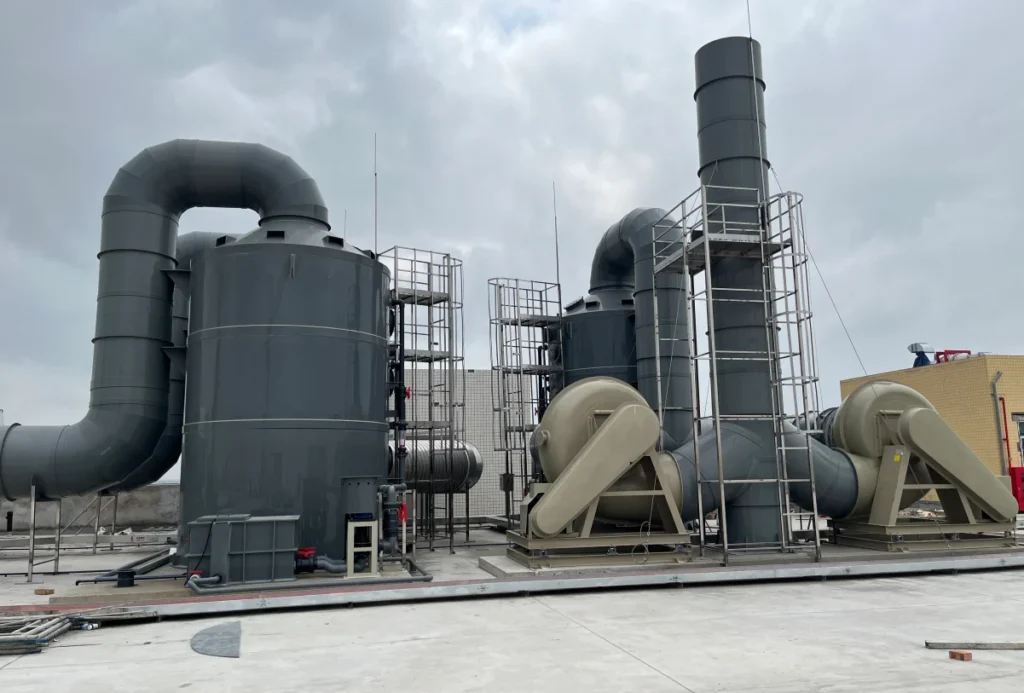
The gas scrubber price for an industrial installation typically ranges from $25,000 for a small packaged unit to over $500,000 for a large field-erected system, and the equipment price is only half the story. A buyer who budgets on the bare vessel misses the installed cost, the operating cost, and the maintenance that together determine the real price over the equipment life. This guide answers how much does a gas scrubber cost by technology and scale, separates the equipment price from the installed cost, breaks down the annual operating cost, and provides a price benchmark table and a negotiation checklist. Procurement teams and plant engineers can use the ranges here to set a realistic budget and evaluate supplier quotes on the same basis.
Key Takeaways
- A gas scrubber price ranges from $15,000-40,000 for a small packaged unit to $80,000-200,000 for a 50,000 m3/h packed bed scrubber in equipment alone. The installed cost adds 1.5-2 times the equipment price.
- The equipment price by technology at 10,000 m3/h in FRP is $25,000-55,000 for a spray tower, $30,000-80,000 for a packed bed, and $55,000-120,000 for a venturi.
- The operating cost, not the equipment price, dominates the total cost of ownership: the five-year TCO for a 10,000 cfm system ranges from $175,000-420,000 for a spray tower to $910,000-1,670,000 for a venturi scrubber.
- Material and manufacturer drive the price: FRP costs 1.5-2 times PP, stainless steel 3-4 times PP, and a Chinese manufacturer may quote 30-50% below a Western fabricator for equivalent FRP work.
- Compare bids on total cost of ownership with a component price breakdown. A low bid that under-specifies the fan or controls can erase its saving in the first year of operating cost.
Gas Scrubber Price: What to Expect
The gas scrubber price is set by the technology type, the gas flow, the material, and the scope of supply. The equipment price is the number a quote headline carries; the installed price and the operating cost are the numbers the budget must absorb.
Equipment Price by Technology Type
At a reference flow of 10,000 m3/h in fiberglass construction, the equipment price by technology type is a useful starting band. A spray tower runs $25,000-55,000 because the vessel is open and the internals are limited to nozzles and a mist eliminator. A packed bed scrubber runs $30,000-80,000, reflecting the packing media, the liquid distributor, and the closer design margin. A venturi scrubber runs $55,000-120,000 because of the throat section, the high-energy fan duty, and the tighter fabrication tolerance. These are the same reference figures cited in the gas scrubber and wet scrubber guides, and they assume FRP construction with a recirculation pump and basic controls.
Price by Scale
The price scales with the gas flow because the vessel diameter, the fan, and the pump all grow with it. A packaged packed bed scrubber at 5,000 m3/h runs $20,000-40,000. At 10,000 m3/h the same technology runs $30,000-80,000. At 50,000 m3/h the equipment price reaches $80,000-200,000, and the vessel diameter at that flow approaches 3 m, which requires a larger fabrication facility and heavier structural design. The price does not scale linearly: doubling the flow raises the vessel diameter by only 40%, so the price per unit of flow falls as the system grows.
Installed Cost vs Equipment Cost
The installed cost is typically 1.5-2 times the equipment price once the fan, the controls, the ductwork connections, the installation labor, and the commissioning are added. A $50,000 packed bed scrubber commonly lands at $75,000-100,000 installed. The multiplier is higher for a system that needs a foundation, an interconnecting duct run, or a complex control integration, and lower for a packaged skid unit that arrives pre-piped and pre-wired. Quote the installed cost in the RFQ, because a low equipment price with high installation labor is often the more expensive option on a total basis.
Compare prices on the same basis by converting the gas flow to a common unit. A quote in cfm and one in m3/h describe the same system in different units, and 1 cfm equals roughly 1.7 m3/h. The gas scrubber price differences between bids for the same duty usually trace to differences in scope, not to the flow unit. Confirm the scope of supply, the warranty, and the performance guarantee before comparing the headline numbers, because a lower price that excludes the fan or the commissioning labor is not a lower price for the same system.
The equipment price also carries a regional component that is separate from quality. Fabrication labor rates, shop overhead, and local material costs move the quote by 10-30% for the same drawing set built in different regions. This regional variation is why the same specification can attract quotes that differ by a wide margin from manufacturers in different countries, and why the gas scrubber price must be evaluated together with the shipping cost, the import duties, and the after-sales service reach. A low equipment price from a distant fabricator can be erased by freight, customs, and a service response measured in weeks instead of days.
Factors That Drive the Price
Four factors move the gas scrubber price more than any other: the material of construction, the instrumentation scope, the degree of customization, and the manufacturer type. Two quotes for the same nominal flow can differ by 50% or more when these four are specified differently.
Material of Construction
The vessel material is the largest single price driver. Polypropylene is the lowest-cost option and covers most acid and alkali service below 80 C. Fiberglass reinforced plastic costs roughly 1.5-2 times PP and extends the temperature range to about 110 C. Stainless steel costs 3-4 times PP and is required above 110 C or for abrasive service, but it fails rapidly in hydrochloric or hydrofluoric acid. A buyer who specifies SS where FRP would serve is paying for the upgrade without needing it; a buyer who specifies PP for a 90 C stream is saving capital and buying a premature failure.
Instrumentation and Controls
The controls add a defined increment. A basic system with a level switch, a pressure gauge, and a manual reagent feed runs $5,000-12,000 for the chemical dosing and pH control package, and a standby pump adds $3,000-6,000. A full PLC-based system with pH control, variable-frequency fan drive, and remote monitoring adds 10-15% to the total equipment cost. The instrumentation is where low bids are most often trimmed, because cutting the controls does not change the vessel price but does change the compliance reliability.
Custom vs Standard Design
A standard packaged design costs less because the engineering is amortized across many units. A custom-engineered system for a specific gas composition, a tight footprint, or a high-temperature inlet carries the full engineering cost of that project. The custom premium is typically 15-35% over a standard unit of similar capacity. The premium is worth paying when the gas conditions fall outside the standard envelope, because a modified standard unit can underperform at the actual duty. The wet scrubber design guide covers the engineering content that drives the custom premium.
Manufacturer Type
The manufacturer type shifts the price within the same specification. A regional fabricator typically quotes 10-30% below a global integrator for the same equipment because of lower overhead. A Chinese manufacturer may quote 30-50% below a Western fabricator for equivalent FRP work, with a quality gap that has narrowed for standard scrubbers but persists for complex systems. The evaluation method that separates the low price from the low total cost is covered in the wet scrubber manufacturer guide, and the price alone should not drive the selection.
The scope of ancillary equipment is where the gas scrubber price drifts between quotes. A bare vessel quote and a complete system quote for the same duty can differ by 40-60% because the complete system adds the recirculation pump, the fan, the reagent feed, the controls, the ductwork connections, the stack, and the commissioning. Ask each supplier to state explicitly what is included, and verify that the recirculation loop, the mist eliminator, the instrumentation, and the installation are either included or priced as separate line items. A quote that excludes the ancillary equipment appears competitive until the missing items are added, at which point the apparent bargain disappears. Define the scope boundary in the RFQ and hold every bidder to the same boundary.
Scrubber Operating Cost Analysis
The scrubber operating cost often exceeds the equipment price within the first three to five years, and it is the number that separates a good scrubber choice from a bad one. Four cost centers dominate: fan and pump energy, reagent consumption, water and wastewater, and maintenance.
Fan and Pump Energy
Fan energy is the largest operating cost for high-pressure scrubber types. The annual energy cost for a 10,000 cfm system varies by an order of magnitude across technologies. A spray tower operating at 2-6 inches of water column draws 7-14 horsepower and costs $10,000-20,000 per year in fan and pump energy. A packed bed at 4-30 inches WC costs $50,000-65,000 per year. A venturi at 40-60 inches WC draws 90-150 horsepower and costs $125,000-140,000 per year. The energy cost difference alone can justify a spray tower or packed bed over a venturi when the pollutant does not require sub-micron capture. The Engineering Toolbox provides the fan-power correlations for these calculations.
Reagent Consumption
The reagent is the second-largest operating cost. For a 10,000 cfm stream containing 500 ppm of HCl, the sodium hydroxide consumption is roughly 40-55 tons per year at $500/ton, or $20,000-28,000 per year. For SO2 removal, lime or limestone at $80-150/ton is the lower-cost reagent but requires a slurry handling system. For odor control with sodium hypochlorite, the chemical cost adds $5,000-15,000 per year depending on the oxidant demand. The reagent consumption scales directly with the pollutant load, so the operating cost is set by the inlet concentration, not by the equipment size.
Water and Wastewater
Water supply and wastewater treatment add a recurring cost that is easy to underestimate. At $5-15 per 1,000 gallons for supply and $3-10 per 1,000 gallons for treatment, the annual water cost for a 10,000 cfm scrubber runs $3,000-28,000 depending on local rates and the blowdown volume. A facility with a high discharge fee or a strict wastewater permit may find the water and treatment cost equal to the reagent cost. The blowdown rate is set by the dissolved solids limit, and a facility that can reuse the blowdown in another process cuts this line significantly.
Maintenance and Media Replacement
Maintenance runs $8,000-20,000 per year for a 10,000 cfm system, covering nozzles, gaskets, seals, and the shop labor for routine service. Packing replacement in a packed bed scrubber is a larger periodic event, required every 3-7 years and costing $8,000-25,000 per event for materials and labor. The maintenance burden favors a spray tower over a packed bed in fouling service, which is why the lowest-maintenance technology is not always the highest-priced one. The venturi wet scrubber guide details the high-energy scrubber where the energy and maintenance costs are highest.
The operating cost converts directly into a price-per-unit-of-flow that makes the comparison concrete. At $0.08 per kWh and 8,760 operating hours per year, each additional 10 horsepower of fan duty on a 10,000 cfm system costs roughly $5,200 per year in electricity. The difference between a spray tower and a venturi on the same duty is therefore not the $30,000-70,000 equipment gap; it is the $100,000+ per year energy gap that the equipment gap cannot recover. When the pollutant allows a lower-energy technology, the annual saving pays for the more expensive equipment option many times over the service life. The gas scrubber price evaluation should always include this operating-cost line, because it is the line that decides the low-cost option over ten years.
Total Cost of Ownership
The scrubber total cost of ownership is the sum of the installed cost plus the operating cost over the equipment life, and it is the number that should drive the purchase decision. The equipment price can be the smallest term of the equation.
The 5-Year TCO Calculation
Over a five-year horizon, the operating cost dominates the total for every high-energy scrubber type. For a 10,000 cfm system, the five-year total cost of ownership ranges from $175,000-420,000 for a spray tower to $910,000-1,670,000 for a venturi scrubber, with the energy cost making up the difference. A venturi that costs $55,000-130,000 in equipment but $125,000-140,000 per year in energy is sustainable only when the process genuinely requires sub-micron particulate capture. Build the TCO model from the installed cost, the annual energy, reagent, water, and maintenance costs, and the expected service life, and compare suppliers on that total instead of on the equipment price.
Dry vs Wet Price Comparison
The dry scrubber options change the capital picture for acid gas service. For a 50,000 m3/h stream treating 500 ppm of SO2, a dry sorbent injection system costs $80,000-150,000 installed, a spray dryer absorber runs $300,000-600,000, and a circulating dry scrubber runs $400,000-800,000. A wet scrubber for the same duty costs $400,000-1,200,000 installed once the vessel, the packing, the reagent preparation, and the wastewater treatment are included. The wet system carries the higher capital cost but the lower reagent cost per ton of pollutant removed. The dry scrubber system and dry scrubber vs wet scrubber guides detail the comparison, and the EPA control technology fact sheets document the performance data behind the cost estimates.
Incinerator Spray Tower Price
For waste incineration flue gas treatment, the spray tower operates at a different price scale. A large incinerator spray tower handling the flue gas from a municipal or industrial incinerator runs $500,000-1,000,000 installed once the vessel, the reagent system, the quench section, and the ancillary controls are included, with an annual operating cost of $50,000-150,000. The incinerator spray tower price reflects the corrosive, high-temperature flue gas duty and the corrosion-resistant construction it requires. The incinerator spray tower guide covers the design parameters that drive this price.
The capital-versus-operating tradeoff is the core of the TCO decision. A wet scrubber costs more to build than a dry sorbent injection system but less to operate per ton of pollutant removed, so the wet option wins on total cost only when the duty is continuous and the pollutant load is high. A dry system wins when the duty is intermittent, the water cost is high, or a baghouse already exists. The crossover point is set by the operating hours and the reagent cost, not by the equipment price. A facility that runs a scrubber 2,000 hours per year and one that runs it 8,000 hours per year should reach different technology conclusions for the same gas composition, and the TCO model should be run for the actual duty before the capital comparison drives the choice.
The gas scrubber price should also be reviewed against the compliance value it delivers. A system that meets the permit limit avoids a violation that carries fines and a mandated shutdown, and the cost of non-compliance frequently exceeds the scrubber’s entire first-year operating budget. When the scrubber is evaluated as the control that protects the compliance position instead of as a piece of equipment, the price comparison shifts from the cheapest option to the option with the strongest performance guarantee. The cheapest system that reliably meets the limit is the low-cost answer; the cheapest system that does not meet the limit is the most expensive possible outcome.
How to Get an Accurate Price Quote
An accurate gas scrubber price quote starts with a precise specification. The quote is only as good as the request for quotation that produced it, and the differences between bids usually trace back to differences in what the suppliers were asked to quote.
What to Include in the RFQ
Give each supplier the same technical basis so the bids are comparable. State the gas flow at actual conditions, the inlet temperature and pressure, the pollutant concentrations and their variability, the particulate loading, and the moisture content. Specify the required outlet concentration, the maximum allowable pressure drop, the operating hours per year, and the expected service life. Attach the site constraints: the available footprint, the power supply, the water quality, and the installation access. A supplier that receives the full gas characterization can quote a system that meets the duty; a supplier that receives a vague inquiry protects itself with margin or quotes a system that underperforms.
Price Breakdown to Request
Ask for the quote broken down by component: the vessel, the internals or packing, the fan and motor, the pump, the controls and instrumentation, the ductwork and stack, and the installation and commissioning. The breakdown lets you compare each subsystem against the market and spot a quote that under-specifies the fan or the controls to win the headline price. A transparent breakdown also gives you the basis for negotiating a scope change during the project, because the component prices can be adjusted for the modification. Treat a lump-sum quote without a breakdown as a signal that the supplier does not want its pricing compared.
Red Flags in Low Bids
A price far below the comparable bids is a risk signal, not a bargain. Check whether the low bid uses a thinner corrosion barrier, a lighter fan, a smaller pump, a manual reagent feed instead of a pH-controlled feed, or a shorter warranty. A $20,000 price difference on a $100,000 scrubber is a small fraction of the $50,000-140,000 per year operating cost, and an undersized fan or a weak controls package can erase the saving in the first year. Require the low bidder to document that the quoted equipment meets the specified duty, and verify the performance guarantee covers the actual outlet concentration before awarding the contract.
Negotiate the terms that carry the most risk, not just the headline price. The two highest-value items are the performance guarantee with liquidated damages and the corrosion warranty scope. Push for liquidated damages proportional to the compliance exposure, and for a corrosion warranty that runs for the design service life instead of the standard equipment warranty. A modest price concession accepted in exchange for a stronger guarantee is usually the better trade for the buyer, because the guarantee is the clause that protects the operating budget if the system underperforms. The gas scrubber price negotiation should conclude with a written scope, a written performance guarantee, and a documented delivery schedule, so that the price paid is the price of the system that was specified.
Price Benchmark Table by Capacity
The gas scrubber price benchmarks below give a budget starting point by capacity. The ranges assume FRP construction with a recirculation pump and controls; add the material premium for SS and the installed multiplier for the full system cost.
Packaged Systems
A packaged scrubber is a self-contained unit on a skid, pre-piped and pre-wired, suited to flows up to roughly 5,000 m3/h. A packaged packed bed scrubber at 1,000-3,000 m3/h runs $15,000-40,000 installed-ready. A packaged unit for a small chemical vent or a single fume hood fits this bracket, and the price is dominated by the factory assembly quality instead of field labor. For small dry systems, a 3,500 cfm DSI unit retrofitted into an existing baghouse plant can run as low as $12,000-24,000 for the equipment alone.
Mid-Size Systems
A mid-size system treats 10,000-20,000 m3/h and is the most common industrial purchase. A 10,000 m3/h packed bed scrubber runs $30,000-80,000 in equipment and $55,000-160,000 installed. A skid-mounted system in polypropylene at 10,000 cfm runs $35,000-55,000, with chemical dosing and pH control adding $5,000-12,000 and a standby pump adding $3,000-6,000. A 20,000 m3/h venturi for sub-micron service runs $60,000-150,000 in equipment because of the throat and high-energy fan duty.
Large Field-Erected Systems
A field-erected system above 20,000 m3/h is built at the site and carries the highest price. A 50,000 m3/h packed bed scrubber runs $80,000-200,000 in equipment and $150,000-400,000 installed. A custom-engineered 50,000 cfm FRP system with full instrumentation, dual pumps, and a variable-frequency fan drive runs $120,000-200,000. At the utility scale, a flue gas desulfurization wet scrubber for a 500 MW plant runs $15-25 million installed with a $2-4 million per year operating cost. The field-erected price is driven by the fabrication capacity, the installation logistics, and the engineering content.
Apply the material multiplier to the benchmarks when the service deviates from FRP. A stainless steel vessel for the same 10,000 m3/h duty adds roughly 3-4 times the PP material cost, which can move a $30,000-80,000 packed bed scrubber into the $80,000-200,000 range. A high-temperature inlet that forces SS construction is therefore a material decision with a price consequence, and the temperature survey upstream of the scrubber pays for itself by avoiding an unnecessary upgrade. The benchmarks also assume a standard scope; add the chemical dosing package, the standby pump, the variable-frequency drive, and the remote monitoring as priced line items instead of folding them into an unknown.
For a project-specific budget, browse the gas scrubber product range or contact our team with your gas characterization for a quote matched to the actual duty. A gas scrubber price benchmark is a budgeting tool, not a quotation, and the final number depends on the flow, the material, the instrumentation, and the scope that only a complete specification can define.
FAQ
How much does a gas scrubber cost?
A gas scrubber price ranges from $15,000-40,000 for a small packaged unit to $80,000-200,000 for a 50,000 m3/h packed bed scrubber in equipment alone. The installed cost adds 1.5-2 times the equipment price once the fan, controls, installation, and commissioning are included.
What is the most affordable type of gas scrubber?
A spray tower is the lowest-cost technology, at $25,000-55,000 for a 10,000 m3/h FRP unit, because the open vessel has minimal internals. It also has the lowest operating cost, at $10,000-20,000 per year in fan and pump energy, making it the least expensive option where the pollutant is soluble and the removal target is moderate.
What affects the price of a gas scrubber?
The price is driven by the material of construction (PP is lowest, FRP costs 1.5-2 times, stainless steel 3-4 times), the instrumentation scope, the degree of customization, and the manufacturer type. A regional fabricator typically quotes 10-30% below a global integrator, and a Chinese manufacturer may quote 30-50% below a Western fabricator.
How much does a wet scrubber cost?
A wet packed bed scrubber at 10,000 m3/h runs $30,000-80,000 in equipment and $55,000-160,000 installed. At 50,000 m3/h the equipment price reaches $80,000-200,000. A full wet SO2 removal system at 50,000 m3/h, including reagent preparation and wastewater treatment, runs $400,000-1,200,000 installed.
What is the operating cost of a scrubber system?
The annual operating cost is dominated by fan energy, reagent, water, and maintenance. For a 10,000 cfm system, the energy cost ranges from $10,000-20,000 per year for a spray tower to $125,000-140,000 for a venturi. Reagent adds $20,000-28,000 per year for 500 ppm HCl service, water $3,000-28,000, and maintenance $8,000-20,000.
How much does an incinerator spray tower cost?
A large incinerator spray tower for waste incineration flue gas runs $500,000-1,000,000 installed, with an annual operating cost of $50,000-150,000. The price reflects the corrosive high-temperature duty and the corrosion-resistant construction it requires.
How do I get the best price on a gas scrubber?
Write a precise RFQ with the full gas characterization, request bids from 3-5 qualified suppliers, and compare them on total cost of ownership instead of equipment price. Ask for a component price breakdown, and treat a price far below the comparable bids as a risk signal that requires verification of the specified duty.
How much does a scrubber system cost to install?
The installed cost is typically 1.5-2 times the equipment price. A $50,000 packed bed scrubber commonly lands at $75,000-100,000 installed once the fan, controls, ductwork connections, installation labor, and commissioning are added. The multiplier is higher for a system requiring a foundation or complex control integration.
What is the cheapest way to control acid gas emissions?
For a water-constrained retrofit with an existing baghouse, dry sorbent injection at $80,000-150,000 for a 50,000 m3/h system is the lowest-capital option. For a greenfield wet installation with high removal requirements, a packed bed wet scrubber is the standard low-lifecycle-cost choice, with the energy and reagent cost far below a venturi on the same duty.