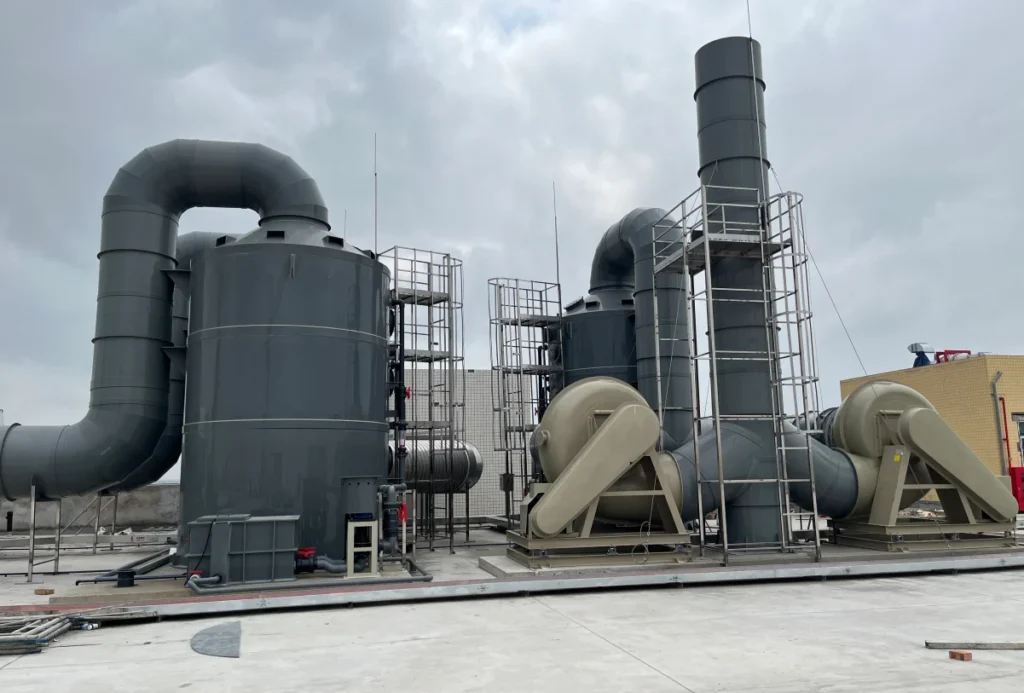
A gas compressor scrubber is the protective vessel installed on the suction side of a gas compressor to remove entrained liquid and solids before they reach the machine. Liquid carryover is the single most destructive failure mode for gas compressors: a slug of condensate or water entering a reciprocating compressor can destroy the valves in one cycle, and a centrifugal machine can trip into surge or erode its impeller. The suction scrubber sits between the incoming gas stream and the compressor intake, and its size and internals determine whether the machine survives the worst case the facility can produce. This guide covers why a gas compressor scrubber is required, how liquid carryover damages each compressor type, the scrubber configurations and sizing, and the protection logic and maintenance that keep it effective.
Key Takeaways
- A gas compressor scrubber is the protective vessel installed on the compressor suction side to remove entrained liquid and solids, sized for the worst-case slug the facility can produce instead of the average flow. Liquid carryover can destroy a reciprocating compressor in a single cycle.
- The damage mode differs by machine: reciprocating compressors fail by valve destruction and hydraulic lock, centrifugal compressors by impeller erosion and surge trips, and screw compressors by oil-film washout and bearing wear. The scrubber is specified against the machine’s specific failure mode.
- The vessel diameter follows the Souders-Brown equation at a K factor of 0.35-0.45 ft/s for vane internals, designed at 75-80 percent of maximum; at a K of 0.40 and a gas density of 1.5 lb/ft3 the maximum velocity is about 2.5 ft/s.
- The vessel length is set by the liquid capacity for 1-3 minutes of hold-up plus the worst-case slug, and the high-level shutdown switch is the scrubber’s ultimate protection, tripping the compressor before liquid reaches the inlet nozzle.
- A vertical scrubber with a vane mist eliminator is the standard for reciprocating and centrifugal suction duty; a filter scrubber with coalescing elements is added where the gas carries sub-micron mist or solids. The pressure drop is a suction loss that directly reduces compressor capacity.
What Is a Gas Compressor Scrubber?
A gas compressor scrubber is a pressure vessel installed immediately upstream of a gas compressor to remove the entrained liquid and solid load from the gas before it enters the machine. It is the first line of defense against the damage that liquid carryover inflicts on compressor internals, and it is specified as part of every compressor package in gas processing, transmission, and compression service.
The Gas Compressor Suction Scrubber Defined
The gas compressor suction scrubber is a vertical or horizontal vessel with a gravity settling section and a mist-eliminating element. The gas enters the vessel, slows to a low velocity so the bulk liquid falls out, passes through the mist eliminator to capture the fine droplets, and exits through the outlet nozzle to the compressor intake. The collected liquid drains to a sump controlled by a level controller that opens the drain valve to a liquid handling system. The vessel is sized for the worst-case liquid load the facility can produce, not the average, because a single slug reaching the compressor is the failure the scrubber exists to prevent.
The Liquid Carryover Problem
Liquid carryover is the entry of liquid droplets or slugs into a compressor with the gas stream. The liquid can be water, hydrocarbon condensate, glycol, or a combination, and it enters the gas when the upstream separation is incomplete or when the process trips and dumps liquid into the suction line. The damage is severe and rapid. A reciprocating compressor exposed to liquid suffers valve failure, rod and piston damage, and hydraulic lock. A centrifugal compressor suffers impeller erosion, surge trips, and seal damage. A screw compressor suffers rotor and bearing damage. The cost of one carryover event frequently exceeds the cost of the suction scrubber that prevents it, which is why the scrubber is treated as protective equipment instead of an option. The broader role of the equipment in the scrubber oil and gas equipment family is covered in the scrubber oil and gas guide, and the general technology in the gas scrubber guide.
Scrubber vs Filter vs Separator
The terms describe the fineness of removal. A separator removes bulk liquid by gravity settling, capturing droplets above roughly 300 microns. A scrubber adds a mist eliminator to capture finer droplets down to 10 microns with a vane or 5 microns with a mesh. A filter separator uses coalescing elements to capture droplets down to 0.1-1 micron and solid particles as well. For compressor protection, the suction scrubber is normally a vertical vessel with a high-efficiency mist eliminator, and a filter separator is added when the gas carries fine mist or solids that would erode the compressor internals. The configuration is driven by the contaminant size, and the Gas Processing News archive documents the design practice across the industry.
A gas compressor scrubber is specified whenever a compressor runs on a stream that can carry liquid, which is essentially every compressor in gas gathering, transmission, processing, and fuel gas service. The exception is a machine on a dry, clean, spec gas supply with no upstream liquid source. The scrubber is a standard item in the compressor package because the alternative, relying on the upstream separation alone, leaves the machine exposed to every upset in the process. The suction scrubber is the compressor’s own protective barrier, and its presence is what allows the machine to run at its design throughput without carrying the risk of a liquid event.
Liquid Carryover Damage by Compressor Type
The damage that liquid carryover inflicts depends on the compressor type, and the gas compressor scrubber is specified against the failure mode of the specific machine it protects.
Reciprocating Compressors
A reciprocating compressor is the most sensitive to liquid carryover because its valves, piston rings, and cylinders are precision components with small clearances. Liquid entering the cylinder is incompressible, so a trapped slug produces hydraulic lock that can bend the connecting rod or crack the cylinder head. Even fine mist coats the valve plates, preventing them from seating and destroying the valve within minutes. The failure is sudden and catastrophic, and the repair is a full compressor overhaul. The suction scrubber for a reciprocating machine must provide near-total liquid removal, and the level shutdown is set to trip the compressor before the liquid sump fills to the inlet nozzle.
Centrifugal Compressors
A centrifugal compressor tolerates fine mist better than a reciprocating machine but fails on droplets and slugs in a different way. Entrained liquid droplets erode the impeller and the diffuser at the high tip speeds, and a liquid slug entering the impeller can trip the machine into surge, damage the dry gas seal, or cause a rotor imbalance that forces a shutdown. The erosion is cumulative, thinning the impeller over time until a blade fails. The suction scrubber for a centrifugal machine focuses on removing the larger droplets that cause erosion and on providing enough liquid capacity to prevent a slug from reaching the seal. A filter separator is often added where the gas carries fine mist.
Screw Compressors
A screw compressor handles some liquid tolerance by design, since the rotors can pass a small amount of liquid, but carryover beyond the design allowance causes rapid wear and bearing failure. The liquid washes the lubricating oil film from the rotors and dilutes the oil, shortening the bearing life and raising the operating temperature. The screw compressor suction scrubber protects the oil system and the bearings, and the liquid load it removes is usually lower than for a reciprocating machine. The scrubber still requires the same sizing discipline, because the tolerance for liquid is finite and the failure cost is a full rotor set.
Where the gas also contains hydrogen sulfide, the carryover is corrosive as well as destructive, because the liquid carries dissolved H2S into the compressor internals. The H2S scrubber system guide covers the chemistry and the material requirements for sour gas service, and the suction scrubber in sour duty is specified with the corrosion allowance and the material that match the sour liquid it collects.
A common carryover source is the upstream process itself. A dehydration unit that trips can dump glycol into the suction line, a slug catcher that overfills releases condensate, and a well that ramps up produces a surge of water and formation solids. The scrubber is sized for these events, not for the steady flow, and the drain system is sized to pass the surge. The operator procedure for a process upset includes watching the suction scrubber level, because the first sign of a carryover event is the scrubber sump filling faster than the drain can pass it.
Gas Compressor Scrubber Types and Configurations
The gas compressor scrubber configuration follows the compressor size, the liquid load, and the space available, and the suction scrubber oil and gas selection starts with the vessel orientation.
Vertical Suction Scrubber
A vertical suction scrubber is the standard configuration for compressor protection. The gas enters the side near the bottom, rises through the gravity settling section, passes the mist eliminator near the top, and exits through the top or side outlet to the compressor. The vertical orientation concentrates the liquid in a small-diameter sump, which makes the level control simple and handles a high liquid rate without a large liquid surface. The vertical vessel is compact, which matters in a compressor station where the scrubber must fit beside the machine, and it is the default choice for reciprocating and centrifugal suction duty. The diameter is set by the Souders-Brown velocity at the mist eliminator, typically 2-4 feet per second depending on the operating pressure.
Horizontal Suction Scrubber
A horizontal suction scrubber is used where the gas flow is high and the footprint is available. The gas flows along the long axis, giving a longer settling path and a larger liquid surface, which suits high-flow transmission compressor stations. The horizontal vessel handles a larger liquid surge volume for the same diameter because the liquid occupies a long low section, which makes it the choice where slug capacity is the priority. It requires more footprint and a more complex level-control arrangement with the liquid at the bottom of a long vessel.
Filter Scrubber for Fine Mist
A filter scrubber adds coalescing filter elements to the vessel to remove the fine mist and solid particles that a vane or mesh cannot capture. The elements force the gas through a fiber medium, capturing droplets down to 0.1-1 micron and protecting the compressor internals from the fine mist that erodes them over time. A filter scrubber is specified for high-speed centrifugal compressors, for gas turbine fuel gas service, and for any stream carrying sub-micron contamination. The filter elements are consumables with a scheduled replacement interval, and the element cost is an operating expense that the compressor protection justifies.
Suction Scrubber Oil and Gas Installation
The installation location and the piping matter as much as the vessel. The scrubber is installed as close to the compressor intake as practical, so that no long suction line can accumulate liquid between the scrubber and the machine. The suction line is sloped back to the scrubber, and the scrubber outlet is free of low points where liquid can pool. The vessel is designed and stamped to the applicable pressure vessel code, and the design follows the API standards for the separator and the compressor package. The gas turbine fuel gas case is covered in the fuel gas scrubber guide, and the layout must give the scrubber access for internal inspection and element replacement.
The vessel material and the pressure rating follow the compressor suction pressure. A low-pressure gathering compressor at 100-300 psi uses a carbon steel vessel with a standard rating. A high-pressure transmission or processing compressor at 1,000-1,500 psi requires a thicker, higher-rated vessel, and sour service adds a corrosion allowance or a corrosion-resistant lining. The material decision is driven by the gas chemistry and the collected liquid, and it follows the same selection rules as the rest of the compression station.
Sizing the Compressor Suction Scrubber
The gas compressor scrubber is sized by three independent criteria: the gas velocity that sets the vessel diameter, the liquid capacity that sets the vessel length, and the internals that set the removal fineness. All three must be satisfied, and the compressor suction scrubber sizing is complete only when the worst-case case is covered.
Souders-Brown Velocity
The vessel diameter follows the Souders-Brown equation: v_max = K x sqrt((rho_l – rho_g) / rho_g), where rho_l and rho_g are the liquid and gas densities and K is an empirical constant for the mist eliminator. For a vane eliminator at a typical compression pressure, K runs 0.35-0.45 ft/s, and the design velocity is set at 75-80 percent of the maximum. At a K of 0.40 and a gas density of 1.5 lb/ft3, roughly 290 psi for natural gas, the maximum velocity is 0.40 x sqrt((62.4 – 1.5) / 1.5) = 2.5 ft/s, and the design velocity is about 1.9 ft/s. The vessel diameter follows directly from the actual gas flow at the operating pressure, and the Engineering Toolbox provides the gas density and velocity correlations for the calculation.
Liquid Capacity and Slug Handling
The vessel length is set by the liquid volume the scrubber must hold between drain cycles. The sump is sized for the normal liquid flow plus a surge volume for the worst-case slug, typically 1-3 minutes of liquid hold-up above the normal level. A facility that can produce a large slug on a trip, such as a dehydration unit dumping glycol or a process vessel dumping condensate, needs a larger sump and a faster drain system than the average flow requires. The high-level shutdown point is set above the normal and surge levels, and the vessel is sized so the level controller and the shutdown switch both have a defined operating window. The slug capacity, not the average flow, is the number that protects the compressor.
Internals and Mist Eliminator
The mist eliminator sets the removal fineness and the pressure drop. A vane eliminator operates at 12-20 feet per second and captures droplets down to 10 microns with a low pressure drop and a high tolerance for fouling. A mesh pad operates at 8-12 feet per second, captures droplets down to 5 microns, and carries a higher pressure drop and a higher plugging risk. For compressor protection, the vane is the standard choice because the gas is usually clean of solid particulate and the pressure drop budget is tight. A filter scrubber replaces the vane with coalescing elements where sub-micron removal is required. The pressure drop across the scrubber is a suction pressure loss on the compressor, so an over-sized internals section that adds pressure drop directly reduces the compressor capacity and the energy efficiency.
The scrubber must also operate across the compressor’s flow range. At low flow the gas velocity through the vessel falls, and the liquid may not be entrained to the mist eliminator efficiently; at high flow the velocity approaches the Souders-Brown limit. The design should check both ends of the flow range, confirming that the velocity stays below the limit at maximum flow and above the minimum wetting velocity at turndown. A scrubber sized for the nameplate flow but operated at 60 percent load for most of the year spends its working life below the design velocity, which can allow liquid to fall out in the wrong section and accumulate in the vessel. The operating flow range is a design input as much as the peak flow is.
Protection Logic and Operation
A gas compressor scrubber protects the machine only if its protection logic and maintenance keep it operating as designed. The vessel is passive; the instrumentation and the operating discipline are what make it an active safeguard.
High-Level Shutdown
The high-level shutdown is the scrubber’s ultimate protection. A level switch above the normal and surge levels trips the compressor when the liquid sump approaches the inlet nozzle, before a slug can be carried into the machine. The shutdown point is set high enough to avoid nuisance trips from a normal liquid level fluctuation and low enough to leave a safe margin above the inlet. The switch is tested on a scheduled interval, and the trip logic is reviewed when the process changes, because a level setpoint that was correct for one liquid rate can be wrong for another. A suction scrubber without a functional high-level shutdown is not protective; it is a vessel with a drain.
Liquid Drainage and Level Control
The liquid is drained by a level controller that opens the drain valve to hold the sump at the setpoint. The drain line runs to the liquid handling system, typically a condensate header or a blowdown drum. The drain system must be sized for the surge flow, because a drain valve that cannot pass the peak liquid rate lets the level rise to the shutdown point even with the controller working. A facility with intermittent liquid surges needs a drain line and valve sized for the surge, not the average, and the drain piping is sloped and free of low points so the liquid does not accumulate. The level transmitter and the drain valve are the moving parts of the scrubber, and they are the first items to check when the scrubber performance degrades.
Inlet Gas Scrubber Maintenance
The inlet gas scrubber requires a scheduled inspection that covers the internals, the level instrumentation, and the vessel integrity. The mist eliminator is inspected for damage and fouling on an annual basis, and the filter elements are replaced on the manufacturer’s interval. The level instrumentation is calibrated and the shutdown switch is proof-tested. The vessel interior is inspected for corrosion, particularly at the sump where the liquid collects and at the inlet where the gas impinges. A scrubber that looks sound from the outside can have a fouled eliminator or a corroded sump that has quietly stopped protecting the compressor. The maintenance records document the interval and the condition, and they are the evidence that the gas compressor scrubber has been kept in protective service. The related fuel gas suction duty is covered in the fuel gas scrubber guide.
Cold-weather operation adds a winterization requirement. The sump, the drain line, and the level instrumentation can freeze in a cold climate, turning the protective vessel into a liquid trap that fills and trips the compressor or, worse, fails to drain and lets liquid carry over. The winterization includes heat tracing on the drain line, insulation on the vessel, and a level instrument configured for the service. A facility that operates below freezing addresses winterization in the scrubber specification, not after the first winter shutdown forces an unplanned outage.
Selecting a Scrubber for Your Compressor
The gas compressor scrubber selection converges on the duty the compressor sees in service, and the correct choice balances the removal fineness, the slug capacity, and the pressure drop against the machine type.
Duty Assessment
Start with the four inputs that define the duty: the gas flow at actual conditions, the liquid load and its variability, the contaminant size distribution, and the operating pressure. Measure the flow at the compressor suction under normal and peak conditions. Establish the liquid source: free water from the well, condensate from the pipeline, glycol from a dehydration unit, or process liquid from an upset. A facility that can identify the liquid source can size the sump and the drain for the actual surge. Estimate the droplet and solid size distribution, because it decides whether a vane, a mesh, or a filter element is required. Confirm the operating pressure, because it sets the vessel rating, the Souders-Brown velocity, and the material.
Matching the Scrubber to the Compressor
Match the configuration to the machine type. A reciprocating compressor needs a vertical suction scrubber with a high-efficiency mist eliminator and a generous slug capacity, because the machine has zero liquid tolerance. A centrifugal compressor needs a scrubber that removes the erosive droplets and provides slug protection, with a filter element added where the gas carries fine mist. A screw compressor needs a scrubber that protects the oil system, sized for a lower liquid load but with the same design discipline. The pressure drop matters for every type, because it is a suction loss that reduces the compressor capacity; an over-sized internals section that adds pressure drop costs throughput on every operating hour. The wet and dry emission-control options do not apply to the suction scrubber, which is a separation vessel, but the technology comparison in the dry scrubber vs wet scrubber guide is relevant where the compressed gas is later treated.
The cost of the gas compressor scrubber is small next to the compressor it protects. A suction scrubber for a mid-size compressor station runs $15,000-50,000 depending on the pressure rating and the internals, while the compressor it protects is a $500,000-2,000,000 machine. The scrubber is not a place to economize on the internals or the instrumentation, because a cheaper vessel that lets liquid through replaces a multi-hundred-thousand-dollar overhaul with a few thousand dollars of savings. The economic case is measured in avoided downtime, and the scrubber that protects the machine protects the facility’s compression capacity on every operating day.
For a specific compressor and gas stream, browse the gas scrubber product range or the wet scrubber system, and contact our engineering team with the gas composition, the flow, and the compressor type for a suction scrubber matched to the duty.
FAQ
What is a gas compressor scrubber?
A gas compressor scrubber is a pressure vessel installed on the suction side of a gas compressor to remove entrained liquid and solids from the gas before it enters the machine. It protects the compressor from the damage that liquid carryover causes, and it is sized for the worst-case liquid load the facility can produce.
What is a gas compressor suction scrubber?
A gas compressor suction scrubber is a vertical or horizontal vessel with a gravity settling section and a mist eliminator, installed immediately upstream of the compressor intake. The gas slows in the settling section so the bulk liquid falls out, passes the mist eliminator to capture the fine droplets, and exits to the compressor. The collected liquid drains to a level-controlled sump.
What happens if liquid enters a compressor?
Liquid entering a reciprocating compressor can destroy the valves and cause hydraulic lock that bends the connecting rod. Liquid entering a centrifugal compressor erodes the impeller, trips the machine into surge, and damages the dry gas seal. Liquid entering a screw compressor washes the oil film from the rotors and shortens the bearing life. The repair cost of any one of these events typically exceeds the cost of the suction scrubber.
How is a compressor suction scrubber sized?
The vessel diameter is set by the Souders-Brown velocity at the mist eliminator, using a K factor of 0.35-0.45 ft/s for a vane eliminator designed at 75-80 percent of the maximum. The vessel length is set by the liquid capacity for 1-3 minutes of hold-up plus the worst-case slug. The internals are selected for the droplet removal target.
What is the difference between a scrubber and a filter separator for compressor protection?
A scrubber removes bulk liquid and droplets down to 10 microns with a vane or 5 microns with a mesh. A filter separator uses coalescing elements to remove droplets down to 0.1-1 micron plus solid particles. The filter separator is specified where the gas carries fine mist or solids that would erode high-speed compressor internals.
Does a compressor suction scrubber remove H2S?
No. A suction scrubber is a physical separation vessel that removes liquid and solid droplets, not gas-phase contaminants. Removing H2S from the gas requires a downstream treating unit such as an amine or caustic scrubber, because the H2S is dissolved in the gas phase, not carried as liquid droplets.
How often should a compressor suction scrubber be inspected?
The mist eliminator and the internals should be inspected annually, the filter elements replaced on the manufacturer’s interval, the level instrumentation calibrated on the scheduled interval, and the high-level shutdown switch proof-tested. The sump is inspected for corrosion at each vessel internal inspection.