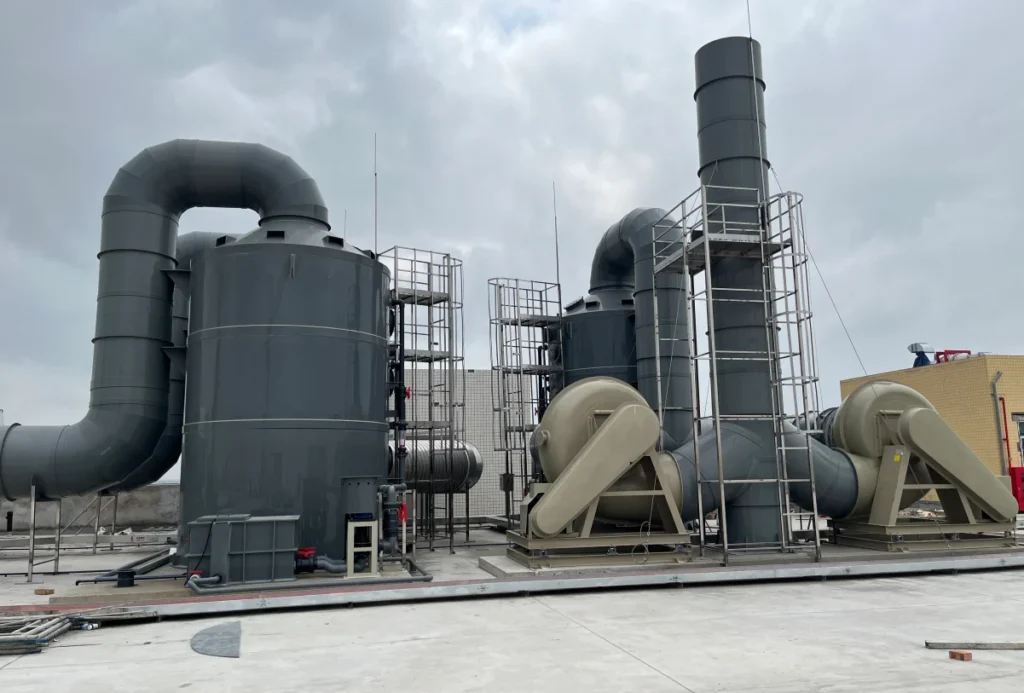
A biogas scrubber system cleans the raw gas from an anaerobic digester or a landfill before it can be used for heat, power, or pipeline injection. Raw biogas contains hydrogen sulfide that corrodes engine parts and a carbon dioxide fraction that lowers the heating value, and a scrubber system removes the contaminants in two distinct roles: the desulfurization scrubber that protects the CHP engine or upgrading plant, and the water-scrubbing unit that removes carbon dioxide to produce biomethane. The treatment choice depends on the gas end use, the hydrogen sulfide load, and the scale. This guide covers the biogas composition and treatment chain, the H2S removal technologies and their trade-offs, the methane gas scrubber water-scrubbing method, and the complete system from raw biogas to specification biomethane.
Key Takeaways
- A biogas scrubber system cleans raw biogas in two roles: the desulfurization scrubber that removes hydrogen sulfide to protect the CHP engine or upgrading plant, and, for a biomethane project, the carbon dioxide removal unit that raises the methane content to 96-98%.
- Raw biogas is roughly 50-70% methane, 30-50% carbon dioxide, 100-10,000 ppm hydrogen sulfide, water saturated, with trace siloxanes. The treatment chain removes water, H2S, siloxanes, then CO2 only when upgrading.
- Three desulfurization options trade capital, operating cost, and removal level: caustic scrubbing to below 10 ppm with reagent cost scaling with load, biological scrubbing to 50-100 ppm with the lowest operating cost on a steady load, and iron-oxide media to below 1 ppm suited to small-to-medium flow.
- The methane gas scrubber uses water scrubbing at 7-12 bar to absorb carbon dioxide while the methane passes through, producing 96-98% methane with a 96-99% methane recovery and no chemical reagent.
- The end use sets the scope: a CHP project needs cleaning only, while a biomethane project adds upgrading and pipeline conditioning. The system is sized as one chain to the same peak load, and the biomethane spec requires 96-98% methane, H2S below 4 ppm, and low moisture.
What Is a Biogas Scrubber System?
A biogas scrubber system is the set of gas treatment units that remove the contaminants from raw biogas so the cleaned gas meets the requirement of its end use. The system is not a single vessel; it is the desulfurization unit, the moisture removal, and, where the biogas is upgraded, the carbon dioxide removal unit working as one chain. The scope of the scrubber system is set by the end use of the gas.
Biogas Composition and the Treatment Chain
Raw biogas from anaerobic digestion or landfill gas contains roughly 50-70% methane, 30-50% carbon dioxide, hydrogen sulfide at 100-10,000 ppm depending on the feedstock, water vapor at saturation, and trace siloxanes and ammonia. The treatment chain removes the contaminants in order: the bulk water and solids first, the hydrogen sulfide next, the siloxanes for engine protection, and the carbon dioxide only when the gas is upgraded to biomethane. The EPA AgSTAR program documents the biogas recovery practice across the industry, and the gas scrubber guide covers the general scrubbing technology.
Biogas Cleaning vs Biogas Upgrading
The two terms describe different scopes. Biogas cleaning removes the trace contaminants, principally hydrogen sulfide and moisture, so the gas can be burned in a CHP engine or a boiler. Biogas upgrading goes further and removes the carbon dioxide, raising the methane content from roughly 55-65% to 96% or higher so the gas meets pipeline or vehicle-fuel quality and can be sold as biomethane. A biogas scrubber system for a CHP plant stops at cleaning; the system for a biomethane project adds the upgrading stage. The distinction sets the capital budget, which is why the end use is the first design input.
The Scrubber’s Role in Biogas
The scrubber in the biogas system removes the specific contaminants that damage equipment or violate a specification. The desulfurization scrubber removes hydrogen sulfide, which corrodes engine components and poisons the catalysts in an upgrading plant. The water scrubber in upgrading removes carbon dioxide by absorption. A facility that compresses the gas uses a suction scrubber to protect the compressor from liquid carryover, covered in the gas compressor scrubber guide. The same scrubber oil and gas equipment family applies here, and the scrubber oil and gas and fuel gas scrubber guides cover the related equipment.
The moisture and siloxane removal units sit between the desulfurization and the end use. The bulk water is removed by a knockout vessel or a chiller at the digester outlet, because the saturated biogas carries a heavy water load that would condense in the pipework and damage the engine or the compressor. The siloxanes, present at 0.1-30 mg/m3 in digester gas from certain feedstocks and higher in landfill gas, are removed by activated carbon or a refrigeration stage because they form silica deposits that damage the engine combustion chamber and the upgrading adsorbents. A biogas scrubber system that skips the siloxane stage to save capital trades a small equipment saving for a major engine-maintenance cost over the plant life, because the silica deposits shorten the combustion-chamber and oil life by a measurable margin.
H2S Removal in Biogas
Hydrogen sulfide is the contaminant that most often forces a scrubber into a biogas system, and the biogas desulfurization choice is the first technology decision in the treatment chain.
Why H2S Removal Is Required
Hydrogen sulfide is corrosive and toxic, and its impact depends on the gas end use. In a CHP engine, H2S corrodes the exhaust system, contaminates the lubricating oil, and shortens the engine life; most engine manufacturers specify a maximum H2S concentration of 200 ppm, and many operators target below 100 ppm. In an upgrading plant, H2S poisons the amine, the membrane, and the PSA adsorbents, and the biomethane specification requires the treated gas to be below roughly 4 ppm. The raw biogas H2S load is set by the feedstock sulfur content, so the scrubber is sized on the measured load, not a fixed figure. The general H2S scrubbing chemistry is covered in the H2S scrubber system guide; this section covers the biogas-specific application.
Chemical Scrubbers (Caustic)
A caustic scrubber contacts the biogas with a sodium hydroxide solution that absorbs the H2S and converts it to a sulfide in the liquid phase. The caustic scrubber removes H2S to below 10 ppm reliably and handles a varying H2S load well, which makes it a common choice for CHP and upgrading projects. The operating cost is the caustic consumption, which scales directly with the H2S load, plus the disposal of the sulfide-laden blowdown. The chemical scrubber is a wet system, and the liquid waste must be managed; a facility with a high H2S load and a high water disposal cost evaluates the biological and iron-oxide options before committing to caustic.
Biological Scrubbers
A biological scrubber uses a bacterial bed or a biotrickling filter to oxidize the H2S to elemental sulfur or sulfate. The bacteria consume the H2S, so the reagent cost is low and the waste is primarily the sulfur and the blowdown. A biological scrubber typically removes H2S down to 50-100 ppm and requires a small air injection and careful nutrient and pH control to keep the bacteria active. The biological option has the lowest operating cost of the three for a steady H2S load, and it suits a large, continuous biogas flow where the load is consistent. The downside is the biological sensitivity to load spikes and the longer response to a process change.
Iron-Oxide Scrubbers
An iron-oxide scrubber passes the biogas through a bed of iron-oxide media that reacts with the H2S to form iron sulfide, removing it to below 1 ppm. The media is a consumable, replaced when the bed is saturated, and the spent media is either regenerated or disposed as a solid waste. The iron-oxide scrubber is simple, reliable, and well suited to a small or medium biogas flow with a modest H2S load, and it produces no liquid waste. The operating cost is the media replacement, which is why the iron-oxide option suits a low-to-moderate H2S load and loses its advantage at a high continuous load where the media consumption becomes the dominant cost.
The H2S load measurement is the input that sets the desulfurization size. The load is the product of the gas flow and the H2S concentration, expressed in kilograms of sulfur per hour. A 1,000 m3/h biogas stream at 500 ppm H2S carries roughly 0.7 kg of sulfur per hour, and the scrubber, the reagent, and the media consumption are sized against that number. The desulfurization stage of a biogas scrubber system is specified for the peak load the feedstock can produce, and the operating cost scales with the average load the plant sees. A feedstock change that raises the H2S concentration by an order of magnitude also raises the reagent or media cost by the same factor, so the feedstock plan is a design input as much as the gas analysis is.
Comparing Biogas Desulfurization Technologies
The three desulfurization options differ in capital cost, operating cost, removal level, and waste, and the biogas scrubber system selection is driven by the H2S load and the gas end use.
Cost and Operating Trade-offs
The chemical caustic scrubber has the lowest capital cost and the highest reagent cost, making it the right choice for a moderate load where the caustic consumption and the liquid disposal are manageable. The biological scrubber has a higher capital cost and the lowest operating cost, making it the long-term winner on a large, steady load. The iron-oxide scrubber has a moderate capital cost and a media cost that scales with the load, suiting a small-to-medium flow with a low-to-moderate H2S concentration. The removal level also differs: the caustic and iron-oxide scrubbers reach the low single-digit ppm required for upgrading, while the biological scrubber reaches 50-100 ppm, adequate for CHP but not for a biomethane spec without a polishing stage.
Selecting by H2S Load and Scale
The decision table starts with two numbers: the average H2S concentration and the gas flow. A small digester at 500 m3/h with 500 ppm H2S going to a CHP engine is well served by an iron-oxide scrubber, which removes the H2S to below the engine limit with simple operation and no liquid waste. A large AD plant at 2,000 m3/h with a steady 1,000 ppm load going to upgrading needs a caustic or biological scrubber sized to reach the low ppm, and the biological option wins on operating cost if the load is consistent. A plant with a highly variable H2S load, such as one fed with varying food waste, needs the responsive caustic scrubber over the slower biological unit.
The wet and dry technology families apply here as they do to any acid gas stream, and the dry scrubber vs wet scrubber guide covers the general comparison. The selected desulfurization technology becomes one unit in the full biogas scrubber system, sized to the same peak load as the rest of the chain.
The desulfurization technology is also sized against the outlet requirement of the downstream unit. A CHP engine at a 200 ppm H2S limit has different needs than a biomethane plant at 4 ppm. Where the selected technology cannot reach the outlet spec alone, a polishing stage is added: a biological scrubber followed by a small iron-oxide bed reaches the low ppm for upgrading at a lower operating cost than a caustic scrubber alone, because the biological unit removes the bulk of the load and the iron-oxide bed polishes the remainder. The system design defines the removal split between the stages, and the biogas scrubber system is specified so each stage operates within its efficient range instead of forcing one technology to do the whole job at a high cost.
The Methane Gas Scrubber and CO2 Removal
When the biogas is upgraded to biomethane, the biogas scrubber system adds the carbon dioxide removal stage, and the water scrubbing method is the technology that gives the methane gas scrubber its name.
Biogas Upgrading Overview
Biogas upgrading separates the carbon dioxide from the methane so the product gas meets pipeline or vehicle-fuel quality. Raw biogas at 55-65% methane is upgraded to 96-98% methane by removing the carbon dioxide and the residual trace contaminants. The upgrading plant sits downstream of the desulfurization and moisture removal units, and it takes the cleaned gas to the sales specification. The capital cost of upgrading is the largest single item in a biomethane project, and the technology choice sets both the capital and the operating cost over the plant life. The DOE Bioenergy program documents the upgrading technologies and their performance.
Water Scrubbing for CO2 Removal
Water scrubbing removes carbon dioxide by absorbing it into water under pressure. The biogas is compressed to 7-12 bar and contacted with water in a packed column, where the carbon dioxide dissolves into the water while the methane, being far less soluble, passes through. The product gas leaves at 96-98% methane. The carbon-dioxide-laden water is regenerated by pressure release and air stripping in a second column, and the water is recycled, so the water consumption is limited to the make-up. Water scrubbing is the most established upgrading technology, with a simple operation, no chemical reagent, and a methane recovery of 96-99%. The energy cost is the compression and the water circulation, and the water must be dried after upgrading to meet the pipeline moisture spec.
Other Upgrading Technologies
The other upgrading options compete with water scrubbing on the same duty. Pressure swing adsorption (PSA) uses a carbon molecular sieve to separate carbon dioxide, reaching 96-98% methane with a lower methane recovery of roughly 96-98% and a more complex operation. Membrane separation uses selective membranes, compact and simple but with a methane loss and a need for multi-stage operation. Amine scrubbing uses a regenerable chemical solvent, reaching the highest methane purity but with a chemical and energy cost. The methane gas scrubber water-scrubbing method is the benchmark for simplicity and methane recovery; the alternative technologies are selected when the site constraints, the carbon dioxide purity requirement, or the energy cost favor them.
The water scrubbing column is designed like any packed absorption column, with the gas rising through a packed bed while the water falls and the carbon dioxide transferring to the water phase. The column is sized for the gas flow at the operating pressure, and the packing provides the contact surface for the mass transfer. The water rate is set by the carbon dioxide load and the target methane purity, and the regeneration column strips the dissolved carbon dioxide with air before the water returns to the absorption column. The water scrubbing stage of the biogas scrubber system consumes water and energy but no chemical reagent, and the operating cost is dominated by the gas compression and the water circulation pumps, which is why the energy efficiency of the compressor and the pumps is a design consideration.
The biomethane product has three main end uses. Grid injection sells the upgraded gas into the natural gas distribution network at the pipeline quality spec, displacing fossil natural gas and earning the renewable-gas credit. Vehicle fuel compresses the biomethane for use in natural gas vehicles, meeting the vehicle-fuel standard. Direct use supplies the upgraded gas to an industrial heat customer or a large boiler. The end use sets the final conditioning requirements, because grid injection and vehicle fuel each have a specific quality spec that the upgrading and drying stages must meet, and the biogas scrubber system is sized for the end use that earns the revenue.
The Complete Biogas Scrubber System
The full biogas scrubber system is the treatment chain that takes raw biogas from the digester to the end-use specification, and each unit in the chain protects the next.
The Treatment Chain
The chain runs in a fixed order. The raw biogas first passes a knockout vessel or moisture separator that removes the bulk water and condensate. The desulfurization scrubber then removes the hydrogen sulfide to the end-use limit. Where the gas contains siloxanes, an activated carbon or refrigeration unit removes them before the gas reaches the engine, because siloxanes form silica deposits that damage combustion chambers at concentrations of a few ppm. The cleaned gas then goes either directly to the CHP engine or, for a biomethane project, to the upgrading unit that removes the carbon dioxide and a final drying stage that meets the pipeline moisture spec. A compressor in the chain is protected by a suction scrubber, covered in the gas compressor scrubber guide, and the fuel gas handling is covered in the fuel gas scrubber guide.
Biomethane Quality Specification
The biomethane quality specification is set by the grid operator or the vehicle-fuel standard and typically requires 96-98% methane, a hydrogen sulfide content below 4 ppm, a low moisture content, and a Wobbe index within the pipeline range. The specification is the contract that the upgrading plant must meet, and the biogas scrubber system is sized so every unit in the chain contributes to the final gas meeting that contract. The American Biogas Council provides the industry reference for the biomethane quality and the injection requirements.
Conditioning and Compression
The final conditioning adds the compression, the odorization, and the metering that connect the upgraded gas to the grid or the vehicle-fuel dispenser. The compression raises the gas to the pipeline pressure, the drying and filtration bring it to the moisture and particulate spec, and the metering measures the injected volume for the sale. The conditioning section is the interface between the biogas plant and the gas grid, and it is specified against the grid operator’s requirements. The complete biogas scrubber system is the sum of these units, and the design is driven by the end-use specification, the gas flow, and the H2S and CO2 load measured at the digester.
The economics of the biogas scrubber system are set by the end-use revenue and the operating cost. A CHP project earns the electricity and heat value of the methane, and the cleaning system protects that revenue by keeping the engine online and out of the maintenance shop. A biomethane project earns the higher gas price and the renewable-gas credits, and the upgrading cost is justified by the revenue premium over the raw biogas value. The operating cost of the full system, including the caustic or media, the power, the water, and the maintenance, is the recurring number the project economics must absorb, and the technology selection sets that number over the plant life. A system selected on the lowest capital cost can carry a reagent or media cost that exceeds the capital saving within the first two years of operation.
Selecting a Biogas Scrubber System
The biogas scrubber system selection starts with the end use and the measured gas composition, and the system is sized so every unit meets the same peak load.
Duty Assessment
Define the end use first, because it sets the treatment scope. A CHP project needs desulfurization and moisture removal only; a biomethane project needs the upgrading stage and the pipeline conditioning as well. Then measure the biogas composition: the flow rate, the methane and carbon dioxide fractions, the hydrogen sulfide concentration and its variability, the moisture content, and the siloxane level. Measure the H2S load over a full operating cycle, because food-waste digesters and landfill gas can swing the concentration by an order of magnitude, and the scrubber must be sized for the peak that the end use can tolerate. The gas analysis is the foundation of the whole design, and a system specified without it protects the supplier instead of the plant.
System Sizing and Integration
Size the system as one chain, not as independent units. The desulfurization scrubber is sized for the peak H2S load, the upgrading unit for the peak CO2 load, and the moisture and siloxane removal for the full gas flow. Each unit’s outlet condition is the next unit’s inlet, so the specification must be consistent from one stage to the next. The integration includes the compressor and its suction scrubber, the instrument air, the control system, and the waste handling for the sulfide-laden liquid or the spent media. A plant that sizes the units to different loads ends up with a bottle-neck that limits the whole system. The capital and operating cost of the biogas scrubber system is a large fraction of the biogas project, and the technology selection is the decision that sets the long-term economics.
The biogas scrubber system cost scales with the flow and the treatment scope. A desulfurization-only system for a 500 m3/h CHP digester runs $30,000-100,000 depending on the technology and the H2S load. A full upgrading system with water scrubbing for a 2,000 m3/h plant runs $500,000-1,500,000 including the compressor, the scrubbing columns, the drying, and the conditioning. The operating cost is dominated by the reagent or media, the power, and the water, and the system is specified against a ten-year operating-cost projection, not the first-year capital. The comparison between a low-capital and a low-operating-cost technology is a lifecycle decision, and the biogas scrubber system that minimizes the ten-year total is the low-cost option.
For a specific biogas composition and end use, browse the gas scrubber product range or the wet scrubber system, and contact our engineering team with the gas analysis for a scrubber system matched to the duty.
FAQ
What is a biogas scrubber system?
A biogas scrubber system is the set of gas treatment units that remove contaminants from raw biogas so the cleaned gas meets its end-use requirement. It includes the desulfurization scrubber for hydrogen sulfide removal and, for a biomethane project, the carbon dioxide removal unit and the final conditioning.
How do you remove H2S from biogas?
The three main methods are chemical caustic scrubbing, biological scrubbing, and iron-oxide media beds. A caustic scrubber removes H2S to below 10 ppm with a reagent cost that scales with the load. A biological scrubber removes it to 50-100 ppm with the lowest operating cost on a steady load. An iron-oxide bed removes it to below 1 ppm with a media replacement cost suited to a small-to-medium flow.
What is a methane gas scrubber?
A methane gas scrubber is the water-scrubbing unit that removes carbon dioxide from biogas during upgrading. The biogas is compressed and contacted with water, which absorbs the carbon dioxide while the methane passes through, raising the methane content to 96-98% for pipeline or vehicle-fuel quality.
What is the difference between biogas cleaning and biogas upgrading?
Biogas cleaning removes the trace contaminants, principally hydrogen sulfide and moisture, so the gas can be burned in a CHP engine or boiler. Biogas upgrading goes further and removes the carbon dioxide, raising the methane content to 96% or higher so the gas meets pipeline or vehicle-fuel quality as biomethane.
How much H2S can a CHP engine tolerate?
Most engine manufacturers specify a maximum H2S concentration of 200 ppm, and many operators target below 100 ppm to extend the oil and engine life. The desulfurization scrubber is sized to the measured peak H2S load to keep the engine inlet below the limit.
What is the typical biogas composition?
Raw biogas from anaerobic digestion is roughly 50-70% methane, 30-50% carbon dioxide, 100-10,000 ppm hydrogen sulfide depending on the feedstock, water vapor at saturation, and trace siloxanes and ammonia. The composition drives the treatment chain and the scrubber sizing.
Does a biogas scrubber system remove siloxanes?
Siloxanes are removed separately from the hydrogen sulfide and carbon dioxide, typically by an activated carbon or refrigeration unit, because they form silica deposits that damage combustion chambers. The siloxane removal unit sits in the treatment chain ahead of the engine or upgrading plant.
How much does a biogas scrubber system cost?
A desulfurization-only system for a 500 m3/h CHP digester runs $30,000-100,000 depending on the technology and the H2S load. A full upgrading system with water scrubbing for a 2,000 m3/h plant runs $500,000-1,500,000 including the compressor, the scrubbing columns, the drying, and the conditioning. The operating cost is dominated by the reagent or media, the power, and the water.