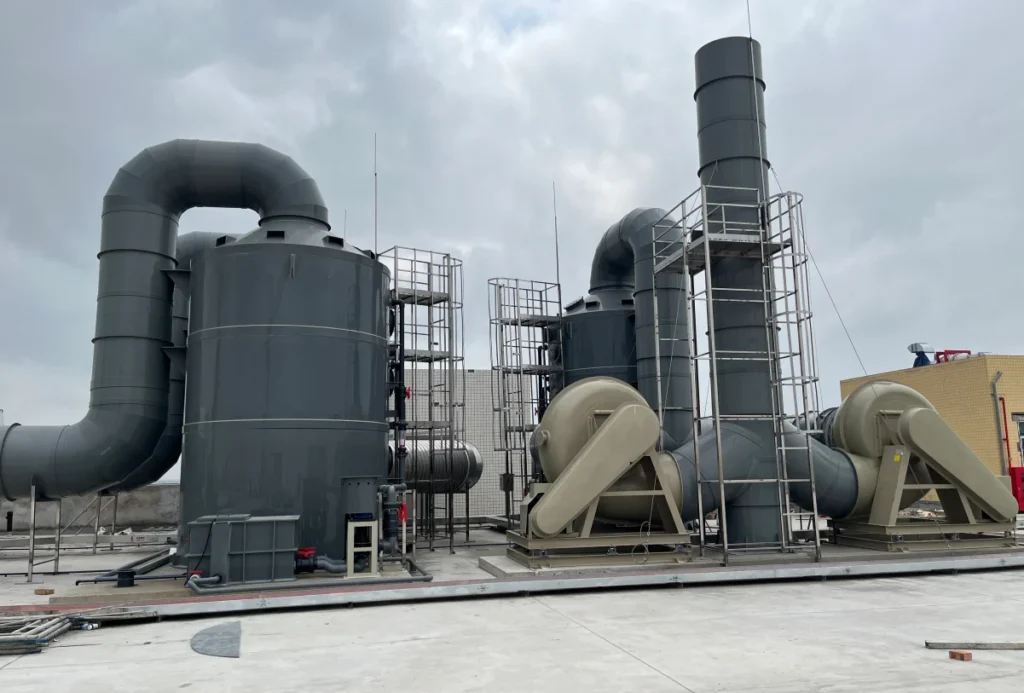
An open loop scrubber system is a wet scrubber that uses a single pass of water to remove pollutants and discharges the washwater after one use, and it is the simplest form of scrubbing in both marine and industrial service. In marine service, the open loop seawater scrubber is an IMO-compliant exhaust gas cleaning system that uses the natural alkalinity of seawater to remove sulfur oxides from ship engine exhaust. In industrial service, the open loop system draws once-through water, scrubs the gas, and discharges the spent water to the sewer or outfall. The alternative, a closed loop scrubber system, recirculates the washwater with chemical treatment and produces a small bleed stream instead. This guide covers both the open and closed loop configurations, the trade-offs in water, waste, and cost, and how to select the right loop for a ship or a plant.
Key Takeaways
- An open loop scrubber system passes water through the scrubber once and discharges it, using the water’s own chemistry and no reagent. In marine service it uses seawater alkalinity to remove SOx; in industrial service it uses once-through water.
- A closed loop scrubber system recirculates the washwater with a chemical reagent and bleeds a small controlled stream, trading a higher reagent and treatment cost for a low water consumption and a manageable discharge.
- The IMO 2020 sulfur rule sets the global fuel sulfur limit at 0.50% and the ECA limit at 0.10%; a ship meets it by burning low-sulfur fuel or operating an approved exhaust gas cleaning system. A growing number of ports restrict or ban open loop discharge, which forces the closed loop or hybrid in those waters.
- The hybrid scrubber captures both modes: it runs as an open loop at sea for the low operating cost and switches to a closed loop in port for compliance. It carries the highest capital cost and the most flexibility.
- The loop selection follows the operating profile: open loop where water and discharge are free, closed loop where water is scarce or discharge restricted, and hybrid for a vessel with a mixed route. The decision balances water consumption, wastewater discharge, and operating cost.
What Is an Open Loop Scrubber System?
An open loop scrubber system draws water from a source, passes it through the scrubber once to remove the pollutants from the gas, and discharges the spent water after the single pass. There is no recirculation loop and no chemical reagent; the water’s own chemistry does the scrubbing. The system is simple and cheap to operate, and its cost is the water it consumes and the discharge it produces.
The Open Loop Scrubber Systems in Marine Service
The marine open loop scrubber systems use seawater as the washwater, drawing it from the sea, pumping it through the scrubber, and discharging it overboard. Seawater has a natural alkalinity from its dissolved carbonate and bicarbonate that neutralizes the sulfur oxides absorbed from the engine exhaust, so no caustic reagent is added. The seawater flow is large, typically several hundred cubic meters per hour for a medium engine, because the alkalinity per liter is modest and the sulfur load is high. The open loop system is the most common configuration on ocean-going vessels that installed scrubbers for the IMO sulfur rule, because the seawater is free and the operating cost is limited to the pump energy.
The Marine Scrubber EGCS and IMO 2020
The marine scrubber is the exhaust gas cleaning system (EGCS) that lets a ship burn high-sulfur fuel oil while meeting the IMO sulfur cap. Under IMO 2020, the global sulfur limit in marine fuel is 0.50% and the limit in designated emission control areas is 0.10%. A ship can meet the limit either by burning low-sulfur fuel or by operating an approved EGCS that removes the sulfur to an equivalent level. The open loop seawater scrubber is one of the three EGCS configurations, alongside the closed loop and the hybrid, and it is the cheapest to operate because it uses seawater instead of a chemical reagent. The IMO exhaust gas cleaning systems guidance defines the approval and the monitoring requirements.
How the Open Loop Seawater Scrubber Works
The open loop seawater scrubber works by gas-liquid contact in a packed or spray column. The engine exhaust enters the scrubber, where the seawater is sprayed into the gas stream and absorbs the sulfur dioxide. The dissolved sulfur dioxide reacts with the seawater alkalinity to form sulfate, which stays dissolved in the washwater. The cleaned gas exits through the stack, and the washwater, now with the absorbed sulfur, is discharged overboard after treatment to meet the discharge criteria. The seawater alkalinity is the working chemistry, and the scrubber is sized so the alkalinity of the available seawater is enough to neutralize the sulfur load at the engine’s maximum sulfur fuel. The fuel gas handling on the ship is covered in the fuel gas scrubber guide, and the general scrubbing technology in the gas scrubber guide.
The seawater quality sets the open loop scrubber performance. The seawater alkalinity varies with the location, and the scrubber is sized for the lowest alkalinity on the vessel’s route, because the neutralization capacity must hold at the worst-case water. The scrubber operating cost also includes the seawater pump energy, which is proportional to the flow, and the discharge monitoring. The alkalinity and the discharge criteria are documented in the EGCS approval, and the vessel’s operating manual sets the seawater temperature and quality limits that the scrubber can tolerate. The open loop scrubber system is simple, but the seawater dependence is the reason it is not the universal choice for every ship and every route.
Closed Loop Scrubber Systems
A closed loop scrubber system recirculates the same washwater through the scrubber, treating it with a chemical reagent to keep it reactive and bleeding only a small stream to control the dissolved solids. The closed loop trades a low water consumption and a controlled discharge for the cost of the reagent and the treatment.
The Closed Loop Scrubber System Design
The closed loop scrubber system draws a small amount of makeup water, scrubs the gas, returns the washwater to a tank, adds reagent to restore the chemistry, and bleeds a small stream to remove the accumulated pollutant. The circulation pump moves the water through the loop continuously, and the reagent feed holds the pH in the working range. The closed loop removes the same pollutants as the open loop but concentrates them in the bleed stream, so the discharge is small, controlled, and treatable. The closed loop is the choice where the water supply is limited, the discharge is restricted, or the makeup water lacks the alkalinity that the open loop depends on.
Industrial Closed Loop Recirculation
In industrial wet scrubber service, the closed loop is the standard configuration for acid gas and particulate removal. The washwater is recirculated with a caustic or reagent feed, and a blowdown stream controls the dissolved solids. The industrial closed loop uses a fraction of the water of an open loop system and produces a small, concentrated wastewater stream that is treated on site. The recirculation loop is the same design covered across the industrial scrubber system, and the blowdown and reagent chemistry are detailed in the biogas scrubber system and H2S scrubber system guides, which cover the closed loop recirculation in their respective services.
Marine Closed Loop with Caustic
The marine closed loop scrubber uses freshwater recirculated with caustic soda as the reagent, and it is selected where the open loop seawater discharge is restricted. The closed loop marine scrubber consumes a small amount of freshwater makeup and a caustic dose proportional to the sulfur load, and it discharges a small bleed stream that is treated and monitored. The operating cost is the caustic and the treatment, which is higher than the open loop’s pump-only cost, but the closed loop can operate where open loop discharge is banned, such as in ports and waters with strict washwater limits. The closed loop is the compliant answer for ships that trade into restricted waters, and it is the configuration selected when the vessel’s operating area forces the choice.
The closed loop reagent and bleed rate are sized against the pollutant load. The reagent dose is proportional to the sulfur or acid absorbed, and the bleed rate is set by the dissolved solids limit that the washwater can carry. A marine closed loop scrubber burning high-sulfur fuel in a restricted area bleeds at a higher rate than one burning low-sulfur fuel, and the caustic consumption scales with the engine load and the fuel sulfur. The closed loop operating cost is therefore set by the fuel and the load profile, and the bleed stream is held on board and disposed onshore where the port rules require it. The reagent and the bleed are the two operating inputs that the closed loop operator manages day to day.
Open Loop vs Closed Loop vs Hybrid
The open loop scrubber system, the closed loop, and the hybrid cover the full range of washwater configurations, and the choice is driven by the operating area, the water supply, and the discharge limits.
The Close Loop Scrubber System Variant
The close loop scrubber system is the same recirculating design as the closed loop, and the spelling variants refer to the identical equipment. The washwater is recirculated, treated with reagent, and bled in a small stream. The term appears in both the marine and the industrial literature, and the design and the trade-offs are the same whether it is written closed or close. A buyer evaluating a close loop scrubber system quote should confirm the reagent feed, the bleed rate, and the treatment scope, because these define both the compliance and the operating cost.
The Hybrid Scrubber System
A hybrid scrubber system can operate in either mode, switching between the open loop and the closed loop as the operating area and the discharge rules change. In open ocean waters, the hybrid runs as an open loop seawater scrubber, using free seawater with no reagent. When the ship enters a port or a restricted area where open loop discharge is banned, the hybrid switches to the closed loop mode, recirculating with caustic and holding the washwater for onshore disposal. The hybrid captures the low operating cost of the open loop at sea and the compliance of the closed loop in port, and it is the most flexible of the three configurations. The added complexity is the caustic system, the storage tank, and the control logic, and the capital cost is the highest of the three.
Selecting the Loop Configuration
The selection follows the operating profile. A ship or a plant with unrestricted discharge and an available alkaline water source chooses the open loop for the lowest operating cost. A facility in a discharge-restricted area, or with a limited water supply, chooses the closed loop. A ship that trades across both open-ocean and restricted waters chooses the hybrid to keep the operating cost low at sea and the compliance in port. The industrial selection follows the same logic: an open loop system suits a site with abundant clean water and a permitted outfall, and a closed loop suits a site where water is costly or the discharge is limited. The wet technology families apply across both, and the dry scrubber vs wet scrubber guide covers the related choice.
The loop selection is documented in the vessel or plant operating analysis. The operator reviews the route or the operating area, the water and discharge situation, the pollutant load, and the projected operating cost of each configuration, and records the analysis as the basis for the selection. The analysis is revisited when the route or the discharge rules change, because a configuration that suited an open-ocean route may be non-compliant when a port on the route restricts discharge. The open loop scrubber system is the base case in the analysis, and the closed loop and the hybrid are evaluated against it on the water, waste, and cost trade-offs.
The Trade-offs: Water, Waste, and Cost
The open loop scrubber system and the closed loop differ in three measurable ways: the water consumed, the waste produced, and the operating cost. The correct choice balances the three against the operating area and the discharge permit.
Water Consumption
The open loop consumes water at the full washwater rate, because every liter passes through once and is discharged. A marine open loop scrubber on a medium engine draws several hundred cubic meters of seawater per hour, which is free at sea but represents a large intake and discharge flow. An industrial open loop scrubber draws the same once-through flow from the water supply, which carries a water cost and a supply limit. The closed loop consumes only the makeup and the bleed, typically a small fraction of the open loop flow, which makes it the choice where water is costly, scarce, or subject to a supply constraint. The water consumption is the first number to compare, because it sets the intake, the pump size, and the discharge.
Wastewater and Discharge Limits
The open loop discharges the full washwater flow with the absorbed pollutant, and the discharge must meet the applicable water quality limit. In marine service, the IMO sets washwater discharge criteria for pH, polycyclic aromatic hydrocarbons, turbidity, and nitrates, and a growing number of ports restrict or ban open loop discharge. In industrial service, the open loop discharge must meet the sewer or outfall permit, which can require treatment for the pH and the dissolved metals. The closed loop concentrates the pollutant in a small bleed stream that is treated and disposed, which makes the discharge manageable where the full-flow discharge is not permitted. The EPA control technology fact sheets document the wastewater considerations for the industrial wet scrubber systems.
Operating Cost Comparison
The open loop operating cost is dominated by the pump energy that moves the once-through water, with no reagent. The closed loop operating cost is dominated by the reagent and the treatment, with a small pump load. A marine open loop scrubber pays for the seawater pump only, while a closed loop marine scrubber pays for the caustic proportional to the sulfur burned. The hybrid pays the open loop cost at sea and the closed loop cost in port. The comparison between the configurations is the same structure as the wet and dry comparison in the dry scrubber vs wet scrubber guide: the lowest-cost configuration depends on the operating hours in each mode, the water cost, and the discharge compliance cost, and the open loop scrubber system is the low-operating-cost option only where the water and the discharge are free.
The water chemistry also differs between the loops. The open loop relies on the alkalinity of the source water, whether seawater or supply water, and its performance varies with that chemistry. The closed loop controls the washwater chemistry with the reagent feed, so its performance is consistent regardless of the source water. A plant with variable supply water quality finds the closed loop more predictable, and a ship in a region of variable seawater alkalinity finds the open loop performance varying along the route. The chemistry control is an additional point in favor of the closed loop where the pollutant load or the water quality is not stable.
Compliance and Regulatory Context
The open loop scrubber system in marine service is an approved exhaust gas cleaning system, and its compliance is defined by the IMO sulfur rule and the washwater discharge criteria.
IMO 2020 SOx Limits
The IMO sulfur rule set the global marine fuel sulfur limit at 0.50% from January 2020 and the limit in emission control areas at 0.10%. A ship meets the limit either by burning fuel within the sulfur cap or by operating an approved scrubber that achieves the equivalent sulfur reduction. The scrubber is approved on the basis of its removal efficiency, and the ship documents the compliance through the fuel log, the sulfur content declaration, and the scrubber operating records. The IMO SOx Regulation 14 is the governing rule, and the exhaust gas cleaning systems guidance defines the approval path.
Port Discharge Restrictions
The washwater discharge is the compliance constraint that decides the loop configuration. The IMO sets washwater discharge criteria for the open loop seawater discharge, including a pH above 6.5 at four meters from the discharge point and limits on polycyclic aromatic hydrocarbons, turbidity, and nitrates. A growing number of ports and regions, including parts of the Baltic, the North Sea, China, and some US states, restrict or ban open loop discharge, which forces ships trading there to use the closed loop or the hybrid in closed mode. The port restrictions are the reason the open loop scrubber system is not universally the simplest choice, and the operating-area analysis is part of the scrubber selection.
EGCS Approval and Monitoring
An approved EGCS is tested and documented against the IMO guidelines, and the ship carries the approval certificate and the washwater monitoring records. The scrubber is fitted with continuous monitoring of the discharge pH, turbidity, and temperature, and the recorded data demonstrates the washwater compliance during the voyage. The engine exhaust and the scrubber operation are logged to show the sulfur removal is maintained. The approval and monitoring burden is higher for the open loop, because the full washwater flow is discharged and monitored, and lower for the closed loop, which holds and treats a small stream. The compressor and gas handling that support the EGCS operation are covered in the gas compressor scrubber guide.
The industrial compliance context parallels the marine rules. A plant that discharges scrubber washwater to a sewer or an outfall must meet the water quality permit, which sets the pH, the metals, and the pollutant limits. The open loop industrial discharge is a full-flow stream that must meet the permit directly, which can require pH adjustment or treatment. The closed loop industrial discharge is a small bleed that is treated and disposed, which makes the compliance manageable where the full-flow discharge would not pass the permit. The permit analysis, like the port analysis in marine service, is the input that decides whether the open loop or the closed loop is the compliant choice for the site, and it is reviewed when the permit terms change.
Selecting a Scrubber System
The open loop scrubber system selection is made against the operating profile and the discharge rules, and the marine and industrial assessments follow the same logic with different inputs.
Marine Duty Assessment
The marine assessment starts with the vessel’s trading area. A ship that operates mainly in open ocean, with ports that permit open loop discharge, can use the open loop seawater scrubber for the lowest operating cost. A ship that trades into ports with open loop discharge restrictions needs the closed loop or the hybrid in closed mode for those calls. The assessment also covers the engine power, the fuel sulfur content the ship intends to burn, and the washwater discharge criteria of the ports on the route. The scrubber is sized for the maximum engine load and the maximum sulfur fuel, and the operating cost is projected across the expected fuel consumption and the mode splits. The hybrid is the low-risk choice for a vessel with a mixed route, because it captures both operating modes.
Industrial Duty Assessment
The industrial assessment starts with the water supply and the discharge permit. A plant with abundant clean water and a permitted outfall can use an open loop scrubber system for the simple once-through design, provided the discharge meets the water quality limit. A plant with a costly water supply or a restrictive discharge permit uses the closed loop with recirculation and a treated blowdown. The industrial assessment also covers the pollutant load, which sets the reagent demand in the closed loop and the discharge chemistry in the open loop, and the site water cost, which sets the open loop penalty. A plant that evaluates the water cost against the closed loop reagent and treatment cost selects the configuration that minimizes the total operating cost over the equipment life.
The capital cost of the configurations follows the operating flexibility. The open loop scrubber system has the lowest capital cost because it omits the reagent system and the treatment equipment. The closed loop adds the reagent feed, the storage tank, and the treatment. The hybrid adds the switching valves, the extra storage, and the control logic, and it carries the highest capital cost of the three. The capital premium for the hybrid is justified only if the operating area genuinely requires both modes, because a vessel or a plant that never operates in a restricted area pays for the closed loop capability it never uses. The capital and operating comparison is the final input in the selection, and it is balanced against the compliance risk of each configuration on the actual route or operating area.
For a specific marine or industrial duty, browse the gas scrubber product range or the wet scrubber system, and contact our engineering team with the gas flow, the pollutant load, and the water and discharge data for a scrubber system matched to the duty.
FAQ
What is an open loop scrubber system?
An open loop scrubber system is a wet scrubber that draws water, passes it through the scrubber once to remove pollutants, and discharges the washwater after a single use. In marine service it uses seawater, and in industrial service it uses once-through process or supply water. There is no recirculation and no chemical reagent.
What is scrubber system in ships?
A scrubber system in ships is an exhaust gas cleaning system (EGCS) that removes sulfur oxides from the engine exhaust so the ship can burn high-sulfur fuel while meeting the IMO sulfur limit. It operates in three configurations: the open loop using seawater, the closed loop using recirculated freshwater with caustic, and the hybrid that switches between the two.
What is the difference between an open loop and a closed loop scrubber?
An open loop scrubber passes water through once and discharges it, using the water’s own chemistry and consuming no reagent. A closed loop scrubber recirculates the washwater with a chemical reagent and bleeds only a small stream. The open loop has a lower operating cost where water and discharge are free; the closed loop is the choice where water is scarce or the discharge is restricted.
What is a close loop scrubber system?
A close loop scrubber system is the same recirculating design as the closed loop, and the spelling variant refers to identical equipment. The washwater is recirculated, treated with reagent, and bled in a small controlled stream. A buyer evaluating a close loop quote should confirm the reagent feed, the bleed rate, and the treatment scope.
Are open loop scrubbers banned?
Open loop scrubber discharge is not banned globally, but a growing number of ports and regions restrict or ban it, including parts of the Baltic, the North Sea, China, and some US states. Ships trading into these waters use a closed loop or a hybrid in closed mode for those calls.
How does an open loop seawater scrubber remove SOx?
The seawater is sprayed into the engine exhaust in a packed or spray column, and its natural alkalinity neutralizes the sulfur dioxide, converting it to sulfate that stays dissolved in the washwater. The cleaned gas exits the stack, and the washwater is discharged after meeting the pH and water quality criteria.
How much does an open loop scrubber system cost to operate?
The open loop operating cost is dominated by the pump energy that moves the once-through water, with no reagent. A marine open loop scrubber pays for the seawater pump only, while a closed loop marine scrubber pays for caustic proportional to the sulfur burned. The open loop is the low-cost option where the water and the discharge are free.