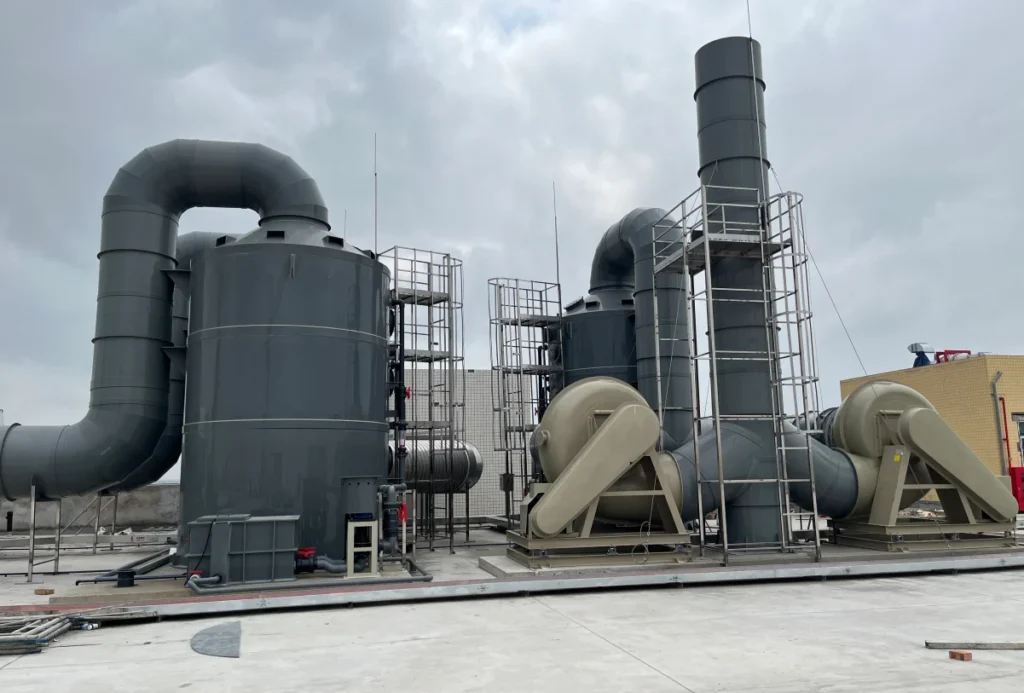
A plant manager watching acid gas emissions approach the permit limit has two choices: install more mass-transfer surface area, or make the scrubbing liquid chemically aggressive toward the pollutant. A caustic spray tower takes the second approach. It is a standard spray tower scrubber that uses a sodium hydroxide (NaOH) solution instead of plain water as the scrubbing medium. The caustic solution neutralizes acid gases by chemical reaction rather than relying on physical solubility alone. This guide covers what a caustic spray tower is, how the acid-base chemistry works, where caustic scrubbers outperform plain water alternatives, and the design and operating parameters that determine whether a caustic spray tower is the right choice for your acid gas exhaust stream.
Key Takeaways
- A caustic spray tower achieves 99%+ removal of strong acid gases (HCl, HF) by using sodium hydroxide to chemically neutralize the pollutant rather than relying on physical water solubility. The same hardware can remove SO2 at 95-98% efficiency and H2S at 90-98% efficiency with hypochlorite addition. The chemical reaction removes the solubility barrier that limits water-only scrubber performance.
- Caustic consumption is calculated from reaction stoichiometry, not Henry’s law. For HCl, 1 mole of NaOH neutralizes 1 mole of HCl. For SO2, 2 moles of NaOH per mole of SO2 at pH above 7. For Cl2, 2 moles of NaOH per mole of Cl2. The annual chemical cost for a 50,000 m3/h system treating 500 ppmv SO2 is approximately $25,000-35,000 at current caustic prices.
- The pH control loop is the most critical component of a caustic spray tower. A drift of 0.5 pH units from the setpoint can reduce removal efficiency by 10-20%. Redundant pH sensors, weekly calibration, and automated caustic feed with a 1.5-2.0x stoichiometric margin are standard design practice.
- Salt precipitation from reaction products is the primary maintenance risk. Total dissolved solids in the recirculating liquid must be kept below 80,000-100,000 ppm through controlled blowdown. Nozzle inspection every 2-3 months and periodic cleaning with dilute acid prevents performance degradation from salt crystallization. For tailored designs, explore custom-engineered spray tower configurations →.
What Is a Caustic Spray Tower?
A caustic spray tower is a spray tower scrubber that circulates a sodium hydroxide (NaOH) solution as the scrubbing liquid instead of water. For a complete overview of spray tower fundamentals, see our spray tower scrubber guide →. The caustic solution chemically neutralizes acid gases on contact, converting them to neutral salt solutions that are discharged in the blowdown stream. This chemical reaction allows the tower to achieve removal efficiencies far beyond what physical absorption in water alone could deliver.
How Caustic Spray Towers Differ from Standard Spray Towers
The hardware is nearly identical to a standard water-only spray tower: an empty cylindrical vessel with spray nozzles, a mist eliminator, and a recirculation pump. The difference is in the liquid chemistry and the control systems that manage it.
A standard water spray tower relies on the pollutant dissolving into the water droplets according to Henry’s law. For highly soluble gases like HCl, this works well. For moderately soluble gases like SO2 or H2S, water-only removal efficiency is too low to meet permit limits. A caustic spray tower solves this problem by adding NaOH to the recirculating water. The NaOH reacts with the dissolved acid gas immediately, consuming it on the liquid side and maintaining a near-zero effective concentration of the dissolved pollutant. This sustains the maximum possible concentration gradient between the gas and liquid phases, driving continued absorption.
The caustic scrubber system includes additional components beyond the standard spray tower: a caustic storage tank, a metering pump controlled by a pH sensor in the recirculation line, and a blowdown management system to control dissolved solids concentration. The caustic feed rate is automated to maintain the target pH setpoint, typically 7-10 depending on the target pollutant and the local discharge regulations for the spent scrubbing solution.
The Role of Chemical Reaction in Gas Removal
The chemical reaction changes the mass transfer driving force fundamentally. In physical absorption, the maximum liquid-side concentration of the pollutant is limited by its solubility at the operating temperature. Once the liquid approaches saturation, absorption stops regardless of how much gas remains in the exhaust stream. In chemical absorption, the reaction consumes the dissolved pollutant as fast as it enters the liquid phase, keeping the liquid-side concentration near zero. The absorption rate is then limited by the gas-side mass transfer coefficient and the interfacial area, not by the equilibrium solubility.
This principle is why a caustic wet scrubber achieves 99%+ removal of HCl with an L/G ratio that would deliver only 80-90% removal in a water-only tower. The caustic effectively removes the solubility barrier.
How Caustic Spray Towers Work – Chemistry
The acid-base neutralization reactions inside a caustic spray tower follow predictable stoichiometry. Understanding the chemistry allows the designer to calculate the caustic consumption rate, the blowdown composition, and the operating cost per kilogram of pollutant removed.
HCl + NaOH – The Simplest Acid Gas Reaction
Hydrogen chloride (HCl) reacts with sodium hydroxide to form sodium chloride and water:
HCl + NaOH -> NaCl + H2O
One mole of NaOH neutralizes one mole of HCl. For an exhaust stream containing 100 ppmv HCl at 10,000 m3/h, the HCl mass flow is approximately 1.5 kg/h. The stoichiometric NaOH requirement is 1.5 x (40/36.5) = 1.6 kg/h of pure NaOH. At a typical delivery concentration of 50% NaOH, this corresponds to approximately 3.2 kg/h of caustic solution.
The reaction product – sodium chloride (common salt) – is highly soluble in water, so the blowdown stream remains clear and non-scaling. This is the simplest and most maintenance-free caustic scrubbing application.
SO2 Absorption with NaOH
Sulfur dioxide reacts with NaOH in two stages depending on the solution pH:
At pH above 7: SO2 + 2 NaOH -> Na2SO3 + H2O
At pH 5-7: SO2 + NaOH -> NaHSO3
The first reaction consumes two moles of NaOH per mole of SO2. The second consumes one mole. In practice, the pH is controlled between 6 and 8 to balance caustic consumption against removal efficiency. Below pH 5, the reaction slows significantly because the liquid-phase sulfite concentration approaches equilibrium with the gas-phase SO2.
For an exhaust containing 200 ppmv SO2 at 10,000 m3/h requiring 95% removal, the SO2 mass flow is approximately 5.2 kg/h, and the stoichiometric NaOH consumption is 5.2 x (80/64) = 6.5 kg/h of pure NaOH assuming the reaction proceeds to Na2SO3. The sodium sulfite byproduct can be oxidized to sodium sulfate (Na2SO4) by aerating the sump, which reduces the chemical oxygen demand of the blowdown.
H2S Removal with Caustic and Hypochlorite
Hydrogen sulfide removal requires more than caustic alone because H2S is a weak acid and its sodium salt (NaHS) retains an objectionable odor. The standard approach is a two-stage reaction: first absorb H2S into caustic solution at pH 9-10 to form sodium bisulfide (NaHS), then oxidize the bisulfide with sodium hypochlorite (NaOCl) to sodium sulfate and water:
Stage 1: H2S + NaOH -> NaHS + H2O
Stage 2: NaHS + 4 NaOCl -> Na2SO4 + 4 NaCl + H2O
The overall reaction consumes 4 moles of NaOCl per mole of H2S, plus 1 mole of NaOH. Operating cost for H2S removal is dominated by the hypochlorite consumption, not the caustic.
Chlorine Gas Scrubbing with NaOH
Chlorine reacts with NaOH to form sodium hypochlorite and sodium chloride:
Cl2 + 2 NaOH -> NaOCl + NaCl + H2O
This reaction is fast and exothermic. A caustic scrubber for chlorine gas typically operates at pH 10-12 with excess caustic to ensure complete reaction and to prevent the release of chlorine gas from the hypochlorite solution if the pH drops. The reaction product – sodium hypochlorite – is a commercial bleach solution that can be sold or sent to wastewater treatment.
Caustic Spray Tower Design Parameters
A caustic spray tower follows the same basic sizing calculations as a water-only spray tower, but three parameters shift significantly: the L/G ratio, the control system requirements, and the material selection.
L/G Ratio and Stoichiometric Calculation
The required L/G ratio in a caustic spray tower is determined by the reaction stoichiometry, not by the pollutant solubility. The minimum caustic solution flow rate is set by the mass of NaOH needed to neutralize the target pollutant mass flow, divided by the NaOH concentration in the recirculating solution.
For HCl scrubbing at 100 ppmv in 10,000 m3/h of exhaust, the HCl mass flow is approximately 1.5 kg/h and the stoichiometric NaOH requirement is 1.6 kg/h of pure NaOH. If the recirculating solution is maintained at 5% NaOH by weight (50 g/L), the minimum solution flow rate is 1.6 / 0.05 = 32 L/h – a small addition to the recirculation flow. The actual recirculation rate is set by the need to achieve uniform liquid distribution across the tower cross-section, not by the chemical demand.
A practical rule is to design the caustic feed pump at 1.5 to 2.0 times the stoichiometric rate to handle concentration surges and to maintain excess alkalinity in the sump. The bulk recirculation flow is sized to provide 3-5 spray nozzle coverage passes per minute, which typically corresponds to an L/G of 0.5-2.0 L/m3 (consistent with EPA wet scrubber monitoring data).
pH Control and Automated Reagent Feed
Continuous pH monitoring is essential in any caustic scrubber system. A pH sensor in the recirculation line downstream of the spray zone provides the feedback signal for the caustic metering pump. The control logic is straightforward: when the pH drops below the setpoint, the pump injects more caustic; when the pH rises above the setpoint, the pump reduces flow.
The pH setpoint varies by application. For HCl scrubbing, pH 7-8 is adequate. For SO2, pH 6-8 balances removal against caustic consumption. For Cl2 scrubbing, pH 10-12 ensures complete reaction and prevents chlorine release from hypochlorite decomposition. A second pH sensor in the sump provides redundancy and early warning of drift.
Material Selection for Caustic Service
Sodium hydroxide at concentrations up to 20% is compatible with polypropylene (PP) and fiberglass-reinforced plastic (FRP) at temperatures up to 80 deg C. Stainless steel (SS304 and SS316) also resists caustic solutions well at moderate temperatures. The selection is driven by the acid gas being scrubbed, not the caustic itself: HCl service favors PP or FRP, SO2 service allows SS or FRP, and Cl2 service requires FRP with a vinyl ester resin because chlorine gas attacks stainless steel even in the presence of caustic.
Byproduct Handling and Blowdown Management
The neutralization reactions produce dissolved salts – NaCl from HCl, Na2SO3/Na2SO4 from SO2, NaOCl/NaCl from Cl2. As these salts accumulate in the recirculating liquid, the total dissolved solids (TDS) concentration rises. When TDS exceeds approximately 100,000 ppm (10% by weight), salt precipitation can begin, particularly on the mist eliminator and spray nozzles. The blowdown rate must be set to keep TDS below this threshold. A conductivity meter provides a practical real-time measurement of TDS.
The blowdown volume depends on the pollutant load and the target TDS limit. For an HCl scrubber removing 2.0 kg/h of HCl, the salt production is approximately 3.2 kg/h of NaCl. At a target TDS of 80,000 ppm, the blowdown rate must be at least 3.2 / 0.08 = 40 L/h, plus the water lost to evaporation in the tower (typically 1-3% of the recirculation rate). The blowdown is discharged to the plant wastewater system or, in remote locations, to an evaporation pond. For a 50,000 m3/h system with moderate acid gas loading, the total liquid waste flow is typically 100-500 L/h.
Industrial Applications
Caustic spray towers serve a narrower range of industries than water-only spray towers, but within their niche they are the standard technology. Any process that emits acid gases and operates near atmospheric pressure is a candidate for caustic scrubbing.
Chemical Plant Acid Gas Removal
Chemical manufacturing is the largest application for caustic spray towers by number of installed units. Reactor vent streams containing HCl, SO2, HF, and other acid gases are treated in caustic spray towers before discharge. The towers handle the fluctuating loads characteristic of batch chemical processes because the caustic feed control responds to pH changes within seconds.
The spent caustic blowdown from chemical plant scrubbers typically goes to the plant’s wastewater neutralization system. The sodium salts in the blowdown do not require special treatment beyond pH adjustment before discharge to sewer.
Electroplating and Metal Finishing
Electroplating lines generate acid mist from chromic acid, sulfuric acid, and nitric acid plating baths. A caustic wet scrubber captures these acid mists efficiently. The chromic acid mist (CrO3) is reduced by the caustic to chromium hydroxide, which precipitates as a sludge that must be dewatered and disposed of as hazardous waste. This sludge handling requirement adds approximately 15-25% to the operating cost compared to a simple acid mist scrubber.
Semiconductor Exhaust Treatment
Semiconductor fabs generate acid exhaust from wet etch processes using HF, HCl, and H3PO4. The exhaust from hundreds of process tools is collected in a central acid exhaust header and routed to a large caustic spray tower before discharge. The combined acid gas concentration is typically low – 5-50 ppmv – but the total flow can reach 300,000 m3/h. The caustic consumption is correspondingly low, and the primary operating cost is the recirculation pump electricity.
Wastewater Treatment Odor Control
Wastewater treatment plants use caustic spray towers for H2S removal from ventilation air. The H2S concentration in headworks and sludge handling areas ranges from 5-200 ppmv. A caustic spray tower with hypochlorite injection achieves 90-98% H2S removal. The operating cost is dominated by the hypochlorite consumption at approximately $1.50-3.00 per kg of H2S removed.
Chlorine Handling and Storage Facilities
Facilities that store or use chlorine gas – water treatment plants, pulp and paper mills, chemical manufacturing sites – install caustic spray towers as emergency scrubbers for chlorine containment areas. A caustic scrubber for chlorine gas is designed to handle a sudden release at full-rated flow. The tower must have a caustic inventory sufficient to neutralize the worst-case chlorine release without external reagent supply, typically 30-60 minutes of operation at maximum chlorine load. The caustic concentration is maintained at 10-15% NaOH to ensure rapid reaction kinetics.
The chlorine scrubbing reaction generates significant heat: Cl2 + 2 NaOH releases approximately 56 kJ/mol. For a large release scenario, the sump temperature can rise by 10-20 deg C within minutes if the recirculation cooling capacity is inadequate. Emergency chlorine scrubbers include a heat exchanger on the recirculation loop or a chilled water supply to the sump to maintain the liquid temperature below 50 deg C. The reaction product – sodium hypochlorite solution – is typically sent to the plant wastewater treatment system for dechlorination before discharge.
Operation and Maintenance
Caustic spray towers require more active monitoring than water-only towers because the liquid chemistry changes continuously as acid gases are absorbed. Three parameters need daily attention.
Caustic Concentration and pH Monitoring
The pH of the recirculating liquid is the primary operating control variable. A drift of 0.5 pH units from the setpoint can reduce removal efficiency by 10-20% depending on the target pollutant. The pH sensor should be calibrated weekly and replaced every 3-6 months because caustic solutions gradually attack the glass electrode membrane.
The caustic concentration in the recirculation tank should be checked by titration weekly. If the concentration drops below 2% NaOH, the buffering capacity becomes too low to handle acid gas surges. If it exceeds 10%, caustic carryover into the mist eliminator can cause scaling and foaming.
Nozzle Maintenance in Caustic Service
Caustic solutions do not cause the same erosion as abrasive slurries, but they introduce a different risk: salt crystallization. If the recirculating liquid TDS exceeds the solubility limit of the reaction product salts, crystals form on nozzle surfaces and inside nozzle orifices. A partially plugged nozzle shifts the spray pattern, creating untreated gas bypass channels.
Nozzle inspection should occur every 2-3 months in caustic service. Signs of salt crystallization include a white crust around the nozzle orifice and an uneven spray pattern visible through sight ports. Cleaning with dilute acid (5% HCl) dissolves the salt deposits without damaging polypropylene or FRP nozzles. Stainless steel nozzles should be cleaned with inhibited acid to prevent pitting.
Salt Precipitation and Scale Prevention
The reaction products of caustic scrubbing – NaCl, Na2SO3, NaOCl – are highly soluble, but they still precipitate if the blowdown rate is inadequate. The blowdown rate should maintain the TDS below 80,000 ppm to provide a safety margin below the solubility limit. A side-stream filtration system that removes suspended solids from the recirculating liquid can extend the time between sump cleaning outages.
In SO2 scrubbing, the oxidation of sodium sulfite to sodium sulfate in the sump consumes oxygen and can generate sulfate scaling on the sump walls if the pH is allowed to drift below 5. Maintaining pH above 6 prevents this.
Advantages and Limitations
Caustic spray towers offer a specific set of engineering advantages that make them the right choice for acid gas applications. They also have genuine limitations that should be weighed before specification.
Where Caustic Spray Towers Excel
High removal efficiency for acid gases. A caustic spray tower achieves 99%+ removal of HCl, HF, and other strong acids at L/G ratios that a water-only tower would deliver only 85-90% removal. For SO2, caustic scrubbing achieves 95-98% removal compared to 50-70% with water alone. The chemical reaction removes the solubility barrier.
Simple control. The pH-control feedback loop is reliable, well understood, and requires standard instrumentation. A single pH sensor and metering pump automate the reagent feed. Plant operators familiar with pH control from wastewater systems can manage a caustic spray tower without specialized training.
Low capital cost. The caustic spray tower hardware is identical to a standard spray tower. The only additional equipment is the caustic storage tank, metering pump, and pH instrumentation. The total capital cost premium over a water-only tower is typically 10-20%.
Tolerance for fluctuating loads. The caustic inventory in the sump provides buffering capacity. A sudden increase in acid gas concentration causes the pH to drop gradually, not instantly, giving the control system time to respond. This makes caustic spray towers well suited to batch chemical processes.
Limitations and Operating Costs
Ongoing chemical cost. NaOH is a recurring operating expense. At $400-600 per dry metric ton for 50% caustic solution, the annual chemical cost for a 10,000 m3/h system treating 200 ppmv SO2 at 95% removal is approximately $20,000-30,000. This must be budgeted as an ongoing cost, not a one-time installation expense.
Waste disposal cost. The spent caustic blowdown contains dissolved sodium salts that must be discharged to a permitted wastewater treatment system. Facilities without access to sewer discharge or on-site treatment may face significant disposal costs.
Safety handling. NaOH solutions at concentrations above 25% are corrosive to skin and eyes. Bulk caustic storage requires secondary containment, eyewash stations, and operator training. Emergency shower stations must be located within 10 meters of the caustic feed pump area.
Frequently Asked Questions
What is the difference between a caustic spray tower and a standard spray tower?
The hardware is the same. The difference is the scrubbing liquid: a caustic spray tower uses sodium hydroxide (NaOH) solution instead of plain water. The NaOH chemically neutralizes acid gases, achieving higher removal efficiencies than water alone can deliver, especially for moderately soluble gases like SO2 and H2S.
What concentration of caustic should I use?
Typical recirculating concentrations range from 2% to 10% NaOH by weight. Below 2%, the buffering capacity is too low for stable pH control. Above 10%, caustic carryover can cause scaling on the mist eliminator and foaming in the sump. The bulk storage concentration is typically 50% NaOH, which is diluted to the target concentration in the scrubber sump.
How do I calculate caustic consumption?
Use the reaction stoichiometry. For HCl: 1 mole NaOH per mole HCl. For SO2: 2 moles NaOH per mole SO2 if the target pH is above 7. For Cl2: 2 moles NaOH per mole Cl2. Multiply the pollutant mass flow rate by the stoichiometric ratio and the molecular weight ratio (NaOH MW / pollutant MW). Add 20-50% excess to account for concentration variations and control system response time.
Can a caustic spray tower handle multiple acid gases simultaneously?
Yes. Caustic neutralizes all acid gases present in the exhaust stream. The total caustic consumption is the sum of the stoichiometric requirements for each acid gas. The pH control system responds to the combined acid load. The blowdown will contain a mixture of the sodium salts of each acid gas.
What safety equipment is required for caustic handling?
Bulk caustic storage requires secondary containment with a volume equal to 110% of the tank capacity. Eyewash and emergency shower stations must be accessible within 10 seconds of travel from the caustic feed pump area. Operators handling concentrated caustic (above 25%) should wear chemical-resistant gloves, face shields, and aprons. Dilute caustic below 5% presents minimal handling risk.