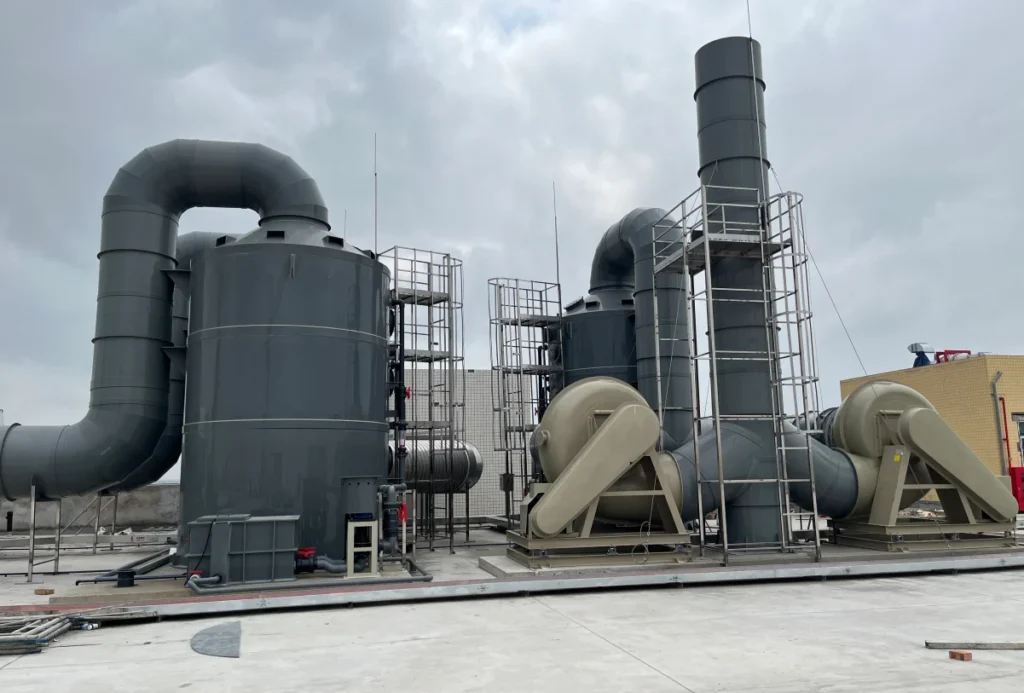
A scrubber system is an integrated air pollution control installation that removes pollutants from an industrial gas stream before it is released to the atmosphere. A scrubber system is not a single machine: it is a coordinated assembly of a vessel, a recirculation loop, a reagent feed, a fan, controls, and a stack that work together as one closed loop. The difference between a scrubber and a scrubber system is the difference between an engine and a car. If you are asking what is a scrubber system for the first time before a purchase decision, the answer determines the scope of the budget and the equipment. This guide explains what a scrubber system is, what it does, how the parts work together, and when an industrial facility needs one. Plant engineers and EHS managers new to the topic can use this as the definitional entry point before moving to the detailed scrubber system technical guides.
Key Takeaways
- A scrubber system is an integrated installation, not a single machine: it combines the vessel with the recirculation pump, reagent feed, fan, controls, mist eliminator, and stack into one coordinated system. The full system costs 1.5-2 times the bare vessel.
- The scrubber system working principle is gas-liquid contact in counterflow: gas rises through the packing while the liquid falls, transferring the pollutant out of the gas phase by absorption or reaction.
- A wet scrubber system removes 95-99.9% of highly soluble gases such as HCl, HF, and NH3 but produces wastewater. A dry scrubber system removes 90-98% with no wastewater, suiting water-constrained sites.
- Every scrubber system performs five functions – capture, contact, neutralize, discharge, and waste handling – and a failure in any one fails the compliance objective even if the other four operate.
- A facility needs a scrubber system when an emission or exposure obligation cannot be met by process changes. The removal target comes from the applicable NESHAP or exposure standard, and the monitoring plan must be designed into the system.
What Is a Scrubber System?
A scrubber system is an integrated installation that removes gaseous pollutants, particulates, or odors from an industrial gas stream by bringing the gas into contact with a liquid or a dry reagent. The system transfers the pollutant out of the gas phase and into the liquid or solid phase, producing a cleaned gas that exits through the stack and a waste stream that the facility manages.
A System, Not a Single Machine
The word “system” matters. A bare scrubber vessel is only one component. A complete scrubber system adds the recirculation pump and piping that move the scrubbing liquid, the reagent feed that maintains the chemistry, the fan that drives the gas through the vessel, the mist eliminator that stops liquid carryover, the controls that keep every part within its operating window, and the stack that discharges the treated gas. Each component depends on the others. The vessel cannot scrub without the pump moving liquid; the pump cannot neutralize without the reagent feed; the whole installation cannot function without the fan providing the gas flow.
The Core Definition
In engineering terms, the answer to what is a scrubber system comes down to one mechanism: gas-liquid contact to achieve mass transfer. The pollutant dissolves into the scrubbing liquid, reacts with a chemical reagent, or is captured by a droplet or packing surface. The two common configurations are the wet scrubber system, which uses water or a chemical solution, and the dry scrubber system, which uses a dry alkaline sorbent. The gas entering the system is contaminated; the gas leaving the stack meets the emission target; the pollutant ends up in a liquid blowdown, a sludge, or a collected solid that the facility treats or disposes.
Scrubber System vs a Standalone Scrubber
The distinction is scope. A standalone scrubber is the vessel and its internals, treated as a piece of equipment. A scrubber system includes the scrubber plus everything required to make it operate continuously: the liquid loop, the reagent storage and feed, the fan, the controls, the ductwork and stack, and the wastewater handling. Buyers who price only the vessel discover that the full system cost is 1.5-2 times the vessel alone once the pumps, fan, controls, and installation are added. The gas scrubber pillar guide and what is a gas scrubber explain the device itself; this guide covers the system that the device operates within.
The System Boundary
Defining the system boundary determines the scope of the purchase and the responsibility. The boundary runs from the gas connection where the contaminated stream enters, through the vessel and the liquid loop, to the stack exit where the cleaned gas discharges, and it includes the utility connections for power, water, reagent, and drainage. A system scoped too narrowly – the vessel only – leaves the fan, the pump, the reagent feed, and the controls as separate purchases that the buyer must engineer and integrate. A system scoped completely is delivered as an operating installation with the performance guarantee attached. For a mid-size industrial scrubber system, the integration cost of assembling the components in-house typically runs 20-35% of the equipment total, which is what the system supplier’s package covers.
What Does a Scrubber System Do?
A scrubber system removes pollutants from an industrial gas stream and produces two outputs: a cleaned gas that meets the emission limit and a waste stream that is contained and managed. The pollutant type determines the technology, and the emission limit determines the removal target.
Removing Pollutants from Industrial Gas
The target pollutants fall into three classes. Acid gases such as HCl, HF, SO2, and H2S are absorbed by an alkaline scrubbing liquid. Alkaline gases such as ammonia and amines are absorbed by an acid scrubbing liquid. Particulates and odors are captured by droplet impaction, by packing surface contact, or by chemical reaction. A wet scrubber system achieves 95-99.9% removal of highly soluble gases and 80-95% for moderately soluble pollutants, depending on the design. The OSHA air contaminant standards define the exposure limits that drive the capture side of the system.
The Five Functions
Every scrubber system performs five functions in sequence. Capture draws the contaminated gas into the system through a hood, duct, or direct process connection. Contact brings the gas into contact with the scrubbing liquid or reagent inside the vessel, where the pollutant transfers out of the gas phase. Neutralization reacts the absorbed pollutant with the reagent chemistry to hold it in the liquid phase and keep the liquid from becoming corrosive. Discharge passes the cleaned gas through a mist eliminator and out the stack at a height that ensures dispersion. Waste handling collects the liquid blowdown, sludge, or spent sorbent for treatment or disposal. A system that fails any one of the five functions fails its compliance objective even if the other four operate correctly.
The Compliance Role
The scrubber system is the control technology that makes a permit achievable. The system converts a gas stream that exceeds the emission limit into a gas stream that meets it, and it does so continuously, not as a batch treatment. The removal efficiency is defined as the difference between the inlet and outlet concentration divided by the inlet concentration, and it is the number a permit cites. A system treating 500 ppm of HCl at 99% removal discharges 5 ppm at the stack; at 95% removal it discharges 25 ppm, which is why the efficiency target is set by the limit, not by the equipment. The pollutant load, the inlet concentration, and the gas flow define the system size, and a change in any one of the three shifts the operating point that the rest of the system must hold.
What a Scrubber System Does Not Do
The limits matter as much as the capabilities. A scrubber system does not remove pollutants that are insoluble in the scrubbing liquid, such as the non-polar volatile organic compounds benzene and toluene, unless a specialized scrubbing chemistry is added. It does not handle gas above the material temperature limit without a quench section upstream; a fiberglass system is limited to roughly 110 C and a metal system to higher service. It does not replace source reduction, and it does not operate unattended – the reagent feed and the liquid chemistry need routine attention to hold the removal efficiency. Defining the pollutant solubility and the gas temperature before purchase prevents the two most common mismatches: specifying a scrubber system for an insoluble pollutant and running a wet system on a gas stream that exceeds its material rating.
How Does a Scrubber System Work?
A scrubber system works by running the contaminated gas and the scrubbing liquid through the same vessel in counterflow, so every parcel of gas passes through the liquid contact zone while the liquid continuously recycles. The operating sequence is best understood as three parallel paths: the gas path, the liquid path, and the chemistry path.
The Gas Path
The gas enters the system at the inlet duct, typically at a temperature between ambient and 60-80 C, and flows upward through the vessel. In a packed bed system, the gas passes through a bed of packing media where it meets the downward-flowing liquid. The gas velocity through the packing, typically 1-2 m/s, sets the residence time and the pressure drop. After the contact zone, the gas passes through a mist eliminator that removes entrained liquid droplets down to 10-50 um, then leaves through the stack. The gas path ends clean; the pollutant has transferred to the liquid during the contact pass.
The Liquid Path
The scrubbing liquid is drawn from a sump at the vessel base by a recirculation pump and delivered to a distributor at the top of the packing. The liquid flows down through the packing by gravity, wetting the media surface where the gas-liquid contact occurs, and returns to the sump. The liquid-to-gas ratio, typically 2-4 L of liquid per m3 of gas for a packed bed, sets the pump size and the contact intensity. A continuous blowdown removes the accumulated pollutant and dissolved solids, and fresh water or reagent replaces the volume. The liquid path is a closed loop that concentrates the pollutant over time until the blowdown purges it.
The Chemistry
The chemistry path keeps the liquid reactive. For acid gas removal, an alkaline reagent such as sodium hydroxide is metered into the recirculating liquid to hold the pH in the working range, typically 8-10. The absorbed acid reacts to form a salt that stays dissolved in the liquid. For ammonia removal, an acid reagent holds the pH in the acidic range. The reagent feed rate is set by the pollutant load, and the pH controller adjusts the feed as the load varies. The scrubber system overview covers the configurations, and the wet scrubber design guide details the contact-zone engineering. This is how scrubber system works at the process level: three continuous loops, each doing one job, coordinated by the control system.
The control system holds the three loops in balance as the operating conditions change. The gas load varies with the process schedule, so the fan maintains the design flow against a changing system resistance. The pollutant concentration varies with the process chemistry, so the pH controller adjusts the reagent feed to hold the working pH. The liquid level varies with evaporation and blowdown, so the level controller adds make-up water. The removal efficiency stays at the design value only while all three loops stay within their windows. A scrubber system that lacks the instrumentation to track these variables operates blind, and the first sign is usually a rising outlet concentration on the next emission test.
The Five Subsystems of a Scrubber System
A scrubber system is built from five subsystems, each with a distinct job. Understanding the subsystems is the practical way to scope a purchase, because a vendor quote that covers only the vessel has skipped four of the five.
Gas Handling Subsystem
The gas handling subsystem moves the contaminated air from the source to the stack. It includes the capture hood or process connection, the inlet ductwork, the vessel gas-side internals, the mist eliminator, and the stack. The ductwork must be sized for the design gas flow at a transport velocity that prevents settling, typically 8-20 m/s depending on the contaminant. The inlet duct and the stack are part of the system because their pressure drop contributes to the total the fan must overcome.
Liquid Recirculation Subsystem
The liquid recirculation subsystem delivers the scrubbing liquid to the contact zone and returns it to the sump. It includes the sump, the recirculation pump, the supply and return piping, the liquid distributor, the nozzles, and the blowdown valve. The pump is typically the largest single mechanical component and the main power consumer after the fan. A pump failure stops the scrubbing action immediately, which is why the pump is the first component to get redundancy in continuous duty.
Reagent Feed Subsystem
The reagent feed subsystem maintains the liquid chemistry. It includes the reagent storage tank, the metering pump, the pH probe, and the feed control valve. For an acid gas application, the reagent is typically sodium hydroxide at 20-50% concentration; for an ammonia application, it is sulfuric acid. The metering pump adjusts the feed to hold the target pH, and the reagent consumption is directly proportional to the pollutant load. Running the system without the reagent feed active is the fastest way to fail the emission test.
Fan and Draft Subsystem
The fan and draft subsystem drives the gas through the entire chain. It includes the fan, the motor, the drive, and the damper or variable-frequency drive that controls the flow. The fan must be sized for the total system pressure drop, which for a packed bed scrubber system is typically 1-4 kPa, not for the vessel alone. The fan placement determines whether the system runs under negative pressure (fan downstream of the scrubber) or positive pressure, and the negative-pressure arrangement is preferred because leaks draw air in instead of releasing contaminated gas.
Control and Monitoring Subsystem
The control and monitoring subsystem keeps every other subsystem in its operating window. It includes the PLC or relay logic, the pH and pressure instrumentation, the level switches, and the interlocks that shut the process down on a low liquid flow or a high temperature. A variable-frequency drive on the fan holds the gas flow constant as the packing loads. The control system converts the scrubber from a mechanical installation into an operated system, and its cost is typically 10-15% of the total. The gas scrubber system guide details the configurations, and our wet scrubber system range shows the assembled units.
How the Subsystems Are Scoped
The five subsystems scale with the duty, and the cost split between them is a useful scoping tool. For a mid-size packed bed wet system, the vessel and internals are roughly 40-50% of the equipment cost, the fan and motor 15-20%, the pump and piping 15-20%, the controls and instrumentation 10-15%, and the reagent feed and auxiliary items the balance. A buyer who understands the split can spot a quote that under-specifies the fan or the controls, which are the two subsystems most often cut to lower the price. The gas handling and liquid recirculation subsystems are the largest power consumers, so their efficiency drives the operating cost over the 10-15 year equipment life.
Types of Scrubber Systems
Scrubber systems divide into two families by the phase that captures the pollutant, and the two families handle different pollutant profiles.
Wet Scrubber Systems
A wet scrubber system uses water or a chemical solution as the capture medium. The gas is contacted with the liquid in a packed bed, a spray chamber, or a venturi throat, and the pollutant dissolves or reacts into the liquid phase. Wet systems handle acid gases, alkaline gases, soluble VOCs, and particulates, and they achieve the highest removal efficiencies for soluble pollutants: 95-99.9% for HCl, HF, and NH3. The trade-off is the wastewater: the blowdown carries the pollutant and must be treated or disposed of, and the liquid chemistry must be maintained with reagent. Wet systems are the dominant choice for chemical processing, semiconductor fabs, and acid fume control. The wet scrubber guide covers the technology in depth.
Dry Scrubber Systems
A dry scrubber system uses a dry alkaline sorbent such as lime, sodium bicarbonate, or a dry chemical that reacts with the acid gases in the gas stream. The reaction product is captured in a baghouse or a particulate collector. Dry systems consume minimal water and produce no wastewater, which makes them attractive where water is scarce or wastewater disposal is expensive. They remove SO2, HCl, and HF at 90-98% depending on the sorbent and the operating conditions, slightly lower than a well-designed wet system for the same duty. The operating cost is driven by the sorbent consumption instead of the liquid chemistry.
System Configurations
Beyond the chemistry, scrubber systems come in three physical configurations. A packaged unit mounts the vessel, pump, fan, and controls on a common skid for flows up to about 10,000 m3/h. A modular system adds standardized sections that scale the capacity in increments. A field-erected system is built at the site for large flows and complex duty, typically above 20,000 m3/h. The configuration choice trades factory quality and fast installation against capacity and flexibility, and it is driven by the gas flow, the available space, and the installation schedule.
Selecting the System Type
The selection starts with the pollutant, not with the equipment. Measure the gas flow, the inlet concentration, the temperature, and the particulate loading first. Soluble acid gas points to a packed bed wet system. Sub-micron fume or dust points to a venturi wet system. Coarse particulate with light gas load points to a spray chamber. A water-constrained site with acid gas points to a dry system. The removal target comes from the applicable emission limit, and the system is then sized to meet that target with margin. A system selected on price alone, without the pollutant measurement, frequently ends up either oversized for the actual duty or undersized for the peak load. The same technology family handles a range of pollutants, but the internals, the material, and the chemistry change with the specific gas.
When Do You Need a Scrubber System?
A facility needs a scrubber system when an emission or an exposure obligation cannot be met by process changes alone. The trigger is usually a regulatory limit, a permit condition, or a measured pollutant load that exceeds the acceptable level.
Regulatory Drivers
The regulatory obligation sets the removal target. National Emission Standards for Hazardous Air Pollutants (NESHAP) under 40 CFR Part 63 and New Source Performance Standards under 40 CFR Part 60 limit the emission of specific pollutants for defined source categories. Occupational exposure limits set the concentration in the work environment. A scrubber system is installed when the process generates a pollutant that must be removed before discharge, and the EPA control technology fact sheets document the expected scrubber performance that informs the system design.
Application Signals by Industry
The application signal varies by industry. A chemical plant treats acid gas vents from reactors and storage tanks. A semiconductor fab treats the tool exhaust from etch and deposition processes, where the pollutant load is intermittent and the removal requirement is often 99%+. A wastewater plant treats hydrogen sulfide and odor from the headworks. A paint or coating line treats solvent and overspray from the booth. Where the contaminant is a specific gas, the system design follows the pollutant chemistry: the H2S scrubber system and toxic gas scrubber guides detail those applications, and the scrubber ventilation systems guide covers the capture-to-stack chain for building and process exhaust.
Compliance Monitoring
The system must demonstrate that it meets the limit, which requires instrumentation and records. Most permits require a log of the emission or vent concentration, the scrubbing liquid flow and pH, and the fan operation. A continuous pH recorder on the recirculating liquid and a pressure gauge across the packing provide the operating evidence. The monitoring plan is part of the system design, not an add-on, because the compliance record depends on data the system can produce. Browse the gas scrubber product range or the exhaust gas scrubber to see how the system requirements translate into equipment, or contact our engineering team to scope a system for your pollutant load.
The Sizing Inputs
The decision to buy a system is only the first step; the sizing inputs determine what the system must handle. The gas flow rate sets the vessel diameter, the fan size, and the duct dimensions. The inlet pollutant concentration and its variability set the removal target and the reagent consumption. The gas temperature sets the material selection, because a fiberglass vessel is rated for service up to about 110 C and a metal vessel is needed above that. The particulate loading sets the need for a pre-collector or a venturi stage. A facility that measures these four inputs before issuing a request for quotation receives bids that meet the duty; a facility that asks for a quote without the measurements receives bids that protect the bidder, not the plant. The measurement cost is small next to the cost of an undersized system that fails its compliance test.
FAQ
What is a scrubber system?
A scrubber system is an integrated air pollution control installation that removes pollutants from an industrial gas stream before discharge. It combines the scrubber vessel with the recirculation pump, reagent feed, fan, controls, mist eliminator, and stack into one coordinated system.
What does a scrubber system do?
A scrubber system performs five functions: it captures the contaminated gas, contacts it with a scrubbing liquid or reagent, neutralizes the absorbed pollutant, discharges the cleaned gas through a stack, and handles the resulting waste stream. The removal target is set by the emission limit the facility must meet.
What is the scrubber system working principle?
The scrubber system working principle is gas-liquid contact in counterflow. The gas rises through the vessel while the liquid falls through the packing or spray, and the pollutant transfers from the gas phase into the liquid phase by absorption or chemical reaction. The liquid recirculates continuously, the reagent feed maintains the chemistry, and the cleaned gas exits through the mist eliminator and stack.
What is the difference between a wet and dry scrubber system?
A wet scrubber system uses water or a chemical solution and removes 95-99.9% of highly soluble gases, producing a liquid blowdown that needs treatment. A dry scrubber system uses a dry alkaline sorbent and removes 90-98%, producing no wastewater. Wet systems suit chemical and semiconductor duty; dry systems suit water-constrained sites and retrofit applications.
What pollutants can a scrubber system remove?
A scrubber system removes acid gases such as HCl, HF, SO2, and H2S; alkaline gases such as NH3 and amines; soluble VOCs; and particulates. The specific removal depends on the technology: a packed bed handles soluble gases, a venturi handles sub-micron particles, and a spray chamber handles coarse particles and gas cooling.
How much does a scrubber system cost?
The cost scales with the gas flow, the pollutant, and the configuration. A packaged wet scrubber system for 1,000-5,000 m3/h runs $20,000-60,000. A mid-size system for 10,000 m3/h runs $50,000-150,000. A field-erected system for large industrial flows runs $150,000-500,000. The full system costs 1.5-2 times the bare vessel once the pump, fan, controls, and installation are included.
Do I need a scrubber system for my facility?
You need a scrubber system when an emission limit or an exposure obligation cannot be met by process changes alone. If your facility generates acid gas, alkaline vapor, soluble VOC, or particulate that exceeds the regulatory threshold, a scrubber system is the standard control technology. Start with a stack or vent measurement to establish the pollutant load, then confirm the applicable standard.
How long does a scrubber system last?
A well-maintained scrubber system operates 10-15 years for the vessel and 5-10 years for the packing media. The service life depends on the material, the acid concentration, and the maintenance. A fiberglass vessel in light acid service lasts 12-15 years; the packing is replaced as a consumable when the pressure drop rises. The pump, the fan, and the controls are serviced on the same schedule as any industrial rotating equipment.