



Duct Reducer — PP and PVC Reducing Coupling for Different-Diameter Duct Connection
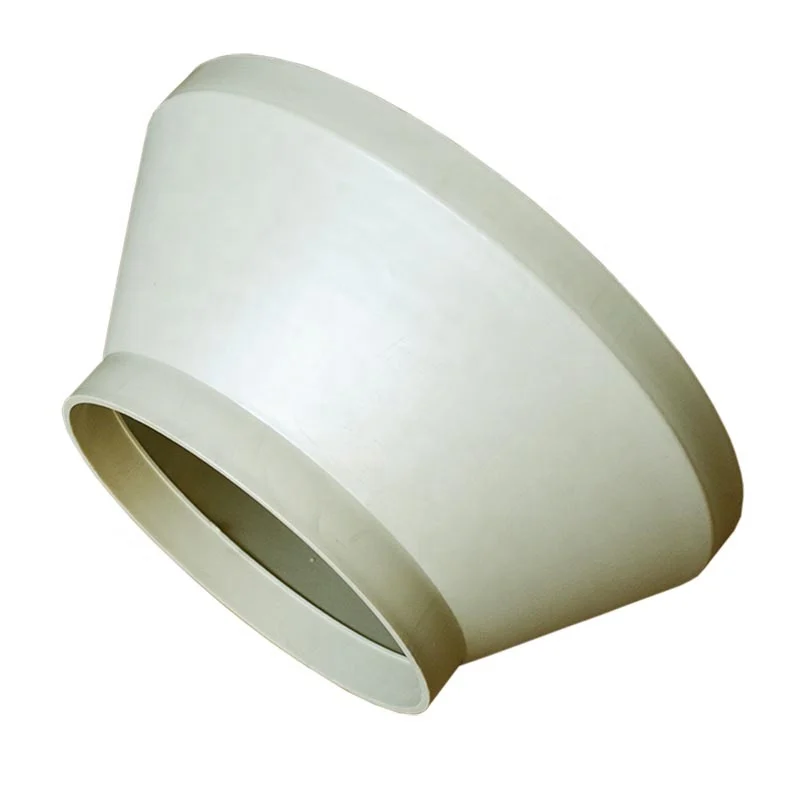
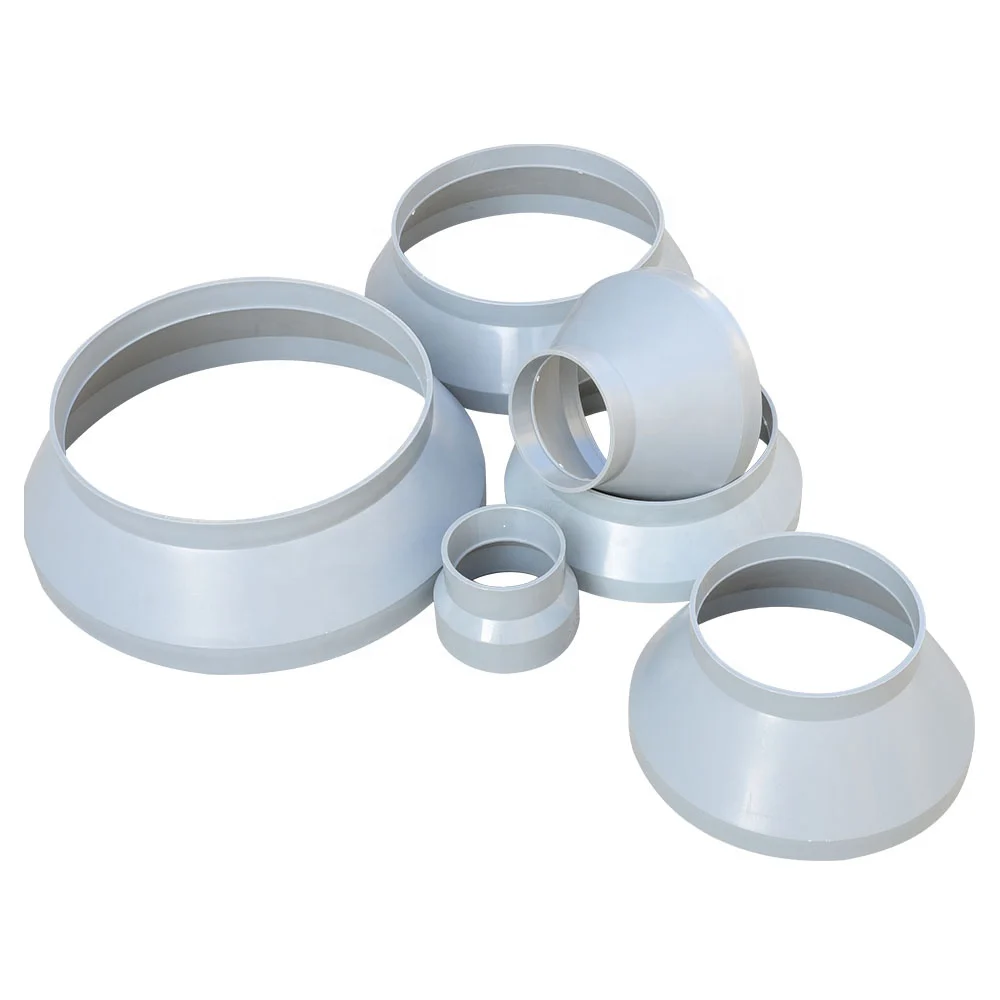
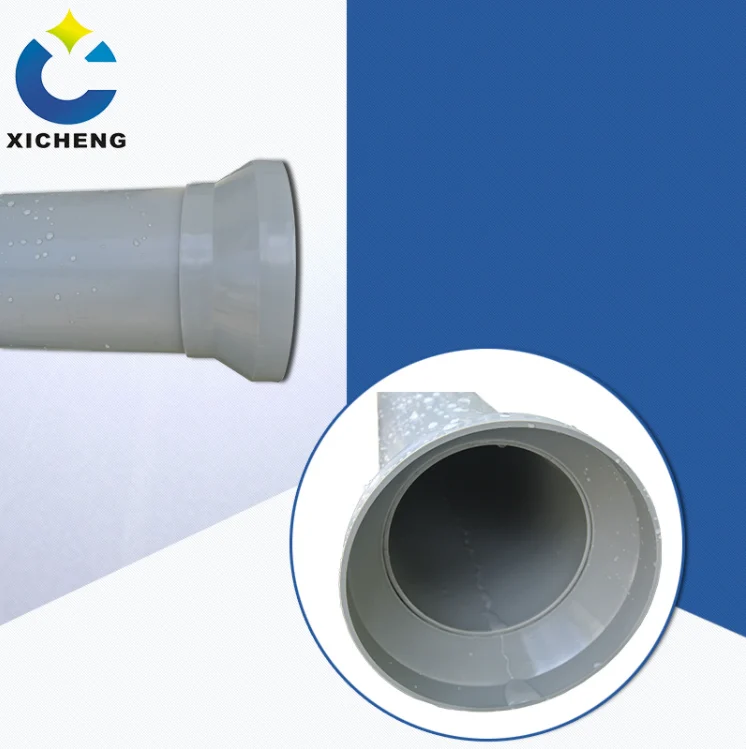
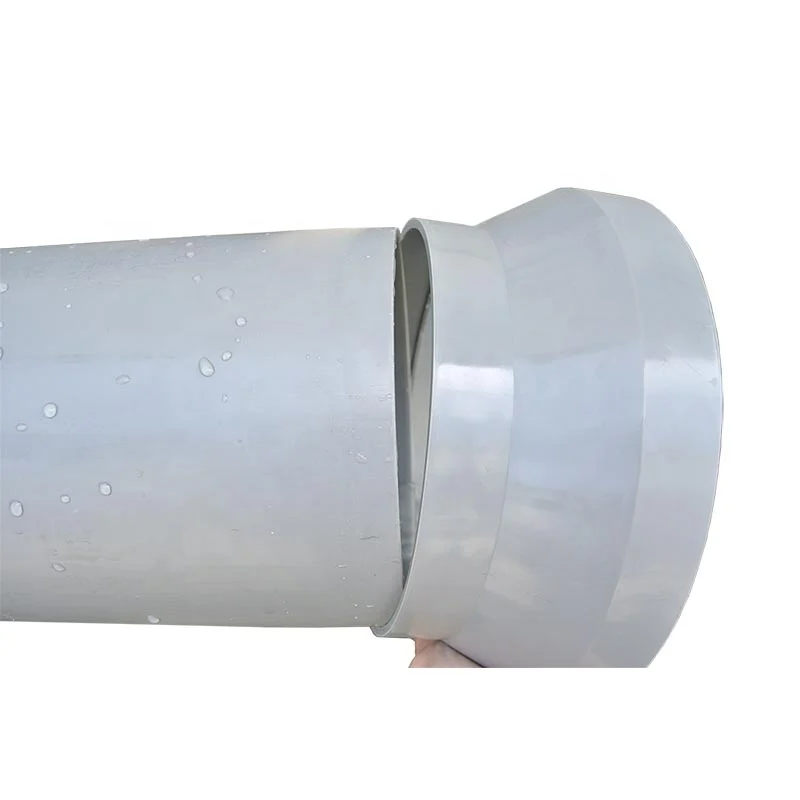
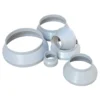
A duct reducer — also called a reducing coupling — connects two duct sections of different diameters in a single, compact fitting. It has a larger socket at one end and a smaller socket at the other. No taper. No transition section. Just a direct step from one diameter to the next. When you need to join a 250mm duct to a 200mm duct without inserting a tapered reducer between them, this is the fitting.
Xicheng manufactures duct reducers in polypropylene and PVC. Standard diameter combinations are injection-molded as single-piece components — each end formed to its respective diameter with the step occurring at the center of the fitting. Custom combinations beyond standard tooling are hand-welded from PP or PVC sheet by fabrication specialists.
The geometry is simple. The function is direct. The manufacturing quality — whether the socket diameters are within tolerance, whether the wall thickness is uniform through the step, whether the material is virgin-grade resin — determines whether the connection seals or leaks.
When a Short Coupling Is All the Space Allows
A tapered reducer requires length. The transition from the larger diameter to the smaller must be gradual enough to avoid excessive turbulence — typically 1.5 to 2 times the diameter difference. In a congested duct run where every millimeter of linear space is occupied by parallel services, that length may simply not be available.
A reducing coupling makes the same diameter change in the length of a standard socket fitting — roughly 100 to 200 millimeters depending on the diameters involved. The trade-off is a higher pressure drop across the abrupt diameter change compared to a gradual taper. In systems where the diameter reduction is small relative to the duct diameter — 250mm to 200mm, for example — the pressure drop difference between a reducing coupling and a tapered reducer is negligible. In systems with large diameter changes, a tapered reducer is the aerodynamically correct choice. In systems where space constraints rule out a tapered reducer entirely, a reducing coupling is the only practical option.
Injection-Molded: Both Diameters in One Piece
An injection-molded reducing coupling is produced as a single part with the larger socket diameter at one end and the smaller at the other. The diameter step occurs at the midpoint of the fitting, where the mold transitions from one cavity diameter to the other. The wall thickness is uniform throughout. Both sockets are concentric — the centerlines of both duct diameters align.
This matters when connecting two duct sections that must remain on the same axis. A reducing coupling with an off-center socket forces the downstream duct out of alignment, putting stress on every downstream joint. An injection-molded coupling, produced in a single mold cavity with both ends machined into the same tooling, maintains concentricity within the tolerance of the mold itself — a level of precision that hand fabrication approximates but does not guarantee.
For standard diameter combinations within injection molding capacity, the per-unit cost and lead time favor molded construction. For custom combinations — a 275mm by 190mm coupling, for example, where neither diameter is a standard size and the ratio is not covered by existing tooling — hand-welded fabrication is the practical route.
Technical Specifications
| Parameter | Specification |
|---|---|
| Material | Virgin-grade PP (Polypropylene), PVC |
| Type | Reducing coupling — larger diameter at one end, smaller at the other |
| Standard Combinations | Common diameter pairs |
| Injection-Molded | Single-piece, both diameters in one mold cavity |
| Hand-Welded | Fabricated from PP/PVC sheet for non-standard combinations |
| Density (PP) | 0.90 to 0.91 g/cm3 |
| Operating Temperature (PP) | -10-degrees-Celsius to 90-degrees-Celsius |
| Operating Temperature (PVC) | 0-degrees-Celsius to 60-degrees-Celsius |
| Connection | Socket weld, butt weld |
| Certifications | ISO 9001, ISO 14001; SGS tested |
| Custom | Non-standard diameter pairs, wall thicknesses |
Where Reducing Couplings Connect Different-Diameter Ductwork
An electronics manufacturer in East Asia expanded its acid etching exhaust system, adding a new production line with 200mm duct drops that needed to connect to an existing 250mm main header. The space between the header and the ceiling slab was 300 millimeters — insufficient for a tapered reducer. Injection-molded PP reducing couplings, each 150 millimeters in overall length, made the connection within the available space.
A pharmaceutical facility replaced corroded galvanized steel reducing couplings in a fume hood exhaust network with PP equivalents. The original steel couplings had been custom-machined to match the duct diameters — 180mm to 140mm — a non-standard combination. Xicheng fabricated PP reducing couplings to the same diameter pair, matching the existing ductwork without requiring duct modifications.
A wastewater treatment plant installed reducing couplings in an odor control duct system where the main header diameter reduced at each branch takeoff point. The abrupt diameter change at each coupling was aerodynamically acceptable because the flow volume had already decreased at each preceding branch, maintaining approximately constant velocity despite the diameter reduction.
Global Compliance and Industrial Trust: Why Customers Choose Xicheng
A reducing coupling is a simple fitting — two different socket diameters in one short piece. The simplicity is deceptive. The socket diameters must be within tolerance to seal. The wall thickness must be uniform to avoid stress concentration at the diameter step. The material must be virgin-grade to provide the specified chemical resistance. Any one of these requirements, if unmet, turns the cheapest fitting in the system into the most expensive failure point.
Xicheng Environmental operates over 40 production bases and offices across China, with 2 dedicated manufacturing facilities in Vietnam. Standard injection-molded reducing couplings ship from inventory. Custom diameter combinations are fabricated to order with lead times confirmed at quotation.
ISO 9001 governs quality management. ISO 14001 governs environmental management. SGS testing covers the raw materials — PP sheets, PPS, PP pipes, and PVC sheets — with current documentation for every order.
One-Stop Engineering Support: From Spec to Shipment
You need a reducing coupling with the correct socket diameters at both ends. The diameters must match the ductwork on both sides. The connection type must be compatible.
Here is how Xicheng handles every order:
- Specification Confirmation. Send us the larger duct diameter, smaller duct diameter, and exhaust gas composition. We confirm material compatibility and whether the diameter pair is available as a standard injection-molded coupling or requires fabrication.
- Certified Manufacturing. Production under ISO 9001 and ISO 14001. Hand-welded couplings receive weld inspection along the longitudinal seam.
- Complete Documentation. SGS test reports, certificate of origin, packing list, and commercial invoice. Container loading photographs and tracking information before departure.
- Engineering Access. Direct contact with our engineers by phone, email, or WhatsApp.
Frequently Asked Questions
Q: What is the difference between a reducing coupling and a tapered reducer?
A: A reducing coupling is a short fitting with different socket diameters at each end and an abrupt diameter change at the center. A tapered reducer is a longer fitting with a gradual transition between the two diameters. Use a reducing coupling when space is limited and the diameter change is relatively small. Use a tapered reducer when the installation has sufficient space and a gradual transition is required to minimize pressure drop.
Q: Can you produce a reducing coupling for non-standard diameter pairs?
A: Yes. Send us both diameters. We fabricate reducing couplings to non-standard diameter combinations. This is a routine order.
Q: What connection types are available?
A: Socket weld is standard for PP and PVC reducing couplings. Butt weld and flanged connections are available on request.
Q: What is the lead time?
A: Standard injection-molded reducing couplings ship within 5 to 7 working days. Custom diameter combinations require 10 to 15 working days.
Send us your duct diameters and exhaust gas composition. Our engineering team will confirm material compatibility — and you will have a quotation within 48 hours.
Contact Xicheng Environmental Today.
- 🎯 Address: No.34 Zhenxing Road (Shengtaian Heavy Industrial Park B), Loucun, Guangming New Dist, Shenzhen, Guangdong, China
- ☎️ Phone/WhatsApp: +86 18028775826
- 🗺️ Email: xichengepltd@gmail.com


Reviews
There are no reviews yet.