

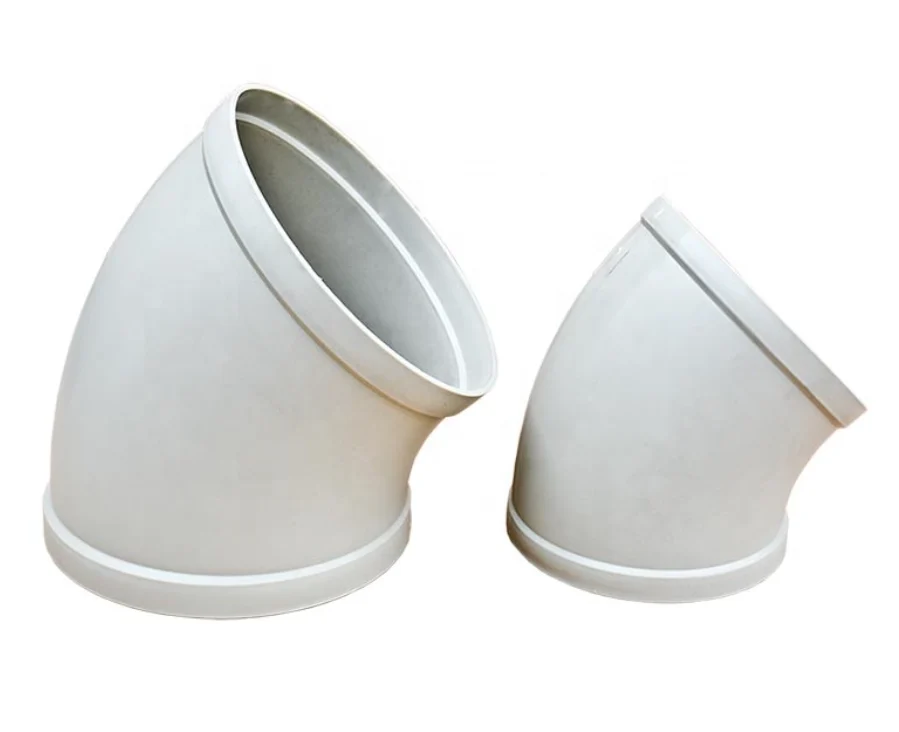
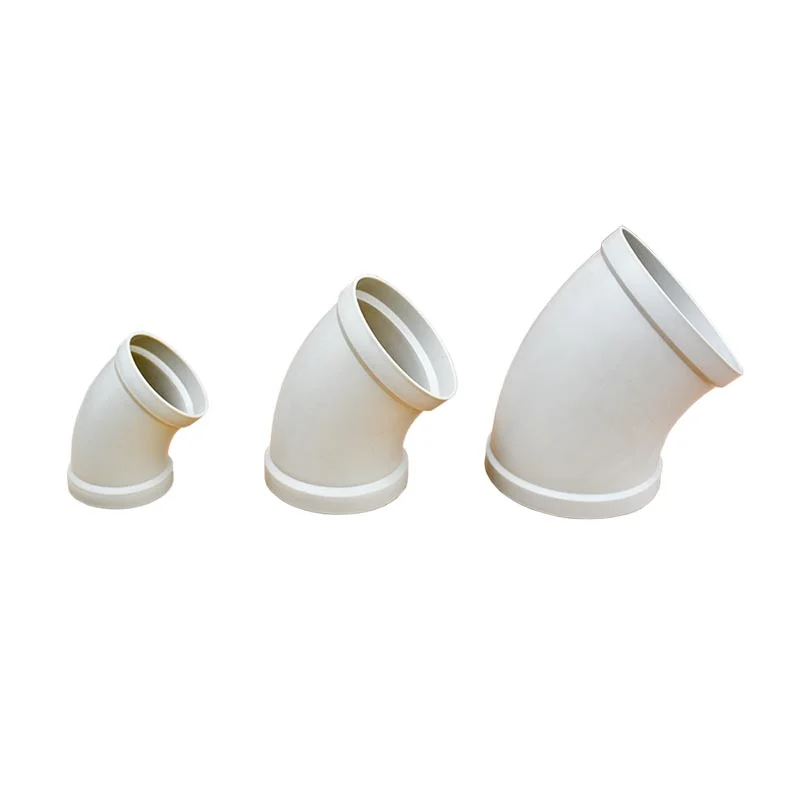


45 Degree Duct Elbow — PP and PVC Ventilation Elbow
A 45-degree duct elbow imposes roughly half the pressure drop of a 90-degree elbow of the same diameter. That single fact drives most of the engineering decisions around when to specify one angle over the other — but it is not the only one that matters.
In exhaust streams carrying particulate, a 45-degree bend reduces dropout at the turn. In duct runs with vertical offsets, a pair of 45-degree elbows achieves the same directional change as a single 90-degree fitting but with lower accumulated static pressure. In systems where fan energy cost is a measurable line item on the operating budget, the cumulative difference between forty 45-degree bends and forty 90-degree bends shows up on the electricity bill every month.
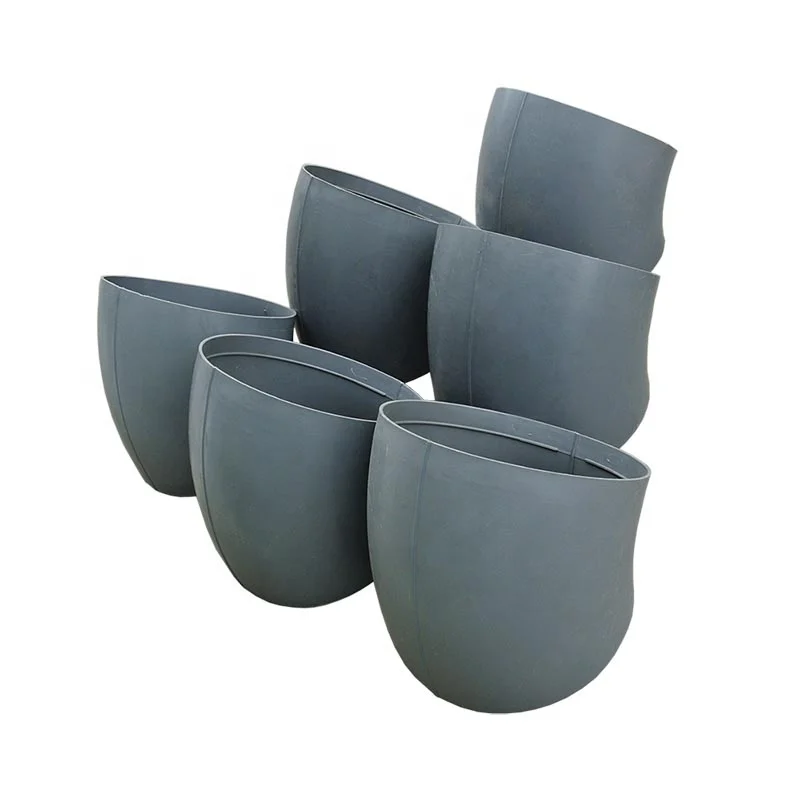
Xicheng manufactures 45-degree duct elbows in polypropylene and PVC through the same two manufacturing routes that serve our 90-degree elbows: injection-molded as single-piece components for standard diameters, and hand-welded by PP fabrication specialists for diameters and configurations beyond molding capacity. Both share the same virgin-grade materials, ISO 9001 inspection, and chemical resistance ratings.
When a 45-Degree Elbow Is the Right Specification
Most duct systems use both 45-degree and 90-degree bends. Knowing which to specify where is the difference between a system that performs to design and one that fights its own geometry.
Specify a 45-degree elbow when the duct run has space to accommodate the longer turning radius. A 45-degree bend takes more linear distance to achieve a directional change than a 90-degree bend, but returns that investment in reduced pressure loss. In a long straight duct run with a single directional change, the additional length is negligible. At the other extreme, in a congested service shaft where every meter of duct competes with pipe racks, cable trays, and structural steel, the 90-degree elbow’s compact footprint may be the only practical option.
Specify a 45-degree elbow when the exhaust stream carries particulate. The gentler turn radius reduces the centrifugal force that throws particles against the outer wall of the bend, where they accumulate, absorb corrosive moisture, and create localized chemical attack zones. This is particularly relevant in textile processing, food production, and any application where the exhaust carries fibers, dust, or process solids.
Specify a pair of 45-degree elbows instead of a single 90-degree elbow when you need to offset a duct run vertically without inducing a sharp directional change. Two 45-degree bends separated by a straight section produce the same net 90-degree turn but with lower total pressure drop than a single 90-degree elbow.
Injection-Molded or Hand-Welded: The Same Choice, Different Stakes
For standard-diameter 45-degree elbows, injection molding delivers a single seamless part with no internal discontinuities. This is particularly important in particulate-laden exhaust streams, where an internal weld bead provides an accumulation point that does not exist in a molded elbow. For diameters under 500mm, injection-molded elbows provide a zero-weld option with the fastest available lead time.
For diameters or flange configurations beyond molding capacity, hand-welded fabrication is the practical route. The weld quality standard does not change: full-penetration hot-gas welding with matched-material PP rod, executed by specialists averaging eight years of exclusive polypropylene fabrication experience, inspected before the fitting leaves the factory.
The application determines the risk tolerance. A 45-degree elbow handling clean chemical vapor at moderate temperature in an accessible location is a low-consequence application — either manufacturing method, properly executed, will serve reliably. A 45-degree elbow handling particulate-laden exhaust at elevated temperature in a location accessible only during scheduled shutdowns is a high-consequence application — the manufacturing method and quality verification that goes with it deserve corresponding attention.
Technical Specifications
| Parameter | Specification |
|---|---|
| Material | Virgin-grade PP (Polypropylene), PVC |
| Angle | 45-degree |
| Injection-Molded | Single-piece, no internal joints |
| Hand-Welded | Full-penetration, matched-material PP rod |
| Density (PP) | 0.90 to 0.91 g/cm3 |
| Operating Temperature (PP) | -10-degrees-Celsius to 90-degrees-Celsius |
| Operating Temperature (PVC) | 0-degrees-Celsius to 60-degrees-Celsius |
| Chemical Resistance (PP) | HCl below 80%, H2SO4 below 75%, HNO3 below 20% at 60-degrees-Celsius |
| Connection | Socket weld, butt weld, flanged |
| Certifications | ISO 9001, ISO 14001; SGS tested |
| Custom | Non-standard diameters, flange patterns, wall thicknesses |
Where 45-Degree Elbows Earn Their Place
A textile mill in South Asia operates a network of exhaust ducts extracting fiber-laden air from carding and spinning machines. The original system used 90-degree bends throughout. Particulate accumulation at the inner radius of each 90-degree elbow required quarterly cleaning to maintain design airflow. A retrofit replaced critical bends with 45-degree injection-molded PP elbows. The gentler turn radius reduced particulate dropout at the bends, extending cleaning intervals from quarterly to annual.
A chemical processor in the Middle East redesigned a reactor vent header with paired 45-degree PP elbows replacing single 90-degree bends at each floor penetration. The accumulated static pressure reduction allowed the existing exhaust fan to maintain design flow without an upgrade that would have required a larger motor, new VFD, and structural reinforcement of the fan platform.
A food production facility processing acidic ingredients required corrosion-resistant duct elbows for a washdown-area exhaust system. The duct routing had sufficient space for 45-degree bends throughout, and the cumulative pressure drop reduction across eighteen directional changes allowed downsizing the exhaust fan by one frame size — a capital cost saving that offset the entire duct fitting order.
Global Compliance and Industrial Trust: Why Customers Choose Xicheng
When you specify a 45-degree elbow instead of a 90-degree elbow, you are making an engineering decision — trading installation space for lower operating cost. When you specify Xicheng as the manufacturer, you are making a supply chain decision — trading uncertainty for documented quality and predictable delivery.
Xicheng Environmental operates over 40 production bases and offices across China, with 2 dedicated manufacturing facilities in Vietnam. Our engineering team reviews every custom order against the full context of the application: exhaust composition, operating temperature, particulate load, and the interaction between multiple fittings in series.
ISO 9001 governs quality management. ISO 14001 governs environmental management. SGS testing covers the PP sheets, PPS, PP pipes, and PVC sheets that become your duct fittings. These are not marketing claims — they are audited certifications with current documentation available for every order.
We have manufactured and shipped duct fittings to over 50 countries across chemical processing, electronics manufacturing, electroplating, food production, textile, and heavy industrial sectors. The 45-degree elbows in your system were built on the same production lines and under the same quality standards as those operating in facilities you would recognize.
One-Stop Engineering Support: From Spec to Shipment
You need confirmation that the material specification is correct. You need a delivery commitment you can build a project schedule around. You need documentation that satisfies customs authorities and your own quality audit requirements.
Here is how Xicheng handles every order:
- Application Review. Send us your duct diameter, exhaust gas composition, operating temperature, and — if relevant — particulate load characteristics. We confirm material compatibility and recommend injection-molded or hand-welded construction based on your specifications and the application’s consequence level.
- Certified Manufacturing. Production under ISO 9001 and ISO 14001. Hand-welded fittings receive individual weld inspection. Material traceability from incoming raw material to finished product.
- Complete Documentation. SGS test reports. Certificate of origin. Packing list. Commercial invoice. Container loading photographs. Tracking information the same day your shipment departs.
- Engineering Access. Direct contact with our engineers by phone, email, or WhatsApp — no sales gatekeepers, no forwarded messages, no delayed responses when your installation team has a question.
Frequently Asked Questions
Q: When should I use a 45-degree elbow instead of a 90-degree elbow?
A: Use a 45-degree elbow when the duct run has sufficient space for the gentler turn radius, when the exhaust stream carries particulate that would accumulate at a sharper bend, or when accumulated pressure drop across multiple bends affects fan sizing. Use a 90-degree elbow when space constraints demand the tightest directional change.
Q: Does a pair of 45-degree elbows really outperform a single 90-degree elbow?
A: Two 45-degree elbows with a straight section between them produce roughly 30 to 40 percent less total pressure drop than a single 90-degree elbow making the same net directional change. The trade-off is the additional linear space required — a factor that must be evaluated against the available installation geometry.
Q: What about particulate buildup in a 45-degree bend?
A: A 45-degree elbow reduces the centrifugal force acting on particles at the turn compared to a 90-degree elbow, resulting in less dropout at the outer wall. In particulate-heavy exhaust streams, specifying 45-degree bends and injection-molded construction — which eliminates internal weld beads that trap particles — provides the lowest maintenance burden over the system’s operating life.
Q: What are the lead times for 45-degree elbows?
A: Standard injection-molded 45-degree elbows ship within 5 to 7 working days. Hand-welded standard diameters ship within 7 to 10 working days. Custom diameters or flange configurations require 12 to 18 working days.
Send us your duct diameter, exhaust gas composition, and operating temperature. Our engineering team will confirm material compatibility and recommend the appropriate manufacturing method — and you will have a quotation within 48 hours.
Contact Xicheng Environmental Today.
- 🎯 Address: No.34 Zhenxing Road (Shengtaian Heavy Industrial Park B), Loucun, Guangming New Dist, Shenzhen, Guangdong, China
- ☎️ Phone/WhatsApp: +86 18028775826
- 🗺️ Email: xichengepltd@gmail.com

Reviews
There are no reviews yet.