

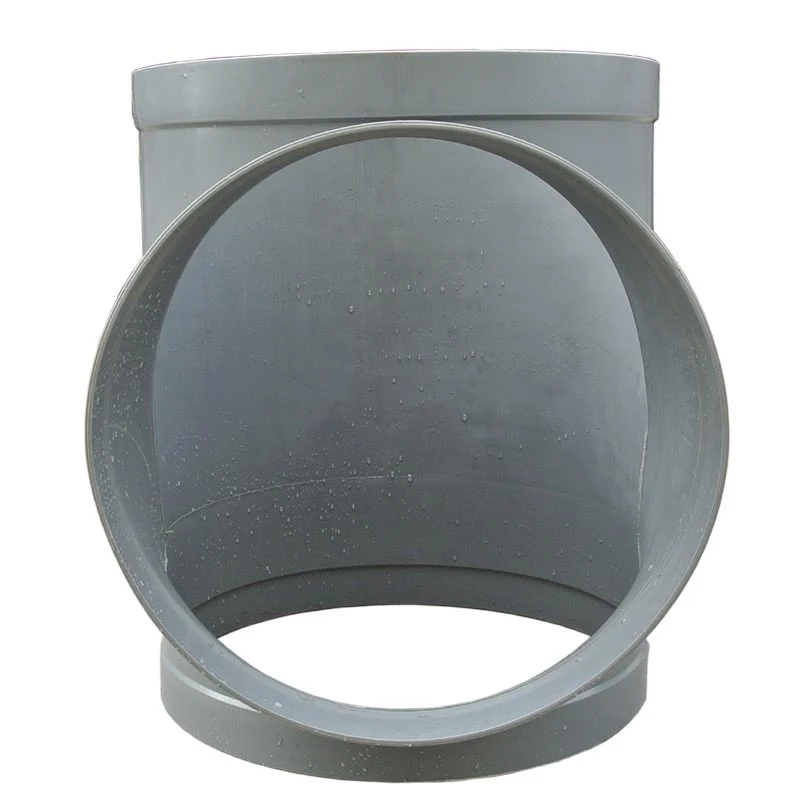
Reducing Tee — Branch-Off PP and PVC Duct Junction
A reducing tee takes a main exhaust header and splits off a smaller branch line — maintaining full flow velocity through the main run while directing a portion of the airflow to an individual machine, a single tank hood, or a dedicated treatment device. The branch diameter is smaller than the main run. The reduction is not a separate fitting added to a standard tee — it is integral to the component, and its geometry determines whether the branch performs to design or starves the downstream equipment of the airflow it needs.
Xicheng manufactures reducing tees in polypropylene and PVC. Injection-molded versions are produced as single-piece components with a smooth, radiused transition at the reduction — no internal step, no weld bead at the branch root, no crevice where corrosive mist condenses in the dead zone behind a sharp diameter change. Hand-welded versions are fabricated by PP welding specialists for main-run and branch-diameter combinations beyond molding capacity.
The transition from the main run diameter to the smaller branch diameter is the highest-stress point in any reducing tee. Airflow accelerates through the reduction, particulate impacts the transition surface, and chemical mist concentrates where flow separation creates a low-velocity recirculation zone downstream of the diameter change. In a fabricated tee with a sharp step at the reduction — the simplest geometry to produce — this recirculation zone becomes a chemical attack site. An injection-molded reduction with a radiused transition minimizes flow separation and the associated corrosion risk.
When the Branch Line Needs Less Air Than the Header
Industrial exhaust systems are hierarchical. A main header collects from multiple branch lines, each serving individual equipment or workstations. Every branch takeoff from the header is a reducing tee — the branch diameter is smaller because the branch serves less airflow than the main run carries at that point.
The diameter ratio between the main run and the branch is not arbitrary. A branch that is too small creates excessive velocity at the takeoff, increasing pressure drop and potentially starving the connected equipment of design airflow. A branch that is too large adds unnecessary material cost and weight without any airflow benefit. Standard reducing tee combinations — 200mm by 160mm, 315mm by 200mm, 400mm by 250mm — cover the most common industrial applications. Non-standard combinations are fabricated to order.
The branch orientation also matters. Most reducing tees have the branch at 90 degrees to the main run. This is the standard configuration for horizontal headers with vertical drops to individual hoods or enclosures. Other branch angles — 45 degrees for sloped takeoffs, 60 degrees for space-constrained installations — are available as custom fabrications.
The Reduction Geometry: Where Manufacturing Method Defines Service Life
An injection-molded reducing tee incorporates the reduction as a continuous, radiused surface — not a discrete step where the diameter changes abruptly. This matters because a sharp diameter reduction creates a flow separation zone immediately downstream of the transition. In a corrosive exhaust stream, that zone becomes a condensation point where acid mist deposits and concentrates over thousands of operating hours.
Fabricated reducing tees can approximate this geometry through skilled welding and careful fit-up of the transition section. The difference between an expert fabrication and an adequate one is visible at the reduction: a smoothly tapered transition versus a stepped joint with an internal weld bead projecting into the flow path.
Xicheng’s injection-molded reducing tees are produced in standard main-run and branch-diameter combinations. For combinations not covered by existing tooling, hand-welded fabrication by specialists with an average of eight years of exclusive PP welding experience produces the reduction geometry from sheet material. For diameters under 500mm, injection-molded elbows demonstrate the same single-piece manufacturing principle applied to a different fitting geometry.
Technical Specifications
| Parameter | Specification |
|---|---|
| Material | Virgin-grade PP (Polypropylene), PVC |
| Type | Reducing tee — branch diameter smaller than main run |
| Standard Combinations | 200×160, 250×200, 315×200, 400×250, and others |
| Injection-Molded | Single-piece, radiused reduction transition |
| Hand-Welded | Full-penetration, matched-material PP rod |
| Branch Angle | 90-degree standard; custom angles available |
| Density (PP) | 0.90 to 0.91 g/cm3 |
| Operating Temperature (PP) | -10-degrees-Celsius to 90-degrees-Celsius |
| Operating Temperature (PVC) | 0-degrees-Celsius to 60-degrees-Celsius |
| Connection | Socket weld, butt weld, flanged |
| Certifications | ISO 9001, ISO 14001; SGS tested |
| Custom | Non-standard diameter combinations, branch angles, flange patterns |
Where Reducing Tees Split the Load
An electroplating line in Southeast Asia operates twenty-four individual tank hoods, each connected to a main exhaust header through a reducing tee. The main header diameter steps down progressively along the length of the line as each branch takeoff removes airflow from the header — a design that maintains approximately constant velocity in the main run despite the decreasing flow volume. Each reducing tee in the sequence has a different diameter combination, matching the header diameter at that position.
A chemical processing plant uses reducing tees to connect individual reactor vent lines to a common treatment header. The main header diameter is constant along its length. Each reactor’s vent line diameter is determined by the reactor’s exhaust flow rate. The reducing tees at each connection point have identical main-run diameters but varying branch diameters — a configuration that required custom fabrication for the non-standard combinations.
A pharmaceutical facility’s fume hood exhaust network uses reducing tees at each floor level to connect individual laboratory drops to the building riser. The branch diameter serves a single fume hood. The main-run diameter serves the accumulated flow from all fume hoods on the floors above.
Global Compliance and Industrial Trust: Why Customers Choose Xicheng
Specifying a reducing tee is specifying a flow condition. The diameter ratio, the branch angle, and the reduction geometry together determine whether the branch delivers design airflow to the connected equipment. Get the fitting right and the system performs as calculated. Get it wrong and a machine runs underventilated for the life of the installation.
Xicheng Environmental operates over 40 production bases and offices across China, with 2 dedicated manufacturing facilities in Vietnam. Our engineering team reviews reducing tee specifications against the intended flow condition: branch airflow requirement, main-run flow rate, and whether the branch serves a critical or non-critical function in the overall exhaust system.
Every fitting is produced under audited certifications — ISO 9001 for quality management, ISO 14001 for environmental management — with SGS-tested raw materials and current documentation for every order.
One-Stop Engineering Support: From Spec to Shipment
A reducing tee has more specifications than a straight fitting or an equal tee: main-run diameter, branch diameter, branch angle, and flange standards at all three ports. Getting any one of these wrong means the fitting does not connect.
Here is how Xicheng handles every order:
- Specification Verification. Send us the main-run diameter, branch diameter, branch angle, flange standards, and exhaust gas composition. Our engineering team reviews the combination and confirms material compatibility.
- Certified Manufacturing. Production under ISO 9001 and ISO 14001. Hand-welded reducing tees receive individual weld inspection at the reduction transition — the geometry that determines the fitting’s service life.
- Complete Documentation. SGS test reports, certificate of origin, packing list, and commercial invoice. Container loading photographs before departure. Tracking information the day your shipment leaves.
- Engineering Access. Direct contact with our engineers by phone, email, or WhatsApp.
Frequently Asked Questions
Q: What is the difference between a reducing tee and an equal tee?
A: An equal tee has all three ports at the same diameter. A reducing tee has the branch port smaller than the main run — typically because the branch line serves less airflow. If you are connecting a single machine drop to a main header, you need a reducing tee. If you are splitting a header into two equal branches, you need an equal tee.
Q: Can you produce reducing tees with non-standard diameter combinations?
A: Yes. If standard combinations do not match your duct dimensions, we fabricate reducing tees to your specified main-run and branch diameters. Send us both diameters and we confirm feasibility and lead time.
Q: Does the branch angle affect airflow performance?
A: A 90-degree branch takeoff is standard and works for the majority of applications. A 45-degree branch angle reduces pressure drop at the takeoff but requires more linear space — a consideration in congested duct routing. Custom branch angles are available for applications where standard configurations will not work.
Q: What is the lead time for reducing tees?
A: Standard injection-molded reducing tees in common diameter combinations ship within 5 to 7 working days. Hand-welded tees in standard combinations ship within 7 to 10 working days. Non-standard diameter combinations require 12 to 18 working days.
Send us your main-run diameter, branch diameter, and exhaust gas composition. Our engineering team will confirm material compatibility — and you will have a quotation within 48 hours.
Contact Xicheng Environmental Today.
- 🎯 Address: No.34 Zhenxing Road (Shengtaian Heavy Industrial Park B), Loucun, Guangming New Dist, Shenzhen, Guangdong, China
- ☎️ Phone/WhatsApp: +86 18028775826
- 🗺️ Email: xichengepltd@gmail.com

Reviews
There are no reviews yet.