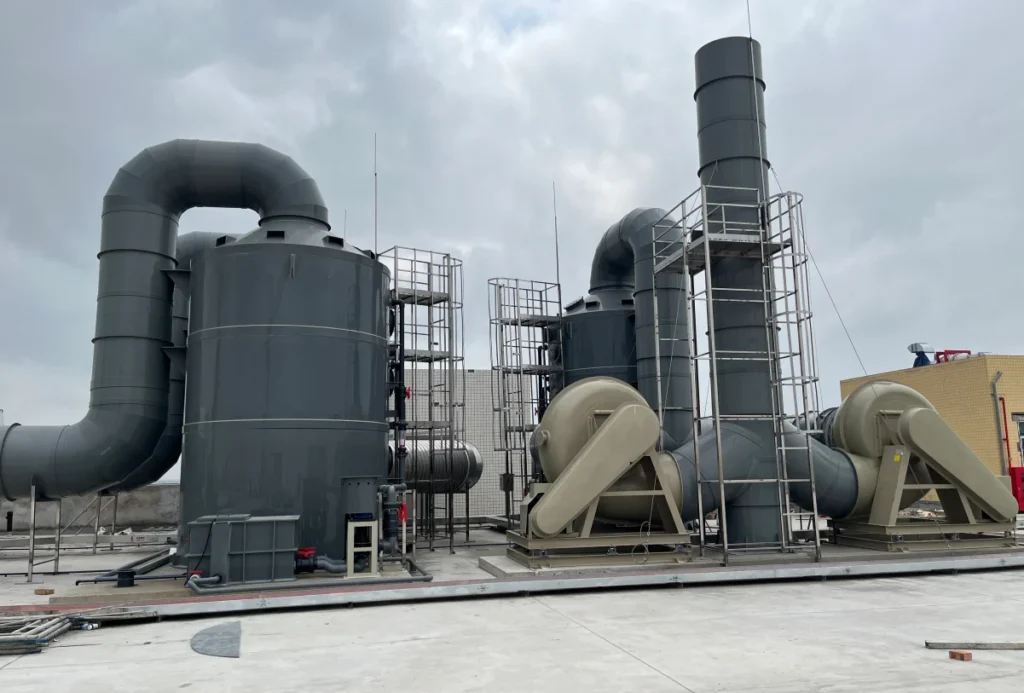
You have an exhaust stream carrying acid gas, fine dust, or both, and the emission deadline is not negotiable. The question is not whether to treat it but which technology can handle your specific pollutant mix without breaking the operating budget. A baghouse catches particulate but lets soluble gas pass through. A dry sorbent system removes gas but generates solid waste you must haul away. The wet scrubber handles both in a single vessel, yet many buyers select the wrong type because they compare price before they measure what is actually in the gas. This guide covers what a wet scrubber is →, the five main configurations, how to match one to your pollutant profile, what it costs to buy and run, and where it fits in your compliance strategy.
Key Takeaways
- A wet scrubber removes both soluble gases and particulate in a single vessel. If your exhaust contains HCl or NH3 plus fine dust, no baghouse or dry sorbent system alone can handle both. The wet scrubber simplifies a multi-stage train into one piece of equipment.
- Five scrubber types exist, and selecting the wrong one wastes both capital and operating budget. A packed bed scrubber achieves 95-99% acid gas removal at low pressure drop but fouls when dust exceeds 0.1 gr/dscf. A venturi scrubber captures 99%+ submicron particulate at 15-60 inches H2O, but the fan energy cost is 3-5 times higher than a packed bed.
- Scrubbing chemistry determines performance more than vessel size does. A packed tower with correctly dosed NaOH removes 95-99% of HCl. The same tower with plain water drops to 40-60% within minutes as the liquid saturates. The chemical dosing system is not an accessory ??it is the scrubber’s engine.
- Operating cost dominates the 10-year total. A 20,000 CFM packed bed scrubber treating 200 ppm HCl costs approximately $65,000 in capital but $295,000 in operating costs over 10 years. Selecting the cheapest bid without evaluating the operating cost profile is the most expensive decision. A full advantages and disadvantages comparison → covers the trade-offs a buyer can make.
- The cost gap between scrubber types is in the operating budget, not the purchase order. A packed bed scrubber costs more upfront but less to operate than a venturi scrubber of the same capacity. The crossover point occurs at 12-18 months, and the savings continue for the remaining 13+ years of service life.
What Is a Wet Scrubber?
A wet scrubber is an air pollution control device that removes contaminants from industrial exhaust gas by bringing the gas into direct contact with a liquid, typically water, a chemical solution, or a slurry. The pollutant transfers from the gas phase into the liquid phase through absorption, impaction, or chemical reaction, and the cleaned gas passes through a mist eliminator before discharge. This dual-role capability ??capturing both soluble gases and particulate in a single vessel ??is what distinguishes wet scrubbers from dry collection technologies such as baghouses, electrostatic precipitators, and dry sorbent injection systems.
The term wet air scrubber covers several configurations that share the same core principle but differ in how they achieve gas-liquid contact. A packed bed scrubber routes gas through a bed of plastic or ceramic media wetted by recirculating liquid, maximizing surface area for gas absorption. A spray tower relies on high-pressure nozzles to create a fine liquid mist. A venturi scrubber accelerates gas through a constricted throat where high-velocity liquid droplets capture fine particulate. Each configuration is suited to a different pollutant profile, which means selecting the wrong type can leave you with a system that runs but does not meet the emission limit.
What a Wet Scrubber Can Remove
Wet scrubbers remove three broad categories of pollutants. The first is acid gases: hydrogen chloride (HCl), hydrogen fluoride (HF), sulfur dioxide (SO2), hydrogen sulfide (H2S), and to a limited extent nitrogen oxides (NOx). These gases are soluble in water or react rapidly with alkaline scrubbing solutions such as sodium hydroxide (NaOH) or calcium hydroxide (Ca(OH)2). Removal efficiency for HCl and HF typically exceeds 95% in a properly designed packed bed scrubber, while SO2 removal ranges from 90% to 99% depending on the alkalinity and contact time.
The second category is alkaline gases, primarily ammonia (NH3) and amines. These are highly water-soluble and can be removed with water alone, though acidic scrubbing solutions (sulfuric or phosphoric acid) improve efficiency and reduce the liquid volume required. The third category is particulate matter: coarse dust above 10 microns, fine particulate down to PM2.5, and condensable aerosols. Venturi scrubbers achieve 99%+ removal on submicron particulate, while packed bed scrubbers are less effective on particulate and tend to foul when dust loading exceeds 0.1 grains per dry standard cubic foot (gr/dscf).
Wet scrubbers also remove soluble organic vapors and odor-causing compounds, though removal efficiency varies widely by compound and is generally lower than for acid gases. For streams containing mixed pollutants ??HCl plus fine dust, or SO2 plus condensable aerosols ??the wet scrubber’s ability to handle both in one vessel simplifies what would otherwise be a multi-stage treatment train.
When a Wet Scrubber Is the Right Choice
The decision to specify a wet scrubber starts with the pollutant profile. A wet scrubber is the right choice when the exhaust stream contains soluble gases that require chemical neutralization, when the gas temperature exceeds 180 degF (a baghouse would require expensive filter media), when the gas is saturated with moisture (dry filters blind quickly), or when the stream carries both gas and particulate and you need one system to handle both. A wet scrubber is usually the wrong choice when the only contaminant is dry particulate (a baghouse or cyclone costs less and operates at lower pressure drop), when water is unavailable or discharge is prohibited, or when the pollutant concentration is so low that a dry sorbent system can handle it without generating excessive waste.
How a Wet Scrubber Works
The operating principle of a wet scrubber is gas-liquid mass transfer. Contaminated gas enters the scrubber vessel and passes through a zone of intense liquid contact where pollutants transfer from the gas into the liquid. The cleaned gas exits through a mist eliminator, while the liquid is recirculated or discharged. The process follows five sequential steps, each of which must be correctly designed for the scrubber to perform.
Step 1: Contaminated Gas Enters the Scrubber
The gas stream enters through an inlet designed to distribute flow evenly across the vessel cross-section. Uneven entry creates channeling ??gas bypasses the contact zone and exits untreated. Inlet velocity is typically kept between 30 and 50 ft/s to prevent re-entrainment of settled liquid. A distribution baffle or inlet diffuser is common in larger vessels.
Step 2: Scrubbing Liquid Is Introduced
The scrubbing liquid enters through spray nozzles, a liquid distributor above packed media, or injection points in a venturi throat. The method determines the droplet size, surface area, and contact pattern. Nozzles produce droplets from 200 to 2000 microns depending on pressure and orifice design. Packed bed distributors rely on gravity to spread liquid evenly over the packing surface. The liquid-to-gas (L/G) ratio is the key design parameter, with reference data available from Engineering Toolbox scrubber design resources, typically ranging from 2 to 10 gallons per 1,000 actual cubic feet of gas. An L/G ratio too low starves the contact surface; too high wastes pump energy and may flood the packing.
Step 3: Gas-Liquid Contact and Pollutant Transfer
This is the core of the scrubber’s function. Pollutants transfer from the gas phase into the liquid phase through four mechanisms. Absorption occurs when soluble gas molecules dissolve into the liquid film ??HCl and NH3 are highly soluble and transfer rapidly. Chemical reaction follows dissolution when the scrubbing liquid contains a reactive chemical ??NaOH neutralizes HCl to form NaCl and water, driving the absorption rate higher by keeping the liquid-phase concentration near zero. Impaction captures particulates heavier than 1-3 microns when the gas stream turns around a liquid droplet and the particle’s inertia carries it into the droplet. Diffusion captures submicron particles that collide with droplets via Brownian motion. Each mechanism is dominant in a different particle size range, which is why different scrubber types excel at different duties.
The step-by-step working guide → details the chemistry. The chemistry of the scrubbing liquid is not an accessory decision. For acid gas removal, NaOH concentration is typically maintained at 1-5% by weight in the recirculation tank, with pH controlled between 8 and 10. If pH drifts below 7, acid gas removal efficiency drops sharply because there are insufficient hydroxide ions available for neutralization. A pH controller and chemical dosing pump are standard equipment on any scrubber handling acid gases, not optional upgrades.
Step 4: Mist Elimination
After the contact zone, the cleaned gas carries entrained liquid droplets that contain dissolved pollutants, reaction byproducts, and suspended solids. A mist eliminator removes these droplets before the gas exits the stack. Three designs are common: vane packs (chevron blades) for droplet removal above 10 microns, mesh pads for removal above 3-5 microns, and cyclonic separators for high-liquid-load applications. Pressure drop across the mist eliminator is typically 0.5-2 inches H2O. Undersized or fouled mist eliminators cause visible stack emissions, liquid loss from the recirculation system, and downstream corrosion in ductwork.
Step 5: Liquid Recirculation and Blowdown
The scrubbing liquid collects in the sump at the bottom of the vessel, where it is recirculated through the pump loop. A portion of the liquid is continuously bled off as blowdown to control the buildup of dissolved solids and reaction byproducts. The blowdown rate depends on the inlet pollutant load and the target total dissolved solids, typically 5-15% of the recirculation rate. The blowdown stream requires treatment through the plant’s wastewater system before discharge. pH is controlled by adding fresh chemical to the recirculation loop, and make-up water replaces the volume lost to blowdown and evaporation. This liquid management loop is as important as the gas-side performance ??many scrubber failures trace back to neglected chemical dosing or uncontrolled solids buildup rather than vessel design.
Main Types of Wet Scrubbers
Five main scrubber configurations dominate industrial use. Each has a distinct gas-liquid contact method, efficiency range, and operating cost profile. The right match depends on your pollutant type, particle size, gas temperature, and site constraints. The table below summarizes the differences; detailed coverage of each type is available in the types of wet scrubber guide →.
Packed Bed Scrubber
The packed bed scrubber routes gas upward through a bed of randomly packed media ??Pall rings, Raschig rings, or saddle shapes ??while scrubbing liquid flows downward over the media surface. The packing creates a large wetted surface area (typically 30-100 ft2/ft3) for gas-liquid contact. Packed bed scrubbers are the most common choice for acid gas absorption because they provide the highest mass transfer efficiency per unit of pressure drop. They operate at 3-8 inches H2O pressure drop, achieve 95-99% removal on soluble acid gases, and handle gas flow rates from 500 to 100,000 CFM. Their main limitation is that they foul when the inlet particulate loading exceeds 0.1 gr/dscf. For a comparison of packing media types, see the detailed scrubber types article.
Spray Tower Scrubber
The spray tower is the simplest wet scrubber design: gas enters the bottom of an empty vessel while liquid is sprayed from nozzles at the top. No packing media means there is nothing to foul, making spray towers the preferred choice for high-temperature gas (above 180 degF), sticky particulates, and applications with heavy dust loading. Removal efficiency is lower than packed bed designs ??typically 80-90% for gases and 70-85% for particulate ??because the gas-liquid contact is less intense. Pressure drop is low at 1-4 inches H2O. Spray towers are commonly used for gas quenching, bulk particulate removal upstream of a polishing scrubber, and applications where the gas temperature would damage packing media.
Venturi Scrubber
The venturi scrubber accelerates gas through a constricted throat where high-velocity liquid injections create a dense field of fine droplets. The high relative velocity between gas and droplets (up to 400 ft/s at the throat) makes the venturi the most efficient wet scrubber for fine particulate, achieving 99%+ removal on submicron particles. This performance comes at a cost: pressure drop ranges from 15 to 60 inches H2O, which translates directly into fan energy cost. A venturi scrubber for a 20,000 CFM system can consume $8,000-15,000 per year more in electricity than a packed bed scrubber at the same flow rate. Venturis are specified when outlet particulate limits are below 10 mg/Nm3 or when the particulate is predominantly submicron, such as in incinerator flue gas, metal fume from smelting, or chemical process aerosol streams.
Crossflow Scrubber
The crossflow scrubber routes gas horizontally through a packed bed while liquid flows vertically downward, creating a cross-flow contact pattern. This configuration requires less vertical headroom than a packed tower, making it suitable for rooftop installations, indoor retrofits, and applications where the vessel height is constrained by building structure. Removal efficiency is comparable to packed bed scrubbers for gas absorption but slightly lower for particulate due to the flow pattern. Crossflow scrubbers are commonly specified for corrosive gas handling in chemical plants and semiconductor fabs where space above the equipment is limited.
Dynamic and Cyclonic Scrubbers
Dynamic scrubbers use rotating internals or centrifugal action to create gas-liquid contact without packing media. A cyclonic scrubber spins the gas stream to throw particulate toward a wetted wall, while a dynamic scrubber uses a motor-driven impeller to atomize liquid and create high-intensity contact. These designs handle sticky or moist particulates that would foul a packed bed, and they operate at moderate pressure drop (4-10 inches H2O). Their main drawback is higher maintenance due to moving parts. They are specified for applications such as food processing dust, textile fiber lint, and pharmaceutical powder recovery where the particulate is difficult to handle in a packed tower.
Type Selection Quick Reference
| Parameter | Packed Bed | Spray Tower | Venturi | Crossflow | Dynamic |
|---|---|---|---|---|---|
| Best for | Acid gas absorption | Hot gas, bulk removal | Fine PM, PM2.5 | Corrosive gas, low headroom | Sticky/moist dust |
| Gas removal | 95-99% | 80-90% | 90-98% | 90-95% | 80-90% |
| PM removal | 70-85% | 70-85% | 99%+ | 75-85% | 80-90% |
| Pressure drop | 3-8 in H2O | 1-4 in H2O | 15-60 in H2O | 2-5 in H2O | 4-10 in H2O |
| Temp limit | 180 degF (PP) | 250 degF (FRP) | 250 degF (FRP) | 180 degF (PP) | 200 degF |
| Capital cost | Moderate | Low | High | Moderate | Moderate |
| Operating cost | Low | Low | High | Low | Moderate |
| Limitation | Fouls on high dust | Lower efficiency | High energy use | Larger footprint | Moving parts maintenance |
Key Components of a Wet Scrubber System
A wet scrubber is more than the vessel visible from outside. The system includes the scrubber vessel and internals, a recirculation pump and piping loop, a chemical dosing skid, instrumentation for monitoring and control, and a fan or blower to move gas through the system. Each component must be correctly sized for the system to meet its emission target.
The scrubber vessel contains the internals that create gas-liquid contact: packing media, spray nozzles, or a venturi throat. The vessel material must resist the corrosive action of both the gas and the scrubbing liquid. Polypropylene (PP) is the most common material for acid gas scrubbers operating below 180 degF. FRP is specified for larger diameters above 8 ft or for gas temperatures up to 220 degF. Stainless steel 316L is required for high-temperature or oxidizing environments such as chlorine gas or nitric acid fume.
The recirculation pump delivers liquid from the sump to the spray nozzles or distributor at the required flow rate and pressure. Pump head must overcome the static lift, nozzle pressure, piping friction, and any elevation difference between the sump and the distribution point. Flow rate is set by the L/G ratio, typically 50-200 gpm per 10,000 CFM of gas flow depending on the application. A standby pump is standard on critical installations.
The chemical dosing system maintains the scrubbing liquid chemistry. For acid gas scrubbers, a NaOH storage tank, metering pump, and pH controller are standard. The metering pump injects concentrated NaOH into the recirculation loop at a rate controlled by the pH sensor. Consumption ranges from 5 to 50 gallons per day of 25% NaOH depending on the acid gas load. For NH3 scrubbers, the dosing system delivers sulfuric acid. For odor control scrubbers using NaOCl (sodium hypochlorite), an ORP controller replaces the pH controller.
Instrumentation includes a pH sensor (or ORP sensor), differential pressure transmitter across the packing, liquid flow meter, and sump level switch. A pH sensor that drifts out of calibration is the single most common cause of wet scrubber performance degradation, and weekly calibration is recommended. Differential pressure monitoring detects fouling of the packing or mist eliminator before the pressure drop increases fan power consumption beyond the motor capacity. A simple control panel with a PLC and HMI is standard on scrubbers above 5,000 CFM; simpler relay-based controls suffice for smaller packaged units.
The fan draws gas through the scrubber and discharges it through the stack. Fan static pressure must overcome the scrubber pressure drop plus ductwork losses, typically 5-20 inches H2O for packed bed and spray tower scrubbers, and up to 60 inches H2O for venturi scrubbers. The fan motor power scales directly with pressure drop and flow rate, which is why a venturi scrubber’s operating cost is dominated by electricity rather than reagent.
Industrial Applications of Wet Scrubbers
Wet scrubbers serve as a versatile wet scrubber for air pollution control across industries because their ability to handle both gas and particulate simplifies complex emission problems. The scrubber type, material, and chemistry change by industry, but the principle is the same: bring the exhaust gas into contact with a liquid that absorbs or neutralizes the target pollutant.
Chemical Processing
Chemical plants generate HCl, HF, H2SO4, and SO2 from reactors, distillation columns, storage tank vents, and loading stations. A packed bed scrubber with NaOH solution is standard, achieving outlet concentrations below 5 ppm for HCl and HF. For nitric acid plants, the NOx absorption requires a multi-stage approach with oxidation and water scrubbing. The choice between PP and FRP construction depends on the temperature and the presence of organic solvents that attack polypropylene.
Metal Finishing and Electroplating
Electroplating baths generate acid mist containing HCl, H2SO4, and HF from chrome, nickel, and zinc plating lines. Local exhaust ventilation draws the fume through a packed bed scrubber mounted adjacent to the bath or connected by ductwork. Chrome plating requires particular attention because hexavalent chromium (Cr6+) is a regulated air toxic, and the scrubber must achieve outlet concentrations below 0.01 mg/Nm3 in some jurisdictions. A packed bed scrubber with a mist eliminator and demister pad is standard, and the scrubbing liquid (water or caustic) is bled to the plant’s wastewater treatment system for chrome reduction before discharge.
Semiconductor Manufacturing
Semiconductor fabs generate HF, NH3, Cl2, and HCl from CVD, etch, and clean processes. The gas streams are often intermittent, dilute, and carried in large volumes of exhaust air. Packed bed scrubbers with caustic solution handle acid gases, while separate scrubbers with acidic solution handle NH3. The fab environment places a premium on reliability because a scrubber outage can shut down the entire production line. Dual scrubbers with automatic changeover are common on critical tools, and the scrubber materials (PP or PVC) are selected to avoid metallic contamination of the exhaust stream.
Pharmaceutical Production
Pharmaceutical operations generate solvent vapors (acetone, methanol, IPA), acid gases (HCl from chemical synthesis), and odorous organic compounds. Wet scrubbers for solvent vapor control typically use water as the scrubbing medium when the solvents are water-soluble, or a packed bed with acidic/alkaline solution when the target is an acid gas. For non-water-soluble VOCs, a wet scrubber alone is insufficient and a carbon adsorber or thermal oxidizer is needed downstream. The pharmaceutical industry’s batch operations mean the scrubber must handle widely varying loads, which requires a control system that adjusts chemical feed and recirculation rate dynamically.
Waste Incineration and Power Generation
Incineration flue gas contains SO2, HCl, HF, heavy metals, and fine particulate. A multi-stage treatment train is standard: dry sorbent injection or a quench stage upstream, a wet scrubber for acid gas removal, and a wet electrostatic precipitator for fine particulate and aerosol capture. The wet scrubber stage typically uses a spray tower or packed bed with NaOH or lime slurry. The challenge is the high gas temperature entering the scrubber (350-500 degF after the quench) and the presence of chlorides that create highly corrosive conditions. FRP is not suitable at these temperatures, so the scrubber is lined with acid-resistant brick or constructed from high-nickel alloy.
Other Key Sectors
Pulp and paper mills use wet scrubbers for recovery boiler flue gas and bleach plant exhaust. Food processing plants use them for odor control from rendering, cooking, and wastewater treatment. Mining and smelting operations use venturi scrubbers for particulate control on crushers, conveyors, and furnaces. Each application requires a different combination of scrubber type, material, and chemistry, which is why a one-size-fits-all approach to scrubber selection consistently underperforms.
How to Select an Industrial Wet Scrubber
Selecting the right industrial wet scrubber requires evaluating five variables in sequence. Skipping any one leads to a system that either fails to meet the emission limit or costs more to operate than necessary.
Step 1: Fully Characterize the Exhaust Stream
The single most common cause of scrubber underperformance is incomplete inlet data. Before any selection begins, you need the gas flow rate (actual CFM, not standard), gas temperature at the scrubber inlet, the identity and concentration of every pollutant present, particulate loading and particle size distribution if the stream contains dust, and moisture content or relative humidity. Without this data, scrubber selection is guesswork. A scrubber designed for 100 ppm HCl at 100 degF will not perform the same way on 500 ppm HCl at 180 degF because the reaction kinetics and the equilibrium solubility change with concentration and temperature.
Step 2: Identify the Applicable Emission Limit
The regulatory outlet limit sets the minimum removal efficiency your scrubber must achieve. EPA MACT standards, EU BREF BAT-AEL limits, India CPCB Schedule VI, China ultra-low emission standards, and World Bank IFC guidelines all specify different outlet concentrations for the same pollutant. A dry scrubber that meets the US EPA limit of 10 ppm HCl may fail the EU BAT-AEL of 1-3 ppm. Know your limit before you select your technology. The EPA wet scrubber monitoring guidelines provide a starting point for US facilities.
Step 3: Match Scrubber Type to Pollutant Profile
With the inlet data and outlet target established, match the scrubber type to the pollutant. Soluble acid gases at moderate concentration (50-500 ppm) with low particulate loading go to a packed bed scrubber. Fine particulate at submicron range with low gas load goes to a venturi scrubber. High-temperature gas above 200 degF goes to a spray tower or quench stage first, then a packed bed. Mixed streams containing both high dust and soluble gas may need a spray tower for bulk removal followed by a packed bed for polishing. The decision matrix in the types section of this guide maps each pollutant profile to the recommended scrubber type.
Step 4: Evaluate Site-Specific Constraints
Three site constraints can override the ideal technical selection. Available footprint determines whether a vertical packed tower or horizontal crossflow scrubber fits. Water quality and quantity determine whether a wet scrubber is feasible at all ??if the site has no wastewater discharge permit, a dry system or zero-liquid-discharge scrubber may be the only option. Electrical capacity determines whether the fan motor for a high-DP venturi scrubber can be supported without a transformer upgrade. Evaluate these constraints before the detailed design phase begins.
Step 5: Compare Total Cost of Ownership
The scrubber with the lowest purchase price is rarely the lowest-cost option over 10 years. A venturi scrubber costs 20-40% less capital than a packed bed scrubber of equivalent capacity, but its annual fan energy cost is 3-5 times higher, and the crossover point where the packed bed is cheaper occurs at 12-18 months. A polypropylene scrubber costs 30-50% less than a stainless steel scrubber but may need replacement at year 10 in a service where SS lasts 20 years. Compare the 10-year total cost ??capital plus annual operating cost multiplied by 10 ??not the initial equipment price. A detailed cost model is provided in the cost section below.
Wet Scrubber Cost Framework
The cost of a wet scrubber is the sum of capital equipment and 10 years of operating expenses. The capital number appears in the purchase order. The operating number appears in the monthly budget for the life of the system. Both must be evaluated together.
Capital Cost by Type and Size
Capital cost depends primarily on gas flow rate (which sets vessel diameter and packing volume), material of construction, and the scope of auxiliary equipment. The ranges below are for a complete scrubber system including vessel, packing, nozzles, mist eliminator, recirculation pump, chemical dosing skid, basic instrumentation, and a control panel. Fan and ductwork are not included because these vary significantly by installation.
| Flow Rate | Packed Bed (PP) | Spray Tower (FRP) | Venturi (FRP) |
|---|---|---|---|
| 5,000 CFM | $25,000-40,000 | $18,000-30,000 | $35,000-55,000 |
| 20,000 CFM | $55,000-75,000 | $35,000-55,000 | $70,000-100,000 |
| 50,000 CFM | $90,000-130,000 | $60,000-90,000 | $120,000-180,000 |
Material choice significantly affects the capital cost. Customizable configurations are available through our wet scrubber customizable product line →. Moving from PP to FRP adds 15-25%. Moving from PP to stainless steel 316L adds 60-100%. The material premium is usually justified when the gas temperature exceeds 180 degF, the scrubbing chemistry is oxidizing, or the service life requirement exceeds 15 years.
Operating Cost Breakdown
Operating costs fall into four categories. Reagent consumption is the largest variable cost for acid gas scrubbers. A 20,000 CFM system treating 200 ppm HCl consumes approximately 25-35 kg of NaOH per day at 25% concentration, costing $15-25 per day at bulk pricing. Annual NaOH cost runs $5,000-9,000 for this duty.
Energy cost is dominated by the fan. A packed bed scrubber at 5 inches H2O on a 20,000 CFM system requires approximately 20 brake horsepower at 60% fan efficiency. At $0.10/kWh and 8,000 operating hours per year, annual fan energy cost is approximately $12,000. A venturi scrubber at 40 inches H2O on the same flow requires 90 bhp and costs $54,000 per year in fan energy alone ??a $42,000 annual penalty for the higher pressure drop.
The recirculation pump adds $1,000-3,000 per year depending on head and flow rate. A 200 gpm pump at 60 ft head on a 20,000 CFM scrubber draws approximately 5 bhp and costs $3,000 per year.
Wastewater treatment cost depends on local discharge limits and is typically $2,000-8,000 per year for a 20,000 CFM acid gas scrubber, covering neutralization, solids settling, and discharge permitting. The blowdown stream is a neutral salt solution (NaCl, Na2SO4, NaF) that is readily treatable through standard industrial wastewater facilities in most jurisdictions. Solids from the blowdown are typically less than 1% of the inlet gas mass flow, which is negligible compared to the solid waste generated by a dry sorbent injection system.
10-Year Total Cost of Ownership Example
For a 20,000 CFM packed bed scrubber treating HCl at 200 ppm inlet, the 10-year TCO breaks down as follows: capital cost of $65,000 (PP packed bed system), NaOH reagent at $7,000/year ($70,000 over 10 years), fan energy at $12,000/year ($120,000 over 10 years), pump energy at $3,000/year ($30,000), wastewater treatment at $4,000/year ($40,000), and maintenance labor and parts at $3,500/year ($35,000). The 10-year total is approximately $360,000, of which only 18% is the initial capital. This ratio is typical for wet scrubbers: operating cost dominates the lifecycle cost, which is why selecting for low purchase price is almost always the wrong decision.
Frequently Asked Questions
What gases can a wet scrubber remove?
A properly designed wet scrubber removes HCl, HF, H2SO4, HNO3, SO2, NH3, Cl2, H2S, and many soluble organic vapors. The common requirement is that the gas must be soluble in or reactive with the scrubbing liquid. Highly soluble gases like HCl and NH3 are removed most efficiently (95-99%+). Gases with lower solubility such as NO and CO require chemical oxidation or biological treatment and cannot be removed by a conventional wet scrubber alone.
What is a wet scrubber machine?
The term wet scrubber machine usually refers to a complete pre-engineered scrubber system supplied as a skid-mounted package: the vessel, recirculation pump, mist eliminator, chemical dosing skid, control panel, and fan are assembled on a common base frame. These packaged systems are most cost-effective for flow rates between 500 and 15,000 CFM, where the engineering cost of a custom field-erected system is disproportionately high relative to the equipment value. The package includes all internal piping, wiring, and interconnecting components, so installation requires only connection to the ductwork, water supply, and electrical power.
What materials are used in wet scrubber construction?
Polypropylene (PP) is the most common material for acid gas scrubbers below 180 degF. FRP is specified for larger diameters (above 8 ft) and for higher temperature service up to 220 degF. Stainless steel 316L is required above 220 degF and for oxidizing services such as chlorine and nitric acid. PVC and CPVC are used for small-diameter pipework and chemical distribution lines. The material must be matched to the specific corrosive environment ??a scrubber handling HCl at 150 degF can use PP, but the same scrubber handling HCl at 200 degF with traces of nitric acid requires FRP or SS 316L.
How does a wet scrubber compare to a baghouse?
A baghouse achieves 99.9%+ particulate removal at lower operating cost than a wet scrubber when the gas is dry and the only target is particulate. But when the gas contains soluble gases, a baghouse cannot remove them, and a wet scrubber removes both gas and particulate in one vessel. The wet scrubber also handles hot gas (up to 250 degF with FRP) where a baghouse would require expensive high-temperature filter media. The comparison depends on whether your emission problem is pure particulate or a mixed gas and particulate stream.
Can a wet scrubber handle high-temperature gas?
Yes, with the correct material selection. A spray tower or quench stage can handle inlet gas up to 1,000 degF. The gas is cooled to saturation by evaporative cooling in the quench section before entering the main scrubber bed. For gas temperatures between 200 and 350 degF entering the scrubber directly, FRP construction is required. Polypropylene softens above 185 degF and should not be used above 180 degF. Above 350 degF, a refractory-lined or alloy scrubber is required, and a quench stage is nearly always specified to protect downstream equipment.
Conclusion
The wet scrubber is the most versatile single technology for industrial air pollution control because it handles both gas and particulate contaminants in one vessel. The five main configurations ??packed bed, spray tower, venturi, crossflow, and dynamic ??cover the full range of pollutant types, gas conditions, and site constraints found across chemical, metal, semiconductor, pharmaceutical, and power generation industries.
Each selection decision starts with the same question: what exactly is in your exhaust, and what outlet concentration does your permit require? Measure the gas before you choose the equipment. Match the scrubber type to your pollutant profile, not to a budget. And evaluate the 10-year total cost, not the purchase price ??because the operating expense of a mismatched scrubber compounds every year it runs.
For a custom wet scrubber recommendation based on your exhaust parameters, contact our engineering team or browse the wet scrubber product range → for standard configurations.