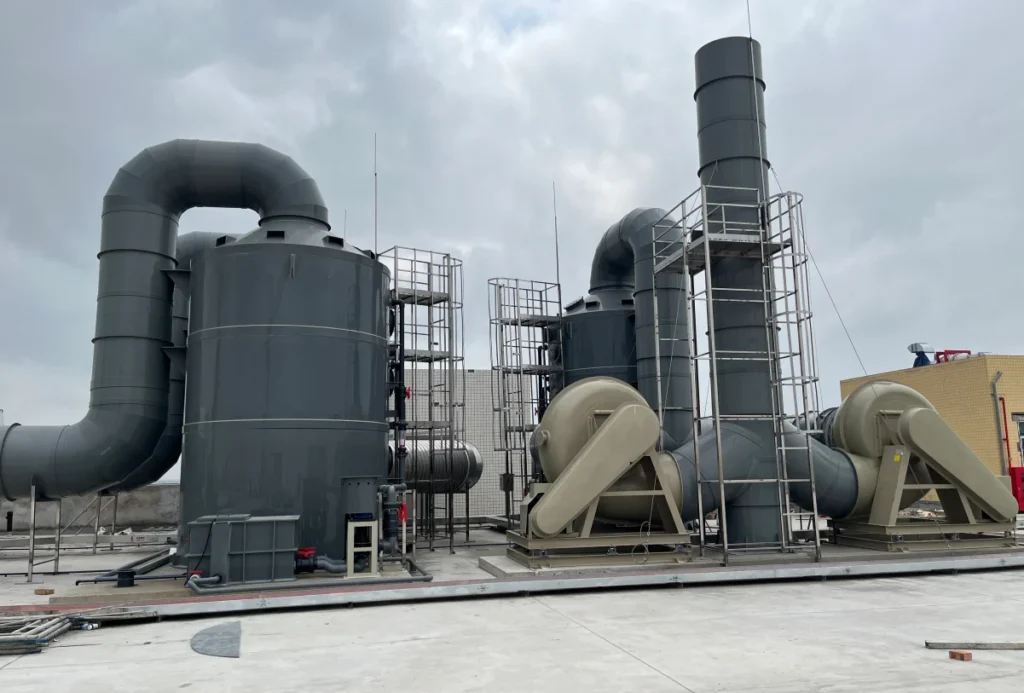
What is a wet scrubber? A wet scrubber is an industrial air pollution control device that uses a liquid — typically water or a chemical solution — to remove harmful pollutants from exhaust gas streams. Every industrial facility that burns fuel, processes chemicals, or manufactures goods produces exhaust gas containing pollutants that must be removed before discharge to the atmosphere. Wet scrubbers are one of the most widely used technologies for this task — they remove acid gases, particulate matter, and odorous compounds by bringing the contaminated gas stream into intimate contact with a scrubbing liquid. Unlike dry collection systems that capture pollutants on filter media, a wet scrubber transfers pollutants from the gas phase into the liquid phase, where they can be neutralized, dissolved, or collected as slurry. This makes a wet scrubber the preferred choice for applications where the gas stream is hot, moist, or contains sticky particulates that would blind a dry filter. This guide covers what a wet scrubber is and how it works, the key components of a wet scrubber system, what pollutants a wet scrubber can remove with quantified efficiency data, a comparison of wet scrubbers against dry scrubbers and baghouses, and common applications and maintenance considerations.
Key Takeaways
- A wet scrubber removes pollutants from industrial exhaust by forcing contaminated gas into contact with a scrubbing liquid — pollutants transfer from the gas phase into the liquid phase, where they are captured, neutralized, or dissolved. This makes wet scrubbers effective for acid gases (SO2, HCl, NH3), particulate matter, and odorous compounds simultaneously.
- Wet scrubbers achieve 99%+ removal efficiency for soluble acid gases (SO2, HCl, HF) and 90-99% for particulate matter above 1 micron, but they consume 0.5-3 L of water per 100 m3 of gas treated and generate a wastewater stream that requires treatment before disposal.
- Unlike dry scrubbers that use powdered sorbents or baghouses that use filter media, wet scrubbers can handle hot gas streams above 200C without cooling, moist or sticky particulates that would blind dry filters, and combustible dusts that pose explosion risks in dry collection systems.
- A wet scrubber system has eight essential components — the scrubber vessel, gas inlet, liquid distribution system, packing or contact section, recirculation pump, mist eliminator, fan, and instrumentation. Each must be correctly sized; the most commonly overlooked is the mist eliminator, which prevents contaminated liquid droplets from escaping the stack.
- Wet scrubbers are not a one-size-fits-all solution. They work best for gas streams above 30C, for pollutants that are water-soluble or reactive with alkaline scrubbing liquids, and for facilities that already have wastewater treatment. For dry gas streams below 30C where water is limited, a dry scrubber or baghouse may be more practical.
What Is a Wet Scrubber? Definition and Overview
The wet scrubber definition is straightforward: it is an air pollution control device that uses a liquid medium to capture pollutants from industrial exhaust.
A wet scrubber is an air pollution control device that uses a liquid — typically water, a chemical solution, or a slurry — to remove harmful pollutants from industrial exhaust gas streams. The contaminated gas is forced into intimate contact with the scrubbing liquid, and pollutants transfer from the gas phase into the liquid phase through absorption (for soluble gases), impaction (for particulate matter), or chemical reaction (for reactive compounds). The cleaned gas then passes through a mist eliminator to remove entrained liquid droplets before being discharged to the atmosphere.
Wet scrubbers are used across a wide range of industries: chemical plants use them to capture acid gases such as HCl and SO2, metal smelters use them for particulate and fluoride control, food processors use them for odor control, and coal-fired power plants use them for flue gas desulfurization (FGD). XICHENG EP supplies industrial wet scrubber systems → for these and other applications in materials including FRP, PP, and SS316L. They are particularly valuable for gas streams that are hot, moisture-laden, or contain sticky particulates — conditions that would damage or blind dry filtration systems such as baghouses or cartridge collectors.
What Does a Wet Scrubber Do?
To understand what is a wet scrubber in practical terms, it helps to look at the four specific functions it performs in industrial exhaust treatment.
A wet scrubber performs four distinct functions in industrial exhaust treatment, and which function is primary depends on the application.
Acid gas removal: The most common application. Soluble acid gases — SO2, HCl, HF, H2S — dissolve rapidly into water or react with alkaline scrubbing solutions (NaOH, Ca(OH)2, Mg(OH)2). SO2 absorption in a packed tower scrubber with caustic achieves 99%+ removal efficiency at a liquid-to-gas ratio of 4-20 gallons per 1,000 cubic feet of gas treated, depending on the target removal rate and gas concentration.
Particulate collection: Particles in the gas stream collide with liquid droplets and are captured by inertial impaction. Wet scrubbers are effective for particles above 0.5-1 micron; for submicron particles, a venturi scrubber with high pressure drop (30-100 in wc) is required to achieve adequate capture efficiency.
Odor control: Odor-causing compounds — hydrogen sulfide, ammonia, mercaptans, amines — are typically water-soluble or reactive with oxidizing chemicals such as sodium hypochlorite (bleach) or hydrogen peroxide, making wet scrubbing an effective odor control technology for wastewater treatment plants and food processing facilities.
Gas cooling and quenching: When exhaust gas enters a scrubber at 200-800C, the scrubbing liquid evaporates and cools the gas to near the adiabatic saturation temperature (60-80C), protecting downstream equipment and condensing volatile pollutants for easier capture.
How Does a Wet Scrubber Work? Working Principle Explained
The wet scrubber working principle is based on gas-liquid mass transfer. Here is how a wet scrubber works step by step.
At its core, what is a wet scrubber doing when it cleans exhaust gas? It follows three steps.
The operation of a wet scrubber follows a three-step process: gas-liquid contact, pollutant capture, and mist elimination. The specific equipment and conditions vary by scrubber type, but the principle is the same across all designs.
Step 1: Gas-Liquid Contact
The first thing to understand about how a wet scrubber works is that the gas and liquid must be brought into close contact. A wet scrubber relies on this contact to transfer pollutants from gas to liquid.
The contaminated gas enters the scrubber vessel through an inlet duct and is brought into contact with the scrubbing liquid. The contact method depends on the scrubber type: in a spray tower, liquid is sprayed downward through nozzles while gas rises upward; in a packed bed scrubber, liquid is distributed over packing material while gas flows countercurrently upward; in a venturi scrubber, liquid is injected at the throat where gas velocity exceeds 50 m/s, shattering the liquid into fine droplets. The goal of every contact method is the same — maximize the surface area where gas and liquid interact. The liquid-to-gas (L/G) ratio is the key design parameter, typically ranging from 4 to 20 gallons per 1,000 cubic feet of gas treated for gas absorption applications. A higher L/G ratio increases removal efficiency but also increases pumping energy and water consumption — the optimal L/G is determined by the target removal efficiency and the solubility of the target pollutant. For highly soluble gases such as HCl, a lower L/G ratio is adequate; for less soluble gases such as SO2, a higher L/G ratio and alkaline chemical addition are required to achieve 99%+ removal.
Step 2: Pollutant Capture
Pollutants transfer from gas to liquid through two mechanisms depending on the pollutant type. For soluble gases (SO2, HCl, NH3, H2S), the driving force is absorption — the pollutant dissolves into the liquid because its concentration in the liquid is lower than in the gas. The absorption rate depends on the concentration gradient, the gas-liquid contact area, and the contact time. Chemical absorption occurs when the dissolved pollutant reacts with a chemical in the scrubbing liquid — for example, SO2 dissolved in water reacts with NaOH to form sodium sulfite (Na2SO3), which is much more soluble than SO2 alone, maintaining the concentration gradient that drives continued absorption. Without this chemical reaction, the water would quickly become saturated with SO2 and absorption would stop at approximately 0.1% SO2 loading. The chemical dosing rate must be controlled by a pH controller to maintain the correct chemical environment — for SO2 scrubbing, the pH is typically maintained at 6.5-7.5 using a caustic (NaOH) dosing pump controlled by a pH sensor in the recirculation tank.
For particulate matter, the capture mechanism is inertial impaction — particles in the gas stream have higher mass and momentum than gas molecules, so they cannot follow the gas flow around liquid droplets and instead collide with and adhere to the droplets. The collection efficiency for particles increases with particle size, gas velocity, and the number of liquid droplets per unit volume of gas. For particles above 5 microns, collection efficiency in a properly designed scrubber exceeds 99%. For submicron particles below 1 micron, the efficiency drops to 50-80% in a low-energy scrubber (spray tower or packed bed) and requires a high-energy venturi scrubber with 30-100 in wc pressure drop to achieve 90%+ efficiency. The particle collection efficiency follows the cut diameter relationship: at a given pressure drop and liquid-to-gas ratio, particles smaller than the cut diameter are collected at less than 50% efficiency, while particles larger than the cut diameter are collected at greater than 50% efficiency.
Step 3: Mist Elimination
After the gas-liquid contact section, the cleaned gas contains fine droplets of scrubbing liquid that must be removed before the gas exits the stack. These droplets carry the captured pollutants — if they escape, the scrubber effectively transfers the pollution from the gas to a visible liquid mist, creating a new problem. A mist eliminator (also called a demister pad or chevron vane pack) is installed at the scrubber outlet to capture these droplets. Wire mesh demisters capture droplets down to 3-5 microns with 99% efficiency; chevron vane packs handle higher gas velocities and fouling service but have a coarser cut point of 10-15 microns. The captured liquid drains back into the scrubber sump for recirculation.
Wet Scrubber System Key Components
Knowing what is a wet scrubber made of helps understand how it functions. Every wet scrubber system includes eight components, each correctly sized for the application.
| Component | Function | Selection Consideration |
|---|---|---|
| Scrubber vessel | Provides the chamber where gas and liquid contact occurs | Material: FRP, PP, SS316L depending on gas corrosivity and temperature; diameter determines gas velocity |
| Gas inlet duct | Directs contaminated gas into the vessel with uniform distribution | Inlet configuration affects gas distribution; poor inlet design reduces effective contact area by 20-30% |
| Liquid distribution system | Delivers scrubbing liquid into the gas stream in the correct droplet size and coverage pattern | Spray nozzles (full cone, hollow cone, spiral) or packed bed distributor; nozzle material must resist corrosion |
| Packing or contact section | Increases gas-liquid surface area for mass transfer (packed towers only) | Packing type (random vs structured), material (PP, ceramic, metal), surface area 100-300 m2/m3 |
| Recirculation pump | Circulates scrubbing liquid from the sump to the distribution system | Flow rate determined by L/G ratio; head determined by nozzle pressure + static lift + piping losses |
| Mist eliminator | Captures entrained liquid droplets from the cleaned gas before the outlet | Wire mesh for fine mist (<5 micron); chevron vanes for fouling service or high velocity |
| Fan or blower | Moves gas through the scrubber system | Pressure rating must overcome scrubber pressure drop (5-30 in wc for packed/spray; 30-100+ for venturi) |
| Instrumentation | Monitors pH, pressure drop, flow rate, temperature, and liquid level | pH control is essential for chemical scrubbers; dp across bed indicates fouling or flooding |
What Pollutants Can a Wet Scrubber Remove?
Understanding what a wet scrubber can remove is essential for selecting the right technology. A wet scrubber achieves different removal efficiencies depending on the pollutant type, concentration, gas temperature, scrubber design, and chemical composition of the scrubbing liquid. The table below shows typical removal efficiencies for a wet scrubber treating common industrial pollutants. A wet scrubber performance varies by pollutant type and operating conditions.
| Pollutant | Typical Removal Efficiency | Scrubbing Liquid | Notes |
|---|---|---|---|
| Sulfur dioxide (SO2) | 95-99%+ | NaOH, Ca(OH)2, lime slurry | Alkaline scrubbing required; pH above 6.5 for >99% |
| Hydrogen chloride (HCl) | 99%+ | Water or dilute NaOH | Highly water-soluble; water alone achieves >99% |
| Hydrogen fluoride (HF) | 99%+ | Water or dilute NaOH | Highly soluble; requires special materials (HF attacks glass) |
| Ammonia (NH3) | 95-99% | Dilute H2SO4 or water | Acid scrubbing required for >95%; water alone achieves 70-85% |
| Hydrogen sulfide (H2S) | 95-99% | NaOH + NaOCl or NaOH alone | Oxidizing chemical (bleach) for >95%; NaOH alone achieves 80-90% |
| Particulate matter (>1 micron) | 90-99% | Water | Efficiency depends on pressure drop and droplet size |
| Particulate matter (0.5-1 micron) | 70-90% | Water | Venturi scrubber with high dp required for >90% |
| VOCs (water-soluble) | 80-95% | Water or chemical solution | Limited to soluble VOCs (alcohols, ketones); insoluble VOCs require carbon or thermal oxidation |
| Odor compounds (H2S, mercaptans, amines) | 95-99% | NaOH + NaOCl | Two-stage scrubbing (absorption + oxidation) for complete odor removal |
Removal efficiency is affected by gas concentration, contact time, liquid-to-gas ratio, and chemical concentration in the scrubbing liquid. The values above represent achievable performance in a properly designed and operated scrubber at design conditions. Actual field performance may be lower if the scrubber is undersized, the chemical feed is not properly controlled, or the gas flow rate exceeds the design value. For EPA-referenced scrubber design methodology and emission standards see the EPA wet scrubber for particulate matter design manual.
Types of Wet Scrubbers
Four main wet scrubber types are used in industrial applications. The wet scrubber types differ in how they create gas-liquid contact.
Four main scrubber designs are used in industrial applications. Each creates gas-liquid contact in a different way, making it suited for specific pollutant types and operating conditions. The table below provides a quick comparison; detailed guides for each type are available in the C04 and C05 clusters.
Spray tower scrubbers are the simplest design — liquid is atomized through nozzles while gas rises upward. They are best for gas absorption and cooling where high efficiency is not required. Low pressure drop (2-6 in wc) but limited removal efficiency for particles above 10 microns.
Packed bed scrubbers use random or structured packing to maximize gas-liquid contact area. They provide the highest mass transfer efficiency for gas absorption and are the standard for chemical scrubbers requiring 99%+ removal. Pressure drop: 4-10 in wc per meter of packing.
Venturi scrubbers force gas through a narrow throat at high velocity (50-100 m/s), atomizing injected liquid into fine droplets. They are the most effective wet scrubber for submicron particulate capture. Pressure drop: 30-100+ in wc, requiring higher fan power.
Crossflow scrubbers have horizontal gas flow with vertical liquid flow through packing. They are compact and used for space-constrained installations. Moderately lower efficiency than countercurrent packed towers.
When to Use a Wet Scrubber — and When Not To
Knowing what is a wet scrubber good for and where it falls short helps avoid costly misapplications.
A wet scrubber is the right choice for specific operating conditions and the wrong choice for others. Understanding when a wet scrubber fits prevents costly mistakes. Understanding the boundary conditions prevents misapplication.
Use a wet scrubber when: The gas temperature exceeds 80C (a baghouse would need cooling), the gas is saturated with moisture (dry filters blind), the particulate is sticky or hygroscopic (it would adhere to filter media), the exhaust contains both gases and particles requiring simultaneous removal, combustible dust is present (wet scrubbing eliminates explosion risk), or the gas contains condensible hydrocarbons that would blind dry media.
Do not use a wet scrubber when: Water is unavailable or expensive to treat on site, the target pollutant is water-insoluble and non-reactive (certain VOCs, carbon monoxide, nitrogen), the particulate is submicron and a high-efficiency venturi is not cost-justified, freezing temperatures would affect outdoor operation without heated enclosures, or the facility has no wastewater treatment capability for the blowdown stream. For these conditions, dry scrubbers, carbon adsorbers, thermal oxidizers, or baghouses may be more appropriate.
The decision also depends on the target emission limit. Wet scrubbers achieve 95-99%+ removal for soluble acid gases but typically only 70-95% for submicron particulate. If the permit requires 99.9% particulate removal below 1 micron, a baghouse or ESP followed by a wet scrubber may be needed — not a wet scrubber alone.
Wet Scrubber Design Parameters
Four design parameters determine whether a wet scrubber achieves its target removal efficiency: liquid-to-gas ratio, gas velocity, pressure drop, and contact time. Understanding these parameters helps you evaluate whether a proposed scrubber design is adequate for the application.
Liquid-to-gas (L/G) ratio is one of the most important design parameters for a wet scrubber. It is the volume of scrubbing liquid per volume of gas treated, typically expressed in gallons per 1,000 cubic feet (gal/1000 cf) or liters per cubic meter (L/m3). For packed tower gas absorption, the L/G ratio ranges from 4 to 20 gal/1000 cf. A higher L/G ratio increases removal efficiency but also increases pump energy and water consumption. The optimal L/G is determined by the solubility of the target pollutant — highly soluble gases such as HCl require a lower L/G, while less soluble gases such as SO2 require a higher L/G plus chemical reaction to maintain the concentration gradient that drives absorption.
Gas velocity through the scrubber vessel determines the gas-liquid contact time and the pressure drop. Typical superficial gas velocities are 2-4 ft/s (0.6-1.2 m/s) for packed towers, 4-8 ft/s (1.2-2.4 m/s) for spray towers, and 100-300 ft/s (30-90 m/s) at the throat of a venturi scrubber. Higher velocities increase turbulence and improve mass transfer but also increase pressure drop and the risk of liquid entrainment in the outlet gas.
Pressure drop across the scrubber is the primary operating cost driver for any wet scrubber because it determines the fan power required. A packed tower scrubber has a pressure drop of 4-10 in wc (10-25 mbar) per meter of packing height. A spray tower has 2-6 in wc (5-15 mbar). A venturi scrubber has 30-100+ in wc (75-250+ mbar) — 10x higher than packed towers, requiring significantly larger fans and higher energy consumption. The pressure drop increases with gas velocity squared and with liquid flow rate.
Contact time between gas and liquid determines how completely the pollutant transfers from gas to liquid. A wet scrubber with insufficient contact time cannot achieve its design removal efficiency regardless of chemical dosage. For packed towers, the gas residence time in the packing is typically 2-10 seconds depending on packing height and gas velocity. For spray towers, the contact time is 5-20 seconds. For venturi scrubbers, the contact time at the throat is milliseconds — the high turbulence compensates for the short contact time.
Understanding what is a wet scrubber capable of and where its limits lie is essential before making a purchase decision.
Wet Scrubber Emission Standards and Compliance
Understanding what is a wet scrubber required to achieve for emission compliance is essential for proper specification.
Wet scrubbers are installed to meet specific emission limits set by environmental regulations. The applicable standards depend on the industry, pollutant, and location. In the United States, the EPA sets emission limits under the Clean Air Act — for coal-fired power plants, the Mercury and Air Toxics Standards (MATS) require SO2 removal of 95%+ and particulate matter below 0.010 lb/MMBTU. For chemical plants, the EPA’s National Emission Standards for Hazardous Air Pollutants (NESHAP) set limits for HCl, HF, and other acid gases that typically require 99%+ removal in wet scrubbers. For waste incinerators, the EPA sets limits for HCl below 30 ppmv and particulate below 0.015 gr/dscf, requiring a combination of dry injection followed by wet scrubbing in many configurations.
In Europe, the Industrial Emissions Directive (IED) sets Best Available Techniques (BAT) conclusions for large combustion plants, waste incineration, and chemical manufacturing. The BAT-associated emission levels (BAT-AELs) for SO2 from combustion plants are 35-150 mg/Nm3 depending on fuel type and plant size. For HCl, the BAT-AELs are 2-10 mg/Nm3 for most processes. Marine scrubbers must comply with IMO MEPC.259(68) guidelines, which limit SOx emissions to the equivalent of 0.50% sulfur fuel (global) and 0.10% (emission control areas). The IMO guidelines specify washwater discharge criteria including pH above 6.5, PAH concentration, turbidity, and temperature limits.
When specifying a wet scrubber, the target emission limit must be established first — the scrubber design (type, size, L/G ratio, chemical dosage) is determined by the required removal efficiency, not the other way around. A scrubber designed for 95% SO2 removal will not achieve 99% without additional packing height, higher L/G ratio, or more aggressive chemical dosing. The cost difference between 95% and 99% removal can be 30-50% in capital cost and 20-30% in operating cost, making it essential to specify the exact emission limit rather than a generic “high efficiency” target. For additional regulatory context, the EPA wet scrubber for acid gas design manual provides detailed design procedures for packed tower and spray tower scrubbers used in acid gas absorption.
Before selecting equipment, every plant engineer should understand what is a wet scrubber required to achieve for their specific emission limits and gas conditions.
Wet Scrubber vs Other Control Methods
The wet scrubber vs dry scrubber decision depends on gas conditions and site utilities.
To understand what a wet scrubber offers compared to alternatives, it helps to compare them side by side across the parameters that matter for industrial exhaust treatment. A wet scrubber is the only technology that captures both gases and particles simultaneously.
The choice between a wet scrubber, dry scrubber, and baghouse depends on the gas conditions, pollutant type, and site utilities. A wet scrubber is the only option when both gas and particle removal are needed in a single device. The table below provides a side-by-side comparison across the decision-critical parameters.
| Parameter | Wet Scrubber | Dry Scrubber | Baghouses |
|---|---|---|---|
| Gas temperature limit | >800C (with quench) | <180C (bag limit) | <260C (fabric limit) |
| Particulate removal (submicron) | 70-90% (venturi: 90-99%) | N/A (gas only) | 99.9%+ |
| Acid gas removal | 95-99%+ | 90-95% | N/A (gas only) |
| Simultaneous gas + particle | Yes | No | No |
| Water consumption | 0.5-3 L/100 m3 gas | None | None |
| Wastewater generated | Yes — requires treatment | No | No |
| Pressure drop | 5-100+ in wc | 4-8 in wc | 4-8 in wc |
| Capital cost (relative) | 1.0x (baseline) | 0.7-0.9x | 0.5-0.8x |
| Handles sticky/moist gas | Yes | Limited | No — blinds bags |
| Handles combustible dust | Yes (wet quenches sparks) | Yes (if inert) | No — explosion risk |
Select wet scrubbers when the gas is hot, moist, or contains both gases and particles. Understanding what is a wet scrubber capable of helps match the technology to the application. Select dry scrubbers when water supply is limited or wastewater cannot be handled on site. Select baghouses when only particulate removal is needed and the gas is dry and cool. In many industrial applications, a wet scrubber is specified because no single dry technology can handle the combination of pollutants — a chemical plant venting both HCl gas and hygroscopic dust needs a wet scrubber because neither a dry scrubber (gas only) nor a baghouse (particles only, and easily blinded by the sticky dust) can solve the problem alone.
Wet Scrubber Applications
Wet scrubber applications span nearly every industry that generates exhaust gas containing pollutants.
Wet scrubbers serve across a broad range of industries. In chemical manufacturing, they capture acid gases from reactors, storage tank vents, and process exhaust — typically using packed tower scrubbers with caustic recirculation. In coal-fired power generation, large FGD scrubbers handle millions of cubic meters per hour of flue gas, removing over 95% of SO2 using limestone slurry. In metal smelting and refining, wet scrubbers capture fluoride fumes, metal oxide particulates, and SO2 from furnaces and converters. In food processing, they control odors from cooking, drying, and waste handling using two-stage scrubber systems with bleach oxidation. In maritime shipping, seawater scrubbers on ocean-going vessels remove SOx from engine exhaust to comply with IMO sulfur limits (0.50% global, 0.10% in emission control areas since 2020), allowing ships to continue using lower-cost high-sulfur fuel oil. In pharmaceutical manufacturing, wet scrubbers capture solvent vapors and acid gases from chemical synthesis processes. In waste incineration, they serve as the final polishing step for acid gas removal after dry injection systems, achieving the combined removal efficiency needed to meet strict emission limits. In semiconductor manufacturing, wet scrubbers handle toxic gases such as arsine, phosphine, and silane that must be removed before exhaust can be released. The common thread across all these industries is the need to handle gas conditions that dry technologies cannot accommodate — high temperature, high moisture, corrosive components, or the simultaneous presence of gases and particles.
Wet Scrubber Maintenance Considerations
Regular wet scrubber maintenance prevents the common issues that reduce performance and shorten equipment life.
A wet scrubber operates in a challenging environment. Wet scrubbers handle corrosive gases and abrasive particles in a wet environment, creating four persistent maintenance concerns. Corrosion is the most common: acidic scrubbing liquids attack metal surfaces, requiring FRP, PP, or rubber-lined construction for long service life. Scaling occurs when dissolved minerals precipitate as hard deposits on packing, nozzles, and piping — regular pH control and periodic acid cleaning cycles manage scale buildup. Nozzle clogging from debris and solids in the recirculated liquid requires suction strainers and regular nozzle inspection — typically monthly in clean service, weekly in high-solids service. The scrubbing liquid becomes a waste stream containing captured pollutants that must be treated before disposal — a wastewater treatment system (clarifier, filter press, or neutralizing pit) is an essential part of any wet scrubber installation, not an optional add-on.
To summarize what is a wet scrubber offers: it is a versatile air pollution control device that removes gases and particles simultaneously using a liquid medium.
FAQ
What is a wet scrubber in simple terms?
A wet scrubber is an air cleaning device that uses water or a chemical solution to wash pollutants out of industrial exhaust gas. The gas passes through a liquid spray or a wet packing material, and the pollutants dissolve into or collide with the liquid, which is then collected and treated.
What pollutants can a wet scrubber remove?
Wet scrubbers remove acid gases (SO2, HCl, HF, H2S, NH3), particulate matter (dust, fumes, smoke), water-soluble VOCs (alcohols, ketones), and odorous compounds (mercaptans, amines). They can remove multiple pollutant types simultaneously — a single scrubber can capture acid gas, dust, and odors at the same time.
How efficient are wet scrubbers for SO2 removal?
Well-designed wet scrubbers achieve 95-99%+ SO2 removal efficiency when using alkaline scrubbing liquids with proper pH control. The efficiency depends on the liquid-to-gas ratio, gas concentration, and pH of the scrubbing liquid — maintaining pH above 6.5 is critical for high SO2 removal.
What is the difference between a wet scrubber and a dry scrubber?
A wet scrubber uses liquid to capture pollutants; a dry scrubber uses powdered or slurried sorbents injected into the gas stream. Wet scrubbers achieve higher removal efficiencies (99%+ vs 90-95%) and can handle hot gas and sticky particulates, but they consume water and produce wastewater. Dry scrubbers avoid wastewater but have lower efficiency and higher sorbent consumption.
How much water does a wet scrubber use?
Water consumption varies by scrubber type and application. For gas absorption in packed towers, water consumption is 0.5-3 L per 100 m3 of gas treated, depending on the evaporation rate and blowdown frequency. Part of the water is lost to evaporation (which provides gas cooling), and part is removed as blowdown to control dissolved solids concentration.
Can a wet scrubber handle high-temperature gas?
Yes. Wet scrubbers can handle inlet gas temperatures up to 800C or higher if a quench section is installed before the main scrubber vessel. The quench sprays water into the hot gas, cooling it to near the adiabatic saturation temperature (60-80C) by evaporation before the gas enters the scrubber contact zone.
Conclusion
A wet scrubber is a versatile and highly effective air pollution control technology that can remove acid gases, particulate matter, and odorous compounds from industrial exhaust streams simultaneously. Wet scrubbers handle conditions that dry collection systems cannot — hot gas, moist gas, sticky particulates, and combustible dust — making them the standard choice for chemical plants, metal smelters, power plants, food processors, and marine vessels. The selection between spray tower, packed bed, venturi, and crossflow designs depends on the target pollutant, removal efficiency requirement, and site conditions. For a detailed comparison of scrubber types see the types of wet scrubber guide.
In summary, a wet scrubber is a versatile and highly effective air pollution control technology that removes acid gases, particulate matter, and odorous compounds from industrial exhaust. Understanding what a wet scrubber is and how it works helps plant engineers and procurement teams make informed decisions about emission control equipment. XICHENG EP LTD designs and manufactures wet scrubber systems for a wide range of applications. Contact our applications engineering team with your exhaust gas conditions for a scrubber system recommendation and budget quote. Visit our wet scrubber product page → for an overview of available configurations and materials. For a detailed introduction to scrubber types and selection criteria, see our wet scrubber guide → and types of wet scrubber → article. To discuss your specific exhaust gas conditions with our engineering team, contact us for a customized wet scrubber solution →.