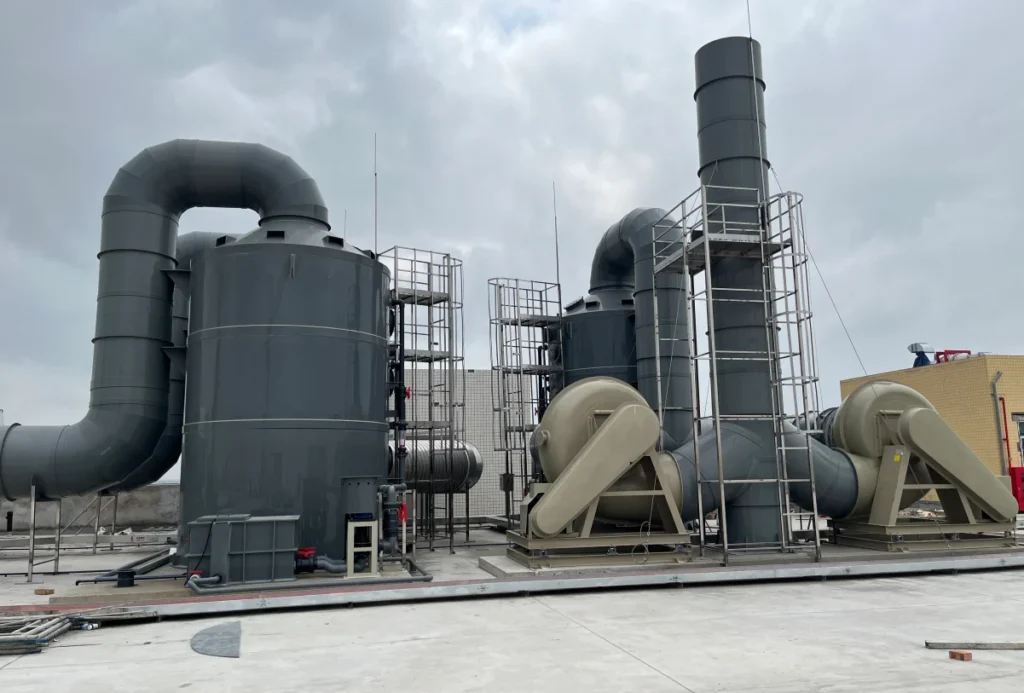
How does a wet scrubber work? The short answer is that it forces contaminated gas into contact with a liquid, and pollutants transfer from the gas into the liquid. The useful answer is that how does a wet scrubber work depends on three distinct mechanisms ??inertial impaction for particulate, absorption for soluble gases, and chemical reaction for acid neutralization ??and the engineering challenge is matching the right mechanism to your pollutant profile. Many scrubber selection errors come from treating “how it works” as a single process rather than understanding that a scrubber captures dust by a completely different physical mechanism than it absorbs gas. This article explains each mechanism, walks through the five-step process inside a scrubber, and provides the operating parameters that determine whether your scrubber actually performs at its design efficiency. Understanding how does a wet scrubber work through each of these mechanisms is the difference between buying a scrubber that works and buying one that runs but never quite meets the permit limit.
Key Takeaways
- A wet scrubber captures pollutants through three fundamentally different mechanisms: inertial impaction for particulate, absorption for soluble gases, and chemical reaction for acid neutralization. Selecting a scrubber without understanding which mechanism your pollutant requires is the single most common cause of underperformance.
- Particulate capture depends on the Stokes number, which scales with the square of particle diameter. A 10-micron particle has 100 times the inertia of a 1-micron particle. Venturi scrubbers achieve 99%+ submicron removal by operating at 200-400 ft/s throat velocity; spray towers at low velocity capture only 70-85% of the same particles.
- Chemical reaction is the efficiency multiplier for acid gas removal. NaOH + HCl = NaCl + H2O consumes the dissolved acid as it enters the liquid film, keeping the concentration gradient at maximum. A caustic scrubber achieves 99% removal at a lower L/G ratio than a water-only scrubber achieves 90%.
- pH control is not optional. If the pH in a caustic scrubber drifts below 7, removal efficiency drops from 99% to 60-70% within minutes ??not because of any mechanical failure but because the chemistry has shifted out of range. Weekly pH sensor calibration is the minimum maintenance standard.
- The liquid-to-gas ratio determines whether the contact surface is adequate. Packed bed scrubbers operate at 2-6 gpm/1000 cfm for gas absorption; venturi scrubbers require 5-20 gpm/1000 cfm for fine particulate. An L/G ratio too low starves the contact zone; too high wastes pump energy without improving performance.
What Is a Wet Scrubber and How Does It Work?
A wet scrubber is an air pollution control device that removes contaminants from industrial exhaust by forcing the gas into intimate contact with a liquid. The pollutant transfers from the gas phase into the liquid phase, where it is captured by one of three mechanisms: inertial impaction for particulate above 1-3 microns, absorption for soluble gases, or chemical reaction for acid gases that require neutralization. The cleaned gas then passes through a mist eliminator and exits the stack, while the liquid is recirculated or discharged.
How does wet scrubber work in practice? The gas enters the scrubber vessel, passes through a zone where liquid is continuously introduced, and pollutants are removed through the combination of physical and chemical capture. The specific design ??packed bed, spray tower, or venturi ??determines which mechanism dominates, but the core principle is the same: create the maximum possible surface area for gas-liquid contact and let the natural driving forces of impaction, dissolution, and reaction do the work. The specific configuration – packed bed for gas absorption, venturi for fine particulate, spray tower for hot gas quenching – determines which mechanism dominates, but all wet scrubbers rely on the same fundamental principle: match the contact method and chemistry to the pollutant profile. The difference between a scrubber that removes 70% of the target pollutant and one that removes 99% is not the vessel size – it is whether the contact method and chemistry are matched to the pollutant profile.
The Core Principle: How a Wet Scrubber Works
How a wet scrubber works depends on which pollutant you are targeting. Particulate capture and gas absorption operate through fundamentally different physical mechanisms, and understanding the difference is the key to understanding how does a wet scrubber work starts with selecting the right scrubber type for your application.
Inertial Impaction ??How Particulate Gets Captured
Particulate capture in a wet scrubber is primarily driven by inertial impaction. When the gas stream flows around a liquid droplet, particles heavier than gas molecules cannot follow the streamlines ??their inertia carries them forward into the droplet, where they are trapped. The likelihood of capture depends on the Stokes number (Stk), a dimensionless parameter that describes the ratio of particle inertia to fluid drag forces. A Stokes number above 0.5 means the particle will likely impact the droplet; below 0.1, the particle follows the gas stream around the droplet and escapes capture.
The Stokes number scales with the square of particle diameter. A 10-micron particle has 100 times the inertia of a 1-micron particle at the same velocity, which is why wet scrubbers easily capture coarse dust but struggle with submicron particulate. To capture particles below 1 micron, the scrubber must either increase the gas velocity (venturi scrubbers operate at throat velocities of 200-400 ft/s, raising the Stokes number for small particles) or decrease the droplet size to increase the number of target droplets in the gas stream. This physical limitation is why venturi scrubbers achieve 99%+ removal on PM2.5 at 15-60 inches H2O pressure drop, while spray towers at 1-4 inches H2O capture only 70-85% of the same particles.
Absorption ??How Soluble Gases Dissolve
Gas absorption is governed by a different principle: the concentration gradient between the gas phase and the liquid phase. A soluble gas molecule like HCl or NH3 at high concentration in the gas stream will dissolve into the liquid film at the gas-liquid interface, where its concentration is near zero. The driving force is the difference in concentration across the interface, described by Henry’s Law. The greater the concentration gradient and the more surface area available for transfer, the faster the gas is absorbed.
For highly soluble gases like HCl and NH3, removal efficiency of 95-99% is achievable in a packed bed scrubber because the liquid film continuously absorbs fresh gas and the recirculation loop dilutes the dissolved concentration. For less soluble gases like SO2, the absorption rate is lower and the required L/G ratio is higher, which changes how does a wet scrubber work for that application. The Engineering Toolbox scrubber design resources provide reference data for gas solubility in water across common industrial pollutants.
Chemical Reaction ??The Efficiency Multiplier
Adding a reactive chemical to the scrubbing liquid transforms the absorption process. When NaOH is added to water for HCl removal, the absorbed HCl reacts instantly with hydroxide ions to form NaCl and water: NaOH + HCl ??NaCl + H2O. This reaction consumes the dissolved HCl, keeping its liquid-phase concentration near zero, which maintains the maximum concentration gradient at the interface. The result is that a chemically assisted scrubber achieves 99% removal at a lower L/G ratio than a water-only scrubber achieving 90%.
pH control is not optional in a chemically assisted scrubber. For acid gas removal, NaOH concentration is maintained at 1-5% in the recirculation tank, with pH controlled between 8 and 10. If pH drifts below 7, the hydroxide ion concentration becomes insufficient to neutralize the incoming acid gas, and removal efficiency drops from 99% to 60-70% within minutes. How does a wet scrubber work reliably over time? A pH controller with weekly calibration and a metering pump for chemical feed are standard equipment ??a scrubber running without pH control on acid gas service will inevitably fail to meet its emission limit, not because of any mechanical problem but because the chemistry has drifted out of range.
Step-by-Step: How a Wet Scrubber System Works
These five steps describe how a wet scrubber works at the system level, from gas entry to liquid discharge.
Step 1: Contaminated Gas Enters the Scrubber
The gas stream enters through an inlet designed to distribute flow evenly across the vessel cross-section. Inlet velocity is typically 30-50 ft/s ??high enough to prevent dust settling in the duct, low enough to avoid re-entrainment of liquid from the sump. A distribution baffle or inlet diffuser is common in vessels above 6 ft diameter to prevent channeling. Uneven gas distribution is one of the most common installation problems: gas that bypasses the contact zone exits untreated, and the operator sees a visible stack plume that cannot be fixed by adjusting the chemical feed rate.
Step 2: Scrubbing Liquid Is Introduced
The scrubbing liquid enters through spray nozzles, a packed bed distributor, or venturi injection ports. Nozzles produce droplets from 200 to 2,000 microns depending on pressure (20-60 psi) and orifice design. Smaller droplets provide more surface area for capture but are harder to separate in the mist eliminator. The liquid-to-gas ratio (L/G) is the single most important operating parameter, expressed as gallons of liquid per 1,000 actual cubic feet of gas. Typical values range from 2-6 gpm/1000 cfm for packed bed scrubbers on gas absorption duty, 4-12 gpm/1000 cfm for spray towers, and 5-20 gpm/1000 cfm for venturi scrubbers on fine particulate. An L/G ratio too low starves the contact surface; too high wastes pump energy and may flood the packing.
Step 3: Gas-Liquid Contact Occurs
This is the heart of the system. The contact method determines which capture mechanism dominates. In a packed bed scrubber, gas flows upward through wetted packing media while liquid flows downward ??the liquid film on the packing surface provides continuous renewal of the absorption surface, ideal for gas removal. In a spray tower, gas rises through a fine liquid mist created by high-pressure nozzles ??contact is less intense but there is nothing to foul, ideal for hot or dusty gas. In a venturi scrubber, gas accelerates through a constricted throat where high-velocity liquid injection creates intense turbulence ??the high relative velocity between gas and droplets enables submicron particulate capture through inertial impaction. Each type is optimized for a different pollutant profile, which is why selecting the contact method to match your gas composition determines whether the system performs at year one and year ten.
Step 4: Mist Eliminator Removes Entrained Droplets
After the contact zone, the cleaned gas carries entrained liquid droplets that contain dissolved pollutants, reaction byproducts, and suspended solids. A mist eliminator removes these droplets before the gas exits the stack. Three designs are common: vane packs for droplets above 10 microns, mesh pads for removal above 3-5 microns, and cyclonic separators for high-liquid-load applications. Pressure drop across the mist eliminator is typically 0.5-2 inches H2O. Undersized or fouled mist eliminators cause visible stack emissions and liquid carryover into downstream ductwork.
Step 5: Liquid Recirculation and Blowdown
The scrubbing liquid collects in the sump and is recirculated through the pump loop. A portion is continuously bled off as blowdown to control the buildup of dissolved solids and reaction byproducts, typically 5-15% of the recirculation rate. The blowdown is a neutral salt solution (NaCl, Na2SO4, NaF) that is treated through the plant’s wastewater system. pH is controlled by adding fresh chemical to the recirculation loop, and make-up water replaces volume lost to blowdown and evaporation. Many scrubber performance problems trace back to neglected chemical dosing or uncontrolled solids buildup rather than vessel design ??the liquid management loop is as important as the gas-side contact zone.
Key Components of a Wet Scrubber System
How does a wet scrubber work at the component level? Each component in the system has a specific function, and undersizing or omitting any one of them compromises the entire installation.
Scrubber Vessel and Internals
The vessel contains the contact zone where gas-liquid mass transfer occurs. In a packed bed scrubber, the vessel contains random packing media (Pall rings, Raschig rings, or saddle shapes) that create a large wetted surface area, typically 30-100 ft2/ft3. In a spray tower, the vessel is empty except for the nozzle array. In a venturi scrubber, the vessel contains the converging-diverging throat section. The vessel material must resist corrosion from both the gas and the scrubbing liquid: polypropylene is standard for acid gas service below 180 degF, FRP handles larger diameters above 8 ft at up to 220 degF, and stainless steel 316L is required for high-temperature or oxidizing environments. The internal components – packing support grid, liquid redistributors, and bed limiters – must be designed to handle the weight of the wetted packing and the thermal expansion at operating temperature.
Recirculation Pump and Piping
The recirculation pump delivers liquid from the sump to the distribution point at the required flow rate and discharge pressure. The flow rate is set by the L/G ratio, typically 50-200 gpm per 10,000 CFM of gas. The pump head must overcome the static lift from the sump to the nozzles, the nozzle operating pressure (20-60 psi for spray nozzles), and the friction losses through the piping and control valves. A centrifugal pump with a wetted end in polypropylene or PVDF is standard for corrosive scrubbing solutions. A standby pump with automatic changeover is standard on critical installations where a scrubber outage would force a production shutdown.
Chemical Dosing System
The chemical dosing system maintains the scrubbing liquid chemistry. For acid gas scrubbers, the system consists of a NaOH storage tank (typically 25% or 50% concentration), a metering pump controlled by the pH sensor output, and injection point in the recirculation line. The metering pump should be sized for 150% of the worst-case acid gas load – a sudden process upset that doubles the HCl concentration will overwhelm an undersized pump within minutes. The pH sensor requires weekly calibration because electrode drift is the single most common cause of performance degradation in chemically assisted scrubbers. For NH3 scrubbers, the dosing system delivers sulfuric acid instead of NaOH; for odor control scrubbers, sodium hypochlorite with ORP control replaces the pH controller.
Mist Eliminator
The mist eliminator removes entrained liquid droplets from the cleaned gas before it exits the stack. Vane packs (chevron blades) remove droplets above 10 microns at 0.5-1.5 inches H2O pressure drop. Mesh pads remove droplets above 3-5 microns at 1-2 inches H2O but are more prone to fouling. Cyclonic separators handle high liquid loads at 2-4 inches H2O. The mist eliminator must be sized for the maximum gas flow rate plus a safety factor – an undersized mist eliminator causes visible stack emissions regardless of how well the contact zone is performing.
Fan and Blower
The fan draws gas through the scrubber system and discharges it through the stack. The fan static pressure must overcome the scrubber pressure drop plus inlet and outlet ductwork losses. For packed bed scrubbers, the total system pressure drop is typically 5-12 inches H2O. For venturi scrubbers, it ranges from 20-60 inches H2O depending on throat velocity. The fan motor power is directly proportional to the flow rate multiplied by the pressure drop, which is why understanding how does a wet scrubber work from an energy perspective matters, which is why the energy cost difference between scrubber types is dominated by fan electricity, not reagent consumption.
Operating Parameters That Affect Wet Scrubber Performance
A wet scrubber meets its design efficiency only when the operating parameters remain within the design range. Four parameters determine whether the system performs: gas velocity, liquid-to-gas ratio, pressure drop, and temperature and pH control.
Gas Velocity and Residence Time
Gas velocity through the scrubber vessel determines the residence time available for mass transfer. In a packed bed scrubber, the superficial gas velocity is typically maintained between 2 and 8 ft/s. Below 2 ft/s, the vessel diameter becomes uneconomically large. Above 8 ft/s, the gas begins to entrain liquid from the packing, raising the pressure drop and flooding the bed. The residence time at design flow is typically 1-3 seconds for a packed bed scrubber, during which the gas must transfer its pollutants to the liquid phase. If the velocity is too high, the gas passes through the contact zone before the absorption or impaction reaction is complete, and removal efficiency drops regardless of the chemical feed rate or L/G ratio.
Liquid-to-Gas Ratio (L/G)
The L/G ratio controls the available liquid surface area for pollutant capture. For packed bed scrubbers on soluble gas absorption, the ratio ranges from 2 to 6 gpm per 1,000 acfm. For venturi scrubbers on fine particulate, the ratio ranges from 5 to 20 gpm per 1,000 acfm. A low L/G ratio starves the contact surface ??there are not enough liquid droplets or film area to capture the incoming pollutant load. A high L/G ratio wastes pump energy and may flood the packing or overload the mist eliminator. The correct L/G ratio is determined by the pollutant concentration and target removal efficiency, not by a rule of thumb, and it should be verified during commissioning by testing removal efficiency at different liquid flow rates.
Pressure Drop
Pressure drop is the operating cost you cannot avoid. In a packed bed scrubber, the clean bed pressure drop is 2-4 inches H2O per foot of packing depth at design flow, giving a total of 3-8 inches H2O for a typical installation. As the packing fouls with captured particulate or biological growth, the pressure drop rises, increasing fan power consumption. A pressure drop increase of 30% above baseline indicates that the packing needs cleaning or replacement. In a venturi scrubber, the pressure drop is 15-60 inches H2O, which translates directly into fan energy cost ??approximately $8,000-15,000 per year more than a packed bed scrubber on a 20,000 CFM system.
Temperature and pH
Gas temperature affects both the absorption rate (solubility decreases as temperature rises) and the material limits of the scrubber. Polypropylene is limited to 180 degF continuous; FRP handles 200-220 degF; stainless steel 316L is required above that. For pH control, the target range for acid gas scrubbing is 8-10. The pH sensor requires weekly calibration, and the metering pump should be sized to handle the worst-case acid gas load, not the average ??a sudden process upset that doubles the HCl concentration will overwhelm an undersized pump, and the scrubber outlet will spike above the permit limit.
Frequently Asked Questions
Is there a standard wet scrubber system diagram available?
A standard wet scrubber system diagram shows the gas inlet entering the bottom of the vessel, the scrubbing liquid introduced through nozzles or a distributor above the packing, the gas-liquid contact zone in the middle section, the mist eliminator near the top, and the cleaned gas exiting through the stack. The liquid recirculation loop connects the sump at the bottom to the pump, then up to the nozzles, with a chemical feed line and blowdown line branching off. While there is no single ISO standard diagram, the general arrangement is consistent across packed bed scrubbers from all major manufacturers.
How does a wet scrubber work differently for acid gases compared to particulate?
For acid gases, a wet scrubber works by absorption and chemical reaction – the gas dissolves into the liquid film on the packing surface and reacts with the alkaline scrubbing solution. For particulate, the scrubber works by inertial impaction – particles collide with liquid droplets and are trapped. The two mechanisms require completely different design parameters: gas absorption benefits from a packed bed with high surface area at moderate pressure drop (2-6 gpm/1000 cfm L/G), while particulate capture requires high velocity and fine droplets (5-20 gpm/1000 cfm L/G for venturi scrubbers). When the stream contains both pollutants, a hybrid or multi-stage configuration is common.
What is the difference between how a wet scrubber and a dry scrubber work?
A wet scrubber uses liquid to capture pollutants from exhaust gas, either by dissolving them (for soluble gases) or by impaction (for particulate). A dry scrubber injects a dry alkaline powder into the gas stream, where it reacts with acid gases on the particle surface. The fundamental difference is the reaction medium: liquid-phase in a wet scrubber allows continuous renewal of the reactive surface, while the dry sorbent particle loses active sites as its surface becomes coated with reaction product. This is why wet scrubbers achieve 95-99% removal in a single stage while dry scrubbers typically reach 70-90% and require a downstream polishing stage for tight emission limits.
What happens if the pH in a wet scrubber is not controlled?
If pH drifts below 7 in a caustic scrubber handling acid gas, the hydroxide ion concentration becomes too low to neutralize the incoming acid load. Removal efficiency drops from 99% to 60-70% within minutes. Because the chemical reaction is the primary capture mechanism for acid gases, a pH excursion is equivalent to turning off the scrubber – the vessel and pump continue running, but the gas passes through without being cleaned. Weekly pH sensor calibration and a properly sized metering pump are the minimum safeguards against this failure mode.
Why does a venturi scrubber cost more to operate than a packed bed scrubber?
The venturi scrubber operates at 15-60 inches H2O pressure drop versus 3-8 inches H2O for a packed bed scrubber. Fan power is directly proportional to pressure drop, so a venturi scrubber on a 20,000 CFM system consumes $8,000-15,000 more per year in electricity alone. The higher operating cost is justified when the target pollutant is submicron particulate that a packed bed scrubber cannot capture efficiently. For applications where the pollutant is primarily soluble gas (HCl, SO2, NH3), the packed bed scrubber achieves the same removal efficiency at lower energy cost.