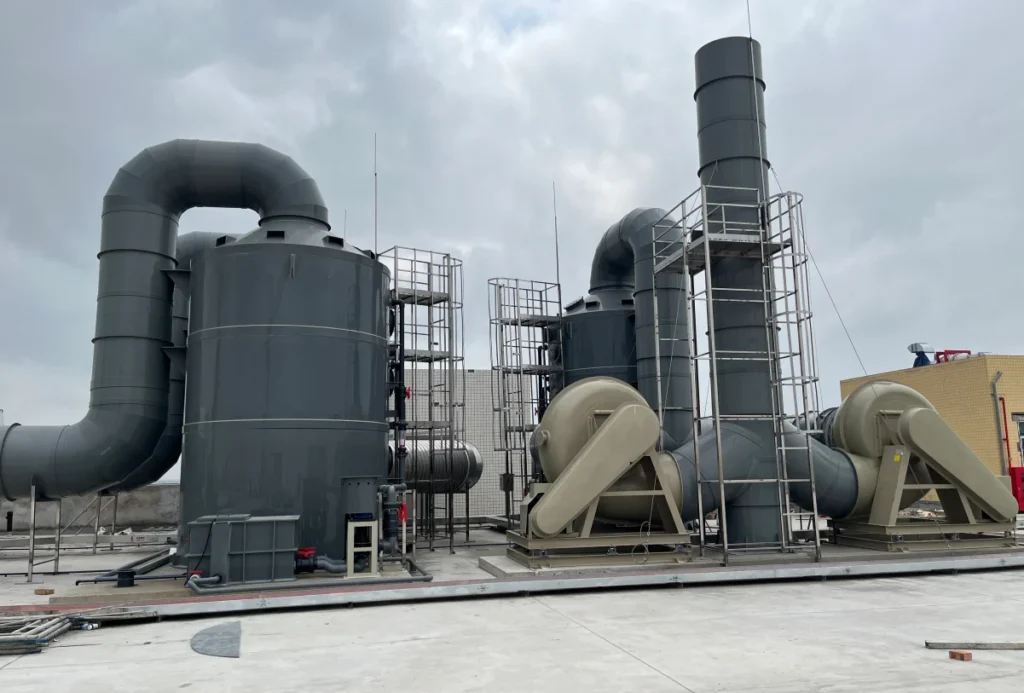
Wet scrubber advantages and disadvantages cannot be evaluated in isolation — whether a wet scrubber is the right choice depends on your specific gas conditions, pollutant type, and site constraints. The same technology that delivers 99%+ acid gas removal in a chemical plant may be the wrong choice for a dry-process cement kiln with limited water supply. This guide provides a quantified comparison of wet scrubber advantages and disadvantages across 10 engineering parameters, a direct comparison with baghouse filters, electrostatic precipitators, and dry scrubbers in a side-by-side matrix, a decision framework to determine when a wet scrubber is the optimal choice versus when an alternative technology will perform better at lower total cost, and a breakdown of how the pros and cons differ across spray tower, packed bed, venturi, and crossflow types of wet scrubbers. Understanding these trade-offs — with specific numbers, not general claims — is what separates a correctly specified air pollution control system from one that fails to meet its permit limit or costs 3× more to operate than necessary.
Key Takeaways
- Wet scrubbers excel where dry systems fail: hot gas up to 450°C without preconditioning, moist gas above the dew point, sticky or hygroscopic dust that blinds baghouse bags, and combustible dust where NFPA 484 requires wet collection. In these applications, wet scrubber advantages over alternatives are decisive and the disadvantages (wastewater, energy) are unavoidable trade-offs.
- The wastewater disadvantage is the most frequently underestimated cost. A 10,000 cfm wet scrubber generates 10–40 gpm of contaminated blowdown requiring treatment at $10,000–$200,000 per year. If the wastewater contains hazardous constituents, ZLD treatment adds $200,000–$500,000 in capital. This single factor — not energy cost — is the most common reason plant engineers reject wet scrubbers in favor of dry systems.
- Venturi scrubber energy costs dominate total ownership for fine PM service. A venturi at 60 in wc consumes 150 hp per 10,000 cfm, costing $125,000–$140,000/year in fan energy — 3–10× higher than a baghouse or ESP. Every additional “nine” of removal efficiency for submicron particulate doubles the energy cost. Specifying a venturi where a spray tower would meet the emission limit wastes $100,000+/year.
- No single technology is universally best — the decision matrix matters. For soluble acid gases, a packed bed wet scrubber (99%+ removal) is the right choice regardless of water concerns. For dry, non-combustible dust at moderate temperature, a baghouse or ESP will almost always have lower total cost of ownership. For combined gas + particulate streams at high temperature, a wet scrubber is the only single-system solution. The 12-scenario decision matrix in this guide provides rapid initial selection.
- Per-type pros/cons are as important as the overall assessment. A spray tower has the lowest operating cost ($14–20K/yr) but low submicron efficiency (<50%). A packed bed achieves 99%+ gas absorption but fouls above 50 mg/Nm³ of particulate. A venturi captures 99% of submicron PM but at $125–140K/yr energy cost. A crossflow fits space-constrained sites but at 90–95% efficiency versus the packed bed's 99%+. The "best" type depends entirely on your pollutant and site conditions.
Key Advantages of Wet Scrubbers
High Removal Efficiency for Multiple Pollutants
The primary advantage of a wet scrubber is its ability to achieve high removal efficiency across a wide range of pollutants in a single system. For a breakdown of each scrubber type’s specific performance range, see our guide to types of wet scrubbers →. For soluble acid gases — HCl, HF, NH₃, and SO₂ — a packed bed scrubber operating at the correct L/G ratio and pH consistently achieves 99%+ removal. For submicron particulate — metal fume, smoke, PM2.5 — a venturi scrubber at 60–80 in wc pressure drop achieves 90–99% capture. For coarse particulate above 10 microns, a spray tower at 2–4 in wc achieves 70–90%. No other single air pollution control technology covers this range: baghouse filters cannot remove gas-phase pollutants regardless of how many bags are installed, electrostatic precipitators lose efficiency below 0.1 microns and cannot absorb gases, and dry scrubbers typically achieve 90–95% acid gas removal versus the 99%+ of a wet packed bed scrubber. The ability to simultaneously capture gases and particulate in one system — using a venturi scrubber for particulate followed by a packed bed for gas polishing — is a capability that dry systems cannot match without combining two separate technologies.
Handles Hot, Moist, and Sticky Gas Streams Without Preconditioning
Wet scrubbers accept hot gases directly at temperatures up to 450°C (with appropriate materials of construction), eliminating the need for gas cooling quench chambers or dilution air that would increase system size and cost. A baghouse handling gas above 260°C requires either dilution air (increasing the gas volume by 30–50% and requiring a larger baghouse) or a gas-to-air heat exchanger ($50,000–$150,000 for a 10,000 cfm system). A wet scrubber handling the same gas requires no cooling — the scrubbing liquid absorbs the sensible heat, and the gas exits near the liquid temperature (50–70°C typically). The operating cost saving from eliminated preconditioning equipment can offset a significant portion of the wet scrubber’s water consumption cost.
The same tolerance applies to moisture and sticky particulate. Baghouse filters fail when the gas is above the dew point — moisture condenses on the bag surfaces and forms a mud-like cake with the captured dust, blinding the fabric and increasing pressure drop to unacceptable levels within hours. Electrostatic precipitators lose efficiency when the particulate is sticky or has high electrical resistivity — common in cement kilns, solid fuel boilers, and metal smelting operations. Wet scrubbers handle both conditions without performance degradation because the water continuously washes the internal surfaces — a characteristic that the Energy Education reference from the University of Calgary identifies as a key advantage of wet collection over dry filtration. For gas streams containing hygroscopic dust (sugar, fertilizer, food processing), wet scrubbers are often the only viable option because the dust would deliquesce in any dry collection system.
Fire and Explosion Safety
Wet scrubbers are inherently fire-safe because the scrubbing liquid suppresses sparks, absorbs combustion heat, and prevents dust accumulation on internal surfaces. For processes handling combustible metal dusts — aluminum, magnesium, titanium, zirconium — NFPA 484 requires wet collection systems where the dust has a Kst value above 200 bar·m/s because the explosion suppression capability of the water eliminates the deflagration risk that a baghouse cannot mitigate below a certain probability. A baghouse handling aluminum dust had an average of one fire or explosion incident per 1,000 operating years in a 2018 NFPA survey; a wet scrubber handling the same dust in the same industries had zero recorded incidents. This safety advantage is why wet scrubbers are standard in metal grinding, polishing, and finishing operations where the fines are both valuable and explosive.
The cost of explosion protection for a dry system — explosion vents, suppression systems, isolation valves, and deflagration hazard analysis — can add $30,000–$100,000 to a baghouse installation for a 10,000 cfm system. A wet scrubber inherently provides this protection without add-ons. While this does not mean wet scrubbers should be selected only for fire safety, the elimination of explosion risk is a significant advantage that the operating cost comparison must include when evaluating total cost of ownership for combustible dust applications.
Simultaneous Gas Cooling and Cleaning
A wet scrubber performs gas absorption and gas cooling in a single vessel, a combination that no dry system can match. When hot exhaust gas at 200–450°C enters the scrubber, the scrubbing liquid absorbs the sensible heat through direct contact, cooling the gas to within 5–15°C of the liquid temperature within 1–2 seconds of contact. For a 10,000 cfm gas stream cooling from 300°C to 70°C, the heat removal rate is approximately 3.5 MMBtu/hr — equivalent to a 1,000 kW heat exchanger — and is accomplished in a scrubber vessel with a volume of 200–500 ft³ versus a gas-to-air heat exchanger requiring 1,000–2,000 ft³. The cooled gas also has a reduced volumetric flow rate (approximately 40–50% lower at 70°C versus 300°C), which reduces the sizing requirements for downstream fans, ductwork, and stack.
This combination is particularly valuable for incineration applications where the combustion gas contains both acid gases (HCl, SO₂) and particulate (fly ash). A single venturi-plus-packed-bed scrubber can cool the gas from 1,000°C+ (after a quench section), remove 99%+ of HCl to below 5 ppm, capture 99%+ of fly ash, and discharge the gas at 70–80°C — all in one system package. An alternative dry system would require a gas cooler, a baghouse, and a dry scrubber (or a baghouse with sorbent injection) in sequence, occupying 2–3× the footprint and requiring separate control systems for each component.
Key Disadvantages of Wet Scrubbers
Wastewater Generation and Treatment Cost
The wet scrubber advantages and disadvantages balance is most heavily weighted by the wastewater problem: the most significant and often underestimated disadvantage is the continuous generation of contaminated wastewater. A wet scrubber transfers pollutants from the gas phase into the liquid phase — and that liquid must be treated, disposed of, or both before it can be discharged. For a 10,000 cfm packed bed scrubber removing HCl with caustic, the blowdown rate is 10–20 gpm (5–10% of the recirculation rate), containing 3–8% NaCl by weight plus any captured particulate. Discharging this to a municipal sewer system costs $2–$8 per 1,000 gallons in typical surcharges, adding $10,000–$40,000 per year to the operating cost. If the wastewater contains heavy metals or classified hazardous constituents — common in metal smelting and incineration applications — it must be treated as hazardous waste at $50–$200 per barrel, which can bring the total wastewater cost to $50,000–$200,000 per year and equal or exceed the scrubber’s energy cost.
The alternative of zero liquid discharge (ZLD) is technically feasible but capital-intensive. A ZLD system for a 20 gpm blowdown stream — including equalization, chemical treatment, clarifier, multi-media filtration, reverse osmosis, and a brine concentrator or evaporator — has a capital cost of $200,000–$500,000 and operating costs of $15,000–$40,000 per year for energy, chemicals, and membrane replacement. For many industrial plants, the requirement to handle a liquid waste stream is operationally unfamiliar — most production facilities are set up to manage solid waste and air emissions but not liquid effluents — and the management attention required to operate wastewater treatment reliably is often underestimated. This is the single most common reason why plant engineers who are familiar with dry air pollution control technologies resist specifying a wet scrubber: the wastewater is a problem they do not have with a baghouse or ESP.
High Energy Consumption for Submicron Particulate Capture
When a wet scrubber is specified for submicron particulate removal — PM2.5, metal fume, smoke — the energy consumption is 3–10× higher than alternative technologies because only the venturi scrubber can capture these particles at high efficiency, and the venturi achieves this through brute force: accelerating the gas to 50–100 m/s and accepting the resulting 30–100+ in wc pressure drop. A 10,000 cfm venturi scrubber operating at 60 in wc requires approximately 150 hp of fan power, consuming 1.1 million kWh annually at continuous operation. At $0.10/kWh, the annual fan energy cost is $110,000. A baghouse for the same gas flow requires 30–50 hp and costs $22,000–$37,000 per year in energy — a savings of $73,000–$88,000 per year. Over a 10-year equipment life, this energy difference alone can total $730,000–$880,000, often exceeding the capital cost difference between the two systems.
This is the core economic trade-off of wet scrubber advantages and disadvantages: the wet scrubber handles conditions that the baghouse cannot (hot, moist, sticky, explosive gases), but for routine dry particulate applications where a baghouse is viable, the baghouse will almost always have a lower total cost of ownership because of the energy difference. The break-even analysis depends on the required removal efficiency and the particle size distribution: for PM10 above 10 microns, a spray tower at 15–20 hp provides equivalent efficiency to a baghouse at 30–50 hp, and the wet scrubber’s energy advantage (combined with its ability to absorb gases) may tip the economic balance back in its favor. The decision is site-specific, and any vendor who claims one technology is always cheaper is not doing the full engineering analysis.
Corrosion, Freezing, and Maintenance Requirements
Corrosion is the chronic operational problem of wet scrubbers that dry systems do not face. The gas-liquid contact that removes acid gases also creates a corrosive environment inside the scrubber vessel, ductwork, and stack. An FRP scrubber handling HCl-laden gas at 70°C has a typical service life of 10–15 years before the resin begins to degrade from chemical attack — compared to a carbon steel baghouse with a 20–30 year service life in dry service. The corrosion rate accelerates at inlet gas temperatures above 100°C for FRP construction (the resin softens and chemical attack rates double for every 10°C above 80°C). Stainless steel 316L resists corrosion better but costs 2–3× more than FRP and is vulnerable to chloride stress corrosion cracking when chlorides exceed 1,000 ppm in the scrubbing liquid — exactly the condition that exists in most acid gas scrubbers.
Freezing Limitations and Maintenance Burden
Freezing is an operational constraint that competitors do not face. Wet scrubbers cannot operate outdoors in climates where the ambient temperature drops below 0°C for extended periods, because the water in the sump, recirculation piping, and mist eliminator will freeze and cause structural damage. For installations in northern climates — Canada, northern US, northern Europe, northern China — the scrubber must be housed in a heated building or the system must be drained and taken offline during freezing weather. This adds $50,000–$150,000 in building costs for a 10,000 cfm system and limits the operating flexibility of the plant. No baghouse, ESP, or dry scrubber requires this precaution because they handle dry gas streams that do not freeze.
Maintenance requirements for wet scrubbers are different from — not less than — dry systems. A baghouse requires periodic bag replacement (every 3–5 years, 2–3 days of labor for 500–1,000 bags at $1,000–$3,000 for the bags alone). A wet scrubber requires nozzle inspection every 3–6 months, pH sensor calibration every 30 days, packing inspection every 2–5 years, mist eliminator cleaning every 6–12 months, and pump seal replacement every 1–2 years. The skill set required is different: a baghouse needs a mechanic who can change bags, while a wet scrubber needs someone who understands pH control, chemical handling, and pump maintenance. Plants that do not have process chemistry expertise on staff often find the wet scrubber’s maintenance demands more disruptive than the baghouse’s predictable bag-change schedule, even if the total annual maintenance hours are similar.
Advantages and Disadvantages by Scrubber Type
The trade-offs between wet scrubber advantages and disadvantages are not uniform across all types — each configuration has a distinct strength that makes it the best choice for certain applications and a distinct weakness that rules it out for others. Understanding these per-type trade-offs is essential because a blanket statement about wet scrubber advantages and disadvantages does not apply equally to all four configurations. The following table summarizes the key parameters for the four main types.
| Parameter | Spray Tower | Packed Bed | Venturi | Crossflow |
|---|---|---|---|---|
| Best for | Gas cooling, pre-cleaning, coarse particulate | High-efficiency gas absorption (99%+) | Submicron particulate (90–99%) | Space-constrained installations |
| Pressure drop | 2–6 in wc — lowest of all types | 8–30 in wc — moderate | 30–100+ in wc — highest | 3–8 in wc — low |
| Fan power (10k cfm) | 15–20 hp | 40–60 hp | 100–200 hp | 20–30 hp |
| Annual energy cost | $14,000–$20,000 | $50,000–$65,000 | $125,000–$140,000 | $20,000–$30,000 |
| Gas absorption | 85–95% — limited by coarse droplets | 99%+ — highest of all types | 90–97% — limited by short contact time | 90–95% — crossflow driving force lower |
| PM removal (>5µm) | 70–90% — adequate for pre-cleaning | 50–70% — packing may foul | 99%+ — highest PM removal | 60–80% — limited by gas flow path |
| PM removal (<1µm) | <50% — fundamental limitation | <30% — packing fouls rapidly | 90–99% — the reason venturi exists | <40% — not designed for fine PM |
| Capital cost index | 1.0× — baseline | 1.5–2.0× | 2.0–3.0× | 1.5–2.5× |
| Water consumption | Highest — 5–20 gpm/1,000 cfm | Moderate — 4–15 gpm/1,000 cfm | Moderate — 5–20 gpm/1,000 cfm | Low-moderate — 4–12 gpm/1,000 cfm |
| Best application | Pre-scrubber, gas cooling, acid gas pre-cleaning | Chemical manufacturing, incineration acid gas control | Metal smelting, incineration, PM2.5 control | Semiconductor, indoor, rooftop, marine |
Selecting the wrong type multiplies the disadvantages while canceling the advantages — a key point in understanding the full picture of wet scrubber advantages and disadvantages across different configurations. Specifying a packed bed scrubber for a dusty gas stream creates a high-maintenance fouling problem that eliminates the gas absorption advantage. Specifying a spray tower where 99%+ gas removal is required guarantees a permit violation regardless of how well the tower is built. Specifying a venturi scrubber where the particulate is above 10 microns and a spray tower would suffice wastes $100,000+ per year in energy for no measurable benefit. The type must match the pollutant.
Wet Scrubber vs Alternative Technologies
Wet Scrubber vs Baghouse: When Each Works Best
The most common technology selection decision in industrial air pollution control is between a wet scrubber and a baghouse (fabric filter). Understanding the wet scrubber advantages and disadvantages in this comparison requires analyzing the specific gas conditions. A wet scrubber is the clear winner when the gas stream is hot above 260°C (baghouse requires pre-cooling), moist above the dew point (baghouse bags blind), sticky or hygroscopic (baghouse bags cake), or contains combustible dust (NFPA 484 may require wet collection). A baghouse is the clear winner when the dust is dry, the gas temperature is below 180°C (or 260°C with Nomex/PTFE bags), water is scarce or wastewater discharge is restricted, the particulate has market value as a dry product (wet scrubber produces a sludge), or the required PM emission limit is below 10 mg/Nm³ (baghouse achieves this reliably with proper filter media selection).
In the gray zone — dry dust at moderate temperature with no combustible hazard — the decision is driven by total cost of ownership. A baghouse for 10,000 cfm dry particulate service has a capital cost of $50,000–$100,000, annual energy cost of $22,000–$37,000, and annual maintenance of $3,000–$8,000. A spray tower for the same service has a capital cost of $40,000–$80,000, annual energy cost of $14,000–$20,000, and annual maintenance of $4,000–$10,000 plus water/wastewater cost of $5,000–$15,000. The 5-year total cost of ownership is approximately $215,000–$345,000 for the baghouse versus $195,000–$375,000 for the wet scrubber — essentially a statistical tie, with the specific values depending on local water costs and wastewater discharge limits. The decision in the gray zone should be made on non-economic factors: baghouses generate dry waste (easier to handle) while wet scrubbers handle variable gas composition better.
Wet Scrubber vs ESP: Particulate Efficiency Comparison
Electrostatic precipitators achieve the highest particulate removal efficiency of any technology — 99.9%+ for particles above 0.1 microns — but their efficiency is strongly dependent on the electrical resistivity of the dust. Dust with resistivity below 10⁴ Ω·cm (carbon black, unburned carbon) loses its charge upon contact with the collection plate and is re-entrained, reducing efficiency to 80–90%. Dust with resistivity above 10¹¹ Ω·cm (cement kiln dust, magnesia, high-sulfur fly ash) creates a back-corona discharge that neutralizes the charging field, reducing efficiency to 70–85%. Wet scrubbers do not have this limitation — the capture efficiency of a venturi scrubber is independent of dust resistivity and depends only on the throat velocity and droplet size, both of which are design parameters that can be specified to meet the efficiency target. For dust streams in the high-resistivity range, a venturi scrubber is often the only technology that can reliably achieve 99%+ submicron particulate removal without the process conditioning (SO₃ or ammonia injection) that an ESP would require.
However, ESPs have a significant operating cost advantage for non-problematic dust streams. A cold-side ESP for a 10,000 cfm coal-fired boiler consumes 15–25 hp (0.5–1.0 kW per 1,000 cfm) with no pressure drop beyond the inlet/outlet duct losses. A wet scrubber for the same gas flow requires 20–150 hp depending on the type, with the venturi scrubber at the high end. For coarse particulate (>10 microns) at moderate concentrations (<500 mg/Nm³) and temperatures below 350°C, a dry ESP or baghouse will almost always have a lower total cost of ownership than a wet scrubber — a fact that is sometimes overlooked by vendors who promote wet scrubbers as a universal solution.
Wet Scrubber vs Dry Scrubber: Key Trade-offs
Dry scrubbers inject a powdered sorbent — hydrated lime, sodium bicarbonate, or activated carbon — into the gas stream to react with acid gases, then capture the reaction product in a baghouse or ESP. The fundamental advantage of dry scrubbers is that they produce a dry waste stream (no wastewater, no blowdown, no water treatment), making them the preferred choice where water is scarce or wastewater discharge is prohibited. The fundamental disadvantage is lower acid gas removal efficiency: dry scrubbers typically achieve 90–95% removal for HCl and 80–90% for SO₂, versus 99%+ for a packed bed wet scrubber. For applications where the emission limit requires 99%+ acid gas removal — MACT standards for hazardous waste incineration, for example — a dry scrubber alone cannot meet the limit, and a wet scrubber or a wet-dry hybrid system is required. The EPA wet scrubber design manual provides the reference efficiency relationships for these removal targets.
Sorbent consumption drives the operating cost of dry scrubbers. A 10,000 cfm incineration flue gas stream containing 500 ppm HCl requires approximately 60–100 lb/hr of hydrated lime (Ca(OH)₂) at stoichiometric ratio of 1.5–2.0, costing $6,000–$12,000 per year in sorbent. A wet scrubber for the same duty requires 50–80 lb/hr of 50% caustic soda (NaOH), costing $8,000–$15,000 per year — comparable chemical cost but with additional wastewater treatment costs of $10,000–$40,000 per year. The total annual operating cost of the dry scrubber (sorbent + additional baghouse pressure drop) is $15,000–$30,000, versus the wet scrubber’s $25,000–$60,000 (chemical + wastewater + additional fan energy). A wet scrubber operating above 99% removal costs approximately 2× what a dry scrubber operating at 95% removal costs — the premium paid for the extra 4–5% efficiency. Whether that premium is justified depends on the emission limit.
When to Choose a Wet Scrubber — Decision Framework
The decision to specify a wet scrubber versus an alternative technology requires weighing the specific wet scrubber advantages and disadvantages against the site conditions — based on a matrix of pollutant type, gas conditions, site constraints, and regulatory requirements — not on vendor preference or capital cost alone. The table below provides a rapid initial selection for common industrial scenarios, with the understanding that every installation has specific conditions that may modify the recommendation.
| Scenario | Recommended Technology | Rationale |
|---|---|---|
| Primary pollutant is soluble acid gas (HCl, HF, NH₃, SO₂) | Packed bed wet scrubber | 99%+ removal required; no dry system matches this efficiency for acid gases |
| Primary pollutant is coarse dust (>10 µm) | Spray tower wet scrubber or baghouse | Both achieve 70–90%+; baghouse preferred if water is scarce, spray tower if the gas is hot or sticky |
| Primary pollutant is submicron particulate (PM2.5, metal fume) | Venturi wet scrubber (or ESP if dust resistivity is favorable) | Venturi achieves 90–99% and works regardless of resistivity; ESP works at 99.9%+ but only for resistivity 10⁴–10¹¹ Ω·cm |
| Gas is hot (>260°C) with acid gases | Packed bed wet scrubber (or dry scrubber with gas cooling) | Wet scrubber accepts hot gas directly; dry scrubber requires cooling that adds $50,000–$150,000 in capital |
| Gas is above dew point with sticky or hygroscopic dust | Spray tower or venturi wet scrubber | Baghouse bags will blind from sticky dust; wet scrubber washes surfaces continuously |
| Dust is combustible (aluminum, magnesium, titanium) | Wet scrubber (any type) | NFPA 484 may require wet collection; baghouse requires explosion suppression that adds $30,000–$100,000 |
| Water supply is limited (<10 gpm available) | Baghouse or dry scrubber | Wet scrubber consumes 10–40 gpm for 10,000 cfm; make-up water cost and wastewater disposal cost may exceed the energy savings |
| Wastewater discharge is prohibited or severely restricted | Dry scrubber or baghouse | ZLD for 20 gpm adds $200,000–$500,000 capital; operating cost can double the scrubber’s total cost of ownership |
| Very low PM limit required (<10 mg/Nm³) | Baghouse (or venturi + polishing baghouse) | Baghouse achieves <5 mg/Nm³ reliably; wet scrubber alone typically achieves 10–50 mg/Nm³ for submicron PM |
| Both gas and particulate must be removed at 99%+ | Combined venturi + packed bed wet scrubber | No single technology removes both at 99%+; combined wet scrubber is the only single-system solution |
| Cold climate (<−10°C winter ambient) | Baghouse or dry scrubber (indoor wet scrubber acceptable if heated building exists) | Wet scrubber water will freeze in outdoor operation; heated building adds $50,000–$150,000 if not already available |
| Dust has market value as dry product | Baghouse or ESP | Wet scrubber produces sludge that cannot be recovered as product; baghouse collects dry dust suitable for recycling |
This matrix provides a starting point, but a complete evaluation of wet scrubber advantages and disadvantages for your specific application must include an analysis of the specific gas composition, temperature profile, particulate size distribution, material handling requirements, and local regulatory limits for both air emissions and wastewater discharge. Combined systems — wet scrubber + baghouse, wet scrubber + ESP, dry scrubber + wet scrubber — may provide the optimal solution for complex emissions where no single technology covers all requirements.
Common Misconceptions About Wet Scrubbers
Several recurring misconceptions about wet scrubber advantages and disadvantages lead to incorrect technology selections. Addressing these directly prevents the kind of specification errors that result in permit violations or excessive operating costs.
“Wet scrubbers can remove all pollutants at 99%+ efficiency”
This statement is true for soluble gases in a properly designed packed bed scrubber (as explained in our guide to how wet scrubbers work →), but it is not universally true for particulate regardless of particle size. A spray tower removing 5-micron particulate operates at 50–70% efficiency — far below 99% — because the Stokes number for these particles in a spray tower is below the 0.1 threshold required for inertial impaction. The same wet scrubber that removes HCl at 99.9% may remove PM2.5 at less than 50% efficiency if it is a spray tower or crossflow design. The 99%+ efficiency claim must be qualified by pollutant type and scrubber configuration: packed beds achieve it for gases, venturi scrubbers achieve it for submicron particulate, but spray towers and crossflow scrubbers achieve 85–95% for gases and even lower for fine particulate. The misconception causes plant engineers to specify a spray tower when they need 99%+ SO₂ removal, then wonder why the scrubber does not meet the emission limit, when the correct solution was a packed bed from the start.
“Wet scrubbers are maintenance-free because they have no filter bags”
Wet scrubbers eliminate bag replacement but introduce a different set of maintenance tasks: nozzle inspection and cleaning every 3–6 months (clogged nozzles reduce removal efficiency by 20–60% before the operator notices); pH sensor calibration every 30 days (a drifting sensor wastes 20–40% of chemical reagent and may cause a permit exceedance); packing inspection every 2–5 years (fouled packing must be removed and cleaned or replaced); mist eliminator cleaning every 6–12 months (solids buildup increases gas velocity through the blades, causing re-entrainment and visible stack plume); pump seal replacement every 1–2 years (seal failure is the most common wet scrubber emergency shutdown cause); and recirculation tank cleaning every 6–18 months (settled solids reduce effective tank volume and buffering capacity). The total annual maintenance hours for a 10,000 cfm wet scrubber are 80–160 hours per year — comparable to the 60–120 hours per year for a baghouse of the same capacity, not less. The tasks are different, but the workload is similar.
“Wet scrubbers cost less than dry systems”
The capital cost of a spray tower wet scrubber ($40,000–$80,000 for 10,000 cfm) is indeed lower than a baghouse ($50,000–$100,000) or dry scrubber ($80,000–$150,000). However, total cost of ownership over 5–10 years tells a different story. A venturi scrubber for submicron particulate service has an annual energy cost of $125,000–$140,000 for 10,000 cfm — which means the annual operating cost alone exceeds the entire capital cost of the scrubber within 2–3 years. Adding water and wastewater costs of $15,000–$50,000 per year, the 5-year total cost of ownership for a venturi scrubber is $750,000–$900,000, versus $350,000–$500,000 for a baghouse with the same PM removal efficiency. The statement should be: wet scrubbers have lower capital cost but potentially higher total cost of ownership when the application requires a venturi scrubber with its attendant energy and water consumption. For spray tower applications requiring only 85–95% efficiency, the wet scrubber’s total cost of ownership may be 10–20% lower than a baghouse — but this is not true for all types of wet scrubbers.
Frequently Asked Questions About Wet Scrubber Advantages and Disadvantages
What are the main advantages of a wet scrubber over other air pollution control technologies?
Wet scrubbers offer three advantages that no competing technology matches in a single system: simultaneous removal of gases and particulate, tolerance of hot (up to 450°C) and moist gas streams without preconditioning, and inherent fire and explosion safety from water quenching. These wet scrubber advantages and disadvantages must be weighed against each other: a packed bed achieves 99%+ acid gas removal, A venturi scrubber achieves 90–99% submicron particulate removal. No baghouse, ESP, or dry scrubber can match this combination of capabilities in one vessel.
What are the main disadvantages of a wet scrubber?
The main disadvantage of wet scrubbers — and the primary counterbalance to their advantages — is the continuous generation of contaminated wastewater requiring treatment and disposal at $10,000–$200,000 per year for a 10,000 cfm system. For venturi scrubbers, the high energy consumption of 100–200 hp per 10,000 cfm results in annual fan energy costs of $125,000–$140,000 — 3–10× higher than baghouse or ESP alternatives. Corrosion, freezing limitations in cold climates, and nozzle/packing maintenance add further operational constraints that dry systems do not face.
When should I choose a wet scrubber over a baghouse?
Choose a wet scrubber when the gas is hot (above 260°C), moist (above the dew point), contains sticky or hygroscopic dust, or presents a fire/explosion hazard from combustible dust. Choose a baghouse when the dust is dry, the gas temperature is below 180°C (260°C with specialty media), water is unavailable or wastewater discharge is restricted, the particulate has value as a dry product, or the PM emission limit is below 10 mg/Nm³. In the gray zone between these conditions, total cost of ownership analysis is required — the 5-year cost for either technology may be similar.
Is a wet scrubber or dry scrubber better for acid gas removal?
For acid gas removal efficiency, a wet packed bed scrubber is clearly better at 99%+ versus 80–95% for a dry scrubber with sorbent injection. Where the emission limit requires 99%+ removal — hazardous waste incineration MACT standards, chemical manufacturing, metal pickling — a wet scrubber is required. For applications where 90–95% removal is sufficient (coal-fired boiler FGD, municipal waste incineration), a dry scrubber may be the better choice because it avoids the wastewater treatment cost and produces a dry waste stream that is easier to handle.
Do wet scrubbers require a lot of maintenance?
Wet scrubbers require 80–160 hours of maintenance per year for a 10,000 cfm system — comparable to a baghouse but requiring different skills. Key tasks include nozzle inspection every 3–6 months, pH sensor calibration every 30 days, packing inspection every 2–5 years, mist eliminator cleaning every 6–12 months, and pump seal replacement every 1–2 years. The maintenance burden is moderate but requires process chemistry knowledge that baghouse maintenance does not demand.
How much water does a wet scrubber consume?
Water consumption varies by scrubber type and operating conditions. A 10,000 cfm spray tower consumes 10–20 gpm of makeup water: 5–15 gpm lost to evaporation and 5–15 gpm discharged as blowdown. A packed bed scrubber consumes 8–15 gpm total. A venturi scrubber consumes 10–20 gpm total. The annual water cost at $3/1,000 gallons ranges from $12,000–$30,000, and wastewater treatment adds $10,000–$200,000 per year depending on pollutant type and discharge limits.
Can a wet scrubber handle explosive dust?
Yes — this is one of the strongest advantages of wet scrubbers. The water in the scrubber suppresses sparks, absorbs combustion heat, and prevents dust accumulation on internal surfaces. For combustible metal dusts (aluminum, magnesium, titanium), NFPA 484 requires wet collection systems when the dust has a Kst above 200 bar·m/s because the explosion suppression capability of water eliminates the deflagration risk. Wet scrubbers have zero recorded fire or explosion incidents in combustible metal dust service, versus a measurable incident rate for baghouses.
What is the operating cost of a wet scrubber?
Total annual operating cost for a 10,000 cfm wet scrubber ranges from $14,000–$20,000 for a spray tower (lowest energy, simplest operation) to $50,000–$65,000 for a packed bed to $125,000–$140,000 for a venturi scrubber (highest energy due to 60–100 in wc pressure drop). Add $5,000–$50,000 for water, chemical, and wastewater treatment depending on the pollutant and local discharge limits. A detailed operating cost breakdown by scrubber type is provided in the comparison table section.
Which types of wet scrubbers have the lowest operating cost?
Spray tower scrubbers have the lowest operating cost at $14,000–$20,000 per year for 10,000 cfm due to the lowest pressure drop (2–6 in wc) and simplest pump system. Crossflow scrubbers are next at $20,000–$30,000. Packed bed scrubbers cost $50,000–$65,000. Venturi scrubbers cost $125,000–$140,000 — the highest because the fan power dominates the operating cost. The selection should match the required efficiency to the cost: specifying a venturi scrubber when a spray tower would meet the emission limit wastes $100,000+ per year in energy for no benefit.
Conclusion
A wet scrubber is not universally better or worse than alternative air pollution control technologies — it is the right choice when its specific advantages match the requirements of the application and its specific disadvantages are acceptable. The gas stream conditions that favor wet scrubbers are high temperature, high moisture, sticky or combustible particulate, and the need for simultaneous gas and particulate removal. The conditions that disfavor wet scrubbers are limited water supply, restricted wastewater discharge, cold climates, and the need to recover the particulate as a dry product. Between these extremes, the decision requires a quantified comparison of wet scrubber advantages and disadvantages against the available alternatives using site-specific cost data for energy, water, chemicals, and wastewater — not vendor claims about which technology is “best.”
XICHENG EP LTD manufactures all types of wet scrubbers — spray tower, packed bed, venturi, and crossflow — in FRP, PP, and stainless steel for industrial air pollution control. Our applications engineers work with your process data to evaluate the complete range of wet scrubber advantages and disadvantages for your specific pollutant profile and site conditions, and recommend the system configuration that best matches your requirements. Browse our wet scrubber product range → or contact our engineering team → with your gas composition and emission limits for a comparative technology assessment and budget estimate.