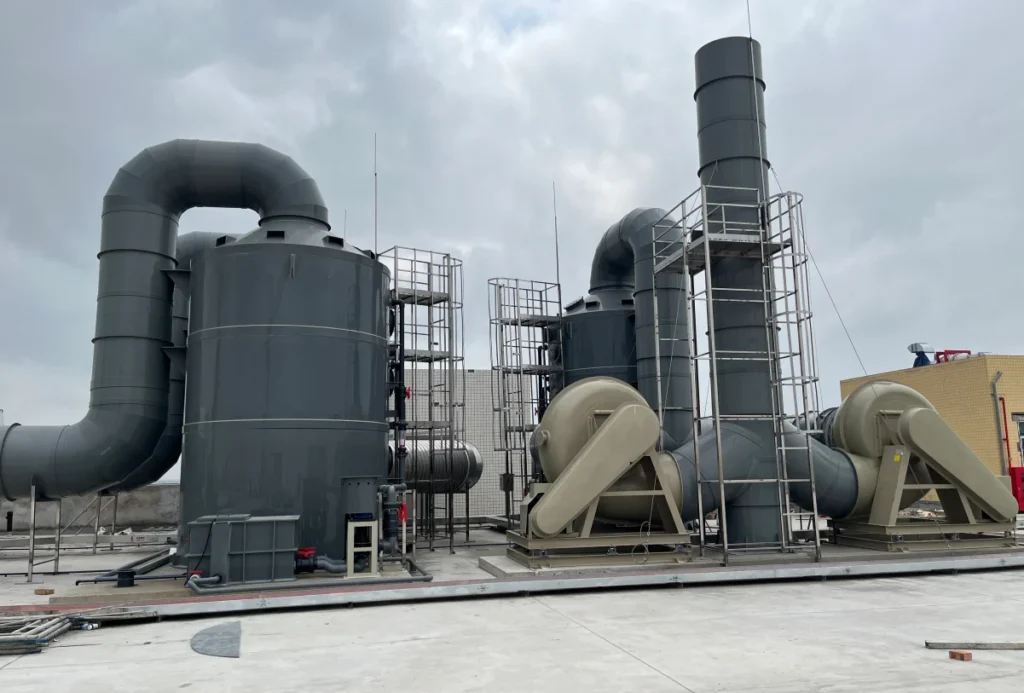
The four main types of wet scrubbers — spray tower, packed bed, venturi, and crossflow — each remove pollutants through a fundamentally different gas-liquid contact mechanism, producing removal efficiencies from 70% to 99%+ at pressure drops ranging from 2 in wc to over 100 in wc and annual energy costs from $14,000 to $140,000 for a 10,000 cfm system (see the Engineering Toolbox scrubber design reference for standard pressure drop correlations). Selecting the wrong type of wet scrubber for your application means either failing your emission limit or paying 3–10× more in operating cost than necessary. This guide covers all types of wet scrubbers with quantified engineering data: operating principle and key components for each type with H3/H4 breakdown, removal efficiency for specific pollutants and particle sizes, pressure drop and energy consumption with annual cost comparisons, a 10-parameter side-by-side comparison table covering six scrubber types including specialty designs, a step-by-step selection framework to match scrubber type to your specific gas conditions and pollutant profile, and coverage of additional types including tray tower, cyclone spray chamber, orifice, mechanically aided, horizontal, portable, and tank vent scrubbers for niche applications.
Key Takeaways
- Four mainstream types of wet scrubbers exist for a reason — each solves a different problem. Spray towers handle gas cooling and pre-cleaning at the lowest energy cost ($14–20K/yr). Packed beds deliver 99%+ gas absorption when emission limits require it. Venturi scrubbers capture submicron particulate that no other type can touch, at $125–140K/yr energy cost. Crossflow scrubbers sacrifice 5–10% efficiency to fit into spaces where a vertical tower cannot be installed. Picking the wrong type means either failing your permit or paying 3–10× more than necessary.
- Particle size determines the feasible scrubber type, not the vendor’s preference. Particles above 10 microns are captured by spray towers (70–90%). Particles between 2–10 microns require cyclone or venturi scrubbers. Submicron particles below 1 micron — metal fume, smoke, PM2.5 — require venturi or mechanically aided scrubbers for 90%+ capture. If you specify a packed bed for a submicron particulate stream, the packing will foul and the scrubber will fail regardless of packing depth.
- Energy cost varies by a factor of 7× between the cheapest and most expensive types. A spray tower costs $14,000–$20,000/year for 10,000 cfm. A packed bed costs $50,000–$65,000/year. A venturi costs $125,000–$140,000/year — the annual energy cost alone can exceed the capital cost within 2–3 years. The contact power theory means every extra “nine” of removal efficiency for submicron particulate roughly doubles the energy cost.
- Combined systems solve mixed gas-particulate streams that single types cannot. When the gas contains both soluble gases and particulate — incineration, biomass combustion, metal smelting — a venturi scrubber followed by a packed bed provides the best overall performance. The venturi removes particulate and cools the gas; the packed bed polishes acid gases to 99%+ removal. No single type of wet scrubber achieves 99%+ for both pollutant classes.
- Site constraints often override theoretical efficiency rankings. A packed bed requires 20–30 ft vertical clearance. If your building has a 16 ft ceiling, the choice is not between packed bed and spray tower — it is between crossflow, horizontal, and a building modification. Always measure available height, electrical capacity, and water/wastewater capacity before selecting the scrubber type. The best scrubber on paper is useless if it does not fit your site.
Spray Tower Scrubbers
Operating Principle and Key Components
Spray tower scrubbers are the most common type of wet scrubber, with an installed base estimated at over 40% of all wet scrubbing systems. Contaminated gas enters the bottom of a cylindrical vessel at 1.2–2.4 m/s (4–8 ft/s) and rises upward while scrubbing liquid is sprayed downward through 2–3 levels of nozzles. The countercurrent flow provides 2–5 seconds of gas-liquid contact time at a liquid-to-gas ratio of 5–20 gal/1,000 cfm (0.67–2.67 L/m³). The open vessel design — no packing, no internals except nozzles and headers — keeps the pressure drop at 2–6 in wc (5–15 mbar), the lowest of all types of wet scrubbers.
Tower Geometry and Materials
The height-to-diameter ratio ranges from 1.5:1 to 3:1, with taller towers used for multiple spray levels. A typical 10,000 cfm spray tower has a diameter of 6–8 ft and a height of 12–20 ft. FRP is the standard construction material for acid gas service, with service life of 15–20 years in well-designed HCl applications. Polypropylene is used for alkaline scrubbers below 80°C, and stainless steel 316L for high-temperature or high-purity applications where chloride stress corrosion cracking above 1,000 ppm Cl⁻ must be avoided. Shell thickness per ASME RTP-1 standards is typically 6–12 mm depending on vessel diameter.
Nozzle Types and Spray Configuration
Three nozzle types dominate. Full cone nozzles produce 500–1,200 micron droplets with uniform coverage for general scrubbing. Hollow cone nozzles produce 200–600 micron finer atomization for improved absorption but require higher pressure. Spiral nozzles produce 800–2,000 micron droplets with the largest free passage for clogging resistance in dirty water service. Nozzle operating pressure is 15–50 psi (1–3 bar), with higher pressures producing finer droplets at increased pump energy cost. A 10,000 cfm tower with two spray levels requires 200–400 gpm delivered by a centrifugal pump rated at 15–30 hp. Spray levels are spaced 3–6 ft apart with 50–100% overlap to eliminate bypass channels. Nozzle inspection every 3–6 months is required to detect wear and clogging before removal efficiency degrades.
Performance Range and Operating Cost
Spray towers achieve 85–95% removal for soluble acid gases (HCl, HF, NH₃) and 70–90% for particles above 10 microns. Efficiency drops below 50% for submicron particles — a fundamental limitation of the coarse droplet (500–2,000 micron) gas-liquid contact at low relative velocity. The energy advantage is significant: at 4 in wc pressure drop, fan power is approximately 15 hp for 10,000 cfm, with annual fan energy cost of $8,000–$10,000 at $0.10/kWh. Total annual energy (fan + pump) is $14,000–$20,000, making the spray tower the least expensive type of wet scrubber to operate. Makeup water consumption is 10–15 gpm to evaporation plus 10–40 gpm blowdown for dissolved solids control. A 10,000 cfm spray tower has a capital cost of approximately $40,000–$80,000 depending on materials and accessories.
Best Applications and Limitations
Spray towers excel in three scenarios: acid gas pre-cleaning ahead of more efficient secondary scrubbers, hot gas quenching and cooling where the spray simultaneously cools and cleans, and applications where 85–95% removal is sufficient for the emission limit. They are the standard type of wet scrubber for HCl mist removal in steel pickling lines and NH₃ scrubbing in fertilizer plants. The most common specification mistake is selecting a spray tower where 99%+ removal is required — a spray tower cannot achieve this regardless of L/G ratio because the coarse droplet contact provides insufficient interfacial area of only 10–50 m² per m³ of gas volume. For gas streams requiring higher efficiency, a packed bed scrubber with 100–300 m²/m³ of wetted surface area is the correct type of wet scrubber for the application. Maintenance consists of nozzle inspection every 3–6 months and sump cleaning every 6–12 months to remove settled solids.
When you need higher gas absorption efficiency than a spray tower can deliver — 99%+ versus 85–95% — the next type of wet scrubber to consider is the packed bed scrubber, which uses packing media to multiply the gas-liquid contact area by 10–50×.
Packed Bed Scrubbers
Packing Media and Mass Transfer
Packed bed scrubbers achieve 99%+ removal for soluble acid gases by forcing gas through a bed of packing media that creates a wetted surface area of 100–300 m² per m³ of packing volume. The scrubbing liquid is distributed over the top of the packing and flows downward by gravity while gas flows upward countercurrently at 2–4 ft/s (0.6–1.2 m/s). The countercurrent flow maintains a strong concentration gradient — cleanest gas contacts freshest liquid at the top — which is the fundamental reason this type of wet scrubber achieves higher gas absorption efficiency than any other configuration.
Random vs Structured Packing
Random packing — Pall rings, Berl saddles, Intalox saddles, Raschig rings — is the most common choice, available in sizes from 1 to 3.5 inches (25–90 mm). Packing diameter should not exceed 1/8 of the tower diameter to prevent wall channeling and should be at least 15× the largest particle size to prevent solids bridging. Structured packing — corrugated sheet metal or knitted wire mesh — provides higher capacity and lower pressure drop per theoretical stage but costs 2–4× more and is typically specified for high-purity applications where the gas flow rate is stable and fouling potential is low. Polypropylene random packing is the standard for alkaline service up to 80°C. Ceramic packing withstands acid service up to 150°C and is preferred for HCl, HNO₃, and H₂SO₄ absorption. Stainless steel and PTFE are specified for service up to 300°C but cost 5–10× more than polypropylene.
Design Parameters and Performance
For SO₂ scrubbing with 5–10% NaOH at pH 6.5–7.5, the design parameters are: L/G ratio of 4–15 gal/1,000 cfm, bed depth of 2–4 m, and superficial gas velocity of 2–4 ft/s — held below 70–80% of the flooding velocity per the modified Sherwood correlation. Pressure drop is 4–10 in wc (10–25 mbar) per meter of packing, so a typical 3 m bed operates at 12–30 in wc total, requiring 40–60 hp fan power for 10,000 cfm. The packing height is calculated from NTU × HTU. For SO₂ removal from 2,000 ppm to 40 ppm (95% removal) at an L/G of 10 gal/1,000 cfm with 5% NaOH, approximately 3–4 transfer units are needed at an HTU of 0.8–1.2 m for 2-inch Pall rings, giving a required packed height of 2.4–4.8 m. Towers are designed with 2–4 m of packing divided into two or more beds with liquid redistributors every 1.5–2 m to prevent liquid channeling at the tower wall.
Flooding and Operating Window
Gas velocity is maintained at 60–75% of flooding to maximize mass transfer while maintaining stability margin for flow fluctuations. Below 30% of flooding velocity, the packing is inadequately wetted and mass transfer efficiency drops sharply. The operating window narrows as packing size increases: 2-inch packing offers wider turndown than 3.5-inch but at higher pressure drop per transfer unit. Continuous pressure drop monitoring is the primary diagnostic tool — a 30–50% increase from baseline indicates packing fouling, while a sudden 20–30% decrease may indicate channeling from liquid distributor failure.
Applications and Limitations
Packed bed scrubbers are the standard type of wet scrubber for chemical manufacturing (HCl absorption, NH₃ recovery), metal pickling (HF/HNO₃ fume control), and waste incineration (acid gas removal from flue gas). A packed bed handling 10,000 cfm of HCl at 500 ppm inlet produces an outlet below 5 ppm — well within the EPA MACT standard of 12 ppmv. The primary limitation is particulate fouling: gas streams above 50–100 mg/Nm³ of particulate will gradually plug the packing, increasing pressure drop and reducing efficiency. Sticky particulate — tars, oils, organic condensables — is particularly problematic because it cannot be removed by washing and may require packing replacement at $5,000–$15,000 for a 5 ft diameter tower. For gas streams containing both particulate and soluble gases, a venturi scrubber followed by a packed bed provides the best overall performance. Total annual operating cost for a 10,000 cfm packed bed is $50,000–$65,000 (fan energy 60–70%, chemical 10–15%, pump 15–20%, maintenance 5–10%). Packing requires inspection every 2–5 years depending on gas cleanliness.
Packed beds are not designed for particulate removal. When your emission contains submicron dust, metal fume, or smoke requiring 90%+ capture, the venturi scrubber — with its throat velocity of 50–100 m/s — is the appropriate type of wet scrubber for the job.
Venturi Scrubbers
Throat Velocity and Atomization
Venturi scrubbers are the only type of wet scrubber engineered specifically for submicron particulate capture, as documented in the EPA wet scrubber design manual, achieving 90–99% removal for particles down to 0.5 microns. The gas accelerates to 50–100 m/s (150–300 ft/s) through a converging-diverging throat, where injected liquid is shattered into 50–200 micron droplets — 10–40× finer than spray tower droplets. The resulting droplet density reaches 10⁸–10¹⁰ droplets per cubic meter of gas. The Stokes number for 1-micron particles at these conditions is 1–10, well above the Stk > 0.1 threshold for inertial impaction, compared to Stk 0.01–0.05 in a spray tower where the same particles pass through largely uncaptured. The pressure drop follows an approximately quadratic relationship with velocity: 60 m/s produces ~30 in wc (75 mbar), while 100 m/s produces 80–100 in wc (200–250 mbar).
Variable-throat designs use a movable cone or adjustable side walls to maintain throat velocity as gas flow varies, providing a 3:1 turndown ratio versus 1.5:1 for fixed-throat designs. Fixed-throat venturis lose collection efficiency below 70% of design flow because the throat velocity drops below the minimum required for fine droplet atomization. Liquid is injected at or slightly upstream of the throat through 3–8 nozzles at an L/G ratio of 5–20 gal/1,000 cfm.
Efficiency vs Energy Trade-off
Venturi collection efficiency follows the contact power theory: Nt = k × ΔP⁰·⁵⁻⁰·⁷, where the number of transfer units increases with pressure drop. Each additional 10 in wc of pressure drop delivers 5–15% improvement in submicron capture up to approximately 60 in wc, after which the gain per unit pressure drop diminishes. At 40 in wc, single-stage efficiency is approximately 95% for 0.5-micron particles; at 80 in wc, it reaches 99%. The final 4% improvement requires doubling the pressure drop and therefore doubling the fan energy consumption. The energy penalty is substantial: a venturi handling 10,000 cfm at 60 in wc requires 150 hp of fan power, consuming 1.1 million kWh annually at continuous operation. At $0.10/kWh, the annual fan energy cost is $110,000. Adding pump energy (20–40 hp, $15,000–$30,000/year) brings the total annual energy cost to $125,000–$140,000 — enough to exceed the scrubber capital cost within 2–3 years. For comparison, a baghouse for the same gas flow requires 30–50 hp at $22,000–$37,000/year — a savings of $90,000–$110,000 per year that drives the economic decision toward dry collection whenever the gas conditions allow.
Applications and Combined Systems
Venturi scrubbers are specified when the gas contains submicron particulate that no other type of wet scrubber can capture efficiently. Standard applications include metal smelting (lead, copper, zinc — where metal fume requires 99%+ capture), incineration (municipal solid waste — where the gas contains both submicron fly ash and acid gases), and boiler flue gas (biomass combustion — where PM2.5 emissions must be controlled). In each case, the venturi is often followed by a packed bed scrubber for acid gas polishing, since the venturi’s gas absorption capability is limited to 90–95% by the short contact time of 0.1–0.5 seconds through the throat. The venturi removes the particulate; the packed bed polishes the gas to 99%+ removal. Wastewater handling is a significant operational consideration: a 10,000 cfm venturi recirculates 150–300 gpm of water, of which 5–15 gpm is bled as blowdown containing the captured particulate — potentially classified as hazardous waste in smelting or incineration applications, adding $50,000–$200,000 per year in disposal costs.
Venturi scrubbers deliver unmatched particulate removal, but they require 20–30 ft of vertical clearance for the vessel and ductwork. When the installation site cannot accommodate that height — indoor retrofits, rooftop installations, marine applications — the crossflow scrubber’s horizontal gas flow configuration reduces the vertical footprint by 30–50%.
Crossflow Scrubbers
Horizontal Gas Flow Configuration
Crossflow scrubbers are a distinct type of wet scrubber where gas flows horizontally while scrubbing liquid flows vertically downward through a packing section at right angles. This perpendicular flow path eliminates the flooding constraint that limits gas velocity in countercurrent towers — crossflow scrubbers operate at 3–6 ft/s versus 2–4 ft/s for countercurrent. The configuration reduces overall height by 30–50% compared to a countercurrent packed tower of the same capacity, making crossflow the practical choice when vertical space is constrained. The packing depth in the flow direction is typically 1–2 m, with random 2–3 inch Pall rings or saddles retained between support grids. Pressure drop is 3–8 in wc (8–20 mbar), comparable to a spray tower on a per-meter basis.
The crossflow geometry changes the mass transfer driving force relative to countercurrent operation. In a countercurrent packed bed, the cleanest gas contacts the freshest liquid at the top of the column, maintaining a strong concentration gradient across the entire packing height. In crossflow, the liquid concentration gradient develops across the vessel height while the gas concentration gradient develops across the packing depth — the average driving force is 10–20% lower than countercurrent for the same inlet and outlet concentrations. This reduction is partially offset by the higher operating gas velocity (3–6 ft/s vs 2–4 ft/s), which increases the gas-film mass transfer coefficient. Crossflow scrubbers achieve 90–95% removal for soluble acid gases versus the 99%+ of countercurrent packed beds, but the height saving often justifies the moderate efficiency reduction in space-constrained installations.
When to Choose Crossflow
The decision to specify a crossflow scrubber is almost always driven by site geometry. Crossflow scrubbers are chosen for indoor installations where ceiling height limits vertical construction to 8–12 ft versus the 20–30 ft required for a countercurrent packed tower of the same capacity. They are common under existing ductwork where a vertical riser would require building structural modifications, on rooftops where a low profile reduces wind loading and visual impact, and in marine and offshore applications where vessel motion affects tall towers less than compact horizontal designs. In each case, the selection is a practical compromise — accepting 90–95% removal efficiency — in exchange for being able to physically fit the scrubber into the available space. Maintenance access is a secondary advantage: packing is accessible from side doors without top-head removal, making inspection easier for fouling-prone service. Crossflow scrubbers are the standard type of wet scrubber for semiconductor manufacturing (limited subfab ceiling height), food processing odor control, wastewater H₂S control, and pharmaceutical manufacturing — all applications where pollutant concentrations are moderate (10–100 ppm) and achievable outlet concentrations are within permit limits.
Other Types of Wet Scrubbers
Beyond the four mainstream types, several additional types of wet scrubbers serve specific industrial niches. These designs offer advantages for particular pollutant profiles, operating conditions, or space constraints that the mainstream configurations cannot match efficiently.
Tray Tower (Plate) Scrubbers
Tray towers use horizontal perforated trays inside a vertical column to create discrete gas-liquid contact stages. Gas rises through openings in each tray — simple holes (sieve trays), valve caps, or bubble caps — and disperses into a 1–4 inch liquid layer maintained on the tray surface by a downcomer or weir. The intimate gas-liquid mixing creates a froth zone that achieves one theoretical stage of mass transfer per tray. A typical tower has 5–20 stages, with each stage providing 50–70% removal of the remaining contaminant. Tray towers excel where the gas stream contains solids that would plug random packing — the open hole area of a sieve tray (10–20% of tray area) is less susceptible to plugging than the tortuous flow path through packing. Pressure drop is 2–4 in wc per tray, so a 10-tray tower operates at 20–40 in wc total. Tray towers handle higher liquid flow rates than packed beds, up to 30–50 gpm per inch of weir length. Common applications include natural gas processing (amine contactors), chemical distillation, and refinery gas treatment where the gas is dirty and high efficiency is required.
Cyclone Spray Chambers
Cyclone spray chambers combine centrifugal gas motion with spray scrubbing in a single vessel. Gas enters tangentially at 15–25 m/s, creating a cyclonic vortex that throws particles toward the wetted wall while central spray nozzles inject scrubbing liquid outward into the rotating gas stream. The centrifugal acceleration of 5–20 g increases the relative velocity between particles and droplets by 3–5× compared to a conventional spray tower, improving fine particulate capture without the energy penalty of a venturi scrubber. Cyclone chambers achieve 85–95% removal for particles in the 2–5 micron range at a pressure drop of 5–15 in wc (12–37 mbar) and energy consumption of 20–50 hp for 10,000 cfm. This makes them more energy-efficient than venturi scrubbers for intermediate particulate removal where 99% submicron efficiency is not required. Common applications include woodworking (sawdust), grain handling, and mineral processing where the particulate is relatively coarse and a venturi would be over-specified.
Orifice and Impingement Scrubbers
Orifice scrubbers pass gas at high velocity over a pool of scrubbing liquid, entraining droplets that capture pollutants by inertial impaction. The gas then strikes baffles or impingement plates that knock the captured material out of the gas stream. This self-induced spray design eliminates spray nozzles and recirculation pumps entirely while achieving 85–95% removal for particles down to 2–5 microns at 6–20 in wc pressure drop. Impingement plate scrubbers are a refinement: gas passes through a perforated tray covered with a thin layer of liquid, creating a froth zone with each tray providing 60–80% removal. A three-tray impingement scrubber at 12 in wc total pressure drop achieves approximately 97% removal for 5-micron particles with only 1–3 gal/1,000 cfm liquid recirculation — significantly less than the 5–20 gal/1,000 cfm required by spray towers and venturi scrubbers. The low water consumption makes impingement scrubbers attractive where water supply is limited or wastewater disposal is expensive. They are common in foundries, cement plants, and mineral processing operations.
Mechanically Aided (Dynamic) Scrubbers
Mechanically aided scrubbers, also called dynamic wet scrubbers, use a motor-driven rotor operating at 500–1,800 RPM to atomize the scrubbing liquid by mechanical shear rather than relying on gas velocity. The rotor creates fine droplets of 100–500 microns regardless of gas flow rate, maintaining capture efficiency across a 5:1 turndown range — significantly better than the 1.5:1 range of fixed-throat venturi scrubbers. The rotor motor consumes 50–150 hp for a 10,000 cfm unit. Dynamic scrubbers are specified for batch processes, intermittent operations, and applications where gas flow varies widely throughout the production cycle, because they maintain 90–95% removal for 2-micron particles across a wider flow range than any static scrubber type. However, moving parts in direct contact with the gas stream create maintenance demands that static scrubbers do not have: shaft seals in corrosive service require replacement every 1–2 years, and blade wear from erosive particulate may require rotor replacement every 3–5 years.
Specialty Wet Scrubbers
Several specialty configurations expand the range of applications that types of wet scrubbers can serve. These designs address constraints — limited vertical space, mobile operation, fugitive emission sources — that the mainstream types cannot accommodate efficiently.
Horizontal Wet Scrubbers
Horizontal wet scrubbers orient the entire gas flow path horizontally through a rectangular or cylindrical vessel, reducing overall height by 50–70% compared to a vertical tower of equivalent capacity. A 10,000 cfm horizontal scrubber is typically 4–6 ft tall and 15–25 ft long, versus 20–30 ft for a vertical tower. The low profile allows installation inside existing buildings with standard ceiling heights, under elevated ductwork, or on rooftops where a vertical tower would require structural reinforcement. Liquid distribution requires careful leveling — a 1–2° tilt can shift 30–50% of the liquid flow to the low side, creating dry channels that bypass gas and reduce efficiency. Gas velocity must be maintained above 3–5 ft/s to prevent solids settling in the bottom of the horizontal vessel. Horizontal scrubbers are typically specified for indoor odor control in wastewater treatment, marine exhaust gas cleaning where deck clearance limits height, and pharmaceutical facilities where a tall external tower would be architecturally intrusive.
Portable Wet Scrubbers
Portable wet scrubbers are self-contained, skid-mounted units for temporary emission control during plant maintenance, tank cleaning, emergency bypass, or construction. The unit integrates the scrubber vessel, recirculation pump, fan, chemical feed system, and control panel into a single 8–20 ft skid for transport by flatbed truck. Capacities range from 500–10,000 cfm, with smaller units (500–2,000 cfm) movable by pallet jack. The scrubber type is almost always a spray tower or crossflow design for simplicity and reliability in temporary operation. Rental rates are $2,000–$6,000/month depending on capacity, with chemical and disposal costs additional. Portable scrubbers are used when a permanent system is not justified for a short-duration emission source — tank degassing (1–4 weeks), catalyst changeout (2–6 weeks), or as emergency backup when a permanent scrubber is down for maintenance (1–4 week repair window). For applications requiring temporary control for less than 6 months, renting a portable unit is typically more economical than purchasing a permanent system.
Tank Vent Scrubbers
Tank vent scrubbers are small, direct-mounted units installed on the vent nozzle of storage tanks containing volatile hazardous chemicals. They capture vapors displaced during tank filling (working losses) and evaporation during storage (standing losses) before they can escape to the atmosphere. A typical unit is a 12–36 inch diameter FRP or steel vessel containing 2–4 ft of packing with a 1–5 hp recirculation pump and 5–50 gallon chemical reservoir. The design flow rate matches the maximum tank filling rate — typically 5–200 cfm for standard chemical storage. Tank vent scrubbers achieve 99.0–99.9% removal for organic vapors and acid gases at low capital cost. They are the standard control technology for tanks storing HCl (water scrubber, outlet below 5 ppm), NH₃ (sulfuric acid scrubber), and volatile organic compounds with suitable scrubbing solvent. The small size and direct mounting eliminate the need for ductwork, fans, and structural support. Tank vent scrubbers are required by EPA Subpart Wa for storage tanks at facilities subject to MACT standards for organic chemical manufacturing.
Now that we have covered all types of wet scrubbers individually — from mainstream spray towers and packed beds to specialty portable and tank vent units — the comparison table in the next section provides a side-by-side quantitative reference across 10 engineering parameters to help narrow your selection.
Comparison of Wet Scrubber Types
The table below compares six types of wet scrubbers across 10 engineering parameters. Use this as a quick reference to narrow the selection before working through the detailed selection guide.
| Parameter | Spray Tower | Packed Bed | Venturi | Crossflow | Tray Tower | Mechanically Aided |
|---|---|---|---|---|---|---|
| Gas velocity | 4–8 ft/s | 2–4 ft/s | 150–300 ft/s (throat) | 3–6 ft/s | 3–6 ft/s | 5–15 ft/s |
| Pressure drop | 2–6 in wc | 8–30 in wc | 30–100+ in wc | 3–8 in wc | 10–40 in wc | 10–30 in wc |
| L/G ratio (gal/1k cfm) | 5–20 | 4–15 | 5–20 | 4–12 | 8–25 | 1–5 |
| Gas absorption | 85–95% | 99%+ | 90–97% | 90–95% | 99%+ | 80–90% |
| PM >5µm removal | 70–90% | 50–70%* | 99%+ | 60–80% | 70–85% | 85–95% |
| PM <1µm removal | <50% | <30%* | 90–99% | <40% | <50% | 80–90% |
| Fan power (10k cfm) | 15–20 hp | 40–60 hp | 100–200 hp | 20–30 hp | 40–80 hp | 30–50 hp + rotor |
| Annual energy cost | $14–20K | $50–65K | $125–140K | $20–30K | $50–80K | $50–80K |
| Capital cost index | 1.0× | 1.5–2.0× | 2.0–3.0× | 1.5–2.5× | 2.0–3.0× | 2.0–3.5× |
| Best application | Gas cooling, pre-cleaning | Chemical, acid gas control | Smelting, PM2.5 control | Semiconductor, indoor | Refinery, dirty gas | Variable flow, batch |
* Packing fouls in particulate service — these values assume clean gas conditions. Annual energy cost at $0.10/kWh, continuous 8,760 hrs/year, including fan and pump energy. Capital cost index relative to spray tower baseline.
How to Select the Right Type of Wet Scrubber
Selecting the correct type of wet scrubber requires matching the scrubber’s performance characteristics to your specific gas conditions, pollutant types, and site constraints. Apply this four-step framework before requesting vendor quotes — it will prevent both under-specification (permit violations) and over-specification (unnecessary capital and operating costs).
Step 1: Identify Your Pollutant
Classify your emission as primarily gaseous, primarily particulate, or mixed. If you need a refresher on basic operating principles, our guide to what a wet scrubber is → covers the fundamentals. For gaseous pollutants (HCl, HF, NH₃, SO₂, H₂S), packed bed scrubbers provide 99%+ removal and spray towers provide 85–95%. A packed bed is required when the outlet must be below 10 ppm for most acid gases; a spray tower is sufficient when 20–50 ppm outlet is acceptable. For particulate, particle size is the critical parameter: particles above 10 microns are captured by spray towers (70–90%), 2–10 micron particles require cyclone chambers or venturi scrubbers, and submicron particles below 1 micron require venturi or mechanically aided scrubbers for 90%+ capture. Inlet concentration determines the required number of stages — an HCl inlet of 500 ppm requiring 5 ppm outlet needs 99% removal, demanding a packed bed with 4–5 transfer units (approximately 2–3 m of packing).
Step 2: Determine Required Efficiency
Your required removal efficiency is set by the applicable emission standard, not by what the scrubber can achieve. Check your local regulation — EPA MACT for HCl from chemical manufacturing (40 CFR Part 63 Subpart FFFF) requires outlet below 12 ppmv or 99% removal. For a 500 ppm inlet, this translates to 97.6% removal; for a 1,200 ppm inlet, 99% is required. Apply a 10–20% safety factor on the required efficiency: design for 97–99% if the regulation requires 95%. This adds 0.5–1.0 additional transfer units — approximately 0.5–1.0 m of packing depth — at 5–15% incremental capital cost. The cost of a permit violation (fines, shutdown orders) can exceed the total scrubber capital cost in a single event.
Step 3: Evaluate Site Constraints
Measure available height first. A 10,000 cfm packed bed requires 20–30 ft vertical clearance. If the installation is indoors with a 16 ft ceiling, crossflow (8–12 ft) or horizontal scrubbers (4–6 ft) become the practical choice. Verify structural load — a packed bed filled with liquid weighs 20,000–40,000 lbs for 10,000 cfm, requiring roof reinforcement at $20,000–$50,000. Electrical capacity determines whether a venturi scrubber (150–200 hp) is feasible without transformer upgrades at $30,000–$80,000. For limited water supply (<10 gpm available for makeup), orifice or impingement scrubbers with their low recirculation rate (1–3 gal/1,000 cfm) may be the only viable wet scrubber option — otherwise consider a baghouse.
Step 4: Decision Matrix
| Primary Pollutant | Particle Size | Recommended Type | Expected Efficiency |
|---|---|---|---|
| Soluble acid gas (HCl, HF, NH₃) | N/A (gas) | Packed bed (first choice) or spray tower | 99%+ packed / 85–95% spray |
| SO₂, H₂S, organic vapors | N/A (gas) | Packed bed with chemical reagent (NaOH, NaOCl) | 95–99% |
| Metal fume, smoke, PM2.5 | <1 µm | Venturi scrubber (variable throat preferred) | 90–99% |
| Coarse dust, mist | >10 µm | Spray tower or cyclone spray chamber | 70–90% / 85–95% |
| Mixed gas + particulate | Any | Venturi + packed bed combined system | 99%+ gas + 95–99% PM |
| Dirty gas with solids | >5 µm | Tray tower (resists plugging) | 95%+ gas absorption |
| Variable flow gas | <5 µm | Variable-throat venturi or mechanically aided | 90–95% across 3:1–5:1 turndown |
| Temporary emission source | Any | Portable wet scrubber (spray or crossflow) | 85–95% |
| Storage tank vent | N/A (vapor) | Tank vent scrubber (direct-mounted) | 99.0–99.9% |
| Cold climate (<−10°C ambient) | Any | Heated building for wet scrubber, or dry system | — |
Frequently Asked Questions About Wet Scrubber Types
What are the main types of wet scrubbers?
The four main types of wet scrubbers are spray tower (simplest, lowest dp at 2–6 in wc, 70–90% PM removal), packed bed (highest gas absorption at 99%+, 8–30 in wc), venturi (submicron PM capture at 90–99%, 30–100+ in wc), and crossflow (horizontal gas flow, 30–50% height reduction). Additional types include tray tower, cyclone spray chamber, orifice/impingement, mechanically aided, and specialty types for niche applications.
How do I choose the right type of wet scrubber?
Choose based on pollutant type and particle size (gaseous→packed bed, coarse PM→spray tower, fine PM→venturi), required removal efficiency (99%+→packed bed or venturi), site constraints (limited height→crossflow or horizontal), and total cost of ownership. Use the decision matrix in the selection guide for rapid initial selection. The worst mistake is choosing based on capital cost alone — a spray tower that cannot meet the emission limit costs more than a packed bed never installed.
What is the difference between a spray tower and a packed bed scrubber?
Spray towers are empty vessels with spray nozzles — gas-liquid contact area is limited to 10–50 m² per m³ of gas, achieving 85–95% gas absorption. Packed beds contain packing media creating 100–300 m² of wetted surface per m³, providing 10–50× more contact area for 99%+ gas absorption. Packed beds have 3–5× higher pressure drop (8–30 in wc vs 2–6 in wc) and are vulnerable to particulate fouling above 50–100 mg/Nm³, while spray towers handle dirty gas without plugging but cannot achieve 99%+ removal.
When should I use a venturi scrubber?
Use a venturi scrubber when the gas contains submicron particulate (PM2.5, metal fume, smoke) requiring 90%+ removal. Venturi scrubbers are the only type of wet scrubber that captures particles below 1 micron at high efficiency because the 50–100 m/s throat velocity creates fine droplets at Stokes numbers of 1–10 versus 0.01–0.05 in spray towers. The trade-off is energy: 100–200 hp fan power per 10,000 cfm costs $125,000–$140,000/year in continuous operation — 6–10× more than a spray tower.
What is a crossflow scrubber best for?
Crossflow scrubbers are best for space-constrained installations where vertical clearance is limited. The horizontal gas flow reduces height by 30–50% versus countercurrent towers, making them the standard choice for semiconductor cleanrooms, indoor wastewater treatment, and marine applications. Crossflow achieves 90–95% acid gas removal — slightly lower than the 99%+ of packed beds but acceptable for moderate pollutant concentrations.
Can different types of wet scrubbers be combined?
Yes. The most common combined system is a venturi scrubber for submicron particulate followed by a packed bed for high-efficiency gas absorption — standard in incineration, biomass combustion, and metal smelting. The venturi removes PM and cools the gas; the packed bed polishes acid gases to 99%+ removal. Other combinations include a spray tower pre-scrubber for cooling ahead of a packed bed, and venturi+crossflow for space-constrained combined service.
What is the most cost-effective type of wet scrubber?
The spray tower is the most cost-effective type when 85–95% gas removal or 70–90% coarse PM removal is sufficient — capital cost index 1.0×, annual energy $14,000–$20,000 for 10,000 cfm. For 99%+ gas removal, a packed bed at $50,000–$65,000/yr is the minimum viable option. For submicron PM, a venturi at $125,000–$140,000/yr is required — the most expensive. The most cost-effective choice depends on your required efficiency, not the equipment price.
What materials are used to construct wet scrubbers?
FRP is the standard construction for acid gas service — corrosion-resistant, lightweight, costing 30–50% less than stainless steel. Polypropylene is used for alkaline service below 80°C. Stainless steel 316L handles high-temperature (>80°C) and high-purity applications. PVC and CPVC serve small-diameter units handling aggressive chemicals at moderate temperatures. Dual-laminate construction combines a thermoplastic inner liner with an FRP structural shell for the corrosion resistance of plastic with the strength of FRP. The material choice affects scrubber service life from 10–15 years (FRP in hot HCl service) to 20–30 years (carbon steel in dry service).
Conclusion
Selecting the right type of wet scrubber comes down to three factors: what pollutant you need to remove (gas versus particulate, and at what concentration), what efficiency you need to achieve (99%+ or 85–95%), and what constraints your site imposes (available height, electrical capacity, water supply). Spray towers are the simplest and most economical type of wet scrubber for moderate-efficiency applications. Packed beds deliver 99%+ gas absorption when emission limits are tightest. Venturi scrubbers are the only type of wet scrubber that captures submicron particulate at high efficiency, at a significant energy cost. Crossflow and specialty designs provide practical solutions when space constraints rule out the standard options. XICHENG EP manufactures all mainstream types of wet scrubbers in FRP, PP, and stainless steel, with over 2,600 systems shipped to 60+ countries since 2008. Browse our wet scrubber product range → or contact our engineering team → with your process parameters for a preliminary scrubber selection and budget estimate.