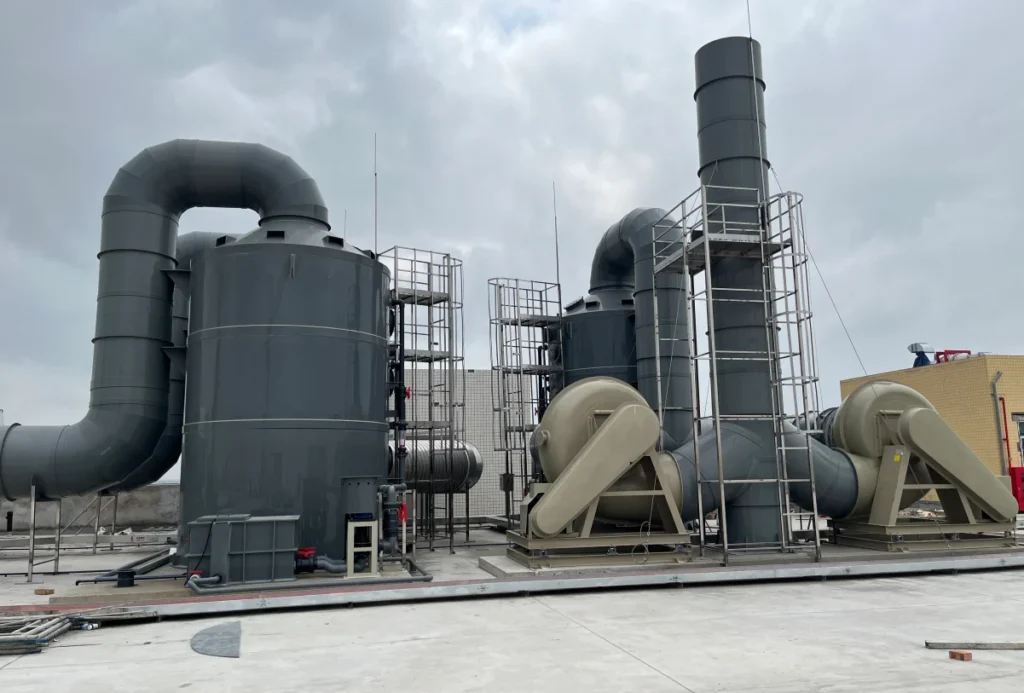
A gas scrubber is the most widely used air pollution control device in industrial manufacturing. When your process emits acid gases, fine particulate, or soluble vapors – from a chemical reactor, a boiler stack, a pharmaceutical dryer, or a marine engine – a gas scrubber is the equipment that removes those pollutants before they reach the atmosphere. Unlike baghouses that only capture dry particulate, or thermal oxidizers that only destroy VOCs, a gas scrubber handles both gases and particles in a single pass using a liquid scrubbing medium.
This guide covers everything you need to evaluate, select, and specify a gas scrubber system for your facility: how they work, the major types and their performance characteristics, key design parameters that determine real-world efficiency, cost ranges by type, applicable regulatory standards, and a step-by-step selection framework. If you already know your process conditions and need a preliminary system recommendation, contact our applications engineering team → with your gas flow rate, pollutant type, and target outlet concentration.
Key Takeaways
- A gas scrubber removes both gaseous pollutants and particulate matter in a single device, unlike baghouses (particulate only) or thermal oxidizers (VOCs only). If your exhaust stream contains acid gases plus dust – HCl and PM from a chemical plant, SO2 and fly ash from a boiler – a gas scrubber is the only single-device solution that achieves compliance for both.
- The scrubbing liquid chemistry determines removal efficiency more than the hardware does. A packed bed scrubber running plain water on HCl achieves 50-70% removal. The same scrubber with a pH-controlled NaOH solution achieves 99.9%+. Do not select a scrubber type before confirming the chemical dosing strategy.
- Energy cost varies by a factor of 7x across gas scrubber types at the same flow rate. A spray tower for 10,000 cfm costs approximately $14,000-20,000/year in fan and pump energy. A packed bed costs $50,000-65,000/year. A venturi scrubber costs $125,000-140,000/year. The energy cost alone can exceed the capital cost within 2-4 years for high-pressure-drop designs.
- Flue gas and stack scrubber systems face different design constraints than process scrubbers. High temperature, varying flow rates, and condensation require material and configuration choices that differ from standard chemical scrubber designs – FRP may not be suitable above 150C, and stack-mounted systems must account for wind loading and thermal expansion.
- A properly scoped gas scrubber system includes instrumentation, not just the vessel. pH control, pressure drop monitoring, liquid flow indication, and tank level control are not optional accessories. Installations that omit these routinely experience efficiency drops within the first 6-12 months of operation.
What Is a Gas Scrubber?
A gas scrubber is an air pollution control device that removes harmful pollutants from industrial exhaust gas streams by bringing the gas into contact with a liquid scrubbing medium. The pollutants – whether acid gases like HCl and SO2, alkaline vapors like NH3, or particulate matter like dust and fume – transfer from the gas phase into the liquid phase through absorption, chemical reaction, or physical impaction. The cleaned gas then exits the scrubber, typically through a mist eliminator that captures any entrained liquid droplets before the gas reaches the stack.
Gas Scrubber vs Other Air Pollution Control Technologies
The table below shows how gas scrubbers compare with the other major air pollution control technologies. The key distinction is that a gas scrubber is the only technology that simultaneously handles soluble gases AND particulate matter – but it generates a wastewater stream that dry technologies do not.
| Technology | Target Pollutants | Typical Efficiency | Waste Stream | Best For |
|---|---|---|---|---|
| Gas Scrubber (Wet) | Soluble gases + PM | 90-99.9% | Wastewater | Combined gas + particulate, hot gas, sticky dust |
| Baghouse / Fabric Filter | Particulate only | 99-99.9% | Solid dust cake | Dry particulate, high-efficiency PM capture |
| Electrostatic Precipitator (ESP) | Particulate only | 95-99.9% | Dry or wet solids | High-volume flue gas, fine PM |
| Thermal Oxidizer | VOCs, combustible gases | 95-99.9% | CO2 + H2O | Volatile organic compounds, odorous gases |
| Carbon Adsorber | VOCs, odor | 90-99% | Spent carbon | Low-concentration VOCs, solvent recovery |
| Dry Scrubber (Sorbent Injection) | Acid gases | 80-95% | Solid reaction product | Moderate acid gas removal without wastewater |
A more detailed comparison of wet and dry scrubbing technologies is available in our wet scrubber advantages and disadvantages guide →, which covers the trade-offs in operating cost, maintenance, and applicability. For a broader explanation of what a gas scrubber is and how it fits into industrial emission control strategies, our what is a wet scrubber article → covers the fundamentals in greater depth.
How Does a Gas Scrubber Work?
A gas scrubber works through three sequential stages: gas-liquid contact, pollutant transfer, and mist elimination. The efficiency of each stage depends on the scrubber design, the liquid chemistry, and the operating conditions. Understanding these stages is essential before selecting a scrubber type – because every design decision affects one or more of these stages.
Stage 1: Gas-Liquid Contact
The contaminated gas stream enters the scrubber vessel and comes into contact with the scrubbing liquid. The method of contact depends on the scrubber type. In a spray tower, liquid is atomized through nozzles into fine droplets that fall through the rising gas stream. In a packed bed, the gas passes through a bed of packing material while liquid flows downward over the packing surface, creating a thin film that maximizes the gas-liquid interface. In a venturi scrubber, the gas accelerates through a narrow throat where high-velocity gas shears the liquid into fine droplets, creating intense mixing.
The contact mechanism determines the effective surface area for mass transfer. A spray tower provides 10-50 m2 of droplet surface area per m3 of gas. A packed bed provides 100-300 m2 of wetted surface area per m3 of gas – 3-10x more. A venturi scrubber creates droplet surface areas comparable to packed beds but with much higher energy input. More surface area means more opportunity for pollutants to transfer into the liquid, which directly translates to higher removal efficiency.
Stage 2: Pollutant Transfer – Absorption and Chemical Reaction
Pollutants transfer from the gas phase to the liquid phase through two mechanisms: physical absorption and chemical reaction. Physical absorption occurs when soluble gases like HCl, HF, or NH3 dissolve directly into the scrubbing liquid. The driving force is the concentration gradient between the gas phase and the liquid phase – Henry’s Law governs how much gas dissolves at equilibrium. Chemical reaction occurs when the dissolved pollutant reacts with chemicals in the scrubbing liquid. For example, when HCl dissolves in water it dissociates into H+ and Cl- ions; if the water contains NaOH, the acid is neutralized: HCl + NaOH -> NaCl + H2O. This reaction consumes the dissolved HCl, maintaining the concentration gradient and driving further absorption.
For particulate removal, the mechanism is different. Particles are captured by liquid droplets through inertial impaction (larger particles cannot follow the gas streamline and collide with droplets), interception (particles following the gas streamline come within one particle radius of a droplet and adhere), and diffusion (submicron particles diffuse randomly and contact droplets). The capture efficiency for each mechanism depends on the particle size: impaction dominates above 1-2 um, diffusion dominates below 0.1 um, and both mechanisms are weak in the 0.1-1 um range, which is why fine PM is the hardest to capture.
Key point: For gaseous pollutants, the scrubbing liquid chemistry is more important than the scrubber hardware. A packed bed scrubber using plain water achieves approximately 50-70% HCl removal. The same scrubber with NaOH dosed to maintain pH 8-9 achieves 99.9%+ removal. pH control is not a refinement – it is a requirement for high-efficiency acid gas scrubbing.
Stage 3: Mist Elimination and Clean Gas Discharge
After the gas-liquid contact section, the gas stream carries entrained liquid droplets. These droplets contain dissolved pollutants, suspended solids, and chemical residues. If discharged to the stack, they create a visible plume (stack opacity), cause downstream corrosion in ductwork, and represent a liquid loss from the recirculation system. The mist eliminator – also called a demister or entrainment separator – removes these droplets before the gas exits.
Mist eliminators typically use vane packs (chevron-style blades that force directional changes, causing droplets to coalesce and drain back), or mesh pads (woven wire or plastic mesh that captures droplets by impaction). Well-designed mist eliminators achieve outlet droplet concentrations below 0.1 grains/dscf. A failing mist eliminator is often the first visible sign of scrubber performance problems – a persistent stack plume when operating conditions have not changed.
For a more detailed walkthrough of each operating stage with engineering diagrams and design equations, see our step-by-step guide to how wet scrubbers work →. For the complete principles of scrubber system design and sizing, our scrubber system article → covers the system-level engineering considerations.
Types of Gas Scrubbers
Gas scrubbers fall into three broad categories based on the mechanism of pollutant capture: wet scrubbers (using a liquid scrubbing medium), dry scrubbers (using a dry sorbent or reagent), and electrostatic precipitators (using electrical charges for particulate capture). Within each category, multiple design configurations exist – each optimized for specific pollutant types, concentration ranges, and operating conditions. The table below summarizes the main types, and the following sections describe each in detail.
Wet Gas Scrubbers
Wet scrubbers are the dominant type of gas scrubber in industrial applications, accounting for the majority of installed systems. They use water or a chemical solution to capture pollutants through absorption, chemical reaction, or physical impaction. The design configuration determines which pollutants are captured and at what efficiency.
Spray Tower Scrubbers
Spray towers are the simplest type of wet gas scrubber – an empty vessel with spray nozzles that atomize scrubbing liquid into the gas stream. The gas typically enters from below and flows upward while liquid droplets fall downward (countercurrent flow). Spray towers achieve 85-95% gas absorption for soluble pollutants and 70-90% removal for particulate above 10 um. Pressure drop is low at 2-6 inches of water column, and the energy cost for a 10,000 cfm system is approximately $14,000-20,000/year. The trade-off: spray towers cannot achieve 99%+ gas removal because the droplet surface area is limited. They are best suited for gas cooling, pre-scrubbing, and coarse particulate removal where moderate efficiency is acceptable.
Packed Bed Scrubbers
Packed bed scrubbers fill the vessel with packing media – structured or random packing that creates 100-300 m2 of wetted surface area per m3 of packing. The scrubbing liquid flows downward over the packing while gas flows upward (countercurrent) or across (crossflow), creating extensive gas-liquid contact. Packed bed scrubbers achieve 99%+ removal for soluble gases like HCl, HF, and NH3 when operated with the correct chemical dosing. Pressure drop ranges from 4-30 inches of water column depending on packing depth and type, and the operating cost for a 10,000 cfm system runs $50,000-65,000/year in fan and pump energy. The limitation: packing media is vulnerable to fouling when the inlet gas contains more than 50-100 mg/Nm3 of particulate matter, which blocks gas passages and increases pressure drop over time.
Venturi Scrubbers
Venturi scrubbers use a converging-diverging throat section to accelerate the gas stream to 50-100 m/s. At this velocity, liquid injected at the throat is sheared into fine droplets (50-200 um), creating intense gas-liquid mixing. Venturi scrubbers are the only type of wet scrubber that captures submicron particulate at high efficiency – 90-99% for particles below 1 um. The capture mechanism follows contact power theory (Calvert, 1977): for submicron particles, efficiency is proportional to pressure drop. Higher pressure drop means finer droplets and more intense mixing, hence higher efficiency. A venturi scrubber operating at 60 inches WC provides approximately 97-98% removal for 0.5 um particles. The energy penalty is substantial: fan power for 10,000 cfm at 60 inches WC is approximately 150 hp, costing $125,000-140,000/year. Variable-throat venturis allow turndown ratios of 3:1 while maintaining efficiency, making them suitable for processes with varying gas flow.
Crossflow Scrubbers
Crossflow scrubbers direct the gas horizontally across a vertical packing section while liquid flows downward through the packing. The horizontal gas flow reduces the overall height by 30-50% compared to a vertical countercurrent tower – a 10,000 cfm packed bed requiring 20-25 feet of vertical clearance can be installed in a space with 12-16 feet of headroom. Crossflow scrubbers achieve 90-95% acid gas removal, slightly below the 99%+ of countercurrent packed beds, because the mass transfer driving force is lower in a crossflow configuration. They are the standard choice for semiconductor cleanrooms, indoor wastewater treatment plants, marine engine rooms, and any installation where building height is limited.
Tray Tower Scrubbers
Tray tower scrubbers (also called plate scrubbers) use horizontal trays or plates with perforations, valves, or bubble caps to create staged gas-liquid contact. Gas bubbles up through the liquid on each tray, and the liquid flows across each tray and down through downcomers to the tray below. Each tray acts as an independent contacting stage, and multiple trays provide high cumulative removal. Tray towers excel in applications with high solids loading (the open tray design resists plugging better than packed beds), and they provide predictable stage efficiency for design calculations. Typical pressure drop is 2-4 inches of water column per tray, and 4-6 trays are common for most applications.
Mechanically Aided Scrubbers
Mechanically aided scrubbers use a power-driven rotor to atomize the scrubbing liquid and create gas-liquid contact, rather than relying on gas velocity or liquid spray pressure. These include dynamic scrubbers (where the fan wheel also atomizes the liquid) and disintegrator scrubbers. The energy required for liquid atomization comes from the mechanical drive rather than the fan, which can reduce total power consumption for applications requiring fine droplet generation. Mechanically aided scrubbers are less common than the types above but are useful for specific applications where conventional designs cannot achieve the required efficiency.
Dry Gas Scrubbers
Dry scrubbers remove acid gases using a dry alkaline sorbent – typically lime (CaO), hydrated lime (Ca(OH)2), sodium bicarbonate (NaHCO3), or trona – that reacts with acid gases to form solid reaction products. They are used when wastewater generation is undesirable or when water supply is limited.
Spray Dryer Absorbers (SDA)
In a spray dryer absorber, the acid gas stream enters a large chamber where a lime slurry is atomized into fine droplets. The droplets react with acid gases (SO2, HCl, HF) while the water evaporates, leaving a dry reaction product that is captured in a downstream baghouse or ESP. SDA systems achieve 90-95% SO2 removal and 99%+ HCl removal. They are commonly used in coal-fired power plants, municipal waste incinerators, and industrial boilers.
Circulating Dry Scrubbers (CDS)
Circulating dry scrubbers inject dry lime or sodium bicarbonate into a reactor where the sorbent is suspended in the gas stream, creating a fluidized bed. The sorbent recirculates multiple times to maximize utilization before being captured in a baghouse. CDS systems achieve 95-98% SO2 removal and are more compact than spray dryer absorbers. They are commonly specified for industrial boilers, cement kilns, and glass furnaces.
Dry Sorbent Injection (DSI)
DSI is the simplest dry scrubbing method – powdered sorbent is injected directly into the ductwork upstream of an existing particulate control device (baghouse or ESP). The sorbent reacts with acid gases during transport through the duct and on the filter cake. DSI achieves 50-90% acid gas removal depending on the sorbent type, injection rate, and contact time. It has the lowest capital cost of any scrubbing technology but also the lowest efficiency and highest sorbent consumption. DSI is often used as a polishing step or for moderate emission reduction where a full wet scrubber is not justified.
Wet vs Dry Scrubber Comparison
| Parameter | Wet Scrubber | Dry Scrubber (SDA/CDS) | Dry Sorbent Injection |
|---|---|---|---|
| Gas removal efficiency | 90-99.9% | 90-98% | 50-90% |
| Particulate removal | Yes (70-99%) | No (requires downstream filter) | No (requires downstream filter) |
| Wastewater generated | Yes | No (dry product) | No (dry product) |
| Capital cost (index) | 1.0x (baseline) | 1.3-1.8x | 0.3-0.5x |
| Operating cost | Moderate-High | Moderate | Low-Moderate |
| Gas temperature limit | Up to 800 degC (with quench) | 120-200 degC (inlet) | 150-300 degC |
| Best for | Combined gas + PM, high efficiency | Acid gases only, no wastewater allowed | Moderate acid gas reduction, low capex |
For a focused comparison of wet scrubber types – spray tower vs packed bed vs venturi vs crossflow – including efficiency data, pressure drop ranges, and cost per type, refer to our complete guide to wet scrubber types →. For a broader comparison between wet scrubbing and other technologies, see our advantages and disadvantages guide.
Gas Scrubber System Components
A complete gas scrubber system includes more than just the scrubber vessel. The performance and reliability of the system depend on every component operating within its design range. The table below lists the 10 major components, their function in the system, and the most common failure mode when that component is underspecified or neglected.
| Component | Function | Selection Criteria | Failure Mode If Neglected |
|---|---|---|---|
| Scrubber vessel | Contains the gas-liquid contact zone, provides residence time for mass transfer | Material compatibility with gas and liquid chemistry; diameter and height for design velocity and contact time | Corrosion perforation within 2-5 years if material is wrong; carryover if velocity exceeds design |
| Spray nozzles / liquid distributor | Atomizes or distributes scrubbing liquid for maximum gas-liquid contact | Drop size distribution; flow rate at design pressure; material resistance to chemical attack and erosion | Choking from suspended solids reduces flow by 30-50% over 6 months; wear enlarges orifices and changes spray pattern |
| Packing media | Provides wetted surface area for gas-liquid contact in packed bed scrubbers | Surface area (m2/m3); void fraction; material temperature limit; fouling resistance | Fouling from particulate (blocks passages, pressure drop increases 2-3x over baseline); channeling from poor liquid distribution |
| Mist eliminator | Removes entrained liquid droplets from the gas stream before the stack | Gas velocity through eliminator (typically <12 ft/s for vane type); material compatibility; wash water provision | Visible stack plume; liquid carryover causes downstream duct corrosion; fouling increases pressure drop |
| Recirculation pump | Maintains liquid flow rate and spray pressure to the contact zone | Flow rate (gpm) at required pressure head; material for chemical service; seal type for abrasive or corrosive liquids | Low flow reduces removal efficiency by 20-50%; seal failure causes unplanned downtime |
| Fan / blower | Moves gas through the scrubber system and discharges to stack | Flow rate at total system pressure drop (scrubber + duct + stack); FRP or lined steel for corrosion resistance | Undersizing limits gas flow (process vent pressure increases); oversizing wastes energy and may exceed vessel velocity limits |
| pH control system | Maintains scrubbing liquid at the optimal pH for chemical absorption | pH probe (durable, self-cleaning); chemical dosing pump; control algorithm sensitivity | pH drift reduces gas removal efficiency by 30-70%; over-dosing wastes chemical by 40-60% |
| Recirculation tank | Collects scrubbing liquid, provides residence time for solids settling and chemical reaction | Volume (typically 2-5 minutes of recirculation flow); material; agitation if solids precipitation is expected; baffling for settling | Undersized tank reduces effective solids removal; sludge buildup reduces working volume over time and requires manual cleaning |
| Blowdown and makeup system | Controls dissolved solids concentration by removing spent liquid and adding fresh water and chemicals | Blowdown rate based on mass balance of dissolved solids; water quality for makeup | Insufficient blowdown causes scaling (calcium or silica deposits); excessive blowdown wastes water and chemicals |
| Instrumentation and controls | Monitors and controls scrubber operation: pressure drop, pH, liquid flow, tank level, fan status | Sensor type and material; control panel with alarms and data logging; remote monitoring capability | No monitoring means problems are detected only after emission failure or visible stack plume; unlogged data makes root cause analysis impossible |
Each component connects to the rest of the system in ways that affect overall performance. A pump that delivers 80% of design flow does not just reduce the liquid rate – it changes nozzle spray pressure, alters droplet size distribution, and reduces the effective surface area for mass transfer. Similarly, a 10% increase in system pressure drop from packing fouling raises the fan power requirement by 10% under fan laws. Our gas scrubber system guide → provides more detail on how these components interact in a complete system design.
Key Gas Scrubber Design Parameters
Five design parameters determine whether a gas scrubber meets its required performance. Getting any one of these wrong means the system will not achieve the required outlet emission level – regardless of how well the other four are specified. The following sections cover each parameter with typical values, calculation methods, and the consequences of mis-specification.
Gas Velocity and Residence Time
Gas velocity through the scrubber determines the gas-liquid contact time and the droplet or particle behavior. Each scrubber type has a design velocity range that balances mass transfer efficiency against carryover risk. For a spray tower, the design superficial velocity is 1.2-2.4 m/s (4-8 ft/s). Below 1.2 m/s, the vessel diameter becomes uneconomically large. Above 2.4 m/s, entrained droplets are carried out and the pressure drop rises steeply. For a packed bed scrubber, the design velocity is 0.6-1.2 m/s (2-4 ft/s) – lower than a spray tower because the packing restricts gas flow and because adequate contact time is needed for the gas to pass through the wetted packing depth. For a venturi scrubber, the throat velocity is 50-100 m/s (165-330 ft/s), which is 40-80x higher than a spray tower – this extreme velocity is what generates the fine droplets needed for submicron particulate capture.
Residence time in the contact zone directly affects the mass transfer achievable. For a packed bed removing HCl from 500 ppm to 5 ppm (99% removal), approximately 4-5 transfer units are required. At a typical HTU (height per transfer unit) of 0.8-1.2 m for a packed bed with 1-2 inch packing, this translates to a packed depth of 3-6 m (10-20 ft) of packing. Reducing the packing depth by half means the scrubber achieves only 70-85% removal – insufficient for most emission limits.
Liquid-to-Gas Ratio
The liquid-to-gas ratio (L/G ratio) is the volume of scrubbing liquid circulated per volume of gas treated, typically expressed in gallons per 1,000 actual cubic feet of gas (gal/1,000 acfm) or liters per m3. The L/G ratio determines the available liquid surface area for mass transfer and the driving force for absorption. Each scrubber type has a typical operating range: spray towers operate at 5-20 gal/1,000 acfm, packed beds at 4-15 gal/1,000 acfm, and venturi scrubbers at 30-100+ gal/1,000 acfm depending on the required collection efficiency.
A higher L/G ratio increases removal efficiency up to a point, after which additional liquid does not improve performance – the gas-liquid interface is already saturated, and extra liquid just increases pumping cost and the load on the mist eliminator. The optimal L/G ratio is determined by the mass transfer requirements of the specific application. For an SO2 scrubber using NaOH, an L/G below 6 gal/1,000 acfm typically gives 90-95% removal, while increasing to 10-15 gal/1,000 acfm pushes removal to 98-99%. The additional pumping cost for the higher L/G must be weighed against the incremental efficiency gain.
Pressure Drop and Energy Consumption
Pressure drop across the scrubber is the single largest operating cost driver over the system lifetime. Fan power follows the fan law: fan power (hp) = [gas flow (cfm) x pressure drop (inches WC)] / [6,356 x fan efficiency]. For a 10,000 cfm system with a fan efficiency of 70%: at 4 inches WC (spray tower), fan power = 10,000 x 4 / 6,356 x 0.7 = 9 hp; at 15 inches WC (packed bed), fan power = 34 hp; at 60 inches WC (venturi), fan power = 135 hp. At $0.10/kWh and 8,760 hours/year, the annual energy costs are $5,900 (spray tower), $22,300 (packed bed), and $88,500 (venturi) – for fan power alone. Adding pump power for liquid recirculation increases these figures by 30-60%.
| Scrubber Type | Pressure Drop (inches WC) | Fan Power (hp/10k cfm) | Annual Energy Cost ($/yr/10k cfm) |
|---|---|---|---|
| Spray tower | 2-6 | 7-14 | $10,000-20,000 (incl. pump) |
| Crossflow scrubber | 3-8 | 10-18 | $15,000-28,000 |
| Packed bed scrubber | 8-30 | 25-70 | $40,000-105,000 |
| Tray tower (6 trays) | 12-24 | 30-55 | $45,000-85,000 |
| Venturi scrubber | 30-100+ | 70-230 | $100,000-340,000 |
The annual energy cost of a venturi scrubber can exceed its capital cost within 2-3 years of continuous operation. For applications where submicron particulate is not present, selecting a lower-pressure-drop scrubber type saves more money over the equipment life than any capital cost optimization.
Material Selection
Material selection determines the useful life of the gas scrubber. Choosing the wrong material means corrosion failure within months – not years. The following table summarizes the standard materials, their temperature limits, chemical resistance, and expected service life.
FRP (Fiberglass Reinforced Plastic)
FRP is the standard material for gas scrubbers handling acid gases. It offers excellent corrosion resistance against HCl, H2SO4, HF, and most acid gas streams at temperatures up to 100-120 degC (with appropriate resin selection, up to 150 degC). FRP costs 30-50% less than stainless steel 316L for scrubber vessels and has a service life of 15-20 years in properly specified chemical service. The limitation: FRP is not suitable for alkaline service above pH 10, high-temperature streams above 150 degC, or applications where mechanical impact or abrasion is expected. Resin selection (vinyl ester, polyester, epoxy) must match the specific chemical environment.
Polypropylene (PP)
Polypropylene is used for gas scrubbers handling alkaline solutions, water-based scrubbing, or mild acid service at temperatures below 80 degC. PP costs less than FRP and is naturally resistant to a wide range of chemicals, but its lower temperature limit restricts its application. PP scrubbers are common in laboratory exhaust, pharmaceutical ventilation, and electroplating fume treatment where gas temperatures are near ambient.
Stainless Steel 316L
SS 316L is used for high-temperature service (above 80 degC up to 400 degC for gas inlet sections), high-purity applications where FRP cannot meet cleanliness standards, and mechanically demanding installations. SS 316L resists most acid gases at elevated temperatures but is attacked by chlorides above 60 degC – for HCl service at elevated temperatures, more expensive alloys (Hastelloy, 904L) may be required. Cost is typically 2-3x that of FRP for the same vessel size.
PVC and CPVC
PVC and CPVC are used for small-diameter scrubbers (up to 24-36 inches), ductwork, and liquid handling components handling aggressive chemicals at moderate temperatures. PVC is rated to 60 degC; CPVC to 95 degC. They are not suitable for large vessels due to structural limitations.
Removal Efficiency Factors
The actual removal efficiency of a gas scrubber depends on multiple interacting factors beyond the design parameters above. The most critical ones are: (1) pH control – for acid gas scrubbing, maintaining pH within +/-0.5 of the setpoint is required for consistent efficiency; a pH shift from 8.5 to 7.5 can reduce HCl removal from 99.9% to 95%; (2) inlet concentration – removal efficiency typically increases with inlet concentration because the mass transfer driving force is higher; (3) gas temperature – lower gas temperature increases gas solubility and improves removal efficiency; (4) liquid distribution uniformity – poor liquid distribution in a packed bed creates dry zones where no mass transfer occurs, reducing overall efficiency by 10-30%; (5) solids buildup in the recirculating liquid – suspended solids above 1-2% can foul packing, erode nozzles, and reduce pump efficiency. Regular monitoring of these factors through proper instrumentation (see Components section above) prevents gradual performance deterioration that might otherwise go unnoticed until a stack test failure.
For the engineering equations and calculation methods behind these design parameters – including NTU/HTU design, mass transfer coefficients, and contact power theory – refer to our detailed engineering guide to wet scrubber operation. For design-specific considerations including sizing calculations and specification sheets, our wet scrubber design guide → covers the engineering methodology in depth.
Gas Scrubber Applications by Industry
The following table maps gas scrubber applications to the major industrial sectors, showing the typical pollutants, the recommended scrubber type for each, and the applicable emission standards. The selection follows the principle that the pollutant profile determines the scrubber type – not the industry name.
| Industry | Pollutants | Recommended Scrubber Type | Key Standard |
|---|---|---|---|
| Chemical processing | HCl, HF, H2SO4 mist, Cl2, NH3, organic vapors | Packed bed (acid gases), venturi (fume), tray tower (high solids) | EPA MACT 40 CFR 63 Subpart FFFF |
| Power generation (coal) | SO2, HCl, HF, fly ash, Hg | FGD spray tower (wet limestone), or circulating dry scrubber | EPA MATS, NSPS 40 CFR 60 Da/Db |
| Steel and metal | PM, SO2, HCl (pickling), metal fume | Venturi (fume), packed bed (acid), tray tower (sintering) | OSHA PELs, local air permits |
| Pharmaceutical | Solvent vapors, HCl, NH3, dust, odor | Packed bed (gas), crossflow (space-constrained) | EPA MACT 40 CFR 63 Subpart GGG |
| Food and beverage | Odor, organic acids, NH3, cooking fumes | Packed bed with chemical oxidation (NaOCl), or bioscrubber | Local odor ordinances, EPA Title V |
| Semiconductor / electronics | HF, HCl, Cl2, NH3, SiH4, dopant gases | Crossflow (cleanroom), local scrubber (POU), packed bed (central) | SEMI S2/S8, local air permits |
| Marine | SO2, NO2, PM (from marine diesel) | Open-loop (seawater), closed-loop (fresh water + NaOH), hybrid | IMO MEPC.259(68), MARPOL Annex VI |
| Waste incineration | HCl, HF, SO2, NOx, dioxins, Hg, PM | Dry scrubber + baghouse + wet scrubber (multi-stage) | EPA MACT 40 CFR 60 Subpart Cb/Eb |
| Pulp and paper | TRS (total reduced sulfur), ClO2, NaClO3 | Packed bed (alkaline), venturi (recovery boiler) | EPA Cluster Rules 40 CFR 63 Subpart S |
| Fertilizer production | NH3, HF, SiF4, PM | Packed bed (acidic solution for NH3), venturi (PM) | EPA MACT 40 CFR 63 Subpart GGGG |
Each application has specific design requirements that affect scrubber sizing, material selection, and auxiliary systems. For example, a marine scrubber must handle varying engine loads, seawater chemistry, and space constraints – requiring different design choices than a stationary chemical plant scrubber processing a steady-state emission stream. Our gas scrubber product page → includes configuration options for various industrial applications, and our engineering team provides application-specific sizing for your process conditions.
Gas Scrubber Cost Analysis
This section provides cost ranges for gas scrubber systems based on actual project data. Costs vary significantly by application, material, and geographic region – the figures below should be used for preliminary budgeting and technology comparison, not for final procurement. All figures are in USD for a nominal 10,000 cfm system unless otherwise noted.
Capital Cost Ranges by Type
Gas scrubber capital costs are driven by four factors: vessel size (determined by gas flow rate), material of construction (FRP vs SS vs lined steel), internal configuration (packing type, nozzle density, mist eliminator design), and auxiliaries (fan, pump, piping, controls, installation). The cost index below uses a spray tower as the baseline (1.0x).
Spray Tower
A 10,000 cfm FRP spray tower with recirculation pump, nozzles, mist eliminator, and basic controls: $28,000-55,000. Spray towers have the simplest internal design – no packing, moderate nozzle count, and a relatively small vessel diameter (typically 6-9 ft for this flow range). Installation and ductwork connections add 35-50% to the equipment cost depending on site conditions. Cost index: 1.0x.
Packed Bed Scrubber
A 10,000 cfm FRP packed bed with 4-6 ft of random packing (1-2 inch PP or ceramic), liquid distributor, recirculation pump, mist eliminator, and instrumentation: $45,000-95,000. The vessel is taller than a spray tower (typically 18-25 ft for this flow range), and the packing, distributor, and support plate add to the internal cost. Cost index: 1.3-1.8x.
Venturi Scrubber
A 10,000 cfm FRP venturi scrubber with variable throat, recirculation pump, mist eliminator, and instrumentation: $55,000-130,000. The venturi section requires precision fabrication and must include erosion-resistant materials at the throat. Cost index: 1.5-2.5x. The fan cost is also higher because the fan required for a venturi scrubber at 60+ inches WC is substantially larger than for other types.
Complete System (Including Fan, Auxiliaries, Installation)
The total installed cost – including scrubber vessel, fan, pump, ductwork, piping, electrical, instrumentation, controls, and installation labor – is typically 2.0-3.0x the equipment cost alone. For a 10,000 cfm system, the total installed cost range by type is: spray tower $55,000-140,000; packed bed $90,000-240,000; venturi $110,000-325,000. These ranges reflect material choices (FRP is at the low end, SS 316L at the high end) and site-specific installation complexity.
Operating Cost Breakdown
Operating costs are calculated for continuous operation (8,760 hours/year) at $0.10/kWh electricity and $500/ton NaOH (100% basis). Actual costs vary with local utility rates, chemical pricing, and operating hours.
Energy Cost (Fan + Pump)
Fan power dominates the energy cost for high-pressure-drop scrubbers. Using the fan law (hp = cfm x DeltaP / 6,356 x n) with 70% fan efficiency and adding pump power at 30-60% of fan power:
| Scrubber Type | Total Power (hp) | Annual Energy Cost |
|---|---|---|
| Spray tower (4 in WC) | 12-20 hp | $14,000-20,000/yr |
| Crossflow (5 in WC) | 15-25 hp | $18,000-28,000/yr |
| Packed bed (15 in WC) | 40-65 hp | $50,000-65,000/yr |
| Venturi (60 in WC) | 130-200 hp | $125,000-140,000/yr |
Chemical Consumption Cost
Chemical cost depends on the pollutant concentration and the stoichiometric ratio. For HCl scrubbing with NaOH: 1 kg HCl requires approximately 1.1 kg NaOH for complete neutralization (theoretical: 0.77 kg NaOH per kg HCl, but excess of 30-50% is typical in practice). For a 10,000 cfm stream containing 500 ppm HCl, the NaOH consumption is approximately 40-55 tons/year at $500/ton, or $20,000-28,000/year. For SO2 scrubbing, lime or limestone is the lower-cost reagent at $80-150/ton but requires 1.5-2.5x the stoichiometric ratio. For odor control using NaOCl, chemical costs add $5,000-15,000/year depending on the oxidant demand.
Water and Wastewater Cost
Water consumption includes evaporation loss (typically 1-3 gpm per 10,000 cfm of saturated gas), blowdown (1-5 gpm to control dissolved solids), and mist eliminator wash water (intermittent). Total water consumption for a 10,000 cfm scrubber is 2-8 gpm, or approximately 1,000-4,200 gallons/day. At $5-15/1,000 gallons for water supply plus wastewater treatment at $3-10/1,000 gallons, the annual water cost is $3,000-28,000/year depending on local rates and blowdown volume.
Maintenance and Labor
Annual routine maintenance for a gas scrubber includes: nozzle inspection and cleaning (quarterly, 8-16 labor hours), pump seal inspection (monthly), pH probe calibration (weekly), mist eliminator inspection (quarterly), and general system walk-down (weekly). Total annual maintenance labor: 100-200 hours at $50-75/hour shop rate plus materials (replacement nozzles, gaskets, seal parts): $8,000-20,000/year. Packing replacement in a packed bed scrubber is required every 3-7 years depending on service conditions, adding $8,000-25,000 per event for materials and labor.
5-Year Total Cost of Ownership Comparison
| Cost Component | Spray Tower | Packed Bed | Venturi |
|---|---|---|---|
| Installed capital cost | $55,000-140,000 | $90,000-240,000 | $110,000-325,000 |
| Annual energy cost | $14,000-20,000 | $50,000-65,000 | $125,000-140,000 |
| Annual chemical cost | $5,000-20,000 | $15,000-30,000 | $10,000-25,000 |
| Annual water + wastewater | $5,000-20,000 | $10,000-30,000 | $15,000-35,000 |
| Annual maintenance | $5,000-12,000 | $10,000-25,000 | $12,000-30,000 |
| 5-year TCO (low) | $175,000 | $520,000 | $910,000 |
| 5-year TCO (high) | $420,000 | $930,000 | $1,670,000 |
The 5-year TCO for a venturi scrubber can exceed a spray tower by a factor of 3-9x at the same flow rate. This does not mean venturi scrubbers are “too expensive” – it means they should only be used when the application requires submicron particulate capture that no other scrubber type can deliver. When the pollutant profile allows a lower-pressure-drop alternative, the lifetime cost savings from energy alone justify the selection. For a complete breakdown of scrubber costs for your specific process conditions, contact our engineering team with your gas flow rate, pollutant type, and target emission level for a preliminary cost estimate.
Flue Gas and Stack Scrubber Systems
Flue gas scrubbers and stack scrubber systems face different design constraints than process scrubbers. The gas stream is typically larger in volume, higher in temperature, and more variable in composition than a process vent. These differences affect the scrubber type selection, material choice, and auxiliary systems.
Flue Gas Desulfurization (FGD) Systems
Flue gas desulfurization is the largest-volume application of gas scrubber technology worldwide, driven by coal-fired power generation. The typical FGD system uses a wet limestone spray tower where a limestone slurry (CaCO3) reacts with SO2 to form calcium sulfite (CaSO3), which is then oxidized to gypsum (CaSO4.2H2O) as a marketable byproduct. These systems handle 100,000-5,000,000+ cfm of flue gas with 90-98% SO2 removal efficiency. The key design challenges in FGD systems are scaling (calcium sulfate deposits on tower internals), corrosion (low-pH condensate in the gas outlet duct), and high liquid recirculation rates (L/G ratios of 50-150 gal/1,000 acfm are common). FGD scrubbers are typically constructed of lined carbon steel or high-alloy stainless steel due to the large vessel sizes – FRP is generally not economical at the diameters required (>30 ft).
Stack Scrubber Configurations
Stack scrubbers are installed directly in or on the exhaust stack, typically for smaller industrial boilers, process heaters, and incinerators. The configuration can be vertical (in-line installation where the scrubber section is integrated into the stack) or side-mounted (the scrubber is installed adjacent to the stack with duct connections at the inlet and outlet). Stack scrubbers must handle high gas velocities (40-80 ft/s in the stack versus 4-8 ft/s in a standard scrubber), temperature cycling from cold start to operating temperature, and condensation during shutdown periods. Material selection is critical: the stack section above the scrubber must resist acid dew point corrosion from the cleaned but saturated gas. FRP is suitable for stack scrubbers serving natural gas-fired equipment; for coal or oil-fired flue gas, alloy materials are required. Our wet scrubber system → can be configured for stack-mounted installation – contact our engineering team for stack-specific design requirements.
Scrubber Ventilation Systems
Scrubber ventilation systems serve a different purpose than process scrubbers: they treat large volumes of dilute exhaust from building ventilation, workspace air, or fugitive emission capture. The pollutant concentrations are lower than in process exhaust ducts, but the air volumes are often much larger.
Industrial Ventilation Scrubbers
Industrial ventilation scrubbers treat exhaust from battery rooms, plating lines, chemical storage areas, wastewater treatment facilities, and similar sources where fugitive emissions are captured by building ventilation. The typical pollutant concentrations range from 1-50 ppm of acid gases or NH3, far below process vent concentrations of 500-5,000+ ppm. Packed bed scrubbers are the standard choice for ventilation service because they provide 95-99% removal even at low inlet concentrations. Crossflow configurations are preferred when headroom is limited, which is common in indoor installations. The capital cost for ventilation scrubbers is lower than for process scrubbers on a per-cfm basis ($2-5/cfm for ventilation versus $4-12/cfm for process), primarily because the materials of construction are less demanding and the instrumentation requirements are simpler.
Emergency Vent Scrubbers
Emergency vent scrubbers (also called emergency scrubbers or safety scrubbers) are normally idle systems designed to treat a catastrophic release from process vents, tank overpressure events, or safety valve discharges. They must handle a short-duration, high-concentration gas release – typically 99.0-99.9% removal efficiency for a 30-60 minute event. The design differs from continuous scrubbers: the recirculation tank is sized for the full-event liquid volume without blowdown, the fan must handle the emergency flow rate (often 1.5-3x normal), and the instrumentation must activate automatically on a high-level alarm from the process. Emergency scrubbers are required by EPA RMP (Risk Management Plan) regulations for facilities handling acutely hazardous chemicals above threshold quantities. Our scrubber system guide includes configuration options for emergency and ventilation applications.
Regulatory Standards for Gas Scrubber Systems
The applicable emission standard determines the required removal efficiency, which in turn determines the scrubber type, design parameters, and cost. The following standards are the most relevant for industrial gas scrubber applications.
EPA Standards (United States)
EPA regulations set emission limits by source category under the Clean Air Act. The Maximum Achievable Control Technology (MACT) standards under 40 CFR Part 63 set the most stringent requirements for hazardous air pollutants (HAPs). For chemical manufacturing (Subpart FFFF), the HCl emission limit is 12 ppmv or 99% reduction. For industrial boilers (Subpart JJJJJJ), the SO2 limit is typically achieved with wet or dry scrubbers depending on fuel sulfur content. The Mercury and Air Toxics Standards (MATS) for power plants (40 CFR Part 63 Subpart UUUUU) set emission limits for HCl, SO2, and particulate that are achievable only with scrubbers on most coal-fired units. State regulations through State Implementation Plans (SIPs) under the National Ambient Air Quality Standards (NAAQS) for SO2 and PM2.5 may set additional limits that are more stringent than the federal MACT standards.
OSHA Standards
OSHA Permissible Exposure Limits (PELs) under 29 CFR 1910.1000 set workplace air concentration limits for hundreds of substances. While OSHA PELs apply to worker exposure (not stack emissions), they indirectly affect scrubber design when the process exhaust is captured from workplace ventilation or when fugitive emissions affect the work area. For example, the OSHA PEL for HCl is 5 ppm ceiling; for NH3 it is 50 ppm (8-hour TWA). Ventilation scrubbers that treat workspace exhaust must achieve outlet concentrations below these levels to maintain compliance at the point of discharge.
EU Directives
The Industrial Emissions Directive (IED, 2010/75/EU) is the primary EU legislation governing industrial emissions. It requires Best Available Techniques (BAT) for emission control across 30+ industrial sectors. The BAT reference documents (BREFs) for Large Combustion Plants, Chemical Manufacturing, and Waste Incineration set emission limit values that typically require scrubber technology for acid gas control. For example, the LCP BREF sets SO2 emission limits of 150-200 mg/Nm3 for existing large combustion plants, achievable with wet FGD or dry scrubbers.
International and Chinese Standards
China’s emission standards under the Ministry of Ecology and Environment (MEE) set limits that are increasingly stringent for industrial sectors. The Emission Standard of Air Pollutants for Boilers (GB 13271-2014) sets SO2 limits of 50-300 mg/Nm3 depending on fuel type and boiler size. For chemical manufacturing, the Emission Standards of Pollutants for Inorganic Chemical Industry (GB 31573-2015) set limits comparable to EPA MACT standards. XICHENG EP LTD manufactures gas scrubber systems that meet all applicable international standards, with CE certification for European markets and SGS-verified compliance for global projects.
How to Select a Gas Scrubber
Selecting the right gas scrubber system requires matching the scrubber type and design to your specific process conditions. Apply this four-step framework to develop a clear specification before requesting vendor proposals. The cost of a wrong selection – measured in permit violations, energy waste, and equipment replacement – far exceeds the cost of doing the selection correctly the first time.
Step 1: Define Your Pollutant Profile
Classify your emission by pollutant type and concentration. This single step determines which scrubber types are technically feasible and which are eliminated.
Gaseous Pollutants
If your stream contains acid gases (HCl, HF, H2SO4, SO2, H2S, Cl2), the selection is between a packed bed scrubber (99%+ removal, moderate pressure drop) and a spray tower (85-95% removal, lowest cost). For alkaline gases (NH3, amines), the scrubber uses an acidic scrubbing solution – the same packed bed design applies with different materials of construction. For VOCs, a gas scrubber alone is typically insufficient (VOCs have low water solubility), so a combination with carbon adsorption or thermal oxidation is required.
Particulate Matter
Particle size determines the feasible scrubber type. Measure the particle size distribution before selecting. Coarse particles (>10 um) are captured by spray towers at 70-90% efficiency – sufficient for many PM permits. Fine particles (1-10 um) require a venturi scrubber or tray tower for 90%+ capture. Submicron particles (<1 um - metal fume, smoke, PM2.5) require a venturi scrubber with 30-60+ inches WC pressure drop for 90-99% capture. If the particle size analysis is not available, design for the worst case - a venturi scrubber captures coarse particles efficiently, but a spray tower cannot be retrofitted to capture submicron particles.
Mixed Gas + Particulate Streams
When the stream contains both soluble gases and particulate matter – incineration exhaust, biomass combustion, chemical plant vents – a single scrubber type is usually insufficient. The standard solution is a venturi scrubber (removes PM and cools the gas) followed by a packed bed scrubber (removes acid gases to 99%+). This combined system achieves 99%+ for both pollutant classes. For a detailed breakdown of which pollutants each scrubber type handles best, refer to our types of wet scrubber article.
Step 2: Determine Required Removal Efficiency
Your required removal efficiency is set by the applicable emission standard for your facility and location (see Regulatory Standards section above). Calculate the required efficiency as: n (%) = (C_inlet – C_outlet) / C_inlet x 100, where C_inlet is the inlet concentration and C_outlet is the permitted outlet concentration. Apply a safety factor – design for 98-99% efficiency when the regulation requires 95%. This safety factor adds 0.5-1.0 additional transfer units, which translates to approximately 0.5-1.0 m of additional packing depth or a moderate increase in venturi pressure drop. The incremental capital cost for this safety factor is typically 5-15% – a small premium compared to the cost of a permit violation or the expense of retrofitting an underperforming system.
Step 3: Evaluate Site Constraints
Site constraints often override theoretical efficiency rankings. Three constraints deserve particular attention.
Available Height
A countercurrent packed bed scrubber requires significant vertical clearance. For 10,000 cfm, the vessel height is typically 20-30 ft including the packed section, mist eliminator, inlet plenum, and liquid sump. If the installation is indoors with a 16 ft ceiling height, crossflow scrubbers (8-12 ft), horizontal scrubbers (4-6 ft), or spray towers (12-18 ft) become the practical choices. The efficiency sacrifice from switching from a packed bed to a crossflow scrubber is approximately 5-10% – acceptable for moderate removal requirements. Our gas scrubber product is available in both vertical and horizontal configurations to match site constraints.
Electrical Capacity
Venturi scrubbers require 150-200 hp per 10,000 cfm. If the facility does not have available electrical capacity for this load, the cost of a transformer upgrade ($30,000-80,000) must be factored into the scrubber selection. A venturi scrubber that requires an electrical upgrade is often less economical than a combination system (e.g., a pre-filter + packed bed) that avoids the upgrade cost.
Water and Wastewater Capacity
Gas scrubbers generate wastewater – the pollutant is transferred from the gas to the liquid. The blowdown volume ranges from 1-5 gpm for a 10,000 cfm scrubber (packed bed or spray tower) to 3-10 gpm (venturi). If the facility has no wastewater treatment capacity or if the blowdown contains regulated pollutants (heavy metals, toxic organics), the cost of wastewater treatment ($10-50/gallon for off-site disposal in some regions) can dominate the operating cost. In such cases, dry scrubbers (no wastewater) should be evaluated as alternatives.
Step 4: Compare Total Cost of Ownership
Compare the 5-year TCO across the technically feasible scrubber types identified in Steps 1-3. Use the cost ranges from the Cost Analysis section above, or request budget pricing from qualified manufacturers. The capital cost difference between two scrubber types is often less than 1-2 years of operating cost difference. A spray tower that costs $28,000-55,000 base equipment but cannot meet the emission limit is not a bargain. A venturi scrubber that meets the emission limit but costs $125,000-140,000/year in energy is sustainable only if the process requires submicron particulate capture. The correct choice is the scrubber type that meets the required efficiency at the lowest site-adjusted 5-year TCO.
For a detailed specification and budget estimate based on your process parameters, contact our engineering team. XICHENG EP supplies gas scrubbers to 60+ countries across chemical, pharmaceutical, power generation, and industrial manufacturing sectors. Our applications engineers will work through this selection framework with you and provide a preliminary system design and budget within 2-3 business days of receiving your process data.
Frequently Asked Questions About Gas Scrubbers
What is a gas scrubber and how does it work?
A gas scrubber is an air pollution control device that removes harmful pollutants from industrial exhaust gas by contacting the gas with a scrubbing liquid. The pollutants dissolve in or react with the liquid, and the cleaned gas exits through a mist eliminator. The process involves three stages: gas-liquid contact, pollutant transfer through absorption or chemical reaction, and mist elimination.
What pollutants can a gas scrubber remove?
Gas scrubbers remove soluble acid gases (HCl, HF, SO2, H2S), alkaline vapors (NH3), and particulate matter including dust, fume, and mist. They are effective for PM10 (70-99%), PM2.5 (90-99% with venturi), and gaseous pollutants at 90-99.9+% efficiency depending on the scrubber type and chemical dosing. VOCs require additional treatment stages beyond scrubbing due to their low water solubility.
What is the difference between a wet scrubber and a dry scrubber?
Wet scrubbers use a liquid (water or chemical solution) to capture pollutants and achieve 90-99.9% removal for both gases and particulate, but generate wastewater. Dry scrubbers use a dry alkaline sorbent that reacts with acid gases to form solid reaction products – they produce no wastewater but achieve lower efficiency (50-98%) and cannot capture particulate. The choice depends on whether wastewater treatment is available and whether the target pollutants include particulate matter.
How much does a gas scrubber system cost?
For a 10,000 cfm system, total installed cost ranges from $55,000-140,000 (spray tower) to $110,000-325,000 (venturi scrubber). Annual operating cost ranges from $14,000-20,000 (spray tower energy) to $125,000-140,000 (venturi scrubber energy). The 5-year total cost of ownership ranges from $175,000-420,000 for a spray tower to $910,000-1,670,000 for a venturi scrubber. Capital cost is typically 15-30% of lifetime cost; energy is the dominant operating expense.
What type of gas scrubber is best for my application?
The best gas scrubber type depends on your specific application conditions. For acid gases requiring 99%+ removal: packed bed scrubber. For submicron particulate: venturi scrubber. For space-constrained installations: crossflow scrubber. For moderate efficiency at lowest cost: spray tower. For high-solids gas streams: tray tower. Use the four-step selection framework in this guide (define pollutant -> determine efficiency -> evaluate site constraints -> compare TCO) to make the right choice, or contact XICHENG EP’s applications engineering team with your process parameters.
What maintenance does a gas scrubber require?
Routine maintenance includes: weekly pH calibration and system walk-down, monthly pump seal and nozzle inspection, quarterly mist eliminator and packing inspection, and annual system performance test. Packing replacement in packed bed scrubbers is required every 3-7 years. Annual maintenance cost ranges from $5,000-12,000 (spray tower) to $12,000-30,000 (venturi scrubber) for a 10,000 cfm system.
Conclusion
Selecting the right gas scrubber system comes down to understanding your process conditions and matching them to the scrubber type that delivers the required efficiency at the lowest site-adjusted total cost of ownership. Define your pollutant profile first – gaseous, particulate, or mixed – because that decision eliminates half the available scrubber types immediately. Determine the required removal efficiency from your applicable emission standard, then apply a 10-20% safety factor. Evaluate site constraints – available height, electrical capacity, and water/wastewater capacity – because the best scrubber on paper is useless if it cannot be installed in your facility. Finally, compare the 5-year TCO across the technically feasible options, recognizing that the operating cost (energy, chemicals, water, maintenance) typically exceeds the capital cost within 2-4 years.
XICHENG EP LTD manufactures gas scrubber systems in FRP, polypropylene, and stainless steel – including spray towers, packed beds, venturi scrubbers, crossflow scrubbers, and tray towers – for industrial applications including chemical processing, power generation, pharmaceutical manufacturing, food processing, semiconductor fabrication, and marine emission control. With over 2,600 air pollution control systems shipped to 60+ countries since 2008, our applications engineering team has the experience to match the right gas scrubber design to your specific process conditions. Browse our complete gas scrubber product range → or contact our engineering team with your gas flow rate, pollutant type and concentration, target outlet level, and site constraints for a preliminary scrubber selection and budget estimate, typically within 2-3 business days.