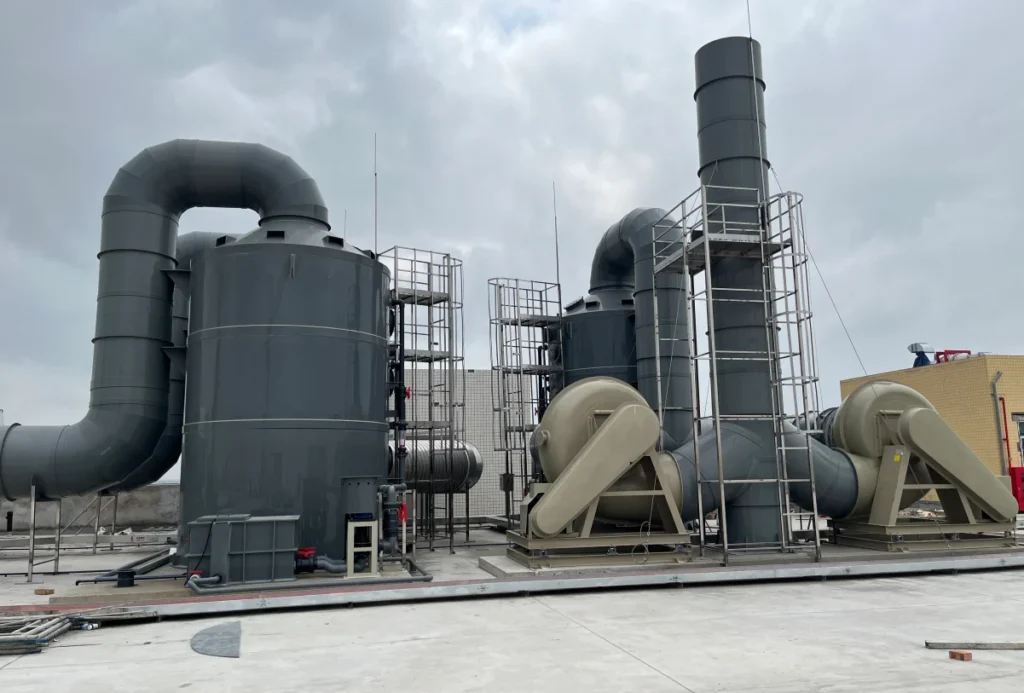
Scrubber gas is the term for any industrial exhaust stream that passes through a wet scrubbing system for pollutant removal. The range of gases that can be scrubbed is broad – from highly soluble acid gases like HCl and HF at 99%+ removal to sparingly soluble pollutants like NO that require chemical oxidation before scrubbing is feasible. Selection starts with classification: identifying which category each target pollutant falls into determines the scrubbing chemistry, the achievable removal efficiency, and the operating cost. This guide covers the complete classification of gases removed by wet scrubbers, the gas properties that determine scrubbing feasibility, the chemical reactions that enable high-efficiency removal for each major gas type, removal efficiency ranges, industry-specific gas profiles, gas analysis requirements, and safety considerations for scrubber gas handling.
Key Takeaways
- Scrubber gas classification determines everything in the system design: acid gases require alkaline chemistry at pH 8-10, alkaline gases require acid chemistry at pH 3-5, soluble VOCs require water or carbon, and particulate requires impaction-based capture. Selecting chemistry before confirming the gas category is the most common design error.
- Gas solubility varies by over 10,000 times across common pollutants – from 800 g/L for HF to 0.05 g/L for NO. The 100 g/L threshold provides a quick triage: gases above it are removable by water alone, gases between 4-100 g/L require chemical enhancement, gases below 1 g/L require oxidation before scrubbing is feasible.
- Temperature reduces solubility by 20-30% per 10 degree C rise. A scrubber achieving 99% removal at 70 degF may fail at 150 degF without a quench stage. This is the most frequently overlooked parameter in scrubber specifications.
- Chemical reaction kinetics determine packing depth and vessel height. Instantaneous reactions like HCl + NaOH achieve 99%+ removal in 3-4 ft of packing. Slower reactions like H2S dissociation need 6-8 ft for the same efficiency at the same L/G ratio.
- Accurate gas composition with concentration ranges is the foundation of every scrubber design. The design must handle the worst-case combination of flow, temperature, and concentration, not the average.
What Is Scrubber Gas?
Definition: Scrubber Gas vs Scrubber Exhaust Gas
Why the Distinction Matters for System Design
Scrubber gas is the contaminated gas stream that enters a wet scrubbing system for treatment. It is a mixture of carrier gas (typically air, nitrogen, or process off-gas) and one or more target pollutants at concentrations from parts per million to a few percent by volume. The carrier gas is rarely the concern – it is the trace pollutants that determine whether a scrubber is needed, what type is appropriate, and what it costs to operate. Scrubber exhaust gas refers to the same stream viewed from the source side: the exhaust from a chemical reactor, storage tank vent, drying oven, or combustion source. The distinction matters because specifying from the gas side means starting with the measured pollutant profile, while specifying from the equipment side means choosing a vessel type first and then trying to fit the gas composition to it – a reverse approach that consistently leads to underperforming installations. For the complete system that processes this gas, see our gas scrubber system guide →.
The Four Categories of Scrubber Gas
Acid Gases – HCl, HF, SO2, H2S, NOx
Acid gases are the most common target for wet scrubbers across all industries. They are characterized by moderate to high solubility in water and rapid reaction with alkaline scrubbing solutions such as sodium hydroxide. HCl and HF are the most efficiently removed, with removal exceeding 99% in a packed bed scrubber under proper pH control. SO2 removal ranges from 90 to 99% depending on the liquid-to-gas ratio and contact time. H2S requires elevated pH above 9 because the molecule must dissociate before reacting. NOx, specifically nitric oxide, is the most challenging because it is practically insoluble in water and requires chemical oxidation upstream of the scrubber before absorption is possible.
Alkaline Gases – NH3, Amines
Ammonia and amine compounds are highly soluble in water – NH3 dissolves at 530 g/L at 20 degrees C, placing it among the most easily removed pollutants. Water alone achieves 90 to 95% removal without chemical addition, making ammonia one of the lowest-cost pollutants to scrub. For higher removal efficiency above 98% or for facilities with strict wastewater discharge limits, a sulfuric acid scrubbing solution at pH 3 to 5 converts ammonia to ammonium sulfate, a stable salt that can be recovered and sold as fertilizer at $50 to 150 per ton, offsetting 10 to 20% of the scrubber operating cost.
Soluble VOCs and Odor Compounds
Water-soluble volatile organic compounds including methanol, ethanol, acetone, and isopropyl alcohol can be removed by wet scrubbing with water alone at 70 to 95% efficiency. Insoluble VOCs such as toluene, xylene, and hexane cannot be removed by wet scrubbing at any practical L/G ratio and require carbon adsorption or thermal oxidation downstream. Odorous compounds including hydrogen sulfide, mercaptans, and amines are effectively controlled by chemically assisted scrubbing using sodium hypochlorite as the oxidizing agent. The oxidation reaction is slower than acid-base neutralization, requiring longer contact time and ORP control rather than simple pH control.
Particulate Matter
When scrubber gas contains particulate matter, the capture mechanism shifts from absorption to inertial impaction. The collection efficiency is governed by the Stokes number, which scales with the square of particle diameter. Venturi scrubbers operating at 15 to 60 inches H2O pressure drop achieve 99%+ removal on PM2.5, while spray towers at 1 to 4 inches H2O capture only 70 to 85% of the same particles. When the gas stream contains both soluble gases and particulate, a wet scrubber handles both in a single vessel – the primary advantage over dry collection systems that require separate equipment for each pollutant type.
Gases Removed: Complete Classification
Acid Gases (HCl, HF, SO2, H2S, NOx)
HCl and HF – 99%+ Removal with NaOH
HCl and hydrogen fluoride are the benchmark gases for wet scrubbing because both are highly soluble in water and react instantly with sodium hydroxide at the gas-liquid interface. The solubility of HCl is 720 g/L at 20 degrees C, meaning 720 grams of HCl gas dissolve in every liter of water before the liquid approaches saturation. At typical industrial inlet concentrations of 200 to 1,000 ppm, the water phase will never reach saturation because the chemical reaction consumes the dissolved acid as fast as it enters the liquid film. The reaction NaOH + HCl yields NaCl + H2O is effectively instantaneous, completing in under 0.1 seconds at the interface. The result is that a packed bed scrubber with pH control at 8 to 10 consistently achieves 99%+ removal at a low L/G ratio of 2 to 4 gallons per 1,000 cubic feet of gas. For a 20,000 CFM stream containing 500 ppm HCl, the system consumes approximately 30 pounds per hour of 25% NaOH and produces a neutral salt blowdown that is readily treatable through standard industrial wastewater facilities.
SO2 – 90-99% with pH Control
SO2 removal is less efficient than HCl because SO2 is less soluble in water at 110 g/L and requires two moles of NaOH per mole of SO2 via the reaction SO2 + 2NaOH yields Na2SO3 + H2O. The second mole of NaOH doubles the reagent cost compared to HCl at the same molar loading. Removal efficiency ranges from 90 to 99% depending on the L/G ratio and gas-liquid contact time. At L/G ratios below 3 gpm/1000 cfm, the mass transfer driving force is too low to achieve 95% removal regardless of the chemical feed rate. At L/G ratios above 6 gpm/1000 cfm, the pump energy cost increases without proportional improvement in efficiency. For SO2 concentrations above 1,000 ppm, a two-stage scrubber configuration reduces reagent cost: the first stage operates at pH 5 to 6 using lime slurry for bulk removal at lower chemical cost, and the second stage polishes with NaOH to achieve the final outlet limit.
H2S – pH-Dependent Dissociation
H2S removal operates by a fundamentally different mechanism from HCl and SO2 because the hydrogen sulfide molecule must first dissociate into its ionic form before it can react with NaOH. H2S is a weak acid with pKa1 of 7.0 for the first dissociation step (H2S to HS- + H+) and pKa2 of 12.9 for the second (HS- to S2- + H+). Only the dissociated forms react with the hydroxide ion. At pH 8, only about 10% of the total H2S is in the reactive dissociated form. At pH 10, over 99% is dissociated. This means H2S scrubbers must operate at pH 10 to 11, consuming three to four times more NaOH than an HCl scrubber at the same molar loading. If the pH drifts below 9 for more than 15 to 20 minutes, removal drops below 70% because the undissociated H2S molecules are only sparingly soluble at 4 g/L and pass through without reacting. For H2S above 500 ppm, NaOCl oxidation is often specified because it is less pH-dependent and produces elemental sulfur rather than dissolved sulfide salts.
NOx – Requires Chemical Oxidation
NOx presents the greatest scrubbing challenge because nitric oxide (NO), which constitutes 90 to 95% of combustion NOx, is practically insoluble in water at 0.05 g/L – over 14,000 times less soluble than HCl. Only nitrogen dioxide (NO2), the remaining 5 to 10%, dissolves readily to form nitric acid. NO must first be oxidized to NO2 using NaOCl or H2O2 injected into the scrubber recirculation loop. The oxidation reaction is slower than acid-base neutralization, requiring longer contact time at a higher L/G ratio of 5 to 10 gpm/1000 cfm. Even with chemical oxidation, total NOx removal rarely exceeds 70 to 90%, making wet scrubbing a partial solution that typically requires selective catalytic reduction downstream when the NOx limit is below 50 ppm.
Alkaline Gases (NH3, Amines)
NH3 – Water or Acid Scrubbing
Ammonia is unique because it is even more soluble than most acid gases at 530 g/L. Plain water alone achieves 90 to 95% removal at L/G of 3 to 5 gpm/1000 cfm, making water scrubbing the simplest approach for moderate loads. For 98%+ efficiency or strict wastewater limits, sulfuric acid at pH 3 to 5 converts NH3 to ammonium sulfate: 2NH3 + H2SO4 yields (NH4)2SO4. At batch operations with wide load variation, the chemical feed control system must respond rapidly to prevent pH excursions during startup transients.
Byproduct Recovery (Ammonium Sulfate Fertilizer)
The ammonium sulfate produced by acid scrubbing is a marketable fertilizer ingredient selling for $50 to 150 per ton. Facilities with continuous NH3 loading above 100 lb/day can recover 10 to 20% of the scrubber operating cost through byproduct sales. A 200 lb/day NH3 load produces approximately 800 lb/day of ammonium sulfate solution. The blowdown handling equipment must be included in the capital budget during the design phase.
Soluble VOCs and Odor Compounds
Water-Soluble vs Insoluble VOCs
Water-soluble VOCs including methanol, ethanol, acetone, and IPA are removable at 70 to 95% efficiency depending on the compound’s Henry’s Law constant. Fully water-miscible VOCs can be scrubbed; VOCs that form a separate phase require carbon adsorption or thermal oxidation. Odor compounds are controlled by NaOCl oxidation at ORP of 600 to 800 mV. The oxidation reaction is two to three times slower than acid-base neutralization, requiring longer contact time and careful ORP control.
Particulate Matter
Stokes Number and Capture Efficiency
Particulate capture is driven by inertial impaction governed by the Stokes number, which scales with particle diameter squared. A 10-micron particle has 100 times the inertia of a 1-micron particle. Venturi scrubbers at throat velocities of 200 to 400 ft/s achieve 99%+ removal on PM2.5 at 15 to 60 inches H2O. Spray towers at 1 to 4 inches H2O capture only 70 to 85% because the lower velocity provides insufficient inertia for small particles to impact droplets. When gas contains both soluble gases and particulate, a wet scrubber handles both in one vessel.
Gas Properties That Determine Feasibility
Solubility in Water (Henry’s Law)
Solubility Table – 8 Gases Compared
Gas solubility in water is the primary screening criterion for wet scrubbing feasibility. A gas with high water solubility can be removed by physical absorption alone, driven by the concentration gradient between the gas phase and the liquid phase. Solubility is quantified by Henry’s Law constant: the lower the constant, the higher the solubility and the easier the scrubbing. The table below compares the solubility of eight common scrubber gases at 20 degrees C and atmospheric pressure with the corresponding scrubbing feasibility classification. The Engineering Toolbox gas solubility reference provides complete data at multiple temperatures for engineering design calculations.
| Gas | Solubility (g/L at 20C) | Scrubbing Feasibility |
|---|---|---|
| HF | 800 | Excellent – water alone sufficient |
| HCl | 720 | Excellent – water alone sufficient |
| NH3 | 530 | Excellent – water alone sufficient |
| SO2 | 110 | Good – chemical addition recommended |
| Cl2 | 6.5 | Moderate – chemical reaction required |
| H2S | 4.0 | Moderate – pH control required |
| NO2 | 0.4 | Poor – oxidation needed before scrubbing |
| NO | 0.05 | Not feasible by scrubbing alone |
The 100 g/L Threshold
The solubility data reveals a natural threshold at approximately 100 g/L that simplifies initial feasibility screening. Gases above this threshold – HF, HCl, and NH3 – are readily removable by water alone at 95%+ efficiency without chemical addition. Gases between 4 and 100 g/L – SO2, Cl2, and H2S – require chemical enhancement to reach 99% removal, and the operating cost of the chemical feed system must be included in the technology evaluation. Gases below 1 g/L – NO2 and especially NO – are not practically removable by wet scrubbing without prior chemical conversion, and alternative technologies such as selective catalytic reduction should be evaluated as primary treatment methods. This threshold system allows a process engineer to complete an initial scrubber feasibility assessment in under five minutes using only the gas composition data sheet.
Chemical Reactivity
Instantaneous Neutralization vs Slow Kinetics
A gas that reacts with the scrubbing liquid after dissolution can be removed at much higher efficiency than a gas that only dissolves, because the chemical reaction consumes the dissolved molecules and keeps the liquid-phase concentration near zero. This maintains the maximum concentration gradient across the gas-liquid interface, driving further absorption. The reaction rate for acid-base neutralization like NaOH + HCl is effectively instantaneous, completing in under 0.1 seconds. This is why an HCl scrubber at pH 8 to 10 achieves 99%+ removal in only 3 to 4 feet of packing depth. In contrast, slower reactions such as H2S dissociation require significantly more contact time because the rate-limiting step is ionization rather than mass transfer. An H2S scrubber may need 6 to 8 feet of packing to achieve the same removal that an HCl scrubber reaches in half the depth. This determines the vessel height and therefore the capital cost.
Concentration and Temperature Effects
20-30% Solubility Loss per 10 degC
Gas solubility decreases by 20 to 30% for every 10 degree C rise in temperature for most acid gases. A scrubber treating HCl at 70 degF achieves 99%+ removal at an L/G ratio of 3 gpm/1000 cfm. The same scrubber at 150 degF would need an L/G of 6 to 8 gpm/1000 cfm to achieve the same efficiency. At 200 degF, the equilibrium solubility of HCl is so low that water alone cannot achieve 95% removal regardless of L/G ratio or packing depth. This temperature effect is the single most frequently overlooked parameter in scrubber specifications, because many engineers provide the average gas temperature without noting that the scrubber must perform at the maximum temperature during process upsets or summer ambient conditions.
Quench Requirements Above 150 degF
When the scrubber inlet gas temperature exceeds 150 degF, a quench stage installed upstream of the packed bed is required to cool the gas to saturation temperature before it enters the packing. The quench is a spray section that uses evaporative cooling to drop the gas from its inlet temperature down to the adiabatic saturation temperature, typically 160 to 175 degF for most industrial exhaust streams. The quench adds 2 to 3 feet of vessel height and approximately 5 to 10% to the capital cost of the scrubber system. Without the quench, the hot gas entering the packed bed at 250 degF will cause the scrubbing liquid temperature to rise above the design range, preventing the scrubber from meeting the outlet limit regardless of packing depth or chemical feed rate.
Scrubber Gas Cleaning Chemistry
HCl Removal – Instantaneous Neutralization
NaOH + HCl Yields NaCl + H2O at pH 8-10
This reaction is the benchmark for all wet scrubbing chemistry because it is the simplest, fastest, and most reliable. HCl gas dissolves rapidly in water and reacts instantly with sodium hydroxide in a precise 1:1 molar ratio. The product is sodium chloride – common table salt – which remains fully dissolved in the recirculation liquid with no tendency toward precipitation or scaling. No solids handling equipment is required, and the blowdown is a neutral salt solution treatable through standard industrial wastewater facilities. Operating pH is 8 to 10. If pH drifts below 7, removal drops from 99% to 60-70% within minutes. If pH exceeds 10.5, NaOH is wasted without efficiency gain. For a 20,000 CFM stream at 200 ppm HCl, the system consumes approximately 30 lb/day of 25% NaOH.
SO2 Removal – Two Moles of NaOH Required
Two-Stage Scrubbing for High Concentrations
SO2 removal via SO2 + 2NaOH yields Na2SO3 + H2O consumes two moles of NaOH per mole of SO2, doubling the reagent cost compared to HCl at the same molar concentration. Removal ranges from 90 to 99% depending on L/G ratio. At L/G below 3 gpm/1000 cfm, efficiency plateaus at 85 to 90%. Increasing L/G to 5 to 6 raises efficiency to 95 to 99%. For SO2 above 1,000 ppm, a two-stage configuration is cost-effective: the first stage uses lime slurry at pH 5 to 6 for bulk removal at lower cost, and the second stage polishes with NaOH at pH 8 to 9. The lime stage produces calcium sulfite sludge that requires dewatering and landfill disposal at $50 to 100 per ton.
H2S Removal – pH-Driven Dissociation
Why pH Must Be Above 9
H2S removal is controlled by a pH-driven dissociation step rather than by mass transfer. H2S dissociates in two steps: H2S to HS- + H+ with pKa1 = 7.0, and HS- to S2- + H+ with pKa2 = 12.9. Only the dissociated forms react with NaOH. At pH 8, only 10% of H2S is dissociated. At pH 10, over 99% is. The scrubber must operate at pH 10 to 11, consuming 3 to 4 times more NaOH than an HCl scrubber at the same molar loading. If pH drifts below 9 for 15 to 20 minutes, removal drops below 70%. The pH sensor is the most critical instrument – weekly calibration with pH 7 and pH 10 buffer solutions is the minimum standard. A backup sensor with automatic switchover is recommended for continuous processes.
NH3 Removal – Water or Sulfuric Acid
Ammonium Sulfate Byproduct Recovery
Water alone achieves 90 to 95% NH3 removal at L/G of 3 to 5 gpm/1000 cfm. For 98%+ efficiency or strict wastewater limits, sulfuric acid at pH 3 to 5 converts NH3 to ammonium sulfate: 2NH3 + H2SO4 yields (NH4)2SO4. The ammonium sulfate is a marketable fertilizer ingredient. Facilities with continuous NH3 loading above 100 lb/day can recover 10 to 20% of the scrubber operating cost through byproduct sales. The blowdown handling equipment must be included in the capital budget during design.
Cl2 Removal – Hypochlorite Intermediate
FRP/PVDF Required, Not PP
Chlorine removal with NaOH follows Cl2 + 2NaOH yields NaCl + NaOCl + H2O, producing sodium hypochlorite (bleach) as an intermediate. The bleach intermediate embrittles polypropylene within 6 to 12 months of continuous exposure. Cl2 scrubbers must be constructed from FRP or PVDF even at operating temperatures below 150 degF where polypropylene would be adequate for any other acid gas. Removal efficiency is 90 to 98% at pH 10 to 12 at L/G of 4 to 8 gpm/1000 cfm. The blowdown contains residual NaOCl and requires dechlorination before discharge if the receiving treatment plant is chlorine-sensitive.
Removal Efficiency by Gas Type (Table)
8-Gas Efficiency Table
Solubility, Chemistry, pH, L/G, and Efficiency
The table below summarizes typical removal efficiency ranges for the eight most common scrubber gases in a packed bed scrubber with the recommended chemistry. Actual field efficiency varies with inlet concentration, gas temperature, packing depth, and L/G ratio. For the process mechanisms that achieve these rates, see our how a wet scrubber works guide →.
| Gas | Recommended Chemistry | Operating pH | L/G (gpm/1000 cfm) | Typical Removal |
|---|---|---|---|---|
| HCl | Sodium hydroxide (NaOH) | 8-10 | 2-4 | 99%+ |
| HF | Sodium hydroxide (NaOH) | 8-10 | 2-4 | 99%+ |
| SO2 | NaOH or lime slurry | 8-10 | 3-6 | 90-99% |
| H2S | NaOH or NaOCl | 10-11 | 4-8 | 85-95% |
| NH3 | Water or H2SO4 | 3-5 or 7 | 3-6 | 90-99% |
| Cl2 | Sodium hydroxide (NaOH) | 10-12 | 4-8 | 90-98% |
| NOx (as NO2) | NaOCl oxidation + NaOH | 8-10 | 5-10 | 70-90% |
| Soluble VOCs | Water only | 7 | 4-8 | 70-95% |
Industry Gas Profiles
Chemical Processing
Multi-Source Vent Manifolds
Chemical plants generate the widest variety of scrubber gas compositions of any industry sector. A single facility may have reactor vents producing HCl at 1,000 ppm, storage tank vents releasing organic vapors at 5,000 ppm, and dryer exhaust carrying particulate with residual solvent at 500 ppm. Multiple sources can be manifolded into a single central scrubber if the gas compositions are chemically compatible – but mixing incompatible gases such as NH3 and HCl, which form solid ammonium chloride crystals that block ductwork, requires thorough evaluation before manifold design. Gas temperature ranges from ambient for tank vents to 350 degF for exothermic reactor vents. Chemical plants typically specify dual recirculation pumps because a scrubber outage on a continuous process forces a production halt within minutes.
Semiconductor Manufacturing
High Flow, Low Concentration, 100% Uptime
Semiconductor scrubber gas is characterized by extremely high gas volume, low pollutant concentration, and absolute uptime requirements. A 300 mm wafer fab generates 100,000 to 200,000 CFM of exhaust containing HF at 10 to 100 ppm, NH3 at 10 to 50 ppm, and Cl2 at 5 to 20 ppm. The concentrations are low because process tools use point-of-use scrubbers for bulk removal. The challenge is gas volume and the need for 100% uptime – a central scrubber failure can shut down over $1 billion of semiconductor production within two to four hours. Dual scrubber trains with automatic changeover are standard, and materials are selected to avoid any metallic contamination that could be carried back into the cleanroom.
Waste Incineration
Multi-Pollutant Train, Chloride Over 10,000 ppm
Incineration flue gas is the most chemically challenging scrubber gas because it contains multiple pollutant types simultaneously: acid gases at 50 to 500 ppm each, heavy metals at parts-per-billion levels, fine particulate at 1 to 5 gr/dscf, and trace dioxins and furans. No single scrubber removes all of these. A typical treatment train uses dry sorbent injection for bulk acid gas removal, a baghouse for particulate capture, a wet scrubber for polishing to single-digit ppm, and a wet ESP or activated carbon bed for mercury and dioxin control. The wet scrubber stage handles pre-cooled gas, but chloride concentration in the recirculation liquid can exceed 10,000 ppm, requiring acid-resistant brick lining or high-nickel alloy construction.
Other Industries (Pharma, Metal Finishing, Wastewater)
Pharmaceutical production generates batch solvent vapors and acid gases at widely varying loads requiring responsive chemical feed control. Metal finishing produces H2SO4 mist and HF at 10 to 200 ppm from plating baths, typically using packed bed scrubbers with water or dilute NaOH. Wastewater treatment plants generate H2S and NH3 at 1 to 50 ppm from anaerobic digesters, using NaOCl oxidation scrubbers with ORP control. Each requires a different configuration but all follow the same gas classification and chemistry principles. For the complete system design methodology, see our gas scrubber system guide.
Gas Analysis Requirements
Minimum Data Set for Scrubber Design
Flow, Temperature, Composition, Particulate
The minimum data set required for a reliable scrubber quotation includes five categories. Gas flow rate must be in actual cubic feet per minute at operating temperature, not standard CFM – a 10,000 SCFM stream at 300 degF is approximately 19,000 ACFM, and a scrubber sized for standard flow will be undersized by nearly a factor of two. Gas temperature must include minimum, normal, and maximum values. Complete gas composition must list every pollutant with its concentration range, not a single average. Particulate loading and particle size distribution are required when the stream contains dust. The required outlet concentration for each regulated pollutant sets the removal efficiency target that determines L/G ratio, packing depth, and chemical feed capacity.
Sampling Methods
EPA Reference Methods
Gas sampling should follow EPA reference methods. Method 26A covers hydrogen halides including HCl and HF. Method 6C covers continuous SO2 measurement. Method 7E covers NOx. Method 18 covers VOCs. Method 5 or 17 covers particulate depending on stack temperature. The sampling location should be at least 8 duct diameters downstream and 2 diameters upstream of disturbances per EPA Method 1. The EPA wet scrubber monitoring guidelines provide the complete methodology. A single grab sample is insufficient – the campaign should cover at least three operating conditions including maximum production, minimum production, and startup transients.
Safety Considerations
Corrosive Gas Handling
Negative Pressure Ductwork
Scrubber gas streams containing corrosive acid gases require the entire collection system to maintain negative pressure at all operating conditions. A positive pressure leak in ductwork carrying 500 ppm HCl will release gas into the work area at concentrations well above the permissible exposure limit of 5 ppm ceiling, causing immediate respiratory irritation. Ductwork must be constructed from corrosion-resistant materials – PVC for low-temperature acid fume, PP for moderate temperature, or FRP for higher temperature – and must be inspected quarterly for corrosion breaches at flanged connections and access doors where gasket failure is most likely.
Flammable Vapor Protection
LEL Monitoring
When scrubber gas contains flammable solvent vapors, the concentration must be maintained below 25% of the lower explosive limit. A packed bed scrubber provides inherent fire protection because the water or caustic solution quenches any ignition source that enters the vessel, but the exhaust fan, ductwork, and stack must be area-rated. A continuous LEL monitor at the scrubber inlet with alarm at 25% LEL and automatic shutdown at 50% LEL is standard. If the LEL alarm activates, the operator must identify the source of the high solvent concentration and reduce the emission rate at the process source rather than relying on the scrubber to handle the overload.
Toxic Gas and Blowdown Management
A scrubber that achieves 99% removal of a toxic gas at 100 ppm inlet still produces a 1 ppm outlet, which may exceed permissible exposure limits for high-toxicity compounds such as arsine and phosphine used in semiconductor manufacturing. For these gases, a polishing stage with chemically impregnated activated carbon must be installed downstream of the wet scrubber. The blowdown stream may contain dissolved toxics at concentrations exceeding wastewater discharge limits even when the air outlet is in compliance – scrubber design must include the liquid waste management plan, not only the gas-side removal efficiency.
Frequently Asked Questions
What is the difference between scrubber gas and scrubber exhaust gas?
Scrubber gas and scrubber exhaust gas are used interchangeably to refer to the contaminated gas stream that enters a wet scrubbing system for pollutant removal. Scrubber exhaust gas places emphasis on the source (the industrial process generating the exhaust), while scrubber gas emphasizes the destination (the scrubber equipment). For the complete system that treats this gas, see the gas scrubber product page →.
What does scrubber gas processing involve?
Scrubber gas processing involves four sequential steps: capturing the gas at the process source through a hood or direct connection, conveying it through ductwork to the scrubber vessel, contacting it with the scrubbing liquid for pollutant capture through absorption or chemical reaction, and discharging the cleaned gas through a stack after mist elimination. Each step must be correctly designed for the system to meet its emission limit.
What is scrubber de gas?
Scrubber de gas is the Spanish-language technical term for gas scrubbing, equivalent to gas scrubber or gas scrubbing system in English engineering terminology. It refers to the same process of removing pollutants from industrial exhaust gas using a liquid scrubbing medium. The engineering principles and design methodology are identical regardless of the language used in the specification document.
What data is needed for scrubber design?
The minimum data set is gas flow rate in actual CFM at operating temperature, gas temperature with min/normal/max values, complete gas composition with concentration ranges for each pollutant, particulate loading and size distribution if applicable, and the required outlet concentration for each regulated pollutant. See the Gas Analysis Requirements section for the complete checklist with EPA reference methods.
Conclusion
Scrubber gas covers the full range of industrial exhaust streams treatable by wet scrubbing – from highly soluble acid gases like HCl and HF at 99%+ removal efficiency to sparingly soluble pollutants like NO that require chemical oxidation before scrubbing is feasible. The feasibility and cost of scrubbing are determined by each gas’s solubility in water, chemical reactivity with the scrubbing solution, and inlet concentration. Matching the gas properties to the correct scrubber chemistry is the difference between a system that meets its permit limit consistently and one that requires constant operator attention to stay in compliance. For a scrubber system designed for your specific gas composition, contact our engineering team.