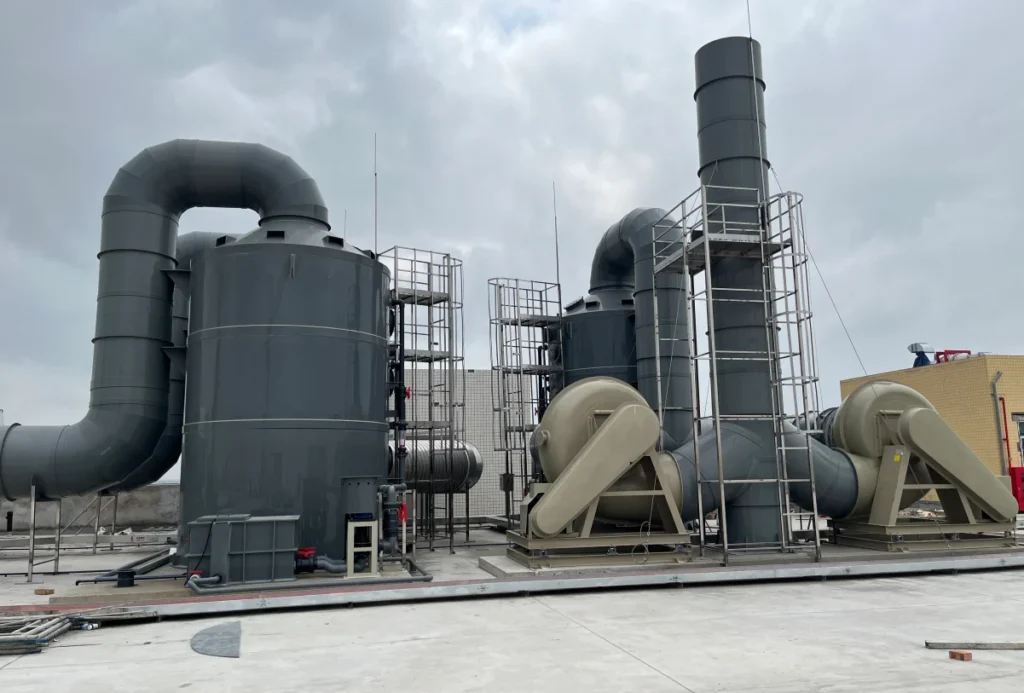
A gas scrubber is an air pollution control device that removes harmful pollutants from industrial exhaust gas by bringing the gas into contact with a liquid scrubbing medium. What is a gas scrubber in practical terms? It takes a contaminated gas stream containing acid gases, particulate matter, or odorous compounds and produces a clean gas stream that meets regulatory emission limits, while transferring the pollutants into a liquid stream that can be treated or discharged. Gas scrubbers are used across chemical plants, semiconductor fabs, pharmaceutical facilities, power plants, and waste incinerators. This guide covers what a gas scrubber is and what does a gas scrubber do, how it works, the main types, what pollutants it removes, its key components, and how to select one for your application.
Key Takeaways
- A gas scrubber removes pollutants from industrial exhaust by transferring them from the gas phase into a liquid phase through absorption, chemical reaction, or inertial impaction. What is a gas scrubber’s defining capability? It handles both soluble gases and particulate in a single vessel – something no dry collection system can match.
- Three operating parameters determine performance: liquid-to-gas ratio (2-6 for packed beds, 5-20 for venturis), pressure drop (which sets fan energy cost at $12,000/yr for packed bed vs $54,000/yr for venturi at 20,000 CFM), and pH control (8-10 for acid gas; below 7 causes efficiency to drop from 99% to 60-70% within minutes).
- Three main scrubber types cover most applications: packed bed for soluble gases at 95-99% removal, spray tower for hot or dusty gas at 80-90%, and venturi for submicron particulate at 99%+. Selecting the wrong type wastes both capital and operating budget.
- What does a gas scrubber do that alternative technologies cannot? It removes HCl, HF, SO2, NH3, and fine particulate simultaneously in one vessel. A baghouse handles only particulate. A dry sorbent system handles only gas. A wet scrubber does both.
- A gas scrubber vessel is not a complete system. The full system includes the recirculation pump, chemical dosing skid, pH controls, mist eliminator, fan, and instrumentation. Specifying a vessel without these auxiliaries consistently leads to installation delays and performance shortfalls.
What Is a Gas Scrubber?
Definition: Gas Scrubber vs Scrubber System
What Does a Gas Scrubber Do? – The Core Function
What does a gas scrubber do in operation? It removes pollutants from an industrial exhaust stream by forcing the gas into intimate contact with a liquid. The pollutant transfers from the gas phase into the liquid phase through physical absorption for soluble gases, chemical reaction for acid gases requiring neutralization, or inertial impaction for particulate matter. The cleaned gas then passes through a mist eliminator to remove entrained liquid droplets before being discharged to the atmosphere. The liquid, now containing the captured pollutants, is either recirculated through the system or sent to wastewater treatment. A properly designed gas scrubber converts an air pollution problem into a manageable liquid waste stream, achieving removal efficiencies of 90 to 99%+ for most common industrial pollutants. What does a gas scrubber do that dry systems cannot? It handles both soluble gases and particulate in a single vessel, making it the preferred choice for mixed pollutant streams.
Gas Scrubber vs Scrubber System – What the Terms Mean
The term gas scrubber can refer to the vessel alone or to the complete assembly. A gas scrubber vessel is the tower containing the contact zone – the packing, nozzles, or venturi throat. A gas scrubber system adds the recirculation pump, chemical dosing skid, instrumentation, controls, mist eliminator, fan, and interconnecting piping. A vessel purchased without these auxiliaries will not function as a pollution control device. When specifying equipment for a new installation, define the system scope at the outset – vessel only, packaged skid, or full engineered system – because the scope determines both the capital cost and the installation timeline. For the complete packaged assembly, see our gas scrubber system guide →.
Where Gas Scrubbers Are Used
Chemical, Semiconductor, Pharma, Power, and Incineration
Gas scrubbers are installed across chemical processing plants for HCl, HF, and H2SO4 fume control from reactors and storage tanks. Semiconductor fabs use them for HF, NH3, and Cl2 exhaust from etching and CVD tools at 100,000 to 200,000 CFM per fab. Pharmaceutical facilities rely on them for solvent vapor and acid gas neutralization from chemical synthesis and tablet coating. Power plants use large-scale flue gas desulfurization scrubbers for SO2, HCl, and mercury control from coal combustion. Waste incinerators use them as part of a multi-stage treatment train for SO2, HCl, heavy metals, and dioxin capture. Each industry requires a different scrubber configuration, but all follow the same operating principles described in the following sections.
How a Gas Scrubber Works
5-Step Process from Gas Entry to Clean Discharge
Step 1 – Gas Entry and Distribution
The contaminated gas enters the scrubber vessel through an inlet designed to distribute flow evenly across the vessel cross-section. Inlet velocity is typically 30 to 50 ft/s. A distribution baffle or inlet diffuser is used in vessels above 6 ft diameter to prevent channeling. Uneven gas distribution is one of the most common installation problems – gas that bypasses the contact zone exits untreated, and the operator sees a visible stack plume that cannot be fixed by adjusting the chemical feed rate.
Step 2 – Scrubbing Liquid Introduction
The scrubbing liquid enters through spray nozzles, a packed bed distributor, or venturi injection ports. Nozzles produce droplets from 200 to 2,000 microns depending on pressure and orifice design. The liquid-to-gas ratio (L/G) is the most important operating parameter, expressed as gallons per 1,000 actual cubic feet of gas. Packed bed scrubbers operate at 2 to 6 gpm/1000 cfm for gas absorption. Spray towers use 4 to 12 gpm/1000 cfm. Venturi scrubbers require 5 to 20 gpm/1000 cfm for fine particulate capture. An L/G ratio too low starves the contact surface; too high wastes pump energy.
Step 3 – Gas-Liquid Contact Zone
This is the heart of the scrubber. In a packed bed, gas flows upward through wetted packing while liquid flows downward, creating continuous renewal of the absorption surface. In a spray tower, gas rises through a fine liquid mist. In a venturi scrubber, gas accelerates through a constricted throat at 200 to 400 ft/s where high-velocity liquid injection creates intense turbulence for submicron particulate capture. Each method is optimized for a different pollutant profile.
Step 4 – Mist Elimination
After the contact zone, the cleaned gas carries entrained liquid droplets containing dissolved pollutants. A mist eliminator removes these droplets before the gas exits the stack. Vane packs remove droplets above 10 microns at 0.5 to 1.5 inches H2O. Mesh pads remove droplets above 3 to 5 microns at 1 to 2 inches H2O. Undersized or fouled mist eliminators cause visible stack emissions and liquid carryover into downstream ductwork.
Step 5 – Liquid Recirculation and Blowdown
The scrubbing liquid collects in the sump and is recirculated through the pump loop. A portion is continuously bled off as blowdown to control dissolved solids buildup, typically 5 to 15% of the recirculation rate. pH is controlled by adding fresh chemical to the recirculation loop. Make-up water replaces volume lost to blowdown and evaporation. Many scrubber performance problems trace back to neglected chemical dosing or uncontrolled solids buildup rather than vessel design.
Gas Scrubber Working Principle – Key Parameters
L/G Ratio, Pressure Drop, and pH Control Drive Performance
The gas scrubber working principle relies on three parameters that determine whether the design efficiency is achieved. The L/G ratio controls the available liquid surface area for pollutant transfer. Reference design data is available from the Engineering Toolbox scrubber design reference. Pressure drop across the scrubber determines the fan energy cost – a packed bed at 5 inches H2O costs approximately $12,000 per year in fan electricity for a 20,000 CFM system, while a venturi at 40 inches H2O costs $54,000 per year. pH control is critical for chemically assisted scrubbers. For acid gas removal, pH must be maintained at 8 to 10. If pH drifts below 7, removal efficiency drops from 99% to 60-70% within minutes because the hydroxide ions required for neutralization are depleted. The EPA wet scrubber monitoring guidelines provide the reference methodology for verifying scrubber performance. A pH sensor with weekly calibration and a properly sized metering pump are the minimum safeguards against this failure mode.
Main Types of Gas Scrubbers
Packed Bed Scrubber
The Packed Bed Is the Most Energy-Efficient Choice for Soluble Gas Absorption
The packed bed scrubber is the most energy-efficient scrubber type for removing soluble acid gases from industrial exhaust, achieving 95 to 99% removal at a pressure drop of only 3 to 8 inches H2O. The gas routes upward through a bed of random or structured packing media while scrubbing liquid flows downward over the packing surface. The packing creates a wetted surface area of 30 to 100 ft2 per ft3 of bed volume, providing extensive gas-liquid contact area without requiring high liquid flow rates. The L/G ratio for packed bed scrubbers on soluble gas duty is 2 to 6 gpm/1000 cfm – significantly lower than spray towers or venturi scrubbers. For a 20,000 CFM system treating 500 ppm HCl, a packed bed scrubber consumes approximately $12,000 per year in fan energy versus $54,000 for a venturi scrubber at the same flow rate. The key limitation is that packing fouls when inlet particulate loading exceeds 0.1 gr/dscf, which means a packed bed on a dusty stream requires a particulate pre-filter. For an engineer selecting a scrubber for a chemical plant exhaust stream with soluble gases and minimal dust, the packed bed scrubber is the clear first choice based on both capital and operating cost.
Spray Tower Scrubber
The Spray Tower Is the Best Choice When Particulate Loading Rules Out Packed Beds
The spray tower is an empty vessel with spray nozzles and no packing media, which means there is nothing to foul regardless of the dust loading in the gas stream. This makes the spray tower the preferred choice for gas streams above 180 degF where polypropylene packing would soften, for applications with particulate loading above 1 gr/dscf where a packed bed would foul within weeks, and for sticky or moist particulates that would blind packing media. Removal efficiency for soluble gases is 80 to 90%, lower than packed beds because the gas-liquid contact is less intense without packing to break up the gas flow and create surface area. Particulate removal is 70 to 85% for particles above 10 microns. Pressure drop is low at 1 to 4 inches H2O, with annual fan energy cost of approximately $4,000 to 6,000 for a 20,000 CFM system. The spray tower is often specified as a quench stage upstream of a packed bed for high-temperature gas streams, providing bulk removal and cooling to saturation temperature before final polishing in the packed bed.
Venturi Scrubber
The Venturi Achieves 99%+ Submicron Removal but at 3 to 5 Times the Energy Cost
The venturi scrubber is the only wet scrubber type that consistently achieves 99%+ removal on submicron particulate below 2.5 microns, but this performance comes at an energy cost that makes it the wrong choice for applications where the primary target is soluble gas rather than fine particulate. The gas accelerates through a constricted throat at 200 to 400 ft/s where high-velocity liquid injection creates a dense field of fine droplets. The extreme turbulence enables capture of submicron particles through inertial impaction at Stokes numbers above 1.0, which no other scrubber type can achieve at practical pressure drop. The pressure drop ranges from 15 to 60 inches H2O, and fan power is directly proportional to pressure drop. For a 20,000 CFM system at 40 inches H2O, the annual fan energy cost is approximately $54,000 versus $12,000 for a packed bed at 5 inches H2O. For applications where the pollutant is primarily soluble gas like HCl or SO2, specifying a venturi scrubber means paying $42,000 more per year in electricity for no improvement in gas removal efficiency. The venturi is the right choice only when the emission limit requires submicron particulate control that a packed bed or spray tower cannot achieve.
What Pollutants Can a Gas Scrubber Remove?
Acid Gases (HCl, HF, SO2, H2S, NOx)
Acid Gas Removal Efficiency Depends on Solubility and Chemical Reactivity, Not Vessel Size
Acid gases are the most common and most efficiently removed target for wet scrubbers because they are highly soluble in water or react rapidly with alkaline scrubbing solutions, but the removal efficiency varies by more than 30 percentage points across different acid gases depending on their solubility and reaction kinetics. HCl and HF achieve 99%+ removal in a packed bed scrubber with NaOH at pH 8 to 10 consuming one mole of NaOH per mole of acid gas, producing neutral salt byproducts that are readily treatable through standard wastewater facilities. SO2 achieves 90 to 99% removal but requires two moles of NaOH per mole of SO2 via SO2 + 2NaOH to Na2SO3 + H2O, doubling the reagent cost compared to HCl at the same molar concentration. At L/G below 3 gpm/1000 cfm, the mass transfer driving force for SO2 is insufficient to achieve 95% removal regardless of the chemical feed rate. H2S requires pH above 9 because the molecule must first dissociate to HS- with pKa of 7.0 before the hydroxide ion can react with it – at pH 8 only 10% of the H2S is in the reactive form, limiting removal to 50 to 60%. NOx presents the greatest challenge because NO is practically insoluble at 0.05 g/L and must be oxidized to NO2 using NaOCl before absorption, with total NOx removal rarely exceeding 70 to 90% even with chemical oxidation. For the complete classification of all scrubber gases with solubility data, see our scrubber gas guide →.
Alkaline Gases (NH3, Amines)
Ammonia Is the Lowest-Cost Pollutant to Scrub Because Water Alone Achieves 90-95% Removal
Ammonia is unique among common scrubber gases because it is more soluble in water at 530 g/L than most acid gases, which means water alone achieves 90 to 95% removal at L/G of 3 to 5 gpm/1000 cfm without any chemical addition. This makes ammonia the lowest-cost pollutant to scrub on a per-pound basis because the only operating cost is pump electricity and wastewater treatment. For higher removal above 98% or for facilities with strict ammonia limits in the wastewater discharge, sulfuric acid at pH 3 to 5 converts dissolved NH3 to ammonium sulfate: 2NH3 + H2SO4 yields (NH4)2SO4. The ammonium sulfate product is a marketable fertilizer ingredient that sells for $50 to 150 per ton, and facilities with continuous ammonia loading above 100 lb/day can recover 10 to 20% of the scrubber operating cost through byproduct sales. This revenue stream should be factored into the technology selection economics during design rather than treated as an afterthought once the scrubber is operating.
Particulate Matter and Odors
A Wet Scrubber Handles Both Particulate and Gas in One Vessel – Something No Dry System Can Match
Gas scrubbers capture particulate through inertial impaction governed by the Stokes number, which scales with particle diameter squared – a 10-micron particle has 100 times the inertia of a 1-micron particle at the same gas velocity. Venturi scrubbers at throat velocities of 200 to 400 ft/s achieve 99%+ removal on PM2.5 at 15 to 60 inches H2O. Spray towers at 1 to 4 inches H2O capture only 70 to 85% because the lower velocity provides insufficient inertia for small particles to impact the liquid droplets. Odor compounds including hydrogen sulfide, mercaptans, and amines are removed by chemically assisted scrubbing using NaOCl as the oxidizing agent at ORP of 600 to 800 mV. The oxidation reaction is two to three times slower than acid-base neutralization, requiring longer contact time and careful ORP control rather than simple pH control. The key advantage of a wet scrubber over a baghouse or ESP is that it removes both soluble gases and particulate simultaneously in a single vessel – a baghouse handles only particulate, a dry sorbent injection system handles only gas, but a wet scrubber handles both at 90 to 99%+ efficiency.
Key Components of a Gas Scrubber
Scrubber Vessel and Internals
The Vessel Material Selection Determines System Life More Than Any Other Single Decision
The scrubber vessel material must resist corrosion from both the gas and the scrubbing liquid simultaneously, and the wrong material for a given gas temperature and chemistry will cause the vessel to fail within months. Polypropylene is the standard material for acid gas service below 180 degF because it resists HCl, HF, and H2SO4 at concentrations up to 20% and costs significantly less than alternatives. FRP is required for vessel diameters above 8 ft where PP lacks structural rigidity, and for gas temperatures up to 220 degF. Stainless steel 316L is necessary above 220 degF and for oxidizing environments such as chlorine gas service where polypropylene embrittles within 6 to 12 months. The vessel contains the packing, nozzles, or venturi throat that creates the gas-liquid contact zone. For packed bed scrubbers, the packing support grid must be designed to handle the weight of wetted packing media (random packing weighs 35 to 55 lb/ft3 when wetted) plus the hydraulic load during operation. The material selection accounts for 15 to 25% of the total vessel cost, and the premium for upgrading from PP to FRP or SS 316L is usually justified when the gas temperature or chemistry pushes beyond the lower-cost material’s operating envelope.
Recirculation Pump and Piping
A Pump Failure on an Acid Gas Scrubber Causes Permit Limit Violations Within Minutes
The recirculation pump delivers liquid from the sump to the distribution point at the flow rate required by the L/G ratio, and losing liquid circulation for even a few minutes on an acid gas scrubber causes the outlet concentration to exceed the permit limit. For a 20,000 CFM packed bed scrubber at L/G of 4 gpm/1000 cfm, the pump delivers 80 gpm at a total dynamic head of 60 to 100 ft. The head must overcome the static lift from the sump to the nozzles, the nozzle operating pressure of 20 to 60 psi, and the piping friction losses through what is typically 50 to 150 ft of pipe equivalent length. A centrifugal pump with polypropylene or PVDF wetted parts is standard for corrosive scrubbing solutions, with a mechanical seal rated for the chemical service. A standby pump piped in parallel with automatic changeover is standard on continuous processes, and the changeover logic should be tested monthly by simulating a pump failure to verify that the standby starts and the check valve seats correctly.
Chemical Dosing and pH Control
A pH Sensor That Drifts by 1 Unit Causes 99% Removal to Drop to 60% Without Triggering Any Alarm
The pH sensor is the single most critical instrument in any chemically assisted scrubber because a sensor that has drifted out of calibration will report normal pH while the scrubber chemistry shifts out of the effective range and removal efficiency drops catastrophically. Electrode drift of 0.5 to 1.0 pH units per week is normal in caustic service due to coating of the glass membrane by reaction byproducts. A sensor that has drifted by 1 pH unit will show pH 9 when the actual tank pH is 8, and the operator sees normal readings while the scrubber outlet climbs above the permit limit. Weekly calibration with pH 7 and pH 10 buffer solutions is the minimum acceptable maintenance standard. The metering pump should be sized for 150% of the worst-case acid gas load, because a sudden process upset that doubles the HCl concentration will overwhelm an undersized pump within minutes. A backup pH sensor with automatic switchover is recommended for continuous processes where a scrubber outage forces a production halt.
Mist Eliminator and Fan
An Undersized Mist Eliminator Causes Visible Stack Emissions Regardless of Contact Zone Performance
The mist eliminator removes entrained liquid droplets before the cleaned gas exits the stack, and an undersized or fouled eliminator makes the scrubber appear to be failing even when the gas-liquid contact zone is performing perfectly. Vane packs remove droplets above 10 microns at 0.5 to 1.5 inches H2O and are the most common choice for packed bed scrubbers because they resist fouling and are easy to clean. Mesh pads remove droplets above 3 to 5 microns at 1 to 2 inches H2O but require quarterly inspection because dissolved solids buildup blocks the mesh and increases pressure drop beyond the fan’s capacity. The mist eliminator must be sized for the maximum gas flow rate plus a 10 to 15% safety factor. The fan must provide static pressure sufficient to overcome the scrubber pressure drop plus duct losses. For packed bed scrubbers, total system pressure drop is typically 5 to 12 inches H2O. For venturi scrubbers, it ranges from 20 to 60 inches H2O. A variable-frequency drive on the fan motor is standard on systems above 10,000 CFM to protect the motor during startup and to allow turndown for reduced production rates.
Gas Scrubber vs Alternative Technologies
Wet Scrubber vs Baghouse Filter
A Baghouse Costs Less to Operate for Particulate-Only Streams but Cannot Remove Gas
A baghouse filter achieves 99.9%+ particulate removal at lower operating cost than a wet scrubber when the gas stream is dry and the only target pollutant is particulate. The baghouse uses fabric filter media to capture particles, with no water consumption, no chemical dosing, and no wastewater generation. The operating cost for a baghouse on a 20,000 CFM dust stream is approximately $5,000 to 8,000 per year for electricity and replacement filter bags, versus $15,000 to 25,000 for a wet scrubber on the same duty. However, a baghouse cannot remove any gas-phase pollutants – HCl, SO2, NH3, and odorous compounds pass straight through the fabric media. When the gas stream contains both particulate and soluble gases, a wet scrubber removes both in one vessel while a baghouse requires a separate gas polishing system downstream. The total capital cost of a baghouse plus a dry sorbent injection system for gas removal often exceeds the cost of a single wet scrubber that handles both duties.
Wet Scrubber vs Dry Sorbent Injection
Dry Sorbent Injection Costs Less Upfront but More Over 10 Years for High-Concentration Streams
Dry sorbent injection (DSI) systems inject powdered lime or sodium bicarbonate into the gas duct, where the sorbent reacts with acid gases and is captured on a downstream baghouse. DSI capital cost is 30 to 50% lower than a wet scrubber because no vessel, recirculation pump, or wastewater treatment is required. However, DSI operating cost is higher because the sorbent must be used at 2 to 3 times the stoichiometric ratio, and the spent sorbent generates solid waste that costs $100 to 300 per ton to dispose of as hazardous waste. For a 20,000 CFM stream at 200 ppm HCl, the 10-year cost of DSI is approximately $240,000 versus $160,000 for a wet scrubber, with the crossover occurring at 18 to 24 months. DSI is competitive when the acid gas concentration is below 50 ppm, the emission limit is above 50 mg/Nm3, and the plant already has a baghouse for particulate control. For any application requiring 95%+ removal or with inlet concentration above 100 ppm, the wet scrubber delivers lower 10-year TCO.
Wet Scrubber vs Electrostatic Precipitator
ESP Handles High-Volume Particulate at Low Pressure Drop but Cannot Control Gas
An electrostatic precipitator (ESP) removes particulate from large gas volumes at very low pressure drop of 0.5 to 1 inch H2O, making it the most energy-efficient option for particulate control on power plants and cement kilns handling 500,000 to 2,000,000 ACFM. The ESP capital cost is high at $50 to 100 per CFM for large utility installations, but the operating cost is low at $0.50 to 1.00 per 1,000 CFM per year for electricity. Like the baghouse, the ESP cannot remove any gas-phase pollutants. A wet scrubber is often installed downstream of an existing ESP to provide acid gas removal and to capture the fine particulate that the ESP misses. In this configuration, the ESP removes 99% of the bulk particulate at low cost, and the wet scrubber polishes the remaining particulate while removing SO2, HCl, and heavy metals to meet multi-pollutant emission limits.
How to Select a Gas Scrubber
Selection Criteria
Pollutant Type, Concentration, Temperature, and Required Efficiency Drive the Decision
Gas scrubber selection starts with four inputs that must be measured before any equipment decision is made. Pollutant type determines the scrubbing chemistry – acid gases require NaOH at pH 8 to 10, alkaline gases require H2SO4 at pH 3 to 5, soluble VOCs require water, and particulate requires inertial impaction. Pollutant concentration determines the reagent consumption rate and the required L/G ratio – a 500 ppm HCl stream requires 2.5 times the NaOH of a 200 ppm stream. Gas temperature determines the material of construction – polypropylene is limited to 180 degF, FRP to 220 degF, and stainless steel is required above that. Required outlet efficiency sets the packing depth and L/G ratio – 95% removal requires 3 to 4 ft of packing while 99%+ may require 6 to 8 ft. The wrong combination of these four inputs produces a system that runs but never meets the permit limit, regardless of how well the individual components are designed.
Site Constraints That Can Override the Ideal Technical Selection
Water Availability, Footprint, and Electrical Capacity Often Decide the Technology
Three site constraints can override the technically optimal scrubber selection and force a different technology choice. Water availability is the most common constraint – a site with no wastewater discharge permit or with limited water supply cannot support a wet scrubber regardless of the efficiency advantage, and a dry sorbent injection system must be used instead. Available footprint determines whether a vertical packed tower or a horizontal crossflow scrubber fits the allocated space. Electrical capacity determines whether the fan motor for a high-DP venturi scrubber can be supported without a transformer upgrade, which at $50,000 to 150,000 for a 500 kVA upgrade may make a lower-DP packed bed scrubber more economical even if the venturi provides technically superior particulate removal. These constraints should be evaluated during the technology screening phase, not after the scrubber type has been selected, because changing from a wet to a dry system after the detailed design has begun wastes engineering time and delays the project schedule.
Industrial Applications of Gas Scrubbers
Chemical Processing
HCl, HF, and SO2 Control from Reactors and Storage Tanks
Chemical plants use gas scrubbers to control acid gas emissions from reactors, distillation columns, storage tank vents, and loading stations. The typical configuration is a packed bed scrubber with NaOH solution in polypropylene construction, achieving outlet concentrations below 5 ppm for HCl and HF. Reactor vents operate at temperatures up to 350 degF requiring a quench stage before the packed bed. Storage tank vents operate at ambient temperature with intermittent flow that requires the scrubber control system to respond rapidly to load changes.
Semiconductor Manufacturing
High-Volume HF, NH3, and Cl2 Exhaust at 100,000 to 200,000 CFM
Semiconductor fabs generate the largest gas volumes of any scrubber application outside of power generation. The exhaust contains HF at 10 to 100 ppm, NH3 at 10 to 50 ppm, and Cl2 at 5 to 20 ppm carried in 100,000 to 200,000 CFM of air. The challenge is not the pollutant load but the gas volume and the requirement for 100% uptime. A central scrubber failure can shut down over $1 billion of semiconductor production within hours. Dual scrubber trains with automatic changeover are standard.
Waste Incineration and Power Generation
Multi-Pollutant Control Including SO2, HCl, Heavy Metals, and Dioxins
Incineration and coal power flue gas contains the widest range of pollutants of any scrubber application. The treatment train typically uses dry sorbent injection for bulk acid gas removal, followed by a baghouse for particulate, a wet scrubber for polishing to single-digit ppm outlet, and a wet ESP or activated carbon bed for mercury and dioxin control. The wet scrubber stage handles pre-cooled gas but must contend with chloride concentrations in the recirculation liquid that can exceed 10,000 ppm, requiring acid-resistant brick lining or high-nickel alloy construction.
Frequently Asked Questions
What is a gas scrubber?
A gas scrubber is an air pollution control device that removes pollutants from industrial exhaust by contacting the gas with a liquid. The pollutant transfers from the gas into the liquid through absorption, chemical reaction, or inertial impaction. See the What Is a Gas Scrubber section above for the full definition. For the complete system, see our gas scrubber system guide.
What does a gas scrubber do?
What does a gas scrubber do in practical operation? It takes a contaminated gas stream containing acid gases, particulate, or odors and produces a cleaned stream that meets regulatory limits. The pollutants are transferred into the scrubbing liquid, which is recirculated or treated as wastewater. A gas scrubber does not destroy pollutants – it transfers them from the gas to the liquid, and the liquid must be managed as part of the plant’s overall waste treatment plan.
What is a gas scrubber diagram showing?
A gas scrubber diagram shows the gas inlet at the bottom, scrubbing liquid introduced through nozzles or a distributor at the top, the gas-liquid contact zone in the middle, the mist eliminator near the top, and the cleaned gas exiting through the stack. The liquid recirculation loop connects the sump to the pump and nozzles, with chemical feed and blowdown lines branching off. For the detailed step-by-step process shown in such a diagram, see our how a wet scrubber works guide →.
What is gas scrubber technology used for?
What is gas scrubber technology used for across different industries? In chemical plants it controls HCl and HF fume from reactors and storage tanks. In semiconductor fabs it treats HF, NH3, and Cl2 from etching and CVD processes. In power plants it removes SO2 and HCl from coal combustion flue gas. In pharmaceutical facilities it neutralizes solvent vapors and acid gas from chemical synthesis. In waste incineration it captures SO2, HCl, heavy metals, and dioxins as part of a multi-stage treatment train. Each application uses the same gas-liquid contact principle but with different scrubber types, materials, and chemistry matched to the specific pollutant profile.
The terms gas scrubber and wet scrubber are used interchangeably. Gas scrubber emphasizes the inlet stream, while wet scrubber emphasizes the capture mechanism. Both refer to the same technology: a device that uses a liquid to remove pollutants from industrial exhaust. For the definition from the equipment side, see our what is a wet scrubber guide →.
Conclusion
A gas scrubber is a versatile pollution control device that removes soluble gases, particulate, and odors from industrial exhaust by contacting the gas with a liquid. The three main types – packed bed, spray tower, and venturi – cover the full range of industrial applications. What is a gas scrubber’s key advantage? It handles both gas and particulate in a single vessel, which dry systems cannot match. The key to a successful installation is matching the scrubber type and chemistry to the measured pollutant profile. For a gas scrubber designed for your specific exhaust composition, contact our engineering team or browse the gas scrubber product page →.