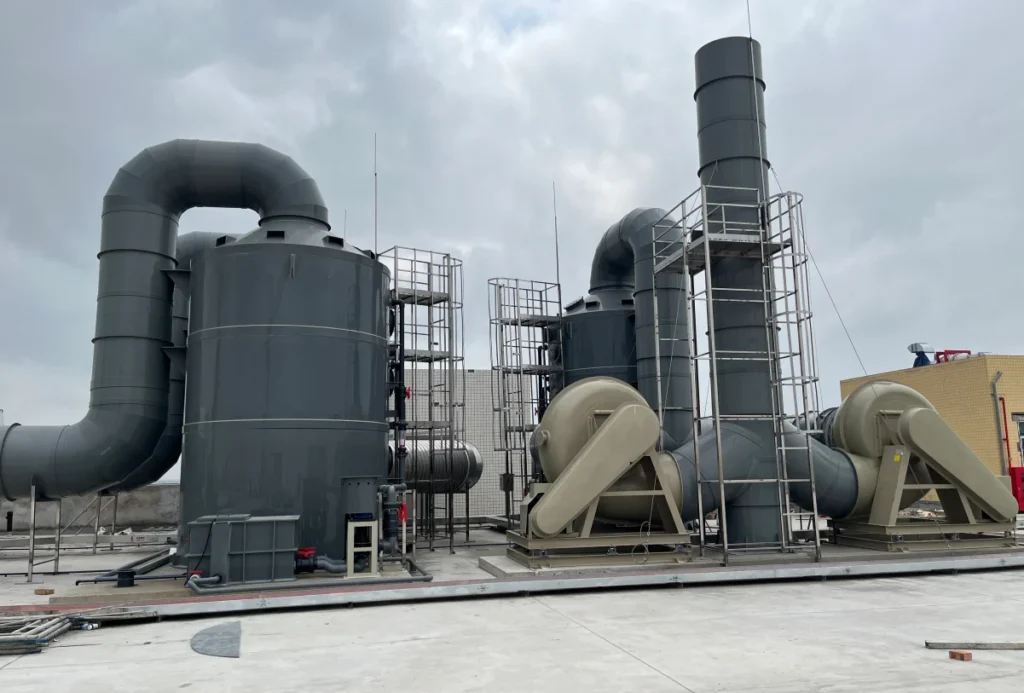
An engineer evaluating air pollution control equipment does not start by picking a scrubber type. The engineer starts with the pollutant: what is in the exhaust stream, at what concentration, at what temperature, and in what industry. The application of spray tower technology is not universal – it fits certain pollutant-industry combinations and does not fit others. This guide maps the specific industries and process conditions where a spray tower scrubber is the right choice, the applications where it is the only practical choice, and the boundary cases where a different technology deserves consideration. The goal is to match the equipment to the problem, not the other way around.
Key Takeaways
- Spray tower scrubbers serve the widest range of industries of any wet scrubber type, but the application of spray tower technology requires matching the equipment to the specific pollutant. From power plant FGD at 1,000,000 m3/h to electroplating acid mist at 10,000 m3/h, the open-chamber design adapts to gas flows spanning two orders of magnitude. The common thread across all successful applications is that the gas stream is chemically aggressive, solids-laden, or both – conditions that disable packed bed alternatives.
- Flue gas desulfurization at coal-fired power plants is the largest spray tower application, but not the most common. By number of units installed, chemical processing, metal finishing, and odor control collectively exceed power generation. The spray tower’s value in these smaller applications is the same as in FGD: reliable operation under corrosive, solids-forming conditions.
- Odor control is the fastest-growing application segment. Food processing plants, wastewater treatment facilities, and waste handling operations increasingly install deodorizer spray towers to meet community pressure and nuisance regulations. A two-stage spray tower with hypochlorite and caustic scrubbing achieves 85-95% removal of H2S, mercaptans, and organic acids at operating costs of $15,000-40,000 per year for a typical installation.
- Spray towers cannot treat every pollutant type. Non-water-soluble VOCs, sub-micron particulate, and applications requiring above 99% removal efficiency are better served by packed beds, venturi scrubbers, thermal oxidizers, or electrostatic precipitators. Matching the technology to the pollutant is the critical first step. For complex exhaust streams, custom-engineered spray towers → can address specific process conditions.
Where Are Spray Towers Used? – An Industry Overview
Spray tower scrubbers appear across more industrial sectors than any other single wet scrubber type. Understanding the application of spray tower technology starts with recognizing functions of spray tower design – open chamber, low pressure drop, high fouling tolerance – map to applications where the gas stream is chemically aggressive, solids-laden, or both.
The Applications That Fit the Spray Tower’s Design Strengths
The common thread across every successful spray tower application is that the gas stream would damage or block a packed bed within weeks (see our spray tower scrubber guide → for design fundamentals). The open-chamber geometry handles three conditions that disqualify packed columns:
High particulate loading. When the inlet gas carries coarse dust, scale fragments, or process solids above approximately 50 mg/Nm3, a packed bed begins to blind. The particulate accumulates in the void spaces between packing elements, increasing pressure drop until the system must be shut down for cleaning. A spray tower treats the same stream without a pressure drop increase because the falling droplets carry the solids into the sump.
Solids-forming contaminants. Certain pollutants react with water to form solid precipitates. Calcium compounds in cement kiln exhaust, ammonium chloride from chemical reactor vents, and gypsum from flue gas desulfurization all form solids on contact with water. A packed bed traps these solids in the media. A spray tower washes them through.
Highly corrosive gas chemistry. Acid gases at elevated temperatures – HCl at 60-80 deg C, HF with moisture, chlorine gas – attack metal packing and FRP tower internals. The spray tower minimizes internal surface area exposed to corrosion because there is no packing.
Industries That Rely on Spray Tower Technology
Power generation owns the largest installed base by gas flow volume, followed by chemical processing and metal finishing. The table below shows the major industries and the primary pollutants each sector treats with spray tower scrubbers.
| Industry | Primary Pollutants | Typical Removal Target |
|---|---|---|
| Power generation | SO2, HCl, HF, fly ash | 90-95% SO2 |
| Chemical processing | HCl, HF, Cl2, SO2, NOx | 95-99% |
| Metal finishing | H2SO4 mist, Cr6+, HNO3 | 90-98% |
| Food processing | H2S, mercaptans, amines | 90-95% (odor) |
| Pharma/Semiconductor | Solvent vapors, acid fumes | 85-95% |
| Mining/Metallurgy | SO2, HF, particulate | 90-97% |
| Incineration | HCl, SO2, heavy metals | 95-99% |
Power Generation – Flue Gas Desulfurization
Flue gas desulfurization (FGD) at coal-fired power plants is the single largest application of spray tower technology by installed gas flow capacity. A single utility-scale FGD spray tower can handle 1,000,000 m3/h or more of flue gas, making spray tower scrubbers the dominant gas-liquid contact device in the power generation sector.
SO2 Removal in Coal-Fired Power Plants
Coal contains sulfur in concentrations ranging from 0.5% to 5% by weight. When the coal burns, the sulfur oxidizes to sulfur dioxide (SO2), which exits the boiler at 120-180 deg C at concentrations of 200-2,000 ppmv. The flue gas enters the spray tower through a quench section that cools it to its adiabatic saturation temperature, then rises through multiple spray levels where a limestone slurry (CaCO3) or lime slurry (Ca(OH)2) absorbs the SO2.
The chemistry follows a well-established path. SO2 dissolves into the aqueous slurry droplets, reacts with dissolved calcium to form calcium sulfite (CaSO3), and the sulfite is oxidized to calcium sulfate (CaSO4-2H2O) – commercially known as gypsum – by air sparged into the sump. A standard FGD spray tower with three to five spray levels achieves 90-95% SO2 removal at liquid-to-gas ratios of 8-12 L/m3 (EPA wet scrubber monitoring data). The gypsum slurry is continuously bled from the sump, dewatered in a hydrocyclone and vacuum belt filter, and sold to wallboard manufacturers or landfilled.
The open-chamber design is essential in FGD service because gypsum scaling on internal surfaces is unavoidable. A packed bed FGD tower would blind within months. The spray tower’s empty vessel allows the scaling to occur on the walls where it can be managed with periodic water washing rather than media replacement.
Biomass and Oil-Fired Boiler Applications
Spray tower scrubbers serve biomass-fired boilers. This application of spray tower technology handles the sticky fly ash and tar aerosols from biomass combustion, which pass through an open chamber without accumulating. The flue gas from biomass contains lower SO2 than coal (typically 50-300 ppmv) but higher HCl from chlorine in the fuel, and spray towers with caustic scrubbing remove both simultaneously.
Gypsum Recovery and Byproduct Utilization
The gypsum produced by FGD spray towers is a salable byproduct when the oxidation system is properly designed. Wallboard-grade gypsum requires less than 1% residual calcium sulfite and a consistent particle size distribution. Achieving this demands precise control of the sump oxidation air rate, slurry pH between 5.0 and 6.0, and blowdown management to prevent chloride buildup above 20,000 ppm.
Chemical Processing Applications
Chemical manufacturing plants use spray tower scrubbers to treat reactor vents, storage tank breather emissions, and process off-gases. The pollutants vary by process – HCl, HF, SO2, NOx, Cl2, and organic acid vapors – but the spray tower’s corrosion resistance and ability to handle fluctuating loads make chemical processing a core application of spray tower technology.
HCl Absorption in Acid Manufacturing
Hydrochloric acid manufacturing produces tail gas containing HCl at concentrations from 500 to 5,000 ppmv. A spray tower absorber with water as the scrubbing medium achieves 95% removal in a single stage because HCl has notably high water solubility. Adding a dilute caustic solution to the recirculating water improves removal to over 99% and neutralizes the acid, producing sodium chloride brine that can be discharged or reused.
The design consideration specific to HCl spray towers is the heat of absorption. HCl dissolving in water releases approximately 74 kJ/mol, which raises the liquid temperature in the tower and reduces the equilibrium solubility. A recirculation rate high enough to keep the sump temperature below 50 deg C is essential to maintain removal efficiency. Most HCl spray towers include a heat exchanger on the recirculation loop or fresh water make-up at a rate sufficient to control temperature rise.
HF and Fluoride Gas Scrubbing in Fertilizer Plants
Fertilizer manufacturing – particularly superphosphate and phosphate fertilizer production – releases hydrogen fluoride (HF) and silicon tetrafluoride (SiF4) from the reaction of phosphate rock with sulfuric acid. These gases are highly toxic and corrosive. Spray towers using water or dilute caustic solution as the scrubbing medium achieve 95-99% removal.
HF scrubbing presents a specific operational challenge: the reaction product – calcium fluoride (CaF2) when lime is used, or sodium fluoride (NaF) with caustic – is a sparingly soluble solid. These solids can precipitate in the sump and on nozzle surfaces if the dissolved solids concentration exceeds solubility limits. Blowdown control and periodic sump cleaning are standard maintenance items in HF spray tower service.
Chlorine and Bromine Exhaust Treatment
Chlorine gas scrubbers in chemical plants, water treatment facilities, and pulp and paper operations use spray towers with caustic solution as the scrubbing medium. The reaction is fast and complete: Cl2 + 2 NaOH produces NaCl + NaOCl (sodium hypochlorite) + H2O. A two-stage spray tower with caustic recirculation achieves 99.5% chlorine removal at inlet concentrations up to 500 ppmv.
The spray tower’s open geometry is advantageous in chlorine service because the reaction can produce sodium chloride crystals in the recirculating liquid, especially at high caustic concentrations. A packed bed would trap these crystals. A spray tower allows them to settle in the sump where they can be removed through a bleed stream.
NOx Abatement in Nitric Acid Facilities
Nitric acid plant tail gas contains NOx – primarily NO and NO2 – at concentrations from 200 to 2,000 ppmv. NOx absorption in a spray tower requires an oxidizing scrubbing medium because NO is not water soluble. Hydrogen peroxide (H2O2) or potassium permanganate (KMnO4) solutions oxidize NO to NO2, which then dissolves and reacts to form nitric acid. Removal efficiencies of 85-95% are achievable.
Metal Finishing and Electroplating
Electroplating and metal finishing operations generate acid mist containing sulfuric acid (H2SO4), chromic acid (CrO3), nitric acid (HNO3), and hydrofluoric acid (HF) from plating bath ventilation hoods. These exhaust streams are an ideal application of spray tower scrubbers because the acid concentrations are moderate (50-500 ppmv), the gas temperature is near ambient, and the particulate loading is low.
Acid Mist Control from Plating Lines
Sulfuric acid anodizing and hard chrome plating baths produce a fine acid mist that must be captured at the tank surface and treated before discharge. A spray tower using recirculated water with pH-controlled caustic injection achieves 90-98% removal of sulfuric acid mist. The tower operates at low gas velocities, typically 0.5-0.8 m/s, to minimize droplet carryover. Chevron vane mist eliminators with generous spacing prevent the accumulation of acid droplets that can cause downstream corrosion.
Chromic acid mist presents a specific challenge because hexavalent chromium (Cr6+) is a regulated hazardous air pollutant with a permissible exposure limit of 0.05 mg/m3 in many jurisdictions. Spray tower scrubbers for chrome plating exhaust frequently use a reducing agent – sodium metabisulfite (Na2S2O5) or ferrous sulfate – in the scrubbing solution to convert Cr6+ to the less hazardous Cr3+ form, which then precipitates as chromium hydroxide for removal as sludge.
Chrome, Nickel, and Cyanide Fume Scrubbing
Nickel plating baths generate nickel sulfate mist. Copper and brass plating generate cyanide gas from cyanide-based plating solutions. Each requires different scrubbing chemistry despite using the same spray tower hardware.
Cyanide scrubbers use sodium hypochlorite (NaOCl) or chlorine as the oxidizing agent in a caustic scrubbing solution. The cyanide is oxidized to cyanate (CNO-) and then to carbon dioxide and nitrogen. Cyanide destruction requires pH control above 10 to prevent the formation of toxic hydrogen cyanide gas in the scrubber. A spray tower for cyanide service should include pH interlocks on the reagent feed pump and a redundant pH sensor.
Nickel and copper acid mist scrubbers operate with water or dilute caustic at pH 7-9. The primary design consideration is materials of construction: polypropylene or FRP are standard because stainless steel in chloride-containing plating exhaust suffers pitting corrosion within months.
Odor Control – Food Processing and Wastewater
Odor control is one of the fastest-growing application of spray tower markets, driven by community pressure on food processing plants, wastewater treatment facilities, and waste handling operations. The pollutants are reduced sulfur compounds, amines, and organic acids at low concentrations (0.1-50 ppmv) where the challenge is not meeting a permit limit but eliminating public nuisance.
Rendering Plant and Food Processing Odor Abatement
Rendering plants – facilities that process animal byproducts into fat, protein meal, and bone meal – generate some of the strongest industrial odors. The exhaust from cookers, driers, and presses contains hydrogen sulfide (H2S), ammonia (NH3), mercaptans (CH3SH), dimethyl sulfide ((CH3)2S), and volatile fatty acids. A single-pass water spray tower pre-cools and humidifies the hot exhaust before it enters a chemically enhanced spray tower or packed polishing bed.
The deodorizer spray tower typically uses a two-stage chemical approach. The first stage operates with sodium hypochlorite (NaOCl) at pH 8-10 to oxidize reduced sulfur compounds. The second stage uses sodium hydroxide (NaOH) to absorb acid gases and acid byproducts from the oxidation reaction. The combined removal efficiency for odor-causing compounds ranges from 85-95%, with the outlet achieving a dilution-to-threshold (D/T) ratio acceptable for the local zoning requirements.
Wastewater Treatment Plant Vent Air
Wastewater treatment plants collect and treat ventilation air from headworks, primary clarifiers, sludge holding tanks, and dewatering operations. The predominant odorants are H2S ammonia (NH3), and volatile organic compounds. H2S concentrations in wastewater collection system exhaust can range from 5-200 ppmv depending on the sewage composition, temperature, and retention time.
Spray tower scrubbers for wastewater odor control use either caustic/hypochlorite chemistry for H2S removal or, in applications with phosphate precipitation requirements, ferric chloride addition to the scrubbing liquid. The tower is typically constructed from FRP or polypropylene because the headspace atmosphere above wastewater treatment tanks is highly corrosive from the combination of H2S, moisture, and microbial activity. Operating costs for a 50,000 m3/h wastewater odor control spray tower range from $15,000 to $40,000 per year including chemicals, electricity, and water.
Deodorizer Spray Tower in Refuse Stations
Refuse transfer stations and waste handling facilities install spray towers to treat building ventilation air before discharge. The exhaust contains a complex mixture of organic decomposition products including H2S, NH3, and VOCs from putrescible waste. A two-stage spray tower with an oxidizing scrubbing solution is the standard design, with a mist eliminator section designed for heavy liquid loading because the high humidity of refuse station exhaust causes continuous condensation in the tower.
Pharmaceutical and Semiconductor Manufacturing
Pharmaceutical and semiconductor facilities require exhaust treatment systems that protect both the environment and the delicate production environment inside the cleanroom. This application of spray tower technology serves both sectors because they handle corrosive acid fumes
Solvent Vapor Recovery in Pharma
Pharmaceutical manufacturing produces reactor vent streams containing water-soluble solvents – isopropyl alcohol, acetone, ethanol, methanol – at concentrations from 100-2,000 ppmv. A spray tower using chilled water as the scrubbing medium achieves 80-95% removal through physical absorption. The solvent-laden water is collected and sent to the facility’s wastewater treatment system or, in larger installations, to a solvent recovery still that separates and recycles the solvent.
The design factor specific to pharmaceutical spray towers is batch operation. Pharmaceutical reactors operate in campaigns that may last hours to weeks, with idle periods between. The spray tower must be designed for intermittent operation with automated shutdown sequences that prevent stagnant liquid from supporting microbial growth in the sump. FRP construction with a vinyl ester resin is standard because the combination of organic solvents and periodic caustic cleaning cycles attacks standard polyester resins.
Acid Exhaust in Semiconductor Fabs
Semiconductor fabrication facilities generate acid exhaust from wet etching and cleaning processes that use hydrofluoric acid, hydrochloric acid, sulfuric acid, and phosphoric acid. The exhaust stream is collected from hundreds of process tools distributed across the fab and combined in a central acid exhaust header before entering the scrubber system. The combined concentration of acid gases is typically 5-50 ppmv – low compared to chemical plant streams – but the total gas flow from a single fab can reach 100,000-300,000 m3/h.
Spray tower scrubbers for semiconductor acid exhaust are almost universally constructed from polypropylene because it resists the full range of acids used in semiconductor processing at the operating temperature of 20-40 deg C. The tower design incorporates multiple spray levels with full-cone nozzles to ensure complete coverage across the large diameter required by the high gas flow rate. Removal efficiency for HF and HCl exceeds 95%. The discharge stream is pH-neutralized before release to the facility wastewater system.
Mining, Metallurgy, and Incineration
Heavy industries extract value from ores and destroy waste at high temperatures, producing exhaust streams that combine acid gases, particulate, and trace metals. The application of spray tower scrubbers in these sectors is driven by the need for equipment that handles temperature swings, particulate loads, and corrosive chemistry without the maintenance burden of packed alternatives.
Aluminum Smelter Gas Treatment
Aluminum smelters produce fluoride gases – primarily hydrogen fluoride (HF) and particulate fluorides – from the electrolytic reduction of alumina in cryolite baths. The potline exhaust contains 10-50 ppmv HF at 80-120 deg C with alumina dust loading of 20-100 mg/Nm3. Spray tower scrubbers using recirculated water achieve 95-98% HF removal.
The unique operating requirement of aluminum smelter HF scrubbers is that the reaction product – hydrofluorosilicic acid (H2SiF6) from the reaction of HF with silica in the alumina dust – is a valuable byproduct sold to the water fluoridation market. The scrubber blowdown containing H2SiF6 at 15-25% concentration is collected and shipped to municipal water treatment facilities. This byproduct revenue partially offsets the scrubber operating cost.
Incinerator and Thermal Treatment Exhaust
Municipal and hazardous waste incinerators produce flue gas containing HCl, SO2, HF, NOx, and heavy metals from the combustion of plastics, batteries, and other waste components. The flue gas enters the scrubber at 180-250 deg C after passing through a heat recovery boiler and dry lime injection system. A spray tower quench section cools the gas to saturation before it enters the absorption zone.
The spray tower in incinerator service operates with lime slurry or caustic solution at pH 6-7. The target is 95%+ removal of HCl and 90%+ removal of SO2 to meet the European Waste Incineration Directive (2000/76/EC) or equivalent national standards. The combination of hot gas, acid chemistry, and abrasive fly ash makes the spray tower’s open-chamber design essential – packed beds in incinerator service would require packing replacement every 6-12 months.
Mineral Processing Off-Gas Scrubbing
Mineral processing operations – copper smelters, lead smelters, gold ore roasters – generate SO2 and metal fume at varying concentrations depending on the ore grade and process conditions. Spray tower scrubbers serve as pre-scrubbers ahead of sulfuric acid plants in copper smelting. The spray tower removes particulate, cools the gas, and absorbs a portion of the SO2 to reduce the load on the downstream acid plant.
Advantages and Limitations in Application Context
The advantages and disadvantages of spray tower technology are not abstract engineering properties. The application of spray tower scrubbers becomes clear only in the context of a specific pollutant and industry.
Where Spray Towers Excel in Real-World Applications
Spray towers deliver measurable advantages in four application categories. A review of the advantages and disadvantages of spray tower technology shows that the same open-chamber design solves problems in fouling service that no packed bed can match.
Fouling service. In flue gas desulfurization, cement kiln exhaust, and biomass boiler flue gas, the gas stream forms solids on contact with water. The spray tower’s open chamber handles this continuously. A packed bed would require media cleaning or replacement every 3-12 months. The cost of a 6-month packing replacement cycle for a 100,000 m3/h packed bed – approximately $25,000-50,000 in media, labor, and downtime – exceeds the entire annual maintenance budget of an equivalent spray tower.
Corrosive service. Chemical plants, electroplating shops, and semiconductor fabs generate acid streams at concentrations and temperatures that attack most packing materials. Polypropylene and FRP spray towers operate in these environments with only periodic nozzle inspection as routine maintenance.
Variable load. Wastewater treatment plants, rendering operations, and batch chemical processes generate exhaust flow and concentration profiles that fluctuate throughout the day. Spray towers respond to load changes without performance degradation because there is no media to flood or dry out. The turndown ratio – the ratio of maximum to minimum gas flow the tower can handle – is typically 4:1 or higher, compared to 2:1 for most packed beds.
Combined pollutant removal. When the exhaust contains both acid gases and coarse particulate, a spray tower captures both simultaneously. The particulate is washed into the sump and removed with the blowdown. No separate pre-collector is needed.
When Alternative Technologies Outperform
The disadvantages of spray tower scrubbers become decisive when the target pollutant has low water solubility, when the required removal efficiency exceeds 99%, or when the particulate is sub-micron.
Low-solubility VOCs – benzene, toluene, xylene, chlorinated solvents – cannot be absorbed by water at meaningful rates in a spray tower. A packed bed with activated carbon or a regenerative thermal oxidizer (RTO) is the appropriate technology. Fine particulate below 5 um – metal oxide fume, diesel soot, incinerator fly ash – passes through spray tower droplets because the particles follow the gas streamlines around the droplets. A venturi scrubber or wet electrostatic precipitator collects these particles effectively.
Removal efficiencies above 99% for moderately soluble gases such as SO2 or H2S are difficult to achieve in a single spray tower regardless of the L/G ratio. A multi-stage spray tower with optimized nozzle spacing and chemical reagent control can approach 99%, but a packed bed or tray tower with the same chemistry achieves it more reliably and at lower capital cost for the same vessel volume.
Frequently Asked Questions
What is the most common application of spray tower scrubbers?
Flue gas desulfurization (FGD) at coal-fired power plants is by far the largest application by installed gas flow volume. A single utility FGD spray tower can handle over 1,000,000 m3/h of flue gas, removing 90-95% of the SO2. However, by number of installed units, chemical processing and metal finishing applications collectively exceed power generation.
Can a spray tower remove VOCs?
Yes, but only water-soluble VOCs such as alcohols (methanol, ethanol, isopropanol), aldehydes (formaldehyde), acetone, and some ketones. Non-water-soluble VOCs – benzene, toluene, xylene, chlorinated solvents – require a packed bed absorber with a specialized scrubbing solution, activated carbon adsorption, or thermal oxidation. The solubility of the target VOC in the scrubbing liquid determines whether a spray tower is effective.
What is the largest spray tower ever built?
The largest FGD spray towers in the power industry reach 20-25 meters in diameter and 30-40 meters in total height, handling flue gas flows of 2,000,000-3,000,000 m3/h per unit. These towers have 4-6 spray stages with 100-200 nozzles per stage, recirculating limestone slurry at rates exceeding 50,000 L/min.
What industries should not use spray towers?
Industries whose exhaust contains predominantly insoluble VOCs – paint manufacturing, printing, chemical storage terminals – should not rely on spray towers for primary VOC removal. Applications requiring sub-micron particulate capture at high efficiency – carbon black manufacturing, metal fume from welding or smelting, diesel engine test cells – need a venturi scrubber or fabric filter instead of or in series with a spray tower.
How do I decide if a spray tower is right for my application?
The decision follows a three-question sequence based on the core functions of spray tower scrubber design. First, is the pollutant water-soluble or reactive with a common chemical reagent? If no, a spray tower is likely not the primary choice. Second, does the exhaust contain particulate or solids that would foul a packed bed? If yes, a spray tower may be the only practical option. Third, is the required removal efficiency 95% or less? If yes, a spray tower can probably meet the target. If the answer to all three is favorable, a spray tower is worth specifying.