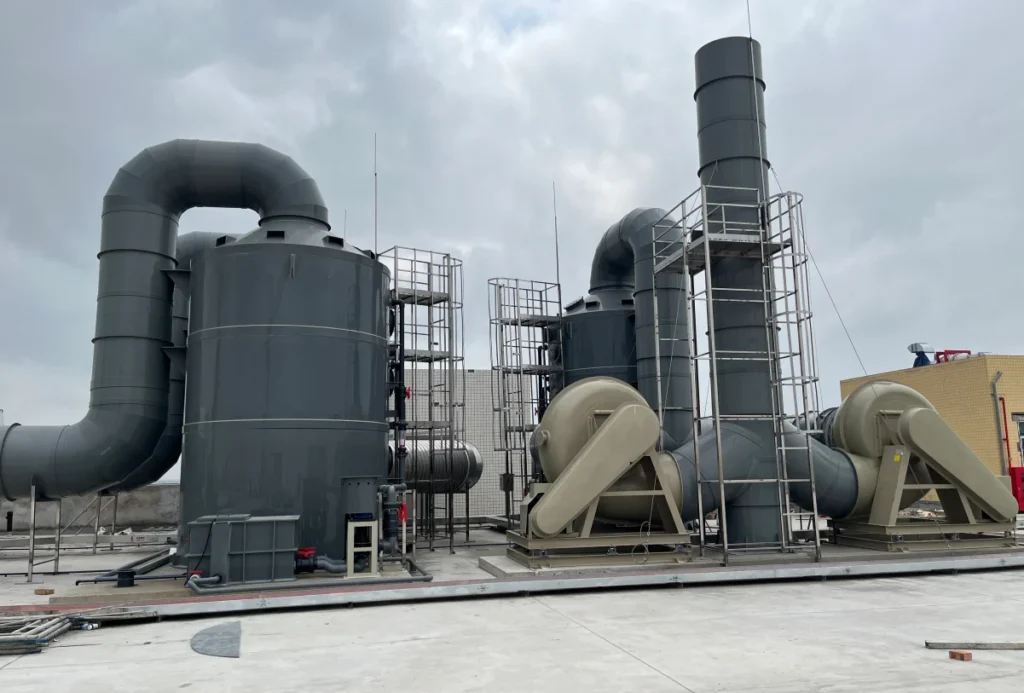
A plant engineer looking at a standard spray tower’s limitations faces a specific problem: the gas velocity cannot exceed approximately 1.2 m/s without causing droplet entrainment, which means the vessel must be large and the capital cost high. A cyclonic spray tower solves this by adding a tangential gas inlet that spins the gas stream as it enters the vessel. The centrifugal force pushes droplets outward to the vessel wall, allowing the tower to operate at 2-4 times the gas velocity of a standard spray tower without carryover.
This configuration gives the cyclonic spray tower a unique position among wet scrubbers: it combines the open-chamber reliability of a standard spray tower with the higher particulate collection efficiency that comes from the increased relative velocity between gas and droplets. This guide covers what a cyclonic spray tower is, how the cyclonic flow pattern improves collection efficiency, the design parameters that distinguish it from standard spray towers, and the specific industrial applications where this configuration outperforms both standard spray towers and other wet scrubber types.
Key Takeaways
- A cyclonic spray tower combines centrifugal particle collection with wet scrubbing in a single vessel, operating at 2-4 m/s gas velocity – two to four times higher than a standard spray tower. The tangential gas inlet generates a centrifugal field of 5-20 G that drives droplets and particles to the vessel wall, eliminating the need for a mist eliminator in many designs.
- The cyclonic design allows a 30-50% reduction in vessel diameter compared to a standard spray tower for the same gas flow rate. A 50,000 m3/h flow requires a 2.1 m diameter cyclonic tower at 4 m/s versus a 4.7 m diameter standard tower at 0.8 m/s. This footprint advantage makes cyclonic spray towers valuable in space-constrained retrofits and packaged skid-mounted systems.
- Particulate collection efficiency is higher than a standard spray tower but lower than a venturi scrubber. Particles above 5 um are collected at 90-98% efficiency. The higher relative gas-droplet velocity in the cyclonic field improves inertial impaction for particles in the 2-10 um range compared to standard spray tower designs.
- The pressure drop of 5-15 cm WC is a compromise between standard spray towers (1.3-7.6 cm WC) and venturi scrubbers (25-100+ cm WC). The annual fan energy cost for a 50,000 m3/h cyclonic system at 10 cm WC is approximately $18,000 – roughly three times a standard spray tower but one-fifth of a venturi. For custom designs, spray tower configurations → can be adapted to cyclonic inlet geometries.
What Is a Cyclonic Spray Tower?
A cyclonic spray tower is a wet scrubber that combines a tangential gas inlet with spray nozzles to create a swirling gas-liquid contact pattern inside the vessel (see our spray tower scrubber guide → for comparison with standard designs). The cyclonic action serves two purposes: it increases the relative velocity between the gas and the liquid droplets, which improves particle collection by inertial impaction, and it centrifugally separates the droplets from the cleaned gas stream, which allows the tower to operate at higher gas velocities without a separate mist eliminator.
How Cyclonic Action Differs from Standard Spray Towers
In a standard countercurrent spray tower, gas enters at the bottom through a straight inlet and rises vertically through the spray zone. The gas velocity is limited to 0.3-1.2 m/s because faster upward flow carries droplets into the mist eliminator. The gas and droplets move in opposite directions, and the contact time is determined by the tower height divided by the gas velocity.
In a cyclonic spray tower, the gas enters tangentially near the bottom or the side of the vessel, creating a spiral flow path that moves upward through the tower. The tangential velocity – typically 3-10 m/s at the inlet – generates a centrifugal field of 5-20 G at the vessel wall, depending on the inlet velocity and the tower diameter. The spray nozzles mounted along the centerline or at multiple levels inject droplets into the swirling gas stream. The centrifugal force drives the droplets outward toward the wall, where they coalesce and drain downward as a liquid film. The cleaned gas exits through a central outlet at the top of the vessel.
This design allows the cyclonic spray tower to operate at superficial gas velocities of 2-4 m/s – two to four times higher than a standard spray tower – because the droplet separation is driven by centrifugal force rather than gravity. The tower diameter for a given gas flow rate can be 30-50% smaller than a standard spray tower.
The Centrifugal Collection Mechanism
Particle collection in a cyclonic spray tower benefits from two mechanisms operating simultaneously. Inertial impaction captures particles that collide with droplets in the swirling flow field. The high relative velocity between the gas and the droplets – typically 3-10 m/s compared to 0.5-1.5 m/s in a standard spray tower – increases the impaction efficiency for particles in the 2-10 um range. Centrifugal deposition captures larger particles and droplets by driving them to the wall where they are collected by the liquid film.
The combination of mechanisms means a cyclonic spray tower can achieve particulate removal efficiencies of 90-98% for particles above 5 um, compared to 70-90% for a standard spray tower at the same L/G ratio. The trade-off is a higher pressure drop, typically 5-15 cm WC compared to 1.3-7.6 cm WC for a standard spray tower.
The cyclonic spray tower is most effective when the target is removing coarse-to-medium particulate and highly soluble gases from an exhaust stream where floor space is limited. For an exhaust containing both grinding dust at 10-50 um and HCl vapor from a pickling line, the cyclonic spray tower handles both simultaneously in a single compact vessel, eliminating the need for a separate cyclone followed by a packed bed scrubber.
Design Features and Operating Principles
A cyclonic spray tower differs from a standard spray tower in three specific design features: the gas inlet geometry, the operating velocity range, and the droplet separation method. Each feature creates a distinct performance envelope.
Tangential Gas Inlet and Swirl Generation
The tangential gas inlet is the defining design feature. The inlet duct enters the vessel at a tangent to the tower wall rather than perpendicular to it. The gas stream follows the curvature of the wall, establishing a spiral flow path that propagates upward through the entire vessel height. The inlet velocity – typically 8-15 m/s – determines the swirl intensity. A higher inlet velocity produces stronger centrifugal force but increases the inlet pressure drop.
The swirl intensity is quantified by the swirl number S, defined as the ratio of tangential to axial momentum flux. For effective cyclonic operation in a spray tower, S should be above 0.6. This is achieved by designing the tangential inlet with a cross-sectional area of 15-25% of the tower cross-sectional area. For a 2.0 m diameter cyclonic tower, the inlet duct area would be 0.5-0.8 m2, corresponding to a rectangular inlet of approximately 0.5 m x 1.0 m.
The swirl intensity decays as the gas rises through the vessel. To maintain effective cyclonic action through the full tower height, the vessel aspect ratio (height/diameter) is typically kept between 2:1 and 4:1. Taller towers require higher inlet velocities or multiple tangential inlets at different elevations to sustain the swirl. The centrifugal acceleration at the wall can be estimated as a_c = v_t^2 / r, where v_t is the tangential velocity and r is the tower radius. At an inlet velocity of 10 m/s in a 2.0 m diameter tower, the tangential velocity near the wall is approximately 5-7 m/s, producing a centrifugal acceleration of 25-50 m/s2 – roughly 3-5 G.
Higher Gas Velocity and Its Trade-offs
The superficial gas velocity in a cyclonic spray tower is 2-4 m/s, compared to 0.3-1.2 m/s in a standard spray tower. This velocity range is possible because the centrifugal force separates droplets from the gas stream, preventing the entrainment carryover that limits standard tower velocity.
The higher velocity has three consequences. First, the tower diameter can be smaller: a 50,000 m3/h flow requires a 2.1 m diameter vessel at 4 m/s versus a 4.7 m diameter vessel at 0.8 m/s for a standard tower. Second, the gas-liquid contact time is shorter: approximately 1-2 seconds versus 3-6 seconds in a standard tower. Third, the pressure drop is higher: 5-15 cm WC versus 1.3-7.6 cm WC for a standard tower.
The shorter contact time means cyclonic spray towers are better suited to particulate collection and highly soluble gas absorption than to low-solubility gas absorption. For HCl or NH3, where the reaction is fast, the reduced contact time has minimal impact. For SO2 or H2S without chemical enhancement, the shorter contact time reduces removal efficiency.
Nozzle Arrangement in Cyclonic Flow
Nozzle placement in a cyclonic spray tower must account for the centrifugal flow pattern. Nozzles are typically mounted along the centerline of the vessel, spraying radially outward into the swirling gas stream. The droplets are carried by the centrifugal field toward the wall, creating a dense liquid curtain that the gas must pass through.
The nozzle arrangement for a high density spray tower configuration places nozzles at multiple elevations with overlapping spray patterns to ensure complete gas coverage. Full-cone nozzles with a 90-120 degree spray angle are standard. The droplet size target is 500-1,000 um, consistent with standard spray tower practice, but the higher relative gas velocity means smaller droplets can be used without entrainment risk because the centrifugal force separates them.
Enhanced Droplet Separation
The centrifugal separation of droplets from the gas stream eliminates the need for a chevron vane or mesh pad mist eliminator in many cyclonic spray tower designs. The liquid film that forms on the vessel wall drains downward by gravity to the sump. A short demisting section at the top of the vessel – typically 0.5-1.0 m of open height above the top spray level – provides additional gravity settling for any droplets that escape the centrifugal field.
This integrated droplet separation is the key advantage that allows the cyclonic spray tower to operate at 2-4 m/s gas velocity. In a standard spray tower operating above 1.2 m/s, the mist eliminator would flood within minutes because the upward gas velocity exceeds the drainage capacity of the eliminator vanes. In a cyclonic tower, the centrifugal force removes the bulk of the liquid from the gas stream before it reaches the demisting section, keeping the liquid loading on the final demisting section low enough for gravity settling alone to complete the separation.
Industrial Applications
Cyclonic spray towers occupy a specific niche: applications where the exhaust contains coarse-to-medium particulate and highly soluble gases, and where the available footprint is smaller than a standard spray tower would require. They are also chosen as pre-cleaners ahead of more efficient scrubber stages.
Dust Removal in Manufacturing
Manufacturing processes that generate coarse particulate – woodworking, metal grinding, powder handling, and glass fiber production – use cyclonic spray towers as dust removal equipment purification spray tower systems. The cyclonic action captures particles above 5 um at 90-98% efficiency, producing a cleaned gas stream that can be discharged directly or sent to a final filter.
A typical installation processes 10,000-50,000 m3/h of exhaust from a grinding or polishing line. The cyclonic spray tower acts as both a dust removal equipment purification spray tower and a gas quench system, removing the bulk of the particulate at a pressure drop of 5-10 cm WC, avoiding the high energy cost of a baghouse or venturi scrubber. The collected particulate is washed into the sump and removed as slurry. For processes generating dry dust that would be combustible in a baghouse – aluminum grinding, magnesium machining – the wet cyclonic spray tower eliminates the deflagration risk because the collected dust is immediately submerged in water.
Chemical and Acid Mist Control
Chemical plants use cyclonic spray towers for acid mist removal from reactor vents and storage tank breather vents where the exhaust contains both acid gas and entrained liquid droplets. The cyclonic action separates the droplets from the gas by centrifugal force while the spray absorbs the acid gas. The combined removal reduces the load on downstream equipment.
Chromic acid mist from plating operations is a good example. The mist contains entrained CrO3 droplets in the 2-10 um range, which a standard spray tower captures poorly because the droplets follow the gas streamlines. A cyclonic spray tower’s centrifugal field drives the droplets to the wall, achieving 95%+ removal of the chromic acid mist while the spray absorbs the acid gas component.
Odor Control and Deodorizer Applications
Cyclonic spray towers serve as pre-scrubbers in odor control systems where the exhaust contains both particulate and odorous gases. The cyclonic stage removes the particulate and cools the gas before it enters a packed bed or activated carbon adsorption stage for final odor removal.
A deodorizer spray tower with cyclonic action is sometimes specified for food processing exhaust that contains both organic particulate (fat aerosols, protein particles) and odorous gases (H2S, NH3, mercaptans). The cyclonic stage removes the particulate that would blind the downstream packed bed, extending the packing replacement interval from 6 months to 2-3 years.
Pre-Cleaning Ahead of Packed Bed or Venturi
In multi-stage scrubber systems, a cyclonic spray tower often serves as the first stage. It removes coarse particulate, quenches hot gas to saturation temperature, and captures a portion of the soluble gases. The downstream packed bed or venturi operates on cleaner, cooler gas with a reduced contaminant load. The overall system achieves higher removal efficiency than either stage alone.
Advantages and Limitations
Cyclonic spray towers offer specific advantages over both standard spray towers and other dry/wet particulate collection technologies. Understanding where they fit – and where they do not – is essential for correct specification.
Where Cyclonic Spray Towers Excel
Smaller footprint for the same gas flow. The ability to operate at 2-4 m/s superficial velocity means a cyclonic spray tower can be 30-50% smaller in diameter than a standard spray tower for the same gas flow rate. This is valuable in retrofit applications where space is constrained or in packaged scrubber systems mounted on skids. For a 50,000 m3/h flow, the cyclonic tower diameter is approximately 2.1 m compared to 4.7 m for a standard tower – a saving of over 5 m2 of floor space. The reduction in shell material weight for FRP construction can offset the slightly more complex inlet fabrication cost.
Better fine particulate collection. The higher relative gas-droplet velocity in a cyclonic flow field increases the inertial impaction efficiency for particles in the 2-10 um range. A cyclonic spray tower achieves 90-98% removal for this particle size range, compared to 70-90% for a standard spray tower at the same L/G ratio.
Integrated droplet separation. The centrifugal droplet separation eliminates the need for a mist eliminator in many designs, reducing maintenance. The liquid film on the vessel wall also provides continuous surface contact for gas absorption – a high density spray tower benefits from this wall film as additional contacting surface beyond the droplet field.
Moderate pressure drop. The pressure drop of 5-15 cm WC is higher than a standard spray tower but much lower than a venturi scrubber – see EPA wet scrubber monitoring data for reference ranges. The fan energy cost is approximately 2-4 times that of a standard spray tower but 5-10 times less than a venturi.
Comparison: Cyclonic vs Standard Spray Tower vs Venturi
| Parameter | Cyclonic Spray Tower | Standard Spray Tower | Venturi Scrubber |
|---|---|---|---|
| Gas velocity (m/s) | 2-4 | 0.3-1.2 | 15-50 (throat) |
| Particle collection (>5 um) | 90-98% | 70-90% | 95-99% |
| Collection (<2 um) | Poor | Poor | 90-98% |
| Pressure drop (cm WC) | 5-15 | 1.3-7.6 | 25-100+ |
| Relative vessel diameter | x1 | x1.5-2 | x0.5 (small) |
| Mist eliminator needed | Often not | Yes | Yes |
| Gas absorption efficiency | Moderate | Moderate-High | Low-Moderate |
Limitations and Selection Considerations
Reduced gas absorption efficiency for low-solubility gases. The shorter gas-liquid contact time in a cyclonic spray tower – typically 1-2 seconds versus 3-6 seconds in a standard tower – reduces the absorption efficiency for moderately soluble gases such as SO2 or H2S without chemical enhancement. For these applications, a standard spray tower or a packed bed is the better choice.
Not suitable for sub-micron particulate. Particles below 1 um are not effectively collected by cyclonic spray towers, regardless of the swirl intensity. The centrifugal force on sub-micron particles is too weak to overcome the gas-phase drag. A venturi scrubber, wet electrostatic precipitator, or fabric filter is required for sub-micron service.
Higher fan operating cost. The pressure drop of 5-15 cm WC requires 2-4 times the fan power of a standard spray tower. For a 50,000 m3/h system, the annual fan energy cost at 10 cm WC is approximately $18,000 compared to $5,500 for a standard spray tower.
Erosion risk at inlet zone. The high tangential velocity of 8-15 m/s at the gas inlet creates an erosion risk on the vessel wall opposite the inlet, particularly when the gas stream carries abrasive particulate. A replaceable wear plate or abrasion-resistant lining in the inlet zone is standard design practice for dusty service.
Frequently Asked Questions
What is the difference between a cyclonic spray tower and a standard spray tower?
The fundamental difference is the gas inlet geometry. A cyclonic spray tower uses a tangential inlet that creates a swirling gas flow, generating centrifugal force that separates droplets and enhances particle collection. A standard spray tower uses a straight gas inlet with gas flowing vertically through the vessel. The cyclonic design operates at higher gas velocities (2-4 m/s vs 0.3-1.2 m/s) and has a smaller diameter for the same flow rate. A cyclonic tower for 50,000 m3/h is approximately 2.1 m in diameter, compared to 4.7 m for a standard spray tower.
Can a cyclonic spray tower replace a cyclone pre-cleaner?
A cyclonic spray tower combines the functions of a dry cyclone and a wet scrubber in a single vessel. It removes particulate by centrifugal force while simultaneously absorbing soluble gases through the spray. In applications where both particulate and gas removal are needed, a cyclonic spray tower can replace a dry cyclone + wet scrubber combination, saving both equipment cost and floor space.
What particle sizes can a cyclonic spray tower collect?
A cyclonic spray tower collects particles above 5 um at 90-98% efficiency. Collection efficiency drops significantly below 2-3 um because the centrifugal force on small particles is too weak to overcome gas-phase drag. For sub-micron particulate, a venturi scrubber or fabric filter is required. The efficiency for 2-5 um particles is in the range of 60-85%, depending on the inlet velocity and the L/G ratio.
Does a cyclonic spray tower need a mist eliminator?
Many cyclonic spray tower designs do not require a separate mist eliminator because the centrifugal field separates droplets from the gas stream and drives them to the vessel wall. A short open demisting section at the top of the vessel provides additional gravity settling. In applications with high L/G ratios or fine droplet sprays, a chevron vane mist eliminator may still be needed above the cyclonic section.
What is the pressure drop of a cyclonic spray tower?
Cyclonic spray towers typically operate at 5-15 cm WC of pressure drop, compared to 1.3-7.6 cm WC for a standard spray tower and 25-100+ cm WC for a venturi scrubber. The pressure drop depends on the inlet velocity, the vessel geometry, and the L/G ratio. The fan power requirement for a 50,000 m3/h cyclonic tower at 10 cm WC is approximately 5.8 kW.
When should I choose a cyclonic spray tower over a standard spray tower?
Choose a cyclonic spray tower when the exhaust contains coarse-to-medium particulate (5-50 um) that needs wet collection, when space is limited, and when the target gas pollutants are highly soluble (HCl, NH3, HF). Choose a standard spray tower when the primary requirement is gas absorption of moderately soluble gases, when the particulate loading is low, or when minimum operating cost is the overriding constraint.