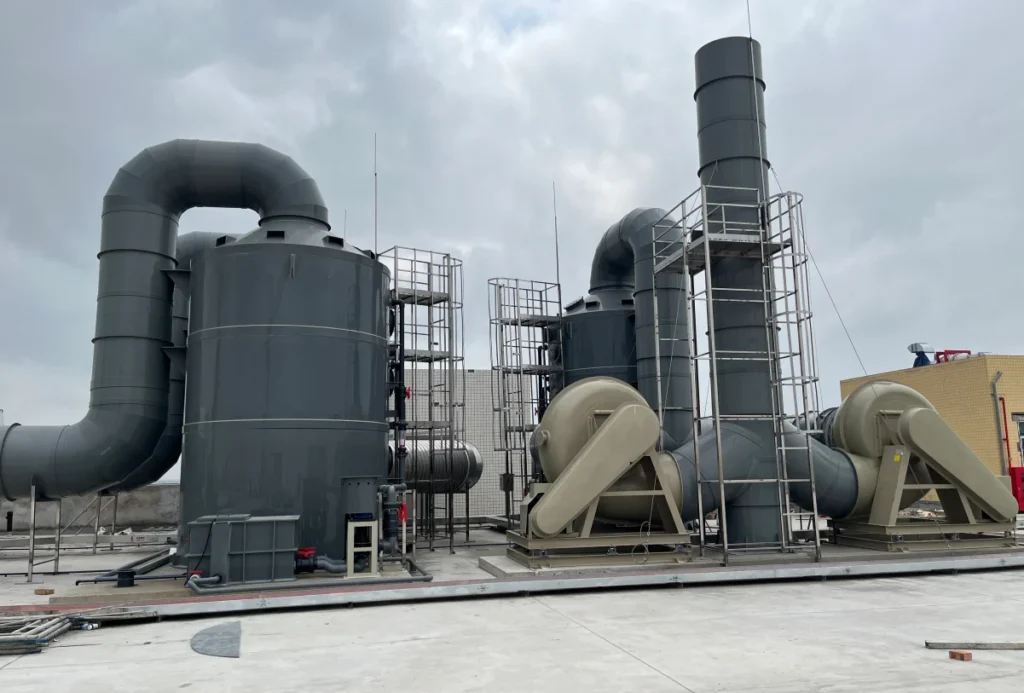
When an engineer is handed an exhaust analysis showing particulate in the 0.5 to 5 µm range, the choice between a venturi scrubber vs wet scrubber (spray tower or packed bed) is not a matter of preference. It is a matter of physics. A spray tower’s 500-1,000 µm droplets, falling under gravity at 1 m/s, cannot capture sub-micron particles by inertial impaction. A venturi scrubber’s 10-50 µm droplets, moving at 60-120 m/s relative to the gas, can. This guide compares venturi scrubber vs wet scrubber technologies across five dimensions: particle size capability, pressure drop and energy cost, design configurations including ejector venturi gas scrubber and multi-venturi wet scrubber options, capital versus operating economics over 10 years, and specific industrial applications where one technology decisively outperforms the other.
Key Takeaways
- The venturi scrubber vs wet scrubber decision turns on one number: the particle size distribution. If the mass median diameter is below 3 µm, or if sub-micron particles represent more than 20-30% of the total mass, a venturi is likely the only wet scrubbing option that meets a 95% removal target. If the particulate is above 10 µm, a spray tower matches venturi performance at 1/25 the energy cost.
- The venturi’s performance advantage comes from velocity, not chemistry. The 30-120 m/s gas velocity at the throat atomizes liquid into 10-50 µm droplets and creates a relative gas-droplet velocity 50-100 times higher than in a spray tower. This drives the inertial impaction efficiency for sub-micron particles that low-energy scrubbers cannot capture.
- The venturi’s operating cost disadvantage is equally real. A 50,000 m3/h venturi at 75 cm WC consumes approximately $140,000 per year in fan electricity, compared to $5,500 for a spray tower. Over 10 years, the fan energy difference alone exceeds $1.3 million. This cost is justified only when fine particulate removal is required.
- For your specific exhaust conditions, industrial wet scrubber systems → can be configured with the appropriate venturi or spray tower design. A packed bed or spray tower with adequate contact time (3-6 seconds) outperforms a venturi (milliseconds) for soluble gas removal. The most common multi-stage arrangement pairs a venturi for particulate with a packed bed for gas absorption.
Understanding the Two Scrubber Categories
The term “wet scrubber” covers a family of technologies that all use liquid (usually water) to remove pollutants from a gas stream. Within that family, the venturi scrubber vs wet scrubber distinction is fundamentally about energy input. See our venturi wet scrubber guide → for detailed specifications.
What Defines a “Wet Scrubber” (Non-venturi)
When most engineers say “wet scrubber,” they mean a spray tower or a packed bed absorber. These are low-to-medium energy devices. The EPA classifies them as low-energy scrubbers operating at pressure drops of 1.3-7.6 cm WC (0.5-3 inches). In these devices, gas-liquid contact is created by gravity-driven droplet settling (spray tower) or gas flow through stationary wetted media (packed bed). The relative velocity between the gas and the scrubbing liquid droplets rarely exceeds 1-2 m/s.
This limits their particle collection capability. A spray tower collects particles above 5-10 µm at 70-90% efficiency, but efficiency drops sharply below 5 µm. The physics is simple: particles smaller than the droplet boundary layer thickness follow the gas streamlines around the droplet and escape capture.
What Defines a Venturi Scrubber
A venturi scrubber is a high-energy device. The EPA classifies it as operating at pressure drops of 25-100+ cm WC (10-40+ inches). The defining feature is a constricted throat where gas accelerates to 30-120 m/s, shearing scrubbing liquid into droplets of 10-50 µm. The relative gas-droplet velocity at the throat is 50-100 times higher than in a spray tower.
This creates the conditions for sub-micron particle capture. The Stokes number – the dimensionless parameter controlling inertial impaction efficiency – is proportional to the particle diameter squared and the relative velocity between gas and droplet. The high velocity in a venturi throat pushes the Stokes number into the efficient impaction range for particles as small as 0.5 µm, which is physically impossible in a low-energy scrubber regardless of how the L/G ratio or droplet size is optimized.
Design Differences – Throat vs Open Chamber vs Packed Bed
The hardware difference between a venturi scrubber and a non-venturi wet scrubber determines not only the performance but the maintenance profile, the footprint, and the tolerance for difficult gas streams.
Venturi Scrubber Design – The Throat Is Everything
A venturi scrubber consists of three sections: a converging duct that accelerates the gas, a throat where the scrubbing liquid is atomized, and a diverging section where the gas decelerates before entering a cyclone demister. The entire particle collection process happens within a few centimeters of throat length and a few milliseconds of residence time.
The throat can be fixed (constant opening, suitable for steady-state processes) or adjustable (variable opening, maintaining efficiency across 30-100% flow turndown). A wetted-throat design coats the throat walls with liquid to prevent abrasion and nozzle plugging – important for high-dust applications like cement kilns and steel furnaces.
An ejector venturi gas scrubber reverses the energy source: high-pressure liquid sprayed at 100-830 kPa creates a vacuum that draws the gas through, eliminating the need for a fan. This design is used for explosive or highly corrosive gases where a spark-free operation is essential. In the venturi scrubber vs wet scrubber analysis, an ejector venturi occupies a unique position: it provides gas-phase scrubbing comparable to a packed bed for highly soluble gases (HCl, NH3) while achieving moderate particulate removal, all without a gas-side fan. The trade-off is an L/G ratio of 7-13 L/m3 – much higher than either a standard venturi or spray tower – and the correspondingly high pump power requirement.
A multi-venturi wet scrubber uses a rod deck – parallel rows of pipes that create multiple longitudinal venturi openings – to handle very high gas flows or dust loadings that would exceed the capacity of a single large throat. This venturi scrubber vs wet scrubber comparison of configurations shows that the multi-venturi design is often chosen when the gas flow exceeds approximately 88,000 m3/h, beyond which a single round throat venturi becomes difficult to design with even liquid distribution.
Spray Tower Design – Open Chamber, Low Velocity
A spray tower is an empty cylindrical vessel with spray nozzles mounted at one or more levels. Gas enters at the bottom and rises at 0.3-1.2 m/s. Droplets fall under gravity through the rising gas. There is no constricted section, no high-velocity zone, and no internal packing. The open-chamber geometry is the spray tower’s defining advantage: it tolerates solids-laden, scaling, or fouling gas streams that would plug a packed bed or erode a venturi throat within weeks.
Packed Bed Design – Maximum Surface Area for Gas Absorption
A packed bed forces the gas through a bed of random or structured packing media that creates a large wetted surface area for gas-liquid mass transfer. The pressure drop is moderate – 5-25 cm WC – and the gas velocity through the bed is 0.5-2.0 m/s. Packed beds are the most efficient wet scrubber type for gas absorption, especially for low-to-moderate solubility gases like SO2 and H2S.
Performance Comparison – Efficiency by Particle Size and Gas Solubility
The performance gap between venturi and non-venturi wet scrubbers is widest for fine particulate and narrows for highly soluble gases.
Particulate Collection Efficiency by Size
| Particle Size | Venturi (75 cm WC) | Spray Tower | Packed Bed |
|---|---|---|---|
| <0.5 µm | 50-85% | <20% | <10% |
| 0.5-1.0 µm | 80-95% | 30-50% | 20-40% |
| 1.0-5.0 µm | 95-99% | 40-70% | 30-50% |
| 5-10 µm | 99%+ | 70-90% | 50-80% |
| >10 µm | 99.5%+ | 90-98% | 80-95% |
The table reveals the decision logic: if the mass median diameter of the particulate is below 5 µm, a venturi is likely the only wet scrubbing option that meets a 95% removal target. If the particulate is above 10 µm, a spray tower or even a simple cyclone will match the venturi at a fraction of the operating cost.
Gas Absorption Comparison
For gas absorption, the ranking reverses. A venturi scrubber’s gas-liquid contact time is on the order of milliseconds, limiting absorption to highly soluble gases (HCl, HF, NH3) or rapidly reacting pollutants. A spray tower provides 3-6 seconds of contact time, and a packed bed provides the longest contact path of any wet scrubber design.
For SO2 removal with caustic: a venturi alone achieves 30-60%, a spray tower with caustic achieves 90-95%, and a packed bed with caustic achieves 96-99%. For HCl removal: all three can achieve 95%+ because HCl is highly soluble, and the venturi’s short contact time is adequate.
The Combined Pollutant Problem
Many real exhaust streams contain both fine particulate and soluble gases. The solution when choosing a venturi scrubber vs wet scrubber is often not either-or but both: a venturi followed by a packed bed or spray tower absorber. The venturi captures the fine particulate and quenches the gas, and the downstream absorber removes the soluble gases. This capitalizes on each technology’s strength – the venturi’s fine particle capability and the packed bed’s gas absorption efficiency.
A venturi wet scrubber for dryer exhaust is a common example in food and chemical processing. The dryer exhaust contains fine product dust (often 1-10 µm), water vapor, and sometimes volatile organic compounds. The venturi captures the dust and condenses some of the water vapor, and the downstream packed bed removes any remaining soluble gases or odors. The combined system handles both particulate and gas phases that neither technology alone could address effectively.
Cost Comparison – Capital vs Operating Over 10 Years
The venturi scrubber vs wet scrubber decision is ultimately an economic one. The technology that meets the emission limit at the lowest total cost of ownership is the right answer. Total cost of ownership includes equipment purchase, installation, energy, water, chemicals, maintenance, and waste disposal over the equipment’s service life.
Capital Cost
Spray towers have the lowest capital cost of the three types: $1,800-8,000 per sm3/sec of gas flow. The open-chamber design requires minimal material and no expensive packing media. Packed beds cost $4,000-15,000 per sm3/sec, with the packing media representing 20-40% of the equipment cost. Venturi scrubbers cost $3,000-12,000 per sm3/sec for fixed-throat designs; adjustable-throat designs add 15-25%.
Operating Cost – The Venturi’s Decisive Disadvantage
The EPA classifies wet scrubbers by pressure drop (EPA monitoring data). For a 50,000 m3/h system at $0.12/kWh and 8,000 hours per year:
| Scrubber Type | DeltaP (cm WC) | Fan Power (kW) | Annual Fan Cost |
|---|---|---|---|
| Spray Tower | 3 | 5.8 | $5,568 |
| Packed Bed | 15 | 29.2 | $28,032 |
| Venturi | 75 | 145.9 | $140,064 |
The venturi fan costs $134,496 more per year than the spray tower fan. Over 10 years, the fan energy difference alone exceeds $1.3 million.
The 10-Year Total Cost Picture
When capital and operating costs are combined over a 10-year equipment life, the venturi scrubber vs wet scrubber economics become clear. A spray tower handling coarse particulate has the lowest 10-year cost. A venturi handling sub-micron particulate has the highest 10-year cost but is the only wet scrubbing option that meets the emission limit. A packed bed for gas absorption falls in the middle: higher capital than a spray tower but lower operating cost than both alternatives for low-solubility gas removal.
The total 10-year cost for a 50,000 m3/h system, including equipment, installation, energy, water, chemicals, and maintenance:
| Scrubber Type | Equipment | 10yr Energy | 10yr Total |
|---|---|---|---|
| Spray Tower | $30,000-80,000 | $55,680 | $85,000-140,000 |
| Packed Bed | $60,000-150,000 | $280,320 | $340,000-430,000 |
| Venturi | $50,000-120,000 | $1,400,640 | $1,450,000-1,520,000 |
The venturi’s 10-year total cost is approximately 10-15 times that of a spray tower. This cost is justifiable only when the application requires sub-micron particle removal that a lower-energy scrubber cannot deliver. For this reason, many industrial installations size the venturi for the minimum pressure drop that meets the permit – an adjustable-throat design tuned to the actual particle size distribution, not over-designed.
When to Choose Each Technology
The decision logic for venturi scrubber vs wet scrubber follows three questions in order: What is the particle size distribution? What is the gas composition? What is the 10-year budget?
Choose a Venturi Scrubber When:
- The particulate mass median diameter is below 2-3 µm, or the fraction below 1 µm represents more than 30% of the total mass
- The emission permit requires >95% particulate removal and the particle size distribution extends below 5 µm
- The gas temperature exceeds 180 deg C (spray tower material limit) or 350 deg C (requiring quenching that the venturi can provide)
- The exhaust contains sticky or hygroscopic dust that would blind fabric filters
- The process is a cement kiln, BOF steelmaking furnace, or fly ash boiler where both high temperature and fine dust are present
- A venturi wet scrubber for dryer exhaust in food or chemical processing can capture fine product dust while quenching hot, humid air. When choosing a venturi scrubber vs wet scrubber for this application, the decisive factor is the particle size of the dried product – if the d50 is below 5 µm, a venturi is required.
Choose a Spray Tower or Packed Bed When:
- The particulate is exclusively above 10 µm – a spray tower matches venturi performance at 1/25 the fan energy cost
- The primary pollutant is a gas with moderate or low solubility (SO2, H2S, VOCs) – a packed bed outperforms a venturi for gas absorption
- The gas stream contains solids-forming compounds that would erode a venturi throat – a spray tower’s open chamber handles these indefinitely
- The capital budget is the binding constraint and coarse particulate removal is the only requirement
- The process is a chemical plant acid gas scrubber, electroplating exhaust treatment, or wastewater odor control system
When to Combine Both
In many installations, the right answer is both: a venturi followed by a packed bed or spray tower. The venturi captures fine particulate and quenches the gas. The downstream absorber removes soluble gases. The combined system achieves high removal for both particulate and gases at a lower total cost than either technology alone trying to do both jobs. For many industrial processes, the decision of venturi scrubber vs wet scrubber is resolved by using both technologies in series rather than choosing one over the other.
Frequently Asked Questions
What is the difference between a venturi scrubber and a wet scrubber?
A venturi scrubber is a type of wet scrubber. The venturi scrubber vs wet scrubber question is about energy input: can your budget support the energy cost to capture sub-micron particles? A venturi accelerates gas to 30-120 m/s through a constricted throat, atomizing liquid into 10-50 µm droplets. A spray tower cannot generate droplets that small, so fine particles escape. The venturi’s pressure drop is 25-100+ cm WC versus 1.3-7.6 cm WC for a spray tower.
Which is better for removing fine dust – venturi or spray tower?
A venturi scrubber is far superior for fine dust. It achieves 95-99% removal for particles in the 1-5 µm range, while a spray tower achieves only 40-70% for the same particles. The higher relative velocity between gas and droplets in the venturi throat is what enables sub-micron particle capture – it is physically impossible in a low-energy spray tower regardless of how the design is optimized.
Why would anyone choose a spray tower over a venturi if the venturi is more efficient?
Cost. A venturi scrubber’s fan consumes approximately 25 times the power of a spray tower fan for the same gas flow. If the particulate is above 10 µm, a spray tower achieves the same removal efficiency at a fraction of the operating cost. A 50,000 m3/h venturi at 75 cm WC costs approximately $140,000/year in fan electricity; the equivalent spray tower costs $5,500/year. The venturi is chosen only when fine particulate removal is required and no lower-energy alternative can meet the permit.
Is a venturi scrubber effective for VOC removal?
Venturi scrubbers are not effective for VOC removal unless the VOC is highly water-soluble (alcohols, some aldehydes) or chemically reactive. Non-soluble VOCs such as benzene, toluene, or chlorinated solvents pass through a venturi essentially untreated. For VOC control, the choice between a venturi scrubber vs wet scrubber is moot – neither technology is the primary answer. Activated carbon adsorption, thermal oxidation, or a packed bed with specialized scrubbing media are more effective for VOC applications.
Can a venturi scrubber remove gases as well as a packed bed?
No. The gas-liquid contact time in a venturi is measured in milliseconds, limiting absorption to highly soluble or rapidly reacting gases. A packed bed provides orders of magnitude more contact time and is the preferred technology for gas absorption applications. For combined particulate and gas removal, a venturi followed by a packed bed absorber is the standard solution.