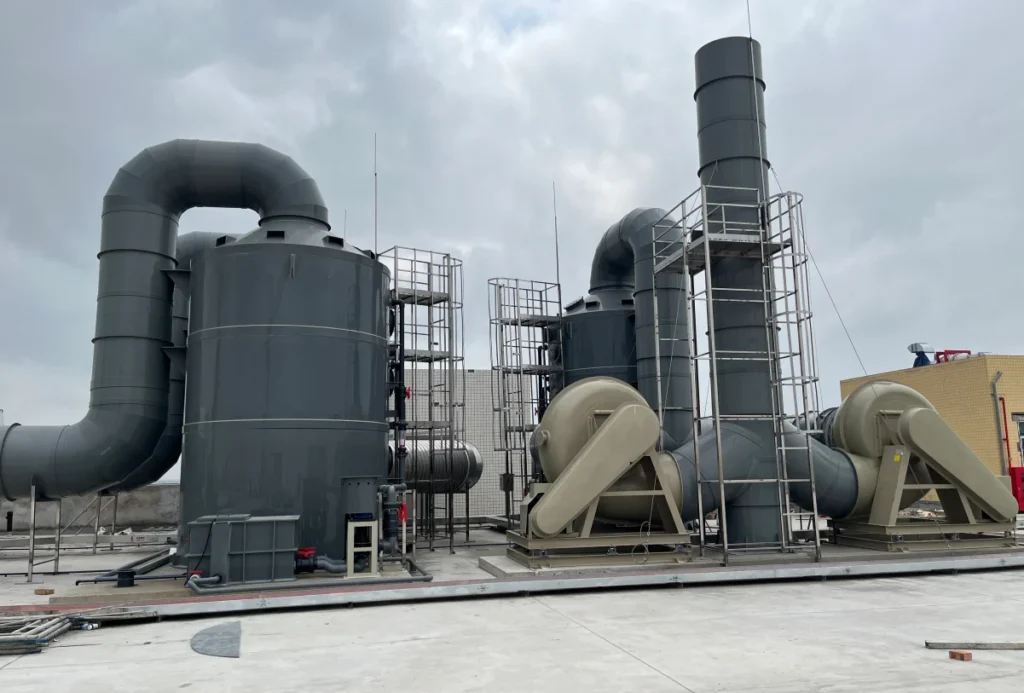
When the exhaust stream is clean enough that it will not plug a bed of structured media, and the target pollutant is a gas rather than particulate, a packed bed wet scrubber is the most efficient wet scrubbing technology available. The packing media – whether random rings, saddles, or structured corrugated sheets – creates many times more wetted surface area per unit volume than a spray tower’s falling droplets. This guide covers what a packed bed wet scrubber is, how the packing creates the gas-liquid contact surface that drives absorption, the packing media types and selection criteria, the design parameters that determine tower size and pressure drop, and the specific applications where a packed bed decisively outperforms spray towers and venturi scrubbers. The equation that fixes tower diameter before packing selection begins is covered in our scrubber sizing calculation guide.
Key Takeaways
- A packed bed wet scrubber provides the highest gas absorption efficiency of any wet scrubber type, achieving 96-99% removal of acid gases and soluble VOCs. The packing media creates 50-200 m2 of wetted surface area per cubic meter of packing volume – roughly 5 to 40 times more than a spray tower’s droplet-based contact. This is the packed bed’s defining advantage and the reason it is the standard technology for chemical plant and odor control gas absorption.
- Packing media selection is a lifecycle decision based on chemistry, temperature, and fouling risk. Polypropylene packing is the lowest cost and covers most acid/alkali service up to 80 deg C. Ceramic handles higher temperatures and oxidizers. Stainless steel fails rapidly in HCl or HF service. Packing size trades surface area (smaller is better) against pressure drop and fouling resistance (larger is better).
- The packed bed’s greatest weakness is its intolerance of solids and fouling. When inlet particulate exceeds the engineering guideline of roughly 20-30 mg/Nm3, packing plugs and pressure drop increases (EPA’s published limit for the technology is 0.45 g/Nm3). In dirty gas streams, a packed bed must be protected by an upstream pre-cleaner (spray tower, venturi, or cyclone). This is the fundamental trade-off: maximum gas absorption efficiency in exchange for a requirement that the gas be clean.
- Packed beds often serve as the polishing stage in multi-stage systems. The most common arrangement pairs a venturi or spray tower with a packed bed absorber downstream. The pre-scrubber removes particulate and quenches the gas, and the packed bed removes the residual soluble gases. A packed bed wet scrubber achieves >99% removal for both particulate and gas phases when used in series. See industrial wet scrubber systems → for complete configurations.
What Is a Packed Bed Wet Scrubber?
A packed bed wet scrubber – also called a packed tower wet scrubber – is a gas-liquid contact device that forces the gas stream through a bed of packing media irrigated with scrubbing liquid (see our venturi wet scrubber guide → for comparison with high-energy alternatives). The packing creates a continuous, high-surface-area wetted film over which the gas passes, maximizing the contact between the gas and the scrubbing liquid. This is fundamentally different from a spray tower, where gas and liquid contact occurs only on the surface of falling droplets. EPA’s cost manual treats packed towers as the reference gas absorber for pollution control, describing them as the most commonly used gas absorbers for the application and summarizing the trade-off as higher removal efficiency, higher tolerable liquid rates and lower water consumption than other absorbers, against high system pressure drop, high clogging and fouling potential and extensive maintenance costs arising from the packing materials (EPA Cost Manual, Section 5.2, Chapter 1).
How Packed Beds Differ from Spray Towers and Venturis
A spray tower relies on the surface area of droplets: a 1 L volume of 700 um droplets at 5 L/m3 L/G ratio provides approximately 5-10 m2 of interfacial surface area per cubic meter of tower volume. A packed bed with 25 mm Pall rings at the same L/G provides 50-200 m2 of wetted surface per m3 of packing volume – roughly 5 to 40 times more. This surface area difference is what makes packed beds the most efficient wet scrubber type for gas absorption where the pollutant is only moderately or poorly soluble.
EPA’s published ranges draw the boundary of that claim. For inorganic gases both device types are reported at the same vendor-estimated 95 to 99 percent removal, but the VOC ranges separate – 70 to greater than 99 percent for a packed bed against 50 to 95 percent for a spray tower (EPA-452/F-03-015; EPA-452/F-03-016). The packed-bed advantage is therefore largest for moderately and poorly soluble compounds, where the extra interfacial area and the higher tolerable liquid rate do the work, and smallest for highly soluble gases that a spray tower already removes at the top of the range.
The trade-off is mechanical. A spray tower’s open chamber handles particulate-laden, scaling, or solids-forming gas streams without clogging. A packed bed’s media traps solids in the void spaces between packing elements, increasing pressure drop over time. A packed tower scrubber system must be protected by an upstream pre-cleaner if the inlet gas contains significant particulate.
The Three Flow Configurations
Counter-current flow is the standard packed bed configuration: gas flows upward, liquid trickles downward through the packing. The outlet gas contacts the freshest scrubbing liquid, maximizing the concentration driving force for absorption. Counter-current packed beds achieve the highest single-stage separation efficiency.
Co-current flow sends gas and liquid in the same direction (usually downward). Higher gas velocities are possible without flooding, and the tower can be smaller. Co-current flow is used when the pollutant is highly soluble and the efficiency loss from co-current operation is negligible.
Cross-flow moves gas horizontally through a vertical bed of packing, with liquid flowing downward perpendicular to the gas. Cross-flow is common in odor control applications because the low pressure drop and modular construction allow large flow areas at low cost.
How Does a Packed Bed Wet Scrubber Work?
The core operating principle of a packed bed wet scrubber is the creation of an extended gas-liquid interface. Scrubbing liquid is distributed across the top of the packing bed and flows downward as a thin film over each packing element. Contaminated gas passes through the spaces between the packing elements, contacting the wetted surfaces.
Gas-Liquid Contact via Wetted Packing Surface
The gas-liquid contact in a packed bed occurs on the wetted surface of the packing elements themselves, not in the open space of the tower. Each packing element is coated with a thin film of scrubbing liquid that flows downward under gravity. The gas stream moves through the void spaces between the packed elements, transferring pollutant molecules to the liquid film by diffusion across the gas-liquid boundary layer. EPA’s fact sheet describes the same geometry from the equipment side: layers of variously-shaped packing are held in place by wire mesh retainers, supported by a plate near the bottom of the tower, and the scrubbing liquid is introduced evenly above the packing and flows down through the bed to coat the packing with a thin film (EPA-452/F-03-015, Packed-Bed / Packed-Tower Wet Scrubber).
The quality of the gas-liquid contact depends on liquid distribution. If the liquid is not evenly distributed across the top of the packing bed, some sections of the packing run dry while others flood. A liquid distributor – typically a perforated tray or spray header with multiple nozzles – ensures uniform coverage. For packed beds deeper than 3-4 meters, intermediate liquid redistributors prevent the liquid from migrating to the tower walls.
Mass Transfer Mechanisms
Three pollutant removal mechanisms operate in a packed bed:
Absorption is the dominant mechanism for gas removal. The pollutant molecule diffuses from the bulk gas phase to the gas-liquid interface, dissolves into the liquid film, and is carried downward with the liquid flow. For highly soluble gases like HCl, the rate-limiting step is gas-phase diffusion to the interface. For moderately soluble gases like SO2, the rate is limited by liquid-phase diffusion, and chemical reagents (NaOH, limestone slurry) are added to enhance the effective solubility. EPA frames the same hierarchy: absorption is enhanced by greater contacting surface, higher liquid-to-gas ratios and higher pollutant concentrations in the gas stream, and although chemical absorption may be limited by the reaction rate, the rate-limiting step is typically the physical absorption rate rather than the chemical reaction rate (EPA-452/F-03-015).
Chemical neutralization converts dissolved pollutants to non-volatile salts. SO2 absorbed into caustic solution forms sodium sulfite, HCl forms sodium chloride, H2S forms sodium sulfide. The chemical reaction consumes the dissolved pollutant, keeping the effective liquid-side concentration near zero.
Particulate capture occurs when suspended particles impact the wetted packing surfaces. The packing acts as a filter, collecting particles by interception and impaction as the gas twists through the convoluted flow path between packing elements. While effective for respirable dust (1-10 um), this mechanism also causes the packing to accumulate solids over time.
Liquid Distribution and Recycle
Scrubbing liquid collected at the bottom of the packed bed drains into a sump. A recirculation pump returns the liquid to the top of the packing through the liquid distributor. A side-stream blowdown removes dissolved solids and reaction products. Fresh makeup water and chemical reagent maintain the target liquid chemistry.
Packing Media Types and Selection
The wet scrubber packing media is the heart of the packed bed scrubber. Selecting the right wet scrubber packing media is the most important design decision.
Random Packing – Raschig Rings, Pall Rings, Saddles
Random packing consists of discrete elements dumped into the tower to form a bed. The elements are designed to maximize surface area and void fraction while resisting nesting or stacking that would create preferential gas flow paths.
Raschig rings are simple hollow cylinders with equal height and diameter. They were the first manufactured random packing, first patented in 1914. Their surface area per unit volume ranges from 60-200 m2/m3 depending on size (12-50 mm). They provide good wetting characteristics but are prone to channeling at the tower walls.
Pall rings are an evolution of Raschig rings with windows punched into the cylinder walls and tabs bent inward. These openings improve liquid and gas distribution through the packing, reducing channeling. Pall rings provide 15-30% more capacity than Raschig rings at the same pressure drop. Surface area ranges from 100-220 m2/m3. They are the most widely used random packing in industrial gas scrubbing.
Saddle packings (Berl saddles, Intalox saddles) are shaped like horse saddles and provide higher surface area than ring-type packings at the expense of slightly higher pressure drop. Surface area ranges from 150-300 m2/m3. Saddle packings are preferred for applications requiring very high mass transfer efficiency with clean liquids.
Structured Packing – Corrugated Sheets, Grid
Structured packing consists of corrugated sheets of metal, plastic, or ceramic arranged in a honeycomb-like geometry. The corrugations force the gas and liquid to follow a defined zigzag path, creating high turbulence while maintaining low pressure drop. Structured packing achieves 250-750 m2/m3 of surface area at pressure drops 30-50% lower than random packing of equivalent efficiency. The cost is 3-5 times higher than random packing.
Structured packing is used where the value of improved separation efficiency justifies the higher capital cost: high-purity chemical manufacturing, pharmaceutical processes, and applications where the tower height is constrained and a taller random-packed bed would not fit.
Packing Material Selection
| Material | Max Temp (deg C) | Best For | Avoid With |
|---|---|---|---|
| Polypropylene | 80 | Acid/alkali, low cost | Aromatics, ketones, >80 deg C |
| PVC/CPVC | 60-90 | Chlorine, strong oxidizers | Solvents, high temp |
| Ceramic | 200+ | High temp, corrosive | Thermal shock |
| Stainless Steel (SS304/316) | 180+ | High temp, structural | HCl, HF, chlorides |
| Carbon Steel | 120 | Non-corrosive, low cost | Any acid service |
Packing Size, Surface Area, and Void Fraction
Larger packing elements (50-75 mm) have lower surface area but higher void fraction, reducing pressure drop and increasing capacity. They are used for high gas flows and dirty gas streams where the larger openings resist plugging. Small packing elements (12-25 mm) maximize surface area at the cost of higher pressure drop. They are used for clean gas streams where maximum mass transfer efficiency is the priority.
Design Parameters and Sizing
Packed bed scrubber sizing involves four interdependent calculations: tower diameter from gas velocity, packing height from mass transfer requirements, pressure drop from packing characteristics, and liquid distribution sizing from the L/G ratio.
Gas Velocity and Tower Diameter
The superficial gas velocity through the packed bed is typically 0.5-2.0 m/s. This is higher than a spray tower (0.3-1.2 m/s) because the packing supports the liquid against the gas flow, preventing droplet entrainment. The tower diameter follows from the gas flow rate divided by the chosen velocity. For a 50,000 m3/h flow at 1.2 m/s: A = 13.9 / 1.2 = 11.6 m2, D = sqrt(4 x 11.6 / pi) = 3.8 m.
EPA’s fact sheet for the device puts the typical gas flow range for packed-bed wet scrubbers at 0.25 to 35 sm3/s (500 to 75,000 scfm). Vendor-estimated removal is 95 to 99 percent for inorganic gases, 70 to greater than 99 percent for VOCs and 50 to 95 percent for particulate matter, with the particulate figure available only at the low dust loadings the packing can tolerate (EPA-452/F-03-015, Packed-Bed / Packed-Tower Wet Scrubber).
The gas velocity cannot exceed the flooding point – the velocity at which the upward gas flow prevents liquid from draining through the packing. Flooding velocity is a function of the packing type, L/G ratio, and gas/liquid physical properties. Standard design practice maintains the operating velocity at 50-70% of the flooding velocity.
Pressure Drop Estimation
Packed bed pressure drop depends on the gas velocity, packing type and size, L/G ratio, and bed depth. For a counter-current packed bed with 25 mm Pall rings at 1.2 m/s gas velocity and 2.0 L/m3 L/G, the pressure drop is approximately 2-4 cm WC per meter of bed depth. A 3-meter bed produces 6-12 cm WC total pressure drop. Structured packing at the same conditions produces 1-2 cm WC per meter. Those figures are for one specific velocity and L/G ratio; EPA’s cost manual gives the general design range for a packed tower as 0.5 to 1.0 in. H2O per foot of packing – roughly 4 to 8 cm WC per meter – and notes that packed towers may be designed assuming isothermal conditions throughout the column (EPA Cost Manual, Section 5.2, Chapter 1).
L/G Ratio and Liquid Distribution
The L/G ratio for packed bed gas absorption typically ranges from 1-5 L/m3 (7.5-37 gal/1,000 ft3), higher than a spray tower’s 0.07-2.70 L/m3 because the packing requires a minimum liquid rate to maintain complete wetting. Below the minimum wetting rate, dry patches appear on the packing surface that reduce mass transfer efficiency.
Liquid distribution at the top of the packed bed is critical. A liquid distributor – typically a perforated pipe or trough with multiple drip points – must provide an even liquid pattern across the full tower cross-section. The standard design provides 40-100 distribution points per square meter.
HETP and Packed Bed Height
The packing height required for a given removal efficiency is determined by the Height Equivalent to a Theoretical Plate (HETP). The HETP depends on the packing type, gas velocity, and pollutant solubility. For 25 mm Pall rings treating SO2 with caustic, the HETP is approximately 0.3-0.6 m. A 3-meter packed bed provides 5-10 theoretical stages, sufficient for >99% removal of highly soluble gases.
Note on design and cost figures. The packing surface areas, capacity gains, superficial velocities, flooding percentages, L/G ratios, HETP values, distributor point densities, pressure-drop figures, packing service lives and fan-energy costs quoted in this guide are Xicheng engineering estimates and typical vendor ranges, not published test data; actual values depend on the specific packing, the gas and liquid properties, operating temperature and the required outlet concentration. Two figures in particular are design guidance rather than published limits: the inlet particulate thresholds of 20-30 mg/Nm3 are conservative practice for continuous service, against EPA’s published limit of 0.45 g/sm3 (450 mg/Nm3) for the device type, and the pressure drops above are for one specific velocity and L/G ratio, against EPA’s general packed-tower range of 0.5 to 1.0 in. H2O per foot of packing. Where a figure comes from a published source, that source is linked inline and listed under Sources at the end of this article.
Industrial Applications
Packed bed wet scrubbers are the standard technology for gas absorption and odor control applications where the gas stream is relatively clean and the pollutant is in the vapor phase. They are the preferred choice when the removal target is above 95% for moderately soluble gases.
Chemical Processing – Acid Gas Absorption
Chemical plants use packed bed scrubbers to remove HCl, SO2, Cl2, and other acid gases from reactor vents and storage tank breathers. A packed tower gas scrubber in chemical service operates with caustic solution at pH 7-10, achieving 96-99% removal of acid gases. Caustic solution is the most common scrubbing liquid used for acid-gas control, though sodium carbonate and calcium hydroxide (slaked lime) are also used (EPA-452/F-03-015, Packed-Bed / Packed-Tower Wet Scrubber). A packed bed wet scrubber in this application can be compact – a 3,000 m3/h reactor vent scrubber may be only 0.8 m in diameter with a 3 m packed bed.
The packing material is typically polypropylene or PVC for acid service up to 80 deg C, with ceramic packing specified for higher temperatures. The packing service life in clean chemical service is 5-8 years before efficiency degradation from fouling or corrosion requires replacement.
Odor Control and VOC Removal
Odor control is one of the largest applications for packed bed scrubbers by number of installations. Wastewater treatment plants, food processing facilities, and rendering operations use packed beds to remove H2S, mercaptans, ammonia, and organic acids from ventilation air. The packing provides the extended contact time needed for the oxidation reactions that destroy odor compounds.
VOC removal in packed beds requires the pollutant to have reasonable water solubility or to react with an oxidizing scrubbing medium. Soluble VOCs – methanol, ethanol, acetone, formaldehyde – achieve 90-98% removal in a packed bed with water or dilute oxidant. Non-soluble VOCs require activated carbon adsorption or thermal oxidation.
Packed Bed as Polishing Stage
In multi-stage scrubbing systems, a packed bed frequently serves as the polishing stage downstream of a venturi or spray tower. The venturi captures the fine particulate, and the packed bed removes the residual soluble gases. This arrangement is standard in incinerator exhaust treatment, where the packed bed removes HCl and SO2 from the gas after the venturi has removed the fly ash. EPA’s venturi fact sheet makes the same pairing explicit: venturis are sometimes used as a pretreatment device, removing PM to prevent clogging of a downstream device such as a packed bed scrubber that is designed to collect primarily gaseous pollutants (EPA-452/F-03-017, Venturi Scrubber).
The packed tower scrubber system in this configuration includes a pre-scrubber section (spray or venturi), the packed bed absorber, a mist eliminator, and a recirculation system with chemical reagent feed. EPA gives mist eliminator performance on wet scrubbers as removing between 90 and 99 percent of the liquid droplets from the waste gas stream (EPA Cost Manual, Section 6, Chapter 2). The combined system achieves simultaneous particulate and gas removal at efficiencies exceeding 99%.
Advantages, Limitations, and Maintenance
Packed bed scrubbers offer the highest gas absorption efficiency of any wet scrubber type, but they are the least tolerant of dirty or solids-laden gas streams. Their advantages and limitations are mirror images of each other.
Advantages – Highest Gas Absorption Efficiency
- Packing media creates maximum interfacial area. A packed bed provides 50-200 m2 of wetted surface per m3 of packing volume – roughly 5 to 40 times more than a spray tower’s droplet-based contact. This directly translates to higher removal efficiency for gases with moderate or low solubility – SO2, H2S, Cl2, NH3 – where the liquid-side mass transfer resistance controls.
Compact tower diameter. The gas velocity of 0.5-2.0 m/s through the packing allows a smaller diameter than a spray tower for the same flow rate. A 50,000 m3/h flow fits in a 3.8 m diameter packed bed versus a 4.7 m spray tower – a 35% reduction in cross-sectional area.
Moderate pressure drop. The pressure drop of 2-5 cm WC per meter of packing depth is manageable. A 3-meter packed bed at 10-15 cm WC total pressure drop costs $25,000-40,000/year in fan energy for a 50,000 m3/h system – significantly less than a venturi but more than a spray tower.
Limitations – Plugging, Channeling, Corrosion
Plugging is the dominant failure mode. When the inlet gas carries particulate above approximately 20-30 mg/Nm3, the solid particles accumulate in the void spaces between packing elements. EPA’s published limit for the device type is 0.45 g/sm3 (0.20 gr/scf) to avoid clogging, and the agency notes that plugging is a serious problem for packed beds because the packing is more difficult to access and clean than in other scrubber designs; the same source points to mobile-bed scrubbers, packed with low-density plastic spheres that are free to move within the bed, as the variant that is less susceptible to plugging (EPA-452/F-03-015, Packed-Bed / Packed-Tower Wet Scrubber). Pressure drop increases, efficiency drops, and the packing must be removed, cleaned, or replaced. Packing replacement cost for a 3 m diameter tower is $5,000-20,000 in media plus 2-5 days of downtime.
Channeling occurs when the liquid distribution system fails or when packing elements shift, creating preferential flow paths where the gas passes through with minimal liquid contact. A 10% channeling fraction can reduce removal efficiency by 20-30%.
Corrosion attacks packing media and tower internals when the gas stream contains acid gases and moisture. Polypropylene packing in HCl service has a 5-8 year service life. Stainless steel packing in chloride service fails within 2-3 years from pitting corrosion. EPA lists the operating problems that wet scrubbing systems are generally susceptible to as inadequate liquid flow, liquid re-entrainment, poor gas-liquid contact, corrosion, and plugged nozzles, beds or mist eliminators – plugging, channeling and corrosion are the three of those that apply specifically to a packed bed (U.S. EPA, Monitoring by Control Technique – Wet Scrubber for Particulate Matter).
Packing Replacement Intervals
| Packing Material | Clean Service | Moderate Fouling | Heavy Duty |
|---|---|---|---|
| Polypropylene | 5-8 years | 3-5 years | 1-2 years |
| Ceramic | 8-12 years | 5-8 years | 3-5 years |
| Stainless Steel | 8-15 years | 3-6 years | 1-3 years (non-chloride) |
Packing inspection should occur annually. The pressure drop across the packed bed is the primary indicator of packing condition: an increase of 50% above the as-installed baseline suggests fouling or damage requiring maintenance.
Frequently Asked Questions
What is a packed bed wet scrubber best at?
A packed bed wet scrubber is best at gas absorption – removing soluble or chemically reactive gases from a clean exhaust stream. It achieves 96-99% removal for acid gases (HCl, HF, SO2 with reagent), ammonia, and soluble VOCs. It is the most efficient wet scrubber type for gas-phase pollutants.
What is the difference between a packed tower and a spray tower?
A packed tower forces gas through a bed of packing media that creates a large wetted surface area for gas-liquid contact. A spray tower uses only the surface area of falling droplets. The packed tower provides roughly 5 to 40 times more interfacial area per unit volume, making it more efficient for gas absorption. However, the packing is susceptible to plugging, making it unsuitable for particulate-laden gas streams.
How long does packing media last?
Polypropylene packing in clean chemical service lasts 5-8 years. Ceramic packing lasts 8-12 years. Stainless steel packing can exceed 15 years in non-chloride, non-acid service. Packing life is shortened by particulate fouling, high-temperature excursions, and chemical attack.
What is the best packing material for acid gas scrubbing?
Polypropylene is the most common and cost-effective for acid gas service up to 80 deg C. For higher temperatures or strong oxidizers (chlorine, concentrated sulfuric), PVDF or ceramic packing is specified. Stainless steel should not be used for HCl or HF service.
When should I not use a packed bed scrubber?
Do not use a packed bed when the inlet gas contains more than roughly 20-30 mg/Nm3 of particulate (EPA’s published limit for the technology is 0.45 g/Nm3, or 450 mg/Nm3), when the gas stream forms solids on contact with water (cement kiln dust, gypsum-forming streams), or when the gas contains sticky or polymerizing compounds. In these cases, a spray tower or venturi scrubber is the appropriate technology.
Sources
- U.S. EPA – EPA-452/F-03-015, Air Pollution Control Technology Fact Sheet: Packed-Bed / Packed-Tower Wet Scrubber.
- U.S. EPA, Office of Air Quality Planning and Standards – Air Pollution Control Cost Manual, Section 5.2, Chapter 1: Wet Scrubbers for Acid Gas.
- U.S. EPA, Office of Air Quality Planning and Standards – Air Pollution Control Cost Manual, Section 6, Chapter 2: Wet Scrubbers for Particulate Matter.
- U.S. EPA – EPA-452/F-03-016, Air Pollution Control Technology Fact Sheet: Spray-Chamber / Spray-Tower Wet Scrubber.
- U.S. EPA – EPA-452/F-03-017, Air Pollution Control Technology Fact Sheet: Venturi Scrubber.
- U.S. EPA – Monitoring by Control Technique – Wet Scrubber for Particulate Matter (Air Emissions Monitoring Knowledge Base).