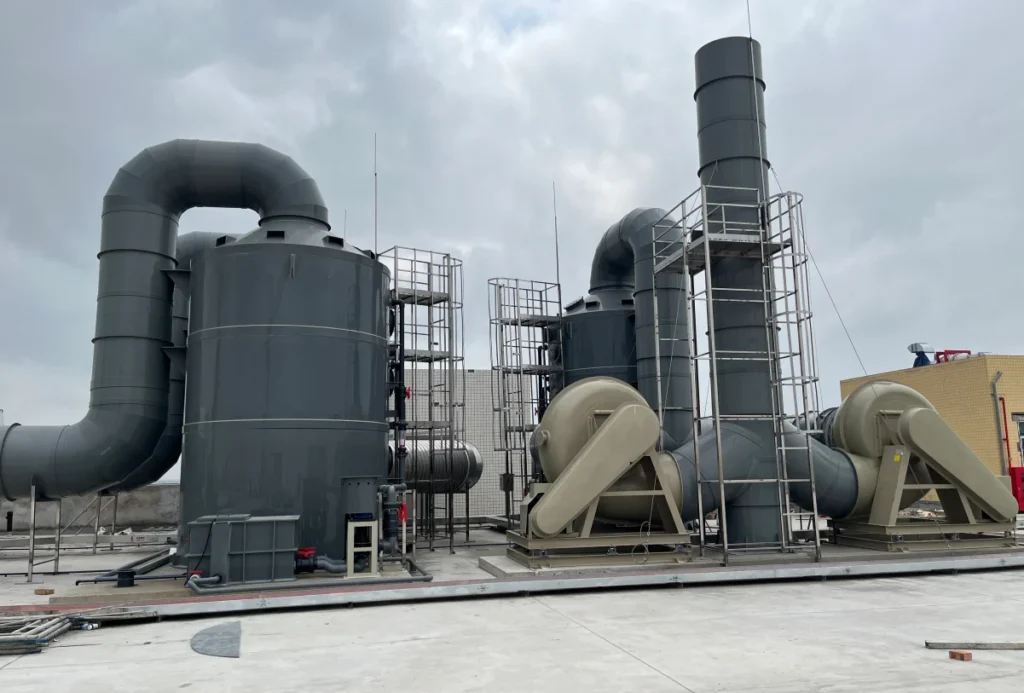
A chemical engineer responsible for chlorine handling at a water treatment plant or chemical facility faces a unique problem among acid gas emissions: chlorine is not only toxic at low parts-per-million concentrations, but its yellow-green gas cloud is visible, immediately reportable, and subject to some of the strictest emergency release regulations in industrial environmental law. Three federal thresholds describe how tightly chlorine is held: 29 CFR 1910.1000 sets the workplace ceiling at 1 ppm — a limit that may not be exceeded at any time, not an 8-hour average — while the EPCRA extremely hazardous substances list at 40 CFR 355 carries a threshold planning quantity of 10 lb and the RMP list at 40 CFR 68.130 a threshold quantity of 2,500 lb. A chlorine gas scrubber is the standard engineering control that protects both the facility and the surrounding community. This guide covers what a chlorine gas scrubber is, the caustic-chlorine chemistry that drives removal, the design differences between emergency and continuous chlorine scrubbing systems, and the material selection decisions that determine whether a chlorine scrubber operates reliably for the life of the plant or has to be rebuilt around a corrosion failure.
Key Takeaways
- Chlorine gas scrubbers require pH above 10 to prevent the hypochlorite reaction product from decomposing back to chlorine gas. The pH setpoint is 11-12, higher than any other common acid gas scrubber. A pH sensor specified for high-pH service (cesium-based glass electrode) is essential; standard electrodes suffer from sodium ion error above pH 12 that causes false low readings.
- An emergency chlorine scrubber must be sized for the worst-case release at 1.5-2.0 times the stoichiometric caustic requirement, with a dedicated caustic inventory that is independent of other plant chemical systems. The inventory figure to hold on to is the one on the design release, not on the container: a 100 kg Cl2 design release — the ten-minute rate the RMP worst-case rule assumes for a pressurised gas, per 40 CFR 68.25(c) — takes about 2,300 L of 10% NaOH at a 2x stoichiometric margin, while scrubbing the full contents of a 1,000 kg cylinder needs roughly ten times that. The caustic inventory must be verified monthly even when the scrubber has not been activated.
- FRP with a vinyl ester resin system is the only recommended construction material for chlorine gas scrubbers. The corrosion barrier must be at least 3.0 mm thick with 90% resin content. Stainless steel (both SS304 and SS316L) fails in wet chlorine service within a matter of months and must never be specified. The EPA’s wet-and-dry-scrubber cost review records the general performance context for the class — wet scrubbers typically achieve 95 to 99 percent removal across most industrial duty — while the materials question is decided by the chloride and oxidiser load, not by the removal target. Polypropylene has limited hypochlorite resistance and is suitable only for recirculation piping in low-concentration continuous service.
- The exothermic Cl2-NaOH reaction can raise the sump temperature by 15-25 deg C during a release, requiring heat management. Above 50 deg C, hypochlorite decomposition accelerates and reduces scrubbing capacity. Emergency scrubbers for high-capacity storage include a heat exchanger or chilled water supply. For chlorine scrubbing systems, see our acid gas scrubber products → and chemical waste gas treatment →.
What Is a Chlorine Gas Scrubber?
A chlorine gas scrubber is a wet scrubber system that uses a sodium hydroxide (NaOH) solution to neutralize chlorine gas (Cl2) from industrial exhaust or emergency containment ventilation air (see our chemical scrubber system guide → for the broader chemical scrubbing framework). The reaction converts chlorine to sodium hypochlorite (NaOCl) and sodium chloride (NaCl), both of which are water-soluble, non-volatile compounds that cannot re-enter the gas phase. This chemical conversion is what distinguishes chlorine scrubbing from physical absorption: the chlorine does not just dissolve into the water; it reacts and becomes a different chemical species.
How Chlorine Scrubbing Differs from Other Acid Gas Scrubbers
Chlorine scrubbing differs from HCl or SO2 scrubbing in three important ways:
The reaction product – sodium hypochlorite – is itself a reactive chemical. Unlike NaCl from HCl scrubbing, which is inert and can be discharged directly to wastewater, the NaOCl produced by chlorine scrubbing must be either used as a commercial bleach product or dechlorinated before discharge. A chlorine scrubber system therefore requires a downstream dechlorination step or a product storage arrangement that a simple acid gas scrubber does not need.
The reaction is highly exothermic. The Cl2-NaOH neutralization releases on the order of 56 kJ per mole of Cl2, and the temperature rise it produces is set by how much liquid that heat is shared with: 100 kg of chlorine scrubbed into a 2,500 L sump works out at a rise of roughly 8 deg C, while the same release into a sump of a thousand litres takes the liquid up by about 19 deg C. The rise reduces the solubility of chlorine in the scrubbing solution and can cause off-gassing if the temperature is not controlled.
The pH requirement is higher. Chlorine scrubbing requires pH above 10 to ensure complete reaction. Below pH 10, the hypochlorite ion decomposes back to chlorine gas, undoing the scrubbing work. An emergency chlorine scrubber system typically maintains pH at 11-12 with excess caustic to provide a safety margin.
Continuous vs Emergency Operation
A chlorine gas scrubber system can operate in two fundamentally different modes. A continuous chlorine scrubber treats a steady, low-concentration chlorine vent stream from a manufacturing process or storage tank breather. The design follows standard packed bed sizing; caustic consumption is low and predictable.
An emergency chlorine scrubber treats a worst-case release scenario – a tank car rupture, a cylinder valve failure, or a pipeline break – at full-rated ventilation flow for 30-60 minutes. The caustic inventory is sized for this contingency, not for normal operation. The emergency chlorine scrubber system operates on demand only, and its design prioritizes reliability and caustic inventory over operating economy.
Why Emergency Chlorine Scrubbers Require Standalone Design
An emergency chlorine scrubber cannot share a chemical feed system with other plant scrubbers because the reagent must be instantly available at full concentration when the chlorine release occurs. The scrubber typically has its own dedicated caustic storage tank sized for the worst-case release, a dedicated recirculation pump on continuous standby, and an independent PLC that activates the system when a chlorine sensor detects a release in the monitored area.
Chlorine Scrubbing Chemistry
The chemical reaction at the heart of every chlorine gas scrubber follows a well-established stoichiometry that determines caustic consumption, byproduct composition, and operating pH requirements.
The NaOH-Cl2 Reaction
Chlorine reacts with sodium hydroxide in a disproportionation reaction that produces sodium hypochlorite and sodium chloride:
Cl2 + 2 NaOH -> NaOCl + NaCl + H2O
One mole of chlorine gas (71 g) reacts with two moles of NaOH (80 g). The sizing basis is regulatory rather than discretionary: 40 CFR Part 68 places chlorine on the list of regulated toxic substances with a threshold quantity of 2,500 lb (1,134 kg), a toxic endpoint of 0.0087 mg/L in Appendix A to Part 68, and a worst-case release rule that treats the whole contents of a pressurised vessel as released as a gas over ten minutes, so the assumed rate is the total quantity divided by ten. For a release of 100 kg of chlorine gas, the stoichiometric NaOH requirement is 100 x (80/71) = 113 kg of pure NaOH, or approximately 226 kg of 50% caustic solution.
The strength of the sodium hypochlorite produced depends on how much liquid it is formed in: scrubbing 100 kg of chlorine to completion yields about 105 kg of NaOCl, which is roughly a 4 percent solution in a 2,500 L sump and about 5 percent in the 2,300 L charge the caustic-inventory sizing above produces — below the 10 to 15 percent of commercial bleach, which is why a scrubber blowdown is usually weaker than the product it resembles. This is chemically the same substance sold commercially as liquid bleach. If the facility can use bleach in its process – for example, a water treatment plant using chlorine for disinfection already has the infrastructure to handle hypochlorite – the scrubber blowdown becomes a usable product rather than a waste stream.
Why Excess Caustic Is Essential for Complete Removal
The NaOH-to-Cl2 ratio must be maintained above the stoichiometric 2:1 to prevent the formation of chlorine gas from hypochlorite decomposition. At pH below 10, the hypochlorite ion (OCl-) reacts with hydrogen ions to form hypochlorous acid (HOCl), which is in equilibrium with chlorine gas:
HOCl + H+ + Cl- -> Cl2 + H2O
If the pH drops below 8, this equilibrium shifts toward chlorine gas, and the scrubber begins to release the same pollutant it is designed to capture. The PubChem record for sodium hypochlorite documents the same instability from the substance side — hypochlorites are powerful oxidisers that “decompose to release oxygen and chlorine gases” particularly in the presence of water or at higher temperature, and react with acids to produce highly toxic fumes of chlorine gas. Standard design practice is to maintain pH at 11-12 with a minimum of 1-2% excess NaOH in the recirculating solution.
Byproduct Formation – Sodium Hypochlorite
The sodium hypochlorite produced in the scrubber decomposes over time, and the rate climbs with temperature. The PubChem record for sodium hypochlorite notes that it is decomposed by hot water and that heating to decomposition emits toxic fumes, which is the qualitative form of the rule a sump design has to respect. In an emergency chlorine scrubber that may go years between activations, the hypochlorite in the sump gradually loses strength, reducing the available chlorine content. Periodic testing and replacement of the scrubbing solution is necessary for emergency systems that have not been activated recently.
pH Control Requirements
A dedicated pH control loop is essential for any chlorine gas scrubber system. The pH setpoint is 11-12, significantly higher than the 7-9 typical of HCl or SO2 scrubbers. The pH sensor must be specified for high-pH service; standard glass pH electrodes suffer from sodium ion error above pH 12 and read low in consequence. High-pH-tolerant electrodes using cesium-based glass are recommended for chlorine scrubber service.
Design Parameters – Emergency vs Continuous Operation
The design of a chlorine gas scrubber differs dramatically depending on whether it serves continuous process exhaust or emergency containment. The same chemical reaction applies to both, but the sizing basis, control philosophy, and component specifications are entirely different.
Emergency Chlorine Scrubber Design
An emergency chlorine scrubber system is sized for a single event: the worst-case chlorine release that the containment area can produce. The design basis includes:
- Maximum release rate (kg/h of Cl2) calculated from the largest chlorine container in the area, assuming a full-bore liquid chlorine line rupture or catastrophic container failure. For a 1-ton chlorine cylinder, the worst-case release rate is approximately 100 kg/min for the first 10 minutes, which is the RMP convention rather than an engineering estimate: 40 CFR 68.25(c)(1) directs that for a regulated toxic substance normally a gas and handled as a gas or as a liquid under pressure, the quantity in the vessel is assumed to be released as a gas over 10 minutes, with the release rate taken as the total quantity divided by ten.
- Required operating duration – typically 30-60 minutes, based on the time needed for the emergency response team to isolate the leak and evacuate the area.
- Caustic inventory sized at 1.5-2.0 times the stoichiometric requirement for the design release, with the total volume calculated from the NaOH consumption plus the water needed to maintain recirculation.
- Ventilation flow rate of the containment building or chlorine room, which determines the scrubber vessel diameter. A typical chlorine storage room ventilation rate is 6-12 air changes per hour. The stack has to be judged against the toxic endpoint rather than against an odour threshold: the RMP toxic endpoint for chlorine is 0.0087 mg/L, the concentration at which the offsite consequence analysis stops, which is far below anything a scrubber can be allowed to approach.
Sizing the Caustic Inventory for the Worst-Case Release
For a chlorine storage area containing a 1,000 kg chlorine cylinder with a design release of 100 kg Cl2 over 30 minutes, the stoichiometric NaOH requirement is 113 kg. At 2x stoichiometric margin and 10% NaOH concentration, the total scrubbing solution volume required is approximately 113 x 2 / 0.10 = 2,260 L (2.3 m3). The scrubber sump and recirculation system must contain at least this volume. Note the asymmetry in how the rule counts inventory: 40 CFR 68.115 ignores a regulated toxic substance present in a mixture below one percent by weight when deciding whether a process is covered, so a dilute caustic solution does not carry chlorine into the programme — but the gas in the cylinder does, at full weight.
Continuous Chlorine Scrubber Design
A continuous chlorine scrubber treats a process vent stream containing chlorine at 50-500 ppmv from a chemical reactor vent or storage tank breather. The vessel is sized as a standard packed bed using the same gas velocity (0.5-1.5 m/s) and packing depth (2-4 m) as any other acid gas scrubber. The caustic feed is controlled by a pH loop maintaining pH 11-12, and the caustic consumption is calculated from the stoichiometric requirement with a 20% excess.
Scrubber Vessel Selection – Packed Bed vs Spray Tower
A packed bed is the standard vessel for continuous chlorine scrubbing, where the gas stream is clean and the packing provides the high mass transfer area needed for efficient chlorine absorption.
A spray tower is preferred for emergency chlorine scrubbers because the open chamber eliminates the risk of packing plugging from the sodium chlorate crystals that can form as the hypochlorite solution ages between emergency events. The spray tower also allows easier internal inspection, which is important for equipment that must be verified ready at all times but operates only once every several years.
Heat Management in Chlorine Scrubbing
The exothermic heat of the Cl2-NaOH reaction raises the sump temperature during a chlorine release event. The rise scales inversely with the liquid inventory: 100 kg of chlorine scrubbed over 30 minutes into a 2,500 L sump is worth roughly 8 deg C, and the same release into a 1,000 L sump roughly 19 deg C, so a compact sump is the case that needs the cooling. Above 50 deg C the sodium hypochlorite decomposition rate accelerates and reduces the effective scrubbing capacity, so the design rule is to hold the liquid below that figure. Emergency chlorine scrubbers serving high-capacity storage areas include a heat exchanger on the recirculation loop or a chilled water supply to the sump to keep the liquid temperature down during a release event.
Materials of Construction for Chlorine Service
Material selection for a chlorine gas scrubber is governed by a single rule: chlorine gas and wet chlorine solutions are among the most corrosive chemical environments in industrial processing. The wrong material choice causes failure within weeks, not years.
FRP with Vinyl Ester – The Standard for Chlorine
Fiberglass-reinforced plastic (FRP) using a vinyl ester resin system is the standard construction material for chlorine gas scrubbers. Vinyl ester resins provide superior resistance to chlorine gas, wet chlorine, and sodium hypochlorite solutions at temperatures up to 110 deg C for continuous service.
The FRP laminate must include a corrosion barrier of at least 3.0 mm thickness with a 90% minimum resin content. The structural laminate behind the corrosion barrier uses a vinyl ester or isophthalic polyester resin with alternating layers of chopped strand mat and woven roving. All resin-to-resin joints must be post-cured to ensure complete polymerization of the corrosion barrier. For the sump section, which sees the highest concentration of sodium hypochlorite, the corrosion barrier thickness should be increased to 5.0 mm.
Materials to Avoid – Stainless Steel and Polypropylene
Stainless steel (both SS304 and SS316L) is not suitable for chlorine gas scrubber service. Chlorine gas and wet chlorine attack stainless steel by pitting corrosion and chloride stress corrosion cracking. Even SS316L, which resists many chloride environments, fails within 2-6 months when exposed to the humid chlorine atmosphere inside a scrubber.
Polypropylene (PP) has limited resistance to chlorine gas and sodium hypochlorite. At concentrations above 10% NaOCl and temperatures above 40 deg C, polypropylene undergoes oxidative degradation that embrittles the material. PP can be used for the recirculation piping in a low-concentration continuous chlorine scrubber but should not be specified for the main vessel in any chlorine gas scrubber system.
Gasket, Nozzle, and Piping Material Selection
PTFE (Teflon) is the standard gasket material for chlorine service. EPDM and Viton gaskets degrade rapidly in wet chlorine. Spray nozzles should be PTFE or polyvinylidene fluoride (PVDF). Recirculation piping is typically PVC or CPVC for the suction side and FRP for the discharge side. The caustic feed line from the storage tank to the scrubber can be polypropylene or PVC.
Industrial Applications
Chlorine gas scrubber systems serve four major industries: water treatment, pulp and paper, chemical manufacturing, and semiconductor fabrication. Each application has distinct operating characteristics that influence the scrubber design.
Water Treatment Plants
Water treatment facilities store chlorine gas in 1-ton cylinders or rail cars for disinfection. The chlorine is vaporized and injected into the water stream. A chlorine scrubber system at a water treatment plant serves as the emergency scrubber for the chlorine storage and vaporizer room. The ventilation system draws room air through the scrubber whenever a chlorine sensor detects a release.
Water treatment plants have a unique advantage for chlorine scrubbing: the sodium hypochlorite produced in the scrubber during a release can be fed directly into the plant water treatment process as a disinfectant, eliminating the need for separate hypochlorite disposal or dechlorination. The caustic used for the scrubber is often the same chemical the plant already stores for pH adjustment, reducing the need for a dedicated reagent supply.
Pulp and Paper Mills
Pulp and paper mills use chlorine dioxide (ClO2) for bleaching. Chlorine gas is generated as an intermediate in the ClO2 production process. The plant includes chlorine gas scrubbers on the ClO2 generator vent and as emergency scrubbers for chlorine storage areas. The pulp and paper industry has the highest concentration of installed chlorine scrubbers by number of facilities because ClO2 bleaching is the industry standard in North America and Europe.
Chemical Manufacturing
Chemical plants producing or consuming chlorine – isocyanate manufacturers, chlorinated solvent producers, water treatment chemical suppliers – install chlorine gas scrubbers on reactor vents, tank car loading stations, and chlorine storage areas. Continuous scrubbers serve production vents where chlorine is a byproduct or where chlorine is used as a raw material. Emergency scrubbers protect personnel and the surrounding community from potential chlorine releases during loading and unloading operations.
Semiconductor Fabrication
Semiconductor fabs use chlorine gas for plasma etching and chemical vapor deposition processes. The chlorine is supplied in small cylinders at sub-atmospheric pressure, which reduces the worst-case release quantity compared to bulk storage. A chlorine gas scrubber system for a semiconductor fab handles the chlorine exhaust from the process tools combined with other acid gases in a central scrubber. The chlorine concentration in the combined exhaust is typically below 10 ppmv, but the toxicity of chlorine requires removal efficiency above 99%.
The semiconductor industry also provides a direct example of why a chlorine gas scrubber must be designed for the specific application: fab exhaust contains not just chlorine but also fluorinated compounds, hydrochloric acid, and particulate from the plasma processes. The scrubber must be compatible with all of these, not just chlorine alone. A single-material specification error in a semiconductor chlorine scrubber can shut down an entire fab.
Operation, Safety, and Maintenance
Chlorine gas scrubbers require a different operational approach than standard acid gas scrubbers because of the toxicity of the target pollutant and the aggressive chemistry of the scrubbing solution.
Caustic Concentration and Inventory Monitoring
For an emergency chlorine scrubber system, the caustic concentration in the recirculating solution must be verified on a scheduled basis, even when the scrubber has not been activated. NaOH concentration should be verified by titration monthly. The target is 8-12% NaOH by weight. If concentration drops below 5%, fresh caustic must be added to restore the design inventory.
The caustic inventory in the storage tank must be maintained at a level adequate for the design release. A low-level alarm in the caustic storage tank alerts the plant operator when inventory drops below the replenishment threshold. For emergency systems, a second dedicated supply of caustic – either a backup tank or a connection to the plant caustic supply header – is standard.
Temperature Monitoring During a Release Event
During an actual chlorine release, the sump temperature is the primary indicator that the scrubbing reaction is proceeding correctly. A rapid temperature rise confirms that chlorine is entering the scrubber and reacting with the caustic. The temperature rate of change is proportional to the chlorine release rate. If the temperature exceeds 50 deg C, the heat exchanger or chilled water supply should be activated to maintain scrubbing efficiency.
The temperature also serves as a safety check: if the temperature remains constant while the chlorine sensor shows concentration in the scrubber outlet, the reaction may not be proceeding, and the caustic concentration or pH should be verified immediately.
Post-Release Inspection and Nozzle Maintenance
After any chlorine release event that activates the scrubber, the system must be inspected before it is returned to standby status. The inspection sequence includes: (1) verification that the caustic concentration is within the target range and replenishment if necessary, (2) spray nozzle inspection for plugging from sodium chlorate crystals that may have formed during the reaction, (3) visual inspection of the vessel interior, the mist eliminator, and the recirculation piping for any damage from the thermal excursion, and (4) a functional test of the pH and temperature sensors, caustic pump, and heat exchanger.
For continuous chlorine scrubbers, nozzle inspection every 2-3 months is standard. The nozzles should be removed and inspected for orifice enlargement from erosion by hypochlorite solution. A nozzle that has increased in orifice diameter by 15% from the as-new dimension should be replaced.
Frequently Asked Questions
What is a chlorine gas scrubber?
A chlorine gas scrubber is a wet scrubber that uses a sodium hydroxide (NaOH) solution to neutralize chlorine gas (Cl2) from industrial exhaust or emergency containment ventilation air. The reaction converts chlorine to sodium hypochlorite and sodium chloride, both of which are non-volatile, water-soluble compounds.
What is the difference between an emergency and a continuous chlorine scrubber?
An emergency chlorine scrubber is sized for a worst-case release, operates on demand only, and maintains a large standby caustic inventory with independent controls. A continuous chlorine scrubber treats a steady low-concentration vent stream, uses a pH control loop for reagent feed, and is sized for predictable daily loads.
What material should I use for a chlorine scrubber?
FRP with a vinyl ester resin system is the standard material. The corrosion barrier must be at least 3.0 mm thick with 90% resin content. Stainless steel (SS304 and SS316L) must not be used in chlorine service. Polypropylene has limited resistance to hypochlorite and should not be specified for the main vessel.
What pH should I maintain in a chlorine scrubber?
pH 11-12 is the target range for chlorine scrubbing. Below pH 10, the hypochlorite reaction product can decompose back to chlorine gas. The pH sensor must be specified for high-pH service; standard glass electrodes suffer from sodium ion error above pH 12.
How do I dispose of the hypochlorite solution from a chlorine scrubber?
At a water treatment plant, the hypochlorite can be fed into the treatment process as a disinfectant. At other facilities, the hypochlorite solution must be dechlorinated before discharge, typically using sodium bisulfite (NaHSO3) or sulfur dioxide (SO2) to reduce the hypochlorite to chloride.
Sources
- U.S. National Archives, Electronic Code of Federal Regulations – 29 CFR 1910.1000 — Air contaminants (OSHA Table Z-1 and Table Z-2 exposure limits) (chlorine, CAS 7782-50-5, is listed in Table Z-1 with a ceiling value of 1 ppm in the federal column and 3 ppm in the former federal column; the rule defines a ceiling as a limit an employee’s exposure shall at no time exceed, assessed as a 15-minute time-weighted average only where instantaneous monitoring is not feasible).
- U.S. National Archives, Electronic Code of Federal Regulations – 40 CFR Part 355 — Emergency Planning and Notification (Appendix A: The List of Extremely Hazardous Substances and Their Threshold Planning Quantities) (chlorine, CAS 7782-50-5, is listed with a threshold planning quantity of 10 lb and a reportable quantity of 100 lb; the part states that any extremely hazardous substance present at a facility in an amount equal to or greater than its TPQ triggers the emergency planning requirements).
- U.S. National Archives, Electronic Code of Federal Regulations – 40 CFR Part 68, Subpart F — Regulated Substances for Accidental Release Prevention (68.130 List of substances) (chlorine, CAS 7782-50-5, appears in Table 1 to 68.130 with a threshold quantity of 2,500 lb; the notes record that the listing is mandated by Congress and that the substance is on the EHS list with a vapour pressure of 10 mmHg or greater; 68.115 sets the one-percent-by-weight mixture exemption used when counting whether a threshold quantity is present).
- U.S. National Archives, Electronic Code of Federal Regulations – 40 CFR Part 68, Subpart B — Hazard Assessment (68.20 to 68.42) (68.25(c)(1): for a regulated toxic substance normally a gas at ambient temperature and handled as a gas or as a liquid under pressure, the quantity in the vessel or pipe must be assumed to be released as a gas over 10 minutes, and the release rate assumed to be the total quantity divided by ten unless passive mitigation systems are in place; 68.25(a) requires the worst-case release scenario that creates the greatest distance to an endpoint in Appendix A; 68.22(b) fixes the worst-case wind speed at 1.5 m/s and F stability class; 68.3 defines a worst-case release as the largest quantity released from a vessel or process line failure).
- U.S. National Archives, Electronic Code of Federal Regulations – 40 CFR Part 68, Appendix A — Table of Toxic Endpoints (chlorine, CAS 7782-50-5, carries a toxic endpoint of 0.0087 mg/L; the endpoint is the concentration used in 68.22(a) to determine how far offsite consequences extend, which is the number the scrubber outlet has to be judged against).
- U.S. Environmental Protection Agency, Office of Air Quality Planning and Standards – EPA Air Pollution Control Cost Manual, Section 5, Chapter 1: Wet and Dry Scrubbers for Acid Gas Control (Response to Comments) (wet scrubbers typically achieve removal efficiencies of between 95 and 99 percent for most industrial applications; and packed bed and tray towers are used to control HF, HCl, HBr, F2, Cl2 and SO2 from incinerators, chemical processes, plating, and steel pickling).
- U.S. EPA, Office of Air Quality Planning and Standards – EPA Air Pollution Control Cost Manual, Section 5.2, Chapter 1: Wet Scrubbers for Acid Gas (the packed-tower basis the vessel sizing in this guide follows: removal efficiencies in excess of 90 percent for most absorbers and as high as 99.9 percent for packed towers on some pollutant-solvent systems; the requirement for corrosion resistant alloys or plastics such as polypropylene in column internals where highly corrosive solvents or gases are used; and the mist eliminator as corrugated sheets or a layer of mesh at the top of the column).
- U.S. National Library of Medicine (NIH), PubChem – PubChem CID 23665760 — Sodium Hypochlorite (solubility of 29.3 g/100 g in water at 0 °C; the hazard summary that salts of hypochlorous acid are generally toxic, irritants and powerful oxidisers, particularly in the presence of water or at higher temperature as they decompose to release oxygen and chlorine gases, and that when heated or on contact with acids they produce highly toxic fumes of chlorine gas; and that the substance is decomposed by hot water and emits toxic fumes of Na2O and hydrogen chloride when heated to decomposition).