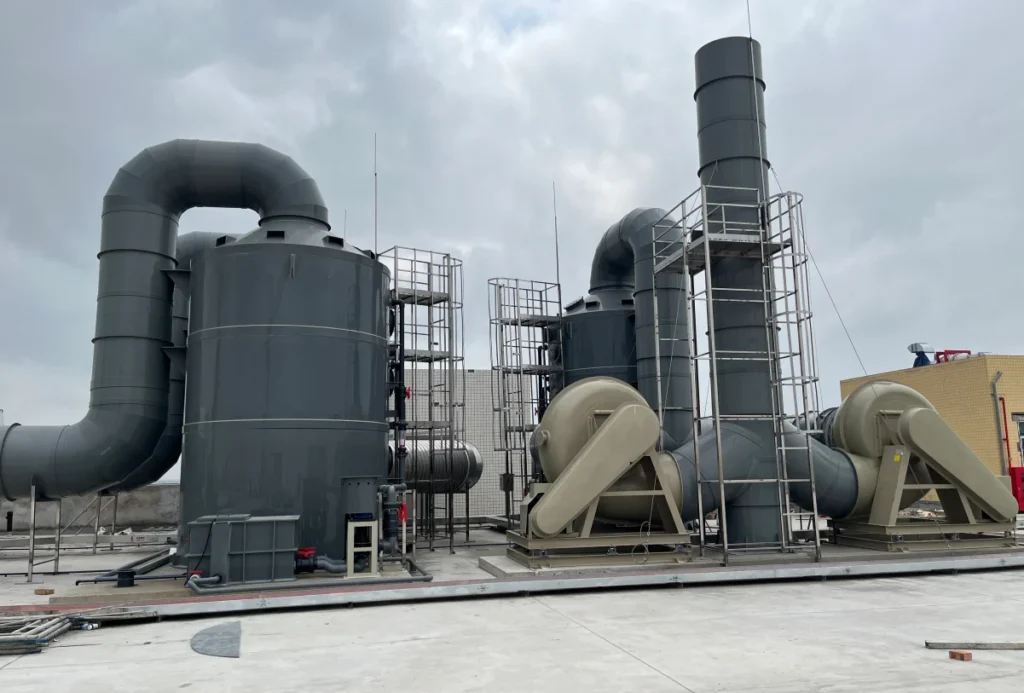
A scrubber system for chemical plant must handle the widest variety of exhaust pollutants of any industrial scrubbing application. A single facility may generate acid gases from chlorination reactions, solvent vapors from distillation columns, toxic gases from storage tanks, and particulate from powder handling – all requiring different scrubbing chemistries and sometimes different scrubber types within the same plant. This guide covers the scrubber configurations, material selections, and operating strategies that chemical plants use to manage their diverse exhaust streams, including reactor vent treatment, tank farm emission control, pharmaceutical process scrubbing, and compact ethylene oxide treatment systems.
Key Takeaways
- A scrubber system for chemical plant must be designed for multi-pollutant streams – acid gases, VOCs, and toxic substances from reactor vents, tank farms, and distillation columns. The scrubber type (packed bed, venturi, or spray tower) is selected based on the specific pollutant chemistry, not the plant type. A chemical plant typically requires multiple scrubber systems, each optimized for a specific process area: reactor vent scrubbers for HCl/SO2, tank farm scrubbers for storage tank emissions, and solvent recovery scrubbers for distillation vents.
- Multi-stage scrubbing is the standard approach for chemical plant exhaust containing both acid gases and VOCs. The first stage uses caustic (pH 7-9) to neutralize acid gases. The second stage uses hypochlorite or peroxide to oxidize VOCs and odorous compounds. For exhaust containing ammonia, an acid stage (pH 2-4 with H2SO4) precedes the caustic stage. The combined system achieves 99%+ removal for acid gases and 85-95% removal for water-soluble VOCs.
- A scrubber system in pharmaceutical industry must meet GMP (Good Manufacturing Practice) documentation standards in addition to emission requirements. Pharmaceutical scrubbers include validated cleaning procedures, changeover documentation between different product campaigns, and effluent monitoring for active pharmaceutical ingredients. The scrubber materials must be compatible with both the process solvents (acetone, methanol, dichloromethane) and the scrubbing reagents.
- Compact EO scrubber systems for ethylene oxide sterilization exhaust use acid-catalyzed hydrolysis to convert EO to ethylene glycol, which is non-toxic and biodegradable. The scrubber operates at pH 2-4 with sulfuric acid and a packed bed contactor. The compact design fits within the sterilization facility footprint and operates on demand with the sterilization cycle. See our chemical waste gas treatment → and wet scrubber system products →.
What Is a Scrubber System for Chemical Plant?
A scrubber system for chemical plant is a wet scrubbing installation designed to handle the diverse range of gaseous pollutants generated by chemical manufacturing operations – acid gases (HCl, HF, SO2, NOx), volatile organic compounds (solvents, monomers), toxic gases (chlorine, phosgene, ammonia), and particulate from powder handling and reactor processes. Unlike a scrubber in a single-purpose facility (such as a power plant FGD system that handles only SO2), a chemical plant scrubber system must be versatile enough to capture pollutants across different production campaigns, batch recipes, and process conditions.
See our toxic gas scrubber guide → for safety-critical scrubbing requirements.
The Chemical Plant Exhaust Challenge – Multi-Pollutant
A typical multi-product chemical plant generates exhaust from multiple sources simultaneously: a reactor vent containing HCl at 500-2,000 ppmv, a distillation column vent with methanol at 200-1,000 ppmv, a storage tank breather with mixed solvents at 50-500 ppmv, and a powder handling area with fine particulate. Each source requires the appropriate scrubbing chemistry. The scrubber system design must provide the correct reagent, contact time, and temperature control for each pollutant.
Batch vs Continuous Process Scrubbing
Batch chemical processes present a unique scrubbing challenge: the pollutant concentration varies throughout the batch cycle. During the reaction phase, the vent may carry 5,000 ppmv of HCl for 2 hours. During the cooling phase, the vent carries only steam and trace acid for 30 minutes. During the cleaning phase between batches, the vent carries cleaning solvent vapors. The scrubber for a batch reactor must be designed with a caustic feed system that can respond rapidly to concentration changes, and a packed bed depth that handles both the peak HCl load and the low-load periods without chemical overfeed.
Key Regulatory Requirements
Chemical plant scrubbers fall under multiple regulatory frameworks: EPA RMP (40 CFR Part 68) for toxic gas releases above threshold quantities, OSHA PSM (29 CFR 1910.119) for process safety management, and NESHAP standards (40 CFR Part 63) for hazardous air pollutants. The scrubber must be included in the facility’s process hazard analysis, mechanical integrity program, and emergency response plan.
Scrubber Types and Configurations
Packed Bed for Acid Gas and VOC Absorption
The packed bed scrubber with 25-50 mm polypropylene or ceramic packing is the most common chemical plant scrubber type. It provides the extended gas-liquid contact time needed for absorption of moderately soluble gases (SO2) and soluble VOCs (methanol, acetone, formaldehyde). The packing depth is 2-4 meters, and the scrubbing solution is caustic at pH 7-9 for acid gases or water with oxidant for VOCs.
A scrubber system for chemical plant using a packed bed is designed for continuous operation with a recirculation pump, a caustic metering pump controlled by a pH sensor, and a blowdown system that removes the reaction product salts. The packing material is polypropylene for most services; ceramic or PTFE is specified for highly oxidizing or high-temperature services.
Venturi for Emergency Release Scenarios
Chemical plants storing toxic gases above EPA RMP threshold quantities install emergency venturi scrubbers on containment rooms and storage areas. The venturi design handles the high gas flow of a pressurized release by entraining and atomizing the scrubbing liquid at the throat. The emergency scrubber is sized for the worst-case release scenario and includes a dedicated caustic inventory of 30-60 minutes at full-design flow.
Multi-Stage Systems for Mixed Pollutants
A scrubber system for chemical plant handling both acid gases and VOCs from the same process area uses a two-stage or three-stage design. Stage 1 neutralizes acid gases with caustic. Stage 2 oxidizes VOCs and odors with hypochlorite or peroxide. Stage 3 (optional) uses activated carbon for final polishing of non-soluble residual VOCs. The stages are arranged in series within the same tower or as separate vessels with interconnecting ductwork.
Compact EO Scrubber Systems – Ethylene Oxide Treatment
Compact eo scrubber systems are specialized packed bed scrubbers designed for the treatment of ethylene oxide (EO) sterilization exhaust from pharmaceutical and medical device facilities. EO is toxic (PEL 1 ppm), flammable, and a suspected human carcinogen. The scrubber uses acid-catalyzed hydrolysis at pH 2-4: C2H4O + H2O -> HO-CH2-CH2-OH (ethylene glycol). The reaction product is non-toxic ethylene glycol, which is biodegradable.
Compact EO scrubbers are skid-mounted, pre-piped, and pre-wired to fit within the sterilization facility footprint. The scrubber includes a sulfuric acid feed system for pH control, a packed bed contactor with 3 meters of packing, and a mist eliminator. The discharge air is monitored for EO breakthrough with a flame ionization detector (FID) or photoionization detector (PID).
Industrial Applications
A scrubber system for chemical plant serves diverse process areas across the facility. Each application requires a scrubber system for chemical plant tailored to the specific pollutant chemistry.
Reactor Vent Treatment – HCl, SO2, Cl2
Chemical reactor vents are the primary source of acid gas emissions in a chemical plant. A packed bed scrubber with caustic at pH 7-9 treats the reactor vent continuously. The vent flow varies with the reaction cycle, and the scrubber must handle the peak acid gas concentration during the reaction phase without breakthrough. The caustic feed is controlled by a pH sensor with 5-second response time to track the rapid concentration changes during batch reactions.
A chlorination reactor producing a chlorinated solvent generates HCl vent at 500-5,000 ppmv. The HCl scrubber achieves 99.9% removal with 5% NaOH. The NaCl reaction product is discharged in the blowdown to the plant wastewater system. The scrubber vessel is FRP with a vinyl ester corrosion barrier.
Tank Farm and Storage Tank Breather Emissions
Chemical storage tanks breathe during filling (out-breathing) and emptying (in-breathing). The out-breathing releases process vapors: HCl from hydrochloric acid storage, solvent vapors from methanol or acetone storage, and mixed VOCs from waste solvent tanks. A scrubber system for chemical plant on a tank farm treats the breather emissions from multiple tanks through a common header. The scrubber operates intermittently, activated by the tank pressure signal. A recirculation pump on continuous standby with an automated caustic feed reduces the chemical consumption during idle periods.
Scrubber System in Pharmaceutical Industry
A scrubber system in pharmaceutical industry handles solvent vapors (acetone, methanol, isopropanol, dichloromethane) from reactor vents, crystallizer exhausts, and dryer outlet air. The solvent vapors are absorbed in a packed bed with water recirculation at L/G of 3-8 L/m3. The scrubber effluent containing the dissolved solvents is sent to solvent recovery or wastewater treatment.
Pharmaceutical scrubbers require GMP-compliant documentation: validated cleaning procedures between product campaigns, changeover verification, and effluent monitoring for active pharmaceutical ingredients (APIs). The scrubber packing must be compatible with the full range of process solvents; polypropylene is standard for most services but PTFE may be required for halogenated solvent service.
Distillation Column and Solvent Recovery
Distillation column vents carry light components and non-condensable gases. The scrubber captures these components before the vent gas is discharged. For solvent recovery applications, a packed bed scrubber with low-temperature water recirculation (5-15 deg C) condenses and absorbs the solvent vapors. The recovered solvent-water mixture is returned to the process or sent to solvent recovery for reuse.
Design Parameters
Material Selection for Chemical Process Service
A scrubber system for chemical plant must be fabricated from materials that resist the specific chemical environment. The material selection matrix for chemical plant scrubbers covers a wider range than any other scrubber application because the gas composition can include strong acids, strong oxidizers, organic solvents, and chlorides simultaneously. Polypropylene (PP) is the standard material for acid gas and caustic service up to 80 deg C. FRP with vinyl ester resin extends the temperature range to 110 deg C and resists strong oxidizers including chlorine and hydrogen peroxide. Stainless steel (SS316L) is used only for non-HCl, non-HF services such as ammonia or dry process vents. PTFE-lined carbon steel is specified for the most aggressive mixed-acid services including HCl plus organic solvents at temperatures above 80 deg C.
Quench Design for Hot Process Vents
Chemical reactor vents are frequently hot (100-300 deg C) and must be quenched to the scrubber operating temperature before the gas contacts the packing. The quench section is a spray chamber at the tower inlet with full-cone water nozzles producing 300-500 um droplets. The water evaporation cools the gas to 50-70 deg C. The quench water requirement for a 10,000 m3/h reactor vent at 250 deg C is approximately 1.0 m3/h of evaporation loss. The quench section material must withstand the hot, corrosive gas at the inlet temperature; FRP or SS316L is standard.
Redundancy and Safety for Toxic Chemical Service
For chemical plant scrubbers handling toxic gases above EPA RMP threshold quantities, redundancy is mandatory. The scrubber design includes dual recirculation pumps (one operating, one on auto-start standby), spare chemical feed pumps with automatic switchover, redundant pH sensors with automatic sensor validation, and an emergency power connection for the recirculation pump. The scrubber outlet is continuously monitored for the target toxic gas. An alarm activates at 10% of the PEL, and the facility emergency shutdown system activates at 25% of the PEL.
Operation, Maintenance, and Compliance
Continuous Monitoring and Instrumentation
A scrubber system for chemical plant requires comprehensive instrumentation to maintain performance and demonstrate regulatory compliance. The minimum instrumentation includes pH sensor (continuous, control), ORP sensor (continuous for oxidation scrubbers), conductivity sensor (continuous for TDS control), gas detector at scrubber outlet (continuous for toxic gas breakthrough monitoring), liquid flow meter on recirculation line, and level transmitters on the sump and reagent tanks. All instrument data is logged to the plant distributed control system (DCS) with alarm settings at deviation from setpoints.
Chemical Reagent Management
Chemical plant scrubbers consume caustic (50% NaOH), sulfuric acid (93% H2SO4), sodium hypochlorite (12.5% NaOCl), or hydrogen peroxide (35% H2O2) depending on the pollutant chemistry. The reagent storage tanks are sized for 2-4 weeks of inventory at normal consumption rates. For emergency scrubbers, the reagent inventory is sized for the worst-case release scenario at 1.5-2.0x stoichiometric requirement. The reagent delivery pumps are positive-displacement diaphragm pumps with turndown ratios of at least 10:1.
EPA RMP and OSHA PSM Compliance
Chemical plant scrubbers handling toxic gases above EPA RMP threshold quantities must be included in the facility’s risk management program. The scrubber must be analyzed in the process hazard analysis (PHA) and the worst-case release scenario analysis. The scrubber mechanical integrity must be verified through scheduled inspections, testing, and preventive maintenance. Records of scrubber performance monitoring, maintenance, and incident investigations must be retained for 5 years under EPA RMP and OSHA PSM requirements.
Frequently Asked Questions
What is the difference between a chemical plant scrubber and a power plant scrubber?
A power plant FGD scrubber handles a single pollutant (SO2) at relatively constant concentration from a continuous process. A scrubber system for chemical plant handles multiple pollutants (HCl, SO2, VOCs, solvents) at variable concentrations from batch processes. The chemical plant scrubber requires more versatile design, including pH control that can track rapid concentration changes and materials compatible with a wider range of chemical species.
How is a scrubber system designed for a multi-product chemical plant?
The scrubber is designed for the worst-case pollutant concentration across all production campaigns. The caustic feed pump is sized at 1.5-2.0x the stoichiometric requirement of the highest-load product. The packed bed depth is determined by the pollutant requiring the most contact time. Flexible piping connections allow the scrubber to be valved to different process areas as production campaigns change.
What is a scrubber system in pharmaceutical industry?
A scrubber system in pharmaceutical industry removes solvent vapors (acetone, methanol, dichloromethane), acid gases, and toxic intermediates from reactor vents and drying equipment. The scrubber must meet GMP documentation standards: validated cleaning procedures between product campaigns, monitored effluent quality, and documented maintenance and calibration records.
How do compact EO scrubber systems work?
Compact eo scrubber systems use acid-catalyzed hydrolysis (pH 2-4 with H2SO4) to convert toxic ethylene oxide gas to non-toxic ethylene glycol. The scrubber is a skid-mounted packed bed with 3 meters of packing. It operates on demand with the sterilization cycle. The outlet gas is monitored for EO breakthrough with a PID or FID detector.
What are the regulatory requirements for chemical plant scrubbers?
Chemical plant scrubbers fall under EPA RMP (40 CFR Part 68) for toxic gas storage, OSHA PSM (29 CFR 1910.119) for process safety, and NESHAP (40 CFR Part 63) for hazardous air pollutants. The scrubber must be included in the process hazard analysis, mechanical integrity program, and emergency shutdown system of the facility.