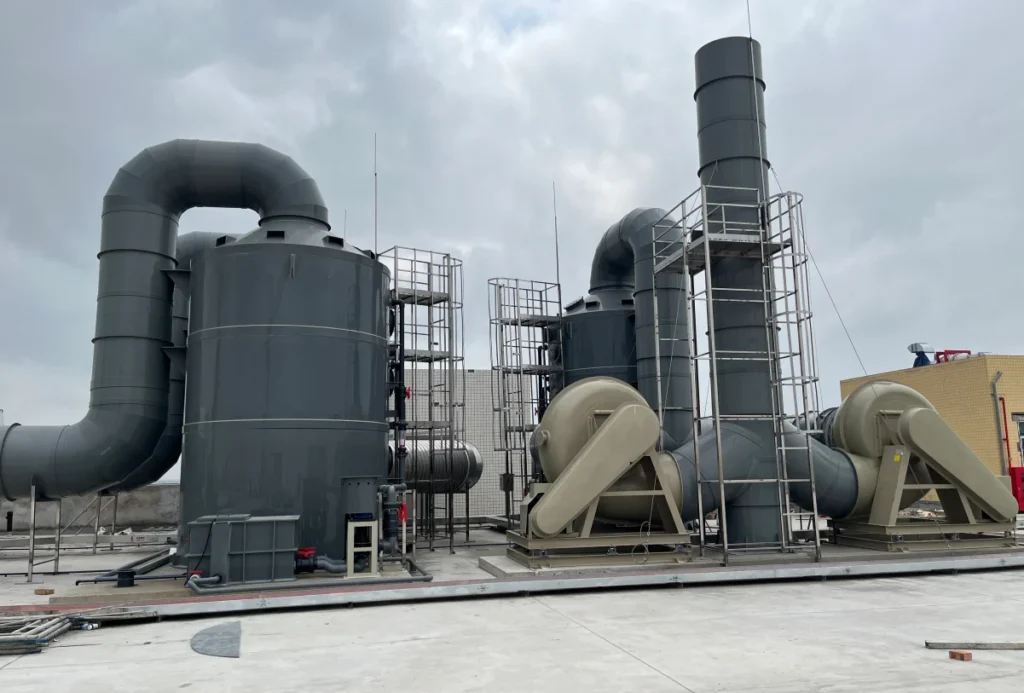
Food processing exhaust is unlike any other industrial emission stream. It carries grease mist and oil aerosols from frying and cooking, water vapor from boiling and drying, food particles from conveying and packaging, and odorous organic compounds from every stage of production. These pollutants are chemically diverse and present at varying concentrations throughout the production day. A wet scrubber for food manufacturing exhaust must handle all of them simultaneously – capturing grease droplets by impaction, absorbing water-soluble VOCs and odors into the scrubbing liquid, and cooling the hot exhaust from ovens and fryers. This guide covers the design considerations, scrubber types, and selection criteria for wet scrubbing systems in food processing applications.
Key Takeaways
- A wet scrubber for food manufacturing exhaust must handle a multi-pollutant stream – grease aerosols, water vapor, food dust, and odorous VOCs – that no single scrubber type addresses optimally. The recommended design is a multi-stage system: a spray tower with high-pressure nozzles (5-10 bar) for bulk grease removal and gas quenching, followed by a packed bed with caustic-hypochlorite for odor absorption, and optionally an activated carbon polisher for non-soluble residual VOCs. The combined system achieves 95-98% odor reduction.
- Grease accumulation is the dominant maintenance concern. A grease skimmer at the quench sump surface removes floating grease daily. Spray nozzles must be inspected monthly for plugging and flushed weekly with hot water (60-80 deg C) and degreasing agent. The quench sump should be drained and cleaned quarterly for moderate grease loading, or monthly for heavy grease loading such as rendering plant exhaust.
- Food dust captured in the scrubber is combustible, requiring NFPA 61 compliance. The scrubber must include water-level monitoring, sump temperature alarm at 60 deg C, and scheduled sludge removal. The wet collection environment inherently eliminates the deflagration risk that a dry baghouse would present.
- Wet scrubbing is the most cost-effective technology for high-moisture, greasy, moderate-VOC food processing exhaust. For a 10,000 m3/h fryer exhaust, the annual operating cost of a wet scrubber ($10,000-40,000) is significantly lower than an RTO ($30,000-80,000) or carbon adsorption ($15,000-50,000), primarily because wet scrubbing handles the grease without media fouling and the moisture without energy penalties. For food exhaust scrubber systems, see our industrial applications → and wet scrubber product range →.
What Is a Wet Scrubber for Food Manufacturing Exhaust?
A wet scrubber for food manufacturing exhaust is a wet scrubbing system specifically designed to treat the combination of grease aerosols, water vapor, food particulate, and odorous gases (see our chemical scrubber system guide → for the broader technology framework). Unlike industrial scrubbers that handle a single pollutant type at predictable concentration, a food exhaust scrubber must handle a mixture of pollutants at concentrations that vary with the production schedule – heavy grease loading during frying, high vapor loading during boiling, and intermittent odorous gas spikes during cleaning and shutdown.
The Unique Challenge of Food Processing Exhaust
Food processing exhaust presents four simultaneous challenges that no single standard scrubber type addresses optimally:
Grease and oil aerosols. Frying, roasting, and grilling generate sub-micron oil droplets that condense on cool surfaces downstream of the cooking process. These droplets are sticky and will coat and blind packing media, fan blades, and ductwork if not removed at the scrubber inlet.
Water vapor. Boiling, steaming, and drying produce near-saturated air at 80-100 deg C. The water vapor condenses in the scrubber, diluting the scrubbing solution and increasing the makeup water requirement.
Food particulate. Flour, starch, sugar, and protein particles from conveying and packaging operations are captured by the scrubber. These particles are often hygroscopic and combustible, requiring NFPA-compliant wet collection.
Odorous VOCs. Food processing generates a complex mixture of odorous organic compounds – aldehydes, ketones, organic acids, reduced sulfur compounds, and ammonia – that must be absorbed or oxidized in the scrubbing solution.
Oil Mist, Water Vapor, Food Particles, and Odors
A wet scrubber for food manufacturing exhaust must be designed as a multi-stage system: a quench/grease-removal stage, an absorption stage for soluble VOCs, and an odor oxidation stage. The quench stage operates at high L/G (3-5 L/m3) to capture grease droplets and cool the gas. The absorption stage uses a packed bed with caustic or water recirculation. The odor stage uses hypochlorite or ozone injection.
Kitchen Exhaust Scrubber System – Commercial vs Industrial
A kitchen exhaust scrubber system serves commercial cooking operations (restaurants, hotel kitchens, food courts) with gas flows of 1,000-10,000 m3/h. The scrubber captures grease and odors before the exhaust enters the building ductwork. Commercial kitchen scrubbers are typically spray towers with high-pressure mist nozzles that create 100-200 um droplets for grease capture. The scrubbing solution contains a degreasing agent. Industrial food processing scrubbers handle 10,000-100,000 m3/h and use packed beds or multi-stage systems with chemical reagent injection.
Why Wet Scrubbing for Food Exhaust?
Wet scrubbing is the preferred technology for food processing exhaust because it handles both particulate (grease, dust) and gases (odors, VOCs) in a single unit. The water-based scrubbing solution is inherently safe for combustible food dust – a flash fire or deflagration cannot propagate through the wetted interior of a scrubber. The liquid effluent from the scrubber can be sent to the plant wastewater treatment system where the organic load is biologically degraded.
Types of Scrubbers for Food Processing
Spray Tower for Bulk Grease and Particle Removal
The spray tower is the first stage in most food exhaust scrubber systems. Hot cooking exhaust enters at the bottom of the tower and rises at 0.5-1.2 m/s while high-pressure spray nozzles (5-10 bar) inject water or a caustic degreasing solution downward. The spray captures grease droplets and food particles by inertial impaction and washes them into the sump. The spray tower stage removes 80-95% of the grease loading and cools the gas from cooking temperature (80-200 deg C) to near-saturation (50-65 deg C).
The spray nozzles for food exhaust service must have large free passages (5-10 mm) to prevent plugging from grease and food particles. Full-cone nozzles with a spiral internal geometry are the standard choice. The spray water temperature should be maintained below 40 deg C to prevent grease from melting and re-entering the gas phase.
Packed Bed for Odor and VOC Absorption
The packed bed stage follows the spray tower and removes water-soluble VOCs and odorous compounds. The packing is typically 25-50 mm polypropylene Pall rings, selected for grease resistance and low cost. The packed bed depth is 2-3 meters. The scrubbing solution in the packed bed stage contains caustic (pH 8-10) and sodium hypochlorite (ORP 400-600 mV) to absorb and oxidize organic acids, aldehydes, and reduced sulfur compounds.
A wet scrubber for food manufacturing exhaust with a two-stage design (spray tower + packed bed) achieves 90-95% odor reduction and 80-90% VOC removal for water-soluble compounds. Residual non-soluble VOCs that pass through the wet scrubber are typically treated by an activated carbon polishing stage.
Multi-Stage System for Complete Treatment
The most complete food exhaust scrubber uses three stages:
Stage 1: Quench and grease removal using a high-pressure spray tower with water at L/G of 3-5 L/m3. Stage 2: Odor absorption using a packed bed with caustic and hypochlorite at L/G of 2-4 L/m3. Stage 3: Final polishing using an activated carbon bed for non-soluble VOCs that pass through the wet stages. The combined system achieves 95-98% odor reduction and meets the most stringent community odor regulations.
Kitchen Exhaust Scrubber System Design
A kitchen exhaust scrubber system for commercial cooking is a compact single-stage spray tower with an integrated grease filter and mist eliminator. The system is mounted on the roof directly above the kitchen hood. The recirculation pump and chemical feed system are enclosed in a weatherproof cabinet. The scrubber operates automatically when the kitchen hood is activated. Chemical consumption is low because the primary scrubbing mechanism is physical capture of grease and condensation of water-soluble VOCs.
Design Parameters for Food Exhaust Scrubbers
Designing a wet scrubber for food manufacturing exhaust requires accounting for grease loading and temperature. Every wet scrubber for food manufacturing exhaust must include a quench stage for hot cooking exhaust.
Grease Loading and Quench Design
The grease loading in food processing exhaust varies from 5-50 mg/Nm3 for baking operations to 50-500 mg/Nm3 for frying operations. The quench section must remove the bulk of this grease before the gas enters the packed bed. The quench water flow is calculated from the heat load: for a 10,000 m3/h fryer exhaust at 180 deg C cooled to 60 deg C, the water requirement is approximately 12,000 x 1.0 x (180-60) / 2,260 = 637 L/h of evaporation. The recirculation rate through the quench stage is typically 3-5 L/m3, providing both heat transfer and grease capture.
The quench sump must be designed for grease removal. A grease skimmer or weir at the sump surface removes floating grease to a waste container. Without grease skimming, the recirculating grease concentration increases until the spray nozzles become coated and lose performance.
Odor Control – H2S, NH3, and Organic Acids
Food processing odors are typically a mixture of hydrogen sulfide from protein decomposition, ammonia from spoilage, organic acids (acetic, butyric, lactic) from fermentation, and aldehydes from cooking. An odor control scrubber uses a two-stage chemical approach: Stage 1 operates with sodium hypochlorite (NaOCl) at ORP 400-600 mV to oxidize H2S, mercaptans, and aldehydes. Stage 2 operates with sodium hydroxide (NaOH) at pH 8-10 to absorb acid gases and acid byproducts from the oxidation reactions.
For a wet scrubber for food manufacturing exhaust serving a rendering plant or fish meal processor, the NaOCl consumption dominates the operating cost at approximately $0.50-1.00 per kg of H2S equivalent removed.
Temperature Control for Hot Cooking Exhaust
Cooking exhaust from fryers, ovens, and roasters enters the scrubber at 100-200 deg C. The quench section must cool the gas to below 60 deg C before it contacts the polypropylene packing (temperature limit 80 deg C). The quench water flow is controlled by a temperature sensor at the quench outlet that modulates the makeup water valve.
Material Selection for Grease and Acid Service
Polypropylene (PP) is the standard material for food exhaust scrubbers. PP resists the organic acids and caustic cleaning solutions used in food processing. The grease layer that accumulates on the vessel walls provides additional corrosion protection. Stainless steel is not recommended because chlorides from food products (salt) cause pitting corrosion at the grease/water interface.
Industrial Applications
Meat, Poultry, and Fish Processing
Meat, poultry, and fish processing plants generate exhaust from cooking, rendering, smoking, and waste handling operations. The exhaust contains grease aerosols, protein particles, and odorous gases including H2S, NH3, and organic amines from protein decomposition. A wet scrubber for food manufacturing exhaust in meat processing uses a two-stage system: a high-pressure spray tower for grease removal followed by a packed bed with hypochlorite oxidation for odor control.
Rendering plants – facilities that process animal byproducts into fat, protein meal, and bone meal – have the highest odor load in the food industry. The scrubber typically operates at L/G of 3-5 L/m3 with NaOCl consumption of 1-3 L per hour of 12.5% solution for a 50,000 m3/h system. A final activated carbon polishing stage achieves 98%+ odor reduction.
Snack Food Manufacturing (Frying, Roasting)
Potato chip, tortilla chip, and nut roasting operations generate hot oil mist and vapor at 150-200 deg C from continuous fryers and roasters. The exhaust contains sub-micron oil droplets (0.5-5 um) that must be captured to prevent visible emissions and comply with EPA opacity standards. A spray tower with high-pressure fog nozzles at 10-15 bar achieves 90-95% oil mist capture.
The oil mist collected in the scrubber floats on the quench water surface and is skimmed off for disposal or, in some facilities, for rendering into animal feed additive. The oil-laden water must be kept below 40 deg C to prevent bacterial growth.
Bakery and Cereal Production
Bakeries and cereal plants generate exhaust from ovens, dryers, and conveying systems. The exhaust contains flour dust, sugar dust, grain particles, and ethanol from yeast fermentation. The food dust is combustible, requiring NFPA 61-compliant wet collection. A spray tower or low-velocity venturi at 10-25 cm WC provides 90-95% collection.
The scrubber water in bakery applications must be monitored for pH because fermentation can produce organic acids that lower the pH and increase corrosion. A caustic feed system maintaining pH 7-8 prevents acid attack on the PP vessel.
Beverage and Brewing Industry
Breweries and beverage manufacturers generate exhaust from fermentation tanks, grain handling, and packaging operations. The exhaust contains ethanol vapor, CO2, and grain dust. A water scrubber at L/G of 2-4 L/m3 achieves 85-95% ethanol removal. The ethanol-laden water is sent to the wastewater treatment system.
Wet Scrubber vs RTO vs Carbon Adsorption for Food Exhaust
Operating Cost Comparison by Exhaust Type
| Factor | Wet Scrubbing | RTO | Carbon Adsorption |
|---|---|---|---|
| Grease tolerance | Excellent | Poor (fouls media) | Poor (blinds pores) |
| VOC removal | 80-95% (soluble) | 95-99% | 90-98% |
| Odor removal | 90-98% | 95-99% | 85-95% |
| Capital cost (10k m3/h) | $30,000-80,000 | $80,000-200,000 | $20,000-50,000 |
| Annual op cost | $10,000-40,000 | $30,000-80,000 | $15,000-50,000 |
| Best for | Greasy, hot, high moisture | Dry, high VOC, >1,000 ppmv | Dry, low VOC, <200 ppmv |
When to Choose Wet Scrubbing
A wet scrubber for food manufacturing exhaust is the right choice when the exhaust contains grease aerosols, when the gas temperature exceeds 80 deg C, when the moisture content is high enough that condensation would foul carbon or RTO media, or when the food dust is combustible and requires wet collection for NFPA compliance. Wet scrubbing is the lowest-cost option for high-flow, moderate-concentration applications typical of food processing.
Wet scrubbing also handles the variable load characteristic of food production: the scrubber responds immediately to concentration changes because the caustic feed is controlled by pH feedback. An RTO requires thermal stabilization time, and carbon adsorbers have a fixed media capacity.
When RTO or Carbon Makes More Sense
RTO is the right choice when the VOC concentration is high enough to support autothermal operation (above 1,000 ppmv as methane equivalent) and the exhaust is dry and grease-free. For bakery ovens, coffee roasting, and snack food drying where the exhaust is hot and dry but the VOC concentration is moderate (200-500 ppmv), an RTO with a primary heat exchanger may be the right choice despite the higher capital cost.
Carbon adsorption is the right choice for low-concentration, low-temperature, dry exhaust streams where the VOCs are non-water-soluble (solvent extraction processes, citrus oil evaporation). The carbon media must be replaced or regenerated when saturated.
Operation and Maintenance
A wet scrubber for food manufacturing exhaust requires daily grease skimmer inspection and monthly nozzle checks.
Grease Removal and Sump Cleaning
Grease accumulation in the scrubber sump is the primary maintenance concern for any wet scrubber for food manufacturing exhaust. The grease skimmer must be checked daily and the waste grease container emptied before it overflows. The sump should be drained and cleaned quarterly. The sump cleaning interval depends on the grease loading: rendering plant scrubbers may need monthly cleaning; bakery scrubbers may need semi-annual cleaning.
The grease that accumulates in the sump is a mixture of cooking oil, condensed water, and captured food particles. In some food processing plants, the grease is sent to a rendering facility where it is processed into animal feed additive or biodiesel feedstock. In other plants, the grease is disposed of as industrial waste.
Nozzle Inspection for Grease Plugging
Grease and food particles can plug spray nozzles in the quench section. A partially plugged nozzle produces an uneven spray pattern, creating untreated gas bypass channels. Nozzles in food exhaust service should be inspected monthly. Signs of grease plugging include reduced spray pressure, uneven spray pattern visible through sight ports, and an increase in outlet gas temperature (indicating reduced quench efficiency).
Nozzles can be cleaned by circulating hot water (60-80 deg C) with a degreasing agent through the spray system for 30-60 minutes. For heavy grease buildup, the nozzles must be removed and soaked in a degreasing solvent. Weekly hot water flushing of the spray system prevents heavy buildup.
NFPA 61 Combustible Dust Compliance
Food dust (flour, starch, sugar, protein powder) is combustible. NFPA 61 (Standard for the Prevention of Fires and Dust Explosions in Agricultural and Food Processing Facilities) requires that wet collection systems for combustible food dust include:
- Water-level monitoring to ensure collected dust remains submerged
- Sump temperature monitoring with alarm at 60 deg C
- Sludge removal on a schedule that prevents combustible dust accumulation
- Bonding and grounding of the scrubber vessel and ductwork
The wet scrubber for food manufacturing exhaust must be included in the facility’s dust hazard analysis (DHA) required by NFPA 652.
Frequently Asked Questions
What is a wet scrubber for food manufacturing exhaust?
A wet scrubber for food manufacturing exhaust is a wet scrubbing system that removes grease aerosols, food particles, water vapor, and odorous gases from food processing exhaust. It uses a multi-stage approach: spray tower for grease capture, packed bed for odor absorption, and optional carbon polishing for residual VOCs.
What pollutants does a food exhaust scrubber remove?
Grease and oil aerosols (0.5-5 um), water-soluble VOCs (alcohols, aldehydes, organic acids), odorous gases (H2S, NH3, mercaptans), food dust particles (flour, starch, protein), and smoke from cooking operations. Removal efficiency is 80-95% for grease, 90-98% for odors, and 80-90% for soluble VOCs.
Is a wet scrubber or an RTO better for food cooking exhaust?
A wet scrubber is better when the exhaust contains grease or is high in moisture. Grease fouls RTO media. High moisture content makes RTO operation inefficient. A wet scrubber handles both grease and moisture with minimal maintenance. An RTO is better for dry, grease-free, high-VOC-concentration exhaust.
What is a kitchen exhaust scrubber system?
A kitchen exhaust scrubber system is a compact spray tower that captures grease and odors from commercial kitchen exhaust before the air enters the building ductwork. It operates at 1,000-10,000 m3/h with high-pressure water spray. The captured grease is collected in a waste container for disposal.
What maintenance does a food exhaust scrubber need?
Daily grease skimmer inspection, monthly nozzle inspection for grease plugging, quarterly sump cleaning, and annual packing inspection. Weekly hot water flushing of the spray system prevents heavy grease buildup.