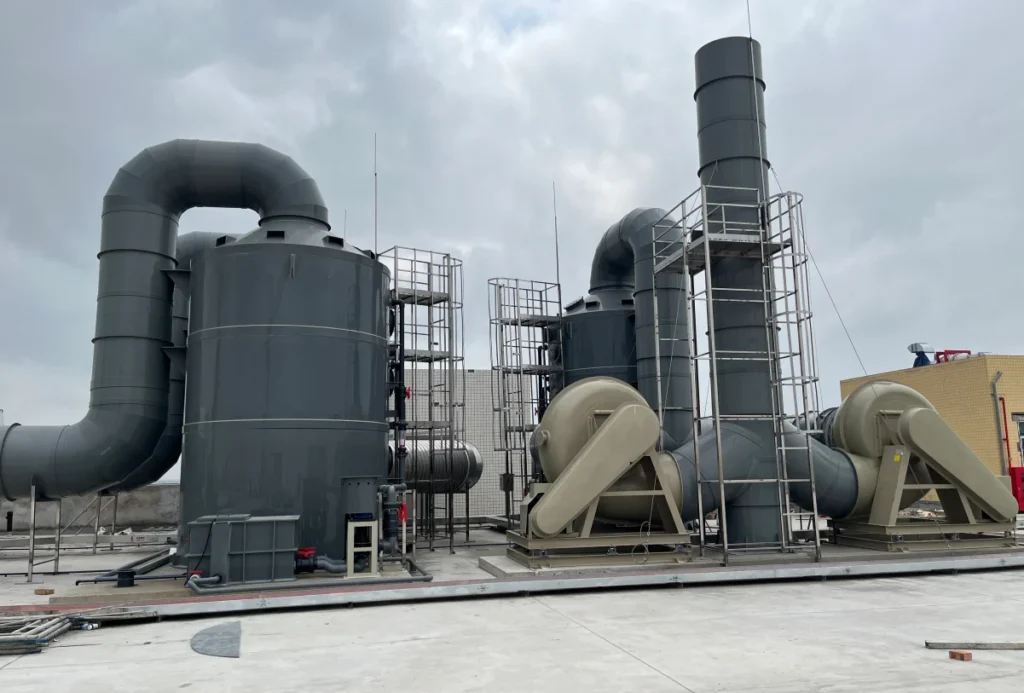
Paint booth exhaust presents a challenge that is both physical and chemical: overspray paint particles are sticky. They will coat, blind, and plug any dry filter media or packed bed that does not actively remove them. The solution in manufacturing is a wet scrubber and dry filter paint booth systems for manufacturing – wet scrubbing captures the bulk overspray by water impingement and washes paint sludge into a collection sump, while staged dry filters capture the residual fine particles and provide final polishing. For solvent-based paints, an activated carbon or RTO stage may follow the wet system to handle VOCs. This guide covers how these systems work together, the design parameters for each stage, and the selection criteria for different paint types and production volumes.
Key Takeaways
- Wet scrubber and dry filter paint booth systems for manufacturing work in series: wet scrubbing captures the bulk of sticky, wet overspray before it can dry and blind downstream dry filter media. The wet stage removes 90-98% of overspray particulate. The water prevents paint adhesion to scrubber surfaces. Dry filter stages downstream handle residual fine particles. For solvent-based paints, carbon or RTO handles the VOC component.
- Paint sludge management is the primary maintenance task. Paint particles washed into the sump form a sludge that must be removed – typically weekly for high-production booths. Sludge removal uses flotation skimming (for floating paints) or settling and drag-chain removal (for sinking paints). The collected sludge is dewatered and disposed as industrial waste. Paint sludge is generally not recyclable.
- Explosion prevention is critical for solvent-based paint booth exhaust. The exhaust concentration of flammable solvents must be maintained below 25% of the Lower Explosive Limit (LEL). Continuous LEL monitoring with automatic ventilation increase at 25% LEL and booth shutdown at 50% LEL is required by NFPA 33 for spray application using flammable materials.
- Source capture wet scrubbers capture overspray at the spray gun location, reducing load on the booth exhaust system. For dry filter systems, see our paint waste gas treatment → and activated carbon adsorption equipment →.
What Are Wet Scrubber and Dry Filter Paint Booth Systems?
Wet scrubber and dry filter paint booth systems for manufacturing combine two fundamentally different particle capture technologies in series (see our toxic gas scrubber guide →). The wet stage uses water impingement – typically a water curtain, spray chamber, or venturi – to capture overspray paint particles before they can dry and harden on filter media. The dry stage uses disposable or cleanable filter media (baffle filters, fiberglass mats, pocket filters) to capture the residual fine particles that pass through the wet stage. For solvent-based paints, a solvent recovery or VOC destruction stage follows the particulate capture stages.
The key operational distinction is that the wet stage operates on paint particles that are still wet and sticky when they enter the scrubber. Contact with water prevents the paint from adhering to surfaces. The paint particles are washed into a collection sump where they form a sludge that is periodically removed. The dry filter stages downstream handle only dried or semi-dry paint particles, so the filter life is extended by preventing the wet, sticky overspray from reaching the dry media.
The Paint Booth Exhaust Challenge – Overspray + VOCs
A typical automotive or industrial paint booth generates exhaust at 10,000-100,000 m3/h with two pollutant categories: overspray paint particles (1-100 um, sticky when wet) and solvent VOCs (toluene, xylene, MEK, butyl acetate at 100-500 ppmv). The overspray load is determined by transfer efficiency – typically 40-70% for manual spray guns and 70-85% for electrostatic application. The remaining 15-60% of the paint becomes overspray that must be captured by the exhaust system.
Wet scrubber and dry filter paint booth systems for manufacturing must handle both the particulate and the VOC components. The wet stage captures 90-98% of overspray particulate. The dry filter stage captures residual fine particles. The VOC component requires carbon adsorption or thermal oxidation if water-soluble solvents (alcohols, some ketones) are not adequately absorbed in the wet stage scrubbing liquid.
Wet Scrubber vs Dry Filter – Complementary Roles
Dry filters alone are inadequate for paint booth exhaust: the wet overspray rapidly blinds the filter media, causing pressure drop increases and requiring filter replacement every few hours to days. Wet scrubbers alone are inadequate because they do not capture non-water-soluble VOCs from solvent-based paints and may exhaust visible water mist. The combination of wet followed by dry captures both overspray particles and fine residual particulate economically.
When to Use Each Technology Alone or in Combination
For water-based paints in a low-production booth: a wet scrubber alone may be adequate because the VOCs are minimal (water is the primary solvent). For solvent-based paints in a high-production booth: a wet scrubber captures overspray, a multi-stage dry filter captures residual particulate, and an activated carbon or RTO system handles VOCs. A source capture wet scrubber captures overspray at the spray gun location, reducing the amount of paint that reaches the booth exhaust system.
How Wet Scrubbers Work in Paint Booth Service
Overspray Particle Capture – Water Curtain and Spray
The wet scrubber stage in wet scrubber and dry filter paint booth systems for manufacturing captures overspray paint particles by two mechanisms: a water curtain (where a continuous film of water falls down a vertical plate, and the exhaust passes through it) or a spray chamber (where water is atomized through nozzles at 3-7 bar into the exhaust stream). The paint particles impact the water droplets or water film, are captured, and flow into the collection sump.
The water in the sump contains degreasing and anti-foaming agents that prevent the paint from adhering to sump surfaces. The scrubbing water is recirculated. A side-stream bleed removes accumulated paint solids to keep the recirculating water clean enough for effective scrubbing. The water temperature is maintained below 35-40 deg C to prevent bacterial growth and excessive evaporation.
Paint Sludge Collection and Dewatering
Paint sludge collected in the sump floats if it is lighter than water (most solvent-based paints) or sinks if it is heavier (water-based paint with high pigment loading). Flotation skimmers remove floating sludge continuously. Settling sludge is removed by a drag chain conveyor or periodic sump cleaning. The sludge is dewatered to 30-50% solids in a centrifuge or filter press before disposal. A typical booth generates 50-500 kg of paint sludge per day depending on production volume.
Water-Soluble VOC Absorption in the Scrubbing Liquid
The scrubbing water in a wet scrubber and dry filter paint booth systems for manufacturing absorbs water-soluble solvents (alcohols, ketones, glycol ethers, some esters) from the paint booth exhaust. The absorption efficiency for water-soluble VOCs is 70-90% at L/G ratios of 3-8 L/m3. Non-soluble solvents (toluene, xylene, butyl acetate, MEK) are not absorbed and pass through the wet stage into the dry filter or carbon stages downstream. The VOC-loaded scrubbing liquid is sent to a water treatment system where the solvent is biodegraded or stripped for recovery.
Dry Filter Stages – Baffles, Fiberglass, Pocket Filters
The dry filter stage follows the wet scrubber and captures residual dry or semi-dry paint particles that passed through the wet stage. Multi-stage dry filtration uses: Stage 1 baffle filters (paint-stop media) that capture particles down to 10 um; Stage 2 fiberglass mat filters capturing 1-10 um particles; Stage 3 pocket or HEPA filters for sub-micron polishing. The dry filter pressure drop starts at 1-3 cm WC and increases as paint particulate accumulates. The filter elements are replaced when the pressure drop doubles.
Design Parameters for Paint Booth Scrubbers
Face Velocity and Capture Efficiency
The face velocity at the paint booth exhaust intake determines the capture efficiency of overspray. For manual spray booths, the minimum face velocity is 0.3-0.5 m/s (60-100 fpm). For robotic and automatic booths, the minimum is 0.25-0.3 m/s (50-60 fpm). Higher face velocities (above 0.5 m/s) increase energy consumption and may disturb the spray pattern but improve capture of fine overspray. The booth exhaust flow rate is calculated from the booth cross-sectional area multiplied by the design face velocity.
Paint Sludge Removal – Flotation, Settling, Centrifugation
The paint sludge removal method depends on the paint chemistry and the specific gravity of the sludge relative to water. Solvent-based paint sludge typically floats and is removed by a surface skimmer with a scraper blade. Water-based paint sludge may sink and is removed by a drag chain conveyor at the sump bottom. Centrifugal separators remove fine sludge particles that neither float nor settle effectively. The side-stream bleed rate from the recirculating water loop is typically 5-15% of the recirculation flow, depending on the overspray loading.
Material Selection for Solvent and Paint Service
The scrubber shell and internals in wet scrubber and dry filter paint booth systems for manufacturing must resist both the water-based scrubbing environment and the organic solvents in the paint exhaust. Galvanized or stainless steel (SS304) is standard for the scrubber vessel. Polypropylene (PP) can be used for the sump and recirculation piping but must be verified compatible with the specific solvent mixture. PVC is not recommended for solvent-based paint booth service because many solvents attack PVC. The ductwork from the booth to the scrubber should be stainless steel or galvanized steel with smooth interior surfaces to prevent paint accumulation.
Explosion Prevention for Flammable Solvent Atmospheres
NFPA 33 (Standard for Spray Application Using Flammable or Combustible Materials) requires that the concentration of flammable vapors in the paint booth exhaust be maintained below 25% of the Lower Explosive Limit (LEL). Continuous LEL monitoring with automatic ventilation increase and alarm is required. At 50% LEL, the spray operation must be automatically shut down. The wet scrubber is inherently safer than a dry collector for solvent-based paints because the water quenches sparks and prevents flame propagation. However, the scrubber electrical equipment (recirculation pump motor, instrumentation) must be rated for the hazardous area classification (typically Class I, Division 1 or 2).
Dry Filter + Wet Scrubber vs Carbon Adsorption vs RTO
Operating Cost and Maintenance Comparison
For a 50,000 m3/h paint booth exhaust with solvent-based paint: a wet scrubber and dry filter paint booth systems for manufacturing with downstream carbon adsorption handles both overspray and VOCs. The wet stage removes 95% of overspray at $0.05-0.15 per 1,000 m3 in water and electricity plus $0.50-2.00 per 1,000 m3 in dry filter replacement. The carbon stage adds $0.50-1.50 per 1,000 m3 in carbon replacement. Total operating cost: approximately $1.50-3.50 per 1,000 m3.
An RTO alone (without upstream wet scrubber) cannot handle paint overspray because the particles blind the ceramic media. An RTO must be preceded by a particulate filter. For paint booth exhaust with overspray at 50 mg/Nm3, a standalone RTO with upstream filters costs approximately $3-8 per 1,000 m3 to operate, primarily in natural gas for thermal oxidation. The filter before the RTO must be changed frequently due to the sticky paint particles.
When Wet+Dry Is the Correct Choice
Wet scrubbing plus dry filtration is the correct choice when the paint booth uses water-based paints (minimal non-soluble VOCs), when the booth is low-to-medium production (less than 5,000 kg of paint per month), or when the primary compliance target is particulate emission limits rather than VOC limits. Wet+Dry systems have the lowest capital cost ($50,000-150,000 for a 50,000 m3/h system) and the simplest operation.
When Only RTO or Carbon Will Meet VOC Regulations
For high-production booths using solvent-based paints with VOC regulations requiring 95%+ VOC destruction, a wet scrubber for overspray removal followed by an RTO with >97% VOC destruction efficiency is the standard solution. A wet scrubber and dry filter paint booth systems for manufacturing with carbon adsorption achieves 90-95% VOC removal and may be acceptable where regulations are less stringent. Carbon adsorbers require media replacement every 6-24 months depending on loading; RTOs have no media replacement cost but higher energy cost.
Frequently Asked Questions
What are wet scrubber and dry filter paint booth systems for manufacturing?
Wet scrubber and dry filter paint booth systems for manufacturing are combined particulate capture systems that use wet water impingement to capture sticky overspray paint particles before they dry on downstream dry filter media. The wet stage removes 90-98% of overspray. The dry stage captures residual fine particles.
How does a paint booth wet scrubber work?
A paint booth wet scrubber uses a water curtain or spray chamber to contact the paint-laden exhaust with water. The overspray paint particles impact water droplets or a water film and are washed into a collection sump. The paint particles form a sludge that floats or sinks, depending on the paint chemistry. The sludge is skimmed or settled and periodically removed for disposal.
Do wet scrubbers remove paint VOCs?
A wet scrubber and dry filter paint booth systems for manufacturing captures water-soluble VOCs (alcohols, ketones, some glycol ethers) at 70-90% efficiency. For non-water-soluble VOCs (toluene, xylene, MEK), wet scrubbing achieves less than 20% removal. These solvents require activated carbon adsorption or thermal oxidation (RTO) after the wet scrubber stage to meet VOC emission limits.
What is a source capture wet scrubber?
A source capture wet scrubber captures overspray directly at the spray gun or robotic applicator location rather than at the booth exhaust. A high-velocity capture hood connected to a small wet scrubber removes overspray before it disperses into the booth. Source capture can reduce the load on the booth exhaust system by 50-70%.
How is paint sludge disposed of?
Paint sludge is a non-hazardous industrial waste for water-based paints and may be hazardous for solvent-based or metal-containing paints (lead, chromium). The sludge is dewatered by filtration or centrifugation and disposed of at a licensed industrial waste facility. Some paint sludge can be used as a fuel supplement in cement kilns if the BTU content is sufficient.