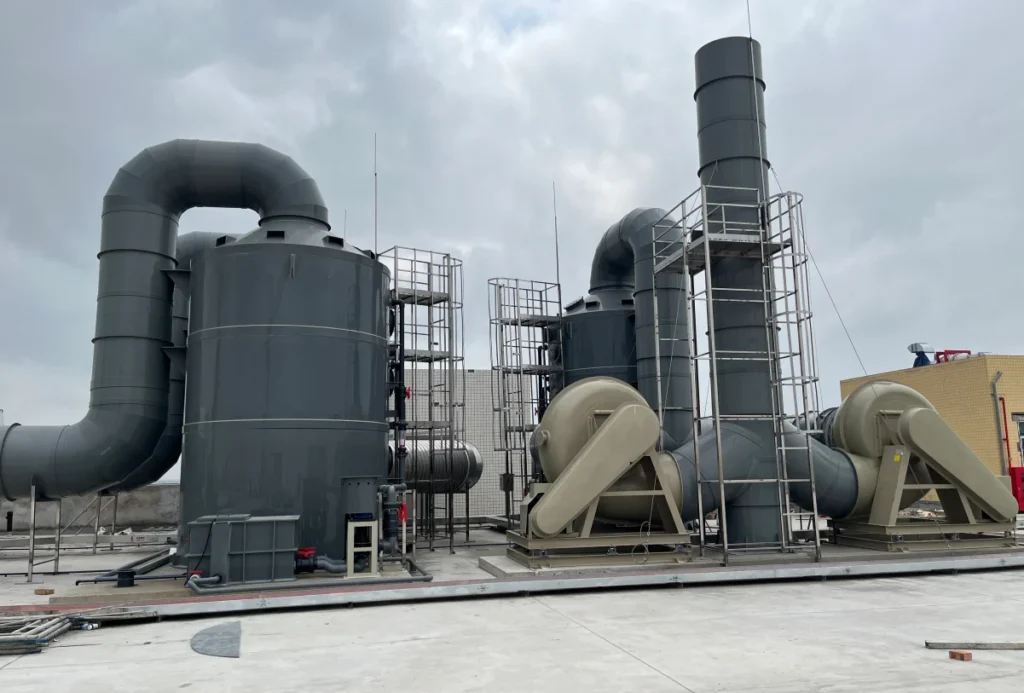
The aluminum smelter wet scrubber outlet temperature is the single variable that determines whether a scrubber system meets its removal efficiency guarantee, avoids corrosion failure, and operates within its energy budget. Engineers specifying scrubbers for aluminum potroom exhaust face a temperature range that spans 50-150°C at the inlet depending on the cell type, the hooding system, the production rate, and the season. The outlet temperature that results from the scrubber design determines the approach to saturation, which directly controls the mass-transfer driving force for HF and SO2 absorption. This guide explains how the outlet temperature is determined by the gas conditions and the scrubber design, how it affects performance across the full operating range, and how to specify a system that maintains the target temperature window under all conditions.
Key Takeaways
- The aluminum smelter wet scrubber outlet temperature is determined by the adiabatic saturation condition and typically falls within 60-80°C. The approach temperature (5-15°C above saturation) directly controls removal efficiency.
- SO2 removal efficiency drops by 10-15 percentage points when the approach temperature increases from 5°C to 15°C. The Henry’s law constant for SO2 increases approximately 3x across the 50-80°C range, reducing the absorption driving force at higher temperatures.
- Prebake cell exhaust enters the scrubber at 80-120°C with well-sealed hooding, while Soderberg cells deliver 50-80°C. Poor hooding can reduce the inlet temperature by 30-40°C and increase the volumetric flow by 20-40%.
- Material selection must be based on the maximum outlet temperature, not the average. PP (80°C ceiling), FRP vinyl ester (110°C), and SS316L (above 110°C or fluoride service) each serve a distinct temperature window.
- The acid dew point for aluminum smelter exhaust is 110-130°C, well above the scrubber outlet temperature. All downstream ductwork must be corrosion-resistant materials, and seasonal L/G adjustment is required to maintain performance across the full temperature range.
What Determines the Outlet Temperature in an Aluminum Smelter Wet Scrubber?
The aluminum smelter wet scrubber outlet temperature is not an independent variable. It is the result of a thermodynamic equilibrium between the hot exhaust gas and the scrubbing liquid, modulated by the scrubber’s design parameters and the ambient conditions at the plant site (EPA Primary Aluminium Technical Support Document).
The Adiabatic Saturation Principle
When hot exhaust gas enters a wet scrubber and contacts the recirculating liquid, water evaporates into the gas stream. The energy required for evaporation comes from the sensible heat of the gas, causing the gas temperature to fall. This process continues until the gas reaches its adiabatic saturation temperature – the wet-bulb temperature corresponding to the inlet gas conditions. At this point, the gas is fully saturated with water vapor, and no further net evaporation occurs.
The adiabatic saturation temperature for aluminum smelter exhaust depends on the inlet gas temperature and the moisture content. For typical potroom exhaust entering at 80-120°C with ambient moisture levels of 1-3% by volume, the saturation temperature falls in the range of 55-75°C. The difference between the actual gas outlet temperature and the theoretical saturation temperature is called the approach temperature.
Inlet Gas Conditions
The inlet gas temperature is the dominant variable. Potroom exhaust from prebake cells operating at 300-500 kA leaves the pot hooding system at 80-120°C under normal conditions. The US EPA Primary Aluminium Technical Support Document reports exhaust temperatures of approximately 570°F (300°C) at the pot outlet before dilution air is drawn in through the hooding system.
The moisture content of the inlet gas also affects the outlet temperature. Ambient air drawn into the hooding system carries humidity that varies with the season. In a humid summer climate with ambient relative humidity above 80%, the inlet gas already contains significant water vapor, which reduces the evaporative cooling capacity of the scrubber and raises the outlet temperature by 5-10°C compared to dry winter conditions.
Scrubber Design Variables
Three design variables determine how close the scrubber brings the gas to saturation. The liquid-to-gas ratio controls the total interfacial area available for heat and mass transfer. Higher L/G ratios produce closer approach temperatures. The gas residence time determines whether the gas-liquid contact is long enough for the evaporation process to reach equilibrium. Insufficient residence time leaves the gas 10-20°C above saturation. The droplet size distribution from the spray nozzles determines the effective surface area per unit volume of liquid. Smaller droplets increase the surface area but are more susceptible to entrainment.
Ambient Conditions
The ambient temperature and humidity at the plant site set the baseline for the entire calculation. A smelter in a cold, dry climate like northern Canada may see inlet air at -30°C with absolute humidity below 0.5 g/kg, producing a saturation temperature of 45-55°C. The same smelter design in a tropical climate with ambient air at 35°C and 90% relative humidity may produce a saturation temperature of 70-80°C. The scrubber designer must account for both extremes, not the average.
Typical Temperature Ranges for Aluminum Smelter Scrubbers
The temperature profile through an aluminum smelter wet scrubber system varies with the cell technology, the hooding design, the operating load, and the ambient conditions at the plant location.
Prebake Cell Exhaust: 80-120°C Inlet
Prebake cells account for over 90% of global primary aluminum production. In a modern prebake smelter operating at 300-500 kA, the exhaust gas collected through the pot hooding system enters the gas treatment ductwork at 80-120°C. The wide range reflects the variation in hooding efficiency. A well-maintained hood system with 95-98% capture efficiency minimizes dilution air, preserving the thermal energy of the gas. A hood system with degraded seals or open panels draws more ambient air, reducing the inlet temperature and increasing the volumetric flow that the scrubber must handle.
The Maryland Eastalco BART determination documents that the volumetric flow from a full-scale aluminum smelter potline can reach 1,620,000 acfm with temperatures spanning 300-700°F (150-370°C) at the source, depending on the extent of dilution before the gas reaches the scrubber (FivesGroup aluminum gas treatment centre data). This wide range demonstrates why each installation must be characterized individually rather than assumed from generic data.
Soderberg Cell Exhaust: 50-80°C Inlet
Soderberg cells, which use a self-baking anode, produce exhaust at lower temperatures because the cell design allows more ambient air to enter the hooding system. Inlet temperatures of 50-80°C are typical. The lower inlet temperature means less evaporative capacity in the scrubber, and the outlet temperature approaches 50-65°C even at moderate L/G ratios.
Soderberg cells also produce higher particulate loading from the baking anode, which increases the solids burden on the scrubber and the downstream particulate control equipment. The combination of lower temperature and higher particulate loading shifts the scrubber design toward spray towers rather than packed beds to avoid plugging.
Stack Temperature: 60-80°C Outlet
The aluminum smelter wet scrubber stack temperature at the scrubber outlet typically ranges from 60-80°C. Within this range, the exact value of the aluminum smelter wet scrubber outlet temperature depends on the inlet gas temperature, the L/G ratio, and the ambient humidity. A scrubber treating prebake exhaust at 100°C inlet with an L/G of 1.5 L/m3 in a temperate climate will produce an outlet temperature of approximately 65-75°C. The same scrubber treating Soderberg exhaust at 65°C inlet may produce an outlet temperature of 55-65°C.
Impact of Hooding Efficiency on Inlet Temperature
The hooding system is the most influential upstream variable. A prebake smelter with new, well-sealed hoods operating at 98% capture efficiency may deliver gas at 110-120°C to the scrubber. The same smelter with aging hoods operating at 90-92% capture efficiency may see inlet temperatures of 70-85°C. The difference of 30-40°C at the inlet translates to a 5-12°C difference at the outlet.
The volumetric consequence is equally important. A hood system drawing excess dilution air increases the gas flow by 20-40% for the same potline production rate. The scrubber must be sized for the peak flow condition, not the average, or the performance will degrade during the seasons when dilution air is highest.
Well-Sealed Hoods (95-98% Capture). These systems deliver gas at the higher end of the temperature range, maximize the concentration of pollutants entering the scrubber, and minimize the equipment size for a given pollutant removal rate.
Poorly Sealed Hoods. These systems reduce the inlet temperature and dilute the pollutant concentration, requiring a larger scrubber vessel and higher fan power for the same removal duty. The capital cost penalty can reach 15-25% for the scrubber system alone.
How Outlet Temperature Affects Scrubber Performance
The aluminum smelter wet scrubber outlet temperature directly controls the mass-transfer rate for acid gas absorption and influences the particulate collection efficiency. The relationship is quantifiable and should be part of the design specification, not treated as a secondary variable.
HF Absorption: Temperature Sensitivity
Hydrogen fluoride is highly soluble in water: the Henry’s law constant for HF at 60°C is approximately 0.01 atm/mol fraction, meaning the equilibrium gas-phase concentration above a neutral-pH scrubbing solution is effectively zero. Over 99% of the HF entering the scrubber is removed regardless of the outlet temperature across the 50-80°C range.
The temperature sensitivity for HF appears not in the equilibrium but in the mass-transfer rate. The gas-film mass-transfer coefficient increases with temperature because the diffusivity of HF in air rises by approximately 1.5% per °C. This means the HF absorption rate is slightly faster at higher scrubber temperatures, but the effect is small enough that it does not drive design decisions. A scrubber achieving 99.5% HF removal at 60°C will still achieve 99.3% at 80°C.
SO2 Absorption: Strong Temperature Dependence
SO2 absorption is far more temperature-sensitive than HF, and the aluminum smelter wet scrubber outlet temperature is the key variable. The Henry’s law constant for SO2 increases by approximately a factor of 3 as the gas temperature rises from 50°C to 80°C. At 50°C, the equilibrium partial pressure of SO2 above a pH 7 scrubbing solution is approximately 0.002 atm. At 80°C, it reaches 0.006 atm. This higher equilibrium partial pressure reduces the driving force for mass transfer.
The practical consequence is that the approach temperature directly determines the achievable SO2 removal efficiency. At a 15°C approach temperature – meaning the outlet gas is 15°C above saturation – a spray tower scrubber with a caustic scrubbing solution typically achieves 82-88% SO2 removal. Reducing the approach temperature to 5°C increases the removal efficiency to 93-97%. The 10°C improvement in approach temperature produces a 10-15 percentage point gain in SO2 removal.
Quantified Effect: Approach Temperature vs Removal Efficiency
For a spray tower scrubber treating aluminum smelter exhaust with 200 ppm SO2 inlet at pH 8-9 scrubbing solution:
- Approach 15°C: SO2 removal 84-88%
- Approach 10°C: SO2 removal 89-93%
- Approach 5°C: SO2 removal 93-97%
The mechanism behind this effect is the combination of two factors. First, the closer approach temperature indicates longer gas-liquid contact and higher interfacial area. Second, the lower absolute temperature at the gas-liquid interface maintains a higher SO2 solubility, sustaining the concentration gradient that drives absorption.
Fine Particulate Collection
The effect of outlet temperature on particulate collection is secondary to the effects on gas absorption but still measurable. For particles in the 1-10 µm range, increasing the gas temperature from 60°C to 80°C reduces the collection efficiency by approximately 3-5 percentage points in a spray tower scrubber. The mechanism is the change in gas viscosity: at 80°C, the viscosity of air is 15% higher than at 60°C, which reduces the inertial impaction efficiency for a given particle size and droplet diameter.
For sub-micron particles below 1 µm, the temperature effect is negligible because the inertial impaction mechanism is already near zero regardless of temperature. These particles require a venturi scrubber or a wet electrostatic precipitator, not a spray tower.
Design Parameters That Control Outlet Temperature
The aluminum smelter wet scrubber outlet temperature is the output of a set of design decisions. Changing any one of the parameters below shifts the outlet temperature by a predictable amount.
Liquid-to-Gas Ratio (L/G) Selection
The L/G ratio is the primary control variable for adjusting the outlet temperature. Increasing the liquid flow rate increases the total droplet surface area available for evaporation, which brings the gas closer to saturation.
For a spray tower scrubber treating aluminum smelter exhaust at 100°C inlet and 1.0 L/m3 L/G ratio, the aluminum smelter wet scrubber outlet temperature typically stabilizes at 12-15°C above saturation. Increasing the L/G to 1.5 L/m3 reduces the approach to 8-12°C. At 2.0 L/m3, the approach temperature reaches 5-8°C.
The trade-off is operating cost. Increasing the L/G from 1.0 to 2.0 L/m3 doubles the pump flow and increases the pump power consumption by approximately 60-70% because the pump head also rises with the flow. For a scrubber handling 100,000 m3/h, the additional pumping cost at $0.08/kWh is approximately $12-20 per operating day. The benefit in improved SO2 removal must exceed this cost.
Gas Residence Time in the Contact Zone
The time that the gas spends in contact with the liquid spray determines whether the evaporation and mass-transfer processes reach equilibrium. For a spray tower, the minimum residence time to achieve a 10°C approach temperature is approximately 6-8 seconds. To reduce the approach below 5°C, the residence time must increase to 10-15 seconds.
The residence time is controlled by the vessel diameter and the height of the spray zone. Increasing the vessel diameter reduces the gas velocity, increasing residence time at the same gas flow. A 3.5 m diameter tower handling 100,000 m3/h has a velocity of approximately 1.0 m/s and requires 6 m of spray zone height for 6 seconds of residence time. Increasing the diameter to 4.5 m reduces the velocity to 0.6 m/s and achieves the same residence time in 3.6 m of height.
Nozzle Type and Droplet Size Distribution
The droplet size from the spray nozzles determines the surface area available for evaporation. A full-cone spray nozzle operating at 1-2 bar pressure produces droplets in the 500-800 µm range. At this droplet size, the total surface area per unit volume of liquid is approximately 8-12 m2/L. Reducing the droplet size to 200-400 µm by increasing the nozzle pressure to 3-5 bar increases the surface area to 15-25 m2/L.
Smaller droplets improve the approach temperature by 2-5°C at the same L/G ratio. The penalty is higher nozzle pressure, which increases pump energy, and increased risk of droplet entrainment, which requires a more effective mist eliminator.
Packed Bed vs Spray Tower
A packed bed scrubber achieves a closer approach temperature than a spray tower at the same L/G ratio because the packing media creates a much higher effective surface area. A typical packed bed with 50 mm random packing provides 100-150 m2/m3 of surface area, compared to 10-30 m2/m3 in a spray tower. The result is that a packed bed achieves an approach temperature of 3-8°C at an L/G of 0.5-1.0 L/m3, while a spray tower requires 1.5-2.0 L/m3 to achieve the same approach.
Packed beds are not always preferred for aluminum smelter service because the potroom exhaust carries particulate that can blind the packing. For Soderberg cells with high particulate loading, a spray tower is the standard choice despite the higher L/G requirement.
Material Selection Based on Temperature
The aluminum smelter wet scrubber outlet temperature determines which construction materials can be used for the scrubber vessel, the ductwork, and the stack. Specifying the wrong material for the temperature range leads to either unnecessary capital cost or premature failure.
Polypropylene (PP): Up to 80°C
PP is the standard material for scrubber vessels handling aluminum smelter exhaust when the aluminum smelter wet scrubber outlet temperature stays below 80°C under all operating conditions. PP offers excellent resistance to HF and dilute sulfuric acid at temperatures up to 80°C, which covers the majority of aluminum smelter scrubbers in temperate climates.
The practical temperature ceiling for PP in continuous service is 80°C. Above this temperature, the material softens and loses mechanical strength. The heat deflection temperature of PP at 4.6 bar is approximately 100-110°C, but sustained operation above 80°C reduces the service life from 10-15 years to 2-5 years due to creep and stress cracking.
For aluminum smelters in tropical climates where the scrubber outlet temperature reaches 80-85°C under summer conditions, PP is not appropriate even if the average temperature is lower. The material selection must be based on the maximum expected temperature, not the average.
FRP with Vinyl Ester: Up to 110°C
When the outlet temperature ranges from 80-110°C, FRP with a vinyl ester resin system is the appropriate choice. Vinyl ester resins provide chemical resistance to HF and sulfuric acid equivalent to or better than PP while maintaining mechanical strength at higher temperatures.
The corrosion barrier on the inner surface of an FRP vessel is typically 2.5-5.0 mm thick with a high resin-to-glass ratio. Above 110°C, the vinyl ester resin begins to degrade, and the corrosion barrier loses its effectiveness. The maximum continuous service temperature for premium vinyl ester resins in wet scrubber service is approximately 110-120°C.
FRP costs 1.5-2.5 times more than PP for an equivalent vessel. The additional cost is justified when the operating temperature exceeds the PP ceiling or when the vessel must handle temperature excursions above 80°C during smelter upsets.
Stainless Steel: Above 110°C
When the outlet temperature exceeds 110°C under any design condition, stainless steel is required. SS304 and SS316L are the standard grades for aluminum smelter scrubber service.
SS316L is preferred over SS304 when the scrubber handles HF at concentrations above 50 ppm. Molybdenum in SS316L provides improved pitting resistance in fluoride-containing environments. The cost of a stainless steel scrubber vessel is typically 2-4 times that of FRP and depends on the nickel and molybdenum content of the alloy.
Downstream Ductwork Protection
The scrubber outlet temperature cannot be considered in isolation from the downstream system. When the gas exits the scrubber at 60-80°C and travels through uninsulated ductwork, the temperature drops further, potentially reaching the water dew point of 45-55°C. Below this temperature, free water condenses in the duct, accelerating corrosion and creating a liquid disposal problem.
For aluminum smelter scrubbers where the outlet temperature is at the low end of the range, the downstream ductwork and stack should be constructed of FRP or lined with acid-resistant material. Carbon steel ductwork below the acid dew point of 110-130°C will corrode at rates exceeding 1 mm per year.
Operational Temperature Management
The aluminum smelter wet scrubber stack gas temperature must be actively managed during operation to prevent corrosion, maintain compliance, and respond to changing process conditions.
Monitoring and Control Systems
A wet scrubber treating aluminum smelter exhaust requires continuous temperature measurement at three locations: the scrubber inlet, the scrubber outlet, and the stack inlet. The aluminum smelter wet scrubber outlet temperature at the outlet is the primary input to the L/G ratio control loop, and the aluminum smelter wet scrubber stack gas temperature at the stack inlet provides the verification point for compliance monitoring.
The control system should maintain the approach temperature within ±2°C of the setpoint by modulating the recirculation pump flow rate or the number of spray levels in service. A 5°C rise in the outlet temperature at constant inlet conditions indicates that the L/G ratio has fallen below the design minimum, requiring investigation of the recirculation pump, the spray nozzles, or the liquid chemistry.
Modern control systems use the approach temperature rather than the absolute outlet temperature as the setpoint because the approach temperature automatically accounts for changes in the inlet gas conditions and the ambient humidity. A fixed outlet setpoint of 70°C may result in a 5°C approach in summer but a 20°C approach in winter, producing widely different removal efficiencies.
Acid Dew Point and Corrosion Control
The most critical operational risk at the scrubber outlet is sulfuric acid corrosion. When the exhaust gas contains SO2 and a fraction is oxidized to SO3 in the scrubber, sulfuric acid forms if the gas temperature falls below the acid dew point. For aluminum smelter exhaust with 5-20 ppm SO3, the acid dew point ranges from 110-130°C.
The scrubber outlet temperature of 60-80°C is well below this acid dew point. This does not mean the system cannot operate – it means that all downstream surfaces must be constructed of materials that resist sulfuric acid. FRP, PP, and acid-resistant brick are standard choices. Carbon steel will corrode rapidly if exposed to gas below the acid dew point.
The water dew point presents a secondary risk. When the aluminum smelter wet scrubber stack gas temperature falls below approximately 45-55°C, free water condenses in the ductwork and the stack. Water condensation accelerates corrosion, collects particulate that forms scale, and creates a liquid discharge that must be managed.
Winter Operations and Visible Plume. In cold climates, the scrubber outlet temperature in winter can drop to 50-55°C. The visible steam plume becomes more pronounced as the cold ambient air cannot hold the water vapor, and community complaints may arise.
For smelters where the visible plume is a concern, a gas reheater can raise the stack temperature to 70-80°C. A steam coil reheater raising the temperature of 100,000 m3/h from 55°C to 75°C requires approximately 700-900 kW of thermal energy. The operating cost of approximately $50-80 per hour at typical steam costs must be weighed against the community relations benefit.
Seasonal Operating Strategy
The control system should be configured with seasonal setpoints. For summer operation, where the approach temperature is naturally closer due to higher ambient humidity, the L/G ratio can be reduced to save pumping energy. For winter operation, where the approach temperature widens, the L/G ratio must be increased to maintain the target removal efficiency.
The total seasonal swing in outlet temperature for a smelter in a continental climate can reach 20-30°C. The scrubber design must accommodate this range, and the operating procedures must adjust the liquid flow rate accordingly.
Aluminum Smelter vs Other Industries
Comparing the aluminum smelter wet scrubber outlet temperature with other industrial applications clarifies which aspects of the design are unique to aluminum smelting and which are common engineering practice. For instance, while the absolute temperature range differs, the underlying adiabatic saturation principle that determines the aluminum smelter wet scrubber outlet temperature applies universally across all wet scrubbing applications.
Copper Smelter: Higher Inlet Temperature, Same Saturation
Copper smelter exhaust from the flash smelting furnace enters the scrubber at 250-350°C – roughly three times the temperature of aluminum potroom exhaust. The SO2 concentration is also far higher at 5-15% compared to 50-400 ppm in aluminum smelter gas.
The scrubber outlet temperature in copper smelting is the same 60-80°C saturation range as in aluminum smelting because the adiabatic saturation temperature for both services is determined by the moisture content rather than the inlet temperature. The difference is in the heat load. A copper smelter scrubber handles 3-5 times more thermal energy per unit volume of gas, requiring a two-stage quench system. The first stage uses recycled acid to cool the gas from 300°C to 80°C, and the second stage provides absorption polishing at near-saturation conditions.
The design practice that transfers directly from copper to aluminum smelting is the two-stage approach for high-temperature gas streams. An aluminum smelter with exhaust above 150°C entering the scrubber should use a quench section before the main absorption stage.
Incinerator: Similar Range, Different Pollutants
Waste incinerator flue gas enters the scrubber at 200-300°C, similar to copper smelting. The outlet temperature after the scrubber is 60-75°C, the same saturation range as aluminum smelting. The pollutant profile differs: incinerators must control HCl at 500-2,000 ppm, SO2 at 50-400 ppm, plus mercury and dioxins.
The common design principles include the quench section for gas above 150°C, the use of approach temperature as the primary control parameter, and the mist eliminator specification for 99% removal at 10 µm. The incinerator industry’s experience with mercury control through activated carbon injection applies to aluminum smelters processing scrap containing mercury-bearing materials.
Power Plant FGD: Larger Scale, Lower Outlet Temperature
Coal-fired power plant FGD scrubbers operate at the largest scale of any wet scrubbing application. A 500 MW plant handles approximately 1,500,000 m3/h of flue gas – 10-30 times the flow of a typical aluminum smelter scrubber. The inlet temperature is 120-180°C, and the outlet temperature is 45-55°C, lower than aluminum smelting because the flue gas from coal combustion has higher inherent moisture content.
The lower outlet temperature in power plant FGD increases the risk of sulfuric acid corrosion downstream. The industry’s standard response – stack gas reheaters, corrosion-resistant duct lining, and continuous dew point monitoring – transfers directly to aluminum smelter scrubbers operating at the low end of the temperature range. See our guide on chemical waste gas treatment for additional cross-industry design practices, and review industrial scrubber applications for technology selection across different exhaust streams.
How to Specify a Scrubber for Target Outlet Temperature
Writing a procurement specification for an aluminum smelter wet scrubber that centers on the aluminum smelter wet scrubber outlet temperature gives the buyer a performance-based evaluation framework rather than a design-based one.
5-Step Design Specification Process
Step 1: Define the gas conditions across all operating cases. List the inlet gas temperature, flow rate, and moisture content for three cases: full-load summer (maximum temperature, maximum humidity), full-load winter (minimum temperature, minimum humidity), and turndown (reduced production, typically 60-80% of full capacity). For an aluminum smelter, the summer case may show 120°C inlet at 40°C ambient, producing an outlet target of 75-80°C. The winter case may show 80°C inlet at -10°C ambient, producing an outlet target of 55-60°C.
Step 2: Calculate the adiabatic saturation temperature for each case. Using psychrometric relationships, determine the saturation temperature corresponding to each inlet condition. The online psychrometric calculator from the Engineering Toolbox or a manual calculation using the carrier equation provides the reference point for the approach temperature specification.
Step 3: Select the target approach temperature. For 95%+ HF removal and 90%+ SO2 removal, specify an approach temperature of 8-12°C. For 95%+ SO2 removal, specify 5-8°C. The tighter approach temperature requires higher L/G ratio and longer residence time, which increases capital and operating cost. The specification should state both the target removal efficiency and the required approach temperature, allowing vendors to optimize the combination.
Step 4: Define the L/G ratio range. Specify the minimum and maximum L/G ratio the system must accommodate. A typical range for an aluminum smelter spray tower is 0.5-2.5 L/m3, with the lower end corresponding to the low-temperature winter condition and the upper end to the high-temperature summer condition. The recirculation pump and the piping must be sized for the maximum flow.
Step 5: State the material requirements based on the maximum outlet temperature. Require the vendor to specify the construction material for the scrubber vessel, the ductwork, and the stack based on the maximum outlet temperature under any design condition. If the maximum exceeds 80°C, PP is not acceptable. If it exceeds 110°C, FRP is not acceptable.
Key Deliverables from Equipment Suppliers
Request the following in the vendor proposal: guaranteed outlet temperature range at full load and turndown, L/G ratio schedule for each operating case, approach temperature calculation methodology, material certification including the temperature rating for each component, control system specification including the sensor locations and the control algorithm, and a written performance guarantee linking the outlet temperature to the pollutant removal efficiency. Contact our engineering team for a preliminary scrubber sizing for your specific gas conditions.
FAQ
What is the typical aluminum smelter wet scrubber outlet temperature?
The typical outlet temperature ranges from 60-80°C, determined by the adiabatic saturation condition of the exhaust gas. The exact value depends on the inlet gas temperature, the liquid-to-gas ratio, and the ambient humidity at the plant site.
How does the aluminum smelter wet scrubber outlet temperature affect SO2 removal efficiency?
The aluminum smelter wet scrubber outlet temperature directly controls the Henry’s law driving force for SO2 absorption. At a 15°C approach temperature, a spray tower achieves 84-88% SO2 removal. At a 5°C approach temperature, the same scrubber achieves 93-97% removal. The 10°C improvement in approach temperature produces a 10-15 percentage point gain in SO2 removal efficiency.
What is the difference between the scrubber outlet temperature and the aluminum smelter wet scrubber stack temperature?
The aluminum smelter wet scrubber stack gas temperature is measured at the stack inlet. In most aluminum smelter installations with direct ductwork between the scrubber and the stack, the two temperatures are within 2-5°C of each other. The difference is caused by heat loss through the duct walls, which is more significant in uninsulated ductwork during winter.
How should the scrubber design change for winter versus summer operation?
The scrubber control system should adjust the L/G ratio seasonally. In summer, when ambient humidity is high and the approach temperature is naturally close, a lower L/G ratio is sufficient. In winter, when the ambient air is cold and dry, the approach temperature widens and the L/G ratio must be increased by 25-40% to maintain the same removal efficiency.
What materials are suitable for different outlet temperature ranges?
PP is suitable for outlet temperatures consistently below 80°C. FRP with a vinyl ester resin system handles up to 110°C. Stainless steel (SS316L preferred for fluoride service) is required above 110°C. The downstream ductwork must be constructed of corrosion-resistant materials when the outlet temperature is below the acid dew point of 110-130°C.
Why does the outlet temperature vary with the hooding system condition?
The hooding system controls the amount of dilution air entering the potroom exhaust. A well-sealed hood system with 95-98% capture delivers gas at 110-120°C to the scrubber. Poorly sealed hoods with 90-92% capture reduce the inlet temperature to 70-85°C, which lowers the outlet temperature by 5-12°C and increases the volumetric flow by 20-40%.