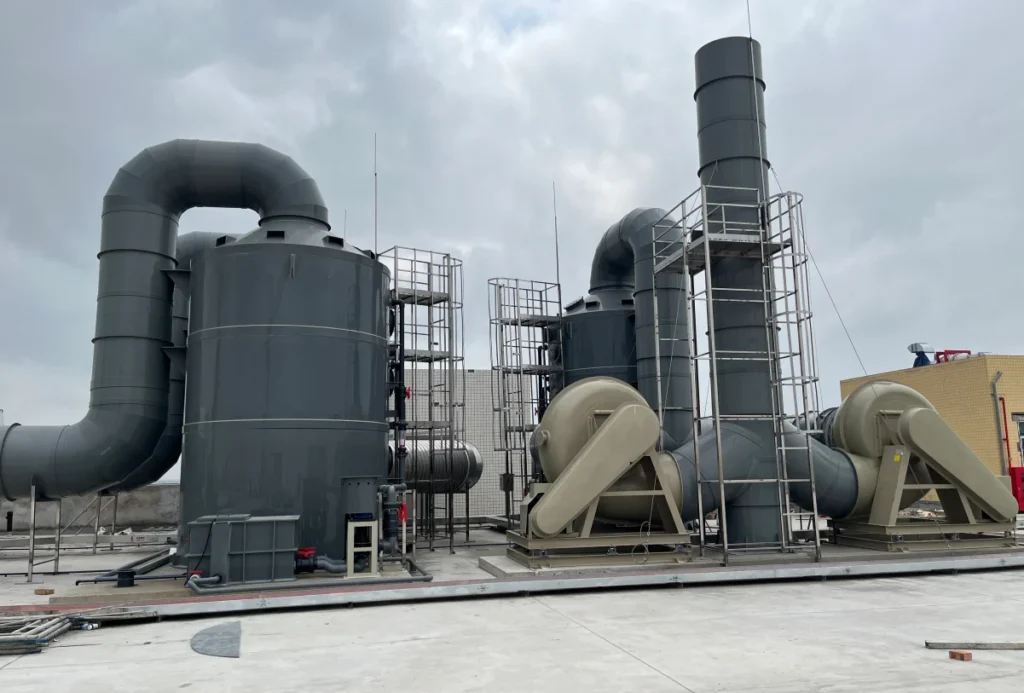
The baghouse vs wet scrubber efficiency comparison is one of the most important decisions in particulate control system design. In any baghouse vs wet scrubber efficiency comparison, the fundamental trade-off is between dry filtration efficiency and wet scrubbing versatility. A baghouse (fabric filter) captures particles by passing the gas stream through a layer of filter fabric, achieving 99.9%+ collection efficiency for all particle sizes regardless of the dust properties. A wet scrubber captures particles by impaction on liquid droplets, achieving 70-99% efficiency depending on the particle size, scrubber type, and pressure drop. The choice between them determines not only the achievable emission limit but also the operating temperature range, the sensitivity to dust moisture and stickiness, the fire and explosion safety, the water consumption, and the waste product (dry filter cake vs wet slurry). This guide provides an engineering comparison across these dimensions.
Key Takeaways
- The baghouse vs wet scrubber efficiency comparison shows a clear advantage for baghouses in fine particulate control: baghouses achieve 99.9%+ efficiency for all particle sizes above 0.1 um, while wet scrubbers vary from 70-99% depending on particle size, scrubber type, and pressure drop. For particles below 2 um, only a high-energy venturi scrubber (75-150 cm WC) approaches baghouse efficiency, but at an operating cost that is typically 5-10 times higher than a baghouse. For coarse particles above 10 um, a spray tower wet scrubber at low pressure drop can match baghouse efficiency.
- Wet scrubbers win decisively for high-temperature exhaust (above 260 deg C), sticky or hygroscopic dust that would blind baghouse filter media, and combustible or explosive dust where a baghouse’s dust layer and spark sources present a deflagration risk. Wet scrubbers can handle gas temperatures above 350 deg C with a quench section, while baghouses are limited to 260 deg C for standard fabrics and 290 deg C for Nomex or Ryton.
- The wet versus dry scrubber selection follows a simple rule: if the dust is dry, non-sticky, and at moderate temperature, a baghouse is almost always the more economical and efficient choice. If the dust is sticky, hygroscopic, combustible, or the gas is hot or contains soluble acid gases that must be removed simultaneously, a wet scrubber is the only practical choice despite its lower PM efficiency.
- A baghouse for a 10,000 m3/h system costs $50,000-150,000 installed with annual operating cost of $3,000-10,000. See our wet scrubber product range → and contact us → for application-specific recommendations.
How Baghouses and Wet Scrubbers Compare for Particulate Control
How a Baghouse Works – Dry Filtration
A baghouse passes the particle-laden gas through a layer of filter fabric – woven or felted bags – that captures particles on the surface and within the depth of the fabric. The gas velocity through the fabric is typically 1-3 m/min (3-9 ft/min) for pulse-jet baghouses. The collected dust accumulates on the bag surface as a filter cake, which itself becomes the primary filtration medium. The filter cake is periodically removed by a pulse of compressed air, a reverse-air flow, or a mechanical shaker. Baghouse collection efficiency exceeds 99.9% for particles larger than 0.1 um when the filter cake is intact. Baghouses are the standard PM control technology for coal-fired power plants, cement kilns, and industrial processes where the dust is dry, non-sticky, and at temperatures below 260 deg C.
How a Wet Scrubber Works – Wet Impaction
A wet scrubber contacts the particle-laden gas with liquid droplets (water or scrubbing solution). The particles impact the droplets by inertial impaction, are captured, and are washed into a collection sump. The collection efficiency depends on the relative velocity between gas and droplets and on the droplet size: a spray tower at 0.3-1.2 m/s gas velocity with 500-1,000 um droplets collects particles above 10 um at 70-90% efficiency; a venturi scrubber at 30-120 m/s throat velocity with 10-50 um droplets collects particles above 0.5 um at 95-99% efficiency. Wet scrubbers are the standard PM control technology for processes with sticky, hygroscopic, or combustible dust, for high-temperature exhaust above 260 deg C, and for simultaneous gas and particulate removal.
The Fundamental Difference – Dry Filter vs Wet Collector
The baghouse vs wet scrubber efficiency comparison centers on the fundamental difference between dry filtration and wet impaction. Dry filtration captures particles on a stationary filter medium that becomes more efficient as the filter cake builds – the cake itself becomes the filtering layer. Efficiency starts high and remains high regardless of particle size. Wet impaction captures particles on moving liquid droplets whose size and velocity determine the collection efficiency. Efficiency depends on particle size: large particles (>10 um) are captured at high efficiency; small particles (<1 um) require energy-intensive scrubber designs for high efficiency. The baghouse produces a dry collected dust that can be recycled or disposed of directly. The wet scrubber produces a wet sludge or slurry that requires dewatering before disposal.
Collection Efficiency Comparison by Particle Size
Efficiency Table – Sub-Micron to Coarse
The baghouse vs wet scrubber efficiency comparison is most clearly illustrated by the collection efficiency at different particle sizes. The fundamental mechanism of dry filtration through a filter cake gives baghouses a decisive advantage for fine particles.
| Particle Size | Baghouse (Pulse-Jet) | Spray Tower | Venturi (75 cm WC) | Cyclonic Wet |
|---|---|---|---|---|
| >10 um | 99.99%+ | 70-90% | 99%+ | 85-95% |
| 5-10 um | 99.99%+ | 40-70% | 98-99% | 60-85% |
| 1-5 um | 99.99%+ | 20-40% | 95-99% | 30-50% |
| 0.5-1 um | 99.9%+ | <20% | 80-95% | <20% |
| 0.1-0.5 um | 99.5-99.9% | <10% | 50-85% | <10% |
Baghouse 99.9%+ for All Sizes, Wet Scrubber Varies
The baghouse achieves 99.9%+ efficiency for all particles above 0.1 um because the filter cake is a depth filtration medium: particles smaller than the pore size are captured by Brownian diffusion within the cake structure. The wet scrubber’s efficiency varies because inertial impaction depends on particle mass: small particles follow gas streamlines around droplets and escape. A venturi scrubber at 75-150 cm WC can approach baghouse efficiency for particles above 0.5 um, but at an operating cost 5-10 times higher than the baghouse fan energy.
Why Baghouses Excel for Fine PM (0.1-5 um)
The baghouse’s efficiency across the fine PM range is unmatched by wet scrubbing. At 1 um, a baghouse achieves 99.99%+; a spray tower achieves 20-40%; a venturi at 75 cm WC achieves 95-99%. The difference is most pronounced in the 0.1-1 um range where wet scrubber efficiency drops to its lowest point (the Greenfield gap between impaction and diffusion). For a 10,000 m3/h source emitting 100 mg/Nm3 of fine PM at 1 um, a baghouse outlet would be below 0.01 mg/Nm3; a venturi scrubber would discharge 1-5 mg/Nm3; a spray tower would discharge 60-80 mg/Nm3.
When Wet Scrubbers Can Match Baghouse Efficiency
Wet scrubbers can match baghouse efficiency for coarse particles above 10 um. A spray tower at 5-10 cm WC achieves 70-90% efficiency, the same range as a baghouse at a lower capital cost. For applications where the dust is exclusively coarse (cement grinding, mineral processing, grain handling) and the particulate emission limit is above 50 mg/Nm3, a spray tower wet scrubber can be an economical alternative to a baghouse. For combined PM and gas removal where the gas must be scrubbed anyway, the wet scrubber’s PM removal is essentially free.
Temperature, Moisture, and Dust Property Constraints
Temperature Limits
The maximum continuous operating temperature for a baghouse is determined by the filter fabric material. Polyester bags are limited to 135 deg C, Nomex to 200 deg C, Ryton to 230 deg C, and fiberglass with PTFE membrane to 260 deg C. Above 260 deg C, no baghouse fabric is commercially viable. A wet scrubber handles inlet temperatures above 350 deg C by using a quench section that cools the gas to saturation (65-80 deg C) before it contacts the scrubber internals. The quench water flow is controlled by the outlet temperature. For a 10,000 m3/h exhaust at 300 deg C, the quench water requirement is approximately 1.0-1.5 m3/h. This fundamental temperature constraint often resolves the baghouse vs wet scrubber decision: if the gas exceeds 260 deg C, a baghouse is not an option.
Moisture and Sticky Dust – Wet Scrubber Advantage
Baghouses fail when the dust is hygroscopic, sticky, or contains condensible hydrocarbons. Sticky dust blinds the filter media: the dust adheres to the bag surface and cannot be removed by pulse-jet cleaning. The pressure drop increases, and the bag must be replaced prematurely – in severe cases, within weeks or months instead of 3-5 years. Condensible hydrocarbons (tars, oil mists) wet the bag surface and trap fine particles. Wet scrubbers handle sticky dust without issue because the dust particles are immediately wetted and washed into the sump before they can adhere to surfaces. Processes that generate sticky or hygroscopic dust – spray dryers, rendering plants, food processing, chemical reactors – are better served by wet scrubbers than baghouses.
Combustible Dust Safety – NFPA Compliance
NFPA standards (61, 484, 652, 664) require wet collection systems for specific combustible dusts because the wet environment eliminates the deflagration risk inherent in dry baghouses. A wet scrubber for combustible dust (aluminum, magnesium, zirconium, zinc, most organic food dusts) prevents flame propagation because the dust is submerged in water immediately upon capture. A baghouse for combustible dust requires deflagration venting, isolation valves, and explosion suppression systems that add significant capital cost.
Operating Cost and Maintenance Comparison
In the baghouse vs wet scrubber efficiency comparison, capital cost depends on the application. See our wet scrubber dust collector guide → for wet collection system details.
Capital Cost – Baghouse Lower for Dry, Non-Sticky Dust
A baghouse for a 10,000 m3/h system costs $50,000-150,000 installed, including the filter housing, bag cages, pulse-jet cleaning system, compressed air supply, and fans. A venturi wet scrubber for the same flow costs $80,000-200,000. A spray tower scrubber costs $40,000-120,000. The baghouse capital cost advantage is largest for small-to-medium flow rates where baghouses are standardized equipment. The wet scrubber requires additional equipment – recirculation pump, chemical feed system, mist eliminator, sump, blowdown treatment – that adds cost. However, when the dust is sticky, hot (above 260 deg C), or combustible, the baghouse requires expensive special materials that close the capital cost gap.
Energy Cost – Baghouse Fan Power vs Wet Scrubber
The baghouse vs wet scrubber efficiency comparison must account for energy cost. A pulse-jet baghouse operates at 10-20 cm WC pressure drop, requiring fan power of approximately 20-40 kW for a 50,000 m3/h system. A venturi scrubber at 75-100 cm WC requires 100-200 kW – 5x more. A spray tower at 3-5 cm WC requires 5-10 kW – 2-4x less than the baghouse. For a 10,000 m3/h system operating 8,000 h/year at $0.12/kWh: baghouse fan cost $8,000-12,000/year; venturi scrubber $40,000-80,000/year; spray tower $2,000-4,000/year. The baghouse vs wet scrubber efficiency comparison shows baghouse fan energy is lower than a venturi but may be higher than a spray tower for coarse dust.
Bag Replacement vs Scrubber Maintenance Costs
Baghouse filter bags are replaced every 3-5 years at $500-1,500 per bag (a 10,000 m3/h system has 100-300 bags, costing $15,000-75,000 per replacement). Wet scrubber maintenance costs are dominated by recirculation pump seal replacement ($500-2,000 every 2-5 years), nozzle replacement ($200-500 per nozzle, 5-20 nozzles, every 1-3 years), and chemical reagent costs. The annual maintenance cost for a baghouse in non-sticky service is $3,000-10,000/year; for a wet scrubber it is $5,000-15,000/year. The key difference is the magnitude of the periodic replacement cost: a baghouse bag change is a $50,000 event every 4 years; a wet scrubber component replacement is a $2,000-5,000 event every 2-3 years. This makes the wet scrubber’s annual cost more predictable and easier to budget.
10-Year Total Cost of Ownership
| Cost Component | Baghouse (10,000 m3/h) | Venturi Scrubber | Spray Tower |
|---|---|---|---|
| Equipment + installation | $80,000 | $120,000 | $60,000 |
| 10-year energy | $100,000 | $500,000 | $30,000 |
| 10-year maintenance | $70,000 | $80,000 | $50,000 |
| Bag replacements (2x) | $60,000 | $0 | $0 |
| Water + chemical | $0 | $40,000 | $20,000 |
| 10-year Total | $310,000 | $740,000 | $160,000 |
The 10-year total for a baghouse vs wet scrubber efficiency comparison shows that the venturi scrubber is 2.4x more expensive than a baghouse over 10 years for the same flow. The spray tower for coarse dust is 1.9x less expensive than a baghouse. The selection must consider both the PM efficiency required and the full economic picture.
Baghouse vs Wet Scrubber – Selection Decision Tree
The 6 Key Questions Before Choosing
The baghouse vs wet scrubber efficiency comparison decision tree helps avoid costly mistakes. For the broader comparison, see our dry scrubber vs wet scrubber guide →.
The baghouse vs wet scrubber efficiency comparison is resolved by answering six questions in order:
1. Exhaust temperature? Above 260 deg C -> wet scrubber only. Below 260 deg C -> proceed to next question.
2. Is the dust sticky, hygroscopic, or oily? Yes -> wet scrubber. No -> proceed.
3. Is the dust combustible (NFPA-defined)? Yes -> wet scrubber (safer and simpler than explosion-proof baghouse). No -> proceed.
4. Is the required PM limit below 20 mg/Nm3? Yes -> baghouse (99.9%+ efficiency assured). No -> proceed.
5. Does the exhaust also contain soluble acid gases? Yes -> wet scrubber for combined removal. No -> proceed.
6. Is water available and wastewater discharge permitted? No -> baghouse. Yes -> wet scrubber is feasible.
When Baghouse Is the Correct Choice
A baghouse is the correct choice when the exhaust temperature is below 260 deg C, the dust is dry and non-sticky, the dust is not combustible (or explosion protection is provided), the PM limit is below 20 mg/Nm3 requiring high-efficiency fine PM collection, water supply is limited or wastewater discharge is prohibited, and the dust has value as a dry product that would be lost in a wet slurry.
When Wet Scrubber Is the Correct Choice
A wet scrubber is the correct choice when the exhaust temperature exceeds 260 deg C, the dust is sticky, hygroscopic, or oily, the dust is combustible and water provides inherent safety, the exhaust also contains acid gases that must be removed simultaneously, water is available and wastewater treatment is feasible, or the process generates sticky or tar-like particulates that would blind baghouse media.
Frequently Asked Questions
What is the difference between a baghouse and a wet scrubber for particulate control?
A baghouse uses dry fabric filtration: the particle-laden gas passes through a filter fabric, and particles are captured on the surface and within the filter cake. A wet scrubber uses liquid droplets: particles impact the droplets and are washed into a sump. The baghouse vs wet scrubber efficiency comparison shows baghouses achieve 99.9%+ efficiency for all particle sizes. Wet scrubbers achieve 70-99% depending on particle size and type.
Which is more efficient – baghouse or wet scrubber?
For fine particulate (0.1-5 um), a baghouse is significantly more efficient (99.9%+ vs 20-95% for wet scrubbers, depending on the scrubber type). For coarse particulate above 10 um, a spray tower wet scrubber can match baghouse efficiency at 70-90% removal. The efficiency gap is widest for sub-micron particles.
Can a wet scrubber replace a baghouse?
Yes, in applications where the dust is coarse (>10 um) or where simultaneous gas removal is required and the permit allows lower PM efficiency. A wet dry scrubber comparison should consider the full operating context: temperature, dust properties, water availability, and waste disposal method, not just PM efficiency.
What is a wet dry scrubber system?
A wet dry scrubber system refers to the choice between wet scrubbing (using liquid) and dry scrubbing (using dry sorbent). In the particulate control context, a dry system is a baghouse or ESP; a wet system is a wet scrubber. The choice depends on the dust temperature, moisture content, stickiness, and combustibility.
What temperature limits apply to baghouses and wet scrubbers?
Baghouses are limited to 260 deg C for standard fabrics (fiberglass with PTFE membrane), with absolute maximum of 290 deg C for Nomex or Ryton. Wet scrubbers handle gas above 350 deg C with a water quench section that cools the gas to saturation before it contacts the wet scrubber internals.