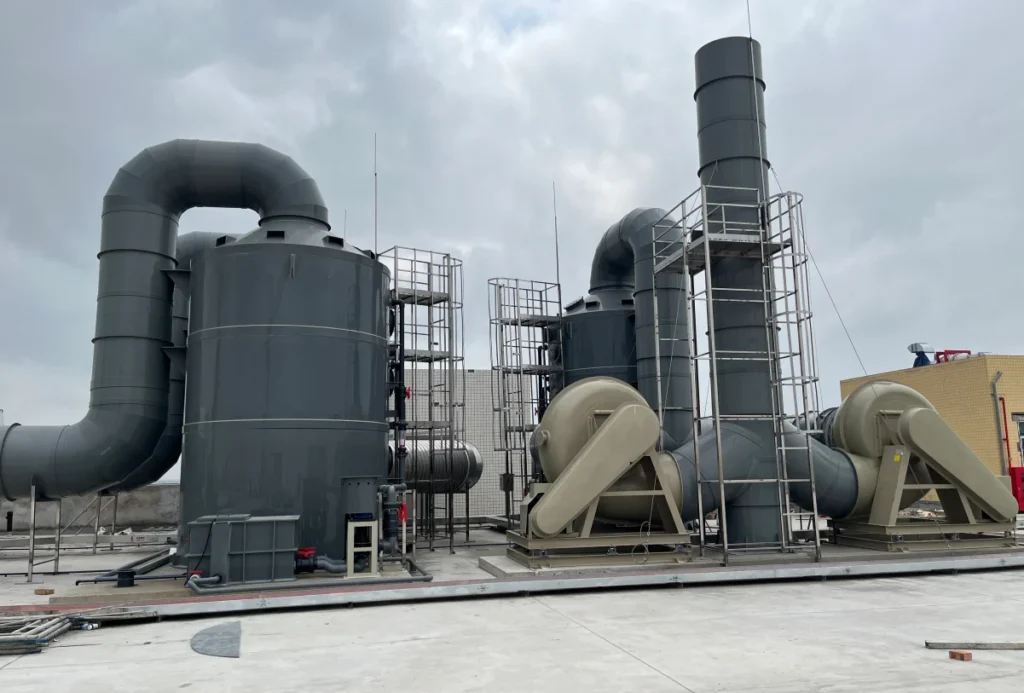
An engineer tasked with controlling industrial dust emissions has fundamentally different options depending on the dust itself. Dry dust that is coarse, dry, and non-hazardous can be collected in a baghouse or cyclone. But wet, sticky, hot, hygroscopic, or combustible dust – metal grinding fines, cement kiln dust, food processing powder, foundry fume – must be handled differently. A wet scrubber dust collector uses water to capture particles by inertial impaction, interception, and diffusion, collecting them as a slurry rather than a dry powder. This eliminates the fire and explosion hazards of dry collection and handles gas streams that would blind or burn fabric filters. This guide covers the types, performance characteristics, applications, and selection of wet scrubber dust collectors.
Key Takeaways
- A wet scrubber dust collector is the only practical choice for combustible dusts, high-temperature exhaust above 260 deg C, sticky or hygroscopic dusts, and gas streams requiring combined particulate and gas removal. For dry, non-sticky, non-combustible dust at moderate temperature, a baghouse or ESP achieves higher filtration efficiency at lower operating cost.
- The particle size distribution determines the scrubber type. Spray towers (0.3-1.2 m/s, <2.5 cm WC) handle coarse dust above 10 um. Cyclonic scrubbers (2-4 m/s, 5-15 cm WC) capture 5-10 um dust. Venturi scrubbers (30-120 m/s throat, 25-100+ cm WC) achieve 95-99% collection for sub-5 um dust. Selecting the minimum energy level that meets the permit limit avoids unnecessary operating costs.
- The most difficult particle size range for wet scrubbers is 0.1-0.5 um, where collection efficiency reaches a minimum. In this range, neither inertial impaction nor Brownian diffusion dominates. Bridging the gap requires either high-energy venturi operation or condensation enhancement. This is the physical limit of wet scrubbing technology. For dust collection systems, see our industrial wet scrubbers → and wet scrubber system products →.
- Solids handling and slurry management are integral to wet dust collector design. The blowdown rate, settling tank size, and nozzle abrasion protection must be designed for the specific dust loading and particle characteristics. For abrasive dusts (silica, cement, iron oxide), the venturi throat and high-velocity sections require replaceable wear liners of silicon carbide or alumina ceramic.
What Is a Wet Scrubber Dust Collector?
A wet scrubber dust collector is any wet scrubber designed primarily to remove particulate matter (see our venturi wet scrubber guide → for high-energy dust collection). While most wet scrubbers remove some particulate as a secondary function, a wet dust collector is configured – through its vessel design, nozzle selection, and operating conditions – to maximize particle collection efficiency for a target particle size range.
How Wet Dust Collection Differs from Dry (Baghouse, ESP)
Wet dust collectors capture particles in a liquid slurry instead of on a filter media surface. This fundamental difference creates several operational advantages:
No filter media blinding. Sticky, hygroscopic, or tarry particles that would blind fabric filter bags within hours pass through a wet scrubber without accumulating on the capture surface. The particles are immediately wetted and flushed into the sump. This is the single most important advantage of wet collection over dry.
No explosion risk. Combustible metal dusts (aluminum, magnesium, titanium), organic dusts (grain, sugar, coal), and reactive chemical dusts are collected in an inert water environment. A wet dust scrubber eliminates the risk of dust deflagration that is inherent in dry baghouse collection.
High-temperature capability. Wet scrubbers handle inlet gas temperatures above 350 deg C that would destroy fabric filter bags or damage electrostatic precipitator internals. The water spray quenches the gas to its saturation temperature, protecting downstream equipment.
Simultaneous gas and particulate removal. A wet scrubber can collect particulate and absorb soluble acid gases in the same vessel. A baghouse or ESP removes only particulate and requires a separate scrubber for gas removal. EPA treats acid gas absorption and particulate collection as two applications of the same device class, and its cost manual covers the gas-absorption side in a separate chapter (EPA Cost Manual, Section 5.2, Chapter 1: Wet Scrubbers for Acid Gas).
The Three Mechanisms of Wet Particle Collection
Inertial impaction dominates for particles above 1 um. The particle’s inertia crosses gas streamlines and impacts a liquid droplet. The collection efficiency increases with the relative velocity between gas and droplet.
Interception captures particles that follow streamlines that pass within one particle radius of a droplet surface. EPA’s cost manual places the interception-dominated band at roughly 1.0 to 0.1 um in diameter, with impaction governing particles above 10 um and diffusion below 0.1 um (EPA Air Pollution Control Cost Manual, Section 6, Chapter 2: Wet Scrubbers) – which is the same band in which the combined efficiency curve is weakest.
Diffusion (Brownian motion) dominates for particles below 0.1 um. Random molecular collisions drive the particle into contact with the droplet surface. Diffusion efficiency increases as particle size decreases.
EPA’s cost manual describes the same division of labour: particles above 10 um are collected mainly by impaction, particles of roughly 1.0 to 0.1 um by interception, and particles below 0.1 um by diffusion (EPA Cost Manual, Section 6, Chapter 2: Wet Scrubbers).
Inertial Impaction, Interception, Diffusion
The three mechanisms operate simultaneously, and the combined collection efficiency curve has a characteristic dip between 0.1 and 0.5 um where neither impaction nor diffusion is fully effective. This “Greenfield gap” is where the most difficult-to-collect particles exist and where high-energy venturi scrubbers are required.
When a Wet Scrubber Is the Only Practical Dust Collector
Wet scrubbers are the only practical choice for combustible metal dusts, high-temperature exhaust above 260 deg C, hygroscopic dusts that deliquesce and blind filters, and gas streams containing both fine particulate and soluble acid gases.
Types of Wet Scrubber Dust Collectors
The choice of wet scrubber type for dust collection depends on the particle size distribution, the required removal efficiency, and the available fan pressure budget. The four main types span the full range from coarse to sub-micron particles.
Spray Tower – Low Energy, Coarse Dust
A spray tower is the simplest and lowest-energy wet dust collector. Gas rises at 0.3-1.2 m/s through an open chamber while water sprays downward from multiple levels. The collection mechanism is inertial impaction on falling droplets.
Spray towers are effective for particles above 10 um, achieving 70-90% collection efficiency at pressure drops below 2.5 cm WC. They are the preferred choice for high dust loadings where plugging resistance is the primary design criterion. EPA notes that spray tower wet scrubbers are not as prone to fouling as other wet scrubber designs, but that capturing fine particulate can require very high liquid-to-gas ratios (EPA-452/F-03-016). A wet dust scrubber of the spray tower type is typically used as a pre-cleaner ahead of a more efficient collector.
Venturi Scrubber – High Energy, Sub-Micron Dust
The venturi scrubber is the highest-efficiency wet scrubber dust collector type, capable of 95-99% collection down to about 1 um and 80-95% in the 0.5-1 um band, where even this design begins to run into the minimum-efficiency region. The gas accelerates to 30-120 m/s in the throat, atomizing the scrubbing liquid into 10-50 um droplets. The high relative velocity between gas and droplets drives inertial impaction for particles as small as 0.2 um.
The trade-off is pressure drop: venturi scrubbers operate at 25-100+ cm WC, requiring 10-25 times the fan power of a spray tower. EPA describes the venturi as the most common high energy wet scrubber and notes that the same device can also be run as a medium energy scrubber by reducing the throat velocity (EPA: Monitoring by Control Technique – Wet Scrubber for Particulate Matter). The venturi is selected when the particle size distribution includes a significant sub-10 um fraction that must be collected at high efficiency.
A wet scrubber dust collection system using a venturi typically includes a water recirculation pump, a settling tank for solids removal, and a cyclone demister at the outlet.
Packed Bed and Impingement Scrubbers
Packed bed scrubbers collect dust by forcing the gas through a wetted packing media where particles impact the wetted surfaces. The tortuous gas path through the packing increases the probability of particle contact with the liquid film. Packed beds are a modest particulate collector: the efficiency table later in this guide puts them at roughly 50-80 percent above 10 um and only 20-50 percent in the 1-10 um band. EPA’s cost manual states the reason plainly – packed towers are most often used for gas adsorption rather than PM removal, because high particle concentrations build up on the packing and clog the tower (EPA Cost Manual, Section 6, Chapter 2), and its fact sheet for the device concludes that packed-bed scrubbers are in general more suitable for gas scrubbing than for PM scrubbing, since plugging is a serious problem when the packing is harder to access and clean than in other scrubber designs (EPA-452/F-03-015).
Impingement scrubbers (also called baffle scrubbers) direct the gas at high velocity into a liquid bath or against a wetted target plate. The dust-laden gas impacts the liquid surface, and the particles are captured by the liquid. Impingement scrubbers are simple and low-maintenance but are limited to coarse dust above 10 um. EPA’s cost manual is blunt about the ceiling: tray towers do not effectively remove submicron particles, though collection efficiencies of 97% are possible for particles larger than 5 um, and because they also absorb soluble gases they suit streams carrying both particulate and gaseous pollutants (EPA Cost Manual, Section 6, Chapter 2).
Cyclonic and Dynamic Wet Scrubbers
Cyclonic wet scrubbers add a tangential gas inlet that spins the gas stream. The centrifugal force drives particles to the wetted vessel wall, where they are captured by the liquid film. A cyclonic wet scrubber operates at 2-4 m/s gas velocity – higher than a spray tower – and collects particles above 10 um at 85-95% efficiency and 60-85% in the 5-10 um band. EPA’s cost manual records the same pattern – cyclonic spray towers reach efficiencies as high as 95% for particles greater than 5 um, but fall to 60-75% for submicron particles (EPA Cost Manual, Section 6, Chapter 2).
Dynamic wet scrubbers use a motor-driven impeller that spins within the scrubber vessel, creating a high-velocity gas zone that atomizes the scrubbing liquid and throws droplets and captured particles outward. Dynamic scrubbers are compact and self-contained but the impeller is subject to erosion and balancing problems in abrasive dust service.
Collection Efficiency by Particle Size
The particle collection efficiency of a wet scrubber dust collector is not a single number; it varies dramatically with particle size, scrubber type, and pressure drop. Understanding this relationship is essential for selecting the correct scrubber type for a given dust.
Efficiency Curves – Coarse, Fine, Sub-Micron
| Particle Size | Spray Tower | Packed Bed | Cyclonic | Venturi (75 cm WC) |
|---|---|---|---|---|
| >10 um | 70-90% | 50-80% | 85-95% | 99%+ |
| 5-10 um | 40-70% | 30-50% | 60-85% | 98-99% |
| 1-5 um | 20-40% | 20-30% | 30-50% | 95-99% |
| 0.5-1 um | <20% | <10% | <20% | 80-95% |
| 0.1-0.5 um | <10% | <10% | <10% | 50-85% |
The table reveals the fundamental decision rule: if the dust has a significant fraction below 5 um, a venturi scrubber is the only wet scrubber type that can achieve high removal efficiency. For dust exclusively above 10 um, a spray tower or cyclonic scrubber matches venturi performance at a fraction of the energy cost.
The 0.1-0.5 um Efficiency Gap
Particles between approximately 0.1 and 0.5 um are the most difficult for wet scrubbers to collect. In this size range, neither inertial impaction (which dominates above 1 um) nor Brownian diffusion (which dominates below 0.1 um) is fully effective. The collection efficiency curve reaches a minimum in this range – sometimes called the “Greenfield gap” – where even high-energy venturi scrubbers may achieve only 50-70% efficiency.
Bridging this gap requires either increasing the pressure drop to push the impaction efficiency deeper into the sub-micron range, or using condensation enhancement (injecting steam to cause water vapor to condense on the particles, increasing their effective mass and making them collectable by impaction).
How Pressure Drop and Energy Input Drive Efficiency
The EPA classifies wet scrubbers by energy level. A low energy scrubber runs at pressure drops below 5 inches of water column and removes particles larger than about 5-10 um; a medium energy scrubber runs from 5 to 25 inches of water column and handles micrometer-sized particles but is not very efficient on sub-micrometer particles; and a high energy scrubber runs from 25 to over 100 inches of water column, which is what sub-micrometer removal requires (EPA: Monitoring by Control Technique – Wet Scrubber for Particulate Matter). Those bands are 12.5, 63 and 250+ cm WC, which is the pressure drop column below. EPA also notes that most wet scrubbing systems operate with particulate collection efficiencies over 95 percent, and that the primary performance indicators are pressure differential, liquid flow rate and scrubber liquid outlet concentration:
| Energy Class | Pressure Drop | Best Particle Size | Annual Fan Cost* |
|---|---|---|---|
| Low energy | <12.5 cm WC | >10 um | $5,500 |
| Medium energy | 12.5-63 cm WC | 5-10 um | $15,000-28,000 |
| High energy | 63-250+ cm WC | 0.5-5 um | $93,000-140,000 |
*Based on 50,000 m3/h, $0.12/kWh, 8,000 h/yr
For a wet scrubber dust collector, the energy cost is directly proportional to the collection efficiency requirement. Specifying the minimum pressure drop that meets the permit limit – rather than designing for “the best available” – avoids wasting energy on unnecessary collection of particles that the regulation does not require to be captured.
EPA Energy Classification: Low/Medium/High Energy
The EPA classification provides a starting point for technology selection. A spray tower (low energy) is adequate for coarse dust. A cyclonic or packed bed scrubber (medium energy) bridges the gap for 5-10 um dust. A venturi (high energy) is required for sub-5 um dust. The energy class directly determines the fan operating cost over the equipment’s 10-15 year life.
Advantages and Limitations vs Dry Collectors
The choice between wet and dry dust collection is rarely about which technology is universally better. It is about matching the technology to the specific dust properties and operating conditions.
Where Wet Collectors Win
High-temperature gas streams. Dry fabric filters are limited to approximately 260 deg C (500 deg F) with fiberglass, the most heat-resistant of the commonly used media, and to about 190 deg C (375 deg F) with aramid (Nomex) felt (EPA Cost Manual, Section 6, Chapter 1: Baghouse and Filters). Above these temperatures, the bags fail. Wet scrubbers handle inlet temperatures above 350 deg C because the water spray quenches the gas to saturation temperature within the first meter of contact.
Sticky, hygroscopic, and tarry dusts. Dust from food dryers, resin manufacturing, asphalt plants, and chemical processes contains oils, sugars, or moisture that causes particles to adhere to filter media. A dust scrubber system washes these particles into a liquid slurry instead of accumulating them on a media surface.
Combustible dusts. Aluminum, magnesium, titanium, and zirconium dusts are explosive in dry collection systems. NFPA 484, Standard for Combustible Metals, and NFPA 652, Standard on the Fundamentals of Combustible Dust, are the consensus standards that cover collection of these dusts; OSHA lists NFPA 484 among its combustible dust consensus standards while noting that such standards are guidance rather than OSHA regulations (OSHA: Combustible Dust – Consensus Standards). Wet collection is the practical answer for reactive metal dusts, because a dust kept submerged in water cannot form the suspended cloud a deflagration needs. A wet scrubber dust collector provides inherently safe operation because the dust is submerged in water continuously.
Gas streams with condensible organics. Vapor-phase organic compounds that condense on cooling can blind fabric filters by forming a sticky coating on bag surfaces. A wet scrubber captures the droplets formed during condensation without media blinding.
Simultaneous particulate and gas removal. When the exhaust contains both fine dust and acid gases, a single wet scrubber removes both. This eliminates the capital cost of separate collection and scrubbing systems.
Where Dry Collectors Win
Dry product recovery. If the collected dust has value as a dry product (metal powders, food ingredients, catalyst fines), a baghouse or cyclone that collects the dust in dry form is preferred over a wet scrubber that produces a slurry requiring dewatering.
Lower operating cost for dry, non-hazardous dust. A baghouse operating on clean, dry, non-sticky dust at moderate temperature has a lower total annual operating cost than a wet scrubber handling the same dust. The baghouse fan power is typically one-fifth that of an equivalent venturi scrubber.
Lower water consumption and wastewater treatment. Wet scrubbers consume water for evaporation and blowdown. The blowdown requires treatment before discharge. A baghouse produces no liquid waste.
Comparison Table – Wet vs Baghouse vs ESP
| Factor | Wet Scrubber | Baghouse | ESP |
|---|---|---|---|
| Max temperature | 350+ deg C | 260 deg C | 400 deg C |
| Fine PM efficiency | 50-99% (varies) | 99.9%+ | 99-99.9% |
| Combustible dust safe | Yes | No (explosion risk) | No |
| Sticky/hygroscopic | Yes | No (blinds) | Limited |
| Gas removal | Combined | Separate needed | Separate needed |
| Operating cost (50k m3/h) | $5,500-140,000/yr | $5,000-15,000/yr | $3,000-10,000/yr |
| Waste stream | Liquid slurry | Dry solids | Dry solids |
Industrial Applications
Mining, Quarrying, and Mineral Processing
Mining and mineral processing operations generate dust from crushing, grinding, screening, and conveying. The dust is typically coarse (50-200 um), abrasive (silica content), and generated at high volume. A spray tower or cyclonic wet scrubber at low-to-medium pressure drop achieves 80-95% removal at low operating cost.
An industrial wet particulate dust scrubber in mining service must be designed for the high slurry solids loading. A dust scrubber system for mining includes a settling tank or clarifier sized to handle 1-5% solids by weight. A drag chain conveyor removes the settled solids as a dewatered cake.
Metals – Steel, Aluminum, Foundries
Steelmaking dust sources include basic oxygen furnaces (BOF), electric arc furnaces (EAF), and secondary metallurgy. The dust is fine (0.1-10 um), hot (150-400 deg C), and contains iron oxide, zinc oxide, and volatile metal compounds. A venturi scrubber at 75-150 cm WC achieves 95-99% removal.
Aluminum smelting generates fluoride dust and fume at 80-120 deg C. A spray tower wet scrubber achieves 90-95% removal of the fluoride dust while simultaneously absorbing HF gas. The wet scrubber dust collection system for aluminum potlines must be constructed from FRP because the fluoride-laden water is corrosive to steel.
Foundry dust from sand systems, pouring lines, and finishing operations contains silica, clay, and resin binders. The dust can be sticky when the resin binders condense on cool surfaces. A venturi scrubber with a flooded elbow prevents buildup in the gas inlet.
Cement, Lime, and Gypsum
Cement kiln dust is fine (0.5-20 um), abrasive, and hot (200-350 deg C). The dust also contains alkali compounds that are hygroscopic and cause blinding in baghouses. A venturi scrubber with wetted-throat design is the standard wet collection technology for cement kiln exhaust. The throat velocity of 60-90 m/s provides 95-99% collection at 50-100 cm WC pressure drop.
Chemical, Food, and Pharmaceutical Dust
Chemical processing generates dust that is often reactive, toxic, or soluble in water. A wet scrubber captures the dust while simultaneously neutralizing any soluble acidic or alkaline components. The resulting slurry is sent to wastewater treatment.
Food processing dust – flour, starch, sugar, protein powder – is combustible and hygroscopic. Where the dust loading in the duct or collector can reach the explosible range, wet collection removes the suspended cloud that a dry-system deflagration requires (OSHA: Combustible Dust). A spray tower or low-velocity venturi at 25-50 cm WC provides adequate collection for food dust above 10 um.
Design Parameters for Wet Dust Collectors
Gas Velocity and Tower Sizing
The gas velocity through the scrubber cross-section determines the vessel diameter. For spray towers, the velocity is 0.3-1.2 m/s. For venturi scrubbers, the throat velocity is 30-120 m/s. For cyclonic scrubbers, the superficial velocity is 2-4 m/s.
A wet scrubber dust collector handling 50,000 m3/h of dusty exhaust requires specific diameter calculations. A wet scrubber dust collection system that includes a spray tower at 0.8 m/s needs a 4.7 m diameter vessel.
The velocity selection affects not only the vessel cost but also the particle cut size. For venturi scrubbers, the cut size is inversely proportional to the square of the throat velocity.
L/G Ratio and Water Recirculation
The liquid-to-gas ratio for particulate collection in wet scrubbers is typically 0.4-1.3 L/m3 (3-10 gal/1,000 ft3). That range describes the impaction-driven designs, where the gas stream does the atomizing. Where the only contacting mechanism is a spray droplet in an open chamber, EPA’s cost manual records the opposite trade-off: fine-PM spray towers need liquid-to-gas ratios above 20 gal/1,000 ft3, about 2.7 L/m3, and it is that liquid flow rather than fan power that dominates their operating cost (EPA Cost Manual, Section 6, Chapter 2). Below 0.4 L/m3, there is insufficient liquid to cover the scrubber cross-section, and some dust passes through without being captured. Above 1.3 L/m3, additional liquid provides diminishing efficiency gains while increasing pumping power.
For a venturi scrubber at 1.0 L/m3 handling 50,000 m3/h:
Recirculation rate: 50,000 x 1.0 = 50,000 L/h = 50 m3/h
The recirculation pump is sized for this flow at a pressure of 2-5 bar, requiring 7-15 kW motor power.
Slurry Handling and Blowdown
The collected dust accumulates in the recirculating water. The solids concentration in the sump is controlled by the blowdown rate and the solids removal system:
Blowdown rate = Dust collection rate / Target slurry concentration
For a dust collection rate of 100 kg/h at 5% target slurry concentration:
Blowdown = 100 / 0.05 = 2,000 L/h = 2 m3/h
The blowdown stream is sent to a settling tank or clarifier where the solids settle. The clarified water is returned to the scrubber. The settled solids are removed as a sludge typically at 15-30% solids content and dewatered further in a filter press or centrifuge before disposal.
Material Selection for Abrasive Dust Service
Abrasive dusts – silica, alumina, iron oxide, cement – cause erosion at gas velocities above 15 m/s. The venturi throat and any ductwork where gas velocity exceeds 15 m/s must be lined with abrasion-resistant materials:
- Silicon carbide tile for severe abrasive service
- Alumina ceramic tile for moderate abrasive service
- Replaceable rubber or urethane liners for light service
FRP vessels without abrasion-resistant liners should not be used for abrasive dust service. The glass fibers exposed by abrasion wick moisture into the laminate, causing delamination within months.
Wet Scrubber Dust Collection System – Operation and Maintenance
Solids Removal – Settling Tanks, Cyclones, Filters
The captured dust must be continuously or periodically removed from the recirculating water to maintain scrubber performance. Three methods are used:
EPA’s cost manual lists the same three families – filters, liquid cyclones and settling tanks – and stresses that because the scrubbing liquid is recycled, its solids content rises as PM is collected and must be held below a design limit or the spray characteristics of the system cannot be maintained (EPA Cost Manual, Section 6, Chapter 2).
Settling tanks are the simplest and most common method. The scrubber blowdown enters a tank sized for 30-60 minutes of retention time. Coarse solids settle to the bottom and are removed by a drag chain conveyor. The overflow is returned to the scrubber. Settling tanks work well for particles above 20 um. Below 20 um, the settling velocity is too slow for practical tank sizes.
Hydrocyclones separate particles down to approximately 10 um by centrifugal force in a conical vessel. The underflow containing the concentrated solids is sent to a filter press or centrifuge. The overflow is returned to the scrubber. Hydrocyclones have no moving parts and require minimal maintenance.
Clarifiers and filters use settling (lamella plate clarifiers) or filtration (pressure filters, vacuum filters) to remove particles below 10 um. These are required when the dust is fine and the scrubber water quality must be high to prevent nozzle plugging.
Nozzle Erosion and Inspection
Erosion from abrasive dust particles in the recirculating water gradually enlarges spray nozzle orifices. An enlarged orifice produces larger droplets (reducing collection efficiency) and consumes more water. The nozzle erosion rate depends on the solids concentration and the particle hardness.
Inspect nozzles every 2-3 months in abrasive dust service. Replace brass or stainless steel nozzles when the orifice diameter has increased by 15% from the as-new dimension. For extreme abrasive service, tungsten carbide or silicon carbide nozzle inserts provide 5-10x the service life of stainless steel.
Combustible Dust Safety in Wet Collectors
NFPA standards (652, 484) require wet collection systems for combustible dusts to be designed with specific safety features:
- Dust accumulation monitoring. The sump solids concentration must be maintained below the level at which the wetted dust could dry out and become airborne.
- Level control. The water level in the sump must be maintained above the gas inlet to ensure that all collected dust remains submerged.
- Over-temperature protection. A temperature sensor above the water level activates an emergency water spray if the gas temperature indicates a fire condition.
- Slurry removal. Collected solids must be removed from the system on a schedule that prevents accumulation above the safe operating level.
For aluminum and other reactive metal dusts, the scrubber water chemistry must be maintained at near-neutral pH (6-8) to prevent hydrogen generation from the metal-water reaction.
Note on cost and design figures. The annual fan cost column, recirculation pump power, blowdown rate, settling tank retention time, hydrocyclone cut size, nozzle wear criterion and inspection interval quoted in this guide are Xicheng engineering estimates and typical vendor ranges, not published price or performance data. The fan cost figures are calculated for 50,000 m3/h at 8,000 h/yr and $0.12/kWh with an assumed overall fan efficiency of roughly 50-70 percent, which is why they are presented as illustrative bands rather than precise values; the pressure drop bands they are keyed to, however, are EPA’s published energy classification (EPA). The particle size efficiency table gives typical ranges for the stated pressure drop and particle size band, not guarantees for a specific gas stream. Blowdown and slurry volumes assume a slurry density of about 1 kg/L. Verified facts carry an inline link and appear under Sources at the end of this article; everything else is engineering judgement.
Frequently Asked Questions
What is a wet scrubber dust collector?
A wet scrubber dust collector is a wet scrubber designed primarily to remove particulate matter from an industrial gas stream. It captures particles by impaction, interception, or diffusion into water droplets or a liquid film. The collected dust is discharged as a slurry rather than a dry powder.
When should I choose a wet scrubber over a baghouse?
Choose a wet scrubber when the gas temperature exceeds 260 deg C (the baghouse limit), when the dust is sticky, hygroscopic, or combustible, when the gas contains condensible organics that would blind filter bags, or when simultaneous gas and particulate removal is required. Choose a baghouse when the dust is dry, non-sticky, and non-combustible, and when dry product recovery is important.
What particle sizes can a wet scrubber dust collector remove?
Spray towers remove particles above 10 um at 70-90% efficiency. An industrial wet particulate dust scrubber of the venturi type removes particles above 0.5 um at 90-99%. The most difficult particle size range is 0.1-0.5 um.
How do I prevent nozzle plugging in a wet dust scrubber?
Use open-nozzle designs (spiral nozzles with 5-10 mm free passage), install a side-stream filter to remove particles above the nozzle’s minimum passage size, and maintain the recirculating water solids concentration below 5% by weight. For heavily contaminated water, use a wetted-throat venturi design that does not rely on spray nozzles.
Is a wet scrubber safe for combustible dust?
Yes. Wet scrubbers are the safest collection technology for combustible dusts because the captured dust is continuously submerged in water. The water keeps the captured dust below the concentration at which a deflagration can propagate, and it acts as a heat sink in the sump. Aluminum, magnesium and the other reactive metal dusts are collected wet for exactly that reason (OSHA: Combustible Dust).
Sources
- U.S. EPA, Office of Air Quality Planning and Standards – Air Pollution Control Cost Manual, Section 6, Chapter 2: Wet Scrubbers (particulate control; scrubber types, collection mechanisms, efficiency by particle size, liquid-to-gas ratios, solids removal).
- U.S. EPA, Office of Air Quality Planning and Standards – Air Pollution Control Cost Manual, Section 6, Chapter 1: Baghouse and Filters (Table 1.6, properties of leading fabric materials, including maximum temperature by media).
- U.S. EPA, Air Emissions Monitoring Knowledge Base – Monitoring by Control Technique: Wet Scrubber for Particulate Matter (low / medium / high energy classification and pressure drop bands).
- U.S. EPA – EPA-452/F-03-015, Air Pollution Control Technology Fact Sheet: Packed-Bed / Packed-Tower Wet Scrubber.
- U.S. EPA – EPA-452/F-03-016, Air Pollution Control Technology Fact Sheet: Spray-Chamber / Spray-Tower Wet Scrubber.
- U.S. EPA – EPA-452/F-03-017, Air Pollution Control Technology Fact Sheet: Venturi Scrubber.
- U.S. EPA, Office of Air Quality Planning and Standards – Air Pollution Control Cost Manual, Section 5.2, Chapter 1: Wet Scrubbers for Acid Gas.
- U.S. OSHA – Combustible Dust: An Explosion Hazard and Consensus Standards (NFPA 484, 61, 654, 655, 664; note that consensus standards are guidance, not OSHA regulations).