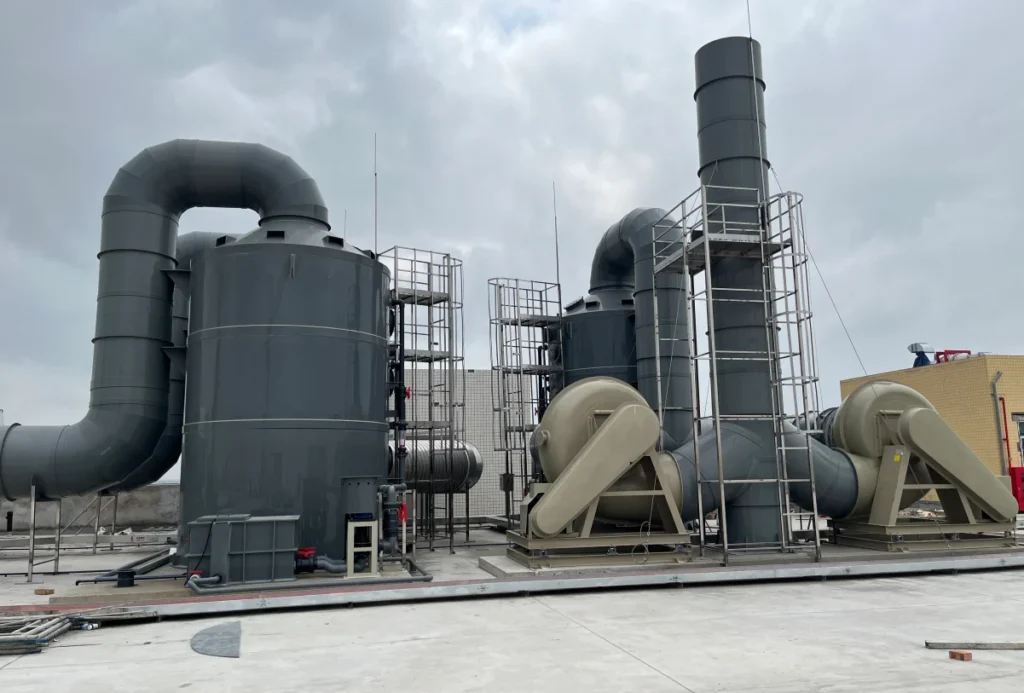
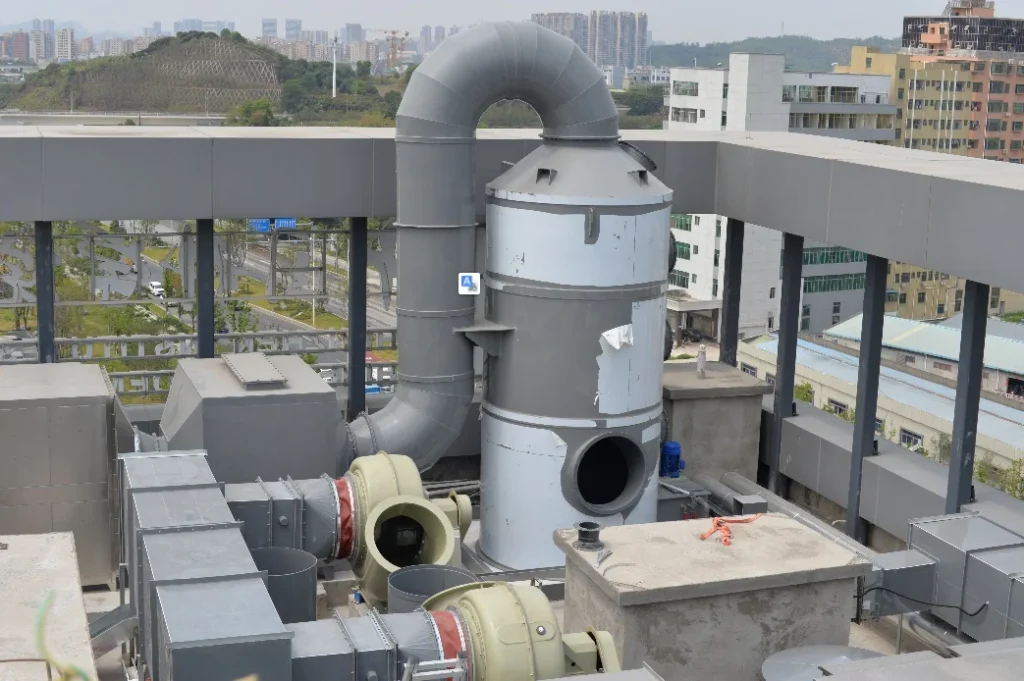
Particulate matter is not a single pollutant. It ranges from coarse dust above 50 um generated by mechanical processes to sub-micron fume from combustion and chemical reactions. Each particle size range requires a different capture mechanism and a different wet scrubber configuration. A wet particulate scrubber must be selected and sized for the specific particle size distribution, dust loading, gas temperature, and dust properties of the application. This guide covers the types of wet particulate scrubbers, the collection efficiency each type achieves for different particle size ranges, the industrial applications that drive scrubber selection, and the practical criteria for choosing between spray towers, cyclonic scrubbers, venturi scrubbers, and packed bed scrubbers for particulate removal.
What Is a Wet Particulate Scrubber?
A wet particulate scrubber is a wet scrubber configured to maximize particle removal (see our wet scrubber dust collector guide → for the full system overview). While all wet scrubbers capture some particulate as a secondary effect, a wet particulate scrubber is designed with the particle collection mechanism as the primary consideration – the gas velocity, droplet size, and contact pattern are selected to optimize inertial impaction, interception, or diffusion for the target particle size range.
How a Wet Particulate Scrubber Differs from a Gas Scrubber
A gas scrubber is designed to maximize gas-liquid mass transfer area and contact time for absorption of gaseous pollutants. The droplet size is 500-1,000 um to balance surface area against droplet entrainment. The gas velocity is low (0.3-1.2 m/s) to maximize contact time. The packing or spray pattern is selected for uniform liquid distribution.
A wet particulate dust scrubber is designed to maximize the probability of particle-droplet collision. The droplet size is smaller (10-50 um in a venturi, 200-500 um in a spray tower with high-pressure nozzles) to increase the number of droplets per unit volume. The relative velocity between gas and droplets is higher to increase inertial impaction efficiency. The gas path may include obstructions (packing, baffles) or centrifugal force (cyclonic inlet) to force particles toward the liquid capture surface.
The Three Particle Collection Mechanisms
Inertial impaction dominates for particles above 1 um. A particle with sufficient inertia cannot follow the gas streamlines as they curve around a droplet. It crosses the streamlines and impacts the droplet surface. The collection efficiency increases with particle size, droplet size, and relative velocity.
Interception captures particles that follow gas streamlines passing within one particle radius of a droplet surface. The particle touches the droplet by proximity rather than by crossing streamlines. This mechanism is significant for particles in the 0.5-5 um range.
Diffusion (Brownian motion) dominates for particles below 0.1 um. Random molecular collisions drive the particle across streamlines to contact the droplet surface. Diffusion efficiency increases as particle size decreases.
Wet Particulate Dust Scrubber Design vs Dry Collector Design
A dry collector (baghouse, ESP) captures particles on a surface that must be periodically cleaned. The collected dust accumulates as a dry cake or powder. A wet particulate scrubber captures particles in a liquid phase, discharging them as a slurry. This eliminates re-entrainment, media blinding, and dust explosion hazards, but produces a liquid waste stream that requires treatment. The wet scrubber also tolerates higher inlet gas temperatures and corrosive atmospheres that would damage dry collection media.
Wet Particulate Scrubber Types by Particle Size
Each wet scrubber type occupies a specific niche in the particle size-efficiency space. Selecting the correct type starts with knowing the particle size distribution of the dust to be collected.
Spray Tower – Coarse Particulate (>10 um)
A spray tower is the simplest and lowest-energy wet particulate scrubber. Gas rises at 0.3-1.2 m/s through an open chamber while water sprays downward from multiple levels. The collection mechanism is inertial impaction on falling droplets.
Spray towers achieve 70-90% collection for particles above 10 um at pressure drops of 1.3-7.6 cm WC. Below 10 um, efficiency drops sharply because the low relative gas-droplet velocity (approximately 1 m/s) does not provide enough inertial force for smaller particles to cross the streamlines. Spray towers are the preferred choice for coarse dust at high loading where plugging resistance is critical.
Cyclonic and Impingement – Medium Particulate (5-10 um)
Cyclonic wet scrubbers add a tangential gas inlet that creates a swirling flow pattern. The centrifugal force drives particles to the wetted wall, where they are captured by a liquid film. The gas velocity is 2-4 m/s – higher than a spray tower – and the centrifugal force is 5-20 G at the vessel wall.
Cyclonic wet scrubbers achieve 60-85% collection for 5-10 um particles at 5-15 cm WC pressure drop. The centrifugal mechanism improves fine particle capture compared to gravity settling in a spray tower. The design eliminates the need for spray nozzles in some configurations, reducing maintenance in abrasive dust service.
Impingement scrubbers direct the gas stream at high velocity toward a liquid surface or wetted target plate. The particles impact the liquid and are captured. Impingement scrubbers are simple but are limited to particles above 10 um due to the moderate impaction velocity.
Venturi – Fine and Sub-Micron Particulate (0.5-5 um)
The venturi scrubber is the highest-efficiency wet particulate scrubber, achieving 95-99% collection for particles in the 0.5-5 um range at pressure drops of 25-100+ cm WC. The gas accelerates to 30-120 m/s in the throat, atomizing the scrubbing liquid into 10-50 um droplets. The high relative velocity between gas and fine droplets creates the inertial impaction conditions needed for sub-micron particle capture.
Venturi scrubbers are the standard choice for fine particulate from combustion processes, metal fume from furnaces, and product dust from dryers. The trade-off is the high fan energy cost – approximately 25 times that of a spray tower for the same gas flow.
Packed Bed – Combined Gas and Particulate
Packed bed scrubbers collect particulate by forcing the gas through a wetted bed of packing media. The tortuous gas path increases the probability of particle contact with the liquid film on the packing surfaces. Packed beds achieve 70-90% collection for particles above 5 um but are prone to plugging at high dust loadings above 30 mg/Nm3. They are best suited to gas streams where the primary pollutant is a gas and the particulate is a secondary concern.
Collection Efficiency by Scrubber Type
Efficiency Comparison Table by Particle Size
| Particle Size | Spray Tower | Cyclonic | Packed Bed | Venturi (75 cm WC) |
|---|---|---|---|---|
| >10 um | 70-90% | 85-95% | 50-80% | 99%+ |
| 5-10 um | 40-70% | 60-85% | 30-50% | 98-99% |
| 1-5 um | 20-40% | 30-50% | 20-30% | 95-99% |
| 0.5-1 um | <20% | <20% | <10% | 80-95% |
| 0.1-0.5 um | <10% | <10% | <10% | 50-85% |
The table shows the fundamental selection rule: for particles above 10 um, any wet scrubber type is adequate, and the spray tower is the most economical choice. For particles in the 1-5 um range, only the venturi achieves high efficiency. For particles below 0.5 um, even the venturi struggles, and alternative technologies such as wet ESPs or fabric filters should be evaluated.
The Role of Pressure Drop in Efficiency
The collection efficiency of a wet particulate scrubber is directly related to the pressure drop. The energy dissipated in the gas-liquid contact creates the relative velocity and droplet size distribution that determine the particle cut size. The relationship is approximately logarithmic: doubling the pressure drop reduces the cut size by approximately 40-50%.
For a venturi scrubber operating at 25 cm WC, the cut size (d50) is approximately 1.5-2.0 um. At 50 cm WC, the cut size drops to approximately 0.8-1.2 um. At 100 cm WC, the cut size is 0.3-0.5 um. This pressure drop-efficiency relationship is the basis for the EPA energy classification: medium-energy scrubbers (12.5-63 cm WC) collect particles down to approximately 2-5 um, while high-energy scrubbers (>63 cm WC) can reach below 1 um.
L/G Ratio and Its Effect on Particulate Collection
The liquid-to-gas ratio affects the number of droplets available for particle capture, not the impaction efficiency per droplet. Below a minimum L/G – typically 0.4 L/m3 (3 gal/1,000 ft3) for a venturi – there are gaps in the spray field through which particles can pass without contacting any droplet. Above approximately 1.3 L/m3 (10 gal/1,000 ft3), additional liquid provides diminishing returns because the droplet density is already high enough that all particles encounter droplets within their Stokes number capture range.
Industrial Applications
Mining and Minerals – Coarse, Abrasive Dust
Mining and mineral processing operations generate coarse dust (50-200 um) from crushing, grinding, screening, and conveying. The dust is abrasive (high silica content) and is generated at high volume. A spray tower wet scrubber at low pressure drop (2-5 cm WC) captures 80-90% of the dust at low operating cost. The collected solids settle in a large tank and are removed by a drag chain conveyor. A wet particulate scrubber in mining service must be designed for slurry solids concentrations of 1-5% by weight.
For fine grinding operations (ball mills, vertical mills) that produce dust below 20 um, a cyclonic wet scrubber or low-pressure-drop venturi at 15-25 cm WC provides 85-95% collection efficiency.
Metals and Foundries – Hot, Fine, Reactive
Steelmaking generates fine iron oxide fume (0.1-5 um) at high temperatures (150-400 deg C). Electric arc furnace (EAF) off-gas contains metal fume, zinc oxide from galvanized scrap, and volatile heavy metals. A venturi scrubber at 75-150 cm WC is the standard wet collection technology, achieving 95-99% removal of the sub-micron metal fume. The wetted-throat design prevents dust buildup and throat erosion.
Foundry dust from sand systems and finishing operations contains silica, clay, and resin binders. When the resin binders condense on cool surfaces, the dust becomes sticky. A venturi scrubber with a flooded elbow at the inlet prevents sticky dust accumulation.
An industrial wet particulate dust scrubber for metal applications must include abrasion-resistant linings in the venturi throat and gas inlet sections, where the combination of high velocity and hard oxide particles causes rapid erosion of unlined steel or FRP surfaces.
Food Processing – Hygroscopic, Combustible Dust
Food dust (flour, starch, sugar, protein powder) is combustible and hygroscopic. NFPA 61 (Agricultural and Food Processing Facilities) requires wet collection systems for many food dust applications because baghouses present a deflagration risk. A wet particulate dust scrubber of the spray tower or low-velocity venturi type provides 90-95% collection at 10-25 cm WC pressure drop.
The scrubber water must be maintained at a temperature below 40 deg C to prevent bacterial growth in the recirculating water. Sludge from food dust scrubbers may be sent to anaerobic digestion or used as animal feed supplement, depending on the dust composition.
Chemical and Pharmaceutical – Toxic, Reactive Dust
Chemical and pharmaceutical dust is often toxic, reactive, or water-soluble. A wet scrubber captures the dust while simultaneously neutralizing any soluble acidic or alkaline components. The dust-laden water is sent to the plant wastewater treatment system. For pharmaceutical dust containing active pharmaceutical ingredients (APIs), the scrubber blowdown may require additional treatment to meet discharge limits for the specific compound.
Selecting the Right Wet Particulate Scrubber
Selecting the correct wet particulate scrubber follows a decision sequence based on the particle size distribution, the gas conditions, and the dust properties.
Selection by Particle Size Distribution
The first question is always: what is the particle size distribution? If the mass median diameter (d50) is above 10 um and the fraction below 5 um is less than 10%, a spray tower is the most economical choice. If the d50 is 5-10 um with a significant fraction above 5 um, a cyclonic wet scrubber provides a good balance of efficiency and energy cost. If the d50 is below 5 um or the sub-2 um fraction exceeds 20%, a venturi scrubber is the only wet scrubber type that can meet a 95% removal target.
For gas streams where the d50 spans a wide range – for example, cement kiln exhaust with both coarse raw feed dust and fine clinker fume – a two-stage approach is often used: a spray tower or cyclone removes the coarse fraction at low energy cost, and a venturi or packed bed removes the fine fraction in a second stage. This staged approach minimizes total energy consumption while achieving the required overall removal efficiency.
A wet particulate dust scrubber in staged configuration can achieve the same overall collection efficiency as a single high-energy venturi at 30-40% lower total fan energy cost, because the coarse fraction (often 60-80% of the total dust mass) is removed by the low-energy first stage and only the fine fraction requires the high-energy second stage.
Selection by Gas Temperature and Dust Properties
Gas temperature determines the scrubber material and whether a quench section is needed. Above 350 deg C, the gas must be quenched to saturation before it contacts the scrubber vessel. A venturi scrubber with water injection at the converging section provides both quenching and particulate collection in a single stage.
Dust properties determine the scrubber configuration. Abrasive dust (silica, alumina, iron oxide) requires wear-resistant linings in the venturi throat and in any section where gas velocity exceeds 15 m/s. Sticky or hygroscopic dust requires wetted-throat venturi designs or spray towers that keep all internal surfaces continuously wetted. Combustible dust requires water-level monitoring, sump temperature alarms, and pH control (for reactive metal dusts) to prevent hydrogen generation.
Operating Cost Comparison Across Scrubber Types
For a 50,000 m3/h system at 8,000 hours per year and $0.12/kWh:
| Scrubber Type | Pressure Drop (cm WC) | Annual Fan Cost | Annual Water Cost | Annual Total |
|---|---|---|---|---|
| Spray Tower | 3 | $5,568 | $2,000-5,000 | $8,000-11,000 |
| Cyclonic | 10 | $18,560 | $2,000-5,000 | $21,000-24,000 |
| Packed Bed | 15 | $27,840 | $2,000-5,000 | $30,000-33,000 |
| Venturi | 75 | $139,200 | $3,000-8,000 | $142,000-147,000 |
The venturi’s total annual cost is 15-20 times that of a spray tower. This cost is justifiable only when the fine particle collection requirement cannot be met by a lower-energy alternative.
Frequently Asked Questions
What is a wet particulate scrubber?
A wet particulate scrubber is a wet scrubber designed primarily to remove solid or liquid particulate matter from an industrial gas stream by capturing particles in water droplets or a liquid film. The captured dust is discharged as a slurry.
What particle sizes can a wet particulate scrubber remove?
Spray towers remove particles above 10 um at 70-90% efficiency. Cyclonic scrubbers remove particles above 5 um at 60-85%. Venturi scrubbers remove particles above 0.5 um at 95-99%. The most difficult size range is 0.1-0.5 um, where neither impaction nor diffusion is fully effective.
How do I select the right wet particulate scrubber for my dust?
Start with the particle size distribution. If the d50 is above 10 um, use a spray tower. If the d50 is 5-10 um, consider a cyclonic or low-energy venturi. If the d50 is below 5 um, a venturi scrubber is the only wet option that achieves 95%+ efficiency. Also consider the gas temperature (above 350 deg C requires a quench) and the dust properties (abrasive dust requires wear liners; combustible dust requires safety monitoring).
Operating cost is the second decision factor. For a 50,000 m3/h system, the difference in annual energy cost between a spray tower ($5,600) and a venturi ($140,000) is $134,000 per year. If the particle size distribution allows a spray tower to meet the permit limit, the spray tower is the economically correct choice regardless of the venturi’s higher efficiency.
What is the most common application for wet particulate scrubbers?
Mining and mineral processing is the largest application by gas volume – spray towers handling coarse crusher dust at low pressure drop. By number of installed units, foundry and metalworking dust collection is the largest segment, using venturi scrubbers to capture metal oxide fume. The fastest-growing segment is combustible dust collection in food processing, driven by NFPA compliance requirements.
What is the difference between a wet particulate scrubber and a gas scrubber?
A wet particulate scrubber optimizes droplet size and gas velocity for particle capture by inertial impaction. A gas scrubber optimizes gas-liquid contact time and surface area for absorption of gaseous pollutants. A particulate scrubber uses smaller droplets and higher relative velocities. A gas scrubber uses larger droplets and lower velocities.
Is a wet scrubber safe for combustible dust?
Yes. Wet scrubbers are the safest collection technology for combustible dusts because the captured dust is continuously submerged in water, eliminating the ignition source and preventing deflagration. NFPA standards require wet collection for reactive metal dusts and many organic dusts.
Key Takeaways
- The particle size distribution is the single most important input for wet particulate scrubber selection. Spray towers (70-90% for >10 um) are adequate for coarse dust from mechanical processes. Cyclonic scrubbers (60-85% for 5-10 um) bridge the medium range. Venturi scrubbers (95-99% for 0.5-5 um) are the only wet scrubber type that can capture fine and sub-micron particulate at high efficiency. The wrong scrubber type for the particle size range will fail to meet the emission limit regardless of how it is operated.
- Pressure drop is directly proportional to collection efficiency. A venturi scrubber operating at 25 cm WC has a cut size of approximately 1.5 um. At 75 cm WC, the cut size drops to 0.5 um. The annual fan energy cost scales with pressure drop: a spray tower at 3 cm WC costs $5,600/year; a venturi at 75 cm WC costs $140,000/year for the same 50,000 m3/h gas flow. Selecting the minimum pressure drop that meets the permit limit is essential for economic design.
- Dust properties determine the scrubber material and configuration. Abrasive dust requires silicon carbide or ceramic wear liners in high-velocity sections. Sticky dust requires wetted-throat designs that prevent particle accumulation. Hygroscopic and food dust requires temperature control to prevent bacterial growth. Combustible dust requires NFPA-compliant safety monitoring including water level, temperature, and pH controls.
- Wet scrubbers are the only safe collection technology for combustible metal and organic dusts. The wet environment eliminates the deflagration risk inherent in baghouses and other dry collectors. NFPA standards (61, 484, 652) explicitly require wet collection for specific combustible dust applications. For wet scrubber systems, see our industrial wet scrubber products → and wet scrubber system configurations →.