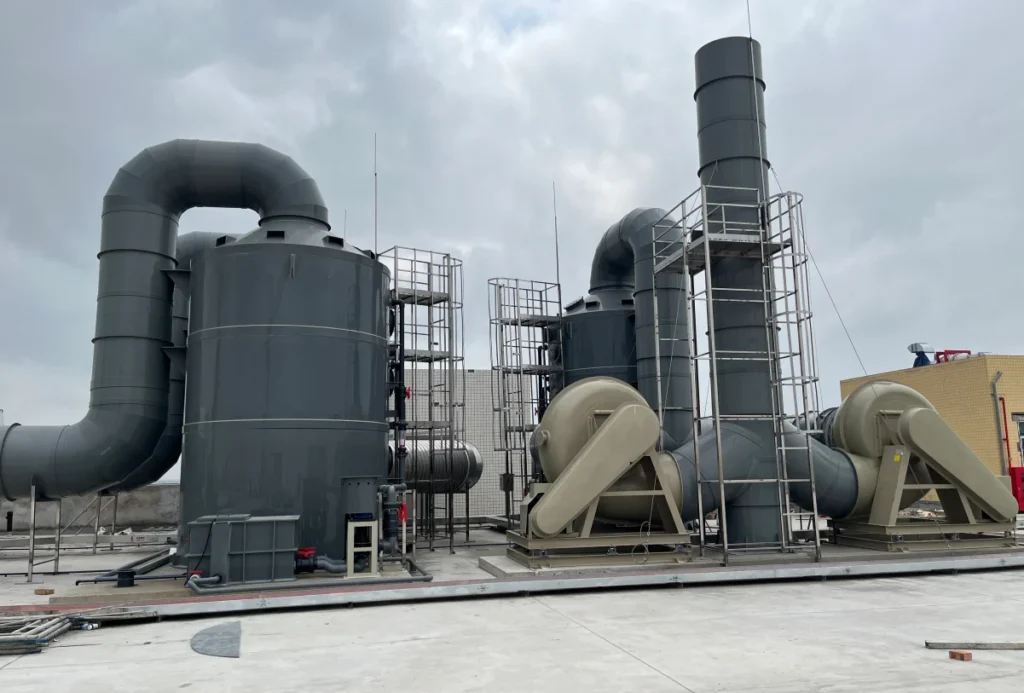
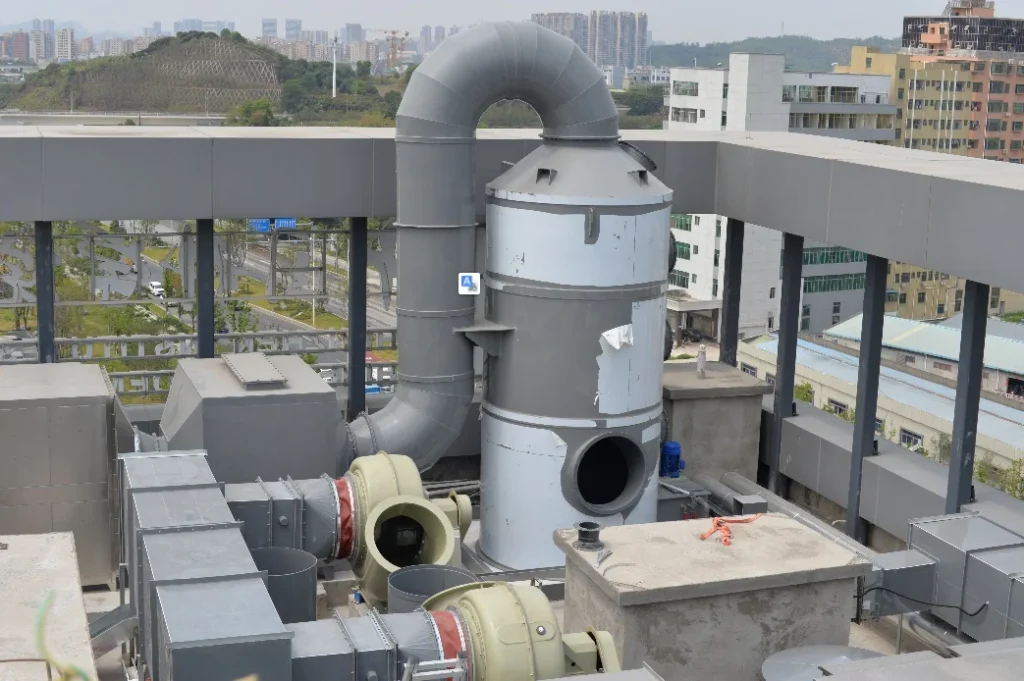
An engineer evaluating air pollution control equipment for an industrial exhaust stream faces a basic question: will wet scrubbing or dry scrubbing better suit the gas composition, temperature, and operating cost constraints of this facility? A **dry scrubber system** removes acid gases without saturating the flue gas, which eliminates the visible steam plume, the wastewater treatment burden, and the corrosion cycle that wet systems introduce. But dry scrubbing brings its own trade-offs in reagent consumption, solids disposal, and removal efficiency limits that vary by pollutant. This guide covers what a dry scrubber system is, the three main technology types, the design parameters that determine performance, and a selection framework to match the system to your specific exhaust conditions.
What Is a Dry Scrubber System?
A **dry scrubber system** is an air pollution control device that removes acid gases, heavy metals, and other pollutants from industrial exhaust streams without saturating the gas with water. Unlike a wet scrubber that uses a liquid spray or packed bed to absorb contaminants, a dry scrubber injects a solid or slurry sorbent into the gas stream and captures the reaction products in a fabric filter.
How Dry Scrubbers Differ from Wet Scrubbers
The defining difference between dry and wet scrubbing is the absence of a liquid phase in the primary removal step. In a wet scrubber, pollutants dissolve into water or a chemical solution, creating a liquid effluent that must be treated before discharge. A dry scrubber system uses a dry alkaline sorbent—typically hydrated lime (Ca(OH)2), sodium bicarbonate (NaHCO3), or trona (Na2CO3·NaHCO3·2H2O)—that reacts with acid gases to form solid salts. Those solids are captured by a downstream baghouse and disposed of as dry powder. The US EPA’s Control Cost Manual provides the standard methodology for sizing these systems and estimating their performance (EPA Wet and Dry Scrubbers for Acid Gas Control).
This difference drives the economics. A wet scrubber handling 50,000 m3/h of flue gas may consume 10-20 m3/h of water in evaporation and blowdown losses alone. A dry scrubber system uses zero process water for pollutant removal, which makes it the preferred choice in water-constrained regions and for applications where wastewater discharge is heavily regulated.
Key Terminology Every Buyer Should Know
**Sorbent or reagent.** The dry alkaline powder injected into the gas stream. Hydrated lime is the most common sorbent for large-scale applications because it is inexpensive and reacts well with sulfur dioxide (SO2) and hydrogen chloride (HCl). Sodium bicarbonate offers higher reactivity per kilogram but costs two to three times more.
**Stoichiometric ratio (SR).** The ratio of sorbent actually consumed by the acid gas reaction divided by the theoretical minimum required. An SR of 1.0 means every molecule of sorbent reacts with a pollutant molecule. Real systems run at SR 1.2 to 3.0 depending on the sorbent type and contact efficiency. The difference between the injected amount and the reacted amount reports as unreacted sorbent in the waste stream, which directly raises operating cost.
**Baghouse or fabric filter.** The downstream particulate collection device that captures the reaction products and any unreacted sorbent. In a dry scrubber system, the baghouse serves double duty: it removes the solid products of the acid gas reaction and also provides a second contact layer where residual gas-phase pollutants encounter sorbent accumulated on the filter cake. This filter-cake contact can add 5-15 percentage points to overall removal efficiency beyond what the absorber vessel alone achieves.
**Approach temperature.** The difference between the actual gas temperature at the absorber outlet and the adiabatic saturation temperature of the gas. In a spray dryer absorber (SDA), the approach temperature is typically 10-20°C above saturation. Running closer to saturation improves removal efficiency but increases the risk of solids buildup on the vessel walls and baghouse fabric.
How Does a Dry Scrubber System Work?
A **dry scrubber system** removes pollutants through a three-stage process: gas cooling, reagent injection and chemical reaction, and particulate collection. Each stage is tuned to the gas composition, temperature, and pollutant concentration of the specific application.
Stage 1 — Gas Cooling and Conditioning
Flue gas entering a dry scrubber system from a boiler, incinerator, or industrial furnace typically arrives at 140-200°C. The first step is to cool the gas to the optimal reaction temperature window for the chosen sorbent. For hydrated lime, the target is 100-140°C. For sodium bicarbonate, the optimum range is 140-180°C, where the bicarbonate decomposes to sodium carbonate and CO2, creating a porous particle with high surface area for acid gas reaction.
Cooling is achieved by one of two methods. In a spray dryer absorber, a water spray quenches the gas to within 10-20°C of its adiabatic saturation temperature. In a circulating dry scrubber or dry sorbent injection system, dilution air or a gas-gas heat exchanger reduces temperature without adding moisture. The cooling step is not optional: injecting sorbent into gas above 200°C can cause the reagent to decompose or sinter before it reacts with the target pollutants, wasting the majority of the sorbent.
Stage 2 — Reagent Injection and Chemical Reaction
Once the gas is within the temperature window, the dry sorbent is injected into the ductwork or absorber vessel at high velocity through a series of nozzles or lances. The turbulent mixing disperses the sorbent particles into the gas stream, where they contact acid gas molecules and initiate the neutralization reaction.
For SO2 removal with hydrated lime, the reaction follows Ca(OH)2 + SO2 → CaSO3 + H2O. The calcium sulfite then oxidizes partially to gypsum (CaSO4·2H2O) depending on the oxygen content of the gas. With sodium bicarbonate, the reaction proceeds as 2 NaHCO3 → Na2CO3 + CO2 + H2O followed by Na2CO3 + SO2 → Na2SO3 + CO2. The sodium-based route is faster and achieves higher utilization of the sorbent, reflected in a lower stoichiometric ratio of 1.2-1.5 versus 1.5-3.0 for lime.
The same injection system handles HCl, HF, and other acid gases with similar reaction paths. HCl reacts almost instantly with either sorbent because hydrogen chloride has high gas-phase acidity. HF reacts readily as well, though the calcium fluoride reaction product is sparingly soluble and accumulates in the baghouse dust.
Stage 3 — Particulate Collection in the Baghouse
After the reaction zone, the gas stream carries the solid reaction products, any unreacted sorbent, and the original fly ash or particulate from the combustion process. This solids-laden gas enters a fabric filter baghouse, where it passes through filter bags. The clean gas exits to the stack, and the solids accumulate on the bag surface as a filter cake.
The filter cake is where a secondary scrubbing effect occurs. Residual acid gas that did not react in the absorber vessel encounters unreacted sorbent trapped in the cake layer, driving overall removal efficiency 5-15 percentage points higher than the absorber alone. The bags are cleaned periodically by reverse pulse jets, and the collected solids are discharged through a rotary valve or screw conveyor for disposal or, where permitted, for use in construction materials.
Types of Dry Scrubber Systems
Three dominant **dry scrubber system** technologies serve the industrial market today: spray dryer absorber (SDA), circulating dry scrubber (CDS), and dry sorbent injection (DSI). Each technology occupies a distinct position on the cost-efficiency-simplicity triangle, and the right choice depends on the gas volume, pollutant concentration, removal target, and budget.
Spray Dryer Absorber (SDA)
A spray dryer absorber is the most established dry scrubbing technology, with hundreds of installations in coal-fired power plants, municipal waste incinerators, and industrial boilers since the 1980s. The SDA operates by atomizing a lime slurry into a vessel where the hot flue gas evaporates the water, leaving dry reaction products that are captured in a downstream baghouse.
SDA Operating Principle
In an SDA, the sorbent is prepared as a slurry containing 20-30% hydrated lime solids by weight. The slurry is atomized through rotary or dual-fluid nozzles into the top of the absorber vessel, where it contacts the hot flue gas entering from the bottom or side. The water evaporates as the droplets fall, and the lime reacts with acid gases to form dry calcium salts. The outlet gas temperature is maintained 10-20°C above the adiabatic saturation temperature—typically 70-80°C—to ensure complete drying before the solids reach the vessel walls or baghouse.
Typical Performance and Operating Range
A properly designed SDA system achieves 90-95% SO2 removal at a stoichiometric ratio of 1.5-2.0 for lime. For HCl, removal exceeds 98% even at lower reagent ratios. The SDA handles gas flow rates from 10,000 to over 1,000,000 m3/h, making it the standard for utility-scale flue gas desulfurization. Capital cost is moderate, and operating cost is dominated by sorbent consumption rather than energy or water.
Circulating Dry Scrubber (CDS)
The circulating dry scrubber is a newer design that achieves higher sorbent utilization and removal efficiency than the SDA by recirculating unreacted sorbent back into the reaction zone. CDS systems are increasingly specified for applications requiring over 95% SO2 removal or where sorbent cost is a primary operating expense.
CDS Operating Principle
In a CDS, flue gas enters a reactor vessel at the bottom and flows upward at high velocity (3-5 m/s), entraining a bed of circulating solids. Fresh sorbent and recirculated solids are injected into the bed, where intense gas-solid mixing achieves near-instantaneous acid gas reaction. The solids exit the top of the reactor and enter a baghouse, where they are collected. A portion of the collected solids is returned to the reactor; the balance is discharged as waste.
Performance Advantage
The CDS achieves 95-98% SO2 removal at a stoichiometric ratio of 1.2-1.5, significantly better sorbent utilization than the SDA. The recirculation gives unreacted sorbent multiple passes through the reaction zone, which improves overall utilization. The high gas velocity also makes the CDS physically smaller than an SDA for the same gas flow, reducing vessel capital cost. The trade-off is higher pressure drop across the reactor and additional material handling equipment for solids recirculation.
Dry Sorbent Injection (DSI)
Dry sorbent injection is the simplest and lowest-capital-cost dry scrubbing technology. In a DSI system, dry powdered sorbent is injected directly into the existing ductwork upstream of an existing baghouse, with no dedicated absorber vessel.
DSI Configuration and Components
A DSI system consists of a sorbent storage silo, a metering feeder, a pneumatic conveying system, and injection lances placed in the duct. The sorbent—typically sodium bicarbonate or hydrated lime—is conveyed to the injection point and dispersed into the gas stream through multiple lances positioned across the duct cross-section. The reaction occurs in the duct between the injection point and the baghouse, and the reaction products are captured on the baghouse bags. No additional vessel is needed.
When DSI Is the Right Choice
DSI is the preferred choice when capital budget is constrained, when the required removal efficiency is moderate (70-90%), or when the existing plant already has a baghouse and only acid gas control needs to be added. DSI systems can be installed during a scheduled outage with minimal ductwork modification. The operating cost is higher per ton of pollutant removed than SDA or CDS because the sorbent utilization is poorer—stoichiometric ratios of 2.0-3.0 are typical—but the capital cost is 30-50% lower.
Key Components of a Dry Scrubber System
Every **dry scrubber system** shares a common set of subsystems regardless of the technology type. Understanding these components helps an engineer evaluate supplier proposals on functional substance rather than packaging.
Absorber Vessel or Reaction Zone
In an SDA or CDS, the absorber vessel is the primary reaction chamber where gas contacts the sorbent. The vessel geometry is determined by the required gas residence time—typically 8-15 seconds for an SDA and 2-4 seconds for a CDS. SDA vessels are large-diameter vertical cylinders with a conical bottom for solids discharge, sized to keep gas velocity below 1.5 m/s to avoid entraining partially-dried slurry droplets. CDS vessels are taller and narrower, designed for gas velocities of 3-5 m/s to maintain the circulating solids bed.
Reagent Storage and Feed System
The sorbent storage system includes a silo sized for 7-30 days of continuous operation, with level indicators, dust collection, and a discharge valve. From the silo, the sorbent moves through a metering feeder that controls the injection rate based on the inlet pollutant concentration, gas flow rate, and desired removal efficiency. For SDA systems, the feed system includes a slurry preparation tank and agitator to maintain the 20-30% solids suspension.
Fabric Filter Baghouse
The baghouse is the final collection point for all solids leaving the system. It contains filter bags made from materials chosen for the gas temperature and chemistry. For dry scrubber applications operating at 140-180°C, the bag material is typically woven fiberglass with a PTFE membrane or Ryton (polyphenylene sulfide) for lower temperatures. The baghouse is divided into compartments so that individual sections can be isolated for bag cleaning or replacement while the rest of the system remains online.
Induced Draft Fan and Stack
The ID fan provides the motive force to pull the gas through the entire system, overcoming the pressure drop across the absorber, ductwork, and baghouse. A dry scrubber system’s total pressure drop ranges from 15-30 cm water column for an SDA to 25-50 cm for a CDS, plus 10-20 cm across the baghouse. Fan selection must account for the gas volume at actual temperature and pressure conditions at the fan inlet, not standard conditions. The stack includes continuous emission monitoring system ports for SO2, HCl, particulate, and O2 to verify compliance with the operating permit.
Dry Scrubber System Design Parameters
Specifying a **dry scrubber system** requires fixing four interdependent parameters that determine whether the system meets its performance guarantee at an acceptable operating cost.
Gas Velocity and Residence Time
Gas velocity through the absorber dictates the vessel cross-section and the contact time between the sorbent particles and the pollutant molecules. In an SDA, gas velocity is kept between 0.6-1.5 m/s to allow the atomized slurry droplets to dry fully before reaching the vessel wall. Residence time is the vessel height divided by the gas velocity. The EPA’s Control Cost Manual specifies a minimum residence time for SDA systems to ensure that acid gas concentrations at the outlet fall to within permit limits consistently (EPA Control Cost Manual: Wet and Dry Scrubbers). For a more detailed overview of the technology, ScienceDirect’s dry scrubber topic entry covers the fundamental chemistry and equipment configurations used across different industries (ScienceDirect: Dry Scrubber Overview).
In a CDS, the velocity is deliberately set higher at 3-5 m/s to create a fluidized or entrained bed of circulating solids. This higher velocity increases gas-solid contact frequency but also increases the pressure drop across the reactor to 10-20 cm water column, versus 2-5 cm for an SDA.
Stoichiometric Ratio
The stoichiometric ratio is the single most important variable for operating cost. A SR of 1.0 is the theoretical minimum: exactly one mole of sorbent per two moles of acid gas. Real systems operate well above this because the reaction occurs on the surface of the sorbent particle, and once the surface layer is consumed, the interior of the particle cannot participate in further reaction without additional grinding or recirculation.
For hydrated lime in an SDA, the commercial SR range is 1.5-2.5 depending on the SO2 inlet concentration and the removal target. Sodium bicarbonate in a DSI system operates at SR 1.5-3.0. At an SO2 inlet concentration of 500 ppm and a target of 90% removal, a system running at SR 2.0 consumes twice the theoretical minimum sorbent, which at lime prices of $80-120/tonne translates to a sorbent cost of $0.15-0.30 per tonne of product processed.
Temperature Window
Gas temperature at the absorber inlet governs both the reaction kinetics and the physical behavior of the sorbent particles. For lime-based systems, the optimal inlet temperature is 100-140°C. Below 80°C, the reaction rate slows to the point where the required residence time becomes uneconomical. Above 180°C, lime particles can sinter, reducing surface area and reactivity. For sodium bicarbonate, the optimal window is 140-180°C because the activation step—thermal decomposition to sodium carbonate—requires sustained temperature above the bicarbonate decomposition point of approximately 100°C.
Pressure Drop
Total system pressure drop determines the fan power requirement, which is the largest continuous electrical load in most dry scrubber installations. An SDA with baghouse typically operates at 20-35 cm water column total. A CDS adds 10-20 cm for the reactor itself. A DSI system adds essentially no pressure drop because the sorbent injection does not occur in a restricted vessel. Each additional centimeter of pressure drop on a 100,000 m3/h system costs approximately $1,500-2,500 per year in fan electricity, depending on local power rates. Optimizing pressure drop is the primary lever for reducing the total cost of ownership.
Industrial Applications of Dry Scrubber Systems
**Dry scrubber systems** serve a narrower set of applications than wet scrubbers, but within that set they offer decisive advantages in operating cost, water consumption, and waste management.
Power Generation and Flue Gas Desulfurization
Coal-fired power plants represent the largest installed base of dry scrubber systems by gas flow volume, primarily using SDA and CDS technology for SO2 control. A 500 MW coal plant firing 2% sulfur coal produces flue gas with SO2 concentrations of 1,000-2,000 ppm at a flow rate of approximately 1,500,000 m3/h. A dry scrubber system on this application consumes 3-5 tonnes per hour of hydrated lime and produces 5-8 tonnes per hour of dry reaction product. The dry byproduct is a mixture of calcium sulfite, calcium sulfate, and fly ash that can be disposed of in a permitted landfill or used in construction applications where local regulations allow.
For biomass-fired power plants, where the flue gas contains 50-300 ppm SO2 plus higher HCl concentrations from chlorine in the fuel, a CDS dry scrubber system achieves 95% or greater removal of both pollutants while consuming substantially less water than a wet scrubber.
Chemical Processing
Chemical plants use dry scrubber systems for acid gas control on process vents, thermal oxidizer exhaust, and reactor off-gases. The absence of liquid effluent is a strong advantage in chemical processing, where the waste stream from a wet scrubber would require neutralization and permitting under the same regulatory framework as the main process wastewater. A medium-scale chemical operation with a **5250 cfm industrial dry scrubber system** treating HCl from a batch reactor vent can operate with a silo refill interval of 30-60 days, depending on the duty cycle and acid gas concentration.
Hydrochloric acid absorption is a common dry scrubbing application in chemical manufacturing. HCl at concentrations of 200-5,000 ppm reacts nearly instantaneously with sodium bicarbonate or lime. A DSI system injecting sodium bicarbonate upstream of an existing baghouse achieves over 95% HCl removal at a stoichiometric ratio of 1.5-2.0, with a capital cost roughly one-third of an equivalent wet scrubber installation.
Waste Incineration
Municipal solid waste incinerators and hazardous waste incinerators use dry scrubber systems to control a broad spectrum of acid gases and heavy metals. In addition to SO2 and HCl, incinerator flue gas contains HF, heavy metals (mercury, lead, cadmium), and trace organic compounds. Dry scrubber systems for incineration applications typically combine a lime-based SDA or DSI with activated carbon injection for mercury and dioxin control. The baghouse captures the reaction products and the activated carbon together in a single waste stream.
The operating temperature range for incineration dry scrubbers is 130-160°C. Within this window, the system achieves SO2 removal above 90%, HCl removal above 95%, and mercury removal of 80-95% depending on the carbon injection rate and the chlorine content of the waste.
Oil and Gas Industry
In oil and gas production, dry scrubber systems treat exhaust from gas turbines, heaters, and sulfur recovery units. The remote locations typical of upstream oil and gas facilities favor dry scrubbers because they eliminate the logistics of water supply and wastewater disposal. A DSI system treating 50,000 m3/h of turbine exhaust with 400 ppm SO2 consumes approximately 0.8 tonnes per day of sodium bicarbonate and requires only a silo, a feeder, and injection lances—no vessel, no water line, no drain.
Advantages and Limitations
A **dry scrubber system** makes strong engineering sense for specific gas conditions and plant constraints. It also has genuine limitations that should disqualify it from certain applications.
Key Advantages
**No wastewater.** A dry scrubber system produces zero liquid effluent. The reaction products discharge as dry powder. For facilities facing strict wastewater discharge limits, high water costs, or zero-liquid-discharge mandates, dry scrubbing eliminates an entire regulatory and operational burden that wet scrubbers carry.
**Lower capital cost for retrofit applications.** DSI systems in particular can be added to an existing plant with a baghouse for 30-50% less capital than a wet scrubber. The equipment list is a silo, a feeder, injection lances, and controls—no vessel, no recirculation pump, no piping, no wastewater treatment.
**Dry byproduct handling.** The collected solids from a dry scrubber system are handled by conventional pneumatic or mechanical conveyors and disposed of in a landfill. There is no sludge dewatering, no settling pond, and no blowdown treatment. In some applications, the dry reaction product can be recycled: lime-based solids from coal plant FGD systems are used in construction materials and mine reclamation.
**No visible steam plume.** Because the gas is not saturated with water vapor, a dry scrubber system produces no visible steam plume at the stack outlet. This eliminates the visual impact that can trigger community complaints at facilities near residential areas.
Limitations and When Not to Use Dry Scrubbers
**Lower removal efficiency for poorly soluble gases.** Dry scrubbers achieve 90-98% removal for SO2, HCl, and HF with proper design. They cannot remove gases that require high liquid-side mass transfer, such as ammonia (NH3) or chlorine dioxide (ClO2). For these pollutants, a wet scrubber with a tailored scrubbing solution is the only practical option.
**Higher operating cost per ton of pollutant removed.** The sorbent cost for dry scrubbing is typically higher than the reagent cost for an equivalent wet scrubbing system when both are calculated on a per-ton-of-SO2-removed basis. A wet scrubber using limestone can have a reagent cost of $30-50 per tonne of SO2 removed, compared to $100-200 for dry lime-based scrubbing. The wet scrubber’s water and wastewater costs offset this difference in some cases, but the dry system has a higher base reagent cost.
**Limited effectiveness for fine particulate control.** A dry scrubber system relies on the downstream baghouse for particulate removal. The baghouse captures particles down to 0.5-1 µm at 99% efficiency. For sub-micron fume below 0.5 µm, a wet scrubber with a high-energy venturi stage is more effective.
**Solids disposal as hazardous waste.** Depending on the pollutant and the sorbent, the dry reaction product may test as hazardous waste under the Toxicity Characteristic Leaching Procedure (TCLP). Heavy metals captured from incinerator or chemical plant exhaust are the primary concern. Classification of the waste stream should be determined during the permitting phase, not after operations begin.
Dry Scrubber vs Wet Scrubber
Choosing between dry and wet scrubbing depends on five variables: water availability, waste disposal requirements, removal efficiency target, gas temperature, and capital budget. Our detailed comparison guide on dry scrubber vs wet scrubber covers the full decision framework. The summary below highlights the breakpoints where one technology clearly outperforms the other.
| Parameter | Dry Scrubber System | Wet Scrubber System |
|---|---|---|
| Water consumption | Near zero (SDA uses some water for slurry) | 10-50 m3/h for typical industrial scale |
| Waste output | Dry powder, landfill or reuse | Liquid effluent requiring treatment |
| SO2 removal efficiency | 90-98% (CDS: up to 98%) | 95-99% (packed bed) |
| HCl removal efficiency | 95-99% | 99%+ |
| Fine PM removal | 99% at >0.5 µm (baghouse) | 99% at >1 µm (packed), >0.5 µm (venturi) |
| Capital cost (relative) | 1.0x (baseline) | 1.5-2.5x for full system with WWT |
| Reagent cost per ton SO2 | $100-200 (lime) | $30-50 (limestone) |
| Visible steam plume | None | Present unless reheated |
| Best for | Water-constrained sites, dry waste, retrofit | High-efficiency gas absorption, fine PM |
A wet scrubber remains the better choice when the target pollutant is highly water-soluble and the removal target exceeds 99%, or when the exhaust stream already contains liquid aerosols that would blind a baghouse. A dry scrubber wins when water is expensive or restricted, when the facility cannot permit a wastewater discharge, or when the capital budget favors a simpler system.
Dry Scrubber System Cost Considerations
The total cost of a **dry scrubber system** is distributed differently across capital and operating categories than a wet scrubber. Understanding this distribution is essential for a fair comparison.
Capital Cost
A DSI system has the lowest capital cost of any acid gas control technology. For a 50,000 m3/h system treating 500 ppm SO2, the equipment cost for a DSI system—silo, feeder, injection lances, controls—falls in the range of $80,000-150,000 installed. An SDA system for the same duty costs $300,000-600,000 including the absorber vessel, slurry preparation, and baghouse. A CDS system ranges from $400,000-800,000.
These figures exclude the baghouse if one already exists. Retrofitting a DSI system into a plant with an existing baghouse reduces the capital cost by 40-60% compared to a greenfield installation. As a reference point, a **3500 cfm industrial dry scrubber system** retrofitted into an existing baghouse-equipped plant might cost as little as $12,000-24,000 for the DSI equipment alone.
Operating Cost
Sorbent consumption is the dominant operating cost for all three dry scrubber technologies. At a lime price of $90/tonne and an SR of 2.0, a 50,000 m3/h system treating 500 ppm SO2 consumes approximately 1.5 tonnes per day of lime at a cost of $135/day. Sodium bicarbonate at $400/tonne would cost approximately $400/day at the same SR.
Power cost for the ID fan is the second-largest operating category. At a system pressure drop of 25 cm water column and a power rate of $0.08/kWh, the fan power cost for a 50,000 m3/h system is approximately $40-60/day. SDA and CDS systems also require compressed air for the baghouse pulse-jet cleaning system, adding $10-20/day.
Solids disposal cost varies by classification. Non-hazardous dry scrubber waste costs $30-60/tonne for landfill disposal. Hazardous waste disposal can exceed $200/tonne, which can double the total operating cost of the system.
Cost Comparison: Dry vs Wet
A wet scrubber system for the same 50,000 m3/h duty has a capital cost of $500,000-1,200,000 including the vessel, packing, recirculation pump, and wastewater treatment. The operating cost is $200-400/day including reagent (limestone at $30/tonne), power, water, and wastewater treatment.
The dry scrubber system has a 30-50% lower capital cost but operating costs that are comparable or slightly higher. The break-even analysis favors dry scrubbers when the site’s water cost exceeds $2/m3 or when wastewater discharge restrictions require expensive treatment systems.
How to Select the Right Dry Scrubber System
Selecting a **dry scrubber system** requires matching the technology type to the gas conditions, the removal target, and the plant’s existing infrastructure. The decision framework below applies to the most common industrial scale ranges.
Step 1 — Define the Gas Conditions and Removal Target
Start with four numbers: gas flow rate (m3/h or cfm), inlet pollutant concentration (ppm), target outlet concentration (ppm), and gas temperature at the proposed injection point. Without these four parameters, no vendor can size a system. For a **3500 cfm industrial dry scrubber system** serving a small chemical process vent, the capital cost is in the range of $20,000-40,000 for a DSI system. A **5250 cfm industrial dry scrubber system** sized for a medium boiler exhaust would run $35,000-60,000. For a **7000 cfm industrial dry scrubber system** on a larger industrial furnace, expect $50,000-90,000 installed. The economics shift across these scales: a **3500 cfm industrial dry scrubber system** at the lower end uses a simpler silo-and-lance configuration, while moving to a **5250 cfm industrial dry scrubber system** often justifies the addition of an automated metering feeder and continuous emission monitoring.
Step 2 — Determine the Required Removal Efficiency
If the target removal efficiency is below 90% and the plant already has a baghouse, DSI is almost certainly the most cost-effective choice. If the target is 90-95% removal, an SDA with lime slurry offers the best balance of operating and capital cost. If the target exceeds 95%—for example, a facility facing Best Available Control Technology (BACT) review—a CDS system is the appropriate specification.
Step 3 — Evaluate Sorbent Options
For SO2 and HCl at concentrations above 200 ppm, hydrated lime at $80-120/tonne is the standard economic choice, particularly for SDA and CDS systems where the higher capital investment is justified by superior sorbent utilization. For lower concentrations or systems where capital cost must be minimized, sodium bicarbonate at $350-450/tonne achieves acceptable removal at SR 1.5-2.0 in a DSI configuration, and the higher sorbent cost is offset by the lower capital investment.
Step 4 — Check Infrastructure Constraints
A DSI system requires an existing baghouse or the installation of a new one. If the plant has no baghouse and the particulate loading is low, an SDA or CDS with an integral baghouse is the right choice. If water is available on site and the facility already operates a wastewater treatment plant, the comparison shifts back toward wet scrubbing. The elimination of water and wastewater infrastructure is the strongest driver for dry scrubber selection on greenfield installations.
Step 5 — Request Vendor Proposals with Performance Guarantees
Issue a performance-based specification that states the gas flow rate, composition, temperature, target removal efficiency, and allowable pressure drop. Require each vendor to quote the sorbent type, stoichiometric ratio, annual sorbent consumption, power consumption, and guaranteed outlet emission concentration at full-load and turndown conditions. A performance guarantee backed by a liquidated damages clause protects the buyer from underperforming systems far more effectively than a low initial price.
For a detailed cost comparison and supplier evaluation framework, see our wet scrubber manufacturer guide and gas scrubber price analysis. Contact our engineering team for a preliminary system sizing and budget estimate for your specific gas conditions.
FAQ
What is the difference between a dry scrubber system and a wet scrubber system?
A dry scrubber system uses a dry alkaline sorbent to neutralize acid gases and captures the reaction products in a baghouse filter. A wet scrubber uses water or a chemical solution to absorb pollutants and produces a liquid effluent that requires treatment. Dry scrubbers consume minimal water and produce no wastewater, while wet scrubbers achieve higher removal efficiencies for certain pollutants but require wastewater handling infrastructure.
What removal efficiency can a dry scrubber system achieve?
An SDA dry scrubber system achieves 90-95% SO2 removal at a lime stoichiometric ratio of 1.5-2.0. A CDS system achieves 95-98% at SR 1.2-1.5. For HCl, both technologies exceed 95% removal. DSI systems achieve 70-90% SO2 removal depending on the sorbent type, injection rate, and gas temperature. All three technologies rely on the downstream baghouse for the final 5-15 percentage points of removal through filter-cake contact.
What gases can a dry scrubber system remove?
A dry scrubber system effectively removes acid gases: SO2, HCl, HF, HBr, and some oxidized mercury compounds. When paired with activated carbon injection, it also removes elemental mercury and dioxins/furans. It is not effective for ammonia, chlorine gas at low concentrations, or volatile organic compounds that require liquid-phase absorption.
What are the main operating costs for a dry scrubber system?
Sorbent consumption is the largest operating cost, typically accounting for 50-70% of total operating expense. For a 50,000 m3/h system treating 500 ppm SO2 with lime at SR 2.0, the sorbent cost is approximately $135/day. Fan power accounts for 15-25% of operating cost, and compressed air for baghouse cleaning accounts for 5-10%. Solids disposal adds 10-20% for non-hazardous waste or up to 50% for hazardous waste.
Can a dry scrubber system handle high-temperature gas?
Yes, within limits. DSI systems operate with inlet gas temperatures up to 180-200°C for sodium bicarbonate and 140-180°C for lime. Above 200°C, the sorbent may decompose or sinter before reacting with the target pollutants. For gas streams above 200°C, a gas cooling step must be added upstream of the sorbent injection point. A **7000 cfm industrial dry scrubber system** handling exhaust from a 250°C thermal oxidizer would require a quench section or dilution air system to reduce the temperature before sorbent injection.
Key Takeaways
- A dry scrubber system uses lime or sodium bicarbonate to neutralize acid gases and captures reaction products in a baghouse, producing zero wastewater—eliminating the treatment infrastructure that wet scrubbers require.
- Three technology types serve the market: SDA (90-95% SO2 removal, SR 1.5-2.0, moderate capital), CDS (95-98% SO2 removal, SR 1.2-1.5, highest capital), and DSI (70-90% SO2 removal, SR 2.0-3.0, lowest capital).
- Sorbent consumption accounts for 50-70% of dry scrubber operating cost. Hydrated lime at $80-120/tonne is the standard for SDA and CDS; sodium bicarbonate at $350-450/tonne offers higher reactivity for DSI retrofit applications.
- Dry scrubber systems excel in water-constrained locations and retrofit scenarios where a baghouse already exists, with capital costs 30-50% below equivalent wet scrubber installations.
- The CDS achieves the highest removal efficiency among dry systems at 95-98% SO2 removal, comparable to wet scrubbers, while maintaining the dry waste handling and low water consumption advantages.