High-Capacity Activated Carbon Media: The Adsorption Engine Behind Every Carbon Tower
When a project fails to reach its odor or VOC target, the box is usually not the problem. The carbon inside it is. The housing only holds the bed — the bed does the work — and bed performance is fixed by three numbers: iodine value, particle size, and the hardness that keeps the carbon from crumbling into dust that bypasses the process.
Our activated carbon media is a granular adsorption media manufactured for industrial gas treatment: from 900 mg/g iodine value upward, in the mesh sizes our own adsorption towers are built around. Because we fabricate both the carbon beds and the housings that hold them, the media is specified to match the vessel — not sold as an afterthought from a trading catalogue.
Why Cheap Carbon Costs More Than It Saves
Carbon is easy to buy cheap and expensive to run. Three failure modes are responsible for almost every underperforming carbon bed, and all three come from media that was specified only by price.
1. Low Iodine Value: You Bought a Sponge That Is Already Half Full
Iodine number is the direct measure of adsorption capacity — the mass of iodine a gram of carbon can trap, which tracks its pore volume. A bed of low-iodine activated carbon media reaches breakthrough in a fraction of the rated service life, and the media swap cost plus the compliance failure dwarfs the saving on the initial fill.
- Our standard: iodine number 900–1,100 mg/g, verified on every batch.
2. Soft Grains: The Carbon That Becomes Dust
In a working bed, particles collide, pack, and bear the weight of the media above them. Soft carbon breaks down into fines, fines migrate and clog, and the pressure drop creeps up while real adsorption surface disappears.
- Our standard: hardness ≥ 95% — the grains hold their structure through handling, transport and the first year of service.
3. Wrong Grade for the Stream
Physical adsorption onto high-surface-area carbon handles hydrocarbons, solvents, benzene and alcohols. Hydrogen sulfide, ammonia, mercaptans and amines need chemically impregnated carbon so the gas reacts on the surface instead of merely condensing. Supplying the wrong one is not a materials error; it is a compliance failure.
- Our approach: the grade is specified from the compound list, not from a one-size-fits-all stock item.
Specified, Not Supplied Blind
Every activated carbon media order is shipped against a written specification, so your engineering team and your inspector both know exactly what is in the bed. The production values below are the standard range for our gas-treatment media:
| Parameter | Unit | Value | Function |
|---|---|---|---|
| Iodine number | mg/g | 900 – 1,100 | Adsorption capacity; the single most important figure |
| Particle size | Mesh | 4×8, 4×10, 6×12 | Chosen for low pressure drop and uniform bed resistance |
| Moisture | % | ≤ 5 | Kept low to preserve maximum adsorption capacity |
| Hardness | % | ≥ 95 | Resists grain breakage and fines generation in service |
| Bulk density | g/L | 450 – 520 | Sets bed weight and therefore the vessel and support design |
| Moulded block | mm | 100 × 100 × 100 | Pre-formed blocks that drop directly into drawer-tray towers |
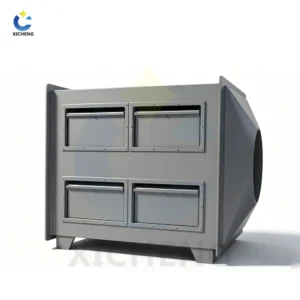
The same media is supplied as loose granules for bulk-filled vessels or as the pre-formed 100×100×100 mm blocks used in drawer-tray adsorption boxes — the block form eliminates filling voids and guarantees uniform bed geometry across the tray.
Tested Against the Streams That Arrive at Your Fence Line
Adsorption is not a single application, and media performance is only meaningful relative to the compound it is asked to remove. Our activated carbon media is regularly specified for the following classes of duty:
- Sulfur compounds — hydrogen sulfide (H₂S) and other sulfur-bearing gases
- Acid gases — SO₂ and NOx streams requiring impregnated grades
- Volatile organic compounds — solvents, benzene, alcohols and process VOCs
- Odor and solvent vapour — the diffuse, low-concentration loads that always smell far worse than they measure
On well-sized beds, Xicheng activated carbon media removes up to 99% of odor and toxic gas content, in line with the adsorption-tower performance our boxes are rated for.
Activated Carbon Media Grades
Select the activated carbon media form that matches your vessel: loose granules for bulk-filled towers, moulded 100×100×100 mm blocks for drawer-tray boxes, with the mesh size and iodine level set to your stream. If you operate a Xicheng adsorption box or tower, tell us the model and we will ship the exact fill specification — the block dimensions are matched to our own tray geometry. For the complete turnkey system that consumes this media, see our activated carbon odor control unit, and for how the bed performs inside the vessel, our activated carbon adsorption box guide.
Media Supply, Re-fill Service and Factory-Direct Delivery
You buy your activated carbon media from the factory that also welds the vessels. The same plant that extrudes the polypropylene, fabricates the adsorption tower and presses the carbon blocks controls the whole supply chain, which is why lead times hold and grade consistency survives a reorder.
How media procurement runs with us:
- Send the stream data. Gas compounds, temperature, humidity, flow rate, and the vessel size or model.
- We confirm the grade. Iodine level, mesh and impregnation specified in writing against your inlet profile.
- We deliver the fill. Loose granules or pre-formed blocks, with batch-specific quality documents.
- We re-fill on schedule. When breakthrough testing shows the bed is spent, a re-fill order is placed against the original specification.
For facilities running our adsorption boxes and towers, the complete equipment range is at activated carbon box, activated carbon filter box, industrial activated carbon filter, activated carbon adsorption tower and activated carbon adsorption equipment.
Xicheng as Your Activated Carbon Supplier
Activated carbon is a consumable, and a supplier that only ships once has none of the engineering that makes a bed work. Xicheng is a 17-year activated carbon manufacturer and supplier operating 40+ production bases and offices across China, with 2 specialized production plants in Vietnam. For a bulk purchase that means three things in practice: the grade is consistent from one order to the next, the moulded blocks are dimensioned for the drawers of our own adsorption boxes, and re-fills are placed against the original specification instead of being re-specified by a trader.
We supply activated carbon to plant operators, EPC contractors and OEMs who build media into their own equipment — as a direct factory activated carbon supplier for volume orders of bulk activated carbon. Every shipment carries batch-specific quality documents and SGS material certification, backed by a 6-month media warranty.
Secure a Specified Carbon Bed — Today
The cheapest fill is the one that breaks through on schedule, with a paper trail your inspector accepts. Send us your compound list and vessel model, and we will confirm the grade, the fill quantity and the factory-direct price — normally within 24 hours.
- 🎯 Manufacturing Head Office: N0.34 Zhenxing Road (Shengtaian Heavy Industrial Park B), Loucun, Guangming New Dist, Shenzhen, Guangdong, China
- ☎️ Direct Hotline / WhatsApp: +86 18028775826
- 📬 Engineering Mailbox: xichengepltd@gmail.com
Frequently Asked Questions
Q: What is the difference between loose granules and moulded blocks?
A: Loose granules are bulk filled, so the bed geometry follows the installer’s pour. Moulded 100×100×100 mm blocks lock the geometry, eliminate voids and keep every cubic metre of gas in contact with an equal thickness of carbon — which is why drawer-tray adsorption boxes use blocks. Both forms ship with the same iodine specification.
Q: How do I know when the media needs replacing?
A: Breakthrough is detected by measurement, not by the calendar. Watch the outlet concentration, or fit the sampling ports we build into our housings and test directly. A media re-fill order repeats the original specification, so ongoing performance does not drift between fills.
Q: Can I use this media in a third-party tower?
A: Yes, as long as the bed geometry is declared. Send us your vessel dimensions, bed depth and flow rate and we will calculate the fill quantity and confirm the grade. For Xicheng brand towers the blocks drop straight into the existing trays with no modification.
Q: Do you sell impregnated carbon for H₂S and acid gases?
A: Yes. For hydrogen sulfide, ammonia, mercaptans and amine streams we supply chemically impregnated grades that trap the gas by reaction rather than by physical adsorption alone. Specify the compound and target concentration and the impregnation is matched to the duty.