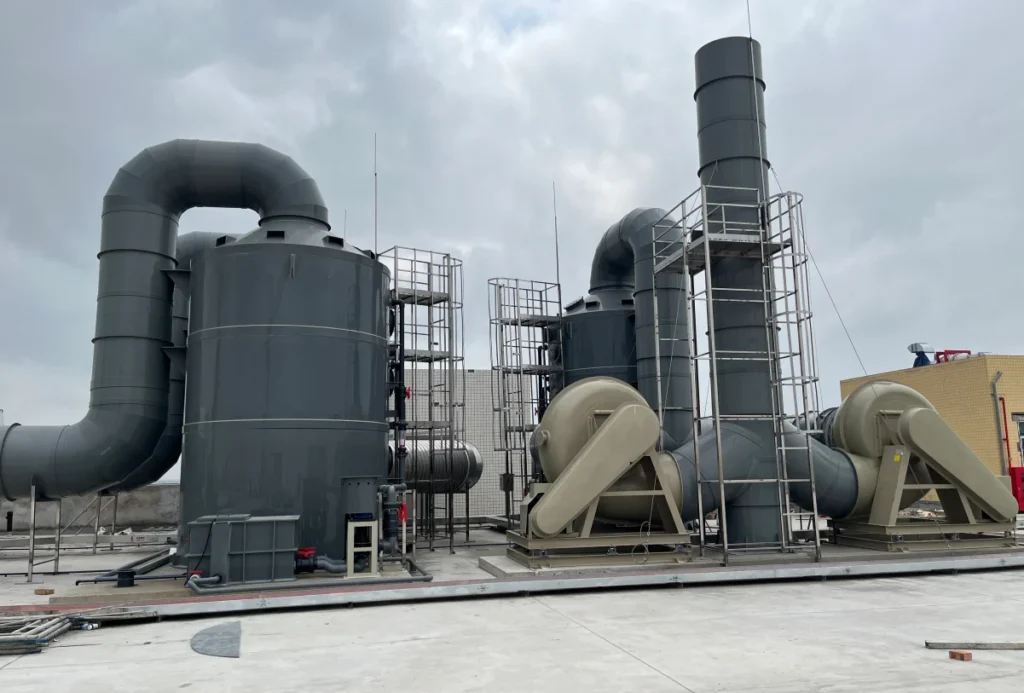
Key Takeaways
An activated carbon adsorption box is a packed-bed gas treater: solvent vapors and odors are caught on the carbon surface as the air passes through, with no moving parts and no chemical feed.
Size it on airflow, pollutant load, working capacity (roughly 10–20 kg per 100 kg of carbon), and the service life you want, with face velocity under 0.5 m/s and a 0.5–2 s residence time as the guardrails.
Match the housing to the gas — epoxy-lined steel for neutral solvent, stainless for corrosive, polypropylene for aggressive service — and buy change-out access, taps, and sensors at order time, not later.
Two safety rules govern carbon boxes: watch bed temperature against the heat-of-adsorption fire risk at high load and low airflow, and never allow entry into the box without an atmospheric test, because wet carbon depletes oxygen.
Run the box by watching differential pressure, outlet concentration, and temperature; breakthrough of the outlet reading is the honest schedule for media change-out.
What Is an Activated Carbon Adsorption Box?
An activated carbon adsorption box is a packaged waste-gas treatment unit filled with granular activated carbon (GAC). Contaminated air is drawn through the packed carbon bed, and volatile organic compounds (VOCs), odors, and other adsorbable pollutants are trapped on the enormous internal surface of the carbon. It is one of the simplest and most reliable ways to treat solvent-laden and odorous exhaust in factories, paint shops, printing plants, and chemical facilities.
The box itself is a rectangular housing with an inlet flange, an outlet flange, an access hatch for media change-out, and internal support layers on which the GAC sits. Because it is factory-built as a single unit rather than field-erected, it saves floor space, installs quickly, and can be tied into an existing duct system within a day. Carbon charges run from a few hundred kilograms on small units to several tonnes on large multi-module systems, which is exactly why sizing needs to be worked out before purchase rather than guessed.
This guide covers how the activated carbon adsorption box works, what it removes, how to size one for your airflow, construction materials, installation, maintenance, and safety. It is written for plant engineers, EHS managers, and buyers who need a working understanding before they specify equipment.
If you only need the hardware, our Activated Carbon Box product line covers standard and custom sizes. The rest of this article explains the engineering behind that equipment, so you can justify your choice internally.
How an Activated Carbon Adsorption Box Works
Adsorption is a surface process, not a chemical reaction. The contaminant molecules diffuse from the air stream into the carbon pores and stick there by physical forces (physisorption), the same attraction that makes activated carbon an effective filter for hundreds of organic compounds. A well-made activated carbon has an internal surface area of roughly 800 to 1,200 m² per gram, so a 500 kg carbon charge gives the stream a surface as large as dozens of football fields.
As dirty air enters the activated carbon adsorption box, the pollutant front moves through the bed in a zone called the mass transfer zone (MTZ). The carbon ahead of the front is still clean, the carbon behind it is saturated. When the leading edge of that zone reaches the outlet, the concentration in the exhaust begins to climb. That moment is called breakthrough, and it tells you the bed needs to be changed out or regenerated.
Two operating parameters determine uptake in practice: face velocity and residence time. Face velocity is the air speed over the full inlet area of the bed, kept low (typically under 0.5 m/s) so the gas has time to reach the inner pores. Residence time is how many seconds the gas actually spends inside the bed; 0.5 to 2 seconds is a common design target for VOC duty.
Adsorption capacity is always quoted as a ratio. Table 1 shows the typical indicators used by plant engineers when they estimate how much pollutant a carbon charge can hold before breakthrough.
Table 1. Typical adsorption capacity indicators for granular activated carbon
| Carbon type | Surface area (m²/g) | Working capacity (kg per 100 kg carbon) | Best suited for |
|---|---|---|---|
| Bituminous coal-based GAC | 800–1,200 | 15–25 | Mixed VOCs, toluene, xylene, solvents |
| Coconut-shell GAC | 900–1,200 | 10–20 | Odor control, low-molecular-weight gases |
| Impregnated or chemical carbon (KOH / sulfur) | 700–1,100 | 8–15 | Hydrogen sulfide, mercaptans, acid gases |
The working capacity in Table 1 follows the widely used rule of thumb that a carbon bed removes roughly 10 to 20 kg of VOC per 100 kg of carbon at industrial conditions, as the U.S. EPA carbon adsorber monitoring documentation reports. Do not design against the theoretical maximum adsorption of the carbon, because real streams carry humidity, temperature swings, and mixtures that all reduce usable uptake.
An activated carbon adsorption box runs on this mechanism, but how much it actually removes depends on what you feed it, which is the subject of the next section.
What an Activated Carbon Adsorption Box Removes
An activated carbon adsorption box is at its strongest on organic vapors with a molecular weight between about 50 and 200, the region where physisorption is efficient. In practice that covers most industrial solvents: toluene, xylene, acetone, ethyl acetate, 2-butanone (MEK), isopropyl alcohol, styrene, trichloroethylene, and similar solvent mixtures found in painting, printing, coating, and adhesive lines.
The same box is also a workhorse for odor control. Low concentrations of hydrogen sulfide, methyl mercaptan, and other reduced sulfur compounds respond well to impregnated carbon, and municipal and industrial odor treatment frequently uses carbon boxes precisely because they are passive and need no continuous chemical feed. At higher H₂S load, a chemical industrial wet scrubber does the bulk removal and the carbon box polishes the tail of the curve.
What a carbon bed does not do is equally important. It does not adsorb permanent gases such as carbon monoxide, carbon dioxide, or methane, and it has little capacity for high-boiling or heavy sticky compounds, which polymerize on the media and poison it. Particulate must be removed upstream, not given to the carbon. If the stream is heavy on fine particles, a filter upstream protects the bed and keeps pressure drop under control.
There is a natural split in gas treatment between particles and molecules: HEPA filters catch solids, while an activated carbon box catches gases. Where paint spray comes with solvent vapor, a well-designed line uses both — HEPA for the overspray and a carbon box for the volatiles, which is the arrangement we build into wet scrubber systems and dry-filter paint-booth packages.
If you are not sure whether your pollutant is adsorbable, the deciding factor is usually the material safety data sheet: it will state the molecule weight, vapor pressure, and whether it is a VOC. Feed those three numbers into the sizing step below and the answer becomes straightforward.
Construction and Materials of an Activated Carbon Adsorption Box
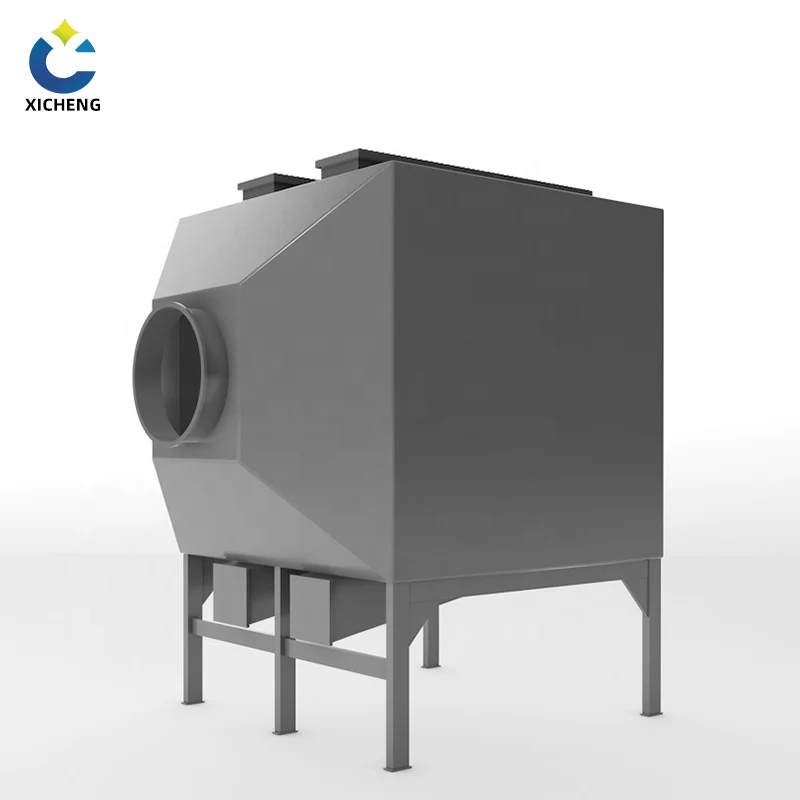
Figure 1 shows a typical packaged activated carbon adsorption box. The housing carries a flanged inlet and outlet, a top or side access hatch, and internal perforated plate or mesh layers that hold the carbon while letting air pass. The lid has to come off cleanly because carbon change-out happens on site, several times over the life of the unit.
Housing Materials
Choose the housing material from the corrosivity of the gas, not from the carbon alone. The three standard options are:
Carbon steel with two-part epoxy lining, the budget choice for neutral or lightly corrosive solvent streams, and the most common housing in paint and printing exhaust. The epoxy protects the steel from condensation pitting.
Stainless steel (SS304 or SS316), selected when the gas is humid, acidic, or corrosive, for example in chemical and plating exhaust, or where wash-down is routine. You pay more per kilogram of housing, but the service life usually justifies it.
Polypropylene or PVC, used in wet or strongly corrosive service where steel would not hold up. Plastic housings are lighter, but temperature tolerance is lower and flame rating has to be checked against the process.
Internal Layout
Inside the shell, the carbon sits as a horizontal or vertical bed depending on the box construction. Supporting the media is a perforated deck with a fine screen on top so granules cannot fall through. Above the bed, a holding grid keeps the carbon from fluidizing when the fan runs at high load.
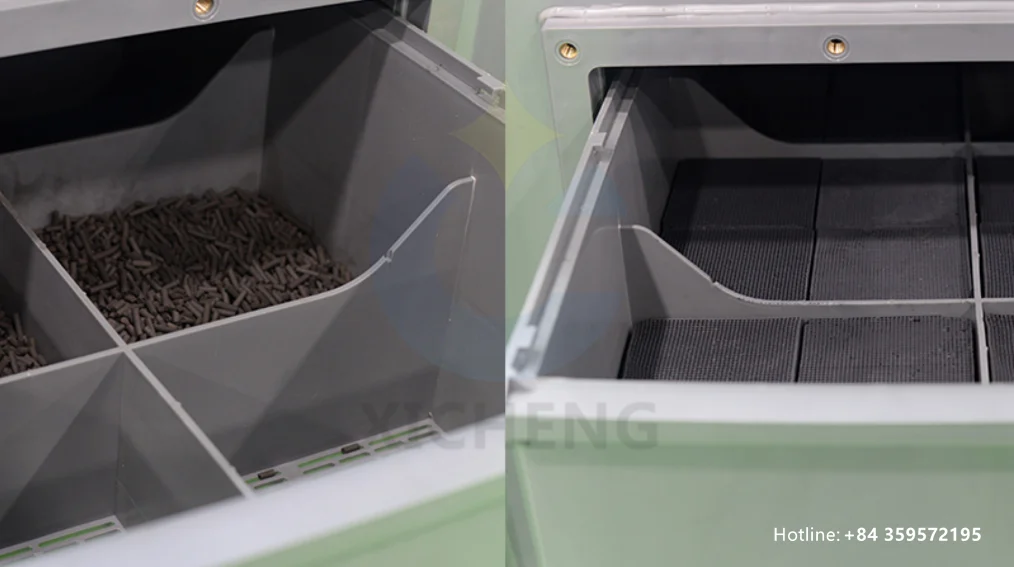
The internals determine most of the maintenance headaches. Cheap units bury the bed and make change-out a shovel job; well-built boxes use a slide-out tray or bagged cartridge that lets a two-person crew swap the charge in a few hours. Figure 2 shows the packed bed that actually does the work.
Frames, Dampers, and Accessories
Complete units normally ship with instrument ports, a spare-media door, lifting lugs, and a drain for condensed water. Optional extras include inlet dampers for balancing, differential pressure taps for bed monitoring, and a dust pre-filter frame.
When you specify the hardware, look at how the carbon is retained and accessed. The Activated Carbon Filter Box and Industrial Activated Carbon Filter pages show the stainless and carbon-steel variants and the change-out method that suits them.
How to Size an Activated Carbon Adsorption Box
Sizing is where projects either succeed or quietly fail. The activated carbon adsorption box has to handle your airflow, your pollutant load, and your required outlet limit, all at once. Missing any one of the three produces either breakthrough too early or cost you did not need to pay.
The Four Sizing Inputs
Airflow (m³/h). The design airflow set by the fans and duct size. Face velocity across the bed should stay below about 0.5 m/s; that fixes how much bed cross-section area you need before anything else.
Pollutant concentration and load. Airflow times concentration gives the mass load in kg/h. This drives how much carbon is consumed per hour, and therefore how fast the bed saturates.
Working capacity. From Table 1, plan on roughly 10 to 20 kg of pollutant per 100 kg of carbon. Conservative designers use the low end when the stream is humid or the material is hard to adsorb.
Required service life. Decide how many months you are willing to run before a carbon change. Carbon charge divided by hourly load times working capacity gives the run time; most plants target 6 to 12 months between change-outs.
Residence time is the check on all of this. Bed volume divided by airflow must land in the 0.5 to 2 second range for VOC duty. Table 2 gives representative ranges for the box classes used in industrial exhaust, to be treated as planning numbers rather than a final design.
Table 2. Representative sizing ranges for an activated carbon adsorption box
| Box class | Rated airflow (m³/h) | Carbon charge (kg) | Face velocity (m/s) | Pressure drop (Pa) |
|---|---|---|---|---|
| Small / pilot | 1,500–5,000 | 150–400 | 0.2–0.5 | 300–600 |
| Medium | 5,000–20,000 | 400–1,200 | 0.3–0.5 | 500–1,000 |
| Large / multi-module | 20,000–60,000+ | 1,200–3,000+ | 0.3–0.5 | 800–1,500 |
Two traps appear again and again on real jobs. The first is oversizing: a box that is too big for the airflow lets the gas barely move, and warm streams then push the relative humidity up inside the bed, which cuts capacity. The second is the opposite, velocity too high, which pushes the MTZ out of the box and gives you breakthrough in weeks instead of months.
Custom activated carbon adsorption equipment is engineered around exactly these four inputs, so give the supplier the airflow, the pollutant, and the concentration, and let them run the media calculation. A data sheet with those three numbers is enough to start a proper quotation.
Activated Carbon Adsorption Box Applications and Typical Exhaust Lines
The same activated carbon adsorption box design re-appears across almost every industry that exhausts volatile solvents or odors. The reason is that the operating principle does not care what the factory makes, only what the air contains. Common applications include:
Paint and metal finishing. Paint booths, powder-coating lines, and spray rooms exhaust toluene, xylene, and MEK at moderate concentrations. An activated carbon adsorption box is the standard VOC control step after a dry filter catches the overspray.
Printing and packaging. Gravure and flexo presses, lamination lines, and ink preparation rooms emit ethyl acetate, isopropanol, and other low-molecular-weight solvents that adsorb readily.
Chemical and pharmaceutical. Reactor vents, solvent recovery areas, and formulation halls use carbon boxes for fugitive VOCs, often as the second stage behind a scrubber.
Electronics and composites. Soldering, cleaning, and resin batching give off solvent vapors that a box handles at low operating cost.
Odor control. Sewage pump stations, transfer stations, and waste treatment plants use carbon boxes for hydrogen sulfide and mercaptans; in these sites impregnated media is the standard.
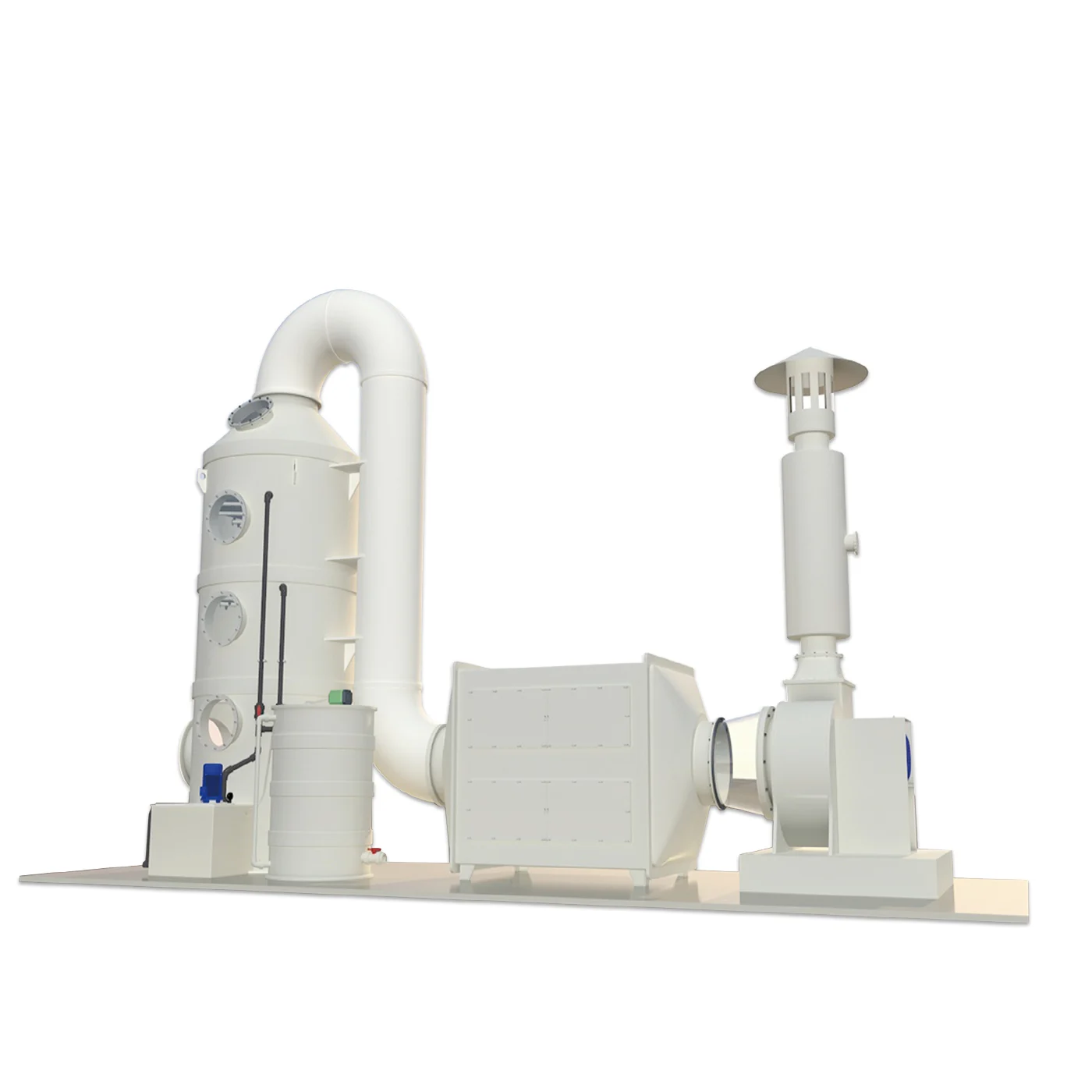
Figure 3 shows a common pairing: a wet scrubber doing the heavy chemical duty, with the gas finishing through a carbon stage for the organic tail. That staged layout is the most reliable way to meet strict outlet limits on mixed streams.
For high-volume facilities the same bed principle is packaged as a vertical tower, our Activated Carbon Adsorption Tower, which suits large airflow with a small footprint. Where the pollutant is mainly acid gas, pair the box downstream of an exhaust gas scrubber rather than feeding everything to the carbon.
Our VOC control scrubber systems article covers the equipment families side by side, and the paint-booth-specific arrangement is described in wet scrubber and dry filter paint booth systems.
Installing an Activated Carbon Adsorption Box
Installation of an activated carbon adsorption box is mostly about the ducting and the fan, because the unit itself is delivered skid-mounted. Get those two right and commissioning is uneventful; get them wrong and the carbon saturates faster than any maintenance plan expects.
Duct Connections
Run duct to the inlet and outlet flanges with the shortest practical straight run. Corrosive solvent exhaust should move in industrial polypropylene duct, with square square polypropylene duct for the wide low-profile sections that keep face velocity down over large openings. Avoid long horizontal runs without drain points, because warm solvent-laden air condenses and the water then sits on the carbon.
Fan Placement
Set the fan downstream of the box (draw-through). That keeps the housing and ducting under negative pressure, so any leak is inward rather than pushing contaminated air into the work area. The fan must be matched to the total pressure drop of the box, the duct, and the stack. Our PP blowers and corrosion-resistant permanent magnet fans are sized for exactly this duty; state the box pressure drop when you quote the fan.
Electrical and Controls
The box itself needs no power, but the installation usually includes differential pressure indication across the bed and an inlet temperature sensor. Wire those into the panel alongside the fan; an interlock that stops the fan if bed temperature climbs is cheap insurance against the heat-of-adsorption case discussed in the safety section.
Grounding and Positioning
Bond the box, duct flanges, and the fan to the plant ground. Solvent-laden air moving through plastic duct builds static charge, and a carbon bed is, in effect, a conductive granule stack that can dissipate a spark. Keep the unit out of areas with open flame or hot surfaces, and leave the access side clear at least a meter so change-out crews can work.
Service access, a drain, and a level base are the three details that decide whether a change-out takes two hours or two days. Confirm them at installation, not after the media saturates.
Operating and Maintaining an Activated Carbon Adsorption Box
An activated carbon adsorption box is a passive machine: no moving parts, no chemical feed, no burner. Almost all of its maintenance is about watching three numbers and acting on them early. Ignore them and the box keeps running while quietly sending untreated gas to the stack.
The Three Numbers to Watch
Differential pressure. A clean bed shows a delta-P in the range in Table 2. When delta-P climbs steadily, dust has loaded the media surface, so it is time to check the pre-filter and eventually change the carbon. A sudden delta-P fall usually means channeling, a crack in the bed that lets gas bypass the carbon.
Outlet concentration. This is the definitive breakthrough indicator. A portable photoionization detector or a scheduled lab sample at the outlet tells you when the leading MTZ edge has reached the end of the bed. The moment outlet concentration approaches your permit limit, the media is spent.
Bed temperature. Heat rises when adsorption is heavy. If the inlet stream is warm, or the concentration is high, watch the bed; the safety section explains why.
Change-Out
Spent carbon is a consumed resource, not something you wash. Options are exchange with the supplier (the spent material is regenerated off-site by steam or pyrolysis at roughly 700 to 1,000 °C), or disposal as hazardous waste if the adsorbed pollutants classify it as such. Regenerated carbon works well at roughly 80 percent of virgin capacity, so the exchange price reflects that.
Change-out procedure safety: wet carbon can deplete oxygen from a confined space, so never enter the box without an atmospheric test and ventilation. Bag the spent material as it is removed, and check the wear on the retaining screens while the bed is empty.
Recording
Log the delta-P and outlet reading once a shift, or continuously if the instrumentation allows. A simple trend line is enough to predict the next change-out within a month, and that prediction is what turns a surprise media bill into a scheduled line item.
Many plants run an activated carbon adsorption box hard for three to five years before the housing itself needs attention. The cash the unit saves in chemicals and energy should be visible in the maintenance ledger; if it is not, revisit the sizing assumptions from the earlier section before you buy again.
Activated Carbon Adsorption Box Safety Considerations
An activated carbon adsorption box is straightforward equipment, but two failure modes deserve a hard look before startup, because both have caused real accidents. Neither is exotic; both are fully preventable with the same three or four controls.
Heat of Adsorption and Bed Fire Risk
Adsorption releases heat. When the inlet concentration is high and the airflow is low, the released heat has nowhere to go, and the temperature inside the bed can climb. Solvent-laden carbon that gets hot enough can ignite. This is why the industry rules are simple: monitor bed temperature, keep the stream below the supplier’s maximum inlet temperature, and come down slowly on fan speed during shutdown of a loaded bed rather than starving it of air.
Spark protection matters on the inlet side. If the exhaust can carry sparks or glowing particles, fit a spark arrester or a knockout screen ahead of the box, and keep any flame guns or dryers physically separated from the carbon unit in the line layout.
Confined-Space and Low-Oxygen Hazard
Wet activated carbon consumes oxygen from the air inside an enclosed vessel. A maintenance worker entering the box without purging can walk into an atmosphere that will not support life. Treat the interior as a permit-required confined space: test the atmosphere, ventilate, and enter with a buddy. This applies at every change-out, not just the first one. OSHA’s confined-space information for general industry is a solid reference for the written program your facility needs behind that practice.
Handling Spent Media
Spent carbon carries the pollutants it adsorbed. Wear gloves and a dust mask when handling, keep the media covered and away from ignition, and confirm with your waste vendor whether the spent charge classifies as hazardous waste in your jurisdiction before you schedule pick-up.
Controls to Install from Day One
The practical checklist is short: a bed temperature sensor with an alarm, a high-temperature interlock on the fan motor, a spark screen on the inlet, drain points on the duct, and a written confined-space entry procedure. Equipment that ships without the sensor taps and access engineered in becomes a retrofit problem later, so specify them in the original order.
Choosing and Buying an Activated Carbon Adsorption Box
By the time you reach this section you know the mechanism, the sizing inputs, and the safety controls. Buying is then a matter of eight decisions, most of which the supplier should be able to answer from your data sheet.
1. Media specification. Coal-based GAC for general solvent duty, coconut-shell for odor, impregnated for H₂S. Confirm the mesh size (4×8 or 6×12 are common), because finer media adsorbs more but pressure-drops more, and mesh must match the retaining screen.
2. Housing material. Epoxy-lined carbon steel for neutral streams, stainless for corrosive and humid ones, polypropylene for aggressive chemical service. Match it to the gas, not to habit.
3. Bed configuration. Single bed, or two beds in series so one can be changed without stopping production? Dual modules in parallel for continuous operation? Series beds are the classic choice when the outlet limit is strict.
4. Change-out access. Slide-out trays and bagged cartridges beat open-bucket digging for crew hours. Ask to see the change-out method before you commit to the standard lid.
5. Instrumentation and controls. Differential pressure taps, bed temperature sensor, and an outlet sampling port are standard on a machine you plan to run for years. Add them at order time, not later.
6. Ancillary equipment. Inlet dust pre-filter, spark arrester, condensate drain, and the fan itself. The fan pressure rating must include the box delta-P; forgetting that is the single most common installation error.
7. Supplier service and media supply. A box is only as good as the carbon source and the change-out experience behind it. Ask about media exchange, regeneration, and local stock before you let price decide the deal.
8. Documentation. You will need the design airflow, carbon charge, working-capacity calculation, pressure-drop curve, and the maximum safe inlet temperature, all in writing, for your permit file and your maintainers.
Our activated carbon adsorption equipment range is engineered around these decisions, and the Activated Carbon Box and Activated Carbon Filter Box pages show the standard options each decision drives. If you are weighing a scrubber against a carbon stage, the dry scrubber vs wet scrubber comparison explains where each technology wins.
Chinese manufacturers build most of the world’s carbon-based exhaust equipment, and one reason buyers prefer to order direct is the customization freedom: housing size, media grade, flange drilling, instrumentation, and even paint color can all be set at the factory. That flexibility is exactly what an industrial activated carbon filter order should exploit, so send the supplier your real numbers and let them draw the unit around the job.
FAQ: Activated Carbon Adsorption Box
How much activated carbon does an activated carbon adsorption box hold?
Small industrial units hold roughly 150 to 400 kg of granular carbon, medium units 400 to 1,200 kg, and large multi-module systems more than 3,000 kg. The exact charge comes from your airflow, pollutant load, and target service life, per the sizing method in this guide.
How often do I need to replace the carbon?
Most plants plan for a change-out every 6 to 12 months, but the real answer is driven by your load and outlet concentration. Watch the differential pressure and an outlet reading; breakthrough is the only honest schedule.
What is the best material for the box housing?
Epoxy-lined carbon steel is the standard for neutral solvent streams, stainless steel (SS304/SS316) for humid or corrosive gas, and polypropylene for aggressive chemical duty. Choose on corrosivity, not on habit.
Can an activated carbon adsorption box handle high humidity?
Yes, but humidity competes with pollutant for the carbon surface, so working capacity falls. Fit a drain on the bed, keep the inlet cool, and drop the capacity factor used in sizing when the stream is consistently wet.
How do I choose between a carbon box and a wet scrubber?
If the pollutant is soluble or reactive, like hydrogen sulfide at high concentration, use a wet scrubber. If it is a solvent VOC or a low-level odor, an activated carbon adsorption box is simpler and cheaper to run. Many strict lines use both, a scrubber first and a carbon stage as polish.
Is an activated carbon adsorption box accepted for exhaust permits?
Yes, carbon adsorption is a listed control technology in air-permit and emissions-monitoring guidance, including the U.S. EPA’s carbon adsorber documentation, provided you can show the design capacity, working-capacity basis, monitoring, and change-out records.