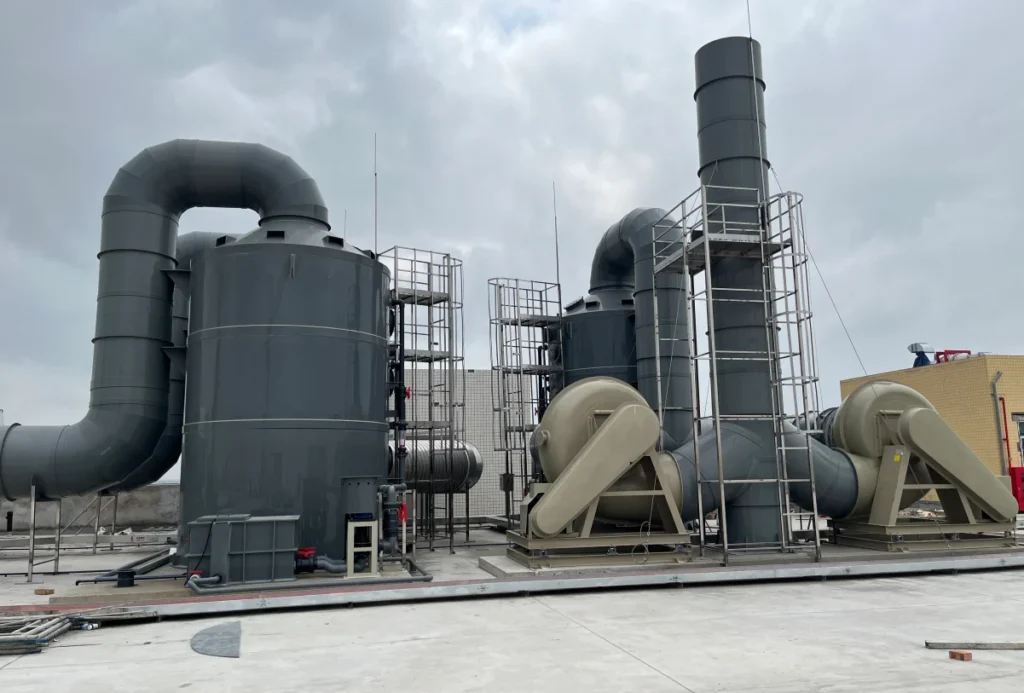
An activated carbon hepa filter box answers two jobs at once: a HEPA stage removes particles, and an activated carbon stage adsorbs gas molecules. It is not one filter pretending to be two — it is two media with different physics sharing one housing.
The physics decides the order. Particles are caught mechanically, gas molecules are adsorbed chemically. A carbon HEPA filter box that skips the prefilter, or feeds an oily load straight into the carbon, guarantees an early failure.
Combo cartridges give you thin carbon. A single HEPA+carbon cartridge must leave room for the pleats, so most carry well under half a pound of carbon. A three-stage box with a separate carbon section delivers real adsorption depth.
Watch pressure, weight and odor. Pressure drop climbs as the HEPA loads, the carbon stage gains weight as it saturates, and odor breakthrough is the final signal. Each stage changes on its own calendar.
The setting changes the arrangement. A ductless fume hood pairs carbon with HEPA in one cabinet; a cleanroom fan-filter unit cascades them; a commercial kitchen adds grease filtration ahead of the carbon. One box family, three layouts.
When One Box Must Remove Both Particles and Gases
Two classes of pollutant travel in the same air, and each needs a different kind of filter. Dust, pollen, weld fume, and powder are particles with mass and size, and a HEPA stage stops them mechanically. Solvent vapour, cooking odour, paint off-gassing, and sulfur odours are gas molecules with no fixed size, and only an activated carbon stage holds them. A plant that faces both problems at once — most do — ends up specifying an activated carbon hepa filter box that carries both media in one ducted housing.
This is not a consumer shopping question. On a production line or in a controlled room, the box is a piece of process equipment, and the difference between the right one and the wrong one shows up in month three, when the first breakthrough happens or the first pressure alarm fires. The engineering logic that separates a working box from a disappointment is the subject of this guide, and it sits inside a cluster that begins with how activated carbon adsorption works and what an activated carbon adsorption box contains.
The core mistake to unlearn first. When an air-handling consultant asks for an activated carbon hepa filter box, many suppliers quote a single cartridge that mixes carbon granules into a pleated pack. That product exists, it is cheap, and it fails the exact duty this guide is about. This article explains the media physics, the correct stage order, the cleanroom, laboratory and kitchen placements, and the maintenance signals that keep the box alive — so you can specify the right architecture once, not the wrong one three times.
HEPA and Carbon Do Not Filter the Same Thing
The phrase activated carbon hepa filter box bundles two technologies, and the bundle is workable only if you understand where each one stops working. They share a housing and a duct; they share almost nothing else. Table 1 sets out the two mechanisms side by side, and the three sections below explain the physics underneath the table.
HEPA: Mechanical Particle Capture
A HEPA filter is a deep mat of fine fibres. Air is forced through it, and particles are caught by three mechanisms working together: direct impact for larger particles, interception when a particle passing a fibre touches it, and diffusion for the smallest particles, whose random motion brings them to a fibre. True HEPA media exceeds 99.97 percent efficiency at 0.3 micrometres — the most penetrating particle size — and most industrial boxes quote 99.97 to 99.999 percent at that challenge. Anything with mass responds to something, from machining dust to flour dust to the droplets that carry biological risk. What HEPA cannot do is touch a gas molecule, which has no physical size to intercept. A smoke odour passes through unharmed, which is why every serious specification pairs the HEPA stage with a carbon stage.
Carbon: Chemical Adsorption of Gas Molecules
Activated carbon is processed so its interior is riddled with microscopic pores, and those pores make up an enormous internal surface area packed into a small volume. Gas molecules adsorb — physically bond — to that surface as the air stream passes. The process is adsorption, not absorption: the molecule clings to the carbon instead of soaking into it. The specification that matters is carbon mass and media depth, because capacity scales with how much carbon is actually in the box. A well-known finding of the consumer air-cleaning market, echoed by the California air regulator and the EPA in their guidance for gases and odours, is that larger carbon quantities outperform small ones and last longer — and that logic carries straight into industrial sizing. For the deeper physical background, the activated carbon article on Wikipedia is a reliable reference.
What Each One Cannot Do
The mirror images are the ones that cost money when ignored. HEPA leaves every gas-phase compound in the stream: solvent vapour, hydrogen sulfide at trace level, kitchen grease odour, formaldehyde from coatings. Carbon leaves every particle in the stream: it has no mesh, and a dusty hour can blind a carbon bed the way it blinds a HEPA pack. Neither stage is optional in an activated carbon hepa filter box for a combined load, and that is the difference between this product class and a single-purpose filter. The two jobs are also assessed differently: HEPA classification governs particle removal, while gas-phase filtration is tested separately, most recently in the AHAM AC-4 method for gas-phase air cleaners.
| Factor | HEPA stage | Activated carbon stage |
|---|---|---|
| Mechanism | Mechanical capture on a fibre mat | Adsorption onto a porous carbon surface |
| Captures | Dust, pollen, fume, spores, droplets, PM2.5 | VOCs, solvent vapour, odour compounds, formaldehyde, H2S |
| Efficiency claim | 99.97–99.999% at 0.3 µm | No single universal %; scales with carbon mass |
| Blind spot | All gases and odours pass through | All particles pass through |
| Capacity signal | Pressure drop climbs as media loads | Weight gain, then downstream odour |
Two Ways to Build the Combination
Every activated carbon hepa filter box on the market is one of two architectures: a single combination cartridge that bundles the media into one pack, or a multi-stage housing that keeps the stages in separate sections. The two look similar in a brochure and behave very differently in service. This section explains both, and why the stage arrangement is the single most important engineering decision in the product class.
Combo Cartridge: Thin Carbon by Design
A combination cartridge places a carbon layer in front of or behind the HEPA media inside one pleated pack. It is compact, it drops into many existing housings, and it gives one filter change instead of three. The catch is structural: the cartridge must leave room for the HEPA pleats, so the carbon layer is thin by design. Consumer-market surveys of combo filters put most at well under half a pound of carbon, and the same constraint scales up into industrial cartridges. For a light, intermittent odour load that is acceptable. For a process that smells all shift, the carbon saturates while the HEPA is still almost new, and the odour returns while the particle stage keeps passing its test — the combination fails at exactly the point where it was supposed to save money.
The Three-Stage Box: Prefilter, Carbon, HEPA
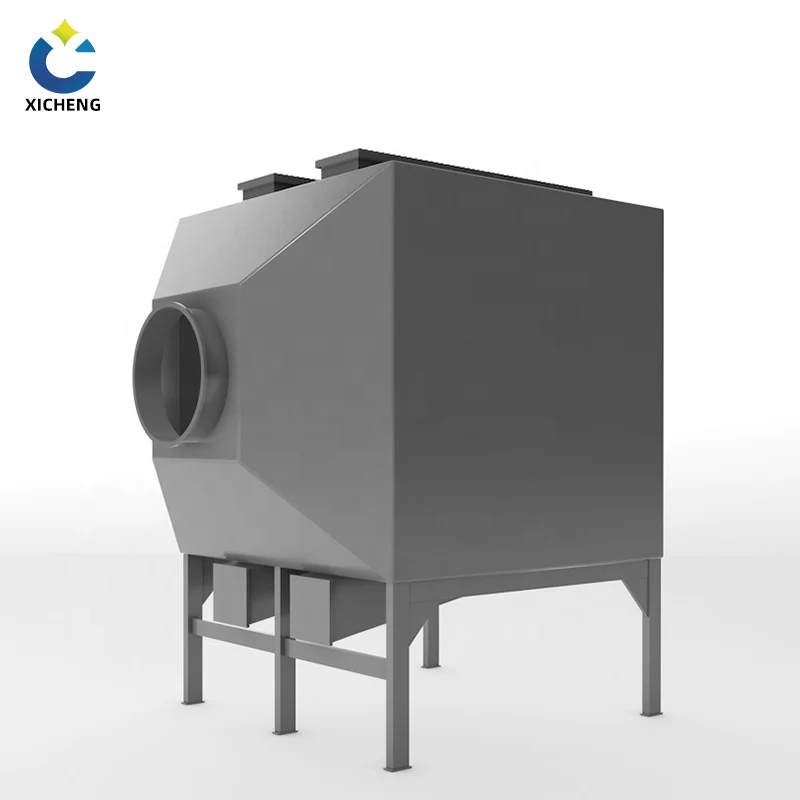
The alternative — the architecture this guide argues for — is an activated carbon hepa filter box with separate sections in sequence: a prefilter stage, a carbon section, and a HEPA section, each sized and replaced on its own cycle. ACiQ’s AFH series inline purification boxes for 4 to 10 inch round ductwork are popular small examples of exactly this sequence — pre-filter, then activated carbon, then HEPA — marketed for dust, mould, smoke, PM2.5, odours and formaldehyde. The same layout scales all the way up to industrial walk-in housings. Because the carbon section no longer shares space with pleats, it carries a realistic charge: hundreds of kilograms in an industrial box instead of a fraction of a pound in a cartridge. The trade that the cartridge hides — carbon volume versus HEPA footprint — disappears when the stages are separate.
A Separate Carbon Section for Depth
The laboratory and fume-hood market settled this question decades ago. HEMCO’s Clean-Aire range, sized up to 1,500 cfm for fume-hood exhaust ducting, sells the HEPA pack and the carbon pack as two separate in-line elements that the installer pairs, each supplied with its own 30 percent pleated prefilter. HEMCO is explicit that the two packs are paired for applications requiring both particulate and fume removal — separate housings, separate change-outs, one duct line. That is the pattern this guide recommends for any plant where odour and particles genuinely coexist, and the sizing arithmetic for the carbon half of such a system runs in the activated carbon box design and sizing guide.
Cleanroom and Laboratory Placement
The controlled-environment world buys this product under a different name and applies a stricter test regime, and its placement rules transfer directly to industrial use. A ductless fume hood is, in effect, a cabinet-scale activated carbon hepa filter box: an activated carbon section adsorbs the gas-phase load from the reagent work, and a HEPA section removes any particle contamination before the air recirculates into the room. Cleanrooms run the same pairing at fan-filter-unit scale. The three placements below are the canonical ones.
Ductless Fume Hood: Carbon for Vapours, HEPA for Particles
Esco’s guidance on ductless fume hoods describes the core architecture plainly: a chemical filter, often activated carbon, adsorbs gases and vapours, while a high-efficiency particulate air filter removes particulate matter — two stages, one recirculating cabinet, no building ductwork. Because the air returns to occupied space, both stages are graded strictly, the carbon against the specific reagent inventory and the HEPA against its rating. The containment discipline is what separates a laboratory hood from a general exhaust: the box must hold negative pressure around the work aperture, and stage failure there is a safety event, not a maintenance nuisance.
FFU Cascade: Carbon Paired with HEPA or ULPA
In a cleanroom, the fan-filter unit (FFU) supplies laminar, particle-cleaned air toward the product. Terra Universal’s charcoal-filter guidance for critical environments states the pairing rule that matters here: when a carbon filter is used in an FFU, it can be paired with a pre-filter, or with a HEPA or ULPA particle filter. That is a cascade — carbon plus HEPA in sequence — and exactly the architecture of the activated carbon hepa filter box this guide concerns. Chemical fumes that particle filters cannot touch are the gap carbon fills, and Terra lists the impregnated grades that target specific molecule families: caustic-impregnated carbon for acids, chlorine, nitrogen oxides and hydrogen sulfide; acid-impregnated for amines; permanganate blends for aldehydes, ethylene and paint odours.
What the Cleanroom Adds: Airflow Uniformity and Containment
Two disciplines from the cleanroom apply to any carbon HEPA filter box in a sensitive duty. First, airflow uniformity: a carbon bed that bypasses — air finding the gaps around the media instead of through it — defeats the chemistry, and a HEPA pack with a poorly gasketed frame defeats the particle claim. Second, containment: the housing, doors and gaskets decide whether the contaminant stays in the duct. A box rated for a general workshop can be a liability in a laboratory or an ISO room, and the activated carbon filter box product range is engineered with gasketed access and matched media packs for exactly that reason.
Commercial Kitchen and Cooking-Fume Exhaust
Kitchens are the hardest placement for an activated carbon hepa filter box because the load is simultaneously oily, hot and odorous. Cooking oil exists in two forms, as particle and as vapour, and both can foul the media. The commercial kitchen exhaust market that once vented straight out through the roof now increasingly runs through a box, either to meet odour limits or to enable recirculation where ducting is impossible. Three rules govern this placement.
Hood Capture and the Duct That Feeds a Box
Everything downstream depends on the hood and the duct that precede the box. A hood that fails to capture the cooking plume simply pushes the odour out into the restaurant, and no filter recovers that. The polypropylene duct customization and blowers-pp product lines on this site size the ductwork and the static pressure a kitchen system actually needs. The box is downstream of capture, and the order cannot be inverted: capture first, predict the flow, then filter.
Oily Load: Filter Grease Before It Reaches Carbon
The single most common failure in kitchen filtration is grease on the carbon. Oil mist lands on the carbon surface, fills the pores with material that does not meaningfully adsorb, and the odour duty dies quietly while the box still looks new. A dedicated grease filter — baffle or mesh — or a washable oil-removal stage must sit ahead of the carbon. Where the stream is heavy and wet, the scrubber-first architecture described in the VOC and odour applications article is the correct train, with the carbon stage acting as the final polish. This is the oil-load rule that the thin-carbon cartridge breaks most reliably: a cartridge with under half a pound of carbon is exhausted by a single shift of frying before the HEPA stage has even loaded.
Recirculating Versus Ducted
Where the building and the code allow it, a ducted system that vents to a treated stack through an inline activated carbon hepa filter box is the simplest, lowest-maintenance answer. Where ducting is physically impossible — a kitchen on an interior floor, a food court on a middle level — a recirculating arrangement returns the polished air to the space, and then the carbon stage must be sized generously and changed on a defensible schedule, because the air goes back to people. The recirculation decision is a code decision as much as an engineering one, and it decides the change-out cadence the whole system lives by.
Stage Order and Duct Integration
Order is not decoration in an activated carbon hepa filter box; it is the difference between a system that runs for a season and one that wakes up broken. The general rule is prefilter first, carbon second, HEPA last, and each of those choices has a mechanical reason, laid out below and summarised in Table 2.
Prefilter First, Carbon Then, HEPA Last — and Why
The prefilter sits first because it is cheap and sacrificial, catching the coarse dust that would otherwise blind the carbon and the HEPA far sooner than they should. Carbon sits ahead of HEPA for a subtler reason: carbon is the media that sheds fines — loose carbon dust abrades and elutriates off a fresh bed — and putting the HEPA downstream catches exactly that carbon dust so it never reaches the room or the process. A HEPA pack placed ahead of the carbon would hold back atmospheric dust but would then be blinded early by the downstream carbon’s own fines as they migrate. The reverse arrangement, HEPA before carbon, is chosen only when the carbon’s fines are acceptable downstream and particle cleanliness upstream matters more; it is the rarer layout and it demands prefiltering on both sides.
Inline Box Basics: Flow, Housing, Access
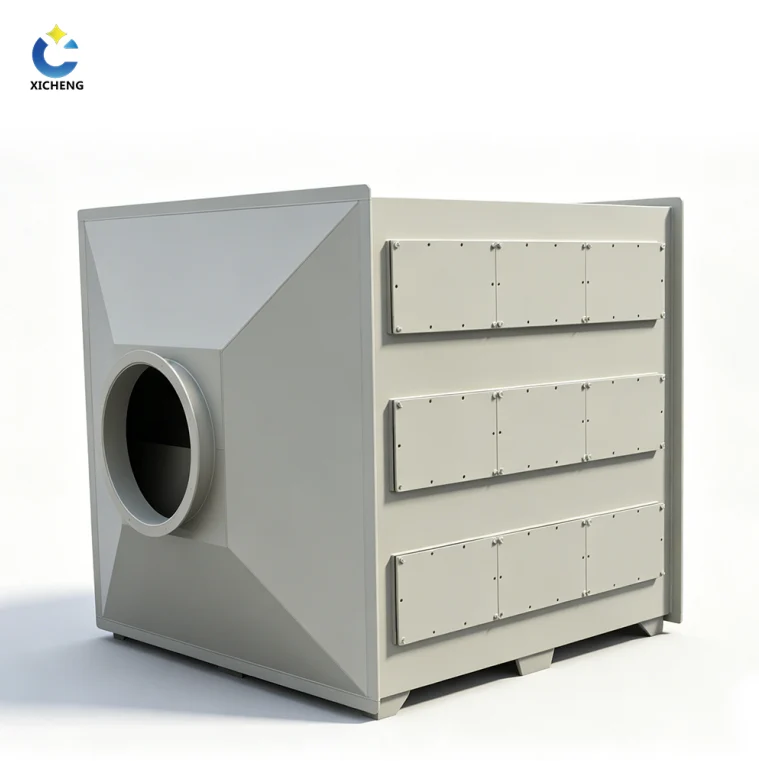
An inline activated carbon hepa filter box is, at its core, a duct component. Flow enters through a collar sized to the duct, crosses the media in order, and exits through the downstream collar. The housing must seal at service pressure, the access door must open to the media with enough room to pull a pack, and the duct collars must match the line without necking that adds unplanned velocity and pressure. Housing material follows the stream: galvanised or painted steel for ordinary duty, 304 or 316 stainless where the chemistry attacks steel, polypropylene where corrosion and weight matter together. The housing, the door and the gaskets are not accessories; they are what keep the product an engineering tool rather than a toy.
Fan and Static-Pressure Budget
Every stage consumes static pressure, and the fan must be selected for the sum. A loaded HEPA pack can add hundreds of pascals across its life; a deep carbon bed adds its share as it loads; the prefilter adds a small early increment. Sizing the fan from the clean-filter pressure alone guarantees the flow falls below specification before the first change-out. The fan-and-duct half of this system is covered in the design guide and the blower range, and the applications that pair the box with scrubbers belong to the VOC and odour treatment article.
| Scene | Recommended arrangement | Change signal |
|---|---|---|
| Cleanroom / FFU | Prefilter → carbon → HEPA (or HEPA/ULPA), cascade | Carbon: baseline weight or odour; HEPA: pressure differential |
| Laboratory / ductless hood | Carbon + HEPA in one cabinet, matched grades | Carbon: reagent-specific breakthrough or sensor; HEPA: rated intervals |
| Commercial kitchen | Grease filter → carbon → HEPA, ducted or recirculating | Carbon: odour return at the hood; grease filters: routine visual check |
| General process exhaust | Prefilter → carbon → HEPA, inline ducted | Per-stage: pressure, weight, odour and schedule |
Pressure Drop and Change-Out Cadence
The maintenance question — when is each stage done? — is answered by three signals that cost nothing to watch: pressure, weight, and odour. The disciplines that sell these boxes keep shipping the same advice, and it converges on the same set of rules for any activated carbon hepa filter box.
Pressure Climb Is the Change Signal
As the HEPA media loads with particles, the air has to push harder across the filter face, and the pressure differential rises in a way you can measure with a simple gauge. HEMCO’s guidance for its packs is direct: fit a minihelic or magnehelic gauge to read the differential across the filter, mount it on the hood or the housing, and treat the static pressure it shows as the change alarm. If the box has no gauge, the fan starts to labour and the flow drops. Install the gauge, record the clean value at commissioning, and change the HEPA when the differential crosses the manufacturer’s limit — typically two to three times the clean value for a packed industrial filter.
Carbon Is Done When Heavy or Odorous
The carbon section of an activated carbon hepa filter box does not reliably show pressure rise the way a particle filter does, because the bed stays open while it loads. The industry’s two practical signals are the ones Terra Universal names for cleanroom charcoal: the filter is heavier than when it was installed — so record a baseline weight before first use — and odour eventually appears downstream, which means the bed has saturated. For a single-molecule ventilation load, breakthrough happens at a predictable bed position, and a carbon breakthrough sampling kit gives an early quantitative warning. Change carbon on schedule once the pattern under consistent conditions is known; most plants move from guesswork to a fixed calendar within two change-outs.
HEPA and Carbon March on Different Calendars
The two media have different life expectancies, and treating them as one unit is the classic management error. A HEPA stage loaded by cleanroom-grade air can last a year or more; the same HEPA stage in a dusty process can reach its pressure limit in weeks. A carbon bed on a light trace load runs a full season; on a heavy solvent load it saturates in days. The box design guide gives the capacity arithmetic that turns a contaminant load into a predicted calendar, and the practical consequence is that the two stages are changed at different moments, on different records, and never as one combined replacement on a single calendar.
Safety and Monitoring
Where the contaminants are inhalable, the box is part of the occupational hygiene system, and every stage choice has a safety consequence. Worker exposure limits, not marketing claims, frame the design of an activated carbon hepa filter box in these duties.
Differential-Pressure Gauges and Breakthrough Sampling
Two instruments belong on a box in safety-critical service. The differential-pressure gauge watches the particle side, and it is the alarm that tells the operator the HEPA stage is loading toward its limit. The carbon side needs a different instrument: a carbon breakthrough sampling kit, which draws a small sample of the treated air and tests for the contaminant the bed is supposed to remove. HEMCO recommends exactly this pair for its packs — a pressure gauge for the HEPA, a breakthrough sample for the carbon — and the pair together is the difference between a maintained system and a guessing game. A VOC sensor downstream of the carbon, as fitted in some ductless hoods, serves the same job continuously for organic load.
When Bag-In-Bag-Out Is Required
Changing a filter that has collected hazardous material is itself a hazardous operation, and the change-out protocol decides the exposure. For acutely hazardous contaminants, the housing must allow filter removal without the operator touching the media or breathing the release: the bag-in-bag-out housing, in which the old filter is drawn into a plastic bag sealed over the access port before it is detached, is the standard answer at hazardous-duty installations. The same discipline applies to the carbon bed, which may hold adsorbed solvent or corrosive acid chemistry long after the process stops. If the stream is hazardous, specify the containment change-out at the same moment you specify the media — retrofitting it later is a rebuild.
Exposure Limits Frame the Design
Every number in the box’s specification traces back to the exposure standard for the contaminant in question. Occupational exposure limits are the published ceilings for airborne concentrations, and they define what acceptable performance means for the air leaving an activated carbon hepa filter box. The reference used across the industry in the United States is the exposure-limits table in OSHA 29 CFR 1910.1000, and the pillar article on the activated carbon adsorption box walks through how an exhaust-train design starts from the exposure target and works backward to a carbon charge and a change-out interval.
What to Send Your Supplier
A purchase order for an activated carbon hepa filter box carries real engineering data, or it buys a box that fails in the field. The supplier cannot size what you have not described. Send the four inputs in this section, in this order, and the quote that comes back will be a design rather than a guess.
Flow Rate and Contaminant Inventory
First, the flow: actual cubic metres per hour at operating temperature, not a nominal fan size. The flow number sizes the fan, the housing and the face area of the carbon section. Second, the contaminant inventory: every compound in the stream, its typical concentration, and the worst case. The inventory decides the carbon grade, the bed depth, and the change-out calendar, and it is the single most common omission. A visitor’s nose is a poor sampling instrument; write the list down. Third, the particle side: particle size distribution and oil or grease content, because that decides the prefilter and whether a grease stage must come first.
Media Grade: Organic, Impregnated, Multi-Gas
Activated carbon is not one material. Standard coconut-shell and coal-based carbons handle the common organic solvents — the organic grade covers acetone, toluene, benzene, and the majority of process VOCs. The moment the stream includes acids, chlorine, ammonia, or hydrogen sulfide, the standard organic grade is the wrong carbon and an impregnated grade takes over: caustic-impregnated carbon for acid gases and H2S, acid-impregnated for amines and ammonia, permanganate blend for aldehydes and ethylene. For a mixed acid-and-base vapour stream, a multi-gas impregnation is the correct choice. The impregnation is not a marketing variant; it decides whether the activated carbon hepa filter box removes the contaminant at all.
Housing: PP, Coated Steel, Stainless
Finally, the housing. Polypropylene suits corrosive and humid streams and keeps weight down; painted or galvanised steel suits dry ordinary duty; 304 or 316 stainless suits chemistry that attacks steel and installations that demand cleanability. State the access requirement explicitly — a hinged, gasketed door and the clearance a filter pull needs — and state the duct-coupling and pressure ratings. The activated carbon adsorption tower and activated carbon filter box product lines are built from this specification sheet, and the full sizing arithmetic runs in the activated carbon box design article.
Activated Carbon HEPA Filter Box: FAQ
What is an activated carbon hepa filter box?
An activated carbon hepa filter box is a ducted housing that contains both an activated carbon stage, which adsorbs gas molecules such as VOCs and odour compounds, and a HEPA stage, which captures particles. It removes the two pollutant classes that a single-purpose filter cannot handle together.
Is a combination HEPA-and-carbon cartridge the same as a carbon HEPA filter box?
Not in engineering terms. A combination cartridge packs carbon into a thin layer inside one media pack, which keeps carbon mass low by design. A three-stage box keeps a separate carbon section and a separate HEPA section, so the carbon section can carry real depth. For heavy or continuous odour, the separate-section box wins.
Which stage comes first, carbon or HEPA?
The standard order is prefilter, then carbon, then HEPA. Carbon sits before the HEPA so that carbon fines shed by a fresh bed are caught by the final particle stage. Flipping the order is rare, and only justified when the carbon fines are acceptable downstream.
How do I know when to change the filters?
Watch three signals. Pressure differential across the HEPA stage climbs as it loads — fit a gauge and act on it. The carbon stage gains weight as it saturates, so record a baseline weight at installation. When odour appears downstream of the carbon, the bed has broken through and must be changed.
Can one activated carbon hepa filter box serve a cleanroom, a lab, and a kitchen?
The box family is the same, but the layout differs. A ductless fume hood pairs the carbon and the HEPA in one cabinet; a cleanroom fan-filter unit cascades the carbon with a HEPA or ULPA stage; a commercial kitchen puts a grease filter ahead of the carbon. Match the arrangement to the load rather than forcing one configuration.
The stage order, the media grades and the capacity arithmetic that decide where the carbon and HEPA sections sit in your train are worked through in the activated carbon adsorption principle article and the box design guide.