Key Takeaways
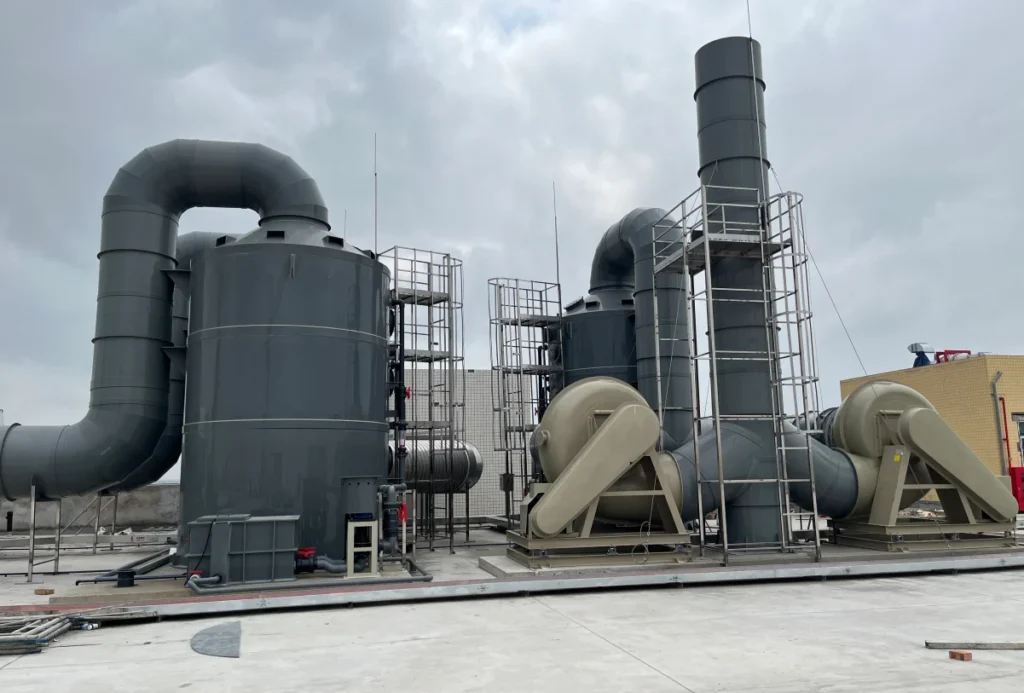
An activated carbon adsorption box for VOC odor treatment is the finishing instrument of an exhaust train. It either treats the whole stream alone or polishes what a wet scrubber or biofilter leaves behind, and where it sits depends on the contaminant, not on the equipment you already own.
VOC compliance and odor complaints are two different design targets. A permit limit is measured in parts per million or milligrams per cubic meter in the stack; an odor is detected at parts-per-billion by the human nose. One box serves both, sized to the stricter of the two.
Carbon adsorbs organic vapors and trace odor compounds. It cannot hold bulk acid gas, ammonia, or dust, so when those are present a wet scrubber and a mechanical prefilter go upstream and the box polishes the outlet — never the reverse.
Four placements cover almost every project: standalone, post-scrubber polish, post-biofilter polish, and passive tank vent. Match the placement to the load band and the box runs unattended for months on a fraction of the power a wet stage needs.
Keep the box out of trouble by design: inlet below roughly 60 °C, humidity managed so water never fills the micropores, dust and oil filtered out ahead of the bed, and bed temperature monitored because heat-of-adsorption can ignite spent loaded carbon.
When “VOC” and “Odor” Mean Two Different Problems
If your project landed on this page, the symptom is usually one of two complaints. Either the stack test keeps failing a permit number, or the neighbors — and quite often your own operators first — keep complaining about the smell. A factory sometimes hears both at once, and the hardware that answers both is the same: an activated carbon adsorption box for VOC odor treatment. The two problems, however, are designed for in very different ways, and mixing them up is how exhaust trains end up undersized or over-specified.
A VOC limit is a chemical concentration measured at the outlet: parts per million, or milligrams per cubic meter, compared against a figure written in a permit, such as the U.S. EPA’s MACT floors for coating lines or the GB 37822 stack limit near 30 mg/m³ of non-methane hydrocarbons used across Chinese industry. Solvent loads in this territory sit between roughly 50 and 5,000 ppm, and a carbon adsorber removes 95 to 99 percent of that mass, which brings almost any booth or dryer into range. An odor, by contrast, is a perception. The molecules that trigger it — hydrogen sulfide, mercaptans, terpenes, amines — are detected by the human nose at parts-per-billion, several orders of magnitude below any concentration limit that will ever be written for them. A carbon box treats the odor stream too, but now the target is the remaining concentration after treatment, not the incoming mass.
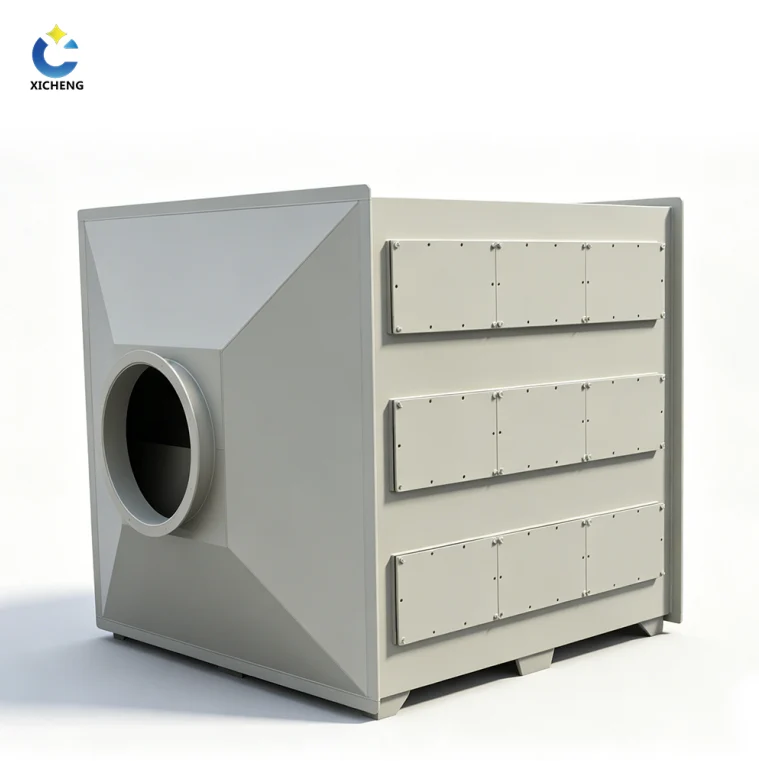
That difference drives every downstream decision: media grade, bed depth, change-out interval, and whether the box works alone or inside a multi-stage train. What follows walks through what the box can and cannot treat, a decision map for where it sits, the four application families that cover most industrial projects, the duct and blower integration that decides installation quality, and the safety limits that keep loaded carbon from becoming a fire. If you need the mechanism before the application — pore structure, isotherms, breakthrough curves — the companion guide to how activated carbon adsorption works covers that groundwork before you size anything. When the placement is decided, the hardware itself is the factory-built activated carbon box on this site, sized to exactly the numbers this article asks for.
What the Box Can and Cannot Treat
An activated carbon adsorption box for VOC odor treatment works the same way in every application: the contaminated gas flows through a deep bed of granular carbon, and vapor molecules stick to the internal surface of the particles — roughly one thousand square meters of surface per gram of media, the internal pore area activated carbon gains when the raw material is carbonized and opened up. Adsorption is selective, and knowing that selectivity is the entire engineering problem. The table below groups the contaminants you will actually meet in an industrial exhaust stream and gives the box’s verdict on each.
| Stream contaminant | Typical loading | Handled by the box? | Media / what must precede it |
|---|---|---|---|
| Aromatic and chlorinated solvents | 50–5,000 ppm | Yes — the core duty | Virgin bituminous or coconut carbon, high iodine value |
| Mixed VOC plus odor organics | ppm down to ppb | Yes | Virgin carbon, bed sized on the VOC mass |
| Hydrogen sulfide / SO2, low load | ppb to tens of ppm | Yes | Impregnated alkaline carbon |
| Bulk H2S, HCl, ammonia | hundreds of mg/m³ and up | No — the scrubber’s job | Wet scrubber first, box polishes after |
| Dust, oil mist, overspray | any | No — blinds the bed | Mechanical prefilter ahead of the box |
Organic Vapors and Solvents: the Natural Job
Aromatic and chlorinated solvents — toluene, xylene, acetone, methylene chloride, styrene, the alcohols and glycol ethers used in coatings and adhesives — are where the box earns its place. Feed concentrations of 50 to 5,000 ppm come out at 95 to 99 percent removal, and the media choice is a single decision: a virgin carbon with a high iodine value. One box, in the right size, treats a paint booth, a parts degreaser, a composites shop, or a solvent dispensing area without any second stage, provided the load is organic only and stays inside that concentration band. For a single booth or dryer line, one activated carbon adsorption box for VOC odor treatment is often the complete answer, with nothing more than a prefilter and a fan around it.
Trace Odor Compounds: a Different Media, the Same Box
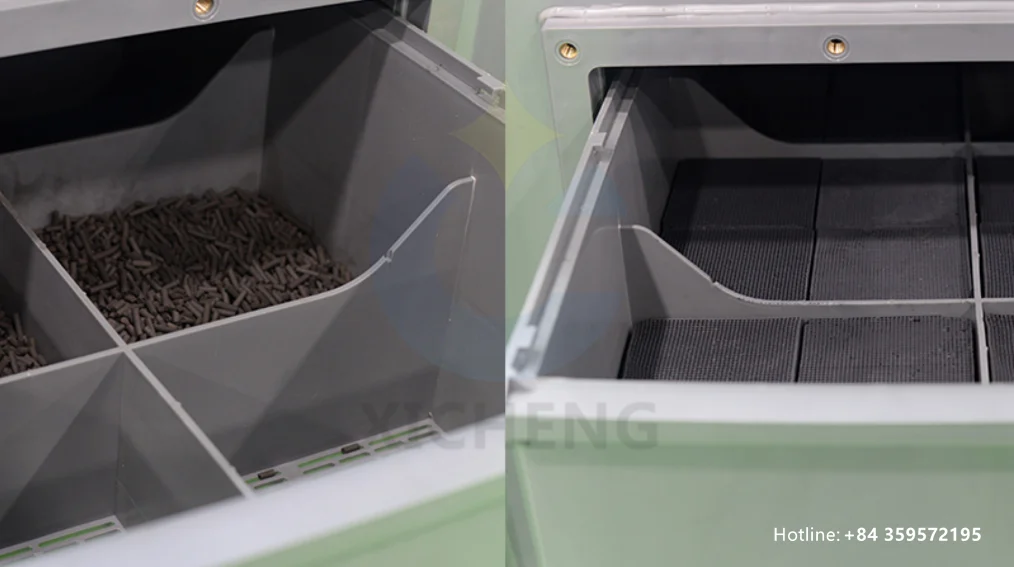
The odor-triggering compounds at ppb-to-low-ppm loads — hydrogen sulfide, mercaptans and thiols, terpenes, amines, aldehydes — are still adsorbable, but the media must match the molecule. Virgin carbon quietly takes the organic odorants. Inorganic odorants need an impregnated grade: an alkaline-impregnated carbon attracts acid gases such as H2S and SO2, while an acid-impregnated carbon targets ammonia and amines. Specifying the impregnation is the standard way to turn an off-the-shelf box into an H2S adsorber for a pump station — an activated carbon adsorption box for VOC odor treatment with the right grade does both duties out of the same frame — and it costs little more than a virgin bed.
Acid Gas, Bulk Ammonia and Dust: the Wrong Job
Nothing fails a carbon bed faster than asking it to do a wet scrubber’s work. Bulk hydrogen sulfide at hundreds of ppm, hydrogen chloride, sulfur dioxide, and concentrated ammonia overwhelm the limited stoichiometric capacity of even an impregnated bed in days rather than months, because every molecule consumed is a molecule of media gone for good. Dust and oil mist do not adsorb at all; they coat the particles, bind the bed together, raise the pressure drop, and shorten the fan’s life. Each of these belongs to a different stage: scrubbers for water-soluble inorganics, mechanical filters for particles, and the box only for the vapor load. The carbon adsorber guidance maintained by the U.S. EPA documents the monitoring practice that keeps exactly this separation legal in operation.
The Decision Map: Where the Box Sits in Your Train
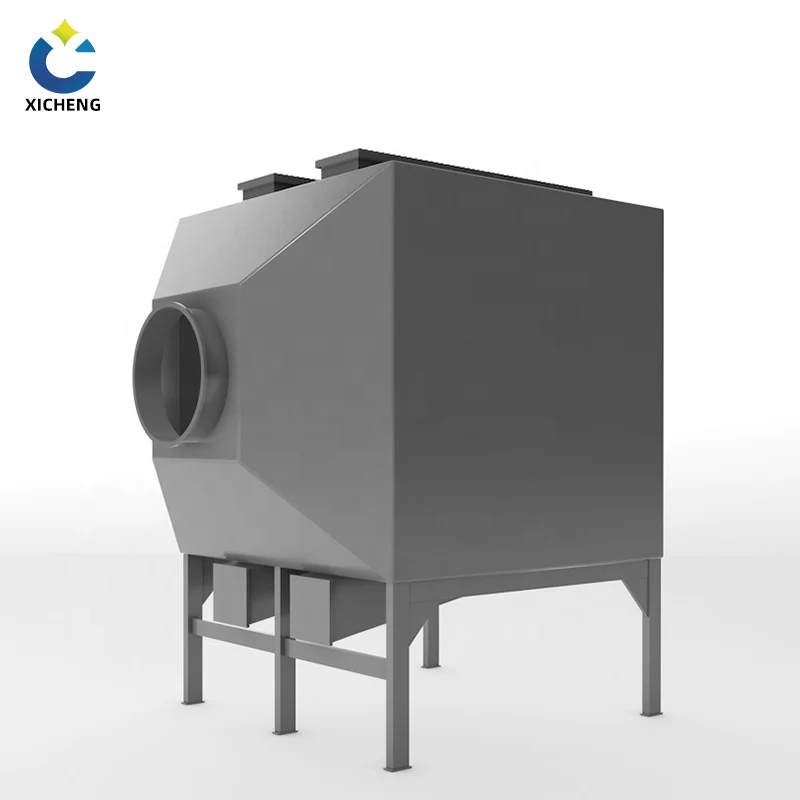
Once the contaminant is known, the placement question mostly answers itself. An activated carbon adsorption box for VOC odor treatment can be the entire exhaust system, or it can be one final stage inside a three-unit train, and choosing wrong is the most common cause of early system failure. The four placements below cover virtually every industrial project, and the table sets out the numbers each one assumes.
Standalone Treatment
When the stream is organic-only, the concentration sits in the 50-to-5,000-ppm band, dust is controlled upstream, and temperature and humidity are ordinary, the box alone is the treatment. Paint booths, parts degreasers, and printing dryers run this way every day. Sized through the standard numbers, a 6,000 m³/h booth lands near 4 m² of face area and a 2,000 kg carbon charge — a single skid, one fan, one media change-out per quarter, and no water, chemistry, or sludge anywhere in the loop.
Post-Scrubber Polish
Water-soluble inorganics are the scrubber’s territory, and the order is not optional. The wet scrubber comes first to strip acid gases and other water-soluble load so they never reach the downstream media, and an activated carbon adsorption box for VOC odor treatment then polishes the residual odor plus the VOCs the water could not hold. Municipal odor engineers use exactly this logic: a biological or chemical scrubber removes most of the hydrogen sulfide, and a carbon polishing stage takes out the tail that would otherwise trip the odor threshold. The scrubber-and-carbon pairing is covered in more depth in the VOC control scrubber systems article, and the wet scrubber hardware sits in the industrial wet scrubber product range sized for exactly this duty.
Post-Biofilter Polish
Biofilters degrade biodegradable odorants cheaply, but every biomass has a bottleneck: compounds that are toxic to the microorganisms, compounds that break down too slowly to matter on your change-out calendar, or a peak concentration that slips straight through the living bed. A carbon stage after the biofilter catches exactly those leftovers. This is why two-stage arrangements — biofilter plus carbon, or scrubber plus carbon — are the standard shape of municipal odor control rather than a niche add-on.
Tank and Vent (Passive)
Small vent-mounted boxes absorb H2S, VOCs, and ammonia from the off-gases of storage tanks, sumps, and reactors under positive pressure. There is no fan and no duct: the gas is pushed through the carbon by the process pressure itself. Removal efficiency above 99 percent is realistic for a well-filled passive unit on a tank vent, and a refillable cartridge makes the media change a five-minute maintenance event.
| Placement | What the box assumes | Key numbers | Choose when |
|---|---|---|---|
| Standalone | Organic-only stream, dust controlled, ordinary conditions | 50–5,000 ppm in; 95–99% removal | Paint booth, degreaser, printer, solvent workshop |
| Post-scrubber polish | Scrubber strips acids and water-soluble load first | Scrubber first, box last; low residual odor | Mixed solvent-plus-acid streams, covered tanks |
| Post-biofilter polish | Biofilter takes the biodegradable bulk | Box catches the non-biodegradable tail | Municipal and food-waste odor control |
| Passive tank vent | Positive-pressure tank, sump, or reactor | No fan; over 99% on trace H2S and VOCs | Storage tanks, reactors, pump sumps |
The map resolves to one sentence. Organic-only with a moderate load: the box stands alone. Inorganics in bulk: scrub the water-soluble compounds first, then polish. Trace odor on a vent: a passive unit. Dust or oil anywhere ahead of the bed: filter before anything. Get the order right and the box runs unattended for months; get it wrong and no volume of media will save the system.
Paint Booth and Coating Exhaust
Paint booths are the single most common home for this equipment, because a booth produces a steady, well-characterized solvent load and a local authority to satisfy. An activated carbon adsorption box for VOC odor treatment placed on the booth exhaust is a textbook standalone application, and it is also where installers make the most predictable mistake: skipping the overspray filter.
The Load a Booth Actually Produces
Mixing, spraying, and curing each emit a different solvent profile. Concentrations run from roughly 50 ppm on a well-ventilated booth to several thousand ppm at a solvent wash station or an enclosed curing oven, and removal to 95 to 99 percent brings the outlet comfortably under a 30 mg/m³ NMHC limit or a MACT-based source limit. Recirculating booth air changes the arithmetic: the carbon must handle the sum of what every pass adds, not just the peak reading on one instrument. Batch work with a wide solvent spread should be sized on the worst shift, not the average shift.
Overspray Has to Come Out First
Paint overspray and oil mist are the failure mode of every carbon box installed with enthusiasm and no prefilter; an activated carbon adsorption box for VOC odor treatment that sits behind an unprotected booth will be blinded long before it is saturated. Atomized paint lands on the bed, binds the granules together, and turns a clean airflow face into a clogged plate in a matter of weeks, long before the adsorptive capacity is anywhere near exhausted. The fix is a mechanical dry filter or filter pads between the booth and the box — the same dry-filter stage a plant already applies in a coated intake, and the exact pairing described in the wet scrubber and dry filter paint booth systems article on this site.
The Five-Element Arrangement
A complete booth-to-stack train is: hood and capture, overspray filter, solvent-resistant duct, carbon box, fan and stack. Run the duct in corrosion-resistant material, keep the fan downstream of the box in draw-through so any leak pulls inward, and size the fan against the box pressure drop plus the whole duct run rather than against flow alone. Put the carbon after the prefilter and never before it. With that arrangement fixed, the same five elements serve a parts coater, a furniture line, a wood finishing shop, or an aerospace prep facility; only the box cross-section and the carbon charge change.
Wastewater Odor Polish
Municipal and industrial wastewater plants generate a concentrated mixture of hydrogen sulfide, mercaptans, and organic odorants, and their odor control is the best-documented multi-stage application in the industry. The activated carbon adsorption box for VOC odor treatment is the polishing stage that the standard municipal train ends with, and it is usually the difference between a pass and a complaint.
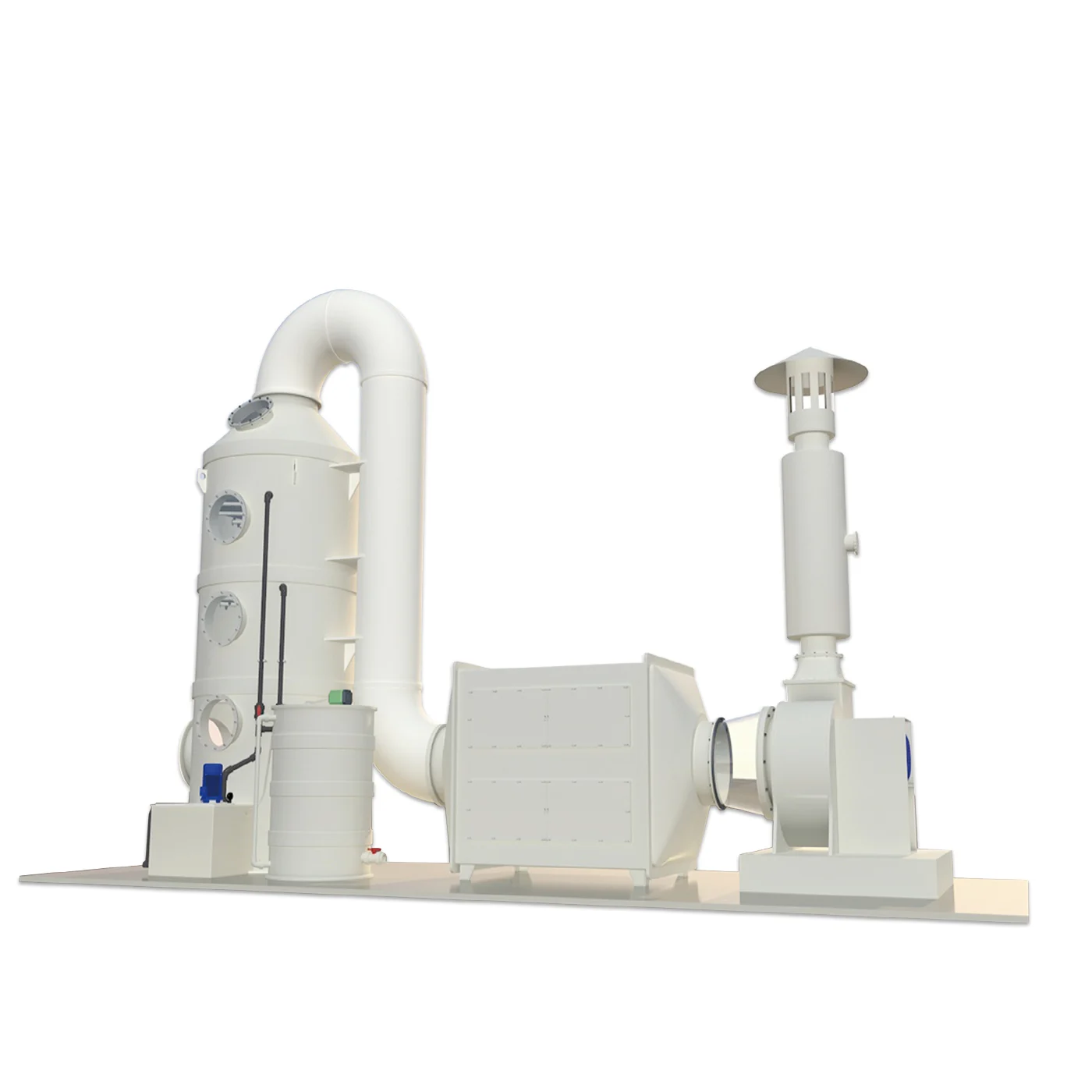
The Standard Train: Scrub or Biofilter, Then Carbon
Covered tanks, headworks, and sludge handling draw air through a first stage that takes out the heavy H2S load — typically a biological system or a chemical scrubber, either of which removes up to about 99 percent of the H2S on its own — and then through carbon as the final polish for the residual H2S and the organic odorants the water chemistry never touches. Put carbon first and the scrubbing chemistry stops being useful; put it last and a single well-charged carbon stage delivers the required discharge odor unit. That ordering is why the H2S scrubber system article treats the two technologies as a pair rather than as rivals.
Sizing Bands by Airflow
Odor control packages come in recognized flow tiers, and picking the wrong tier is the most common mis-step, whichever size of activated carbon adsorption box for VOC odor treatment is on the table. Small skid-mounted carbon adsorbers handle up to roughly 2,000 m³/h for a single covered tank or small pump station. Bulk carbon adsorbers step up to about 10,000 to 34,000 m³/h for a larger works. Containerized carbon units reach 6,000 to 45,000 m³/h when a plant dewaters a whole screen building or channel to one stack. Match the tier to the covered footprint and you avoid both the undersized box that breaks through in weeks and the oversized one that idles on a fraction of its capacity.
Localized vs. Centralized Layout
Site layout decides how many boxes you buy. Localized control fits smaller passive units directly onto each tank vent, which eliminates ductwork entirely when the tanks sit far apart and each breathes at a different rhythm. Centralized control ducts all odorous air to one larger box through ventilated ductwork, which suits a compact works covering many tanks or a covered channel running the length of the site. Multi-stage plants often run a hybrid, taking the non-organic load out locally at the tank and polishing centrally at the stack.
Food, Chemical and Workshop Odor
Beyond paint and wastewater, a large share of projects arrive from food processing, chemical storage, and general workshop ventilation. The box behaves identically in each; what changes is the collection side. An activated carbon adsorption box for VOC odor treatment is only as good as the duct that feeds it, and in these applications the duct is usually the harder half of the job.
Food Plant Extraction
Garlic and onion lines, sauce kitchens, fryers, and rendering produce hydrogen sulfide, aldehydes, ketones, and simple amines that the nose detects at astonishingly low concentrations. Hoods and duct pull the odor clear of the operator, and a carbon stage — alone, or downstream of a scrubber where the stream is wet and loaded with oil — cleans it before the stack. Plants that combine cooking with oil mist usually run a wet scrubber ahead of the carbon, the exact pairing covered in the wet scrubber for food manufacturing exhaust article on this site.
Storage Tanks and Reactor Vents
Chemical storage, solvent tanks, and reactors push vapor out when they fill, heat up, or simply breathe with the day’s temperature swing. A passive or low-flow activated carbon adsorption box for VOC odor treatment on the vent adsorbs that breather loss with no fan and no operator: H2S on a caustic tank, VOCs on a solvent drum farm, ammonia on a fertilizer silo. This is where the media rules from the treatment table matter most, because the vent stream is typically a single molecule, and the box must target that molecule rather than a general-purpose carbon. Get the impregnation right and a vent box runs for a full season between cartridge changes.
Many Small Boxes or One Large One
The warehouse-scale question is architectural. A row of small box-and-fan units at each process keeps ductwork short and lets you shut one line down without affecting the rest, at the cost of several media change-outs scattered through the year. A single central box ducted from every source concentrates the carbon cost and the maintenance into one place, but every upstream leak then spreads odor instead of containing it. Most plants below about 20,000 m³/h of total exhaust start with several local units and migrate toward central control as their coverage map matures.
Duct and Blower Integration
An activated carbon adsorption box for VOC odor treatment arrives skid-mounted with flanged connections, but installation is still a duct, blower, and pretreatment job. Get those right and the box saturates on schedule and passes every stack test; get them wrong and it breaks through early, or the building starts to smell before the stack does. The rules below hold for every application in this guide.
Duct Routing
Run the inlet and outlet in the shortest practical straight run and keep the cross-section generous, in the region of 8 to 12 m/s duct velocity. Corrosive solvent exhaust should move in industrial polypropylene duct, with square polypropylene duct where a wide, low-profile section is needed across a large inlet face. Slope long horizontal runs and set drain points at the low ends: warm, humid exhaust condenses, and water lying on the carbon destroys the adsorption rate in the wettest region of the bed long before the rest of the media saturates.
Blower Selection
Set the blower downstream of the box in draw-through, so the housing and the duct stay under negative pressure and any leak pulls air inward instead of pushing solvent into the work area. The blower must overcome the box pressure drop plus the duct, elbows, stack, and prefilter — total static pressure, not flow alone. Our polypropylene blowers and permanent magnet fans are selected on exactly this arithmetic; state the box differential pressure when you quote the fan, and confirm the fan duty again if the media is due for a heavier grade.
The Pretreatment Stage Goes First
Whatever the stream carries that is not a vapor — dust, overspray, oil mist, entrained droplets — must be removed before the carbon, never after. A mechanical filter or cyclone covers dust, a demister catches droplets, and a cooling step or condenser handles streams above roughly 60 °C, because both high temperature and high humidity attack adsorption capacity directly. When a scrubber is part of the train, it sits ahead of the box for the same reason the prefilter does: protect the expensive, replaceable media from anything that would shorten its life.
Safety, Monitoring and Change-Out
Loaded carbon is a reactive solid, and running an activated carbon adsorption box for VOC odor treatment without watching its temperature and breakthrough behavior is how systems end as fire incidents or failed stack tests. The limits are few, cheap to honor, and non-negotiable once explained.
Temperature, Humidity, and the LFL Rule
Hold the inlet below roughly 60 °C. Adsorption is exothermic, so a warm stream compounds into a hotter bed, and above about 60 °C the physisorption that does the useful work begins to reverse. Humidity above roughly 50 to 70 percent starts filling the micropores with water; an upstream condenser or a drier drop in relative humidity restores the capacity. Where the solvent is flammable, keep the bed temperature well under 25 percent of the lower flammability limit, and never feed a solvent-laden stream into a low-velocity bed where the heat of adsorption can accumulate without being swept away. The same solvent concentrations matter for the operator’s breathing zone, and OSHA’s permissible exposure limit tables are the reference for the air people work in.
The Bed Fire Risk
Spent carbon loaded with reactive solvents can self-heat, and a fixed carbon filter that caught fire during operation is a documented case in this industry. The precautions are mechanical rather than heroic: an inlet temperature sensor, a differential-pressure monitor, an interlock that stops the blower on a climbing bed temperature, and a change-out scheduled before the media’s working capacity is exhausted. The companion activated carbon adsorption box pillar article walks through safe installation and operation end to end, including the grounding and positioning details that stop charge build-up on plastic duct.
Monitoring and the Change-Out Cadence
Walk the change-out off the breakthrough curve, not off a calendar. Monitor the outlet concentration near your permit limit, watch the differential pressure — a rise signals blinding, a fall signals channeling, where gas bypasses the bed through a crack — and replace the media when the outlet approaches the target. A simple low-load box is commonly recharged around 500 operating hours, then the interval is refined from monitoring. For the honest interval on your own stream, the loading equation and the working-capacity math are worked through in the activated carbon box design article, which also gives the 0.3-to-0.5 m/s face-velocity check for verifying quotations.
What to Send Your Supplier
Odor control projects fail most often because they were specified on guesswork — a box chosen to fit a footprint instead of a stream. The cure is a short, complete input sheet, and any competent carbon plant can quote an activated carbon adsorption box for VOC odor treatment from the seven numbers below in a single exchange.
The Seven Inputs
Send the airflow in m³/h, the pollutant and its inlet concentration, the outlet target your permit names, the run hours between change-outs, the inlet temperature, the relative humidity, and the dust or moisture load. Add the solvent mix or molecular-weight distribution if the stream is mixed, because it changes the media grade and the bed life. State whether the exhaust is continuous or batch, and whether it already passes through a scrubber or biofilter — that tells the supplier whether you need a standalone box or a polishing stage, and saves both of you a round of clarification.
Check the Quotation That Comes Back
Before you place the order, verify the tender with two arithmetic checks that take a minute each on a calculator. First, divide the stated airflow by the stated filtration area and confirm the face velocity sits in the 0.3-to-0.5 m/s band. Second, confirm the carbon charge and its working capacity against your run hours. The same sizing walk-through, with a complete worked example for a paint-shop exhaust, is in the activated carbon box design guide, and the finished hardware is the activated carbon filter box product family on this site, delivered with the flanges, media access, and sample points that make the monitoring section above painless.
Activated Carbon Box for VOC and Odor Treatment: FAQ
Can an activated carbon adsorption box for VOC odor treatment also remove H2S?
At trace loads — ppb to tens of ppm from a pump station or a tank vent — yes, with an impregnated alkaline carbon grade. At hundreds of ppm or more, hydrogen sulfide is the wet scrubber’s job, and the box serves as the polishing stage behind it.
Should the carbon box go before or after the wet scrubber?
After. The scrubber strips water-soluble acids and other inorganics first so they never reach the downstream media, and the box polishes the VOCs and residual odor that the water could not hold. Scrubbing downstream of carbon would load the bed with everything the train was meant to remove elsewhere.
How often does the carbon media need to be changed?
When the outlet concentration approaches your limit, which you find by monitoring rather than by calendar. A simple low-load box is typically recharged around 500 operating hours, then the interval is refined from the breakthrough curve and the differential pressure across the bed.
Does high humidity hurt performance?
Yes. Water vapor condenses in the micropores and blocks the surface that does the adsorbing. Keep relative humidity below roughly 50 to 70 percent at the inlet, using cooling or pre-drying ahead of the box where the stream is wet.
Can the box run alone without a scrubber or biofilter?
Yes, when the stream is organic-only and the load sits in the 50-to-5,000-ppm band with dust controlled. Paint booths, degreasers, and printing dryers run standalone boxes every day; mixed and inorganic streams need the staged arrangement from the decision map.