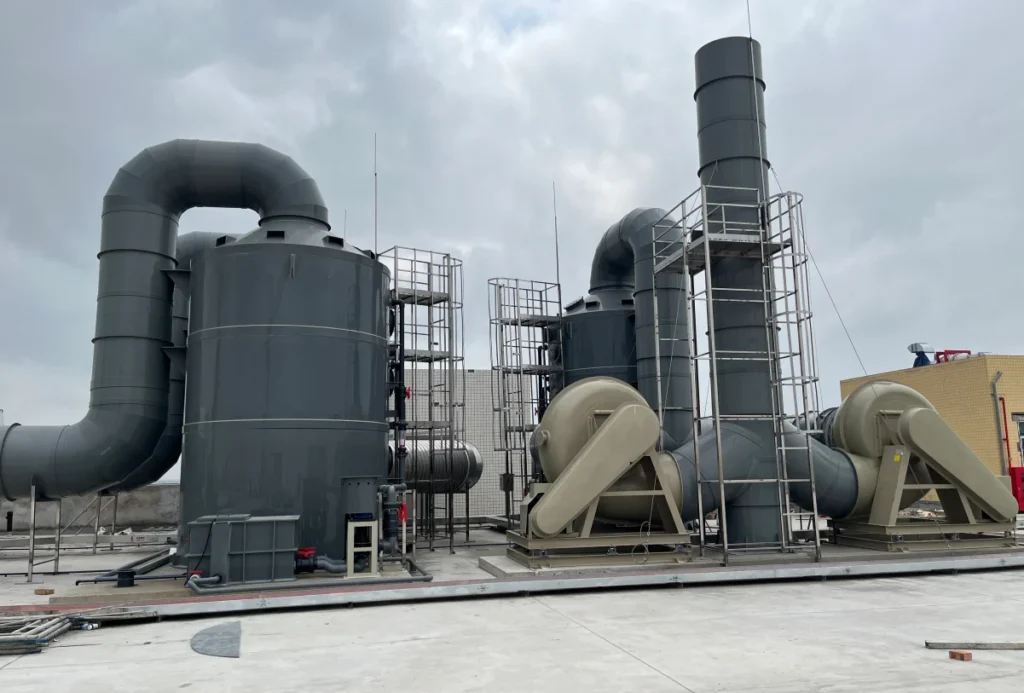
Every chemical plant, steel mill, and power boiler that burns sulfur-containing fuel produces acid gas emissions that must be treated before discharge. An acid gas scrubber is the standard engineering solution: a wet scrubber that uses an alkaline reagent – typically sodium hydroxide (NaOH) or lime slurry (Ca(OH)2) – to neutralize acidic pollutants through controlled chemical reaction rather than relying on physical water solubility. This guide covers what an acid gas scrubber is, the acid-base chemistry for each major pollutant (HCl, SO2, HF, NOx), the design parameters for vessel selection and material compatibility, the operating considerations for pH control and salt management, and the selection criteria for choosing between caustic and lime-based scrubbing.
Key Takeaways
- An acid gas scrubber achieves 99%+ removal of HCl, HF, and SO2 (with caustic) by chemically neutralizing the pollutant rather than relying on physical water solubility. The NaOH-HCl reaction is instantaneous above pH 7. The NaOH-SO2 reaction consumes 2 moles per mole of SO2 at pH above 7 or 1 mole per mole at pH 5-7, making the pH setpoint a direct driver of operating cost.
- Material selection is controlled by the acid gas chemistry, not the scrubbing solution. Polypropylene (PP) covers most acid service up to 80 deg C at lowest capital cost. FRP (vinyl ester) handles HF, Cl2, and temperatures up to 110 deg C. Stainless steel must not be used for HCl or HF service at any temperature. A material error in an acid gas scrubber causes corrosion failure in months.
- The blowdown rate controls the maintenance interval. Each acid gas forms a distinct salt. NaCl from HCl is highly soluble and forgiving. NaF from HF precipitates at approximately 40 g/L and requires controlled blowdown. Na2SO3 from SO2 can oxidize to sulfate and form gypsum if pH drifts below 5. The TDS should be held below the 80,000 ppm engineering guideline through continuous conductivity monitoring – HF service is limited far lower, by NaF saturation at approximately 40 g/L.
- The reagent choice between NaOH and lime slurry depends on the annual chemical consumption. NaOH is simpler to handle but costs $400-600 per tonne of 50% solution. Lime slurry is 70-80% cheaper per mole but requires slurry handling equipment and presents scaling risk. The economic crossover for facilities processing concentrated acid gas streams is approximately $40,000-60,000 per year in chemical cost. See our acid gas scrubber products → for available configurations.
What Is an Acid Gas Scrubber?
An acid gas scrubber is a wet scrubber that removes acidic gases from an industrial exhaust stream by neutralizing them with an alkaline scrubbing solution (see our chemical scrubber system guide → for the broader system context). The chemical reaction converts each acid gas to a non-volatile, water-soluble salt that is discharged in the scrubber blowdown. This distinguishes acid gas scrubbing from physical absorption, where the pollutant dissolves in water only up to its equilibrium solubility limit.
The Acid-Base Neutralization Chemistry
The core chemical reactions in any acid scrubber system follow predictable molar stoichiometry:
HCl + NaOH -> NaCl + H2O. One mole of NaOH neutralizes one mole of HCl. The reaction is nearly instantaneous above pH 7. The product (NaCl) is common salt, highly soluble and non-hazardous.
SO2 + 2 NaOH -> Na2SO3 + H2O at pH above 7. At pH 5-7, the reaction shifts to single-mole stoichiometry producing NaHSO3. The pH setpoint directly affects chemical consumption.
HF + NaOH -> NaF + H2O. The product NaF has limited solubility at approximately 40 g/L, requiring controlled blowdown to prevent precipitation.
NOx scrubbing is more complex because NO (nitric oxide) is not water-soluble. The scrubbing solution must include an oxidizing agent (H2O2 or KMnO4) to convert NO to soluble NO2 before neutralization.
How an Acid Gas Scrubber Differs from a General Wet Scrubber
A general water-only spray tower removing HCl achieves 80-95% at best, because HCl dissolves into water only until the liquid-side concentration approaches equilibrium with the gas phase. An acid gas scrubber with caustic addition achieves 99%+ removal independent of the equilibrium concentration, because the chemical reaction consumes the dissolved HCl as fast as it enters the liquid phase, keeping the effective liquid-side concentration near zero. The chemical reaction removes the solubility barrier. (EPA Cost Manual, Section 5, Chapter 1 (Response to Comments))
Physical Solubility vs Chemical Reaction
The difference is the driving force. In physical absorption, the maximum liquid-side concentration is Henry’s law equilibrium, and absorption stops when saturation is reached. The two gases sit far apart on that curve: SO2’s Henry’s law constant is well constrained at roughly 46 atm per mole fraction, while HCl is very much more soluble, though its apparent constant varies widely because it dissociates (Sander, Henry’s Law Constants: Sulfur Dioxide (CAS 7446-09-5); Hydrogen Chloride (CAS 7647-01-0)). In chemical absorption, the reaction product is a different chemical species with zero vapor pressure, so the driving force is sustained regardless of how much pollutant has been absorbed. This principle allows an acid gas scrubber to achieve high removal for moderately soluble gases like SO2 that a water-only scrubber cannot capture effectively.
Key Design Inputs Before Specification
Before sizing any acid gas scrubber, the designer must know: the complete gas composition with each acid gas concentration at the scrubber inlet, the target outlet concentration (derived from the permit limit), the gas temperature and moisture content, the available material budget (PP, FRP, or SS), the available pressure drop for fan sizing, and the facility’s wastewater discharge limits for the reaction product salts.
Acid Gas Scrubber Applications by Industry
Acid gas scrubber technology is deployed across multiple industries with different dominant pollutants. Each application drives a specific scrubber configuration and reagent choice. EPA’s own survey of the technology covers refineries, fertilizer manufacturers, chemical plants, pulp and paper mills, cement and lime kilns, incinerators, glass furnaces, sulfuric acid plants, plating, steel pickling, and metal smelters, and it draws the same hardware line the sections below follow: spray towers where the waste stream carries particulate, such as coal-fired boiler flue gas SO2 and HF from aluminium production, and packed-bed or tray towers for HF, HCl, HBr, F2, Cl2, and SO2 from chemical processes, incinerators, plating, and steel pickling (EPA Cost Manual, Section 5, Chapter 1 (Response to Comments)).
Chemical Process Vents – HCl and HF Control
Chemical plants manufacturing chlorinated solvents, isocyanates, hydrochloric acid, or fluorinated compounds generate HCl and HF vent streams at 100-5,000 ppmv. An acid gas scrubber system on a reactor vent or storage tank breather typically uses a packed bed scrubber with 5-10% NaOH solution at pH 7-9 achieving 99%+ removal.
Reactor Vents and Storage Tank Breather Emissions
Reactor vents operate intermittently during batch cycles, with acid gas concentration spiking at specific process steps. The scrubber must handle the peak concentration, not the average. Storage tank breather vents emit acid gas only during tank filling or temperature-driven vapor expansion, but the scrubber must activate on demand. A recirculation pump on continuous standby with an automated caustic feed system activated by a pH signal is the standard configuration.
Power and Industrial Boilers – SO2 Removal
Coal- and oil-fired industrial boilers produce SO2 at 200-2,000 ppmv in the flue gas at 150-200 deg C. The flue gas must be quenched to saturation temperature in a spray section before entering the packed bed or tray tower absorber. For boilers above 100 MW, limestone slurry (CaCO3/Ca(OH)2) is the standard reagent because the operating cost is 50-70% lower than NaOH at industrial scale. For boilers below 100 MW, caustic soda is preferred because the lower capital cost of the reagent feed system outweighs the higher unit chemical cost.
Steel Pickling and Metal Finishing
Steel pickling lines use hot HCl (15-20%) to remove mill scale. The exhaust contains HCl vapor at 50-500 ppmv plus entrained acid mist. A packed bed scrubber with polypropylene packing and caustic solution at pH 7-8 achieves 99%+ removal. The gas must be quenched below 60 deg C before entering polypropylene packing. Metal finishing generates H2SO4 mist and chromic acid mist from plating baths. Chrome scrubbing requires a reducing agent (sodium metabisulfite) added to the caustic solution to convert hexavalent chromium Cr6+ to Cr3+.
Semiconductor and Aluminum Smelting
Semiconductor fabs combine HF, HCl, and H3PO4 exhaust from hundreds of process tools into a central packed bed scrubber. The combined acid concentration is low (5-50 ppmv) but the total flow reaches 100,000-300,000 m3/h. Caustic consumption is low. For aluminum smelters, acid scrubber systems handle HF at 95-98% efficiency. The byproduct H2SiF6 is sold for municipal water fluoridation. An acid gas scrubber at a semiconductor fab runs 24/7 with minimal operator attention because the low and steady acid gas concentration does not drive rapid pH changes that would require frequent control tuning.
Scrubber Chemistry – Stoichiometry and Reagent Selection
The reagent consumption cost is the largest operating expense in any acid gas scrubber. Understanding the stoichiometry for each pollutant allows the designer to calculate the annual chemical cost and to choose between sodium hydroxide and lime slurry.
HCl-NaOH Reaction – 1:1 Molar Neutralization
HCl + NaOH -> NaCl + H2O. 1 mole of NaOH (40 g) neutralizes 1 mole of HCl (36.5 g). The mass consumption ratio is 40 / 36.5 = 1.10 kg NaOH per kg HCl.
Worked Example: 200 ppmv HCl at 10,000 m3/h
At 25 deg C, 200 ppmv HCl = 200 x 36.5 / 24.5 = 298 mg/m3. For 10,000 m3/h: 298 x 10,000 / 1,000,000 = 2.98 kg/h of HCl. NaOH required: 2.98 x 1.10 = 3.28 kg/h of pure NaOH. At 50% delivery concentration: 6.56 kg/h of 50% caustic solution. Annual cost at $500/tonne 50% caustic (an engineering estimate – see the note at the end of this guide): 6.56 x 8,000 h x $500 / 1,000 = $26,240/year, assuming 8,000 operating hours and sizing on the full inlet acid load rather than the fraction removed.
SO2-NaOH Reaction – pH-Dependent Stoichiometry
SO2 reacts with NaOH in two ways depending on the solution pH. At pH above 7: SO2 + 2 NaOH -> Na2SO3 + H2O (2 moles NaOH per mole SO2). At pH 5-7: SO2 + NaOH -> NaHSO3 (1 mole NaOH per mole SO2). Operating at pH 6-7 consumes half the caustic of pH 8-9 but has a lower driving force for absorption. The economic pH setpoint is typically 6.5-7.5, balancing reagent cost against removal efficiency.
Worked Example: Caustic Cost for SO2 Removal
For 500 ppmv SO2 at 50,000 m3/h, sized on the full inlet acid load: SO2 mass flow = 50,000 x (500 x 64/24.5) / 1,000,000 = 65.3 kg/h. At pH 6-7 (1:1 ratio), NaOH required = 65.3 x (40/64) = 40.8 kg/h pure NaOH, or 81.6 kg/h of 50% caustic solution. Annual cost at $500/tonne 50% caustic: 81.6 x 8,000 x $500 / 1,000 = $326,400/year.
HF and NOx Considerations
HF + NaOH produces NaF, with limited solubility (approximately 40 g/L at 20 deg C – PubChem’s solubility record gives 4.0 g/100 mL of water at 20 deg C, i.e. 40 g/L, rising to 4.3 g/100 mL at 25 deg C) (PubChem CID 5235, Sodium Fluoride). The blowdown rate must be sufficient to keep NaF below saturation, or precipitation and scaling will occur on packing surfaces and in the sump. NOx scrubbing requires oxidation because NO is insoluble. H2O2 at 1-3% concentration in the scrubbing solution oxidizes NO to NO2, which then reacts with NaOH to form NaNO3. The H2O2 cost adds 30-50% to the total scrubbing chemical cost.
NaOH vs Lime – Reagent Selection Decision Tree
The choice between NaOH and Ca(OH)2 depends on scale and handling capability. NaOH is delivered as a 50% liquid solution, easy to pump and meter, but costs $400-600 per tonne of 50% solution. Lime slurry is 70-80% cheaper per mole of neutralizing capacity but requires slurry preparation equipment, presents scaling risk from calcium sulfate precipitation in SO2 service, and produces solid waste (CaSO4) that requires disposal. The economic crossover point is approximately $40,000-60,000/year in chemical cost: below this, NaOH is preferred for its simplicity; above this, lime amortizes the slurry handling capital cost. EPA’s reagent list for wet acid gas scrubbing covers both routes – sodium hydroxide, sodium carbonate, calcium hydroxide, and magnesium hydroxide – with a lime or limestone slurry typical for combustion sources (EPA Cost Manual, Section 5, Chapter 1 (Response to Comments)).
Design Parameters – Vessel and Material Selection
The physical scrubber hardware for an acid gas scrubber must be selected to match the gas stream characteristics, the acid gas chemistry, and the operating temperature. The wrong vessel type or material causes either poor performance or rapid corrosion failure.
Scrubber Vessel Selection – Packed Bed vs Spray Tower
A packed bed scrubber is the standard choice for acid gas absorption when the inlet gas is clean. As a working guideline, clean means a particulate loading below roughly 30 mg/Nm3; above that, particulate builds up on the packing and clogs the tower (EPA Cost Manual, Section 6, Chapter 2). The 30 mg/Nm3 figure is an engineering working limit, not a published regulatory limit – see the note at the end of this guide. The packing – typically 25-50 mm polypropylene Pall rings – provides 100-200 m2 of wetted surface per cubic meter of bed volume. This high surface area is necessary for efficient absorption of moderately soluble gases like SO2. The packed bed depth is typically 2-4 m, providing 5-10 theoretical stages.
A spray tower is preferred when the gas stream contains particulate or solids-forming contaminants that would plug a packed bed. The open-chamber design handles scaling, fouling, and solids-laden gas streams that would blind packing within weeks. For highly soluble acid gases like HCl, a spray tower with caustic achieves 99%+ removal because the reaction is fast enough that the reduced contact area (compared to a packed bed) does not limit performance. Against EPA’s published numbers the same technology spans a wider band – wet scrubbers typically achieve 95 to 99 percent removal for most industrial applications, with the achieved efficiency lower where the waste gas characteristics vary (EPA Cost Manual, Section 5, Chapter 1 (Response to Comments)).
An acid scrubber system for combined particulate and acid gas duty often uses a venturi followed by a packed bed: the venturi captures the fine particulate, and the packed bed removes the acid gases in a cleaner gas stream. EPA describes the same arrangement – venturi scrubbers used as a pretreatment device, removing PM to prevent clogging of a downstream device such as a packed bed scrubber (EPA-452/F-03-017, Venturi Scrubber).
Material Compatibility Table
| Material | Max Temp | Compatible With | Avoid With |
|---|---|---|---|
| Polypropylene (PP) | 80 deg C | HCl, H2SO4, NaOH, HF(dilute) | Aromatics, ketones, >80 deg C |
| FRP (vinyl ester) | 110 deg C | HCl, HF, Cl2, NaOH, H2SO4 | High abrasion >10 m/s |
| FRP (isophthalic) | 95 deg C | General acid/alkali | Strong oxidizers, Cl2 |
| SS316L | 180 deg C | HNO3, high-temp clean gas | HCl, HF (any temp) |
| PVC/CPVC | 60-90 deg C | Cl2, NaOCl, dilute acids | Solvents, >90 deg C |
PP vs FRP vs SS – Temperature and Chemistry Limits
PP is the most cost-effective material for acid gas scrubbers up to 80 deg C. Above 80 deg C, move to FRP with vinyl ester resin, which extends the service range to 110 deg C. For gas temperatures above 110 deg C, a quench section upstream of the scrubber is cheaper than building the entire vessel from SS316L. Stainless steel should not be used for HCl or HF service regardless of temperature – pitting corrosion occurs within months.
Gas Velocity and Tower Sizing
The superficial gas velocity through a packed bed is 0.5-1.5 m/s. For a 50,000 m3/h flow at 1.2 m/s: A = 13.9 / 1.2 = 11.6 m2, D = 3.8 m. The gas velocity must stay below the flooding point, typically 50-70% of the flooding velocity for countercurrent packed beds. Pressure drop across a packed tower generally runs 0.5 to 1.0 in. H2O per foot of packing – the practical measure of whether the tower is being pushed toward flood (EPA Cost Manual, Section 5.2, Chapter 1).
pH Control Loop Design
The pH control loop consists of a pH sensor in the recirculation line, a pH controller (PID loop in the PLC), a caustic metering pump with variable-speed drive, and a caustic storage tank. The pH setpoint is 7-9 for HCl/HF and 6-8 for SO2. The pump is sized at 1.5-2.0x the stoichiometric rate to handle concentration surges.
Operation and Salt Management
An acid gas scrubber requires more active operational oversight than a water-only scrubber because the chemical reaction produces dissolved salts that accumulate in the recirculating liquid and the pH must be maintained within a tight range.
pH Monitoring – Sensor Selection and Calibration
The pH sensor is the most critical instrument. For acid gas service at pH 6-9, standard glass pH electrodes with a single-junction reference are adequate. The sensor must be located in the recirculation line downstream of the spray zone, not in the sump where solids settle and coating occurs. The calibration interval is weekly; a sensor that requires more frequent calibration should be replaced.
A redundant pH sensor pair allows online verification. If the two sensors diverge by more than 0.3 pH units at the same calibration point, the suspect sensor should be cleaned with dilute HCl and recalibrated. If drift persists, replace the sensor.
Blowdown Rate and TDS Control
Each acid-base reaction produces a dissolved salt. As the salt concentration in the recirculating liquid rises, the total dissolved solids (TDS) approach the solubility limit of the least-soluble reaction product. That 80,000 ppm figure is an engineering guideline for NaCl-dominant (HCl) service, not a solubility limit – NaCl itself dissolves to roughly 360 g/L (PubChem CID 5234, Sodium Chloride). Where HF is present the controlling salt is NaF, which saturates at approximately 40 g/L, so the practical ceiling in HF service is far lower. Crystallization, when it occurs, starts on the mist eliminator and then spreads to packing surfaces.
The blowdown rate is calculated from the salt production rate divided by the target TDS:
Blowdown rate = Salt production rate / Target TDS
Worked Example: Blowdown from NaCl Production
An HCl scrubber removing 3.0 kg/h of HCl produces 3.0 x (58.5/36.5) = 4.8 kg/h of NaCl. At a target TDS of 80,000 ppm: minimum blowdown = 4.8 / 0.08 = 60 L/h. Actual blowdown should be 80-100 L/h to provide margin. A conductivity meter provides continuous TDS measurement: 80,000 ppm NaCl corresponds to approximately 100,000 uS/cm.
Common Operating Problems and Troubleshooting
The five failure modes below map closely to the operating problems EPA tracks for wet scrubbers – inadequate liquid flow, liquid re-entrainment, poor gas-liquid contact, corrosion, and plugged nozzles, beds, or mist eliminators (EPA, Monitoring by Control Technique: Wet Scrubber).
| Problem | Likely Cause | Fix |
|---|---|---|
| Gradual efficiency drop | pH setpoint drift (low reading) | Calibrate sensor; verify with grab sample |
| Salt scaling on packing | Blowdown rate too low | Increase blowdown; verify TDS < 80,000 ppm |
| Sump foaming | Surfactants in process gas | Anti-foam injection; increase blowdown |
| Caustic overfeed | Failed pH sensor (low output) | Replace sensor; check pump VFD settings |
| Packing pressure drop increase | Particulate accumulation | Install pre-filter; plan packing cleaning |
Wet Scrubber Acid Gas Control – Selection Criteria
Choosing the correct approach for wet scrubber acid gas control depends on the pollutant type, the gas stream conditions, and the facility’s resources. An effective wet scrubber acid gas control system integrates the vessel type, the reagent chemistry, and the material selection into a coherent specification.
When an Acid Gas Scrubber Is the Right Choice
An acid gas scrubber is the right choice when any of these conditions apply:
The target pollutant requires removal efficiency above 95% for a moderately soluble gas (SO2, H2S, Cl2) that a water-only scrubber cannot meet. The exhaust stream contains multiple acid gases that can be neutralized by the same reagent. The facility has a caustic supply on-site or has access to reliable NaOH delivery. The wastewater treatment system can accept the salt blowdown from the scrubber. The operating temperature is below the material limit of PP (80 deg C) or FRP (110 deg C), or the cost of a quench section is acceptable.
A caustic-based acid scrubber system is particularly well suited to batch chemical processes where acid gas concentrations fluctuate, because the caustic inventory in the sump provides buffering capacity that smooths out the feed rate spikes.
When Alternative Technologies Make More Sense
If the gas stream contains mainly particulate rather than acid gas, a spray tower with water alone or a dry collector (baghouse, ESP) is more appropriate. If the acid gas concentration is very high (above 10,000 ppmv) and steady, a lime-based system or a regenerative process should be evaluated for lower operating cost. If the wastewater disposal cost is prohibitive, a dry scrubber using sodium bicarbonate injection should be considered.
Dry vs Wet Acid Gas Scrubbing
Dry acid gas scrubbing uses sodium bicarbonate (NaHCO3) or hydrated lime (Ca(OH)2) powder injected into the hot gas stream. The powder reacts with acid gases to form solid salts that are captured in a downstream baghouse. Dry scrubbing has no liquid effluent, no pH control, and no corrosion from recirculating acid solutions. The trade-off is higher solid waste volume and, for a given reagent, lower removal efficiency: EPA’s published ranges are 85 to 95 percent SO2 removal for spray-dryer absorbers and 95 to 98 percent for circulating dry scrubbers, with sodium bicarbonate injection tested at 98 percent, against the 99 percent-plus typical of wet scrubbing (EPA Cost Manual, Section 5, Chapter 1 (Response to Comments); EPA, Dry Sorbent Injection Cost Methodology).
Frequently Asked Questions
What is an acid gas scrubber?
An acid gas scrubber is a wet scrubber that uses an alkaline reagent – typically sodium hydroxide or lime slurry – to chemically neutralize acidic gases (HCl, HF, SO2, NOx) from industrial exhaust. The chemical reaction converts each acid to a non-volatile, water-soluble salt.
What is the difference between an acid gas scrubber and a standard wet scrubber?
The scrubbing liquid. A standard wet scrubber uses water and relies on the pollutant’s physical solubility in water. An acid scrubber system uses a caustic solution that chemically neutralizes the acid gas, removing the equilibrium limitation and achieving 99%+ removal regardless of solubility.
Which acid gases can an acid gas scrubber remove?
HCl, HF, SO2, SO3, NOx (with oxidant), H2SO4 mist, HNO3 vapor, Cl2, HBr, and organic acids (formic, acetic). Any gas that reacts with an alkaline solution can be removed by an acid gas scrubber.
What concentration of caustic should I use?
Maintain 2-5% NaOH in the recirculating liquid for gas absorption. Below 2%, the buffering capacity is too low for stable pH control. Above 10%, caustic carryover can cause scaling on the mist eliminator.
How do I decide between packed bed and spray tower for acid gas scrubbing?
If the inlet gas is clean – as a working guideline, below roughly 30 mg/Nm3 particulate – use a packed bed for highest removal efficiency. If the gas contains particulate or solids-forming contaminants, use a spray tower to eliminate packing plugging risk. For highly soluble gases like HCl, a spray tower achieves 99%+ at lower maintenance cost than a packed bed.
What causes scaling in an acid gas scrubber?
Salt precipitation occurs when the TDS of the recirculating liquid exceeds the solubility limit of the least-soluble reaction product. For HF service, NaF precipitation at approximately 40 g/L is the primary scaling risk. For HCl service, NaCl is highly soluble and scaling is rare if blowdown is maintained. Proper blowdown control prevents scaling.
Note on cost and design figures. Several numbers in this guide are engineering estimates rather than published data, and are labelled here so they can be re-quoted correctly. Reagent pricing: $400-600 per tonne of delivered 50% caustic solution, and the $500 per tonne used in both worked examples, are industry-typical figures rather than quoted market prices; caustic and lime pricing moves with the market and should be re-checked against current supplier quotes. The claim that lime slurry is 70-80 percent cheaper per mole of neutralizing capacity, the H2O2 cost adder of 30-50 percent, and the $40,000-60,000 per year economic crossover point are likewise engineering estimates. Method: both worked examples size the reagent on the full inlet acid load rather than on the fraction removed, which is the conservative basis for a reagent feed system, and both assume 8,000 operating hours per year. The 24.5 L/mol conversion used for ppmv to mg/m3 is the ideal-gas molar volume at 25 deg C; it does not hold at the 150-200 deg C flue gas temperature in the boiler example, where a hot-gas correction is required. The inlet particulate guideline of roughly 30 mg/Nm3 is an engineering working limit for packed beds, not a published regulatory limit. The conductivity correlation of 80,000 ppm TDS to approximately 100,000 uS/cm is instrument- and temperature-specific and should be calibrated against the actual dissolved-salt mixture. Material temperature limits in the compatibility table are generic resin-selection guidance and should be confirmed against the specific resin supplier’s data for the final stream composition.
Sources
- U.S. EPA, Office of Air Quality Planning and Standards – Air Pollution Control Cost Manual, Section 5, Chapter 1: Wet and Dry Scrubbers for Acid Gas Control (Response to Comments).
- U.S. EPA, Office of Air Quality Planning and Standards – Air Pollution Control Cost Manual, Section 5.2, Chapter 1: Wet Scrubbers for Acid Gas.
- U.S. EPA, Office of Air Quality Planning and Standards – Air Pollution Control Cost Manual, Section 6, Chapter 2: Wet Scrubbers for Particulate Matter.
- U.S. EPA – EPA-452/F-03-017, Air Pollution Control Technology Fact Sheet: Venturi Scrubber.
- U.S. EPA – Monitoring by Control Technique – Wet Scrubber for Particulate Matter (Air Emissions Monitoring Knowledge Base).
- U.S. EPA, Office of Air Quality Planning and Standards – Dry Sorbent Injection (DSI) Cost Methodology (Final, January 2023).
- R. Sander, Max-Planck Institute for Chemistry (Atmos. Chem. Phys., 23, 10901-12440, 2023) – Henry’s Law Constants: Sulfur Dioxide (CAS 7446-09-5).
- R. Sander, Max-Planck Institute for Chemistry (Atmos. Chem. Phys., 23, 10901-12440, 2023) – Henry’s Law Constants: Hydrogen Chloride (CAS 7647-01-0).
- U.S. National Library of Medicine, PubChem – Sodium Fluoride, CID 5235 (solubility data).
- U.S. National Library of Medicine, PubChem – Sodium Chloride, CID 5234 (solubility data).