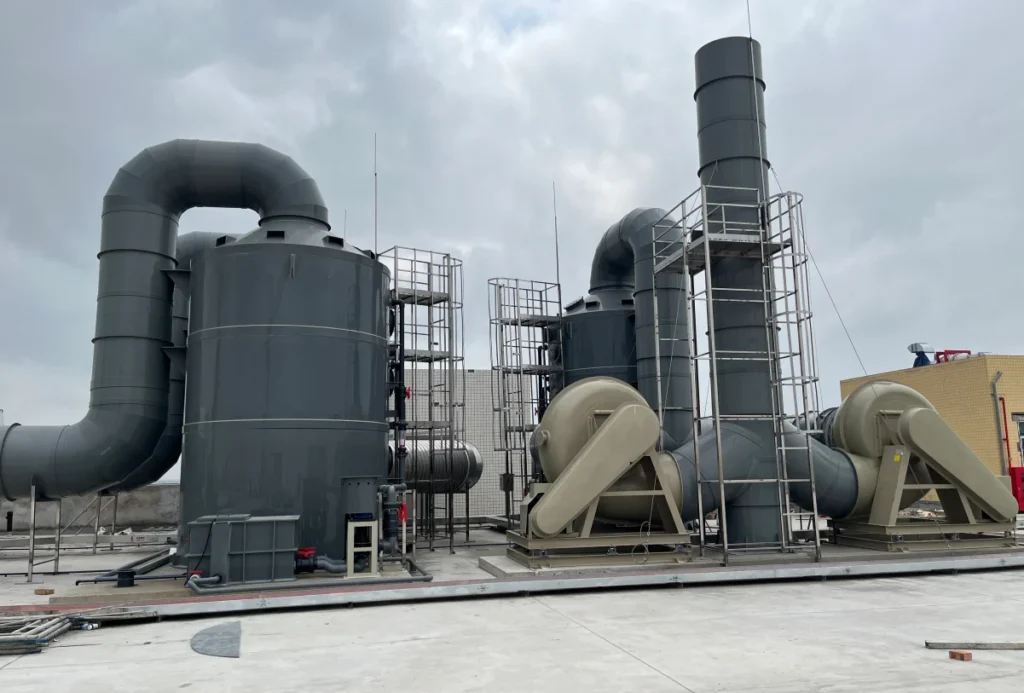
A CO2 scrubber system removes carbon dioxide from a gas stream, and the term covers the amine and caustic scrubbers used in gas processing, the water scrubber used in biogas upgrading, and the small scrubbers used in controlled environments. Carbon dioxide must be removed when it exceeds a sales or process specification, when it must be separated for carbon capture, or when it accumulates in a closed environment. The scrubber choice depends on the gas flow, the CO2 concentration, and the target purity. This guide covers the CO2 removal methods and their chemistry, the carbon capture context, the controlled-environment applications, and the adjacent carbon monoxide and carbon scrubber systems.
Key Takeaways
- A CO2 scrubber system removes carbon dioxide from a gas stream by absorption or reaction, and it is used in natural gas processing to meet the pipeline spec of roughly 2-3% CO2, in carbon capture, in biogas upgrading, and in controlled-environment air treatment.
- Four technologies remove CO2: amine scrubbing with regeneration by heat for high loads, caustic scrubbing with a non-regenerable reaction for small loads, water scrubbing under pressure for biogas upgrading, and membrane or PSA separation for compact physical systems.
- The amine scrubber is the workhorse of industrial CO2 removal and carbon capture, with the regeneration heat as the dominant operating cost; the caustic scrubber is the low-capital option for small CO2 loads.
- The carbon monoxide scrubber system removes CO by catalytic oxidation or carbon adsorption, and the carbon scrubber system uses activated carbon for VOC and odor removal; neither removes CO2 efficiently, so they complement the CO2 scrubber in the treatment chain.
- Select the CO2 scrubber on the gas flow, the CO2 load, and the target purity. The system that meets the purity target at the lowest total cost, with the operating cost as the dominant term over the equipment life, is the correct choice.
What Is a CO2 Scrubber System?
A CO2 scrubber system removes carbon dioxide from a gas stream by contacting the gas with a medium that absorbs, reacts with, or separates the CO2. The system is the CO2 removal link in gas processing, carbon capture, and controlled-environment air treatment, and the technology is selected against the gas flow, the CO2 load, and the target purity.
The CO2 Removal Application
The CO2 removal from gas is required in several distinct applications. In natural gas processing, CO2 is removed from the raw gas to meet the pipeline sales spec, which limits CO2 to roughly 2-3%. In biogas upgrading, CO2 is removed to raise the methane content to 96-98% for biomethane. In flue gas and industrial process gas, CO2 is removed for carbon capture or for a process purity requirement. In a closed environment, CO2 is removed because it accumulates from respiration. The CO2 scrubber system in each case removes the same compound at a different scale and purity target, and the technology is matched to the duty.
Industrial vs Controlled-Environment Scrubbing
The industrial CO2 scrubber and the controlled-environment scrubber differ in scale and purpose. The industrial scrubber treats a large process gas flow and removes a high CO2 concentration to meet a sales or capture spec. The controlled-environment scrubber treats a small recirculated air volume and removes the CO2 that accumulates in a greenhouse, a rebreather, or a sealed room. The industrial system uses the amine or caustic chemistry at a high throughput; the controlled-environment system uses a compact scrubber sized for the space and the occupancy. The selection is set by the application, and the air scrubber system guide covers the air-treatment family that the controlled-environment CO2 scrubber belongs to.
The CO2 Absorption Principle
The CO2 scrubber works by the absorption or reaction of the CO2 into a medium. In amine scrubbing, the CO2 reacts with the amine solution, which is regenerated by heating to release the CO2. In caustic scrubbing, the CO2 reacts with the sodium hydroxide to form a carbonate, which is the reaction product. In water scrubbing, the CO2 dissolves into the water under pressure. The driving force is the concentration difference between the gas and the medium, and the scrubber is sized so the contact zone transfers the CO2 at the rate the gas flow requires. The absorption chemistry is the same principle used across the gas scrubber family covered in the gas scrubber guide.
The CO2 scrubber is also distinguished by the CO2 target and the purity it must reach. A natural gas stream treated to a 2% pipeline spec requires a different removal than a carbon capture stream that must deliver a high-purity CO2 product. The target purity sets the number of contact stages and the medium circulation, and a scrubber sized for a modest removal cannot reach the high purity without an additional stage. The CO2 scrubber system specification states the inlet and outlet concentration, the gas flow, and the operating pressure, because each input changes the size and the energy cost of the unit. A facility that documents the target purity in the specification receives a scrubber that reaches it, and one that specifies only a vague removal target receives a unit that may underdeliver at the actual duty.
The industrial scale of the CO2 removal spans the gas processing plant and the emission source. A natural gas plant treating millions of cubic meters per day uses a large amine system, while a process vent at a few hundred cubic meters per hour uses a compact caustic or carbon unit. The scale sets the equipment size, the energy input, and the capital cost, and the CO2 scrubber system selection is as much a scale decision as a chemistry decision. A facility that matches the technology to the flow and the concentration avoids the two common errors: over-engineering a small stream with a large amine system, and under-treating a large stream with a compact unit that cannot reach the purity.
CO2 Scrubber Technologies
Four CO2 scrubber system technologies remove carbon dioxide from a gas stream, and each matches a different flow, concentration, and purity target.
Amine Scrubbing
The amine scrubber is the workhorse of industrial CO2 removal. The gas is contacted with an amine solution, typically MEA or MDEA, which reacts with the CO2 and holds it in the liquid phase. The CO2-rich amine is regenerated by heating, which releases the concentrated CO2, and the lean amine returns to the absorber. The amine scrubber handles a high CO2 load and reaches a low outlet concentration, which makes it the standard for natural gas sweetening, flue gas carbon capture, and the large biogas upgrading plants. The operating cost is the regeneration heat, which is the dominant energy input, and the amine scrubber is selected where the CO2 load and the purity requirement justify the energy cost.
Caustic Scrubbing
The caustic scrubber removes CO2 by reaction with a sodium hydroxide solution, forming sodium carbonate in the liquid phase. The caustic scrubber is simple and non-regenerable, with the caustic consumed in proportion to the CO2 load. It is selected for a small CO2 flow, a low concentration, or a duty where the amine regeneration is over-engineering. The caustic CO2 scrubber is common in laboratory air treatment, instrument air purification, and small controlled-environment systems, where the caustic consumption is manageable. The operating cost is the caustic, and the caustic scrubber is the low-capital option for the small CO2 loads.
Water Scrubbing
The water scrubber removes CO2 by physical absorption into water under pressure. The gas is compressed and contacted with water in a packed column, where the CO2 dissolves while the other gas components pass through. The water is regenerated by pressure release and air stripping, and the CO2 is released. The water scrubber is the simplest regenerable option with no chemical reagent, and it is the standard for the biogas upgrading covered in the biogas scrubber system guide. The water scrubber reaches a methane purity of 96-98% in biogas service, and its energy cost is the compression.
Membrane and PSA
The membrane and pressure swing adsorption systems separate CO2 by physical means. The membrane passes the CO2 preferentially through a selective layer, and the PSA uses a sorbent that adsorbs the CO2 at pressure and releases it on depressurization. Both are compact and skid-mounted, with no chemical reagent, and they are selected where the footprint and the simplicity outweigh the methane loss or the energy cost. The technology choice among the four is set by the flow, the CO2 concentration, the target purity, and the energy cost, and the wet and dry families covered in the dry scrubber vs wet scrubber guide apply to the CO2 removal as they do to any gas stream.
The operating parameters that set the performance are the liquid-to-gas ratio, the contact time, and the operating pressure. The amine scrubber runs at a liquid circulation set by the CO2 load, and the contact time in the absorber sets the removal. The caustic scrubber runs at a circulation that maintains the reaction, and the pressure and the temperature set the reaction rate. The water scrubber depends on the operating pressure, because the CO2 solubility in water rises with the pressure, and the compression is the energy cost. The CO2 scrubber system design fixes these parameters against the gas flow and the target purity, and a system sized with the correct liquid-to-gas ratio and contact time reaches the purity at the lowest energy cost. The design follows the same mass-transfer method as any packed absorption column, and the contact zone is sized so the transfer meets the target at the peak load.
Carbon Capture and Industrial CO2 Removal
The CO2 scrubber system is the core equipment of carbon capture, and it is the CO2 removal link in the gas processing and industrial streams where the CO2 must be separated.
CO2 in Natural Gas and Process Gas
The natural gas and process gas streams carry CO2 that must be removed to meet the downstream specification. Raw natural gas from a well contains CO2 at a level set by the reservoir, and the gas is treated to the pipeline spec of roughly 2-3% CO2 before it enters the sales line. A process gas stream can carry CO2 as a byproduct or a contaminant, and the scrubber removes it to the process purity requirement. The amine scrubber is the standard for these streams, because it handles the CO2 load and reaches the low outlet concentration the sales or process spec requires. The CO2 removed is either vented, reinjected, or sent to carbon capture, depending on the facility and the economics.
The Carbon Capture Context
Carbon capture is the separation of CO2 from a large emission stream so the CO2 can be stored or used instead of released. The post-combustion capture uses an amine scrubber on the flue gas, absorbing the CO2 and releasing a concentrated stream for compression and storage. The capture is the same amine scrubber technology applied at the emission scale, and the scrubber is the central unit of the capture plant. The DOE carbon capture research documents the capture technologies and their performance. The CO2 scrubber system for capture is sized for the full flue gas flow and the CO2 concentration, and the capture cost is dominated by the regeneration energy of the amine. The water-scrubbing alternative in biogas service is covered in the biogas scrubber system guide.
The CO2 concentration and the gas flow set the capture scale. A flue gas stream at 10-15% CO2 carries a large CO2 mass that the amine scrubber must absorb, and the absorber is sized for the full flue gas flow. The captured CO2 is compressed for pipeline transport and storage, and the compression adds to the capture energy. The capture CO2 scrubber system is the combination of the absorber, the regenerator, the heat recovery, and the compression, and the capture cost is the sum of the regeneration heat and the compression power. The capture economics are driven by the CO2 concentration in the flue gas, because a higher concentration reduces the energy per ton of CO2 captured. The amine scrubber is the mature capture technology, and the capture plant is the large-scale application of the same CO2 scrubber that a gas processing plant uses at a smaller scale.
Controlled-Environment CO2 Scrubbing
The CO2 scrubber system also serves the controlled environments where CO2 accumulates from respiration and must be removed to hold the air within the safe or functional range.
Greenhouse CO2 Control
A greenhouse has two CO2 relationships. In daylight, the plants consume CO2 for photosynthesis, and the grower often enriches the air with CO2 to increase the yield. At night, or in a sealed greenhouse with high plant respiration, the CO2 can exceed the level the crop tolerates, and a CO2 scrubber removes the excess. The greenhouse CO2 scrubber is a compact unit that treats the recirculated greenhouse air, and it is sized for the plant respiration load and the air volume. The controlled-environment CO2 removal is the same scrubber principle applied at the greenhouse scale, and the air-treatment family is covered in the air scrubber system guide.
Closed Environments (Rebreather, Submarine)
The closed-environment CO2 scrubber removes the CO2 that accumulates in a sealed space where people respire. A rebreather, a submarine, a spacecraft, or a sealed shelter uses a CO2 scrubber to hold the CO2 below the breathing limit, because the CO2 concentration rises without ventilation. The scrubber uses a non-regenerable or a regenerable absorbent, and its capacity is matched to the occupancy and the mission duration. The scrubber is the life-support link that keeps the closed environment habitable, and the removal target is set by the CO2 exposure limit. The compact closed-environment scrubber and the industrial CO2 scrubber remove the same compound at opposite ends of the scale, and the ventilation standards that govern the occupied-space CO2 are documented in the OSHA ventilation standards. The related ethylene removal in controlled storage is covered in the ethylene gas scrubber guide.
The closed-environment scrubber is sized on the occupancy and the CO2 production. A person produces roughly 0.8-1.0 kg of CO2 per day through respiration, and the scrubber is sized to remove the CO2 produced by the occupants over the mission or the occupancy period. A submarine or a shelter sized for a crew and a duration carries a scrubber capacity matched to the person-days of the deployment, and the absorbent is a consumable that is replaced or regenerated when spent. The CO2 scrubber system for a closed environment is a life-support sizing exercise, and the capacity margin is set against the mission duration and the worst-case occupancy. The same respiration CO2 production is the load that the greenhouse scrubber removes at night, and the controlled-environment scrubber is the equipment that holds the CO2 within the safe and functional range across all the closed spaces.
Carbon Monoxide and Carbon Scrubber Systems
The adjacent carbon monoxide scrubber system and carbon scrubber system cover the CO and the carbon-based removal that sit beside the CO2 scrubber in the gas-treatment family.
The Carbon Monoxide Scrubber System
A carbon monoxide scrubber system removes carbon monoxide from a gas stream, and it is used where the CO must be reduced below a toxic or a process limit. Carbon monoxide is produced by incomplete combustion and is toxic at a low concentration, so a scrubber is used to treat a combustion exhaust, a confined-space atmosphere, or a breathing-air supply. The common method is catalytic oxidation, which converts the CO to CO2 over a hopcalite or precious-metal catalyst, and an activated carbon bed is used where adsorption is the mechanism. The CO scrubber removes the CO to the low concentration that the exposure limit or the process spec requires, and the gas treatment is detailed in the toxic gas scrubber guide.
The Carbon Scrubber System (Activated Carbon)
The carbon scrubber system uses activated carbon to adsorb the volatile organic compounds, odors, and other contaminants from a gas stream. The carbon is a porous medium that holds the contaminant on its surface, and the bed is regenerated by heating or replaced when saturated. The carbon scrubber is used for odor control, VOC removal, and the polishing of a gas stream after a primary scrubber, and it is the adsorption counterpart to the wet scrubbing that absorbs the soluble gases. The carbon scrubber does not remove CO2 efficiently, which is why the CO2 removal uses the amine, caustic, or water chemistry, but the carbon system is the complement in the treatment chain. The activated carbon adsorption equipment range covers the carbon systems.
Industrial CO Removal
The industrial CO removal covers the combustion and process streams where the CO must be controlled. A boiler or an engine exhaust carries the CO from the combustion, and a catalytic CO scrubber oxidizes it before the gas is discharged. A process stream can carry the CO as a byproduct, and the scrubber removes it to the process spec. The industrial CO removal uses the same catalytic and adsorption methods as the confined-space scrubber, sized for the larger gas flow and the emission limit. The EPA control technology fact sheets document the CO control performance, and the selection follows the same design method as the general gas scrubber.
The distinction between the CO2 and the CO scrubber is the contaminant and the chemistry. The CO2 scrubber absorbs or reacts the carbon dioxide with an amine, a caustic, or water. The CO scrubber oxidizes the carbon monoxide over a catalyst or adsorbs it on a carbon bed. The two are often confused because the names differ by one letter, but the chemistry is entirely different, and a facility that treats a CO stream with a CO2 scrubber removes nothing. The carbon scrubber system sits beside both, using the activated carbon to adsorb the volatile compounds that neither the CO2 nor the CO scrubber removes. The three systems cover the carbon-bearing contaminants in the gas-treatment chain, and the selection is made against the specific contaminant in the stream. The CO2 scrubber system removes the CO2, the CO scrubber removes the CO, and the carbon scrubber removes the volatile organics, and the facility uses each where its chemistry applies.
Selecting a CO2 Scrubber System
The CO2 scrubber system selection starts with the gas flow, the CO2 load, and the target purity, and the technology is matched to the duty.
Duty Assessment
Define the gas stream and the removal target first. The gas flow sets the scrubber size, the CO2 concentration sets the load, and the outlet purity sets the technology. A natural gas stream at 5% CO2 going to a 2% pipeline spec uses an amine scrubber, which reaches the low outlet concentration at a manageable regeneration energy. A small instrument air stream at a low CO2 load uses a caustic scrubber, which is simple and non-regenerable. A biogas stream uses the water scrubber or an amine unit, depending on the plant scale. The duty assessment also covers the operating pressure, which affects the physical absorption, and the temperature, which affects the chemistry. A facility that provides the flow, the composition, and the target purity receives a CO2 scrubber sized to the actual duty.
System Sizing
The system is sized on the CO2 mass flow and the required removal. The CO2 mass flow is the product of the gas flow and the concentration, and the scrubber contact zone and the medium circulation are sized to transfer that mass at the required rate. The amine scrubber is sized for the absorber, the regenerator, and the heat input; the caustic scrubber for the caustic circulation and the reaction product handling; the water scrubber for the absorption and regeneration columns and the compression. The operating cost is the regeneration heat for the amine, the caustic for the caustic scrubber, or the compression for the water scrubber, and it is projected across the operating hours. The CO2 scrubber system that meets the purity target at the lowest total cost is the correct selection, and the operating cost is the dominant term over the equipment life.
The verification of the CO2 removal is the measurement that confirms the scrubber meets the target. A facility measures the outlet CO2 concentration on a schedule, with a continuous analyzer or a periodic sample, and compares it against the purity spec. The measurement catches a scrubber that has lost its amine strength, exhausted its caustic, or dropped its water circulation before the product quality is affected. The operating records track the outlet concentration, the medium condition, and the energy input, and they document the scrubber’s compliance with the removal target. The CO2 scrubber system verification closes the loop between the design and the operation, and a facility that monitors the outlet concentration alongside the scrubber maintenance runs the most reliable CO2 removal.
The specialty scrubber applications related to this guide are covered in the flue gas scrubber guide. For the full scrubber range, browse the blog hub or the activated carbon adsorption equipment range, and contact our engineering team with the gas flow and the composition for a CO2 scrubber matched to the duty.
FAQ
What is a CO2 scrubber system?
A CO2 scrubber system removes carbon dioxide from a gas stream by contacting the gas with a medium that absorbs, reacts with, or separates the CO2. It is used in natural gas processing, carbon capture, biogas upgrading, and controlled-environment air treatment.
How do you remove CO2 from gas?
The four main methods are amine scrubbing, caustic scrubbing, water scrubbing, and membrane or PSA separation. The amine scrubber regenerates with heat and handles a high CO2 load, the caustic scrubber reacts with sodium hydroxide and is non-regenerable, the water scrubber absorbs the CO2 under pressure, and the membrane and PSA separate it physically.
How does an amine scrubber work?
An amine scrubber contacts the gas with an amine solution, typically MEA or MDEA, which reacts with the CO2 and holds it in the liquid phase. The CO2-rich amine is regenerated by heating, which releases the concentrated CO2, and the lean amine returns to the absorber. The regeneration heat is the main operating cost.
What is the difference between a CO2 scrubber and a carbon scrubber?
A CO2 scrubber removes carbon dioxide by absorption or reaction, using amine, caustic, or water chemistry. A carbon scrubber uses activated carbon to adsorb volatile organic compounds and odors, and it does not remove CO2 efficiently. The two are complementary stages in a treatment chain.
What is a carbon monoxide scrubber system?
A carbon monoxide scrubber system removes carbon monoxide from a gas stream, using catalytic oxidation to convert the CO to CO2 over a catalyst, or an activated carbon bed for adsorption. It is used for combustion exhaust, confined-space atmospheres, and breathing-air treatment.
Can a CO2 scrubber remove CO2 from a greenhouse?
Yes. A greenhouse can accumulate CO2 from plant and soil respiration when the space is sealed, and a compact CO2 scrubber removes the excess to hold the air within the level the crop tolerates. In daylight the greenhouse often enriches the CO2 for photosynthesis instead.
How much does a CO2 scrubber system cost?
The cost depends on the technology and the scale. A small caustic scrubber for instrument air runs $5,000-20,000. A medium amine scrubber for a gas processing stream runs $50,000-200,000. A large flue gas carbon capture amine system runs into the millions, with the regeneration energy as the dominant operating cost.
What is the difference between CO2 and carbon monoxide scrubbing?
A CO2 scrubber removes carbon dioxide by absorption or reaction with an amine, a caustic, or water. A carbon monoxide scrubber removes CO by catalytic oxidation over a catalyst or by adsorption on a carbon bed. The chemistries are different, and a facility must match the scrubber to the specific contaminant.
How is a CO2 scrubber sized for a closed environment?
A closed-environment CO2 scrubber is sized on the occupancy and the CO2 production. A person produces roughly 0.8-1.0 kg of CO2 per day through respiration, and the scrubber is sized to remove the CO2 produced by the occupants over the mission or the occupancy period.