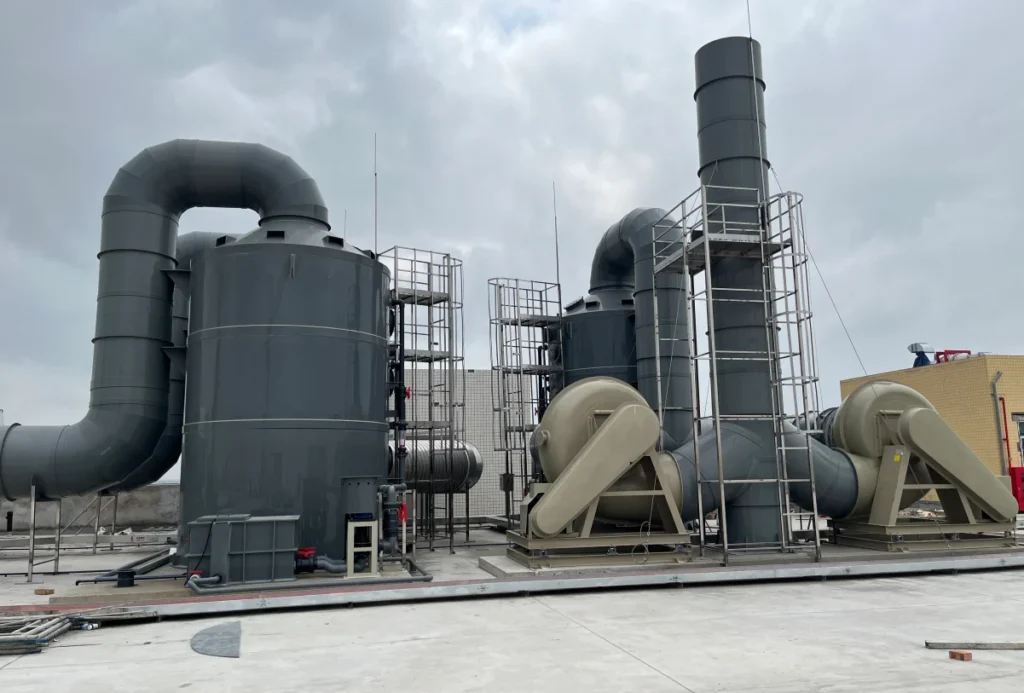
An ethylene gas scrubber removes ethylene gas from the air of a fruit and vegetable storage room, slowing the ripening that ethylene triggers and extending the storage life of the crop. Ethylene is a plant hormone that accumulates in a closed storage room as the fruit respires, and it accelerates ripening and senescence of the ethylene-sensitive crops in the room. The ethylene scrubber is the equipment that holds the concentration below the level where ripening accelerates. This guide covers what an ethylene gas scrubber is, the removal chemistry and the three technology types, the sizing by storage volume, and the adjacent hydrogen gas scrubber and vapor scrubber systems used in industrial gas treatment.
Key Takeaways
- An ethylene gas scrubber removes ethylene from the air of a fruit and vegetable storage room, holding the concentration below roughly 0.1 ppm so the ethylene-sensitive crops do not ripen and decay prematurely. It is the equipment that makes long-term cold storage practical.
- Three technologies remove ethylene: potassium permanganate oxidation with a consumable media, catalytic oxidation with a heater and a regenerable catalyst, and activated carbon adsorption with a regenerable or replaceable carbon bed. The choice balances the media or power cost against the storage duty.
- The scrubber is sized on the room volume, the air circulation rate, and the crop ethylene production, treating one to several room volumes per hour, and it is placed in the evaporator air stream so the entire room air reaches it.
- The adjacent hydrogen gas scrubber removes contaminants from a hydrogen stream to meet the purity spec, and the vapor scrubber systems treat vent and process vapor by absorption. Both use the same wet scrubber technology as the general gas scrubber.
- Select the ethylene scrubber on the room volume, the crop sensitivity, and the storage duration, and budget the recurring operating cost of the media or the power. The unit that holds the room below the crop threshold at the lowest total cost is the correct choice.
What Is an Ethylene Gas Scrubber?
An ethylene gas scrubber is an air treatment unit that removes ethylene gas from the atmosphere of a fruit or vegetable storage room, so the crop stays at its immature state longer and the storage life extends. It is the equipment that makes long-term controlled-atmosphere storage practical for the ethylene-sensitive crops that dominate commercial cold storage.
Why Ethylene Must Be Removed in Storage
Ethylene is a plant hormone that triggers ripening, senescence, and a range of storage disorders. Every fruit in a storage room releases ethylene as it respires, and the concentration in the sealed room rises as the crop ripens. At a concentration above roughly 0.1 ppm, ethylene accelerates the ripening of sensitive crops such as apples, kiwifruit, and bananas, and it triggers the chlorophyll loss, softening, and decay that shorten the storage life. The storage operator removes the ethylene to hold the concentration below the level where the crop responds, and the University of Minnesota Extension documents the ethylene sensitivity of the common storage crops. The ethylene removal is what separates a storage room that holds the crop for months from one that loses it to premature ripening.
The Ethylene Scrubber for Fruit Storage
The ethylene scrubber for fruit storage is installed in the storage room air loop, drawing the room air through the scrubber, removing the ethylene, and returning the cleaned air. The scrubber operates continuously while the room is sealed, and its capacity is matched to the room volume and the ethylene production of the stored crop. The scrubber is the ethylene removal link in the cold storage system, and it is specified alongside the refrigeration, the humidity control, and the controlled-atmosphere gas management. The ethylene scrubber and the broader air scrubber family are covered in the air scrubber system guide, and the general scrubbing technology in the gas scrubber guide.
Ethylene Removal Chemistry
The ethylene removal chemistry depends on the technology. Potassium permanganate oxidizes the ethylene to carbon dioxide and water, consuming the permanganate media in the process. Catalytic oxidation heats the ethylene with a catalyst to convert it to carbon dioxide and water, regenerating the catalyst. Activated carbon adsorbs the ethylene onto the carbon surface, which is regenerated by heating or replaced when saturated. All three remove ethylene from the room air at the part-per-million level, and the choice is set by the storage size, the operating cost, and the removal target. The ethylene concentration in a storage room is measured in parts per million, and the scrubber is designed to hold it below the 0.1 ppm threshold that the sensitive crops require.
The threshold matters because the crop response is not linear. A storage room that holds the ethylene at 1 ppm can lose days or weeks of storage life compared with a room at 0.1 ppm, and the difference is the crop value at the end of the season. The ethylene scrubber is therefore not sized to remove the bulk of the ethylene; it is sized to remove the last fraction that matters, which is why the removal target is set at the part-per-million level. The ethylene gas scrubber that holds the room below the threshold protects the crop value, and the measurement of the room concentration is the check that the scrubber is doing its job.
How Ethylene Removal Works in Cold Storage
The ethylene gas scrubber works as part of the storage room air system, and the removal is set by the room volume, the crop ethylene production, and the air circulation rate.
The Storage Room Air Loop
The storage room air is continuously recirculated by the evaporator fans, and the ethylene scrubber is placed in that air loop so the room air passes through it on each cycle. The scrubber draws a portion of the circulated air, removes the ethylene, and returns the cleaned air to the room. The air circulation rate determines how often the room air volume passes through the scrubber, and the scrubber capacity is matched to the circulation rate and the ethylene load. A room with a high air circulation rate exposes the crop to the cleaned air more often, which is why the scrubber is integrated into the existing fan system instead of operated as a stand-alone unit.
Removal Efficiency and Concentration Targets
The removal target is set by the crop sensitivity. The ethylene-sensitive crops, including apples, kiwifruit, and bananas, respond to concentrations below 1 ppm, and the commercial target is often below 0.1 ppm. The scrubber is sized to hold the room concentration below the crop threshold under the peak ethylene production, which occurs when the crop is at its highest respiration rate. The removal efficiency of the scrubber is the fraction of the ethylene removed in a single pass, and the room concentration is a balance between the ethylene production and the removal rate. A scrubber with a high single-pass efficiency and a high air throughput holds a lower steady-state concentration than one with either metric alone.
Cold Storage Ethylene Removal
The ethylene scrubber in cold storage runs continuously while the room is sealed, and it is a fixed operating cost of the storage season. The potassium permanganate scrubber consumes media that is replaced on a schedule, the catalytic scrubber consumes power for the heater and the catalyst operation, and the activated carbon scrubber consumes the carbon that is regenerated or replaced. The operating cost is part of the storage budget, and it is small next to the value of the crop that the ethylene removal protects. The cold storage ethylene removal is the primary meaning of the ethylene gas scrubber, and it is the application where the term is used in the post-harvest industry.
The ethylene scrubber is integrated with the controlled-atmosphere system in the storage rooms that use it. A controlled-atmosphere room holds the oxygen and carbon dioxide at set levels, and the ethylene scrubber removes the ethylene that the controlled conditions do not manage. The two systems work together: the controlled atmosphere slows the respiration and the ethylene scrubber removes the ripening hormone, and together they hold the crop in its immature state for the long storage season. The scrubber is specified as part of the controlled-atmosphere design, and the gas composition and the ethylene removal are managed together. A storage operation that runs both the controlled-atmosphere control and the ethylene scrubber achieves the longest storage life for the sensitive crops, and the two are the standard combination for the long-term apple and kiwifruit storage rooms.
Ethylene Scrubber Technologies
Three ethylene gas scrubber technologies dominate cold storage service, and each removes the ethylene by a different mechanism with a different operating cost.
Potassium Permanganate Scrubbers
The potassium permanganate scrubber is the most common and the simplest. The ethylene passes through a media bed of alumina pellets impregnated with potassium permanganate, which oxidizes the ethylene to carbon dioxide and water. The permanganate is consumed as it reacts, and the media changes color from purple to brown as it is exhausted. The media is a consumable, replaced when the color change signals depletion, and the operating cost is the media replacement. The potassium permanganate scrubber is passive, reliable, and well suited to a small or medium storage room, and it requires no power beyond the fan that moves the air. The potassium permanganate ethylene scrubber is the baseline against which the other technologies are compared.
Catalytic Ethylene Scrubbers
The catalytic ethylene scrubber oxidizes the ethylene by heating the air and passing it over a catalyst, converting the ethylene to carbon dioxide and water. The catalyst is not consumed, and the scrubber operates continuously with a heater and a fan. The catalytic scrubber handles a higher ethylene load than the permanganate unit and requires no media replacement, but it consumes power for the heater and operates at an elevated temperature in the air stream. The catalytic ethylene scrubber is the choice for a large storage operation or a high-ethylene-load crop, where the media replacement of the permanganate unit would be a recurring cost and the power cost of the catalytic unit is the lower total.
Activated Carbon Ethylene Adsorption
The activated carbon scrubber adsorbs the ethylene onto the carbon surface, removing it from the air without a chemical reaction. The carbon is regenerated by heating or is replaced when saturated, and the operating cost is the regeneration energy or the carbon replacement. The activated carbon scrubber is effective at the part-per-million level and is often used in combination with the permanganate or catalytic technology for a higher total removal. The activated carbon adsorption equipment range covers the adsorption systems, and the EPA indoor air quality guidance documents the adsorption media practice. The choice among the three technologies is set by the storage size, the ethylene load, and the operating-cost budget, and the ethylene gas scrubber that matches the duty is the one that holds the room below the crop threshold at the lowest total cost.
The technology comparison in a storage operation is made against the actual ethylene load and the operating season. A small grower storing a few rooms of apples for a short season chooses the permanganate scrubber for the low capital and the simple operation. A large packer storing many rooms for a long season chooses the catalytic scrubber, because the media replacement of the permanganate units across the season exceeds the power cost of the catalytic units. The comparison is a total-cost-of-ownership calculation over the storage season, and it includes the capital, the media or the power, and the maintenance labor. The ethylene scrubber selection that minimizes the season cost, while holding the room below the crop threshold, is the technology that the storage operation should install.
Sizing and Selecting an Ethylene Scrubber
The ethylene gas scrubber is sized on the storage room volume, the air circulation rate, and the ethylene production of the stored crop, and the correct size holds the room below the crop threshold under the peak load.
Sizing by Storage Volume
The scrubber capacity is matched to the room air volume and the required air turnover. A storage room is sized in cubic meters, and the scrubber is specified to treat a fraction of that volume per hour, typically one to several room volumes per hour depending on the crop sensitivity and the ethylene load. A small apple room of 500 m3 needs a scrubber that turns the room air once to several times per hour, while a large 5,000 m3 room needs a proportionally larger unit or multiple units. The ethylene load scales with the crop quantity and the respiration rate, and the scrubber is sized for the peak load at the warmest point of the storage season. The ethylene absorber sizing starts with the room volume and the crop, and the supplier sizes the unit to the measured or estimated ethylene production.
Air Circulation and Placement
The scrubber placement in the air loop sets its effectiveness. The unit is installed where the circulated air passes through it on each fan cycle, typically in the evaporator air stream or in a dedicated bypass duct. The air circulation rate and the scrubber throughput together set how often the room volume is treated, and a unit that treats a small flow at a high single-pass efficiency can be as effective as a larger unit at a lower efficiency. The placement avoids dead zones where the ethylene can accumulate, and the storage design places the scrubber so the entire room air volume reaches it. The air circulation and the placement are design inputs as much as the scrubber capacity is.
Selection by Crop and Storage Type
The selection follows the crop and the storage mode. A crop with high ethylene sensitivity and a long storage season, such as apples in a controlled-atmosphere room, needs a scrubber that holds the concentration below 0.1 ppm for months, and the catalytic or a permanganate-plus-carbon combination is the reliable choice. A crop with lower sensitivity or a shorter storage period can use a permanganate scrubber at a lower cost. A room used for mixed crops selects the scrubber for the most sensitive crop in the room. The ethylene gas scrubber selection is the balance between the crop value, the storage duration, and the operating cost, and the unit that holds the room below the crop threshold at the lowest total cost is the correct selection.
The cost of the ethylene scrubber scales with the room volume and the technology. A potassium permanganate scrubber for a 500 m3 room runs $5,000-20,000, with the media replacement as the recurring cost. A catalytic scrubber for the same room runs $15,000-40,000, with the power cost replacing the media cost. A 5,000 m3 room needs a larger unit or multiple units, and the capital cost rises into the $50,000-150,000 range for the large storage operations. The operating cost is the media, the power, or the carbon replacement, and it is projected across the storage season. The ethylene gas scrubber cost is small next to the value of the crop in the room, and the storage operator sizes the scrubber to protect the crop value instead of minimizing the equipment cost alone.
Hydrogen Gas Scrubber and Vapor Scrubber Systems
Beyond the ethylene cold-storage application, the scrubber family covers the adjacent hydrogen gas scrubber and vapor scrubber systems used in industrial gas treatment, and this guide covers them as the related meanings of the scrubber term.
The Hydrogen Gas Scrubber
A hydrogen gas scrubber removes the contaminants from a hydrogen gas stream before the hydrogen is used or sold. The hydrogen produced by electrolysis, steam reforming, or a process unit carries trace carbon dioxide, hydrogen sulfide, moisture, and other impurities, and the scrubber removes the specific contaminant to meet the hydrogen purity spec. A caustic or amine scrubber removes the acid gases, a desiccant or separator removes the moisture, and the hydrogen exits at the required purity. The hydrogen gas scrubber is the same wet scrubber equipment as the general gas scrubber, applied to the hydrogen stream, and the hydrogen purity requirement sets the removal target. The wet scrubber technology and the acid gas chemistry are covered in the toxic gas scrubber and dry scrubber vs wet scrubber guides.
Vapor Scrubber Systems
The vapor scrubber systems treat a vapor-laden gas stream, removing the vapor or the condensed liquid from the gas before it is vented or processed. A storage tank vent, a process vapor stream, or a loading vapor carries the volatile compounds that a vapor scrubber removes by absorption or condensation. The vapor scrubber is sized for the vapor flow and the compound, and it protects the atmosphere from the volatile emissions and the downstream equipment from the condensation. The vapor scrubber systems are the general industrial application of the scrubber, and the vapor handling covers the vent and the process streams that the ethylene scrubber does not. The vapor scrubber is specified where a volatile compound must be removed from a gas stream, and the selection follows the compound solubility and the removal target.
Industrial Vapor and Gas Treatment
The industrial vapor and gas treatment is the broad context that connects the ethylene, hydrogen, and vapor scrubbers. A facility that handles volatile compounds, process gases, or storage vents uses a scrubber to remove the contaminant before the gas is released, and the scrubber is the air pollution control device that keeps the discharge inside its limit. The EPA control technology fact sheets document the scrubber performance for the common pollutants, and the selection follows the same design method as the general gas scrubber. The ethylene gas scrubber for cold storage, the hydrogen gas scrubber for hydrogen purification, and the vapor scrubber systems for vent and process gas are the specialty and adjacent applications of the same scrubbing technology.
The hydrogen gas scrubber is growing in relevance with the expansion of hydrogen production and use. An electrolysis plant produces hydrogen with oxygen and moisture, and a steam reformer produces hydrogen with carbon dioxide and carbon monoxide. The hydrogen is purified to the fuel-cell, process, or sales spec, and the scrubber removes the specific contaminant. The hydrogen purity requirement sets the removal target, and the scrubber is sized for the hydrogen flow and the contaminant load. A facility that produces or handles hydrogen specifies the scrubber against the end-use purity, and the hydrogen gas scrubber is the equipment that delivers the hydrogen at the spec the process needs. The vapor scrubber systems serve the storage and transport side, treating the vents and the loading vapor, and the two together cover the hydrogen and vapor handling across the facility.
Selecting an Ethylene Gas Scrubber
The ethylene gas scrubber selection starts with the storage duty, and the correct unit holds the room below the crop threshold at the lowest operating cost.
Duty Assessment
Define the storage room and the crop first. The room volume sets the air volume the scrubber must treat, the crop sets the ethylene sensitivity and the production rate, and the storage duration sets the removal target and the operating cost the room can absorb. Measure the crop quantity and the expected respiration, and confirm the ethylene sensitivity of the stored variety, because an apple cultivar and a banana room have different removal requirements. The duty assessment also covers the air circulation rate of the room, which sets the scrubber placement and the throughput, and the controlled-atmosphere gas composition, which can affect the scrubber chemistry. A storage operator that provides the room volume, the crop, and the circulation rate receives an ethylene scrubber sized to the actual duty.
Operating and Maintenance
The operating cost and the maintenance differ by technology. The potassium permanganate scrubber requires the media replacement on a schedule, and the media color change is the replacement signal. The catalytic scrubber requires the heater and the catalyst inspection, with no media replacement. The activated carbon scrubber requires the regeneration or the carbon replacement. The operating records track the scrubber runtime, the media or the catalyst condition, and the room ethylene concentration, and they document that the scrubber has held the room below the crop threshold. The maintenance is a scheduled part of the storage season, and a scrubber that is not maintained loses the removal capacity that protects the crop.
The verification of the ethylene removal is the operating evidence that the scrubber is protecting the crop. A storage operator measures the room ethylene concentration on a schedule, typically with a portable or a fixed analyzer, and compares it against the crop threshold. The measurement confirms that the scrubber capacity and the air circulation are holding the room below the limit, and it catches a scrubber that has lost its media or its catalyst before the crop is affected. The verification is part of the storage quality program, and the concentration record is the evidence that the ethylene gas scrubber is doing its job. A storage operation that monitors the room concentration alongside the scrubber maintenance runs the most reliable ethylene removal, and the measurement closes the loop between the scrubber capacity and the crop protection.
The specialty scrubber applications related to this guide are covered in the CO2 scrubber system and flue gas scrubber guides. For the full scrubber range, browse the blog hub or the activated carbon adsorption equipment range, and contact our engineering team with the storage room and the crop data for an ethylene scrubber matched to the duty.
FAQ
What is an ethylene gas scrubber?
An ethylene gas scrubber removes ethylene gas from the air of a fruit and vegetable storage room, slowing the ripening that ethylene triggers and extending the storage life of the crop. It holds the room ethylene concentration below the level where the sensitive crops respond.
How do you remove ethylene from cold storage?
The three main methods are potassium permanganate oxidation, catalytic oxidation, and activated carbon adsorption. The permanganate scrubber oxidizes the ethylene and consumes the media, the catalytic scrubber heats the air over a catalyst, and the carbon scrubber adsorbs the ethylene onto the carbon.
What does an ethylene scrubber do?
An ethylene scrubber removes the ethylene gas that accumulates in a sealed storage room as the fruit respires. It prevents the ethylene from accelerating the ripening, softening, and decay of the sensitive crops, extending the storage life and preserving the crop quality.
How much does an ethylene gas scrubber cost?
A small potassium permanganate scrubber for a 500 m3 storage room runs $5,000-20,000, with the media replacement as the recurring operating cost. A catalytic scrubber for the same room runs $15,000-40,000 with a power cost and no media replacement. A large room needs a proportionally larger unit or multiple units.
What is a hydrogen gas scrubber?
A hydrogen gas scrubber removes the contaminants from a hydrogen gas stream, including carbon dioxide, hydrogen sulfide, and moisture, to meet the hydrogen purity spec. It is the same wet scrubber equipment applied to the hydrogen stream, and the purity requirement sets the removal target.
What are vapor scrubber systems?
Vapor scrubber systems treat a vapor-laden gas stream, removing the volatile compounds or the condensed liquid from the gas before it is vented or processed. They are used on storage tank vents, process vapor streams, and loading vapors, and they are sized for the vapor flow and the compound.
Which ethylene scrubber do I need for my storage room?
Define the room volume, the crop, and the storage duration first. A small room with a moderately sensitive crop can use a potassium permanganate scrubber. A large room or a high-ethylene-load crop needs a catalytic scrubber or a permanganate-plus-carbon combination to hold the concentration below the crop threshold.
How long does an ethylene scrubber media last?
The potassium permanganate media life depends on the ethylene load and the airflow. A media bed in a low-ethylene-load room can last a full storage season, while a high-load room can exhaust the media in a few months. The media changes color from purple to brown as it is consumed, and the operator replaces it when the color change signals depletion.