Rectangular Poly Tank: PP Rectangular Storage Tanks Built to Fit the Room
A rectangular tank is usually chosen for a reason that has nothing to do with chemistry: the room. A cylindrical vessel wastes the corners it stands in, and in a plant where the tank has to sit against two walls, pass under a low beam or fit into a bund that already exists, a box shape puts the same volume into less floor than any cylinder can.
Welcome to XICHENG EP LTD. For 17 years we have fabricated polypropylene tanks for chemical processing, water treatment, pharmaceutical and metal finishing plants. A rectangular poly tank from us is not a cylinder with the corners squared off. It is a stiffened box drawn around your available space, with the panel thickness set by the span between supports rather than by a nominal capacity, and with the corners — the part that fails first on every rectangular tank — reinforced by design rather than by hope.
- Capacity from 50 litres to 100,000+ litres — single vessels, or several manifolded into a storage farm.
- Panel thickness from 5 mm to 30 mm, calculated from the span between stiffeners and the specific gravity of what you store.
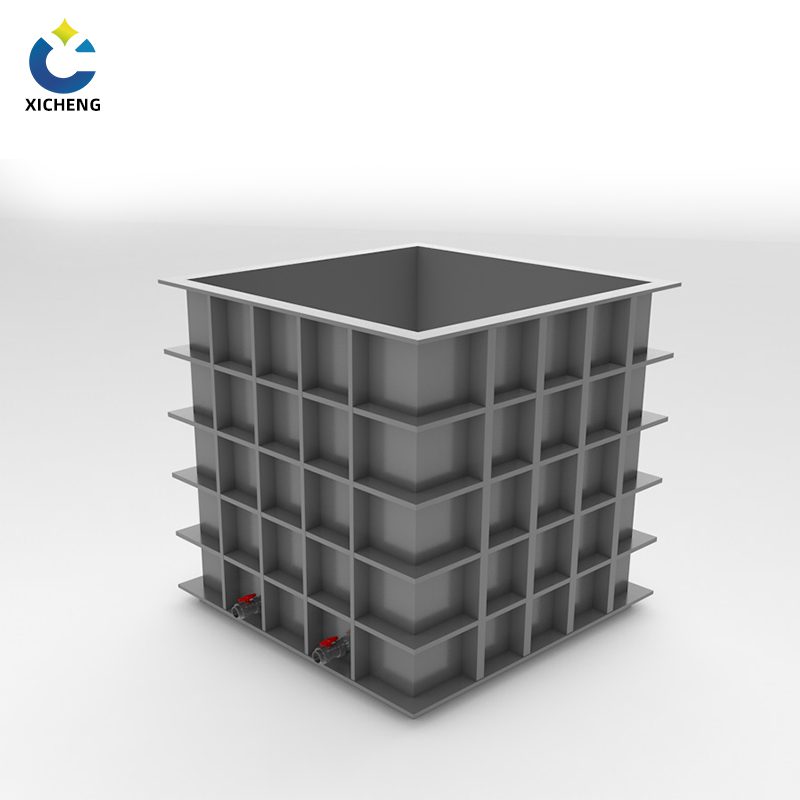
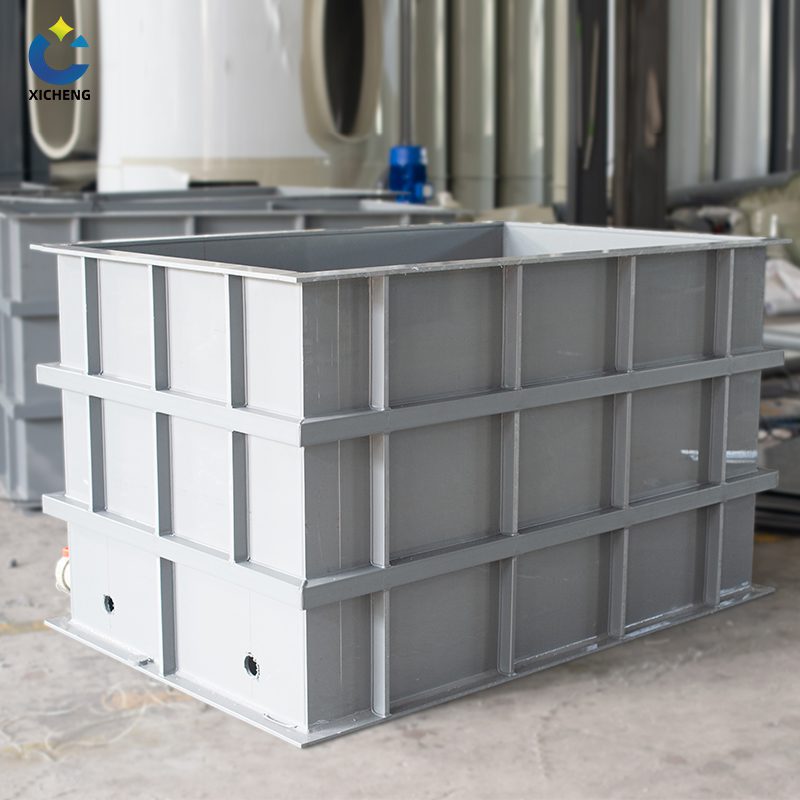
- Reinforced corners and external stiffening — the two places a flat wall actually fails, dealt with in fabrication rather than on site.
- Zero corrosion, zero lining — the wall is the barrier. No coating to blister, no bonded interface to fail, nothing hidden behind a lining corroding unseen.
- Around 70% lighter than steel — a lighter structural load on your slab and bund, simpler rigging, and cheaper freight.
- Lower lifetime cost — a PP tank typically lands 30–50% below an equivalent stainless vessel on total cost of ownership.
Why a Standard Rectangular Tank Fails at the Corners
Rectangular tanks fail differently from cylindrical ones, and the difference is worth understanding before you buy. On a cylinder, the wall is in tension all the way round — the pressure pushes the shell outward and the shell resists by stretching. On a box, the wall is in bending. Each flat panel is pushed outward like a plate held at its edges, and the load concentrates where the panels meet.
| What fails | Why it happens | How a PP rectangular tank solves it |
|---|---|---|
| The vertical corner seam splits | Two panels push outward against one weld line at once, so the corner carries the reaction of both and becomes the highest-stressed joint in the vessel | Corner gussets and full-penetration vertical seams — the corner is built as a joint, not a fold |
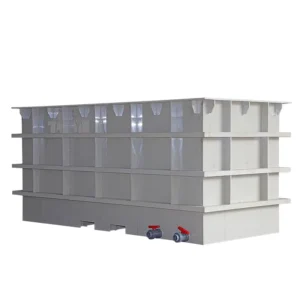
| A panel bows at mid-span | A flat wall is a plate in bending, and deflection rises faster than the load as the unsupported span grows; filling and emptying works it back and forth until a thermoplastic creeps | External ribs and internal baffles break a long wall into shorter spans, which controls deflection far better than adding thickness everywhere |
| The base-to-wall joint leaks | The full hydrostatic column above and the weight of product on the floor plate arrive at the same weld from two directions | Wall thickness set from working depth and specific gravity, with the base joint detailed for both loads |
| The stiffening corrodes | Steel stiffeners, frames and stands sit exactly where a spill and the fume collect, and they are the first thing the product reaches | PP stiffeners and PP-clad steel frames, so no bare metal ever sees the stored product or the spill |
| Bolted metal box joints weep | Bolts, gaskets and welds are all metal, and the acid finds them long before it finds the plate | One welded thermoplastic shell with no metal in the wetted path |
| A flat cover or lid distorts | A flat cover spans the whole opening unsupported, so it carries the same bending problem as the wall with none of the bracing | Top frame and ribbed cover sized to the opening, decided with the tank rather than bought afterwards |
The mid-span row is the one that separates a good rectangular tank from a cheap one, and it is invisible once the tank is full. Doubling the unsupported width of a panel does not double the bending — it multiplies it, because deflection rises with the span far faster than with the load. That is why a wide, shallow tank with short panel spans can use a thinner wall than a narrow, deep tank with one long unsupported face, even though both hold the same litres.
- Shorten the span, don’t just thicken the panel — external stiffeners and internal baffles break a long wall into shorter spans, which controls deflection far more efficiently than adding thickness everywhere.
- Reinforce every corner — corner gussets and full-penetration welds carry the reaction from both panels, so no single seam takes the whole load.
- Prove it before it ships — hydrostatic testing at 1.5× working pressure plus ultrasonic inspection of every critical weld, with the corner seams checked first.
Engineering That Outlasts the Chemical: PP-H Panels from 5 mm to 30 mm
Most rectangular tanks sold as plastic are rotationally moulded, in the fixed sizes the tooling happens to offer. That is the right answer for a few hundred litres of water on a bench. It is not the right answer for a 20,000-litre reagent store that has to fit between two columns, nor for a shallow compartmented box whose panels have to be stiffened to hold depth. Once the tank has to fit a room rather than a shelf, a fabricated PP-H box is the only way to get the plan shape, the panel thickness and the nozzle positions you actually need.
Why Xicheng Polypropylene?
- 100% virgin PP-H homopolymer sheet, fabricated from 5 mm to 30 mm — no regrind, no filler, full batch traceability.
- Extrusion welding gives 30–40% higher joint strength than hot-air welding, with full penetration and smooth, non-porous beads that do not trap product.
- Corner construction designed as a joint, not a fold — corner gussets and full-penetration seams, so the highest-stressed part of a box tank is also the most heavily built.
- Stiffeners and baffles welded in during fabrication — external ribs where the span is long, internal baffles where the process needs compartments, so the wall does not rely on thickness alone.
- Grade honesty: PP-H is the right choice for the overwhelming majority of acid, alkali and water duties, from −10 °C to 95 °C. Where the chemistry or temperature demands something else, we move you to PVC or PVDF rather than sell you a PP tank that will creep.
Every sheet and every weld is independently verified — SGS-tested material, with certificates supplied with the tank.
Chemistry & Material Matching
| Stored product | Recommended material | Notes |
|---|---|---|
| Hydrochloric acid (HCl) | PP-H | Excellent resistance at all concentrations |
| Sulfuric acid (H₂SO₄) | PP-H | Good to 95% concentration below 80 °C |
| Nitric acid (HNO₃) | PVC or PVDF | Required above 50% concentration |
| Sodium hydroxide (NaOH) | PP-H | Excellent across the full range of process concentrations |
| Hydrofluoric acid (HF) | PP-H, increased wall thickness | Reviewed case by case — send us concentration and temperature |
| Organic solvents | PP-H, reviewed case by case | Most are compatible — confirm the specific solvent and concentration with us |
| Demineralised / RO water | PP-H | Standard service; UV-stabilised grade for outdoor installation |
This table reflects standard practice, not a guarantee for every duty. Send us your concentration, operating temperature, specific gravity and any additives, and our engineers will confirm the grade in writing before you commit.
Rectangular Poly Tank Specifications: Capacity, Depth, Stiffening and Connections
Rectangular is a family, not one shape. A square tank is the same flat-panel problem in a bay with equal walls. A low-profile tank is the same problem with the depth taken out so the vessel clears a low beam or a bench. An open-top tank is the same problem with the top frame removed because the process has to reach in from above. Each one changes the span, and the span is what sets the panel.
| Parameter | Range / options | Notes |
|---|---|---|
| Capacity | 50 litres to 100,000+ litres | Single vessels, or multiple tanks manifolded into a storage farm |
| Plan shape | Square, rectangular, or L-shaped around an obstruction | Built to the room, including columns and pipe runs the tank has to work around |
| Panel thickness | 5 mm to 30 mm | Set by the unsupported span and the specific gravity, not by capacity alone |
| Working depth | Built to your available headroom | Low-profile where the beam is close; deep where floor area is the constraint |
| Stiffening | External ribs, top frame, internal baffles | Shortens the span so the panel does not have to carry the whole load in bending |
| Corner detail | Corner gussets, full-penetration vertical seams | The highest-stressed joints in the vessel, built accordingly |
| Bottom | Flat, sloped to drain, or with a sump | Sloped or sumped floors for complete drain-out and solids handling |
| Top | Open, closed with bolted cover, or hinged access | Closed covers for fume containment and odour control |
| Support | Continuous PP base plate or PP-clad steel frame | Chosen against your slab and the height you need at the outlet |
| Connections | Flanged or socket-welded | Custom flange positions, inlet and outlet sizes, drain and overflow ports |
| Internals | Mixer mounts, level sensor ports, dip pipes, weirs, compartment dividers | Welded in during fabrication, not retro-fitted on site |
| Ancillaries | Immersion heaters, level instrumentation, pump and dosing skids | Supplied as a complete storage station where you want one supplier |
| Grades | Natural, UV-stabilised for outdoor service, conductive for flammable solvents | Grade confirmed in writing against your stored product |
| Secondary containment | PP bund or PP-clad steel bund | Sized to the containment volume your local regulation requires |
Connections are the part of that table buyers most often leave open. The three ways through a tank wall, the gasket choice that follows from the stored product and its temperature, and what a stand under a full tank has to carry are set out in poly tank fittings.
Applications: Chemical Processing, Water Treatment and Metal Finishing
The same monolithic PP box is engineered differently for every plant it serves.
Chemical Processing & Water Treatment
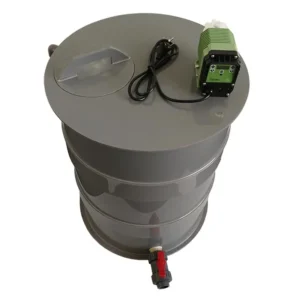
Bulk acid and alkali storage in tight plant rooms, reagent holding tanks, neutralisation and pH correction vessels, RO and demineralised water storage, and wastewater collection where a round tank will not fit the available bay. Where a process needs the reagent delivered at a controlled rate rather than stored in bulk, the same body is built as a chemical dosing tank with a mixer mount, level instrumentation and a pump skid. For water duties specifically, the choice between a fabricated PP tank and a moulded PE one is set out in polypropylene water tank.
Pharmaceutical & Metal Finishing
Purified water storage, CIP solution tanks and chemical preparation vessels, plus plating solution storage, etch baths and waste treatment tanks on metal finishing lines — the duties where a shallow, wide, compartmented box suits the process better than a cylinder. For immersion process tanks built around a part envelope, with heating, fume extraction and busbar provision, see our pickling and electroplating tanks.
Semiconductor & Ultrapure Water
Ultrapure water storage, chemical distribution and waste collection, in virgin-resin PP-H with smooth internal surfaces and documented material traceability for every wetted component.
For the wider picture — which grades exist, what PP cannot take, and how a tank is welded and sized — the polypropylene tank guide covers it in one place.
Bulletproof Compliance: Globally Certified Systems
Exporting process equipment means your compliance officer, your insurer and your customer’s auditor all get a vote. We build and document accordingly.
| Component / system | Certification |
|---|---|
| PP-H sheet and welding consumables | SGS material verification |
| Tank fabrication and quality management | ISO 9001 |
| Environmental management | ISO 14001 |
| Electrical ancillaries (heaters, sensors, pump controls) | CE |
| Non-metallic components in contact with the stored product | RoHS |
Every rectangular tank leaves the shop with:
- Hydrostatic pressure testing at 1.5× working pressure
- Ultrasonic weld inspection on all critical joints, corner seams first
- Dimensional verification and geometric tolerance checking
- Complete material traceability documentation — sheet batch, weld records and test report
- A 12-month warranty on the tank body and all welded joints
How to Order a Rectangular Poly Tank: Four Inputs, One Drawing
We do not sell a fixed range of sizes, so the order starts with the room rather than a part number. Four things decide the drawing:
- The stored product — chemistry, concentration and specific gravity.
- The capacity you need, the working depth, and the operating temperature.
- The footprint and headroom available, including columns, pipe runs and the access route for delivery and rigging.
- The connections and internals — inlets, outlets, level instrumentation, mixing, baffles, heating.
From there the process is the same for every tank we build:
- Engineering review — send a product datasheet, a site layout or a photo of the tank you are replacing. We confirm the duty and the plan shape the room allows.
- Material and panel selection — PP-H, PVC or PVDF, with panel thickness and stiffening calculated for the span and the specific gravity, confirmed in writing.
- Fabrication and welding — CNC-cut sheet, full-penetration extrusion welding, corner gussets, external ribs and PP-clad support frames, all in-house.
- Testing and documentation — hydrostatic test at 1.5× working pressure, ultrasonic weld inspection, dimensional verification and material certificates.
- Export packing and on-site support — sea-freight crating, export documentation, and installation guidance by video call or on site.
We are not a trading office that sub-contracts your tank to whoever answers the phone. Xicheng operates more than 40 production bases and regional offices, which is why a rectangular storage tank for a chemical plant in Vietnam, a water treatment works in the Middle East and a plating shop in Europe can all be engineered to the same standard — and why replacement sheets, spare parts and technical follow-up do not depend on a single workshop staying in business. Standard configurations typically ship in 7–10 days; custom tanks built to your drawing in 2–3 weeks, depending on size and options.
24-Hour Quote: Send the Duty and the Room, Get the Drawing
Send the four inputs and the reply is a dimensioned drawing and a detailed quotation within 24 hours — not a guess, and not a price for the nearest stock size. Replacing a failed tank always costs more than specifying the right one, in lost production, in clean-up, and in the report you have to write afterwards. If polypropylene is the wrong material for your duty, we will say so before you spend the money.
Contact Our Global Engineering & Sourcing Team Directly:
- 📍 Visit Us: No.34 Zhenxing Road (Shengtaian Heavy Industrial Park B), Loucun, Guangming New Dist, Shenzhen, Guangdong, China
- ☎️ Direct Hotline / WhatsApp: +86 18028775826
- 📬 Engineering Mailbox: xichengepltd@gmail.com
Shenzhen Xicheng — Precision Engineering for a Cleaner Future.
Frequently Asked Questions
Q: How is a fabricated rectangular poly tank different from a moulded one?
A: A moulded tank is limited to the sizes and nozzle positions of its tooling. A fabricated PP-H tank is welded from sheet, so the plan shape, the depth, the panel thickness and every connection are drawn around your room and your pipework — including square footprints, low-profile boxes and open tops.
Q: What capacity range can you build?
A: From 50 litres to 100,000+ litres per vessel. Larger stores are built as several tanks manifolded into a storage farm rather than one oversized box.
Q: Why does a rectangular tank need stiffeners when a round one does not?
A: A cylinder resists pressure by hoop tension — the wall stretches. A flat panel resists by bending, which is far less efficient, so the wall has to be supported at shorter intervals. External ribs and internal baffles do that by shortening the span, which is more effective than thickening the whole panel.
Q: Can the tank be built around a column or into an L-shaped space?
A: Yes. Send the plan with the obstruction marked and the tank is drawn around it. That is one of the main reasons a fabricated box is chosen over a moulded one.
Q: Can it be open top?
A: Yes. Open top where the process needs access from above, closed with a bolted cover or hinged access where fume and evaporation have to be controlled.
Q: What is the lead time?
A: Standard configurations typically ship in 7–10 days; custom tanks built to your drawing take 2–3 weeks, depending on size and options.
Q: What warranty do you give?
A: A 12-month warranty on the tank body and all welded joints, with the material certificates, weld records and test report supplied with the vessel.