



Square to Round Duct Transition — PP and PVC Shape-Change Connector
A rectangular duct and a round duct connection do not fit together. They were never designed to. The rectangular duct exists because the building geometry demanded it — a ceiling plenum too shallow for round, a service shaft sized for rectangular risers, an existing installation from decades before current standards. The round connection exists because the equipment at the end of the duct — a fan, a scrubber, a stack — was engineered around a circle.
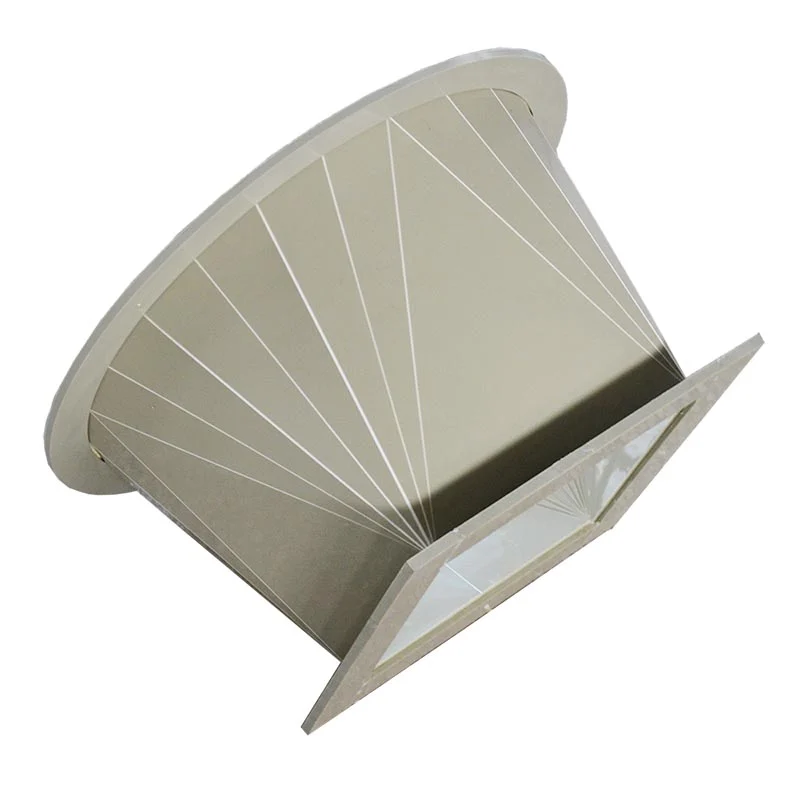
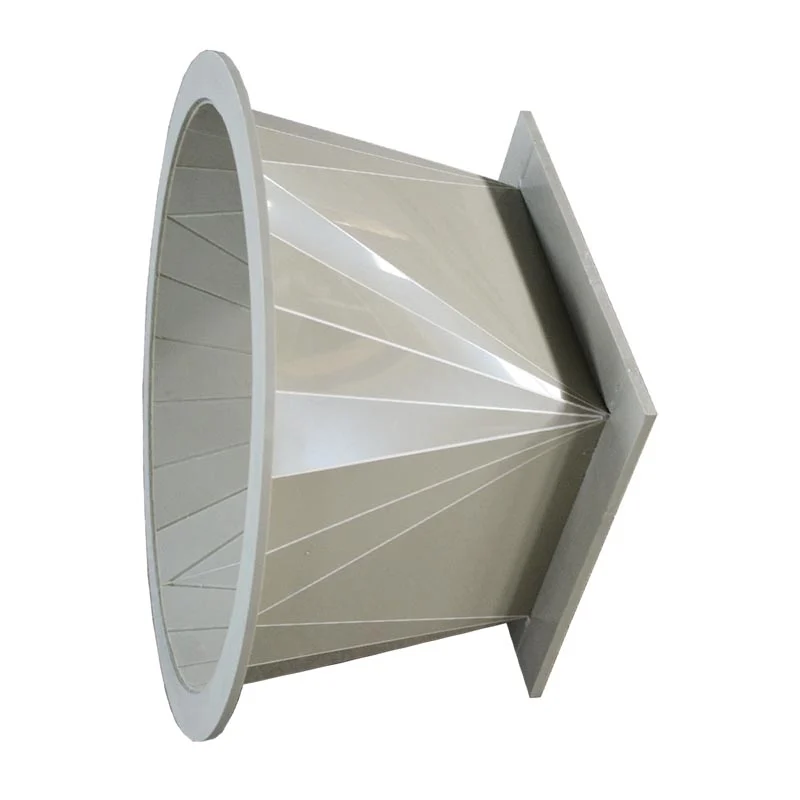
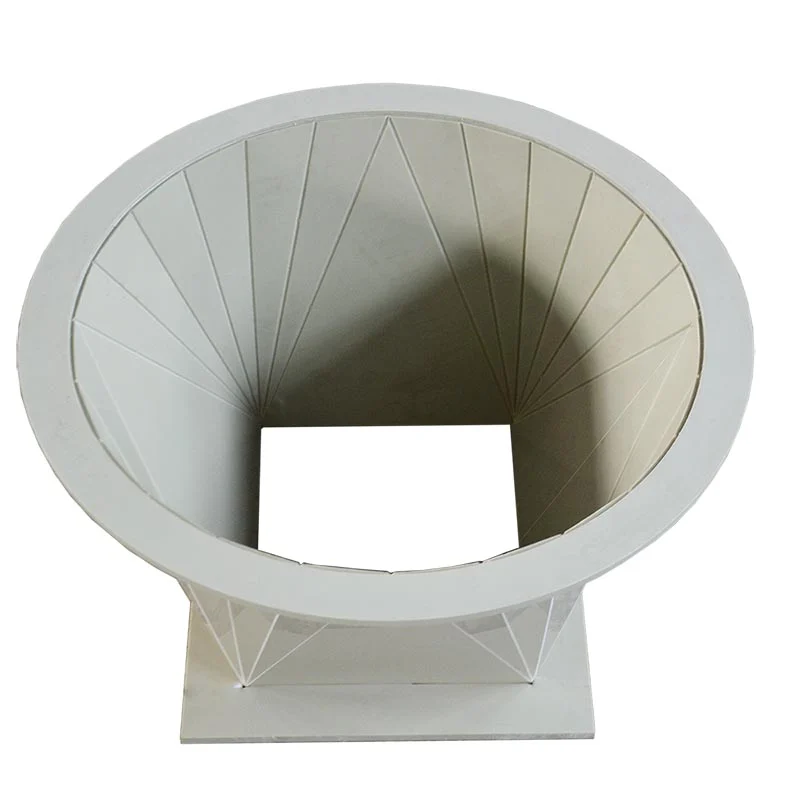
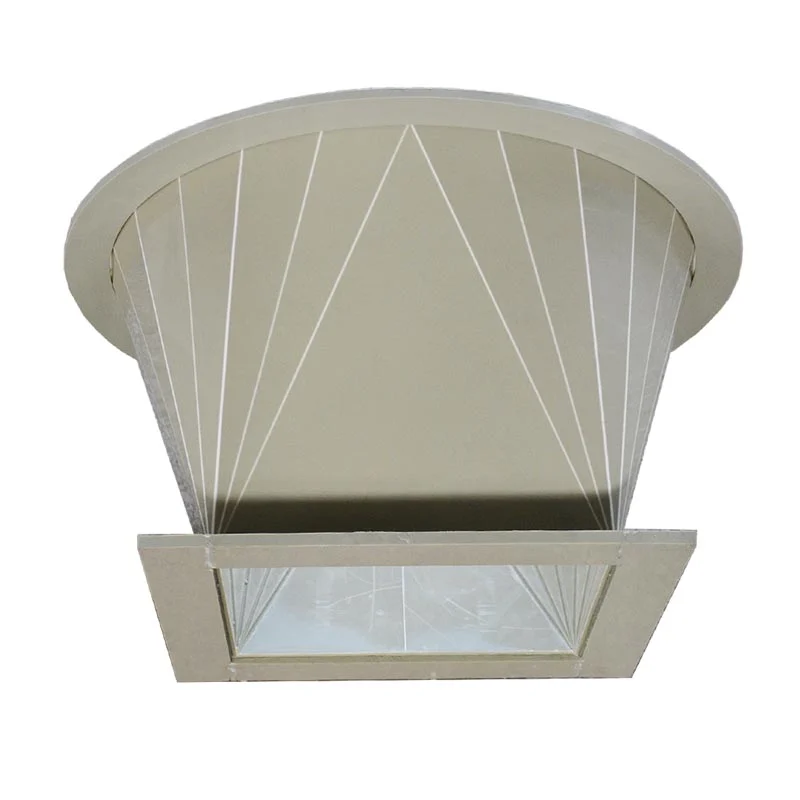
The square to round duct transition is the fitting that resolves this incompatibility. It has a rectangular opening at one end and a round opening at the other. Between them, four flat walls and four sharp corners must merge into a single continuous curve. That transition surface is not a simple cone or a flat pattern that can be stamped from a single sheet. It is a compound surface — developable only by dividing it into segments, cutting each from flat PP or PVC sheet, and welding them together along mathematically determined seam lines.
Xicheng fabricates square to round transitions from virgin polypropylene and PVC. Every fitting begins with a pair of dimensions that do not match. It ends with a single component that connects them.
A Problem of Geometry, Not Material
The difficulty of a square to round transition has nothing to do with the material and everything to do with the shape. At the rectangular end, the perimeter is defined by four straight edges meeting at right angles. At the round end, the perimeter is a circle — a single curve with no corners, no straight sections, no discontinuities. Connecting these two fundamentally different perimeters within a finite length is a problem in descriptive geometry.
The solution is to divide the transition surface into developable triangles and quadrilaterals — flat shapes that can be cut from sheet material and bent along straight lines, but not stretched or compressed. Each segment’s shape is calculated from the rectangular dimensions, the round diameter, and the transition length. The segments are cut, formed to the required curvature, and welded along their common edges.
The corner regions are the most challenging. At the rectangular end, each corner is a 90-degree internal angle. At the round end, each corner has disappeared — blended into the continuous curve. The four corner segments of the transition must bridge this change: sharp at one end, smooth at the other, transitioning along their length from a line to an arc.
Fewer segments mean fewer welds and lower fabrication cost, but a more faceted internal surface and higher pressure drop. More segments mean a smoother internal surface and lower pressure drop, but more welding and higher cost. The standard practice — four corner segments plus four flat side segments — balances aerodynamic performance with fabrication efficiency for most industrial applications.
When Round Equipment Connects to Rectangular Ductwork
A centrifugal exhaust fan has a round inlet flange. The fan manufacturer chose a circle because a circular pressure boundary distributes stress uniformly — no corners to reinforce, no flat panels to stiffen against pulsation.
The duct header feeding that fan is rectangular — 1200 millimeters by 800 millimeters — because the building’s overhead clearance is 900 millimeters and a round duct of equivalent cross-section would not fit. The structural engineer who laid out the service shafts chose the rectangular dimensions. The mechanical engineer who specified the fan chose a round inlet. Neither was wrong. They were solving different problems.
The square to round transition absorbs this conflict. Rectangular at the header end. Round at the fan end. The transition length — typically 1.5 times the round diameter, approximately 1350 millimeters in this example — provides sufficient distance for the airflow to adjust from the rectangular velocity profile to the round one without separating from the duct walls and creating turbulence that wastes fan horsepower.
In a pharmaceutical facility, rectangular fume hood exhaust ducts run through interstitial spaces above laboratory ceilings. The ducts are rectangular because the space between the ceiling and the structural slab above is 400 millimeters. At the building perimeter, each duct connects to a round riser in a vertical service shaft. The transition at each connection is a different size because each duct serves a different number of fume hoods and carries a different airflow volume.
How the Flat Pattern Becomes a Three-Dimensional Fitting
The flat pattern for a square to round transition is developed using triangulation. The rectangular end and the round end are drawn in their true shapes, separated by the transition length. The round end is divided into equal arc segments — typically 12 or 16 divisions depending on the diameter and the required smoothness. Each division point on the circle is connected to the nearest corner of the rectangle by a straight line in the developed view. These lines become the seam lines between segments in the fabricated fitting.
The true length of each seam line is calculated from the plan view and the elevation view using basic trigonometry — the horizontal distance between the two end points in plan, and the vertical distance equal to the transition length, form the legs of a right triangle whose hypotenuse is the true seam length.
The PP or PVC sheet is marked with the developed pattern, cut, and the individual segments are formed to the required curvature. The segments are then welded along the seam lines. The corner segments — the four pieces that transition from the rectangular corners to the adjacent arcs on the round end — are the most difficult to form and weld correctly because they have curvature in two directions.
Technical Specifications
| Parameter | Specification |
|---|---|
| Material | Virgin-grade PP (Polypropylene), PVC |
| Rectangular End | Width × height, to customer dimensions |
| Round End | Diameter, to customer specification |
| Transition Length | Standard: 1.5 × round diameter; custom lengths available |
| Segment Count | 8 segments standard (4 corners + 4 sides) |
| Manufacturing | Hand-fabricated, hot-gas welded from developed flat patterns |
| Weld Type | Full-penetration, matched-material PP rod |
| Density (PP) | 0.90 to 0.91 g/cm3 |
| Operating Temperature (PP) | -10-degrees-Celsius to 90-degrees-Celsius |
| Operating Temperature (PVC) | 0-degrees-Celsius to 60-degrees-Celsius |
| Flange Standards | Rectangular: custom pattern; Round: ANSI, DIN, JIS, custom |
| Certifications | ISO 9001, ISO 14001; SGS tested |
| Lead Time | 10 to 20 working days |
Global Compliance and Industrial Trust: Why Customers Choose Xicheng
Every square to round transition is a small exercise in engineering. The rectangular dimensions. The round diameter. The transition length. The number of segments. The flange patterns at both ends — which may be different standards because the rectangular duct and the round equipment were specified by different engineers at different times.
Xicheng Environmental operates over 40 production bases and offices across China, with 2 dedicated manufacturing facilities in Vietnam. When we fabricate a square to round transition, the flat pattern is developed from your dimensions — not selected from a catalog of standard transitions that approximate your requirements. The fitting that leaves our factory matches the numbers you provided, at both ends, simultaneously.
ISO 9001 governs quality management. ISO 14001 governs environmental management. PP sheets, PPS, PP pipes, and PVC sheets are SGS tested with current documentation for every order.
One-Stop Engineering Support: From Spec to Shipment
A square to round transition needs two sets of dimensions — rectangular and round — plus a length and flange specifications at both ends. Send us the complete set and we build the transition. Send us an incomplete set and we ask questions before we start cutting.
- Dimensional Review. Rectangular cross-section (width by height), round diameter, available transition length, flange standards at both ends, and exhaust gas composition. If your available length is less than 1.5 times the round diameter, we optimize the segment geometry within the constraint.
- Pattern Development and Fabrication. The flat pattern is developed from your dimensions. Segments are cut from PP or PVC sheet, formed, and welded. The corner segments receive particular inspection — they carry compound curvature and four seam lines each.
- Documentation. SGS test reports, certificate of origin, packing list, commercial invoice. Container loading photographs. Tracking information the day your shipment departs.
- Engineering Access. Our engineers are available by phone, email, or WhatsApp. Direct answers — not through intermediaries.
Frequently Asked Questions
Q: How is a square to round transition different from a reducer?
A: A reducer changes diameter within the same shape — round to round, or rectangular to rectangular. A square to round transition changes both shape and cross-sectional area. The geometry is fundamentally more complex because the perimeter at each end has a different number of sides and a different curvature.
Q: How long does the transition need to be?
A: The standard recommended length is 1.5 times the round diameter. This provides sufficient distance for airflow to adjust from the rectangular velocity profile to the round one without excessive turbulence. Shorter transitions are feasible but increase pressure drop. If your installation has a hard length constraint, tell us the maximum available and we design within it.
Q: Can the rectangular end and the round end have different flange standards?
A: Yes — and they often do. The rectangular duct system and the round equipment connection were typically specified at different times by different parties. Each end of the transition is fabricated with the flange pattern you specify for that end.
Q: What is the lead time?
A: Ten to twenty working days, depending on size and complexity. Every square to round transition is a custom fabrication — there is no standard inventory for a fitting defined by two independent sets of dimensions.
Send us the rectangular cross-section, round diameter, available transition length, and exhaust gas composition. You will have a quotation within 48 hours.
Contact Xicheng Environmental Today.
- 🎯 Address: No.34 Zhenxing Road (Shengtaian Heavy Industrial Park B), Loucun, Guangming New Dist, Shenzhen, Guangdong, China
- ☎️ Phone/WhatsApp: +86 18028775826
- 🗺️ Email: xichengepltd@gmail.com

Reviews
There are no reviews yet.