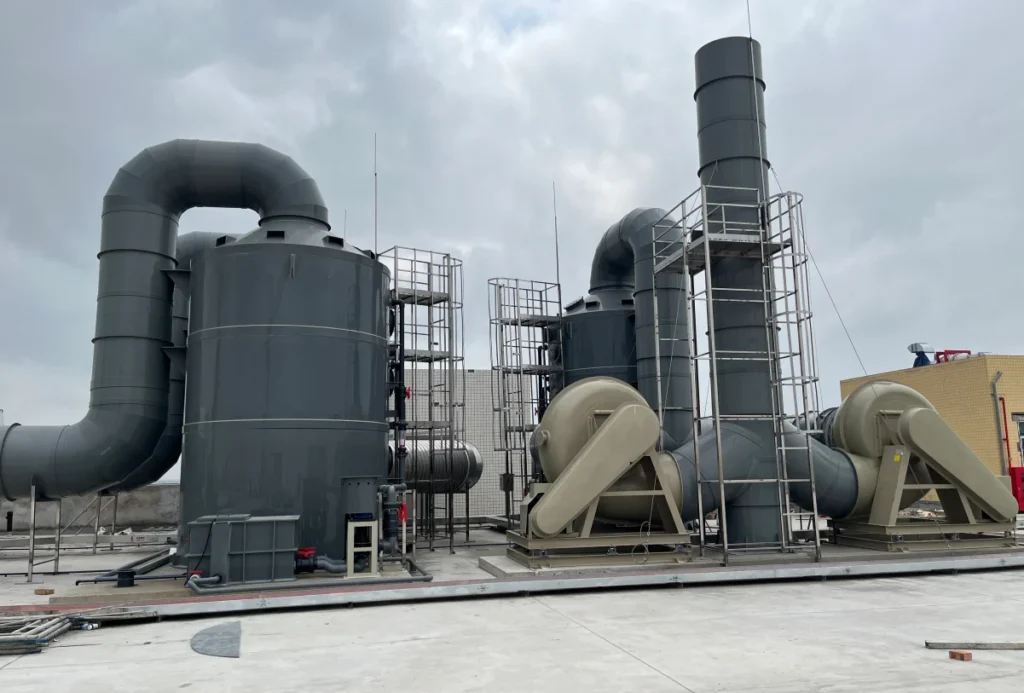
An acid fume scrubber system is a wet scrubber specifically designed to capture and neutralize acid fumes – HCl, H2SO4 mist, HF, HNO3 vapor, and other corrosive acid mists – generated by industrial processes such as steel pickling, chemical manufacturing, electroplating, and semiconductor fabrication. The EPA’s acid-gas scrubber cost review lists that exact duty set — packed bed and tray towers controlling HF, HCl, HBr, F2, Cl2 and SO2 from incinerators, chemical processes, plating, and steel pickling. Unlike a general-purpose gas scrubber that targets a single pollutant at high concentration, an acid fume scrubber must handle the combination of acid vapor and entrained liquid acid mist across a wide range of concentrations. This guide covers what an acid fume scrubber system is, how it works, the specific design considerations for different acid types, and the material selection decisions that determine whether the system lasts 5 years or 20 — the EPA’s acid-gas cost chapter records packing life in adverse service as short as 1 to 5 years from corrosion, fouling, and breakage, against the ideal case where packing lasts as long as the tower itself.
Key Takeaways
- An acid fume scrubber system must handle both vapor-phase acid gases and liquid-phase acid mist droplets simultaneously. The mist capture mechanism is different from vapor absorption: fine spray nozzles or packed bed interception captures the droplets, while caustic neutralization removes the vapor. A high-efficiency mist eliminator at the scrubber outlet is essential to prevent downstream corrosion from entrained acid droplets.
- Material selection is the most critical design decision and is controlled by the acid chemistry, not the temperature alone. Polypropylene (PP) is the standard for HCl, HF, and H2SO4 fume service up to 80 deg C. FRP (vinyl ester) extends the range to 110 deg C. Stainless steel is not recommended for HCl or HF fume service at any practical concentration, because even dilute hydrochloric acid attacks the 304 and 316 grades by pitting and chloride stress-corrosion cracking.
- Hot process vents above 80 deg C require a quench section upstream of the packed bed. The quench cools the gas to saturation temperature and removes the bulk of the acid vapor before the gas reaches the polishing section. Without quenching, the polypropylene packing is run above its service temperature and degrades.
- pH control and the mist eliminator are the two most critical operational components. For a gas as pH-sensitive as SO2, a 0.5 pH unit drift at the low end of the operating window is the alarm threshold most packed-tower control loops are set to. A degraded mist eliminator allows acid droplets to reach the fan and stack. For application-specific systems, see our acid gas scrubber products → and acid mist waste gas treatment →.
What Is an Acid Fume Scrubber System?
An acid fume scrubber system is a wet scrubbing system that removes both acid gases and entrained acid liquid aerosols from industrial exhaust (see our chemical scrubber system guide → for the full chemical scrubbing overview). The system typically uses an alkaline scrubbing solution – sodium hydroxide (NaOH) or sodium carbonate (Na2CO3) – to neutralize the acid, but the design must also address the physical capture of liquid acid droplets that are too large to be absorbed as vapors.
The Difference Between Acid Fume Scrubbers and General Wet Scrubbers
Three factors distinguish acid fume scrubber design from general wet scrubber design:
Dual-phase capture. An acid fume scrubber system must simultaneously remove acid vapor (gas phase) and acid mist (liquid aerosol phase). The mist droplets – typically 1-20 um from plating baths, pickling lines, or chemical reactors – are too large for vapor-phase absorption but too small for gravity settling. A spray tower with fine mist nozzles or a packed bed with high surface area packing captures both phases by different mechanisms: gas absorption for the vapor and droplet interception for the mist.
Material selection constraint. Acid fumes at even low concentrations are corrosive to standard construction materials. An hcl scrubber system handling HCl vapor above 50 deg C requires polypropylene or FRP construction. Stainless steel fails by pitting corrosion in HCl service at concentrations far below the ones this article is about.
Temperature sensitivity. Many acid fume sources – pickling baths at 70-90 deg C, chemical reactors at 100-200 deg C – produce hot exhaust that must be quenched to the scrubber’s operating temperature before gas-liquid contact begins. An upstream quench section is standard in hydrochloric acid scrubber systems for hot process vents.
How the Chemistry Works
The neutralization reactions are identical to those in a caustic spray tower:
HCl + NaOH -> NaCl + H2O – Near-instantaneous reaction. pH maintained at 7-9.
H2SO4 + 2 NaOH -> Na2SO4 + 2 H2O – Sulfuric acid mist is first captured as liquid droplets, then neutralized in the recirculating solution. The mist capture efficiency depends on the droplet size: particles below 5 um require a high-efficiency mist eliminator or a packed bed for complete collection.
HF + NaOH -> NaF + H2O – The reaction product NaF has limited solubility — the published solubility of sodium fluoride is 4.0 g per 100 mL of water at 15 deg C, about 40 g/L, rising only to 4.3 g per 100 mL at 25 deg C — so the fluoride saturates the recirculating liquor quickly.
HNO3 + NaOH -> NaNO3 + H2O – Nitric acid vapor absorbs rapidly into water. The neutralization is straightforward but the NOx byproducts (NO, NO2) require an oxidizing stage if complete removal is required.
Industrial Applications
Steel Pickling – HCl Fume Control
Steel pickling lines use hot hydrochloric acid (15-20% HCl at 85-95 deg C) to remove mill scale from hot-rolled steel. The pickling bath generates HCl vapor and entrained acid mist. An hcl scrubber system on the pickling line exhaust captures the acid fume before it escapes into the plant building.
The typical pickling line exhaust is 10,000-50,000 m3/h at 50-80 deg C with HCl concentrations of 50-500 ppmv plus acid mist. A packed bed scrubber with polypropylene packing and 5% NaOH at pH 7-8 achieves 99%+ HCl removal, which is the level the federal standard for these lines lands on: 40 CFR 63 Subpart CCC applies to steel pickling with hydrochloric acid at 6 percent or more by weight HCl and 100 °F or higher, requires every point where the acid is exposed to the atmosphere to have a local fume capture system ventilated through an air pollution control device, and sets 99 percent collection efficiency for continuous pickling lines, with 97 percent for batch lines. The gas must be quenched below 60 deg C before entering the polypropylene packing to prevent thermal damage.
An hcl gas scrubber for pickling lines also captures the iron chloride fume generated by the pickling reaction. The iron chloride dissolves in the scrubber solution and contributes to the TDS load. Blowdown management must account for the FeCl3 concentration, which accelerates chloride stress corrosion in downstream wastewater piping if not diluted adequately.
Electroplating – H2SO4 and Chromic Acid Mist
Electroplating lines generate sulfuric acid mist from anodizing baths and chromic acid mist from chrome plating baths. The mist is generated by hydrogen bubble evolution at the cathodes, which ejects fine acid droplets (2-10 um) into the tank ventilation air.
An acid fume scrubber system for electroplating uses a spray tower with fine mist nozzles and a high-efficiency mist eliminator. The spray captures the mist droplets by inertial impaction, and the caustic neutralizes the acid. For chrome plating the control problem is set by regulation: 40 CFR 63 Subpart N governs chromium electroplating and anodizing, treats a substance as containing hexavalent chromium at 0.1 percent or more by weight of chromium trioxide (chromic acid) or chromic anhydride, and recognises two control trains — a composite mesh-pad system, and a packed-bed scrubber whose packed section is followed by a mist eliminator sized to strip the chromic acid droplets. In operation the liquor is dosed with a reducing agent (sodium metabisulfite) to convert hexavalent chromium (Cr6+) to the less hazardous trivalent form (Cr3+), which precipitates as chromium hydroxide for removal as sludge; note that the rule does not allow that reduction step to be counted as the means of meeting the emission standard.
Semiconductor and Chemical Manufacturing
Semiconductor fabs use hydrofluoric acid (HF), nitric acid (HNO3), and phosphoric acid (H3PO4) in wet etching processes. The acid fume exhaust from process tools is collected in a central header and treated in a large packed bed scrubber. The HF concentration is typically low (5-50 ppmv), but the toxicity of HF keeps the design target at the top of the usual range: the EPA’s wet-and-dry-scrubber cost review puts typical wet-scrubber removal efficiency at 95 to 99 percent for industrial acid-gas duties, and the OSHA air-contaminant limits as codified in 29 CFR 1910.1000 carry hydrogen fluoride at 3 ppm as an 8-hour time-weighted average, against a 5 ppm ceiling for hydrogen chloride, so an HF duty is held to the tighter of the two stack numbers.
Hydrochloric acid scrubber systems in chemical plants handle reactor vents with HCl concentrations up to 5,000 ppmv at temperatures above 100 deg C. These systems include a quench section – typically a spray tower upstream of the packed bed – that cools the gas to the packing’s operating temperature while removing the bulk of the HCl before the gas reaches the polishing stage.
Design Parameters and Material Selection
Scrubber Vessel Design
For most acid fume applications, a packed bed scrubber is the preferred vessel type because it provides the highest gas-liquid contact area for vapor absorption and the tortuous gas path through the packing captures entrained mist droplets. The packing is typically 25-50 mm polypropylene Pall rings, chosen for corrosion resistance and low pressure drop. The EPA’s acid-gas cost chapter states the rule behind the choice — corrosion resistant alloys or plastic materials such as polypropylene are required for column internals when highly corrosive solvents or gases are used — and lists polypropylene Pall rings among the standard random packings, with an acid-resistant brick lining added for additional chemical and temperature resistance.
A spray tower is preferred when the exhaust contains particulate that would plug a packed bed – for example, pickling line fume with iron oxide dust, or incinerator exhaust with fly ash. The spray tower operates at lower efficiency for gas absorption but eliminates the risk of packing plugging. The EPA’s particulate-scrubber chapter draws the same line: packed towers are most often used for gas adsorption rather than particulate removal, because a high particle concentration fouls the bed.
Material Selection
Material selection is the most critical design decision in any acid fume scrubber system. The acid chemistry and operating temperature determine the appropriate material:
Polypropylene (PP) is the standard material for most acid fume scrubbers. It resists HCl, HF, H2SO4, and HNO3 up to 80 deg C. PP is fabricated by hot-gas welding of sheet stock. The cost is the lowest of all corrosion-resistant materials.
FRP (vinyl ester resin) handles temperatures up to 110 deg C and resists the same acids as PP. It is specified when the inlet gas temperature exceeds 80 deg C or when the packing bed height requires greater structural strength than PP can provide. On cost the material is closer to PP than the temperature rating suggests: in the vendor cost factors the EPA publishes for packed-tower absorbers, where the reference tower is the FRP one, a polypropylene shell carries a factor of 0.80-1.10, so the FRP premium is at most about 25 percent rather than the doubling the temperature difference might imply (acid gas wet scrubber chapter).
PVC/CPVC is used for hypochlorite service and for applications where chlorine gas may be present. Temperature limit is 60-90 deg C depending on grade.
Stainless steel (SS304/SS316L) is not recommended for any acid fume scrubber system handling HCl, HF, or H2SO4 above 50 deg C. Pitting corrosion occurs rapidly. SS316L is acceptable for nitric acid fume at elevated temperatures.
Quench Section Design
When the inlet gas temperature exceeds 80 deg C, a quench section must be installed upstream of the packed bed. The quench is typically a spray tower section or a venturi that injects water or dilute caustic solution to cool the gas to near its adiabatic saturation temperature (50-65 deg C for most acid fume streams). In the EPA’s own packed-tower design example the gas reaching the absorber is taken to be saturated with moisture because it has been cooled in the quench chamber, and the HCl concentration is corrected for the volume change that cooling produces. The quench also removes the bulk of the acid vapor before the gas reaches the polished packing section.
Advantages, Limitations, and Maintenance
Advantages
Simultaneous vapor and mist capture. An acid fume scrubber system removes both acid gas vapor and entrained liquid acid mist in a single unit, eliminating the need for a separate mist eliminator ahead of the scrubber.
High removal efficiency. With caustic neutralization and the scrubbing liquor held at the right pH, an acid fume scrubber reaches 99%+ removal of HCl, HF, and HNO3 vapors. The EPA’s acid-gas cost chapter puts the ceiling at 99.9 percent for packed towers on the pollutant-solvent systems where absorption is favourable, so what limits removal is how soluble the gas is in the chosen liquor, not the inlet loading. H2SO4 mist removal depends on particle size but typically exceeds 95% for mist droplets above 5 um.
Proven and reliable. Acid fume scrubbing with caustic is a mature technology with decades of industrial operating experience. The pH control loop is well understood. Spare parts and technical support are available from multiple vendors.
Limitations
Temperature restriction. Polypropylene scrubbers are limited to 80 deg C continuous operation. Hot process vents above this temperature require a quench section, adding capital cost and water consumption.
Corrosion risk at wet-dry interfaces. The boundary between the dry inlet duct and the wet scrubber interior is the most vulnerable corrosion point in any acid fume scrubber. A failure at this interface can allow unscrubbed gas to bypass the packing.
Mist carryover. High-efficiency mist eliminators are essential for acid fume service because entrained acid droplets in the outlet gas cause downstream corrosion in ductwork, fans, and stacks. A chevron vane mist eliminator is the standard design; the EPA’s acid-gas cost chapter describes the same element as a mist eliminator in the form of corrugated sheets or a layer of mesh installed at the top of the column, on which the droplets coalesce and fall back into the column.
Maintenance
| Component | Inspection Frequency | Common Issue |
|---|---|---|
| Packing bed | Annual | Acid attack, solids fouling |
| Mist eliminator | Quarterly | Scale buildup, droplet carryover |
| pH sensor | Weekly | Calibration drift, coating |
| Recirculation pump | Monthly | Seal wear from salt abrasion |
| Nozzles (spray tower) | 1-3 months | Erosion, plugging from salt |
The intervals above are the floor the regulated sources set. 40 CFR 63 Subpart CCC, which covers HCl pickling lines, requires the pressure drop across the scrubber to be monitored and recorded once per shift, the scrubber internals and mist eliminators to be cleaned at intervals sufficient to prevent solids buildup, and an inspection of each scrubber at intervals of no less than 3 months that includes repair or replacement of droplet eliminator elements and adjustment of damper settings for the required air flow. 40 CFR 63 Subpart N sets quarterly visual inspection for the composite mesh-pad, packed-bed and fiber-bed devices it recognises, and for a packed-bed scrubber it asks specifically that the back portion of the chevron blade mist eliminator be checked to confirm it is dry with no breakthrough of chromic acid mist.
Frequently Asked Questions
What is an acid fume scrubber system?
An acid fume scrubber system is a wet scrubber that captures and neutralizes acid fumes (HCl, H2SO4 mist, HF, HNO3) from industrial exhaust using an alkaline scrubbing solution. It handles both vapor-phase acid gases and liquid-phase acid mist droplets.
What is the difference between an acid fume scrubber and an acid gas scrubber?
An acid gas scrubber targets vapor-phase acid gases for absorption. An acid fume scrubber must also capture entrained liquid acid mist droplets (1-20 um), which requires higher-efficiency mist eliminators and, in some cases, fine mist spray nozzles to generate droplets small enough to intercept the acid mist.
What materials are used for HCl fume scrubbers?
Polypropylene (PP) is the standard material for HCl fume scrubbers up to 80 deg C. FRP (vinyl ester) is used for higher temperatures. Stainless steel is not recommended for HCl service regardless of temperature grade or concentration.
How is chromic acid mist scrubbed differently from HCl fume?
Chrome plating mist contains hexavalent chromium (Cr6+), a regulated hazardous air pollutant. The scrubbing solution must include a reducing agent (sodium metabisulfite, Na2S2O5) to convert Cr6+ to Cr3+, which then precipitates as chromium hydroxide and is removed as hazardous waste sludge.
How do I know if my acid fume scrubber needs a quench section?
If the inlet gas temperature exceeds 80 deg C for a PP scrubber or 110 deg C for an FRP scrubber, a quench section is required. Quenching also condenses water vapor from the gas, which dilutes the scrubbing solution and reduces the chemical consumption rate.
Note on the design figures The material temperature limits (polypropylene 80 deg C, FRP vinyl ester 110 deg C, PVC/CPVC 60-90 deg C by grade), the droplet-size bands, and the airflow, concentration and packing sizing ranges quoted in this guide are typical equipment-vendor design ranges and project experience values rather than regulatory limits. Where a figure carries a regulatory basis, it is cited to the primary source inline; the regulatory thresholds themselves are exact and are quoted from the rule or the EPA chapter that states them.
Sources
- U.S. EPA, Office of Air Quality Planning and Standards – EPA Air Pollution Control Cost Manual, Section 5.2, Chapter 1: Wet Scrubbers for Acid Gas (the vendor cost factors for packed-tower absorbers, given against an FRP reference tower as 304 stainless steel 1.10–1.75, polypropylene 0.80–1.10 and polyvinyl chloride 0.50–0.90; the requirement for corrosion resistant alloys or plastics such as polypropylene in column internals for highly corrosive service; the mist eliminator as corrugated sheets or a layer of mesh at the top of the column; packing life of 1 to 5 years in adverse service against the ideal case of lasting as long as the tower; packed tower efficiencies as high as 99.9 percent for some pollutant-solvent systems; the acid-resistant brick lining; and the quench chamber that saturates the gas before the absorber).
- U.S. EPA, Office of Air Quality Planning and Standards – EPA Air Pollution Control Cost Manual, Section 6, Chapter 2: Wet Scrubbers for Particulate Matter (the 50 °F to 700 °F temperature range to which wet scrubbers are generally limited by evaporation, the quencher needed above it, and the note that high temperature affects the material the scrubber components are made from; and packed towers being used most often for gas adsorption rather than particulate removal because high particle concentrations foul the bed).
- U.S. Environmental Protection Agency, Office of Air Quality Planning and Standards – EPA Air Pollution Control Cost Manual, Section 5, Chapter 1: Wet and Dry Scrubbers for Acid Gas Control (Response to Comments) (the removal efficiency of 95 to 99 percent typical of wet scrubbers for most industrial applications, and the duty list of packed bed and tray towers controlling HF, HCl, HBr, F2, Cl2 and SO2 from incinerators, chemical processes, plating, and steel pickling).
- U.S. National Archives, Electronic Code of Federal Regulations – 40 CFR Part 63, Subpart CCC: National Emission Standards for Hazardous Air Pollutants for Steel Pickling—HCl Process Facilities and Hydrochloric Acid Regeneration Plants (applicability at 6 percent or more by weight HCl and 100 °F or higher; the local fume capture system ventilated through an air pollution control device; 99 percent collection efficiency for continuous pickling lines and 97 percent for batch lines; and the scrubber maintenance plan requiring pressure drop to be recorded once per shift, cleaning of the scrubber internals and mist eliminators, and inspection at intervals of no less than 3 months including repair or replacement of droplet eliminator elements).
- U.S. National Archives, Electronic Code of Federal Regulations – 40 CFR Part 63, Subpart N: National Emission Standards for Chromium Emissions From Hard and Decorative Chromium Electroplating and Chromium Anodizing Tanks (hexavalent chromium defined at 0.1 percent or greater by weight of chromium trioxide, chromic acid or chromic anhydride; the composite mesh-pad and packed-bed scrubber definitions, the latter followed by a mist eliminator; the provision that a reducing agent may not be used to change chromium from hexavalent to trivalent as the means of meeting the standard; and the quarterly inspection regime including the chevron blade mist eliminator check for dryness and no breakthrough of chromic acid mist).
- U.S. National Library of Medicine (NIH), PubChem – PubChem CID 5235 — Sodium Fluoride (solubility in water of 4.0 g per 100 mL at 15 °C, 4.3 g per 100 mL at 25 °C and 5.0 g per 100 mL at 100 °C, which is the basis for the roughly 40 g/L figure given for the reaction product NaF).
- U.S. National Archives, Electronic Code of Federal Regulations – 29 CFR 1910.1000 — Air contaminants (OSHA Table Z-1 and Table Z-2 exposure limits) (hydrogen chloride at a 5 ppm ceiling and sulfuric acid at 1 mg/m3 in Table Z-1, and hydrogen fluoride at 3 ppm as an 8-hour time-weighted average in Table Z-2, which is the comparison used for the HF duty).