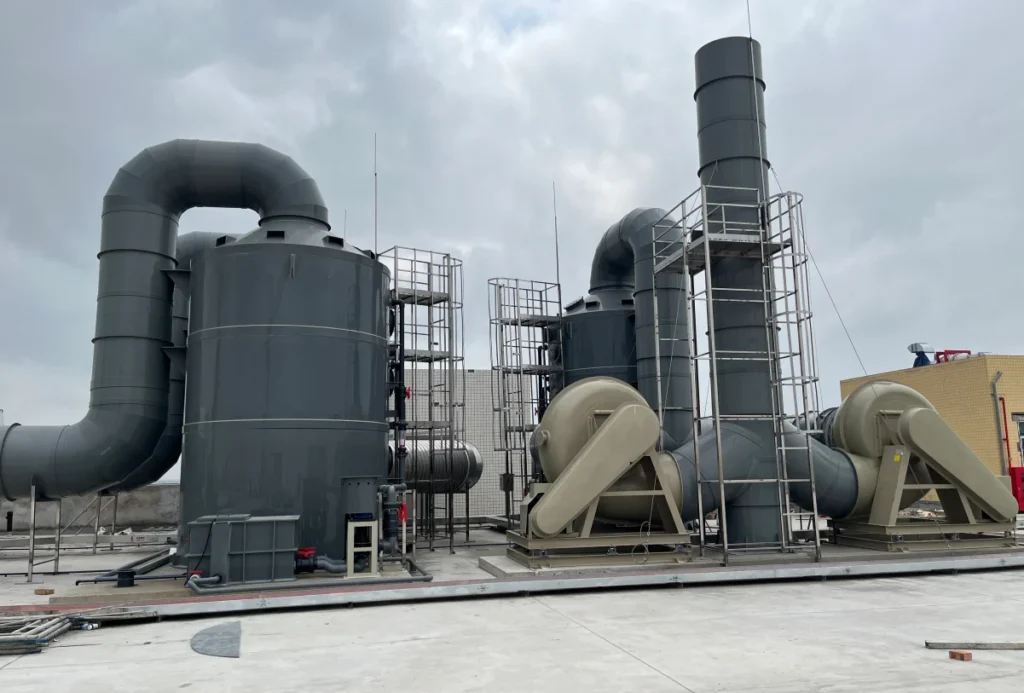
Hydrogen sulfide (H2S) is unlike any other acid gas that a wet scrubber must remove. Selecting and designing an h2s scrubber system requires understanding both the weak-acid chemistry and the oxidation chemistry. It is toxic at 100 ppm (immediately dangerous to life and health), it is detectable by the human nose at 0.5 ppb (far below any instrument), and its removal chemistry is more complex. NIOSH lists 100 ppm as the immediately dangerous to life or health concentration and warns that the sense of smell fatigues rapidly and cannot be relied upon to give warning of continued exposure (NIOSH Pocket Guide: Hydrogen sulfide). An h2s scrubber system must not only absorb the H2S from the gas stream but also oxidize or otherwise convert it to a non-toxic, non-odorous form – a two-step process that distinguishes H2S scrubbing from HCl or SO2 removal. This guide covers the chemistry, design parameters, and industrial applications of H2S scrubber systems, from simple caustic absorbers to multi-stage TRS control systems for the pulp and paper industry.
Key Takeaways
- An H2S scrubber system requires a two-stage chemical process: absorption followed by oxidation. Caustic absorption alone achieves only 80-95% removal because H2S is a weak acid (pKa ~7.0) and a fraction remains as dissolved molecular gas in equilibrium with the outlet gas. Hypochlorite oxidation converts the bisulfide to sulfate, making the removal permanent and achieving 99%+ efficiency.
- The hypochlorite consumption dominates the operating cost, consuming 4 moles of NaOCl per mole of H2S removed. The molar ratio is fixed by the oxidation stoichiometry: NaHS + 4NaOCl produces Na2SO4 + 4NaCl + H2O. For a 50,000 m3/h wastewater odor control scrubber at 50 ppmv H2S, the annual NaOCl cost is $80,000-150,000 – approximately 5-8 times the caustic cost. Understanding the NaOCl consumption is essential for budgeting and technology selection.
- TRS (Total Reduced Sulfur) control is more demanding than H2S-only scrubbing. Methyl mercaptan, dimethyl sulfide, and dimethyl disulfide have lower water solubility and slower oxidation kinetics than H2S. A TRS scrubber requires 4-6 seconds of contact time (vs 2-3 seconds for H2S), higher NaOCl dosage, and often a two-stage design with caustic absorption followed by hypochlorite oxidation.
- Technology selection depends on H2S concentration and gas type. Caustic-hypochlorite is the standard for low-concentration H2S (below 200 ppmv) in air ventilation streams. Iron chelate ($0.50-1.50/kg S removed) is preferred for medium-concentration H2S in biogas and natural gas. Biological scrubbing has the lowest operating cost ($0.10-0.30/kg S) but the highest capital cost and operational complexity. See our H2S gas scrubber products → and odor control solutions →.
What Is an H2S Scrubber System?
An h2s scrubber system is a wet scrubber that removes hydrogen sulfide (see our chemical scrubber system guide →) from an industrial gas stream by first absorbing the H2S into an alkaline scrubbing solution and then chemically oxidizing it to a non-toxic, non-odorous form – typically sulfate (SO4-2) or elemental sulfur (S). This two-step process distinguishes H2S scrubbing from simple acid gas neutralization: absorbing H2S into caustic solution alone produces sodium bisulfide (NaHS), which retains an objectionable odor and can release H2S back into the gas phase if the pH drops.
Why H2S Scrubbing Is Different from Other Acid Gas Scrubbing
H2S is a weak acid with a pKa1 of 7.04 and a pKa2 of 11.96 at 25 deg C (PubChem CID 402). Above the first pKa the bisulfide ion dominates: at pH 8 roughly 90 percent of the absorbed H2S is present as HS-, and by pH 10 the fraction is above 99.9 percent. What limits removal is therefore not the speciation, but the small residual fraction of dissolved molecular H2S, which stays in equilibrium with the gas phase and can be stripped back out of solution if the pH fluctuates downward. For HCl (pKa of approximately -7), the dissociation is essentially complete at any pH above 3, and the absorbed HCl cannot re-enter the gas phase. This difference means that an h2s scrubber system must include an oxidation step that converts the bisulfide to a non-volatile form – sulfate or elemental sulfur – to make the removal permanent.
H2S Is a Weak Acid – Requires More Than Simple Neutralization
The practical consequence of the weak acid chemistry is that a simple caustic scrubber operating at pH 9-10 removes only 80-90% of the inlet H2S. The residual 10-20% that passes through is dissolved molecular H2S, and it is the reverse reaction – bisulfide held in the recirculating liquid returning H2S to the gas phase as the liquid loads up – rather than an undersized bed, that sets the practical limit on caustic-only removal. To achieve 99%+ removal, the bisulfide must be immediately oxidized to sulfate, which removes it from the equilibrium entirely.
The Four H2S Removal Methods
Caustic-only absorption uses NaOH at pH 9-11 to absorb H2S as NaHS. Removal efficiency is limited to 80-95% depending on pH and contact time. This method is used only when partial removal is acceptable.
Caustic + hypochlorite (NaOCl) oxidation is the most common method for high-efficiency H2S removal. Caustic absorbs the H2S, and hypochlorite oxidizes the bisulfide to sulfate. Removal efficiency exceeds 99%.
Iron chelate catalytic oxidation uses a chelated iron catalyst to convert H2S directly to elemental sulfur without producing a liquid waste stream. The sulfur is filtered out as a slurry. This method is common in natural gas and biogas applications.
Biological scrubbing uses microorganisms immobilized on packing media to oxidize H2S to sulfate. Operating cost is low, but the system requires careful control of temperature, pH, and nutrient supply.
Key Applications at a Glance
Wastewater treatment odor control is the largest application by number of installed h2s scrubber units, with inlet H2S concentrations of 5-200 ppmv. Biogas and natural gas treatment handles higher concentrations (500-5,000 ppmv) and often uses iron chelate or biological methods. Pulp and paper TRS (total reduced sulfur) control is the most chemically demanding application, requiring removal of multiple reduced sulfur compounds simultaneously.
H2S Scrubber Chemistry
The chemistry of H2S removal in a wet scrubber proceeds in two distinct stages: absorption and oxidation. Understanding both stages is essential for designing a system that achieves complete, irreversible removal.
Caustic Absorption (Stage 1)
H2S dissolves into the alkaline scrubbing solution and dissociates according to the solution pH:
H2S (gas) -> H2S (aqueous)
H2S (aqueous) + NaOH -> NaHS + H2O
At pH 9-10, more than 98 percent of the absorbed H2S exists as bisulfide ion (HS-). The small remainder stays as dissolved molecular H2S, which is in equilibrium with the gas phase. This equilibrium is the fundamental limitation of caustic-only scrubbing: regardless of how much contact surface area is provided, the gas-phase H2S concentration leaving the scrubber cannot be reduced to zero because some H2S remains in solution as the molecular form.
H2S + NaOH -> NaHS + H2O – Limited Removal
For a scrubber operating at pH 10 with 2 seconds of gas-liquid contact time, the achievable H2S removal is approximately 90-95%. To reach 99%+, the pH must be raised above 11, which increases caustic consumption by a factor of 2-3. The economic optimum for caustic-only H2S scrubbing is typically pH 9-10, accepting 90-95% removal.
Hypochlorite Oxidation (Stage 2)
The bisulfide ion (HS-) produced in Stage 1 is oxidized by sodium hypochlorite (NaOCl) to sulfate in a rapid, complete reaction:
NaHS + 4 NaOCl -> Na2SO4 + 4 NaCl + H2O
This reaction consumes 4 moles of NaOCl per mole of H2S. The sulfate product (Na2SO4) is non-toxic, non-odorous, and fully soluble in water. Once the H2S is oxidized to sulfate, it cannot re-enter the gas phase under any conditions that occur in a scrubber. The oxidation step makes the removal permanent.
NaHS + 4NaOCl + NaOH -> Na2SO4 + 4NaCl + H2O – Complete Oxidation
The oxidation reaction is fast (completing within milliseconds to seconds under proper conditions) but requires excess NaOCl to drive the reaction to completion. The standard design maintains an ORP (oxidation-reduction potential) of 400-600 mV in the scrubbing solution, which corresponds to approximately 50-100 ppm of free chlorine residual. This excess ensures that all reduced sulfur compounds are fully oxidized.
Iron Chelate Catalytic Oxidation
An alternative to hypochlorite oxidation is the iron chelate process, which uses a chelated iron (Fe-EDTA) catalyst to oxidize H2S to elemental sulfur:
H2S + 2 Fe-EDTA (oxidized) -> S + 2 Fe-EDTA (reduced)
2 Fe-EDTA (reduced) + 1/2 O2 -> 2 Fe-EDTA (oxidized) + H2O
The iron chelate catalyst is regenerated by air sparging in a separate oxidation vessel. The elemental sulfur is filtered out as a slurry. The iron chelate process has a significant advantage: it produces elemental sulfur (a salable or disposable solid) rather than a liquid sulfate waste stream.
The pH-NaOCl Operating Window
The effective operating window for caustic/hypochlorite H2S scrubbing is pH 8-10 with 50-100 ppm free chlorine residual. An h2s gas scrubber operating at pH 8.5 with ORP at 500 mV provides optimal conditions for both H2S absorption and bisulfide oxidation. Below pH 8, the H2S absorption rate slows, and the hypochlorite decomposes more rapidly. Above pH 10, caustic consumption increases without proportional improvement in removal efficiency. The ORP controller maintains the hypochlorite residual by adjusting the NaOCl feed rate in response to the measured ORP value.
H2S Scrubber Design Parameters
An h2s scrubber system is sized using the same basic vessel design equations as any packed bed absorber, but the chemical reagent sizing follows the oxidation stoichiometry rather than neutralization stoichiometry.
Scrubber Vessel Selection
The standard vessel for H2S scrubbing is a packed bed with 25-50 mm polypropylene packing. EPA’s cost manual calls packed towers the most commonly used gas absorbers for pollution control (EPA Cost Manual, Section 5.2, Chapter 1), and its fact sheet for the device reports that the packing is more difficult to access and clean than in other scrubber designs, so plugging is a serious problem to design against (EPA-452/F-03-015). A wet scrubber for h2s removal typically uses a 2-4 meter packed bed depth providing 5-10 theoretical stages. Countercurrent flow is standard: gas flows upward through the packing while the caustic-hypochlorite solution trickles downward.
A spray tower is not recommended for H2S service because the shorter contact time (1-2 seconds versus 3-6 seconds in a packed bed) is insufficient for the two-stage absorption-oxidation chemistry to reach completion. EPA classifies spray towers as low-energy scrubbers that are less prone to fouling than other wet scrubber designs but are normally applied to particulate and high-solubility gases rather than to a weakly soluble, slow-reacting gas such as H2S (EPA-452/F-03-016). The oxidation reaction, while fast, requires more contact time than a spray tower provides.
Packed Bed Sizing – Gas Velocity and Tower Diameter
The gas velocity through the packed bed is 0.5-1.5 m/s, consistent with standard packed bed design. For a given gas flow rate, the tower diameter follows the area-velocity equation.
Worked Example: 20,000 m3/h Odor Control Scrubber
Gas flow: 20,000 m3/h = 5.56 m3/s
Design gas velocity: 1.0 m/s
Tower area: 5.56 / 1.0 = 5.56 m2
Tower diameter: sqrt(4 x 5.56 / pi) = 2.66 m
Selected FRP vessel: 2.7 m diameter (actual velocity 0.97 m/s)
Packing depth: 3.0 m of 25 mm polypropylene Pall rings
Packing HETP for H2S absorption: approximately 0.5 m
Theoretical stages: 3.0 / 0.5 = 6 stages (sufficient for 99%+ removal)
System Design Components
A complete h2s scrubber system includes not only the packed bed tower but also a recirculation pump, a chemical storage and feed system for both NaOH and NaOCl, an ORP/pH control panel, and a mist eliminator section at the tower outlet. The recirculation pump is sized to deliver 1-2 L/m3 L/G ratio at the design gas flow. For the 20,000 m3/h example, the recirculation flow is 20,000 x 1.5 = 30,000 L/h = 30 m3/h, requiring a pump with approximately 5-7 kW motor power.
The chemical feed system includes separate storage tanks for 50% NaOH and 12.5% NaOCl, each with dedicated metering pumps controlled by the pH and ORP controllers. The NaOH pump is controlled by the pH signal: when pH drops below the setpoint (typically 9.0), the pump injects caustic until the setpoint is reached. The NaOCl pump is controlled by the ORP signal: when ORP drops below the setpoint (typically 450 mV), the pump injects hypochlorite until the setpoint is reached.
The blowdown rate for an H2S scrubber is set by the sulfate concentration: the reaction produces Na2SO4 at 1 mole per mole of H2S removed. At a target TDS of 80,000 ppm and an H2S removal rate of 2.78 kg/h, the blowdown rate is approximately 2.78 x (142/34) / 0.08 = 145 L/h of liquid waste containing sodium sulfate and excess chloride.
Chemical Reagent Sizing
The NaOH consumption is calculated from the first-stage absorption:
H2S mass flow: 20,000 m3/h x (100 ppmv x 34/24.5) / 1,000,000 = 2.78 kg/h
NaOH at 1:1 molar ratio: 2.78 x 40/34 = 3.27 kg/h pure NaOH (molar masses: NaOH 39.997 g/mol, PubChem CID 14798; H2S 34.1 g/mol, NIOSH Pocket Guide)
At 50% delivery concentration: 6.54 kg/h of 50% caustic solution
Worked Example: NaOCl Consumption for 100 ppmv H2S
NaOCl (as active chlorine) consumption follows the 4:1 molar ratio. For 2.78 kg/h H2S at 100 ppmv:
NaOCl (as Cl2 equivalent): 2.78 x (4 x 71/34) = 23.2 kg/h active chlorine
At 12.5% NaOCl concentration: 23.2 / 0.125 = 186 kg/h of commercial bleach solution
The NaOCl consumption dominates the chemical operating cost. At 12.5% NaOCl the solution volume is about 186 / 1.2 = 155 L/h, since commercial bleach solution has a density near 1.2 kg/L, or roughly 1.24 million L per year at 8,000 h/yr. At a bulk delivered price of about $0.07/L, the annual chemical cost is approximately 1,240,000 x $0.07 = $87,000/year for this example. This makes H2S scrubbing by hypochlorite oxidation significantly more expensive than caustic-only scrubbing for equivalent removal.
Residence Time and Packing Depth
The minimum gas residence time in the packed bed for 99%+ H2S removal by hypochlorite oxidation is 2-3 seconds. At 1.0 m/s gas velocity, this requires 2-3 meters of packing depth. Most odor control H2S scrubbers use 3 meters of packing to provide margin for fouling and flow variations. Increasing the packing depth beyond 4 meters provides diminishing returns because the mass transfer limitation shifts from the gas-liquid contact to the oxidation reaction kinetics.
TRS Wet Scrubber Systems – Total Reduced Sulfur
In the pulp and paper industry and some chemical processes, the pollutants of concern are not just H2S but the broader category of Total Reduced Sulfur (TRS) compounds. A trs wet scrubber system must simultaneously remove H2S, methyl mercaptan (CH3SH), dimethyl sulfide (DMS, CH3SCH3), and dimethyl disulfide (DMDS, CH3SSCH3). Each compound has different solubility and oxidation characteristics.
What TRS Includes
EPA’s kraft pulp mill standards define total reduced sulfur as the sum of the sulfur compounds hydrogen sulfide, methyl mercaptan, dimethyl sulfide and dimethyl disulfide released during the kraft pulping operation and measured by Method 16 (40 CFR 60.281(c)).
TRS compounds share the characteristic of containing reduced sulfur that oxidizes to SO2 when burned, contributing to both odor and SO2 emissions. The compounds differ in their response to chemical scrubbing:
H2S is the most responsive to caustic-hypochlorite scrubbing, with 99%+ removal achievable at moderate chemical dosage.
Methyl mercaptan (CH3SH) is more difficult to absorb into caustic solution than H2S because the methyl group reduces water solubility. Removal efficiency in a standard caustic-hypochlorite scrubber is 85-95%, requiring higher NaOCl dosage than H2S alone.
Dimethyl sulfide (DMS) and dimethyl disulfide (DMDS) are the most challenging TRS compounds. They have very low water solubility and do not ionize in alkaline solution. Removal by caustic-hypochlorite scrubbing is typically 50-80%. Complete removal requires either a strong oxidizing agent (ozone) or an additional treatment stage such as activated carbon adsorption or biofiltration.
TRS Scrubber Design Differences
A trs wet scrubber system requires longer contact time (4-6 seconds) and higher NaOCl dosage (ORP maintained at 500-700 mV) than an H2S-only scrubber. The additional contact time is needed for the slower oxidation reactions of the organic sulfur compounds. Packed bed depth is typically 4-5 meters, and the L/G ratio is higher (2-4 L/m3 vs 1-2 L/m3 for H2S-only).
Why TRS Requires Multi-Chemical Approach
Because the TRS compounds have different chemical characteristics, single-stage scrubbing with hypochlorite is often insufficient. A two-stage design is common: Stage 1 operates with caustic at pH 9-10 to absorb H2S and mercaptans, and Stage 2 uses hypochlorite at pH 8-9 to oxidize the remaining organic sulfur compounds. Some TRS systems add a third stage with activated carbon for final polishing of the most recalcitrant compounds.
Pulp and Paper Industry TRS Control
The pulp and paper industry is the primary source of TRS emissions. The kraft pulping process generates TRS compounds from the reaction of lignin with sodium sulfide in the cooking liquor. The main emission sources are the recovery boiler, lime kiln, and brownstock washers. trs wet scrubber systems on these sources are regulated as chemical recovery combustion sources under 40 CFR Part 63, Subpart MM, while the pulping-system TRS limits for digesters, brownstock washers and condensate strippers sit in Subpart S of the same part (40 CFR Part 63, Subpart MM; Subpart S). The numeric TRS limits themselves come from the new source performance standards for kraft pulp mills in 40 CFR Part 60, Subpart BB: no more than 5 ppmv (dry, corrected to 8 percent oxygen) from a straight kraft recovery furnace, 25 ppmv from a cross recovery furnace, 8 ppmv (corrected to 10 percent oxygen) from a lime kiln, and 5 ppmv from a brown stock washer system (40 CFR 60.283). Well-controlled wet scrubbers on these sources achieve 90-95 percent TRS removal depending on the source type.
Compliance testing for trs wet scrubber systems is performed using EPA Method 16 (determination of total reduced sulfur) or Method 15 (determination of H2S, COS, and CS2). Method 16 is published in 40 CFR Part 60, Appendix A-6, and its stated applicability is the determination of TRS compounds from recovery furnaces, lime kilns and smelt dissolving tanks at kraft pulp mills (40 CFR Part 60, Appendix A-6 (Test Methods 16-18)). The TRS concentration is measured continuously on the scrubber outlet using a flame photometric detector or pulsed fluorescence analyzer. The federal TRS limit for a recovery boiler is 5 ppmv as H2S equivalent (dry, corrected to 8 percent oxygen) for a straight kraft furnace and 25 ppmv for a cross recovery furnace, with site permits often imposing a tighter number (40 CFR 60.283). That limit requires consistent scrubber performance across all operating conditions. The h2s scrubber system used for TRS control must demonstrate 90%+ removal during the compliance test, which is typically conducted annually.
Industrial Applications
Wastewater Treatment Odor Control
Municipal and industrial wastewater treatment plants generate H2S in the anaerobic sections of the collection system and treatment process. The H2S concentration in ventilation air from headworks, primary clarifiers, sludge holding tanks, and dewatering operations ranges from 5-200 ppmv. An h2s scrubber system for wastewater odor control is the most common application of this technology by unit count.
The scrubber typically uses a packed bed with 3 meters of polypropylene packing, operating with caustic (pH 9-10) and hypochlorite (ORP 400-600 mV) at an L/G ratio of 1-2 L/m3. Removal efficiency is 95-99% for H2S. The scrubbing solution blowdown, containing sodium sulfate and excess chloride, is discharged to the plant’s wastewater treatment system where the salt concentration is diluted below any discharge limit.
The design of an h2s scrubber system for wastewater service must account for the high humidity of the ventilation air (typically 90-100% relative humidity), which causes continuous condensation in the scrubber and dilutes the scrubbing solution. The makeup water rate must be reduced to compensate, or the blowdown rate must be increased to maintain the target chemical concentration. Some wastewater treatment plants add a demisting section ahead of the scrubber to reduce the moisture load.
Operating cost for a 50,000 m3/h wastewater odor control scrubber is dominated by NaOCl consumption: approximately $80,000-150,000 per year at typical H2S concentrations. The caustic cost adds $10,000-20,000 per year. Many facilities reduce operating cost by using two-stage operation: Stage 1 operates at a lower ORP (350-400 mV) for bulk H2S removal, and Stage 2 polishes the outlet to the target concentration at a higher ORP (500-600 mV) but with lower chemical consumption because the residual H2S load is small.
Biogas and Landfill Gas H2S Removal
Biogas from anaerobic digesters and landfill gas contains H2S at 50-5,000 ppmv depending on the feed stock and operating conditions. The H2S must be removed before the gas can be used in engines, boilers, or upgraded to pipeline-quality natural gas.
For biogas applications, an h2s gas scrubber using iron chelate or biological oxidation is more common than caustic-hypochlorite, because the biogas is consumed as fuel and the chemical cost of hypochlorite would be prohibitive at the higher H2S concentrations typical of biogas. Iron chelate systems convert H2S to elemental sulfur at an operating cost of $0.50-1.50 per kg of sulfur removed, compared to $3.00-5.00 per kg for hypochlorite oxidation.
Biogas Scrubbing vs Iron Sponge vs Biological
Iron sponge (iron oxide on wood chips) is the simplest technology for small biogas systems below 100 m3/h of biogas. Iron chelate systems serve 100-5,000 m3/h biogas flows with consistent H2S removal above 99%. Biological scrubbing has the lowest operating cost ($0.10-0.30 per kg sulfur) but requires skilled operation and stable conditions.
Natural Gas and Refinery Amine Systems
Natural gas processing and petroleum refining treat high-pressure gas streams containing H2S at 0.1-10% by volume. These applications use wet scrubber for h2s removal based on amine absorption rather than caustic scrubbing, because the amine solution can be regenerated by heating. The H2S released from the amine regenerator is converted to elemental sulfur in a Claus plant.
Pulp and Paper TRS Emission Control
The kraft pulping process generates TRS compounds from multiple sources. Recovery boiler flue gas, lime kiln exhaust, and brownstock washer vents each require trs wet scrubber systems to meet EPA MACT standards, and both the recovery furnace and the lime kiln are regulated as chemical recovery combustion sources under 40 CFR Part 63, Subpart MM (eCFR). The scrubber design varies by source: recovery boiler TRS scrubbers are typically high-energy venturi designs integrated into the flue gas train, while lime kiln and brownstock TRS scrubbers are lower-energy packed beds.
Wet Scrubber for H2S Removal – Selection Criteria
Choosing the correct wet scrubber for h2s removal depends on the H2S concentration, the gas flow rate, the desired removal efficiency, and the facility’s ability to handle chemical reagents and waste streams.
Caustic-Hypochlorite vs Iron Chelate vs Biological
Each H2S removal technology occupies a different niche in the concentration-capability space:
Caustic-hypochlorite is the standard for low-concentration H2S (below 500 ppmv) in air ventilation streams where the gas flow is high and the absolute mass of H2S removed is small. It is the most common choice for wastewater odor control and general industrial ventilation. Removal efficiency exceeds 99% with proper chemical control. The operating cost is dominated by NaOCl consumption at $3-5/kg H2S removed.
Iron chelate is preferred for medium-concentration H2S (500-5,000 ppmv) in process gas streams where the treated gas is used as fuel (biogas, natural gas). The operating cost of $0.50-1.50 per kg H2S removed is significantly lower than hypochlorite, and the elemental sulfur byproduct is easier to handle than liquid sulfate waste. Capital cost is 1.5-2x higher than a caustic-hypochlorite system.
Biological scrubbing has the lowest operating cost at $0.10-0.30 per kg H2S removed, but the capital cost is 2-4x higher than chemical scrubbing, and the system requires stable temperature (25-35 deg C), consistent nutrient supply, and a startup period of 2-6 weeks for biofilm establishment. Biological scrubbers are used primarily for large biogas installations above 1,000 m3/h of biogas.
Selection Table by H2S Concentration and Gas Flow
| H2S (ppmv) | Gas Flow | Recommended Technology | Approximate Cost ($/kg S) |
|---|---|---|---|
| 5-200 | 5,000-100,000 m3/h air | Caustic-hypochlorite | $3-5 |
| 200-1,000 | 1,000-10,000 m3/h air | Caustic-hypochlorite or iron chelate | $2-4 |
| 500-5,000 | 100-5,000 m3/h biogas | Iron chelate | $0.50-1.50 |
| 5,000-50,000 | 50-1,000 m3/h biogas | Iron chelate or biological | $0.10-1.00 |
| >50,000 | >1,000 m3/h natural gas | Amine + Claus | <$0.50 |
When to Choose Each Technology
Choose caustic-hypochlorite when the H2S concentration is low, the gas is air (not fuel gas), the facility has existing chemical storage for NaOCl and NaOH, and the liquid blowdown can be discharged to wastewater treatment. Choose iron chelate when the gas is biogas or natural gas that will be used as fuel, and when sulfur recovery as elemental solid is preferred over liquid waste. Choose biological scrubbing when the operating cost must be minimized and the facility has the operational expertise to manage a biological system.
Operating Cost Comparison
For a 10,000 m3/h air stream at 50 ppmv H2S (approximately 0.7 kg/h H2S), the annual chemical costs are: caustic-hypochlorite $15,000-25,000; iron chelate $3,000-8,000; biological $500-2,000. At higher H2S concentrations, the cost advantage of iron chelate and biological systems increases proportionally.
Operation, Maintenance, and Safety
An h2s scrubber system requires more attention to chemical control than an acid gas scrubber because the two-stage absorption-oxidation chemistry depends on maintaining specific concentrations of both NaOH and NaOCl simultaneously.
NaOCl Concentration Control
The NaOCl concentration in the recirculating solution is controlled by ORP measurement. The ORP setpoint of 400-600 mV corresponds to a free chlorine residual of 50-100 ppm as Cl2. Below 400 mV, the oxidation reaction slows and H2S removal efficiency drops. Above 700 mV, excess NaOCl degrades packing material and increases chemical cost without proportional improvement in removal.
NaOCl decomposes over time, especially at elevated temperatures and in the presence of metal ions. The decomposition rate doubles for every 5 deg C rise above 25 deg C. The scrubbing solution should be maintained below 35 deg C to minimize NaOCl loss. In hot climates or for high-H2S-loading installations, a heat exchanger on the recirculation loop is recommended.
Sulfate Scaling Prevention
The sodium sulfate (Na2SO4) produced by H2S oxidation has a solubility of approximately 280 g/L at 25 deg C – much higher than the typical TDS limit of 80,000 ppm for general scrubber blowdown control. Sulfate scaling is not a problem in hypochlorite-based H2S scrubbers unless the blowdown rate is inadequate or the TDS exceeds the solubility limit.
In iron chelate H2S scrubbers, the elemental sulfur particles produced by the reaction must be continuously removed by filtration to prevent accumulation in the system. A sidestream filter with 5-10 micron cartridges is standard. Filter cake containing 40-60% sulfur is the waste product.
H2S Safety Considerations
H2S is toxic at 100 ppm (immediately dangerous to life and health) and fatal above 500 ppm. NIOSH sets the IDLH at 100 ppm, and OSHA’s ceiling limit is 20 ppm with a 50 ppm peak allowed for 10 minutes once per shift (NIOSH Pocket Guide: Hydrogen sulfide; 29 CFR 1910.1000 Table Z-2). The scrubber and associated piping must be designed to prevent any release of untreated gas. The scrubber should be under negative pressure (exhaust fan on the outlet). The gas detection system should include an H2S detector at the scrubber inlet (to measure loading) and at the outlet (to confirm removal). The outlet detector serves as the primary indicator of scrubber performance.
Note on cost, consumption and design figures. The chemical consumption, ORP and free-chlorine setpoints, pH windows, packing depths, stage counts, hydraulic loadings, pump powers, blowdown rates and operating-cost figures quoted in this guide are Xicheng engineering estimates and typical vendor ranges, calculated from the assumptions stated alongside each example (gas flow, H2S concentration, target removal, target TDS, reagent strengths, utility rates and an assumed bulk delivered price for 12.5% sodium hypochlorite), not published price data. The invariant behind the chemical-cost numbers is the consumption rate: hypochlorite oxidation requires about 4 moles of NaOCl per mole of H2S, or roughly 8.35 kg of active chlorine per kg of H2S removed, and caustic absorption requires about 1.18 kg of NaOH per kg of H2S (1:1 molar ratio). Dollar figures scale directly with those rates and with local chemical prices. Where a figure comes from a published source, that source is linked inline and listed under Sources at the end of this article.
Frequently Asked Questions
What is an H2S scrubber system?
An h2s scrubber system is a wet scrubber that removes hydrogen sulfide from industrial gas streams using a two-stage chemical process: first absorbing the H2S into an alkaline solution (typically NaOH at pH 9-10), then oxidizing the absorbed bisulfide to sulfate using sodium hypochlorite (NaOCl) or an iron chelate catalyst. The oxidation step is essential because absorbed H2S can otherwise be released back into the gas phase if the pH drops.
What is the difference between an H2S scrubber and a TRS scrubber?
A TRS (Total Reduced Sulfur) scrubber must remove not only H2S but also organic sulfur compounds – methyl mercaptan, dimethyl sulfide, and dimethyl disulfide. These compounds are less water-soluble than H2S and require longer contact time (4-6 seconds vs 2-3 seconds), higher NaOCl dosage, and often a multi-stage design to achieve equivalent removal efficiency.
Which is better for H2S removal – caustic-hypochlorite or iron chelate?
Caustic-hypochlorite is better for low-concentration H2S in air ventilation streams where absolute mass removal is small and the facility has existing chemical handling capability. Iron chelate is better for medium-concentration H2S in fuel gas (biogas, natural gas) where the operating cost advantage ($0.50-1.50 vs $3-5 per kg H2S) justifies the higher capital investment.
How much does an H2S scrubber cost to operate?
For a wastewater treatment odor control scrubber treating 50,000 m3/h of air at 50 ppmv H2S, the annual operating cost is approximately $80,000-150,000 in NaOCl and $10,000-20,000 in NaOH. The hypochlorite cost dominates because the 4:1 molar ratio of NaOCl to H2S consumes large volumes of commercial bleach solution.
What is the typical removal efficiency of an H2S scrubber?
A well-designed caustic-hypochlorite packed bed scrubber achieves 95-99% H2S removal. An iron chelate system achieves 99%+ removal. A caustic-only h2s scrubber system without hypochlorite achieves only 80-95% removal because the dissolved H2S (pKa ~7.0) remains in equilibrium with the gas phase, and a fraction of the absorbed H2S exists as molecular H2S that can be stripped out if conditions change.
What is the difference between a wet scrubber and a dry scrubber for H2S removal?
A wet H2S scrubber uses liquid caustic and hypochlorite to absorb and oxidize H2S, producing a liquid blowdown stream containing sodium sulfate. A dry H2S scrubber uses granular iron oxide (iron sponge) or impregnated activated carbon media that reacts with H2S to form solid iron sulfide or elemental sulfur. Dry scrubbers have no liquid effluent and lower capital cost, but the media must be replaced when spent (typically every 6-24 months depending on H2S loading), producing a solid waste that may be hazardous. Dry scrubbers are common for small biogas systems below 100 m3/h of gas flow.
Sources
- U.S. National Library of Medicine (NIH), PubChem – CID 402: Hydrogen Sulfide (pKa1 7.04, pKa2 11.96; HSDB / Merck Index data).
- U.S. CDC / NIOSH – NIOSH Pocket Guide to Chemical Hazards: Hydrogen Sulfide (IDLH 100 ppm; OSHA ceiling 20 ppm; molar mass 34.1).
- U.S. OSHA – 29 CFR 1910.1000 Table Z-2 (hydrogen sulfide acceptable ceiling 20 ppm, 50 ppm 10-minute peak).
- U.S. eCFR – 40 CFR Part 60, Subpart BB: Standards of Performance for Kraft Pulp Mills (§ 60.281(c) TRS definition; § 60.283 TRS limits).
- U.S. eCFR – 40 CFR Part 63, Subpart MM: NESHAP for Chemical Recovery Combustion Sources at Kraft, Soda, Sulfite and Stand-Alone Semichemical Pulp Mills.
- U.S. eCFR – 40 CFR Part 63, Subpart S: NESHAP from the Pulp and Paper Industry.
- U.S. eCFR – 40 CFR Part 60, Appendix A-6: Test Methods 16 through 18 (Method 16, total reduced sulfur).
- U.S. EPA, Office of Air Quality Planning and Standards – Air Pollution Control Cost Manual, Section 5.2, Chapter 1: Wet Scrubbers for Acid Gas.
- U.S. EPA – EPA-452/F-03-015, Air Pollution Control Technology Fact Sheet: Packed-Bed / Packed-Tower Wet Scrubber.
- U.S. EPA – EPA-452/F-03-016, Air Pollution Control Technology Fact Sheet: Spray-Chamber / Spray-Tower Wet Scrubber.
- U.S. National Library of Medicine (NIH), PubChem – CID 14798: Sodium Hydroxide (molar mass 39.997 g/mol).