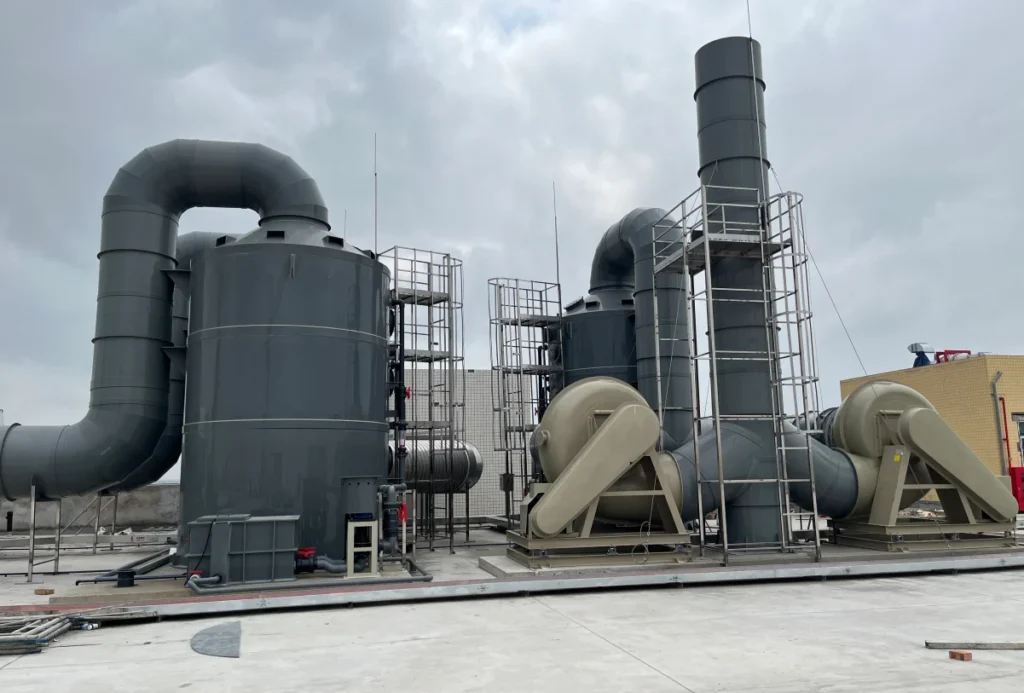
Ammonia (NH3) is one of the most widely used industrial chemicals in the world, essential for fertilizer production, refrigeration, chemical manufacturing, and pollution control. It is also a regulated air pollutant with a sharp, irritating odor (PubChem CID 222, Ammonia) detectable at 5-50 ppm and health effects that range from irritation at the NIOSH recommended exposure limits (25 ppm 8-hour TWA, 35 ppm short-term) to the NIOSH immediately dangerous to life or health (IDLH) concentration of 300 ppm. An ammonia scrubber system removes NH3 from industrial exhaust using either an acid scrubbing solution (typically sulfuric acid) to chemically neutralize the ammonia, or water to physically absorb it. Unlike acid gas scrubbers that use caustic to neutralize HCl or SO2, an ammonia scrubber reverses the chemistry: an acidic solution neutralizes the alkaline NH3 gas. This guide covers the chemistry, design, and applications of ammonia scrubbing systems.
Key Takeaways
- An ammonia scrubber system reverses the acid gas scrubber chemistry: it uses sulfuric acid (pH 2-4) to neutralize alkaline NH3 gas, producing ammonium sulfate fertilizer as a byproduct. The reaction 2 NH3 + H2SO4 produces (NH4)2SO4. For a 200 ppmv NH3 stream at 10,000 m3/h, the acid consumption is approximately 8.6 kg/h of 93% H2SO4, and the (NH4)2SO4 byproduct value offsets 50-100% of the acid cost at current fertilizer prices.
- A packed bed is the standard vessel for ammonia scrubbing because the multi-second gas residence time (3-6 s in the packed bed) is needed for complete NH3 absorption. Spray towers do not provide adequate contact time for NH3 removal. The packing is typically 25-50 mm polypropylene Pall rings with a 2-4 meter bed depth, operating at 0.5-1.5 m/s gas velocity and 2-5 L/m3 L/G ratio for acid scrubbing (water scrubbing uses 5-10 L/m3).
- pH control for ammonia scrubbing is the mirror image of acid gas scrubbing. The setpoint is pH 2-4, and the acid feed pump activates when the pH rises (rather than when it drops). A pH sensor drift above 5 causes NH4+ to revert to NH3 gas, which is stripped out of solution and exits the scrubber outlet.
- The byproduct value of ammonium sulfate makes ammonia scrubbers unusually economical compared to other chemical scrubbers. Fertilizer plants operating ammonia scrubbers recover a saleable ammonium sulfate stream; the byproduct revenue offsets a substantial share of the sulfuric acid cost at current fertilizer prices. The (NH4)2SO4 solution from the blowdown is concentrated and sold as fertilizer. For ammonia scrubbing solutions, see our ammonia scrubber system products → and chemical waste gas treatment →.
What Is an Ammonia Scrubber System?
An ammonia scrubber system is a wet scrubber that removes ammonia (NH3) from an industrial exhaust stream by contacting the gas with an acidic or water-based scrubbing liquid (see our chemical scrubber system guide → for the broader scrubbing technology overview). An ammonia gas scrubber is the reverse of a caustic-based acid gas scrubber: it uses acid to neutralize the base gas.
How NH3 Scrubbing Reverses the Acid Gas Chemistry
In an acid gas scrubber, the pollutant is acidic (HCl, SO2, HF) and the scrubbing liquid is alkaline (NaOH). In an ammonia scrubber, the roles are reversed: the pollutant is alkaline (NH3) and the scrubbing liquid is acidic (H2SO4). The neutralization reaction is:
2 NH3 + H2SO4 -> (NH4)2SO4
Two moles of NH3 react with one mole of H2SO4 to form ammonium sulfate – a valuable fertilizer salt. This reaction is fast and complete at pH 2-4, producing a clear solution of (NH4)2SO4 that can be concentrated and sold as a fertilizer ingredient or liquid fertilizer product.
The pH control logic is also reversed. In an acid gas scrubber, the pH setpoint is 7-9, and a caustic feed pump is activated when the pH drops. In an ammonia scrubber, the pH setpoint is 2-4, and an acid feed pump is activated when the pH rises. The control hardware is identical; only the reagent and setpoint direction change.
The Three Ammonia Removal Approaches
Acid wet scrubbing with H2SO4 is the most common high-efficiency method. The ammonia reacts with sulfuric acid to form ammonium sulfate. Removal efficiency exceeds 99% with proper pH control; the EPA cost manual cross-check for wet acid-gas scrubbers is a 95-99% removal band (EPA, wet and dry scrubbers RTC). The ammonium sulfate byproduct has commercial value as a fertilizer.
Water scrubbing uses plain water to physically absorb NH3, which is highly soluble in water. Water scrubbing achieves 85-95% removal without chemical reagents, but the NH3-laden water requires treatment before discharge. Water scrubbing is used when the ammonia concentration is low and the chemical cost of acid is not justified.
Biofiltration uses microorganisms on organic media to biologically oxidize NH3 to nitrate. Operating cost is low, but the system requires stable temperature and moisture, and the removal efficiency is typically 80-90%.
Wet Scrubbing (H2SO4) vs Water Washing vs Biofiltration
The choice depends on the NH3 concentration, the gas flow rate, and the value of the ammonium sulfate byproduct. Acid scrubbing is preferred for high NH3 concentrations above 200 ppmv. Water scrubbing is adequate for low-concentration ventilation air. Biofiltration is used for very large air volumes at low NH3 concentration where chemical operating cost would be prohibitive.
Ammonia Scrubber Chemistry
2 NH3 + H2SO4 -> (NH4)2SO4 – The Standard Acid Scrubbing Reaction
The primary chemical reaction in an ammonia scrubber system is the neutralization of ammonia with sulfuric acid:
2 NH3 + H2SO4 -> (NH4)2SO4
Two moles of NH3 (34 g) react with one mole of H2SO4 (98 g) to produce one mole of ammonium sulfate (132 g). The stoichiometric mass ratio is 98.079/17.031 = 5.76 kg of pure H2SO4 per kg of NH3 (the 2:1 molar ratio is already carried by the 17.031 g/mol NH3 formula used to compute the NH3 mass flow above), or approximately 6.2 kg of 93% commercial sulfuric acid.
For an exhaust stream containing 200 ppmv NH3 at 10,000 m3/h:
NH3 mass flow: 10,000 x (200 x 17/24.5) / 1,000,000 = 1.39 kg/h
H2SO4 required: 1.39 x 98.079/17.031 = 8.0 kg/h of pure H2SO4
At 93% concentration: 8.0 / 0.93 = 8.6 kg/h of commercial sulfuric acid
The (NH4)2SO4 produced by the reaction is a white crystalline salt whose saturated solution at 20 °C is approximately 43% by mass (PubChem, ammonium sulfate). The scrubber solution is typically maintained at 20-30% ammonium sulfate concentration before the blowdown is sent to crystallization or fertilizer blending.
Ammonium Sulfate as a Valuable Fertilizer Byproduct
Ammonium sulfate (PubChem, ammonium sulfate) contains 21% nitrogen and 24% sulfur, making it a valuable fertilizer for sulfur-deficient soils. Commercial ammonium sulfate sells for $150-300 per metric ton depending on the local market. A scrubber producing 1 ton per day of (NH4)2SO4 generates $50,000-100,000 per year in byproduct revenue, which partially or fully offsets the acid consumption cost. Some fertilizer plants design their ammonia scrubbers specifically to produce salable ammonium sulfate, running the scrubber at elevated concentration to reduce evaporation cost.
Water Scrubbing – Physical Absorption of NH3
NH3 is highly soluble in water (approximately 540 g/L at 20 °C, PubChem CID 222, falling as temperature rises), which makes water scrubbing feasible without chemical reagents. The absorption follows Henry’s law: the equilibrium concentration in water is proportional to the gas-phase partial pressure. A water scrubber at L/G of 5-10 L/m3 (higher than the 2-5 L/m3 used for acid scrubbing, because physical absorption needs more liquid) achieves 85-95% removal at inlet NH3 concentrations below 500 ppmv.
The NH3-laden water from the scrubber must be treated. Options include sending it to the plant wastewater treatment system, using it as liquid fertilizer (if the concentration is adequate), or stripping the NH3 with steam for recovery.
pH Control for Ammonia Scrubbing
The pH control setpoint for an acid-based ammonia scrubber is 2-4. The pH sensor must be specified for low-pH, high-sulfate service. Glass pH electrodes with double-junction reference cells are standard. The acid feed pump injects 93% H2SO4 when the pH rises above the setpoint.
At pH above 5, the ammonium ion (NH4+) begins to convert back to dissolved NH3 gas, since the ammonium/ammonia equilibrium (pKa about 9.25) shifts toward free NH3 as pH rises (PubChem CID 222), which can be stripped out of solution. Maintaining pH below 4 ensures that essentially all the absorbed ammonia remains as non-volatile NH4+. This is the mirror image of the acid gas scrubber requirement (maintaining pH above 10 for chlorine scrubbing to prevent Cl2 release).
Design Parameters – Acid Scrubber vs Packed Bed
An ammonia scrubber system uses a packed bed as the standard vessel. An ammonia wet scrubber with H2SO4 requires the extended contact time that a packed bed provides. The design follows the same gas-liquid contact principles as any packed bed, but the reagent chemistry drives different material and control requirements.
Scrubber Vessel Selection – Packed Bed is Standard
A packed bed scrubber is the standard vessel for ammonia scrubbing because the extended gas-liquid contact time (3-6 seconds) is needed for the NH3 to diffuse from the gas phase into the acid solution. The packing – typically 25-50 mm polypropylene Pall rings – provides the interfacial area for mass transfer. Packed bed depth is 2-4 meters, providing 5-10 theoretical stages. Packed towers are the standard vessel for acid-gas absorption and can reach very high removal efficiency (EPA cost manual, Section 5.2 Chapter 1: Wet Scrubbers for Acid Gas).
A spray tower is not recommended for ammonia removal because the shorter contact time (1-2 seconds) is insufficient for complete NH3 absorption at moderate L/G ratios. NH3 absorption is gas-phase mass transfer limited, meaning that adequate contact time is essential, and the open geometry of a spray tower does not provide enough.
L/G Ratio and Residence Time
The L/G ratio for an ammonia scrubber with H2SO4 is 2-5 L/m3 at 0.5-1.5 m/s gas velocity. The minimum gas residence time in the packed bed is 2-3 seconds. For a 10,000 m3/h exhaust stream at 1.0 m/s:
Tower area: 10,000/3,600/1.0 = 2.78 m2
Tower diameter: sqrt(4 x 2.78 / pi) = 1.88 m
Packing depth: 3.0 m (providing approximately 3 seconds residence time)
L/G at 3 L/m3: recirculation rate = 10,000 x 3 = 30,000 L/h = 30 m3/h
Material Selection for Sulfuric Acid Service
Sulfuric acid at the concentrations used in ammonia scrubbing (typically 1-5% H2SO4 by weight in the recirculating solution, with excursions to 10% before blowdown) is corrosive to many common construction materials, and the acid-gas scrubber cost manual gives relative vessel cost factors by material of construction (EPA cost manual, Section 5.2 Chapter 1). The selection depends on the acid concentration and operating temperature.
PP, FRP, and SS316L – Temperature and Chemistry Limits
Polypropylene (PP) is the standard material for the scrubber vessel and recirculation piping at temperatures up to 80 °C (the design limit for welded PP structures; sheet material is rated somewhat higher). PP resists dilute sulfuric acid at all concentrations up to that limit.
FRP (vinyl ester resin) is specified for temperatures up to 110 °C or for installations where the structural strength of FRP is needed for large-diameter vessels.
SS316L can be used for dilute sulfuric acid below 50 °C in the absence of chlorides, but is not recommended for the main vessel because of the risk of pitting at the acid concentrations used in the scrubber sump.
Gasket material must be PTFE. EPDM and Viton degrade in sulfuric acid. The acid feed line from the storage tank must be carbon steel (commercial 93% H2SO4, PubChem CID 1118, density 1.84, is not corrosive to carbon steel) or PVDF.
Industrial Applications
Fertilizer Manufacturing – (NH4)2SO4 Production
The fertilizer industry is both the largest source of NH3 emissions and the largest user of ammonia scrubbers (EIA energy glossary, ammonia). An ammonia scrubber system on a fertilizer plant reactor vent or granulator captures the NH3 that would otherwise be lost to the atmosphere, converting it back to ammonium sulfate or ammonium nitrate for sale as finished fertilizer product.
A typical NPK (nitrogen-phosphorus-potassium) fertilizer granulator produces exhaust at 50,000-100,000 m3/h containing 200-2,000 ppmv NH3. The scrubber uses 93% H2SO4 at pH 2-4 in a packed bed with 3-4 meters of polypropylene packing. The ammonium sulfate solution from the scrubber blowdown is concentrated in an evaporator and sold as granular ammonium sulfate fertilizer.
The economics of fertilizer plant NH3 scrubbers are unusually favorable: the acid consumption is approximately 5.8 kg of pure H2SO4 per kg of NH3 removed, and the ammonium sulfate byproduct yield is about 3.9 kg per kg of NH3 removed, so the byproduct revenue offsets a substantial share of the reagent cost at current fertilizer prices.
Livestock and Poultry Ventilation Air
Intensive livestock operations generate NH3 from animal waste decomposition in barns and housing facilities (EPA CADDIS, Ammonia). The NH3 concentration in building ventilation air is low (5-50 ppmv) but the air volume is very large (100,000-500,000 m3/h per barn). An ammonia wet scrubber for livestock ventilation uses water scrubbing rather than acid scrubbing because the chemical cost of acid at these low concentrations would be prohibitive.
Water scrubbers for livestock NH3 control achieve 70-90% removal at the lower end of the water-scrubbing range, at L/G of 3-5 L/m3, because the very large air volumes limit practical contact time. The NH3-laden water is used as liquid fertilizer on surrounding cropland, eliminating the wastewater discharge. The capital cost is low, but the water consumption is high (50-100 m3/h for a large barn).
Refrigeration and Cold Storage
Industrial refrigeration systems using anhydrous ammonia as the refrigerant install ammonia scrubbers as emergency containment systems. Anhydrous ammonia is a regulated toxic substance under the EPA Risk Management Program (40 CFR Part 68) and a highly hazardous chemical under OSHA process safety management (29 CFR 1910.119). for the compressor room and storage area. The scrubber activates when an NH3 sensor detects a release, drawing the room air through a packed bed with dilute sulfuric acid or water. The design is similar to chlorine emergency scrubbers: a standby system sized for the worst-case release.
Chemical Processing and Semiconductor
Chemical plants manufacturing nitrogen-containing compounds and semiconductor fabs using NH3 in chemical vapor deposition processes (EPCRA extremely hazardous substances, 40 CFR Part 355) install ammonia scrubbers on process exhaust. The NH3 concentration is typically 20-200 ppmv. A packed bed with dilute H2SO4 at pH 3-4 achieves 99%+ removal. The ammonium sulfate byproduct is discharged to wastewater or collected as fertilizer.
An ammonia scrubber system in a semiconductor fab must handle not only NH3 (OSHA sets the occupational exposure limit for ammonia at 50 ppm as an 8-hour time-weighted average, 29 CFR 1910.1000 Table Z-1) but also other process gases that may be present in the exhaust, including SiH4, PH3, and B2H6. The scrubber design must account for the potential formation of solid reaction products from these gases (SiO2, P2O5) that can plug the packing. A water-scrubbing pre-stage ahead of the acid scrubber removes these particulate-forming hydrides before the NH3 reaches the acid polishing stage. This two-stage design extends the acid scrubber packing service life from the low end of the typical 1-5 year packing life to 5+ years in semiconductor service.
Operation, Maintenance, and Byproduct Handling
Acid Concentration and pH Monitoring
The pH control loop is the most critical instrument in any ammonia scrubber system. The pH setpoint is 2-4, and the acid feed pump injects 93% H2SO4 when the pH rises above the setpoint. The pH sensor must be calibrated weekly. A sensor that drifts toward a higher reading will under-feed acid, allowing the pH to rise above 5 where NH3 can be stripped from the solution.
The acid concentration in the recirculating solution is typically 1-5% H2SO4 by weight. If the concentration drops below 0.5%, the buffering capacity is too low to handle NH3 concentration surges. If it exceeds 10%, the acid consumption is wasteful and the corrosion rate on the recirculation pump increases.
Ammonium Sulfate Crystallization and Recovery
The ammonium sulfate concentration in the scrubber solution increases as NH3 is absorbed. When the concentration reaches 25-35% by mass (saturation at 20 °C is approximately 43% by mass), the solution should be bled to a crystallization or storage system before crystallization occurs in the scrubber. The blowdown rate is:
Blowdown rate = NH3 removal rate x (MW (NH4)2SO4 / (2 x MW NH3)) / Target concentration
For an NH3 removal rate of 1.39 kg/h:
(NH4)2SO4 production: 1.39 x 132/34 = 5.4 kg/h
At 30% concentration: blowdown = 5.4 / 0.30 = 18 kg/h of solution, or approximately 16 L/h at the solution density of about 1.15 kg/L
The blowdown solution is sent to an evaporator crystallizer, a spray dryer, or a fertilizer blending facility where it is mixed with solid fertilizer ingredients.
Common Operating Problems
| Problem | Cause | Fix |
|---|---|---|
| NH3 slip at outlet | pH too high (>5), NH4+ reverting to NH3 | Increase acid feed; verify pH sensor calibration |
| Ammonium sulfate crystallization in packing | Blowdown rate too low | Increase blowdown; verify concentration |
| Corrosion in recirculation piping | H2SO4 concentration above 10% | Increase blowdown; reduce acid feed |
| pH sensor drift | Coating from sulfate crystals | Clean with water; increase calibration frequency |
Ammonia Removal – Selection Criteria
The choice between acid scrubbing, water scrubbing, and biofiltration for NH3 removal depends on the concentration, gas flow, and the value of the byproduct.
Acid Scrubber vs Water Scrubber vs Biofilter
| Factor | Acid Scrubber (H2SO4) | Water Scrubber | Biofilter |
|---|---|---|---|
| Removal efficiency | 99%+ | 85-95% | 80-90% |
| Operating cost | $0.15-0.30/kg NH3 | $0.05-0.10/kg NH3 (water) | $0.02-0.05/kg NH3 |
| Capital cost | Moderate | Low | Moderate-High |
| Byproduct | (NH4)2SO4 (fertilizer) | NH3-laden water | Nitrate (waste) |
| Reagent needed | H2SO4 | None | None |
| Best for | >200 ppmv NH3 | 20-200 ppmv NH3 | <50 ppmv, high air volume |
Selection Table by NH3 Concentration and Gas Flow
| NH3 (ppmv) | Gas Flow | Recommended | Rationale |
|---|---|---|---|
| 5-50 | 10,000-500,000 m3/h air | Water scrubber or biofilter | Acid cost not justified at low concentration |
| 50-500 | 1,000-50,000 m3/h air | Acid scrubber with H2SO4 | Byproduct value offsets acid cost |
| 500-5,000 | 500-20,000 m3/h air | Acid scrubber with crystallization | Target (NH4)2SO4 production |
| >5,000 | Process gas | Acid scrubber + (NH4)2SO4 recovery | Economically required for compliance |
An ammonia scrubber system using H2SO4 is the standard for applications above 200 ppmv NH3 where the byproduct value justifies the acid consumption. Water scrubbing is the standard for low-concentration livestock ventilation where acid cost cannot be justified. Biofiltration is a niche technology for very large air volumes with low NH3 concentration and limited operator attention.
Frequently Asked Questions
What is an ammonia scrubber system?
An ammonia scrubber system is a wet scrubber that removes ammonia (NH3) from industrial exhaust using either sulfuric acid to chemically neutralize the NH3 or water to physically absorb it. Acid scrubbing achieves 99%+ removal and produces ammonium sulfate fertilizer as a byproduct.
How is ammonia scrubbing different from acid gas scrubbing?
The chemistry is reversed. An acid gas scrubber uses an alkaline reagent (NaOH) to neutralize acid gases. An ammonia scrubber uses an acidic reagent (H2SO4) to neutralize the alkaline NH3 gas. The pH setpoint is 2-4 for ammonia versus 7-9 for acid gases.
What happens to the ammonium sulfate produced in the scrubber?
The ammonium sulfate solution from the scrubber blowdown can be concentrated by evaporation and sold as granular fertilizer or liquid fertilizer. At current fertilizer prices, the byproduct value offsets the acid consumption cost, making the net chemical cost of ammonia scrubbing near zero for many applications.
What material should I use for an ammonia scrubber using sulfuric acid?
Polypropylene (PP) is the standard material for the vessel and piping up to 80 °C. FRP (vinyl ester) is used for higher temperatures. SS316L is acceptable for dilute sulfuric acid below 50 °C but is not recommended for the main vessel. Gaskets must be PTFE.
What is the typical removal efficiency of an ammonia scrubber?
An acid-based packed bed scrubber achieves 99%+ removal at pH 2-4 with 2-3 seconds gas residence time. A water scrubber achieves 85-95% removal. A biofilter achieves 80-90% removal.
Can an ammonia scrubber handle high-temperature exhaust?
Yes, but the material selection depends on the temperature. An ammonia gas scrubber using PP handles up to 80 °C. Above 80 °C, FRP with vinyl ester resin extends the range to 110 °C. For gas streams above 110 °C, a quench section upstream of the scrubber is required, or the scrubber vessel must be constructed from stainless steel (SS316L) if the gas does not contain chlorides that would cause pitting. Most ammonia scrubbers operate near ambient temperature because the NH3 sources (fertilizer plants, livestock barns, chemical processes) exhaust at or near ambient conditions.
Sources
The chemical, physical, and regulatory figures in this guide are drawn from the following sources. Engineering ranges that are not tied to a published limit are identified as vendor design ranges in the text.
- U.S. National Library of Medicine, PubChem – Ammonia (CID 222) (water solubility 54 g/100 mL at 20 °C; NIOSH IDLH 300 ppm; NIOSH REL TWA 25 ppm / ST 35 ppm; OSHA PEL TWA 50 ppm; AEGL-1/2/3 30/160/1100 ppm).
- U.S. National Library of Medicine, PubChem – Ammonium sulfate (fertilizer nutrient content and saturated-solution concentration).
- U.S. National Library of Medicine, PubChem – Sulfuric acid (CID 1118) (commercial grades — 66 °Bé = 93.2% H2SO4 at density 1.84; miscible with water).
- U.S. Environmental Protection Agency – CADDIS: Ammonia (ammonia sources and aquatic effects).
- U.S. Environmental Protection Agency – EPA Air Pollution Control Cost Manual, Section 5.2 Chapter 1: Wet Scrubbers for Acid Gas (packed-tower acid-gas absorption; relative vessel cost factors by material of construction; mist eliminator and packing service life).
- U.S. Environmental Protection Agency – EPA Control Cost Manual — Wet and Dry Scrubbers for Acid Gas (RTC) (95-99% removal band for wet acid-gas scrubbers).
- U.S. Occupational Safety and Health Administration / eCFR – 29 CFR 1910.1000 Table Z-1 (ammonia occupational exposure limit 50 ppm 8-hour TWA).
- U.S. Environmental Protection Agency / eCFR – 40 CFR Part 68 — Chemical Accident Prevention Provisions (RMP) (regulated toxic substances and offsite consequence analysis).
- U.S. Environmental Protection Agency / eCFR – 40 CFR Part 355 — Emergency Planning and Notification (EPCRA) (extremely hazardous substances, threshold planning quantities and reportable quantities).
- U.S. Occupational Safety and Health Administration / eCFR – 29 CFR 1910.119 — Process Safety Management of Highly Hazardous Chemicals (threshold quantities in Appendix A).
- U.S. Energy Information Administration – EIA Energy Glossary: Ammonia (ammonia end-use definition).