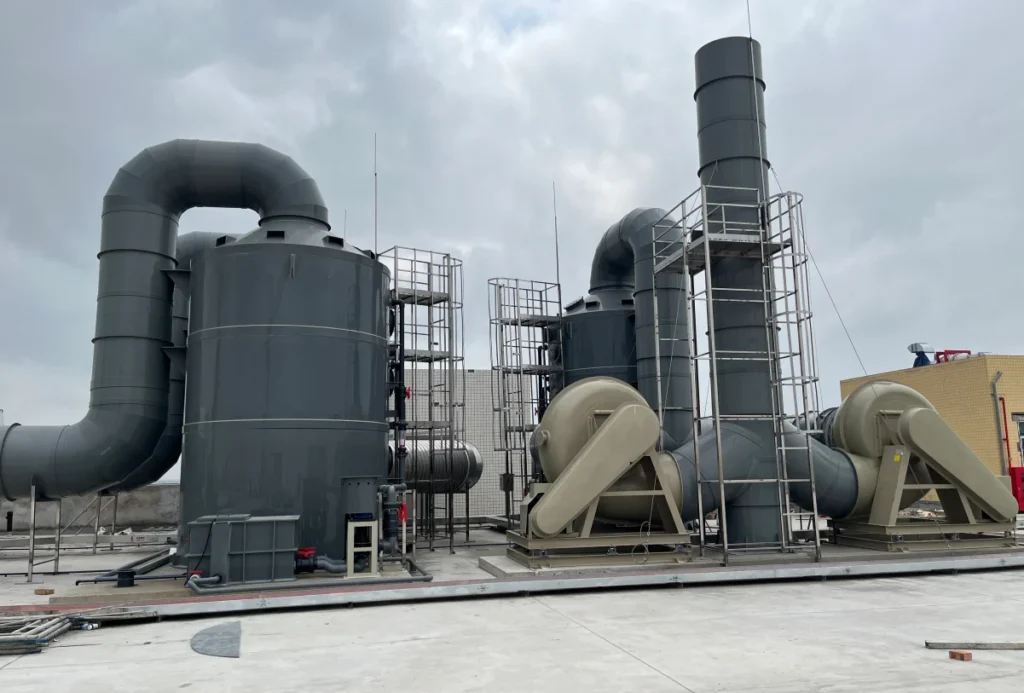
Volatile organic compounds (VOCs) are a diverse family of carbon-based chemicals that evaporate at room temperature; EPA defines them for regulatory purposes as any compound of carbon, excluding carbon monoxide, carbon dioxide, carbonic acid, metallic carbides or carbonates, and ammonium carbonate, that participates in atmospheric photochemical reactions (40 CFR 51.100(s)) and contribute to ground-level ozone formation, odor nuisances, and workplace exposure limits set by OSHA (for example, toluene and xylene are regulated under 29 CFR 1910.1000 Table Z-1). A voc control scrubber systems installation can remove water-soluble and chemically reactive VOCs – alcohols, aldehydes, ketones, organic acids – by absorbing them into a scrubbing liquid. But wet scrubbing is not a universal VOC solution: non-soluble VOCs such as benzene, toluene, xylene, and chlorinated solvents require carbon adsorption, thermal oxidation, or condensation rather than wet scrubbing. This guide covers the principles of VOC wet scrubbing, the design parameters for packed bed absorbers treating soluble VOCs, the industrial applications where wet scrubbing is the right choice, and the boundary between wet scrubbing and alternative VOC control technologies.
Key Takeaways
- VOC control scrubber systems are effective only for water-soluble or chemically reactive VOCs. VOCs with constants below 5 atm-m3/mol are readily absorbed in water. VOCs with constants above 50 atm-m3/mol are poorly removed by wet scrubbing.
- Packed bed scrubbers for VOC removal require higher L/G ratios (3-10 L/m3, per EPA wet scrubber guidance) than acid gas scrubbers because the driving force is physical solubility rather than chemical reaction. The required packing depth is typically 3-4 meters. For a 10,000 m3/h methanol stream at 500 ppmv, the water recirculation rate is 50,000 L/h, achieving 95% removal.
- Multi-stage scrubbing is the standard approach for complex odor control applications. Rendering plants, food processors, and wastewater treatment facilities combine an acid stage (pH 3-4 for NH3/amines), a caustic-hypochlorite stage (pH 9-10 for H2S/mercaptans/aldehydes), and an activated carbon polishing stage to achieve 98%+ overall odor reduction.
- For non-soluble VOCs, wet scrubbing is not the primary answer; EPA notes that gases with low water solubility such as hydrocarbons require non-aqueous absorbents such as dimethylaniline or amines (EPA). Paint booth exhaust, printing press ventilation, and solvent-based coating operations produce non-soluble VOC emissions that require carbon adsorption, regenerative thermal oxidation (RTO), or catalytic oxidation (RCO). Wet scrubbing in these applications is limited to particulate removal. For odor control scrubber systems and other VOC scrubbing solutions, see our activated carbon adsorption equipment → and odor control solutions →.
What Are VOC Control Scrubber Systems?
VOC control scrubber systems are wet scrubbers designed to remove volatile organic compounds from industrial exhaust streams by absorption into a liquid scrubbing medium; EPA notes that most absorbers achieve removal efficiencies in excess of 90 percent (EPA) (see our chemical scrubber system guide → for the broader technology framework). An effective voc control scrubber systems installation must first identify whether the target VOCs are water-soluble or require chemical oxidation. Unlike acid gas scrubbers that rely on chemical neutralization, most VOC scrubbers rely on physical absorption (the VOC dissolves into the scrubbing liquid according to Henry’s law) or on oxidation with a chemical reagent such as sodium hypochlorite (PubChem CID 23665760), ozone, or hydrogen peroxide (PubChem CID 784) to destroy the VOC molecule.
Water-Soluble vs Non-Water-Soluble VOCs
The single most important factor in determining whether wet scrubbing is feasible for a given VOC is its water solubility. VOCs fall into three categories:
Highly water-soluble VOCs include methanol, ethanol, isopropanol, acetone, formaldehyde, acetic acid, and other low-molecular-weight alcohols, aldehydes, ketones, and organic acids. These compounds have Henry’s law constants below approximately 5 atm-m3/mol at 25 °C, meaning they partition strongly into water. A packed bed scrubber with water or dilute caustic at L/G of 3-10 L/m3 achieves 90-98% removal.
Moderately soluble VOCs include MEK (methyl ethyl ketone), ethyl acetate, butanol, and phenol. Their Henry’s law constants are in the 5-50 atm-m3/mol range. Removal efficiency in a water scrubber is 50-85%, depending on the L/G ratio and the tower height. A chemical reagent (NaOCl or H2O2) added to the scrubbing solution can oxidize and destroy these compounds, improving removal.
Poorly soluble VOCs include BTEX (benzene, toluene, ethylbenzene, xylene), chlorinated solvents (perchloroethylene, trichloroethylene), and aliphatic hydrocarbons (hexane, heptane). Their Henry’s law constants are above 50 atm-m3/mol. Wet scrubbing with water achieves less than 20-30% removal for these compounds. A voc scrubber system for these compounds requires either a high-boiling organic scrubbing oil (in a closed-loop system) or a chemical oxidant that reacts with the VOC.
When Wet Scrubbing Works for VOCs – and When It Does Not
Wet scrubbing is the right choice for soluble VOCs from chemical reactors, pharmaceutical dryers, food processing vents, and wastewater treatment off-gases where the VOC concentration is moderate (50-500 ppmv) and the solubility is favorable. It is not the right choice for non-soluble VOCs from paint booths, printing presses, or solvent-based coating lines.
Solubility in Water vs Chemical Reactivity – The Two Gatekeepers
The two gatekeepers for VOC wet scrubbing are: (1) Does the VOC dissolve in water at the concentration and temperature of the exhaust stream? If yes, physical absorption is feasible. (2) If not, does the VOC react with a chemical reagent (NaOCl, H2O2, O3) in the scrubbing solution? If yes, chemical scrubbing is feasible. If the answer to both is no, wet scrubbing is not the appropriate technology.
VOC Scrubber Chemistry and Mass Transfer
Physical Absorption – Henry’s Law for Soluble VOCs
For water-soluble VOCs, removal occurs by physical absorption. VOC control scrubber systems for physical absorption start with knowing the target VOC’s Henry’s law constant. The VOC molecule diffuses from the gas phase to the gas-liquid interface and dissolves into the liquid phase according to Henry’s law.
Methanol (CH3OH) is the most water-soluble VOC, with a Henry’s law constant of approximately 0.2 atm-m3/mol at 25 °C (PubChem CID 887). For comparison, benzene has a constant of approximately 560 atm-m3/mol – 2,800 times higher. A water scrubber that removes 95% of inlet methanol at L/G of 5 L/m3 would remove less than 20% of inlet benzene at the same operating conditions, consistent with the water-scrubbing column of the removal efficiency table below.
Worked Example: Methanol Absorption at 500 ppmv
Exhaust flow: 10,000 m3/h at 25 °C
Methanol concentration: 500 ppmv
Henry’s law constant for methanol in water at 25 °C: H = 0.2 atm-m3/mol
The required L/G for 95% methanol removal is approximately 5 L/m3 (water to air by volume), achievable in a packed bed scrubber with 3-4 meters of packing. For methanol at 500 ppmv in 10,000 m3/h, the methanol mass loading is approximately 6.6 kg/h (at the 25 °C molar volume of 24.45 L/mol; at 0 °C it would be 7.15 kg/h), and the water flow rate at 5 L/m3 is 50,000 L/h.
Chemical Absorption – Oxidizing and Reactive Scrubbing
For VOCs that are not highly water-soluble but are chemically reactive, an oxidizing agent added to the scrubbing solution converts the VOC to a more water-soluble form or destroys it. Common oxidizing agents for VOC scrubbing include:
Sodium hypochlorite (NaOCl) at pH 8-10 oxidizes aldehydes (formaldehyde to formic acid), phenols (to quinones and carboxylic acids), and reduced sulfur compounds (to sulfates). The ORP is maintained at 400-600 mV.
Hydrogen peroxide (H2O2) at pH 3-5 oxidizes a broader range of VOCs, including some chlorinated compounds. The reaction produces oxygen and water as byproducts. H2O2 is more expensive than NaOCl but produces no chlorinated byproducts that require disposal.
Ozone (O3) injected into the scrubbing solution is the strongest oxidizing agent, capable of destroying most organic compounds. Ozone is generated on-site from air or oxygen using corona discharge generators.
VOC Removal Efficiency by Compound Type
| VOC Group | Examples | Water Scrubber | With NaOCl | With H2O2 |
|---|---|---|---|---|
| Alcohols | Methanol, ethanol, IPA | 90-98% | 95-99% | 95-99% |
| Aldehydes | Formaldehyde, acetaldehyde | 80-95% | 95-99% | 95-99% |
| Ketones | Acetone, MEK | 60-90% | 80-95% | 85-95% |
| Organic acids | Acetic, formic | 85-98% | 95-99% | 95-99% |
| Aromatics | Benzene, toluene | <20% | 20-40% | 30-50% |
| Chlorinated | PCE, TCE | <10% | <20% | 40-70% |
Design Parameters for VOC Scrubbers
Packed Bed Sizing – Gas Velocity, L/G, Tower Diameter
A voc scrubber system for soluble VOCs is designed as a packed bed absorber. Effective voc control scrubber systems require careful attention to the L/G ratio because the driving force for mass transfer is physical solubility rather than chemical reaction.
The gas velocity through the packed bed is 0.5-1.5 m/s, consistent with standard packed bed design. The L/G ratio is 3-10 L/m3 for water-soluble VOCs, compared to 1-3 L/m3 for caustic-based acid gas scrubbing. The higher L/G ratio reflects the lower mass transfer driving force when the removal mechanism is physical absorption rather than chemical reaction.
For a 10,000 m3/h exhaust stream containing 500 ppmv methanol requiring 95% removal at 1.0 m/s gas velocity and 5 L/m3 L/G:
Tower area: 10,000/3,600/1.0 = 2.78 m2
Tower diameter: sqrt(4 x 2.78 / pi) = 1.88 m
Recirculation rate: 10,000 x 5 = 50,000 L/h = 50 m3/h
Required packing depth: 3-4 meters (HETP approximately 0.5-0.7 m for 25 mm Pall rings)
Packing Media Selection for VOC Service
Polypropylene (PP) Pall rings in 25-50 mm size are the standard packing for VOC scrubbers. PP resists the full range of water-soluble VOCs – alcohols, ketones, organic acids – at temperatures up to 80 °C.
For applications where the VOC stream contains ketones or aromatic compounds that swell or attack polypropylene, ceramic or stainless steel packing may be required. Ceramic saddles provide excellent chemical resistance up to 200 °C but have higher pressure drop and are more expensive than PP. Stainless steel 316L packing is used for high-temperature VOC streams above 80 °C where the gas does not contain chlorides.
Packing selection must also consider the liquid distribution requirements. The minimum wetting rate for 25 mm PP Pall rings is approximately 0.1 L/m2-s of tower cross-section. At the L/G of 5 L/m3 and 1.0 m/s gas velocity used in the example above, the liquid loading is 5 L/m3 x 1.0 m/s = 5.0 L/(m2.s) – well above the minimum, providing good wetting.
Material Selection – Chemical Resistance to Organic Solvents
The scrubbing liquid in a VOC absorber contains dissolved organic compounds that can attack standard construction materials. The material selection must account for both the water phase and the dissolved VOCs:
Polypropylene (PP) is suitable for most water-soluble VOCs (alcohols, ketones, organic acids at concentrations below 10%). PP swells in aromatic hydrocarbons and chlorinated solvents, which limits its use to non-aromatic VOC service.
FRP (vinyl ester resin) provides broader chemical resistance than PP and handles aromatic VOCs. It is specified when the VOC stream contains traces of benzene or toluene mixed with water-soluble VOCs.
Stainless steel (SS316L) is used for high-temperature VOC streams above 80 °C or for VOCs that attack PP and FRP (chlorinated solvents, strong ketones at high concentration). The cost is 3-5x higher than PP.
Industrial Applications
Chemical and Pharmaceutical Manufacturing
Chemical plants and pharmaceutical manufacturers generate VOC-laden exhaust. A voc control scrubber systems installation on a pharmaceutical dryer vent handles 2,000-10,000 m3/h of exhaust containing 200-2,000 ppmv of mixed solvents. A packed bed scrubber with water at L/G of 5-10 L/m3 achieves 85-95% removal. The VOC-laden water is sent to the plant wastewater treatment system, where the organic load is biologically degraded.
For processes where solvent recovery is economical – typically at solvent concentrations above 5,000 ppmv – the scrubber blowdown can be sent to a distillation column that separates and recovers the solvent, returning the stripped water to the scrubber recirculation loop.
Food Processing Odor Control
Food processing operations – rendering plants, fish meal processors, coffee roasters, snack food manufacturers – generate odorous VOC emissions that are primarily water-soluble organic acids, aldehydes, and reduced sulfur compounds. An odor control scrubber systems installation in a food processing plant uses a multi-stage approach:
Stage 1: Acid scrubber (H2SO4 at pH 3-4) to remove basic odorous compounds (amines, NH3)
Stage 2: Caustic scrubber (NaOH at pH 9-10 with NaOCl at ORP 400-600 mV) to oxidize organic acids, aldehydes, and sulfur compounds
Stage 3: Activated carbon polisher for residual non-soluble VOCs
The two-stage chemical scrubbing system achieves 90-95% odor reduction, and the carbon polisher brings the total to 98%+ reduction.
Wastewater Treatment Plant Odor Control
Wastewater treatment plant ventilation air contains a complex mixture of H2S, NH3, and VOCs – primarily organic acids, aldehydes, and reduced sulfur compounds from anaerobic decomposition. A wet scrubber odor control system for wastewater odor control uses a single packed bed stage with caustic (pH 9-10) and hypochlorite (ORP 500-600 mV) to simultaneously remove H2S, NH3, and soluble organic odor compounds. The residence time is 3-5 seconds. Removal efficiency for H2S is 95-99%, for NH3 85-95%, and for soluble VOCs 60-85%.
Paint, Coating, and Printing
Paint booths, coating lines, and printing presses emit non-soluble VOCs – xylene, toluene, ethylbenzene, MEK, and aliphatic hydrocarbons. For these exhaust streams, wet scrubbing is not the primary VOC removal technology. A water wash spray booth captures the paint overspray particulate, but the VOCs pass through the water curtain with less than 10% removal. The VOC control for these applications requires carbon adsorption, regenerative thermal oxidation (RTO), or catalytic oxidation (RCO).
Wet Scrubber vs Carbon Adsorption vs Thermal Oxidation
Wet scrubbing is one of three major VOC control technologies. The choice between them depends on the VOC type, concentration, gas flow, and the desired destruction efficiency.
Comparison Table
| Factor | Wet Scrubbing | Carbon Adsorption | Thermal Oxidation |
|---|---|---|---|
| Applicable VOCs | Soluble/reactive only | Most VOCs | All VOCs |
| Removal efficiency | 80-99% (VOC-dependent) | 90-99% | 95-99.9% |
| Capital cost (equipment only, vendor quotation ranges) | $50-150 per m3/h | $80-200 per m3/h | $150-400 per m3/h |
| Operating cost | Low-medium | Medium (media replacement) | High (fuel/electricity) |
| Waste stream | Liquid (VOC-laden water) | Spent carbon (solid) | CO2 + H2O (gas) |
| Heat recovery | None | None | 70-95% possible |
| Best for | Soluble VOCs, 50-500 ppmv | Low-medium concentration | High concentration, >95% required |
When to Choose Wet Scrubbing
Wet scrubbing is the right choice when the VOCs are water-soluble or chemically reactive, the concentration is moderate (50-1,000 ppmv), the gas flow is high (above 10,000 m3/h), and the facility already has a wastewater treatment system to handle the blowdown. The operating cost advantage of wet scrubbing over carbon adsorption or thermal oxidation increases with the gas flow rate. For a 50,000 m3/h exhaust stream containing 200 ppmv methanol, wet scrubbing costs approximately one-tenth the operating cost of thermal oxidation, provided the oxidizer must burn supplemental fuel; once the inlet concentration is high enough for autothermal operation the gap narrows sharply.
A voc control scrubber systems approach is the best choice when the exhaust contains both VOCs and other pollutants that can be removed in the same scrubber. A wet scrubber odor control system is particularly effective when the exhaust includes both soluble VOCs and odor-causing compounds.
When Carbon or RTO Makes More Sense
Carbon adsorption is the right choice when the VOCs are non-soluble (BTEX, chlorinated solvents), when the concentration is below 50 ppmv and high removal efficiency (95%+) is required, and when the gas flow is moderate (below 10,000 m3/h). The carbon media is regenerated by steam or replaced.
Thermal oxidation (RTO or RCO) is the right choice when the VOCs are a mixture of soluble and non-soluble compounds, when destruction efficiency above 99% is required, when the VOC concentration is high enough (above 1,000 ppmv) to support autothermal operation (without supplemental fuel), and when the facility has a natural gas supply for the oxidizer burner.
Wet Scrubber Odor Control System – Selection Criteria
The design of voc control scrubber systems must account for the specific VOC fingerprint. A wet scrubber odor control system for VOCs must be selected based on the specific VOC fingerprint. Odor control scrubber systems are most effective when the odor-causing compounds are water-soluble or reactive with common chemical reagents. For this reason, voc control scrubber systems often include a front-end gas analysis step to characterize the VOC composition before the scrubber is specified.
Single-Stage vs Multi-Stage Odor Control
For exhaust streams containing only water-soluble VOCs (methanol, ethanol, acetone from pharmaceutical drying), a single-stage packed bed scrubber with water or caustic is adequate. The packing depth is 3-4 meters, providing 90-95% VOC removal.
For exhaust streams containing a mixture of VOCs, H2S, NH3, and organic acids (wastewater treatment plant ventilation air, food processing, rendering), a multi-stage approach is required. A typical two-stage design:
Stage 1: Acid scrubber (H2SO4 at pH 3-4) removes amines and NH3
Stage 2: Caustic/hypochlorite scrubber (NaOH at pH 9-10, ORP 400-600 mV) oxidizes H2S, mercaptans, and soluble VOCs
For the most demanding odor control applications, a third stage with activated carbon or a polishing chemical scrubber is added after the two wet stages to achieve 98-99% odor reduction.
Chemical Reagent Selection for Odor Compounds
| Odor Compound | Reagent | Mechanism | Target Parameter |
|---|---|---|---|
| H2S, Mercaptans | NaOCl + NaOH | Oxidation to sulfate | ORP 400-600 mV, pH 9-10 |
| NH3, Amines | H2SO4 | Acid-base neutralization | pH 3-4 |
| Organic acids | NaOH | Neutralization | pH 7-9 |
| Aldehydes | NaOCl or H2O2 | Oxidation | ORP 500-600 mV |
| Phenol | H2O2 or O3 | Advanced oxidation | ORP 600-700 mV |
For multi-pollutant exhaust streams, the reagent selection follows the most difficult-to-remove compound. If the exhaust contains both NH3 (requiring acid scrubbing) and H2S (requiring caustic/hypochlorite), a two-stage system is essential because the same scrubber cannot maintain both acidic and alkaline conditions simultaneously.
A chemical scrubber odor control systems installation typically uses a PLC with pH and ORP controllers to manage the chemical feed for each stage independently.
Frequently Asked Questions
Can wet scrubbers remove all VOCs?
No. Wet scrubbers are effective only for water-soluble VOCs (alcohols, aldehydes, ketones, organic acids) and chemically reactive VOCs (those oxidized by NaOCl, H2O2, or O3). Non-soluble VOCs such as benzene, toluene, xylene, and chlorinated solvents require carbon adsorption or thermal oxidation for effective removal.
What is the typical VOC removal efficiency of a wet scrubber?
For water-soluble VOCs like methanol and ethanol, a packed bed scrubber at L/G of 5-10 L/m3 achieves 90-98% removal. For moderately soluble VOCs such as acetone and MEK, removal is 60-90%. For non-soluble VOCs such as toluene (PubChem CID 1140) and xylene, removal is less than 20-30%.
Which is cheaper for VOC control – wet scrubbing or thermal oxidation?
For high gas flows (above 10,000 m3/h) with soluble VOCs at moderate concentrations (100-1,000 ppmv), wet scrubbing is significantly cheaper. The annual operating cost of voc control scrubber systems is typically one-tenth that of an RTO for the same capacity. For high-concentration streams (above 1,000 ppmv) where the RTO operates autothermally, the cost gap narrows.
How do I know if my VOC is scrubbable?
Check the Henry’s law constant. If the constant is below 5 atm-m3/mol at the operating temperature, the VOC is highly scrubbable with water. If it is between 5-50 atm-m3/mol, chemical enhancement (NaOCl, H2O2) may improve removal. If it is above 50 atm-m3/mol, wet scrubbing is not the primary technology choice.
What is the best way to control odors from a rendering plant?
A multi-stage approach is standard: acid scrubber for NH3 and amines, followed by a caustic/hypochlorite scrubber for H2S, mercaptans, and organic acids, followed by an activated carbon polisher for non-soluble VOCs. This combination achieves 98%+ odor reduction.
Sources
- U.S. Environmental Protection Agency, 40 CFR 51.100(s) — Definition of Volatile Organic Compounds (VOC) (VOC defined as any compound of carbon, excluding CO, CO2, carbonic acid, metallic carbides or carbonates, and ammonium carbonate, that participates in atmospheric photochemical reactions; Compounds with negligible photochemical reactivity (methane, ethane, methylene chloride and others) are excluded).
- U.S. Environmental Protection Agency, Air Emissions Monitoring Knowledge Base — Monitoring by Control Technique — Wet Scrubber for Gaseous Control (Most absorbers have removal efficiencies in excess of 90 percent, depending on the pollutant absorbed; Wet scrubber designs include spray tower, tray-type, and packed-bed scrubbers (“low-energy scrubbers”); Gases with low water solubility such as hydrocarbons or hydrogen sulfide may require non-aqueous absorbents such as dimethylaniline or amines).
- U.S. Environmental Protection Agency, EPA Air Pollution Control Cost Manual, Section 5, Chapter 2 — Wet Scrubbers for Acid Gas (Packed tower design basis: gas velocity, liquid-to-gas ratio, and packing depth; Relative vessel cost factors referenced to FRP construction; Mist eliminator forms (chevron and mesh pad) and packing service life).
- U.S. Environmental Protection Agency, Control Cost Manual, 7th Edition — Response to Comments — Wet and Dry Scrubbers (Industrial wet scrubber removal efficiency typically 95-99 percent; Packed and tray towers control HF, HCl, HBr, F2, Cl2, and SO2 from incineration, chemical, electroplating, and steel pickling duty).
- U.S. Environmental Protection Agency, 40 CFR Part 63 — National Emission Standards for Hazardous Air Pollutants for Source Categories (NESHAP) (Framework regulation governing HAP emissions from source categories; Subparts set control device performance levels as weight-basis organic reduction efficiency or outlet concentration).
- U.S. Environmental Protection Agency, 40 CFR 63 Subpart SS — Closed Vent Systems, Control Devices, Recovery Devices and Routing to a Fuel Gas System or a Process (Regulated material includes vapors from volatile organic liquids (VOL), volatile organic compounds (VOC), and hazardous air pollutants (HAP); Control device performance expressed as minimum organic reduction efficiency on a weight basis, or as an outlet organic concentration; Section 63.994 addresses halogen scrubbers and other halogen reduction devices).
- U.S. Environmental Protection Agency, 40 CFR Part 63 Appendix A — Test Methods — HAP Measurement (HAP species measured by specified test methods, e.g. styrene, ethyl acrylate and methyl methacrylate by ASTM D 4827-03; Common solvent HAPs (methanol, methyl ethyl ketone, hexane, phenol) are enumerated with CAS numbers).
- U.S. National Library of Medicine, PubChem — PubChem CID 887 — Methanol (Solubility in water: miscible at 25 °C; Henry’s law constant recorded among the most water-soluble of the common VOC solvents).
- U.S. National Library of Medicine, PubChem — PubChem CID 1140 — Toluene (Solubility in water 0.526 mg/mL at 25 °C (0.07% at 74 °F); log Kow = 2.73; Vapor pressure 7.1 kPa (1.03 psi)).
- U.S. National Library of Medicine, PubChem — PubChem CID 23665760 — Sodium hypochlorite (Solubility in water 293 g/L at 20 °C; Decomposes on contact with water or at elevated temperature, releasing oxygen and chlorine).
- U.S. National Library of Medicine, PubChem — PubChem CID 784 — Hydrogen peroxide (Miscible with water; Unstable, decomposing readily to oxygen and water with release of heat; powerful oxidizing agent).
- U.S. Occupational Safety and Health Administration, 29 CFR 1910.1000 Table Z-1 — Air Contaminants — Permissible Exposure Limits (Acetone PEL 1,000 ppm (2,400 mg/m3) as an 8-hour TWA; Methyl ethyl ketone PEL 200 ppm (590 mg/m3); 2-Butoxyethanol PEL 50 ppm (240 mg/m3) with skin designation; Toluene and xylene regulated under Table Z-1).