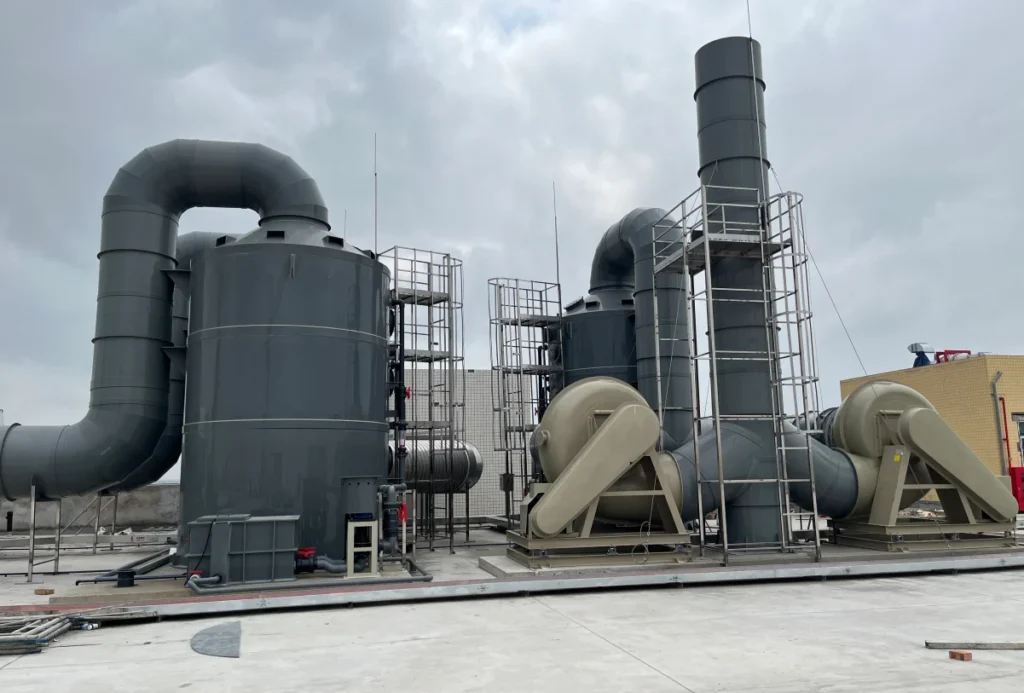
Fume is the most challenging form of industrial particulate to capture. Unlike coarse dust from mechanical processes, fume consists of sub-micron particles formed by condensation of vaporized materials at high temperature – metal oxide fume from welding, acid fume from chemical reactions, or organic fume from thermal decomposition. These particles are too small for spray towers and too hot for fabric filters. A fume scrubber system uses high-energy venturi scrubbing or condensation enhancement to capture sub-micron fume particles and simultaneously absorb any soluble gases present. This guide covers what a fume scrubber system is, the types of scrubbers used for different fume sources, the design parameters for handling hot, reactive fume, and the selection criteria for industrial applications.
Key Takeaways
- A fume scrubber system addresses the most challenging particulate collection problem: sub-micron particles formed at high temperature by condensation of vaporized materials. Unlike dust from mechanical processes, fume particles in the 0.01-1 um range are too small for spray towers and too hot for fabric filters. A venturi scrubber at 75-150 cm WC pressure drop is the standard collection technology, achieving 90-98% efficiency.
- The quench section is the most critical design element for any fume scrubber handling hot gas. The quench cools the fume from inlet temperature to saturation by evaporative cooling, protecting downstream materials and initiating particle growth by condensation. The quench water requirement for a 10,000 m3/h fume stream at 300 deg C is approximately 1.2 m3/h.
- Condensation enhancement can reduce the pressure drop requirement for sub-micron fume collection by 50-75%. Injecting steam before the scrubber causes water to condense on fume particles, increasing their effective mass by 10-100x. The enlarged particles are collectable at 25-50 cm WC instead of the 100+ cm WC needed for the original sub-micron particles.
- The choice between venturi scrubber and wet ESP for fume service depends on the target particle size and the energy cost trade-off. A venturi scrubber handles hot gas and removes soluble gases simultaneously at moderate capital cost but high energy cost. A wet ESP achieves higher fine-particle efficiency at 1/50 the fan energy cost but at 2-4x the capital cost. For fume scrubber systems, see our industrial wet scrubber products → and wet scrubber system configurations →.
What Is a Fume Scrubber System?
A fume scrubber system is a wet scrubber designed to capture fume – fine solid or liquid particulate formed by condensation of vaporized materials (see our wet scrubber dust collector guide -> → for an overview of wet particulate collection). A wet scrubber fume hood integrates the capture hood with the scrubber system. Fume particles are characterized by their small size (0.01-5 um), high number concentration, and often reactive or corrosive chemical composition. A fume scrubber must generate droplets small enough and achieve a high enough relative velocity to capture these sub-micron particles by inertial impaction, and it must handle the elevated gas temperatures and reactive chemistry that distinguish fume from ordinary dust.
How Fume Differs from Dust and Gas
Dust is formed by mechanical processes (crushing, grinding, conveying). Particles are typically 1-100 um, irregular in shape, and chemically similar to the bulk material. Dust can be collected by gravity settling or low-energy impaction.
Fume is formed by condensation of vaporized material. Particles are typically 0.01-1 um, spherical (from liquid droplet formation), and often chemically different from the parent material due to oxidation or reaction during formation. Fume requires high-energy impaction or condensation for collection.
Gas is molecular-level contaminant that requires absorption into a liquid or adsorption onto a solid surface. Gas removal needs high surface area and contact time.
A fume scrubber system must address the sub-micron particle size (requiring venturi or condensation technology) and often the reactive chemistry (requiring chemical reagent injection) simultaneously.
The Unique Challenge of Fume – Sub-Micron, Hot, Reactive
Fume presents three simultaneous challenges (also see our wet particulate scrubber guide -> → for general wet particulate collection):
Sub-micron particle size. Fume particles in the 0.1-1 um range fall in the “Greenfield gap” where neither inertial impaction nor Brownian diffusion is fully effective. Collection requires either high-energy venturi operation at 75-150 cm WC pressure drop or condensation enhancement.
High temperature. Fume is formed at the temperature of the source process. Welding fume exits the arc at 1,000-2,000 deg C. Chemical reactor fume exits at 100-400 deg C. Smelter fume exits at 200-500 deg C. The gas must be quenched to saturation temperature before effective scrubbing can occur.
Reactive chemistry. Metal oxide fume, acid fume, and organic fume are often chemically reactive or corrosive. The scrubber must be constructed from materials that resist the specific chemical attack – FRP for acid fume, stainless steel or lined carbon steel for metal oxide fume.
Wet Scrubber Fume Hood Integration
A wet scrubber fume hood integrates the fume capture hood directly with the scrubber inlet ductwork. The hood design must achieve a capture velocity of 0.5-1.0 m/s at the fume source to prevent fume escape into the work environment. The duct velocity must be maintained above 10-15 m/s to prevent fume particle settling in the ductwork before reaching the scrubber.
Fume Scrubber System Types
Different fume sources require different scrubber configurations. The choice depends on the fume particle size, gas temperature, and chemical composition.
Venturi Scrubber for Sub-Micron Fume
The venturi scrubber is the standard technology for sub-micron fume collection. The throat velocity of 60-120 m/s generates 10-50 um droplets that can capture fume particles down to 0.2 um by inertial impaction. Pressure drops of 75-150 cm WC are typical for fume service, achieving 90-98% collection efficiency for particles in the 0.2-2 um range.
A venturi scrubber for fume service must include a quench section at the converging entry where hot fume gas is cooled to saturation temperature before entering the high-velocity throat. The quench prevents thermal damage to the scrubber and initiates fume particle growth by condensation of water vapor on the fume particles.
Spray Tower for Condensible Fume
For fume streams where the particles are formed by condensation of water-soluble vapors – acid mists from chemical processes, steam-borne organic fume from food processing – a spray tower with fine mist nozzles operating at 5-10 bar pressure can achieve 80-95% capture. The droplets capture the fume particles by inertial impaction and the chemical reagent neutralizes any soluble acid or alkaline components.
Spray towers for condensible fume operate at lower pressure drop (5-15 cm WC) than venturi scrubbers, but they are limited to fume particles above approximately 1-2 um. They are most effective when the fume is formed by condensation within the scrubber itself, where the gas is cooled below the dew point and fume particles nucleate on existing droplets.
Packed Bed for Chemically Reactive Fume
Packed bed scrubbers are used for fume streams where the primary concern is the reactive gas component rather than the particulate – for example, acid fume from chemical reactors containing both fine acid mist and soluble acid gases. The packing provides the extended contact time needed for gas absorption while the tortuous gas path captures some of the entrained mist droplets.
A fume hood scrubber system for a chemical laboratory or pilot plant typically uses a packed bed with PP packing and a caustic or water recirculation system. The hood captures the fume at the source, and the packed bed removes the soluble components before discharge.
Wet ESP as an Alternative to Wet Scrubbing for Fume
Wet electrostatic precipitators (wet ESPs) are increasingly used for sub-micron fume collection as an alternative to high-energy venturi scrubbers. A wet ESP charges the fume particles and collects them on wetted collection plates, achieving 95-99% efficiency for particles in the 0.01-1 um range at a pressure drop of only 1-3 cm WC.
The trade-off is higher capital cost (2-4x a venturi scrubber) and larger footprint. Wet ESPs are preferred for very fine fume (below 0.2 um) where venturi efficiency drops, or for applications where the fan energy savings over 10-15 years justifies the higher capital investment.
Design Parameters for Fume Scrubbers
Quench Section Design for Hot Fume
The quench section is the most critical design element for any fume scrubber handling hot gas. The quench cools the gas from its inlet temperature to the adiabatic saturation temperature (typically 50-80 deg C for most fume streams) by evaporating water injected at the scrubber inlet.
The quench water requirement is calculated from the sensible heat of the gas:
Q_water = (m_gas x Cp_gas x deltaT_gas) / H_vap
For a 10,000 m3/h fume stream at 300 deg C cooled to 70 deg C:
Gas mass flow: approximately 10,000 x 1.2 = 12,000 kg/h
Heat to remove: 12,000 x 1.0 x (300 – 70) = 2,760,000 kJ/h
Water required at 2,260 kJ/kg evaporation: 2,760,000 / 2,260 = 1,221 L/h
The quench section is typically a spray chamber with a residence time of 0.5-1.0 seconds. Full-cone nozzles produce 200-500 um droplets for efficient heat and mass transfer. The quench section must be fabricated from corrosion-resistant material because the cooled, saturated gas is at its most corrosive condition.
Material Selection for High-Temperature, Reactive Fume
The combination of high inlet temperature and reactive fume chemistry limits material options:
Stainless steel (SS316L) is suitable for non-chloride fume streams up to 400 deg C in the quench section. Above 400 deg C, refractory-lined carbon steel is required.
FRP (vinyl ester) is limited to 110 deg C and can be used only after the quench section where gas temperature is below this limit.
Polypropylene (PP) is limited to 80 deg C and is suitable only for the recirculation piping and the packed bed section downstream of the quench.
Refractory linings (silicon carbide, alumina) are used in the quench section and inlet duct for fume streams above 400 deg C.
Fume Hood Scrubber System – Capture Velocity and Duct Design
A scrubber system for fume hood must begin with correct hood and duct design. The capture velocity at the hood face must be adequate to contain the fume: 0.3-0.5 m/s for low-toxicity fume, 0.5-1.0 m/s for toxic or hot fume. The duct transport velocity must exceed 10 m/s for dry fume and 15 m/s for wet or sticky fume to prevent particle settling.
Duct design for fume systems must avoid horizontal sections where fume particles can settle. Vertical or sloped ducts with cleanout ports are standard. Elbows should have a centerline radius of at least 2 duct diameters to minimize particle impaction and erosion.
Condensation Enhancement for Sub-Micron Fume
Condensation enhancement injects steam into the saturated gas stream ahead of the scrubber. The steam condenses on the sub-micron fume particles, increasing their effective mass by 10-100x. The enlarged particles are then collectable by inertial impaction at much lower pressure drop than would be needed for the original particle size. This technique can reduce the pressure drop requirement for sub-micron fume from 100+ cm WC to 25-50 cm WC.
Industrial Applications
Welding Fume – Metal Oxide and Flux Fume
Welding generates fume particles in the 0.01-1 um range, composed of metal oxides from the electrode (iron, manganese, chromium, nickel) and flux compounds. The fume exits the arc at 1,000-2,000 deg C and must be captured at the welding torch by a fume extraction gun or overhead hood. A fume scrubber system for welding fume typically uses a venturi scrubber at 75-100 cm WC pressure drop, achieving 90-95% removal.
The scrubber water chemistry must be maintained at pH 6-8. The collected metal oxide fume accumulates in the recirculating water as a sludge containing the metal oxides. The sludge is filtered and disposed of as industrial waste. For high-volume welding operations (shipbuilding, heavy fabrication), the water treatment system includes a clarifier and filter press to dewater the sludge.
Chemical Process Fume – Reactor and Acid Fume
Chemical reactors produce fume from a combination of vaporized reactants, acid mist from gas evolution in liquid-phase reactions, and thermal decomposition products. The fume is typically hot (100-300 deg C), corrosive (containing HCl, H2SO4, or HF), and sub-micron. A fume hood scrubber system on a chemical reactor vent or sample station uses a packed bed or spray tower with caustic recirculation, constructed from FRP or PP.
The key design requirement for chemical process fume scrubbers is the quench section. The hot, corrosive fume must be cooled below the material temperature limit before it contacts the packing. The quench also removes the bulk of any condensible vapors, reducing the load on the packed bed section.
Smelting and Metallurgical Fume
Non-ferrous smelting (copper, lead, zinc, aluminum) generates fume containing volatile metal oxides (zinc oxide, lead oxide) and acid gases (SO2, HCl) at 200-500 deg C. The fume particles are sub-micron (0.05-0.5 um) and must be collected to meet particulate emission limits and to recover valuable metal values.
A venturi scrubber at 100-150 cm WC is the standard collection technology, followed by a packed bed absorber for SO2 removal if required. The metal oxide sludge from the scrubber water treatment system is sent to a metal recovery facility where the zinc, lead, and other metals are extracted.
Electronics and Soldering Fume
Electronics manufacturing generates fume from soldering operations (rosin flux fume, lead oxide), wave soldering (organic acid fume), and chemical cleaning (solvent vapor). The fume concentration is low but the odor and workplace exposure limits are strict. A packed bed scrubber with water or caustic recirculation is the standard technology for soldering fume. The scrubber construction is typically PVC or FRP.
Selecting the Right Fume Scrubber System
Selection by Fume Temperature and Composition
The selection sequence for a fume scrubber system follows the fume characteristics:
Fume temperature determines whether a quench section is needed and the scrubber material. Above 110 deg C, a quench is required. Above 400 deg C, refractory-lined inlet sections are needed. Below 80 deg C, PP construction is economical.
Fume particle size determines the scrubber type. For d50 above 1 um, a spray tower with high-pressure nozzles or a cyclonic scrubber may be adequate. For d50 below 1 um, a venturi scrubber or wet ESP is required. For d50 below 0.1 um, condensation enhancement or a wet ESP is needed.
Fume chemistry determines the scrubbing reagent and material selection. Acid fume requires caustic recirculation and FRP or PP construction. Metal oxide fume requires pH-neutral water and abrasion-resistant materials. Organic fume may require an oxidizing agent in the scrubbing solution.
Wet Scrubber vs Wet ESP vs Fabric Filter for Fume
| Factor | Venturi Scrubber | Wet ESP | Fabric Filter |
|---|---|---|---|
| Particle size (d50) | >0.2 um | >0.01 um | >0.3 um |
| Efficiency | 90-98% | 95-99% | 99%+ |
| Max temp | No limit (quench) | 80 deg C (FRP) | 260 deg C |
| Pressure drop | 75-150 cm WC | 1-3 cm WC | 10-20 cm WC |
| Annual fan cost* | $140,000-280,000 | $1,800-5,600 | $18,000-37,000 |
| Capital cost | Moderate | High | Moderate |
| Gas removal | Combined | Separate needed | Separate needed |
*Based on 50,000 m3/h at rated pressure drop
The venturi scrubber is the standard choice for hot fume where simultaneous gas removal is needed. The wet ESP is the standard choice for very fine fume (below 0.2 um) where energy cost must be minimized. The fabric filter is the standard choice for dry fume at moderate temperature where the fume particles are not sticky or hygroscopic.
Scrubbing System for Fume Hood – Cost and Performance
A scrubber system for fume hood in a laboratory or pilot plant is typically 500-5,000 m3/h capacity, with a packed bed of 2-3 meters depth and water or caustic recirculation. The capital cost is $5,000-25,000 depending on the material (PP is most common), the recirculation pump size, and the instrumentation. The annual operating cost is $500-2,000 for electricity and $200-500 for chemicals.
Frequently Asked Questions
What is a fume scrubber system?
A fume scrubber system is a wet scrubber designed to capture fine particulate fume (0.01-5 um particles formed by condensation of vaporized materials) from high-temperature industrial exhaust streams. It typically uses a venturi scrubber for sub-micron particle capture with a quench section to cool the hot gas.
How is fume different from dust?
Dust is formed by mechanical processes; particles are 1-100 um and solid. Fume is formed by condensation of vaporized material; particles are 0.01-1 um, often spherical, and formed at high temperature. Fume is more difficult to capture because the particles are smaller and more numerous per unit mass.
What is the best scrubber for welding fume?
A venturi scrubber at 75-100 cm WC pressure drop is the standard technology for welding fume, achieving 90-95% removal of sub-micron metal oxide fume particles. The scrubber includes a quench section at the inlet to cool the fume from arc temperature to saturation temperature.
Can a fume hood scrubber system handle multiple workstations?
Yes. A central fume hood scrubber system can serve multiple laboratory hoods, welding stations, or process vents through a common ductwork system. The duct velocities must be maintained above 10 m/s to prevent fume particle settling. The scrubber is sized for the combined flow from all connected hoods.
Is a wet scrubber or wet ESP better for fume control?
A venturi wet scrubber is better when the fume gas also contains soluble gases (acid vapor, organic vapors) that must be removed simultaneously. A wet ESP is better for very fine fume (below 0.2 um) where minimum energy consumption and maximum fine particle collection are the priorities. The wet ESP capital cost is 2-4x higher but the operating cost is 10-20x lower.