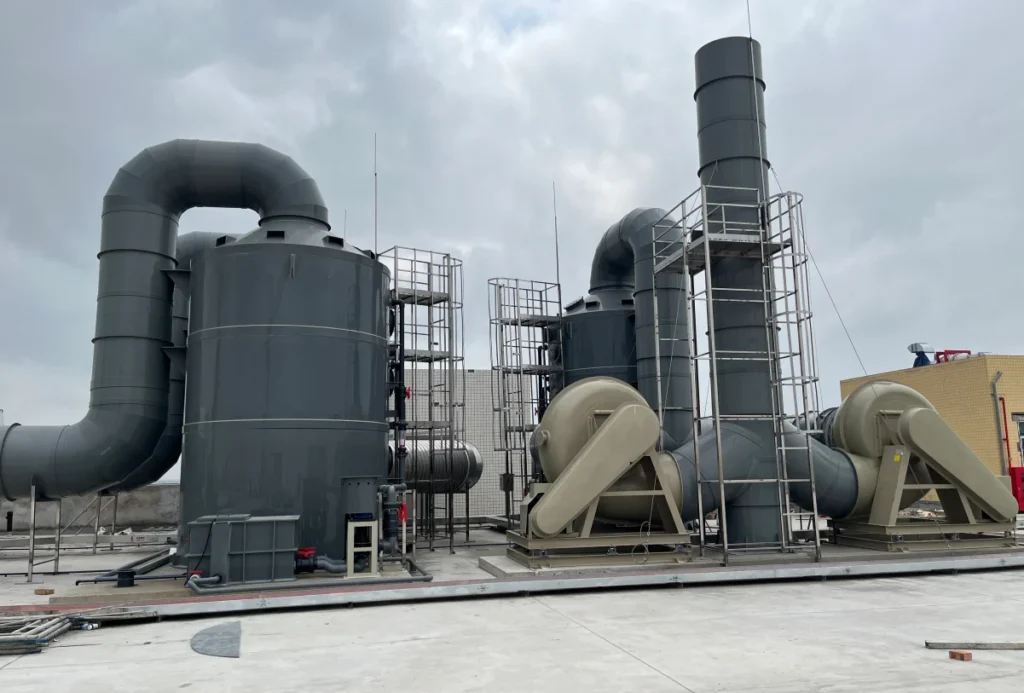
Every wet scrubber – spray tower, packed bed, or venturi – produces cleaned gas that carries entrained liquid droplets from the scrubbing process. Without a properly designed mist eliminator, those droplets exit the stack as a visible plume, carrying dissolved pollutants into the atmosphere and causing downstream corrosion in ductwork and fans. A mist eliminator for wet scrubber is the final stage that separates these droplets before discharge, returning them to the scrubber sump. This guide covers what mist eliminators are, the four main types (chevron vane, mesh pad, cyclonic, and candle filter), the design parameters that determine droplet capture efficiency, selection criteria by gas condition, and maintenance practices to prevent scaling and fouling.
Key Takeaways
- A mist eliminator for wet scrubber is essential for preventing visible plume emissions, protecting downstream equipment, and ensuring regulatory compliance. Without it, 0.1-5% of the scrubbing liquid by volume can carry over to the stack, carrying dissolved pollutants and causing permit violations. The cost of a mist eliminator replacement ($2,000-15,000) is small compared to fan repair, stack corrosion, and fine costs.
- The chevron vane mist eliminator is the standard choice for most wet scrubber applications, offering the best balance of efficiency, pressure drop, and solids tolerance. It operates at 2-5 m/s gas velocity with a cut size of 10-20 um and a pressure drop of 0.5-1.5 cm WC. Mesh pads provide higher efficiency (cut size 3-10 um) for clean gas at lower pressure drop. Cyclonic eliminators handle heavy solids loads without internal plugging. Candle filters achieve sub-micron capture for acid plant service at 10-30 cm WC pressure drop.
- Scaling from salt crystallization is the most common cause of mist eliminator failure. The blowdown rate must maintain TDS below the solubility limit of the least-soluble reaction product. Gypsum solubility is approximately 2.5 g/L, NaF is approximately 40 g/L. Quarterly inspection with a 50% pressure drop increase threshold triggers cleaning. Online water wash systems can extend the interval between manual cleanings.
- Material selection follows the same rules as the scrubber vessel: PP to 80 deg C for acid service, FRP to 110 deg C for strong oxidizers, SS for high-temperature non-chloride service, and PTFE for the most corrosive environments. The mist eliminator material must be compatible with both the gas chemistry and the scrubbing liquid chemistry. For mist eliminator systems, see our industrial wet scrubber products → and wet scrubber system configurations →.
What Is a Mist Eliminator for Wet Scrubber?
A mist eliminator for wet scrubber is a device installed at the gas outlet of a wet scrubber (see our wet scrubber dust collector guide →) that removes entrained liquid droplets from the cleaned gas stream before discharge to the atmosphere. The droplets – typically 1-500 um in diameter – contain water, dissolved pollutants (salts, acids), and captured particulate. A wet scrubber mist eliminator works by forcing the gas to change direction abruptly (chevron vane), pass through a fibrous mat (mesh pad), spin in a cyclonic pattern, or pass through a high-efficiency filter element (candle filter). In each case, the liquid droplets cannot follow the gas flow path and impact a surface, coalesce into larger droplets, and drain back into the scrubber.
Why Every Wet Scrubber Needs a Mist Eliminator
Without a mist eliminator, the liquid loading leaving the scrubber can be 0.1-5% of the recirculation rate by volume – enough to cause visible emissions, corrosion damage, and permit violations. A properly designed mist eliminator reduces the outlet liquid content to below 0.01% (100 ppm by weight), which is invisible to the eye and acceptable for most regulatory permits.
Without a Mist Eliminator: Visible Plume, Corrosion, Permit Violations
In venturi scrubbers operating at high pressure drop, the mist eliminator must handle droplet loadings of 1-5 g/m3 at velocities up to 3 m/s. In spray towers, the loading is lower (0.1-1 g/m3) but the droplets are larger. The cost of a mist eliminator replacement ($2,000-15,000 for most systems) is small compared to the cost of fan repair, stack corrosion, and permit violation fines.
How Mist Eliminators Work – Droplet Coalescence
All mist eliminators operate on the same principle: force the gas to change direction while the liquid droplets, due to their higher inertia, continue moving toward a surface where they impact, coalesce, and drain. The efficiency depends on the droplet size, the gas velocity, and the droplet’s inertia relative to the gas streamlines. The cut size (d50) of a mist eliminator – the droplet diameter at which 50% of droplets are captured – depends on the design geometry and gas velocity. A typical chevron vane has a d50 of 10-20 um at 3-5 m/s gas velocity. A mesh pad has a d50 of 3-10 um. A candle filter has a d50 below 1 um.
The Cost of a Failed Mist Eliminator
A failed or undersized mist eliminator degrades the performance of the entire scrubber system. Visible plume emissions from the stack indicate that liquid – and the pollutants dissolved in it – is being discharged to the atmosphere. Downstream fans and ductwork suffer from corrosion and solids accumulation. The EPA identifies mist eliminator plugging and liquid re-entrainment as common operating problems in wet scrubber systems.
Types of Mist Eliminators
Chevron Vane – Standard for Most Services
The chevron vane mist eliminator for wet scrubber consists of parallel profiled blades. This type of mist eliminator for wet scrubber handles moderate droplet loadings arranged in a zigzag pattern. The gas passes through the spaces between the blades, and liquid droplets impact the blade surfaces due to their inertia. The captured liquid coalesces on the blade surface and drains downward through drainage hooks or channels. Chevron vane mist eliminators are the standard choice for most wet scrubber applications. They handle moderate droplet loadings (up to 5 g/m3), operate at 2-5 m/s gas velocity with a pressure drop of 0.5-1.5 cm WC, and achieve a cut size of 10-20 um. They are available in polypropylene for acid service, stainless steel for high-temperature service, and FRP for corrosive chemical service.
Cut Size 10-20 um, Pressure Drop 0.5-1.5 cm WC
The chevron vane design is self-draining in the vertical orientation (gas flowing upward, liquid draining downward) and resists plugging when the gas velocity is above the minimum drainage velocity of approximately 2 m/s. Below 2 m/s, the liquid may not drain properly and the mist eliminator can flood.
Mesh Pad – High Efficiency for Clean Gas
A mesh pad mist eliminator consists of a bed of knitted wire or plastic mesh, typically 100-200 mm thick, supported on a grid. The gas passes through the mesh, and the fine filaments intercept droplets by impaction and interception. Mesh pads achieve a cut size of 3-10 um at a pressure drop of 0.3-1.0 cm WC. They are the standard choice for clean gas streams where the highest droplet capture efficiency is required and the gas is free of solids that would plug the mesh. The limitation of mesh pads is their tendency to plug when the gas stream contains suspended solids, scale-forming compounds, or sticky particulates. Mesh pads are available in wire (stainless steel, Monel, Hastelloy) for high-temperature service up to 400 deg C, or in plastic (polypropylene, PVDF, PTFE) for corrosive chemical service up to 150 deg C. The wire diameter typically ranges from 0.1-0.3 mm, and the void fraction is 97-99%, providing minimal gas flow resistance.
Cyclonic – Self-Cleaning for High Solids
A cyclonic mist eliminator uses tangential gas entry to spin the gas stream in a cylindrical or conical vessel. The centrifugal force drives droplets to the vessel wall, where they coalesce and drain downward. Cyclonic mist eliminators have no internal elements and are therefore immune to plugging by solids. They are used in venturi scrubber systems where the gas stream carries high solids loading. The cut size is typically 15-30 um at a pressure drop of 2-5 cm WC. Cyclonic eliminators are larger than other types for the same gas flow, requiring 2-3x the vessel diameter of a chevron vane unit. The tangential inlet velocity is typically 10-20 m/s, and the body diameter is selected to achieve a gas velocity of 1-3 m/s at the outlet.
Candle Filter – Sub-Micron Capture for Acid Plants
Candle filters consist of a bundle of elongated filter elements (candles) made from fiberglass, PTFE, or ceramic fibers. The gas passes from the outside to the inside of each candle, and droplets are captured by the fiber matrix. Candle filters achieve the highest capture efficiency of any mist eliminator type, with a cut size below 1 um, at a pressure drop of 10-30 cm WC. They are used for high-performance applications such as sulfuric acid plant mist eliminators, where sub-micron acid mist must be removed to meet stringent emission limits. They are the most expensive type and require periodic replacement of the candle elements.
Design Parameters for Mist Eliminators
Gas Velocity and Flooding Limits
The correct mist eliminator for wet scrubber must be sized for the appropriate gas velocity. Selecting a mist eliminator for wet scrubber requires matching the velocity to the type: chevron vanes at 2-5 m/s, mesh pads at 1-4 m/s.
The gas velocity through the mist eliminator is the primary design parameter. For chevron vane mist eliminators, the recommended velocity is 2-5 m/s. Below 2 m/s, liquid drainage is poor and the eliminator may flood. Above 5 m/s, re-entrainment occurs – captured droplets are stripped from the vane surfaces and re-entrained in the gas stream. For mesh pads, the recommended velocity is 1-4 m/s. Below 1 m/s, the impaction velocity is too low for efficient droplet capture. Above 4 m/s, the mesh pad can flood.
Pressure Drop Across the Mist Eliminator
The pressure drop across a clean mist eliminator is low: 0.5-1.5 cm WC for chevron vanes, 0.3-1.0 cm WC for mesh pads, 2-5 cm WC for cyclonic types, and 10-30 cm WC for candle filters (consistent with EPA wet scrubber monitoring data). Pressure drop increases as the mist eliminator accumulates solids or scale. A 50% increase above the clean baseline indicates that cleaning or replacement is needed.
For comparison with general wet particulate collection, see our wet particulate scrubber guide →.
Capture Efficiency by Droplet Size – Comparison Table
The capture efficiency varies by mist eliminator type and droplet size. The following table shows the approximate cut size (d50) for each type:
| Type | Cut Size (d50) | Efficiency at 50 um | Efficiency at 10 um | Pressure Drop |
|---|---|---|---|---|
| Chevron vane | 10-20 um | 99%+ | 30-70% | 0.5-1.5 cm WC |
| Mesh pad | 3-10 um | 99.9%+ | 80-95% | 0.3-1.0 cm WC |
| Cyclonic | 15-30 um | 95%+ | 20-50% | 2-5 cm WC |
| Candle filter | <1 um | 99.99%+ | 99.9%+ | 10-30 cm WC |
Cut Size (d50) vs Type
The cut size determines the smallest droplet diameter at which the mist eliminator captures 50% of incoming droplets. For general scrubber service where outlet droplet loading is not critical, a chevron vane with d50 of 15 um is adequate. For applications requiring invisible emissions, a mesh pad with d50 of 5 um is the minimum. For acid mist or sub-micron droplet capture, a candle filter with d50 below 1 um is necessary.
Material Selection for Corrosive Service
The material of a mist eliminator for wet scrubber must withstand both the gas chemistry and the scrubbing liquid chemistry. A mist eliminator for wet scrubber in acid gas service requires PP or FRP construction.
Polypropylene (PP) is the standard material for acid gas scrubber mist eliminators up to 80 deg C. FRP (vinyl ester) is used for higher temperatures (up to 110 deg C) and for chlorine or strong oxidizer service. Stainless steel (SS304/SS316L) is used for high-temperature service above 80 deg C where the gas does not contain chlorides. PTFE (Teflon) is used for the most corrosive services, including wet chlorine and mixed acid service, with unlimited chemical resistance up to 200 deg C.
Mist Eliminators for Wet Scrubber Systems – Selection
Selecting the right mist eliminator for wet scrubber requires evaluating the gas conditions and performance requirements. Each mist eliminator for wet scrubber type has specific strengths and limitations.
The selection of mist eliminators for wet scrubber systems follows the gas stream characteristics and the required outlet droplet content.
Selection by Gas Cleanliness and Temperature
Clean gas (no suspended solids, no scale-forming compounds): a mesh pad mist eliminator provides the highest capture efficiency at the lowest pressure drop. The mesh material should be compatible with the gas chemistry.
Dirty gas (suspended solids, scale-forming compounds, high TDS): a chevron vane mist eliminator is the standard choice. The open vane geometry resists plugging, and the self-draining design prevents solids accumulation. For extremely dirty gas with heavy solids loading, a cyclonic mist eliminator is the most reliable choice because it has no internal surfaces to foul.
Hot gas (above 80 deg C): stainless steel chevron vanes or ceramic candle filters are required. Polypropylene and FRP mist eliminators are not suitable above their temperature limits. Corrosive gas (Cl2, HCl, HF, strong oxidizers): FRP or PTFE mist eliminators are required. Stainless steel is not acceptable for HCl or HF service regardless of temperature.
Selection by Required Outlet Droplet Content
The allowable outlet droplet content determines the required cut size. For general industrial applications where a visible plume is unacceptable but trace liquid carryover is tolerable, a chevron vane with a cut size of 15 um is adequate. For applications requiring invisible emissions, a mesh pad with a cut size of 5 um is the minimum. For sulfuric acid mist or other regulated emissions where sub-micron droplet capture is required, a candle filter is necessary.
Comparison Table – Four Types Side by Side
| Factor | Chevron Vane | Mesh Pad | Cyclonic | Candle Filter |
|---|---|---|---|---|
| Cut size (d50) | 10-20 um | 3-10 um | 15-30 um | <1 um |
| Pressure drop | 0.5-1.5 cm WC | 0.3-1.0 cm WC | 2-5 cm WC | 10-30 cm WC |
| Max gas velocity | 5 m/s | 4 m/s | 6 m/s (inlet) | 1-2 m/s |
| Solids tolerance | Good | Poor | Excellent | Poor |
| Relative cost | Low | Low | Medium | High |
| Best for | General service | Clean gas, high efficiency | Dirty gas | Sub-micron mist |
Operation, Fouling, and Maintenance
A mist eliminator for wet scrubber requires regular inspection to maintain performance. The mist eliminator for wet scrubber is the most maintenance-critical component after the spray nozzles.
Scaling and Salt Crystallization Prevention
The most common cause of mist eliminator failure is scaling – the accumulation of dissolved solids that precipitate on the vane or mesh surfaces. This occurs when the recirculating liquid TDS exceeds the solubility limit of the least-soluble reaction product. For a mist eliminator for wet scrubber in acid gas service, the primary scaling risks are gypsum (CaSO4) in limestone FGD systems with solubility of approximately 2.5 g/L, sodium fluoride (NaF) in HF scrubbing with solubility of approximately 40 g/L, and calcium carbonate in hard water service.
The blowdown rate must be set to maintain the TDS below the solubility limit. A wet scrubber mist eliminator in FGD service faces gypsum scaling as the primary risk. Quarterly inspection with a 50% pressure drop increase threshold triggers cleaning. An online water wash system that sprays the mist eliminator from above during operation can prevent scale from accumulating.
Cleaning Methods
Online water wash is effective for light to moderate fouling. A spray header above the mist eliminator sprays water (or dilute acid for caustic service) onto the vane or mesh surface. Online washing can be performed during normal operation without scrubber shutdown. The wash frequency depends on the scaling tendency: systems with high TDS blowdown may need daily washing for 5-10 minutes, while systems with clean recirculating water may only need monthly washing.
Offline chemical cleaning is required for heavy scale. The scrubber is shut down, and the mist eliminator is sprayed or soaked with a cleaning solution. Dilute HCl removes carbonate scale. Caustic solution removes organic fouling. High-pressure water jetting at 2,000-5,000 psi removes hard scale.
Physical removal and replacement is needed when the mist eliminator is damaged or when repeated cleaning no longer restores performance. A chevron vane can be removed in sections, cleaned, and reinstalled. Mesh pads are typically replaced rather than cleaned because the mesh is difficult to clean completely.
Inspection Frequency and Replacement Schedule
| Type | Inspection | Cleaning | Replacement |
|---|---|---|---|
| Chevron vane | Quarterly | As needed (1-3 years) | 8-15 years |
| Mesh pad | Quarterly | As needed (6-18 months) | 3-7 years |
| Cyclonic | Semi-annual | Rarely needed | 15-20 years |
| Candle filter | Annual | Not cleanable | 2-5 years |
A wet scrubber quenching condenser in the same system may concentrate dissolved solids through evaporation, accelerating scaling in the mist eliminator section. A properly designed wet scrubber quenching condenser positioned upstream of the mist eliminator helps control temperature. For this reason, the mist eliminator inspection schedule should be coordinated with the quench section maintenance.
Frequently Asked Questions
What is a mist eliminator for wet scrubber?
A mist eliminator for wet scrubber is a device installed at the scrubber gas outlet that removes entrained liquid droplets from the cleaned gas stream before discharge. It prevents visible plume emissions, protects downstream equipment from corrosion, and reduces pollutant emissions. The four main types are chevron vane, mesh pad, cyclonic, and candle filter.
What are the main types of mist eliminators?
The four main types: chevron vane (standard, cut size 10-20 um), mesh pad (high efficiency for clean gas, cut size 3-10 um), cyclonic (self-cleaning for dirty gas, cut size 15-30 um), and candle filter (sub-micron, cut size below 1 um). Each type is suited to different gas conditions and outlet requirements.
What causes mist eliminator fouling?
The primary cause is salt crystallization when the recirculating liquid TDS exceeds the solubility limit of the dissolved reaction products. For limestone FGD systems, gypsum scaling is the main problem. For HF scrubbers, NaF precipitation. Quarterly inspection and online water washing are standard prevention methods.
How do I select the right mist eliminator for my scrubber?
Select based on gas cleanliness and the required outlet droplet content. Clean gas with high efficiency requirement: mesh pad. Dirty gas with solids: chevron vane. Heavy solids loading: cyclonic. Sub-micron mist (acid plants): candle filter. Also consider gas temperature and corrosivity for material selection. PP to 80 deg C, FRP to 110 deg C, SS above 80 deg C.
How often should a mist eliminator be cleaned?
Inspect quarterly. Clean when pressure drop increases by 50% above the clean baseline or when visible plume appears. Chevron vanes in clean service need cleaning every 1-3 years. Mesh pads in dirty service require cleaning every 6-18 months.