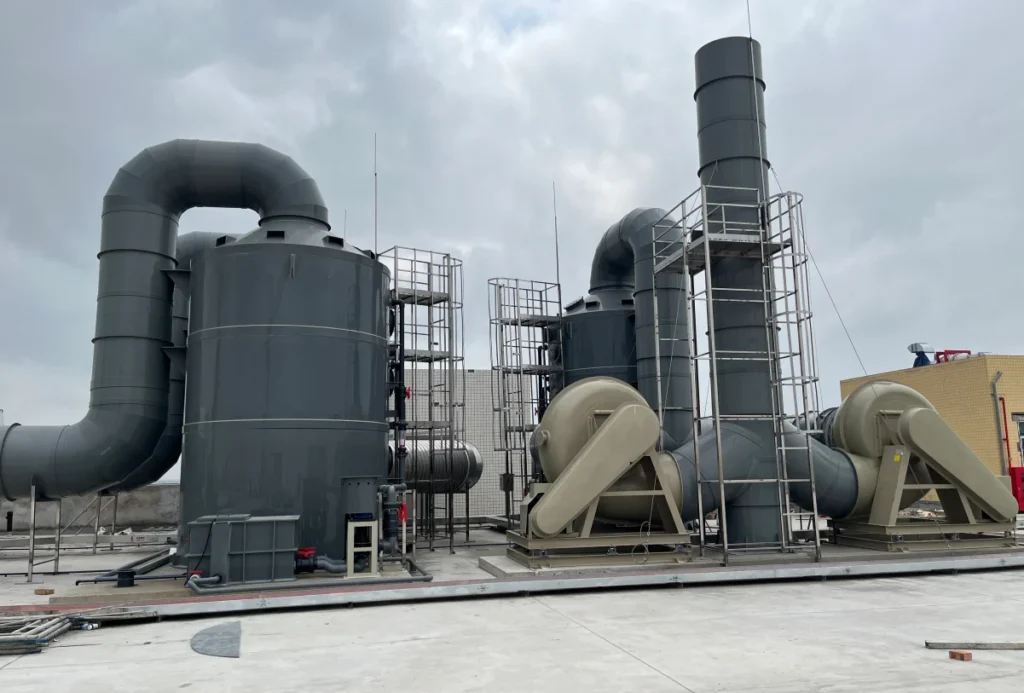
The term air scrubber system names three different products that all clean air but work by different mechanisms. In industrial service, an air scrubber is a wet scrubber that removes pollutants from process exhaust before discharge. In restoration and remediation, an air scrubber is a portable filtration unit that removes dust, mold spores, and odors from indoor air. In indoor air quality, an air scrubber UV system uses ultraviolet light to purify the air. Selecting the right one depends entirely on the application, because a portable filtration unit cannot remove gas-phase pollutants and a UV unit cannot remove particulates. This guide resolves the three meanings, covers the air scrubber filtration, UV, and ventilation system variants, and provides a selection path matched to the application.
Key Takeaways
- Air scrubber system is an ambiguous term with three meanings: the industrial wet scrubber for process exhaust, the portable air scrubber filtration system for indoor dust and odor, and the air scrubber UV system for biological control in indoor air. The selection starts with the contaminant.
- The industrial wet scrubber removes gas-phase pollutants at 95-99% efficiency for soluble gases and 70% to over 99% for particulates, falling to greater than 50% for submicron particles, discharging the cleaned air to the atmosphere and the pollutant in the liquid blowdown.
- The air scrubber filtration system is a portable unit with HEPA and carbon filters rated at 99.97% capture at 0.3 microns, and it adsorbs odors, used in restoration and remediation at 300-2,000 cfm.
- The air scrubber UV system uses 254-nanometer ultraviolet-C light, often with a photocatalyst, to inactivate microorganisms and oxidize low-concentration volatile compounds, and it does not remove particulates or high-concentration gases.
- The air scrubber ventilation system integrates the scrubber into the capture-to-discharge ventilation chain, with the fan sized for the total pressure drop of the hoods, ductwork, and scrubber. The specialty scrubber applications are covered in the ethylene, CO2, and flue gas scrubber guides.
What Is an Air Scrubber System?
An air scrubber system is any equipment that removes contaminants from an air stream, and the meaning of the term changes with the application. The industrial air scrubber removes pollutants from process exhaust. The portable air scrubber removes dust and spores from indoor air. The UV air scrubber purifies indoor air with ultraviolet light. All three clean air, but the removal mechanism and the target contaminant are different, which is why the selection must start with the application.
The Three Meanings of Air Scrubber
The first meaning is the industrial wet scrubber, which contacts the air with a liquid to remove gaseous pollutants and particulates. This is the gas scrubber family covered across this site, and it is the meaning relevant to manufacturing, chemical, and process exhaust. The second meaning is the portable air scrubber filtration unit, a fan-powered box with HEPA and carbon filters that recirculates indoor air to remove dust, mold spores, smoke, and odors, used widely in restoration and remediation. The third meaning is the UV air scrubber, which uses ultraviolet light, often combined with a catalyst, to inactivate microorganisms and oxidize volatile compounds in indoor air. The three meanings serve the same purpose from different directions, and the term alone does not identify the equipment.
Industrial vs Indoor Air Scrubbing
The industrial and indoor applications differ in the air volume, the contaminant, and the discharge. The industrial air scrubber handles a large process air flow, removes a defined pollutant load, and discharges the cleaned air to the atmosphere through a stack, meeting an emission limit. The indoor air scrubber handles a smaller recirculated air volume, removes the contaminants present in the occupied space, and discharges the cleaned air back into the room. The selection between them is set by the location of the problem: an industrial exhaust needs an industrial wet scrubber, while a contaminated indoor space needs a filtration or UV unit. The same wet scrubbing technology appears in both the marine and the industrial contexts covered in the scrubber oil and gas guide.
The Common Air Cleaning Principle
All three meanings share a common principle: the air is moved through a medium that removes the contaminant, and the cleaned air is returned or discharged. The wet scrubber uses a liquid medium, the filtration unit uses a solid filter medium, and the UV unit uses light energy. The removal target is the difference. A wet scrubber removes soluble gases and particles by absorption and impaction. A HEPA filter removes particles down to 0.3 microns by physical interception. A UV unit inactivates microorganisms and oxidizes some volatile compounds. Choosing the medium that matches the contaminant is the core of the air scrubber system selection, and each meaning of the term is the right answer for the contaminant it is designed to remove.
The air scrubber system terminology also varies by region and industry. In the restoration industry, air scrubber always means the portable filtration unit. In the pollution control industry, it means the wet scrubber. In the HVAC industry, it can mean the UV or filter-based unit. A buyer asking for an air scrubber system should specify the application and the contaminant, because the supplier needs to know which meaning of the term the purchase requires. The air scrubber system guide resolves the ambiguity by covering all three meanings, and the application determines which one the buyer needs.
The Industrial Air Scrubber (Air Pollution Control)
The industrial air scrubber system is the wet scrubber that removes pollutants from process exhaust before the air is released to the atmosphere, and it is the meaning of the term most relevant to manufacturing and process facilities.
The Wet Air Scrubber for Process Exhaust
The wet air scrubber contacts the process exhaust with a scrubbing liquid in a packed bed, a spray chamber, or a venturi, transferring the pollutants from the gas phase to the liquid phase. The cleaned air exits through a stack, and the pollutant leaves in the liquid blowdown. The wet air scrubber handles the acid gases, alkaline vapors, and particulates generated by the process, and it is sized for the exhaust flow and the pollutant load. The technology is the same wet scrubber family covered in the wet scrubber guide, and the exhaust treatment chemistry is detailed in the toxic gas scrubber guide.
Pollutants and Removal Efficiency
The wet air scrubber removes the pollutants that dissolve in or react with the scrubbing liquid. A packed bed scrubber removes soluble acid and alkaline gases at 95-99% efficiency, the range EPA attributes to control device vendors, while a venturi scrubber removes particulate from 70% to over 99%, with the highest collection efficiency in the 0.5-5 um band. Submicron particles are the harder case rather than the easier one: EPA’s cost manual chapter on wet scrubbers reports greater than 50% collection for submicron particles and 70% to 99% for particles larger than 1 um in diameter. The removal target is set by the emission limit the facility must meet, and the scrubber is designed so the outlet concentration satisfies the permit at the peak load. The removal efficiency depends on the pollutant solubility, the liquid-to-gas ratio, and the contact zone, and the EPA cost manual chapter on wet scrubbers for particulate matter documents how the achievable performance varies by scrubber type and by pollutant class. The dry scrubber vs wet scrubber guide covers the choice where a dry sorbent alternative applies.
Industrial Air Scrubber Selection
The industrial air scrubber selection starts with the pollutant and the flow. A facility treating acid gas from a process vent selects a packed bed wet scrubber. A facility treating sub-micron fume selects a venturi. A facility with a coarse particulate and a light gas load selects a spray chamber, which EPA’s spray tower fact sheet rates at 70% to over 99% particulate removal, with cyclonic spray towers at the high end of that range and a capital cost EPA puts at $4,200 to $13,000 per cubic meter per second of gas flow. The selection also covers the material, the instrumentation, and the discharge, because the scrubber must match the exhaust chemistry and meet the water discharge permit. The industrial air scrubber is sized on the measured exhaust flow and pollutant concentration, and a facility that specifies the unit on the full gas characterization receives a scrubber that meets the duty. This is the meaning of air scrubber that the rest of the Xicheng scrubber guides cover, and it is the equipment that keeps the process exhaust inside its emission limit.
The industrial air scrubber also serves the facility’s odor and fugitive emission control. A plant that generates an odorous exhaust, such as a wastewater headworks, a rendering plant, or a food processor, uses an air scrubber to remove the odorous compounds before the air is discharged, preventing the odor complaints that draw regulatory attention. The odor-control air scrubber is the same wet scrubber equipment, sized for the exhaust flow and the odor compound, and it is often combined with an activated carbon polishing stage. The air scrubber system in this role protects the facility’s community relationship as much as its emission compliance, and the odor load is treated with the same design discipline as any pollutant.
The Air Scrubber Filtration System
The air scrubber filtration system is the portable, fan-powered unit that recirculates indoor air through filters to remove dust, mold spores, smoke, and odors, and it is the meaning of air scrubber used in restoration and indoor air quality.
Portable Air Scrubber Units
A portable air scrubber is a self-contained unit with a fan and a filter bank, typically HEPA and activated carbon. The fan draws the room air through the filters and returns the cleaned air, and the unit is moved from room to room to treat the contaminated space. The HEPA filter is rated at 99.97% capture for particles of 0.3 microns, the size at which the HEPA class is defined, capturing dust, mold spores, and airborne particulates. The activated carbon filter removes the volatile compounds and odors that the HEPA cannot. The unit is rated by its airflow, typically 300-2,000 cubic feet per minute, and the capacity is matched to the room volume and the contamination level. The portable air scrubber is the standard tool for restoration work after water damage, fire, and mold remediation, and it operates as a negative-air machine when connected to a window exhaust.
Note on filter ratings The 0.3 micron / 99.97% figure quoted above is the basis on which the HEPA grade is classified, not a measured performance of any particular portable unit. Delivered efficiency depends on the filter class specified, on the seal between the filter and its frame, and on the airflow the unit actually delivers. Specify a portable air scrubber by its filter class and its rated airflow, and confirm the indoor result with a particulate measurement rather than from the filter grade alone. The airflow and equipment-cost ranges in this guide are indicative engineering figures for budgeting, not values taken from a published standard.
Restoration, Mold, and Odor Service
The filtration air scrubber serves the restoration and remediation market. After a water loss, the unit removes the mold spores and the airborne dust generated by the drying process. After a fire, it removes the smoke particles and the odor. In a remediation project, the unit is set up to create a negative-pressure containment that keeps the mold spores from spreading to the rest of the building. The filtration system handles the particulates and the odors in the occupied space, and it does not remove gas-phase pollutants at a high concentration, which is the domain of a wet scrubber. The filtration and adsorption media are covered in the activated carbon adsorption equipment product range. The division of labour between a filter and an absorber follows the same line EPA draws for industrial gas cleaning, where packed bed absorbers are applied to gas absorption rather than to particulate removal because a high dust load builds up on the packing and plugs the bed.
Filtration vs Wet Scrubbing
The filtration system and the wet scrubber remove different contaminants. The filtration unit removes particulates and adsorbed odors but does not remove water-soluble gases at a high rate. The wet scrubber removes soluble gases and particulates but requires a water source and a discharge. A restoration contractor uses filtration units for indoor mold and dust, while a factory uses a wet scrubber for process exhaust. The selection is set by the contaminant and the location: an air scrubber filtration system for the indoor occupied space, and an industrial wet scrubber for the process exhaust. The two serve different problems, and the confusion between them is the reason the term needs the resolution this guide provides.
The air scrubber filtration system is also used in industrial settings for dust control and contamination protection. A manufacturing cleanroom or a sensitive process area uses the filtration units to keep the airborne particulate below the contamination limit, and a facility with a dusty operation uses them to protect the workers and the equipment. The filtration units are rated by the HEPA efficiency and the airflow, and the number of units is matched to the room volume and the air-change requirement. The filtration air scrubber and the industrial wet scrubber serve different parts of the same facility, and a plant often uses both: the wet scrubber on the process exhaust and the filtration unit on the occupied or clean space.
The Air Scrubber UV System
The air scrubber uv system uses ultraviolet light, often combined with a photocatalytic catalyst, to purify indoor air, and it is the meaning of air scrubber used in indoor air quality and HVAC treatment.
UV-C Air Purification
A UV air scrubber exposes the passing air to ultraviolet-C light at a wavelength near 254 nanometers, which inactivates microorganisms by damaging their DNA. The UV lamp is mounted in the airstream, and the air passing over the lamp is treated as it flows. Many UV air scrubbers add a titanium dioxide photocatalyst that reacts with the UV light to oxidize volatile organic compounds and odors, converting them to carbon dioxide and water. The UV system is installed in the HVAC duct, at the air handler, or as a stand-alone unit, and it treats the air continuously as the system recirculates. The UV air scrubber removes biological contaminants and oxidizes some volatile compounds. What governs the inactivation is the dose delivered to the microorganism, the product of lamp intensity and exposure time, rather than the lamp wattage on its own, so the unit is specified by its rated airflow at a stated dose and by its lamp life at that dose. That is why the lamp replacement interval is a performance parameter and not a maintenance convenience.
UV System Applications and Limits
The UV air scrubber suits applications where the target is biological or low-concentration odor. It controls mold and bacteria in HVAC systems, treats the air in occupied spaces, and reduces the odors from a modest volatile load. The UV system does not remove particles, which need a filter, and it does not remove high-concentration gases, which need a wet scrubber or an adsorption bed. The UV dose is the design parameter: the effectiveness depends on the lamp intensity, the exposure time, and the airflow, and the system is sized for the residence time the microorganisms need. The UV air scrubber is a complement to filtration, not a replacement, and a complete IAQ system often combines a filter with a UV stage.
UV vs Wet Scrubbing for Odor
The UV air scrubber and the wet scrubber both treat odor, but at different scales and mechanisms. The UV system oxidizes low-concentration odors in indoor air with no water and no discharge. The wet scrubber absorbs high-concentration odorous gases from a process exhaust with a scrubbing liquid. A wastewater plant headworks with a high odor load uses a wet scrubber or an activated carbon system; an office with a modest odor uses a UV unit. The selection is set by the concentration and the flow: the UV system for the indoor low-load application, and the wet scrubber for the industrial high-load exhaust. The two are not competitors; they serve the odor problem at the scale where each is effective.
The UV air scrubber is selected where the biological load is the target and the air is recirculated. A hospital, a food processing facility, or a commercial building installs the UV units in the HVAC system to control the microbial growth that the filters cannot remove. The UV dose and the lamp life are the operating inputs, and the lamps are replaced on the rated interval to hold the inactivating dose. The UV air scrubber is a maintenance item as much as an installation, because the lamps degrade with operating hours, and a system with worn lamps treats the air at a fraction of its rated performance. The air scrubber system selection includes the operating cost of the lamp replacement, which is small next to the biological protection the system provides.
The Air Scrubber Ventilation System
The air scrubber ventilation system is the integration of a scrubber into the building or process ventilation, treating the exhausted air as part of the capture-to-discharge chain, and it is the meaning of air scrubber most relevant to industrial ventilation.
Integrating the Scrubber into Ventilation
The air scrubber ventilation system places the scrubber in the ventilation path so the air exhausted from the process or the building passes through the scrubber before it is discharged. The capture hoods pull the contaminated air from the source, the ductwork carries it to the scrubber, and the cleaned air exits through the stack. The scrubber treats the ventilation air the same way it treats any process exhaust, and the ventilation system provides the capture that feeds it. A ventilation system without the scrubber discharges the contaminated air untreated; a scrubber without the ventilation capture treats only the air that happens to reach it. The two are designed as one system, and the ventilation-to-stack chain is covered in the scrubber ventilation systems guide.
Airflow and Pressure Considerations
The ventilation integration adds the airflow and pressure requirements that a standalone scrubber does not carry. The ventilation system must deliver the design air volume to the scrubber at the capture velocity the hoods need, and the fan must overcome the pressure drop of the hoods, the ductwork, and the scrubber combined. The scrubber is one component in the system pressure balance, and the fan is sized for the total. The OSHA ventilation standards set the capture velocity and the airflow requirements for the ventilation system, and the scrubber is sized to match the ventilation flow. An air scrubber ventilation system that is designed as a single pressure-balanced network keeps every hood at its capture velocity and the discharge inside its emission limit.
Ventilation System Selection
The selection starts with the ventilation capture and the discharge requirement. A process with hood-captured exhaust that must meet an emission limit uses a scrubber in the ventilation path. A building exhaust with a modest odor load uses a scrubber or a carbon system sized to the exhaust flow. The ventilation system and the scrubber are specified together, because the airflow sets the scrubber size and the pressure drop sets the fan size. The air scrubber ventilation system is the application where the industrial wet scrubber and the ventilation design meet, and it is the meaning of air scrubber that connects this guide to the rest of the ventilation and scrubber content on the site.
The air scrubber ventilation system is specified in the facilities where the exhaust volume is the design driver. A laboratory, a plating shop, or a chemical process building exhausts a large air volume that carries a modest pollutant concentration, and the scrubber is sized for the volume as much as the load. The ventilation air scrubber operates at a lower pollutant concentration than a direct process exhaust scrubber, because the ventilation dilutes the contaminant, and the removal efficiency is set by the emission limit for the diluted stream. The large volume and the low concentration favor a low-pressure-drop scrubber, such as a spray chamber or a shallow packed bed, to keep the fan energy within budget, and the scrubber ventilation systems guide details the design.
Selecting an Air Scrubber System
The air scrubber system selection starts with the contaminant and the location, and the correct choice is the meaning of the term that matches the application.
Matching the Type to the Application
The application sets the air scrubber type. A process exhaust with a gas-phase pollutant needs the industrial wet scrubber. An indoor space with dust and spores needs the portable air scrubber filtration system. An indoor space with a biological or low-odor load needs the UV air scrubber. A ventilation system exhausting a process needs the air scrubber ventilation system integration. The decision is made by identifying the contaminant first: gas-phase, particulate, biological, or odor. A facility that applies the wrong type to the wrong contaminant buys equipment that does not solve the problem, and the selection that starts with the contaminant avoids the mismatch.
Odor, Particulate, and Gas Removal
The removal mechanism follows the contaminant class. Gas-phase pollutants are removed by a wet scrubber or an adsorption bed, because they require absorption or adsorption into a medium. Particulates are removed by a wet scrubber or a HEPA filter, by impaction or interception. Biological contaminants are inactivated by a UV system or captured by a filter. Odor is removed by any of the three depending on the source: a wet scrubber for a high-load industrial odor, a carbon filter for a moderate indoor odor, and a UV system for a low biological odor. The three meanings of air scrubber each target a contaminant class, and the selection matches the mechanism to the contaminant. The specialty scrubber applications are covered in the ethylene gas scrubber, CO2 scrubber system, and flue gas scrubber guides.
System Sizing
The system is sized on the air flow and the contaminant load. The industrial wet scrubber is sized on the exhaust flow and the pollutant concentration, the filtration unit on the room volume and the contamination level, and the UV system on the airflow and the required dose. The sizing starts with a measurement of the flow and the contaminant, because a unit sized on a guess either under-treats the air or overspends on capacity. The air scrubber system is one of the three meanings applied to the measured duty, and the correct sizing makes the difference between a system that cleans the air and one that moves it without cleaning it.
The air scrubber system operating cost varies by type and sets the long-term choice. The industrial wet scrubber carries a pump and fan energy cost plus a reagent cost proportional to the pollutant load. The filtration unit carries a filter replacement cost that scales with the particle load. The UV system carries a lamp replacement cost that scales with the operating hours. A facility compares the operating costs against the capital cost and the removal requirement, and the total cost of ownership is the basis for the selection. The air scrubber system that minimizes the operating cost over the equipment life, while meeting the removal target, is the correct choice for the application.
Note on cost figures The ranges quoted in this guide are indicative order-of-magnitude figures for budget screening only. For the industrial wet scrubber, EPA’s cost manual is the published reference: it puts spray tower capital cost at $4,200 to $13,000 per cubic meter per second of gas flow and packed bed capital cost at $23,000 to $117,000 per cubic meter per second. A firm price for any of the three types requires the measured flow, the contaminant, and the duty.
For the full range of scrubber and adsorption systems, browse the blog hub or the activated carbon adsorption equipment range, and match the application to the equipment that removes the actual contaminant.
FAQ
What is an air scrubber system?
An air scrubber system removes contaminants from an air stream, and the term has three meanings. The industrial wet scrubber removes pollutants from process exhaust. The portable air scrubber filtration system removes dust, mold spores, and odors from indoor air. The UV air scrubber purifies indoor air with ultraviolet light.
What is the difference between an air scrubber and an air purifier?
The terms overlap. An air purifier is a consumer device that filters indoor air. An air scrubber filtration system is the same idea in a larger, portable unit used in restoration and remediation, and the industrial air scrubber is a wet scrubber that removes gas-phase pollutants from process exhaust, which an air purifier does not do.
How does an industrial air scrubber remove pollutants?
An industrial air scrubber is a wet scrubber that contacts the process exhaust with a scrubbing liquid. The pollutants transfer from the gas phase to the liquid phase by absorption or impaction, the cleaned air exits through a stack, and the pollutant leaves in the liquid blowdown.
Can an air scrubber filtration system remove odors?
Yes, a portable air scrubber with an activated carbon filter removes many volatile compounds and odors from indoor air. The HEPA filter removes the particulates, and the carbon filter adsorbs the odors. The system is limited to the indoor contaminant load, and a high-load industrial odor needs a wet scrubber.
What is an air scrubber UV system?
An air scrubber UV system uses ultraviolet-C light to inactivate microorganisms and, with a photocatalyst, to oxidize volatile compounds in indoor air. It is installed in the HVAC duct or as a stand-alone unit and is used for biological control and low-concentration odor, not for particulate or high-concentration gas removal.
How much does an air scrubber system cost?
The cost depends on the type. A portable air scrubber filtration unit runs $1,000-5,000 depending on the airflow and the filters. A UV air scrubber for an HVAC system runs $500-2,000. An industrial wet air scrubber runs $20,000-100,000 depending on the flow, the material, and the pollutant, with the installed cost adding 1.5-2 times.
Which air scrubber do I need for my application?
Identify the contaminant first. A process exhaust with a gas-phase pollutant needs an industrial wet scrubber. An indoor space with dust and mold needs a portable filtration unit. An indoor space with a biological or low-odor load needs a UV system. A ventilation system exhausting a process needs a scrubber integrated into the ventilation path.
Are air scrubber systems safe to use?
Yes, with the correct operation. The industrial wet scrubber is safe when the material matches the chemical and the discharge meets the permit. The portable filtration unit is safe in any occupied space and is the standard tool in restoration. The UV air scrubber contains the UV light within the unit, so the light is not exposed to the room, and the unit is safe when installed per the manufacturer instructions.
Sources
- U.S. EPA, Office of Air Quality Planning and Standards – Air Pollution Control Cost Manual, Section 6, Chapter 2: Wet Scrubbers for Particulate Matter (venturi collection of 70% to 99% for particles larger than 1 um and greater than 50% for submicron particles; packed towers used for gas absorption rather than particulate removal).
- U.S. EPA, Clean Air Technology Center – EPA-452/F-03-015 Air Pollution Control Technology Fact Sheet: Packed-Bed / Packed-Tower Wet Scrubber (control device vendor estimates of 95 to 99 percent removal for inorganic gases; packed beds more suitable for gas scrubbing than particulate scrubbing because plugging is a serious problem; capital cost of $23,000 to $117,000 per sm3/sec).
- U.S. EPA, Clean Air Technology Center – EPA-452/F-03-016 Air Pollution Control Technology Fact Sheet: Spray-Chamber / Spray-Tower Wet Scrubber (collection efficiencies of 70% to greater than 99%, with cyclonic spray towers at the high end; capital cost of $4,200 to $13,000 per sm3/sec).
- U.S. EPA, Clean Air Technology Center – EPA-452/F-03-017 Air Pollution Control Technology Fact Sheet: Venturi Scrubber (particulate collection of 70% to greater than 99%, generally higher for aerodynamic diameters of approximately 0.5 to 5 um).